New Vatican document lists ‘grave violations’ of human dignity
By Andrea Tornielli
Three chapters offer the foundations for the fourth, which is dedicated to "some grave violations of human dignity".
That’s the structure of the Dicastery for the Doctrine of the Faith’s new Declaration Dignitas infinita, which commemorates the 75th anniversary of the Universal Declaration of Human Rights and reaffirms "the indispensable nature of the dignity of the human person in Christian anthropology " (Intro.)
The main novelty of the document, which is the fruit of five years' work, is the inclusion of a number of key themes from the recent papal magisterium that accompany the bioethical ones. In the 'non-exhaustive' list that is offered, abortion, euthanasia and surrogate motherhood are listed as violations of human dignity alongside war, poverty and human trafficking.
The new text thus contributes to overcoming the dichotomy that exists between those who focus exclusively on beginning-and-end-of-life issues, while forgetting so many other attacks against human dignity and, conversely, those who focus only on defending the poor and migrants while forgetting that life must be defended from conception to its natural conclusion.
Fundamental Principles
The first three parts of the Declaration recall fundamental principles.
"In the light of Revelation, the Church resolutely reiterates and confirms" the "ontological dignity of the human person, created in the image and likeness of God and redeemed in Jesus Christ" (1).
This is an "inalienable dignity”, corresponding to "human nature apart from all cultural change"(6). It is a "gift" and therefore present in "an unborn child, an unconscious person, or an older person in distress (9).
"The Church proclaims the equal dignity of all people, regardless of their living conditions or qualities" (17), and she does so on the basis of biblical revelation: women and men are created in the image of God.
Christ, by becoming incarnate, "confirmed the dignity of the body and soul" (19), and, in His rising, revealed to us that man's dignity man rests “above all on the fact that he is called to communion with God" (20).
The dignity of every person
The document highlights the misunderstandings of those who prefer the expression "personal dignity" to "human dignity", “since they understand a person to be only ‘one who is capable of reasoning’" (24).
Thus, according to them, "the unborn child would not have personal dignity, nor would the older person who is dependent upon others, nor would an individual with mental disabilities. On the contrary, the Church insists that the dignity of every human person, precisely because it is intrinsic, remains in all circumstances" (24).
Furthermore, the document stresses that "the concept of human dignity is also occasionally misused to justify an arbitrary proliferation of new rights … as if the ability to express and realize every individual preference or subjective desire should be guaranteed." (25).
The list of violations
The Declaration then presents the list of "some grave violations of human dignity".
This includes "all offences against life itself, such as murder, genocide, abortion, euthanasia, and willful suicide” must be recognized as contrary to human dignity ", but also "all violations of the integrity of the human person, such as mutilation, physical and mental torture, undue psychological pressures ".
And, finally, it includes "all offences against human dignity, such as subhuman living conditions, arbitrary imprisonment, deportation, slavery, prostitution, the selling of women and children, degrading working conditions where individuals are treated as mere tools for profit rather than free and responsible persons".
The death penalty is also cited, since it "violates the inalienable dignity of every person, regardless of the circumstances" (34).
Poverty, war and human trafficking
The first issue mentioned is poverty, "one of the greatest injustices in the contemporary world" (36).
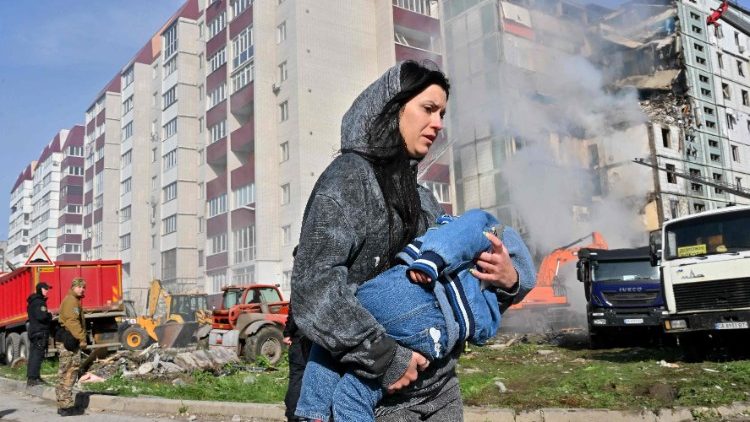
Then there is war, "another tragedy that denies human dignity", and always a “defeat of humanity" (38), to the point that "it is very difficult nowadays to invoke the rational criteria elaborated in earlier centuries to speak of the possibility of a ‘just war.’"(39).
The Declaration also discusses the "travail of migrants", whose "lives are put at risk because they no longer have the means to start a family, to work, or to feed themselves" (40).
The document then dwells on "human trafficking", which is taking on "tragic dimensions" and is described as " vile activity, a disgrace to our societies that claim to be civilized ". The Declaration invites "exploiters and clients" to make a serious examination of conscience (41).
Similarly, it calls for the fight against phenomena such as “the marketing of human organs and tissues, the sexual exploitation of boys and girls, slave labour, including prostitution, the drug and weapons trade, terrorism, and international organized crime” (42).
The document also mentions sexual abuse, which leaves “deep scars in the hearts of those who suffer it”: these are “sufferings that can last a lifetime and that no repentance can remedy” (43).
Discrimination and violence against women are then discussed. Among the latter are listed "coercive abortions, which affect both mother and child, often to satisfy the selfishness of males" and "the practice of polygamy" (45). Femicide is also condemned (46).
Abortion and surrogacy
The condemnation of abortion is strong: "Among all the crimes which can be committed against life, procured abortion has characteristics making it particularly serious and deplorable", and reference is made to the fact that "defence of unborn life is closely linked to the defence of each and every other human right" (47).
The Declaration’s rejection of surrogacy, by means of which "the immensely worthy child becomes a mere object", is also strong. This is a practice that "represents a grave violation of the dignity of the woman and the child … A child is always a gift and never the basis of a commercial contract.” (48)
The list goes on to mention euthanasia and assisted suicide, confusingly defined by some laws as " death with dignity". The document stresses that "suffering does not cause the sick to lose their dignity, which is intrinsically and inalienably their own" (51).
The Declaration then speaks of the importance of palliative care and the avoidance of “aggressive treatments or disproportionate medical procedures”, reaffirming that “Life is a right, not death, which must be welcomed, not administered” (52).
A further serious violation of human dignity is the marginalization of differently-abled persons (53).
Gender theory
The document begins the section on this topic by stressing that "every sign of unjust discrimination” against homosexual persons “is to be carefully avoided, particularly any form of aggression and violence".
It is “contrary to human dignity", the Declaration says, that in some places “not a few people are “imprisoned, tortured and even deprived of the good of life solely because of their sexual orientation" (55).
Gender theory, which is “extremely dangerous since it cancels differences in its claim to make everyone equal", is then criticised (56).
The Church, we read, recalls that "human life in all its dimensions, both physical and spiritual, is a gift from God. This gift is to be accepted with gratitude and placed at the service of the good. Desiring a personal self-determination, as gender theory prescribes … amounts to a concession to the age-old temptation to make oneself God" (57).
Gender theory "intends to deny the greatest possible difference that exists between living beings: sexual difference” (58).
Therefore, " all attempts to obscure reference to the ineliminable sexual difference between man and woman” are “to be rejected" (59).
Sex change is also judged negatively since it "risks threatening the unique dignity the person has received from the moment of conception". This does not mean, however, excluding the possibility that “a person with genital abnormalities that are already evident at birth or that develop later may choose to receive the assistance of healthcare professionals to resolve these abnormalities" (60).
Digital violence
The final item on the list is “digital violence”. “New forms of violence are spreading through social media”, we read, such as cyberbullying, and “the internet is also a channel for spreading pornography and the exploitation of persons for sexual purposes or through gambling” (61).
The Declaration ends by urging that “respect for the dignity of the human person beyond all circumstances be placed at the centre of the commitment to the common good and at the centre of every legal system” (64).
You can find the full text of the Declaration Dignitas infinita on the Holy See website.
Thank you for reading our article. You can keep up-to-date by subscribing to our daily newsletter. Just click here


