Showing posts with label Thanksgiving. Show all posts

Wednesday, November 26, 2025

Thanksgiving is a Catholic tradition that involves much more than Thanksgiving Day


The Catholic Tradition of Harvest Feasts of Thanksgiving


While many Americans are pondering what to do with the leftovers of their Thanksgiving feast, I am taking some time pondering the custom of thanksgiving to God and our Thanksgiving holiday. I’m not ready to get into Christmas preparations! I have heard some Catholics express reservations in celebrating a “secular” holiday. Why should we celebrate Thanksgiving when it was started by Protestant Puritans? There is seemingly no liturgical or Catholic tradition within this American Thanksgiving.

It is true that the historical origins in America are not inherently “liturgical” or Catholic, that doesn’t mean it isn’t proper and right to celebrate Thanksgiving. It is in the natural movement of the soul of man to thank God for our blessings. And it is in the Catholic tradition to celebrate a harvest feast of thanksgiving.

Fulfilling a Basic Obligation

I attended eight years of Catholic parochial school, and one of my highlights was the classroom visits by the parish priests. One visit I particularly remember was by our pastor Father Browning, S.J. during which he explained the acronym “TRAP” to describe the four parts of worship to God: thanksgiving, reparation, adoration and petition. (It is most often referred by the acronym ACTS (adoration, contrition, thanksgiving and supplication.) Thanksgiving must be a part of worship to God. Father Francis Weiser, S.J., in the chapter on Thanksgiving in his Handbook of Christian Feasts and Customs, elaborates how the act of thanksgiving flows naturally within man:

The religious function of giving thanks to Divinity for favors received is as old as humanity. In fact, it is one of the basic elements of worship in all religions, flowing directly from the moral law of nature which governs the relation of man to God and attaches a fourfold purpose to the acts of worship: adoration, petition, atonement, thanksgiving. Thus we find sacrifices and thanksgiving rites as far back as we have documentary and archaeological evidence on the purpose of any forms of worship.

Then he illustrates how Jews in the Old Testament tradition practiced rituals of thanksgiving and sacrifices to God:

The Jews in the Old Testament had an elaborate ritual of sacrifices and offerings in thanksgiving to God. The details of these thank offerings are prescribed in the Law of Moses (Leviticus 1, 2, 3, 7, etc.). They were either private acts of thanksgiving on the part of individuals or public acts of worship offered in the name of the whole community. The gifts offered consisted of Thanksgiving the sacrifice of animals or the presentation of ritual loaves cakes, and wafers.

Jesus offering Himself is the supreme and complete sacrifice, replacing the Old Law rituals. The word “Eucharist” means thanksgiving; the Mass is the ultimate thanksgiving.

In the New Testament, also, the Sacrifice of the Mass contains the same fourfold purpose prescribed by natural law. The function of thanksgiving has never been overlooked. The early Christians were so much aware of it that they called the Blessed Sacrament, which is offered in the Mass, Eucharist (thanksgiving)

Due to the fact that the Holy Sacrifice is the greatest act of thanksgiving that could possibly be offered to God, the Church has refrained from instituting any special feast or liturgical ceremony of thanksgiving other than the Mass. In the Catholic Church, liturgically speaking, every day of the year is “Thanksgiving Day.”

So as Catholics, liturgically speaking, our need for Thanksgiving to God is completely fulfilled by Christ’s sacrifice in the Mass. But that doesn’t eliminate our duty to other forms of thanksgiving in our daily lives.

Is Thanksgiving a Religious Holiday?

The act of thanksgiving to God and to others is normal and natural. But is the American Thanksgiving a religious holiday or contain religious aspects? Father William P. Saunders in 2004 addressed this question in his article, Is Thanksgiving a Religious Holiday? He makes an excellent point about how the Puritans would have been steeped in the Biblical tradition and been very familiar with the Jewish Feast of Tabernacles, and also finding parallels in their journey to a new land similar to the Exodus of the Israelites. Father Francis Weiser, S.J. expanded that Moses actually prescribed two harvest feasts of thanksgiving: “the Feast of the Spring Harvest (Hag Shavuoth, Feast of Weeks, or Pentecost; Leviticus 23, 15-21) and the Feast of the Fall Harvest (Sukkoth, Feast of Tabernacles; Leviticus 29-43) (Handbook of Christian Feasts and Customs, 1952).”

We do not need to be apologetic when reserving some time to be thankful to God for the blessings He has bestowed on us. Celebrating with family and friends and food is using those gifts in a wholesome response. And Thanksgiving in the USA is liturgically incorporated. Thanksgiving is included in our US Proper Calendar as an Optional Memorial, and there are suggested readings and propers for Thanksgiving Mass. I included that information and also a printable Table Prayer of Blessing for Thanksgiving in my previous post: Prayers of Thanksgiving for Thanksgiving Day.

The Catholic Tradition of Harvest Feasts of Thanksgiving

The High Middle Ages (approximately 1000 to 1250 A.D.) marked the beginning of harvest feasts of thanksgiving with Catholic nations. These festivals were attached to particular saint or feast days. Not all days were celebrated everywhere, but they would vary in different countries throughout the liturgical year. Each date links to the CatholicCulture.org page on which the sidebar provides further information in the sections of Activities, Prayers, Recipes, etc. for the feast day:

  • St. Peter in Chains, or Lammas or Loaf-Mass Day, August 1 in the 1962 Extraordinary Form calendar—Lammas is Anglo-Saxon origin, celebrating the first fruits of the summer wheat or grain harvest in the northern English speaking countries of Europe. The Roman Ritual included a Blessing of the Harvest to use on this feast or the Transfiguration.
  • Feast of the Transfiguration, August 6—This feast corresponds with the Jewish feast of Booths or Tabernacles. Both in Eastern churches and in Rome have the blessing of grapes, raisins and other fruits, wine and also blessing and incorporating the wheat grains in the celebration, particularly wheat pilaf. For more information, see my two previous commentaries on the Transfiguration.
  • Feast of the Assumption, August 15—In many Germanic countries this is thanksgiving harvest for first fruits, herbs and flowers, with the Roman Ritual including a Blessing of Fruits and Herbs for this feast. For more information, see my post on the Assumption.
  • Feast of St. Bartholomew, August 24—Because St. Bartholomew is the patron of shepherds and husbandmen, in Britain this was another harvest feast for shepherds and farmers. Lamb and mutton are the traditional foods for this feast.
  • Feast of the Nativity of Mary, September 8—For certain regions like Goa, this feast marked the end of the summer harvest. The Roman Ritual included a blessing of seeds and seedlings for the fall planting. In France the winegrowers brought grapes to be blessed and called this feast “Our Lady of the Grape Harvest.” In the Austrian Alps this was “Drive-Down Day,” bringing herds of cattle and sheep from their summer pastures. After the work, the thanksgiving festivities would begin.
  • Feast of St. Michael or Michaelmas, September 29—In England this was a “quarter day” and huge harvest feast, with a roasted goose as the centerpiece.
  • Solemnity of All Saints, November 1—All Saints’ Day was originally on May 13 in Rome, but the feast day was transferred to November 1, right at the time of harvest to provide food for the pilgrims traveling to Rome. I wouldn’t say this was an official harvest feast, but the timing was around the harvest. I have also included it because of Father Joseph Minihan’s article: The Church’s Thanksgiving Day.
  • Feast of St. Martin or Martinmas, November 11—For most of the European continent Martinmas was the biggest and final fall harvest feast. The festivities were especially for the wine harvest and the great winter slaughters of animals. The feasting usually centered around a Martinmas goose accompanied with apples. Advent used to be 40 days in length, beginning a few days after St. Martin’s. There were more strenuous requirements of fasting and abstinence, so Martinmas would also be a celebration to use up fats and meats in preparation for Advent, similar to Fat Tuesday before Lent. See my previous post, Feastday Highlights: 11-11, Honoring the Real St. Martin of Tours.
  • Feast of St. Leopold, November 15—Most of Austria would wait for their fall harvest feast until St. Leopold’s day, as he is the patron saint of Austria. Today was also referred to as “Goose Day” in Austria.
  • Feast of St. Andrew, November 30—In Britain also known as “Andermess,” this marks the end of autumn and the last harvest feast. In later centuries when Advent was shortened, November 30 marked the beginning of the Advent season. See more information in my previous post, Anticipating Christmas, Beginning with St. Andrew.

Depending on the country, time of year, saint of the day and what kind of harvest would determine the type of thanksgiving festival thanking God for His blessings. Martinmas and Michaelmas are probably the most well-known and larger of the feasts, but each has a distinctive “flavor.” What impressed me while I was compiling this list is that truly it is within the Catholic tradition to celebrate a Thanksgiving feast. And I do wonder if the original Puritans were in some way imitating this rich Catholic tradition.

In addition to festivals of thanksgiving, the Church also has quarterly Ember Days set aside to ask for God’s blessing upon mankind, and to pray in gratitude for the blessings of nature, particularly those used by the Church in her Liturgy, such as olives, grapes, and wheat. These days are marked with prayer, fasting and abstinence and stress spiritual renewal. See Contemporary Observation of Ember Days for more information.

We should not hesitate to celebrate Thanksgiving with food and family even because the seemingly “secular” holiday is really not. Thanksgiving to God is a right inclination within man and has a deep religious and Catholic tradition. It might not be a Martinmas goose, but our Thanksgiving turkey and stuffing can an act of thanksgiving to God.

Thursday, November 28, 2024

A Catholic Thanksgiving in Florida some 50 years before Plymouth Rock


The Real First Thanksgiving in America Was Catholic


November 27, 2024 | by Catholics for Catholics


Over fifty years before the Pilgrims landed at Plymouth Rock, Catholics held the first Thanksgiving in America.

On September 8, 1565, the feast of Our Lady’s Nativity, Spanish Catholics sat down for their first Thanksgiving dinner in the colonial town of St. Augustine, Florida. Three things marked this event: a Catholic hero, a Mass, and a battle.

Both the year and the century were chaotic at the time. Under King Philip II, Spain was the bulwark defending Christian civilization. Phillip II had two pieces of news that concerned him greatly. The Mohamedans had just besieged the tiny island stronghold of Malta garrisoned by the Knights of Saint John. The other piece of news was that French Huguenot pirates had landed in Spanish Florida. They were attacking Spanish vessels and perverting the natives to their sect. Something had to be done.

A Catholic Hero

Phillip needed someone to root out the Huguenots, settle Florida and bring the pagan natives to the Catholic fold. Enter Pedro Menendez de Aviles, the greatest sea captain of his day. The king summoned Menéndez to lead this expedition and plant the Faith in America. The stalwart Menendez accepted this mission and put his whole soul into the expedition. He financed it and even suffered bankruptcy as a result.

He gathered his fleet and set forth. Out of over thirty vessels, only six made it to Puerto Rico because of a hurricane. The French now outnumbered him. He conferred with his remaining captains. Some wanted to turn back. Others wanted to wait for promised reinforcements. However, Menendez wanted the greater glory of God. He told his men that although all seemed against them, God was on their side. Since this was a mission for the king and God, he said they must go forward.

He threw caution to the wind and put his confidence in God and Our Lady.

A Battle of Faith

On August 28, 1565, the feast of St. Augustine, Menendez sighted land. He immediately sought the Huguenot stronghold of Fort Caroline. A few days later, he sighted four warships (all larger than his own) just off the coast of what is now Jacksonville, Florida.

Again he held a conference with his captains, who begged Menendez to turn back. Menendez reminded them that this mission was not for self-glory but God. He also noted that their ships could never outrun the French, who were already making their way towards them. The only solution was to go straight at them, which they did.

Menendez sailed toward the French all evening and only reached them around midnight. He ordered his men to the guns. Menendez hailed the French ship and inquired who they were. The French responded that they were Huguenots sent by Gaspar de Coligny (the political leader of the Huguenots in France). Pedro Menendez responded by telling them his name and his reason for coming: to hang all heretics he found and plant the Church’s standard in Florida.

The Huguenots responded by blaspheming while Menendez fired a broadside at the French, who fled after a quick skirmish. Only the next morning did Menendez realize how dire his position was. Several land batteries were pointed at him, and other French ships (excluding the four he had put to flight) lay in the harbor.

The First Thanksgiving

Menendez prudently headed south to find a safe harbor and plant his standard. On September 8, 1565, he landed on the feast of Our Lady’s nativity at a safe harbor which he named St. Augustine, now the city with the same name. His first actions were to plant the Cross and the standard of Catholic Spain. He claimed the land in the name of God.

All present, including the curious natives, adored and kissed the Cross. Then the first official Mass was celebrated in what is now the United States.

Menendez was quick to make friends with the native population. To celebrate the landing, the natives brought out all sorts of food. Together the Spanish Catholics and Florida Indians held a great banquet of thanksgiving in honor of the birth of the Mother of God. Indeed, it can be said that this was the first Thanksgiving on American soil.

A Catholic Victory

However, the Huguenots, who outnumbered the Catholics, were still prowling around the area. Menendez acted quickly by unloading his supplies and sending his ships to Cuba for reinforcements. Soon afterward, the French who appeared were at the mouth of the harbor. The low tide kept the French at bay for several hours. However, the odds were against Menendez, and all seemed lost. Since it was the feast of the Holy Spirit, Menendez prayed for guidance. Almost immediately, a storm broke the tranquility of the day. A great gale then pushed the French ships south and eventually shipwrecked them all (unbeknownst to Menendez).

Menendez saw the hand of God in his deliverance. He led his men in prayers of thanksgiving and lost no time by asking for five hundred volunteers to attack the fort to the north. Since most Huguenots had manned the ships, the fort was left with few troops to defend it.

A friendly Indian led Menendez and his men through the Florida swamps in chest-high water in the middle of a hurricane. Three days later, four hundred of the five hundred volunteers arrived near the fort. With the cry of “Santiago (Saint James) and at them,” Menendez led the charge and scaled the walls in the downpour. The French were caught entirely off-guard as only twenty escaped. As Menendez reentered St. Augustine, the remaining Spaniards met them with the singing of the Te Deum hymn of thanksgiving.

Soon some natives brought the news that the shipwrecked Huguenots were stranded onshore just south of St. Augustine. Menendez led fifty men to what is now Matanzas inlet. He soundly defeated more than five hundred Huguenots led by Jean Ribault in two separate engagements. Thus the path was open for planting the Holy Catholic Faith in America.

Confidence in God and Our Lady

The rest of the story of the Menendez expedition is full of heroism, conversion and suffering. This Catholic history of America is unfortunately hidden. The account of the real first Thanksgiving is almost unknown. The Catholic founding of America under Pedro Menendez de Aviles highlights the practice of the virtues of confidence and intransigence. Without these two virtues, the Catholics would have turned back, and the course of history changed. However, they placed trust in God and the Blessed Virgin Mary. God supplied them with victory, and they gave glory and honor to Him by giving thanks in St. Augustine, Florida, on September 8, 1565.

Thursday, November 23, 2023

The Thanksgiving Proclamation by President Abraham Lincoln, calling upon Almighty God


President Abraham Lincoln's Thanksgiving proclamation

Opinion by Washington Examiner


President Abraham Lincoln issued his famous "Proclamation of Thanksgiving" on Oct. 3, 1863, with the Civil War still raging. As is our annual tradition, we reproduce the text below in commemoration of Thanksgiving Day, as penned by Lincoln and Secretary of State William Seward.

The year that is drawing towards its close has been filled with the blessings of fruitful fields and healthful skies. To these bounties, which are so constantly enjoyed that we are prone to forget the source from which they come, others have been added, which are of so extraordinary a nature that they cannot fail to penetrate and soften even the heart which is habitually insensible to the ever-watchful providence of Almighty God.

In the midst of a civil war of unequaled magnitude and severity, which has sometimes seemed to foreign states to invite and to provoke their aggression, peace has been preserved with all nations, order has been maintained, the laws have been respected and obeyed, and harmony has prevailed everywhere except in the theater of military conflict; while that theater has been greatly contracted by the advancing armies and navies of the Union.

Needful diversions of wealth and of strength from the fields of peaceful industry to the national defense, have not arrested the plough, the shuttle, or the ship; the ax had enlarged the borders of our settlements, and the mines, as well of iron and coal as of the precious metals, have yielded even more abundantly than heretofore. Population has steadily increased, notwithstanding the waste that has been made in the camp, the siege, and the battlefield; and the country, rejoicing in the consciousness of augmented strength and vigor, is permitted to expect continuance of years with large increase of freedom. No human counsel hath devised nor hath any mortal hand worked out these great things.

They are the gracious gifts of the Most High God, who, while dealing with us in anger for our sins, hath nevertheless remembered mercy. It has seemed to me fit and proper that they should be solemnly, reverently, and gratefully acknowledged as with one heart and voice by the whole American People.

I do therefore invite my fellow citizens in every part of the United States, and also those who are at sea and those who are sojourning in foreign lands, to set apart and observe ... a day of Thanksgiving and praise to our beneficent Father who dwelleth in the heavens. And I recommend to them that, while offering up the ascriptions justly due to Him for such singular deliverances and blessings, they do also, with humble penitence for our national perverseness and disobedience, commend to his tender care all those who have become widows, orphans, mourners, or sufferers in the lamentable civil strife in which we are unavoidably engaged, and fervently implore the interposition of the Almighty Hand to heal the wounds of the nation and to restore it as soon as may be consistent with the divine purposes to the full enjoyment of peace, harmony, tranquility, and union.

The 1st Thanksgiving in America was a celebration of Catholic Mass in Florida way back in 1565


The first Thanksgiving in America was a Catholic Mass


Some historians believe that the first Thanksgiving in America was a Catholic Mass that happened 50 years before Plymouth!

Did you know that the first “thanksgiving” meal in the United States may not have been celebrated by the Pilgrims in Plymouth, but by Spanish settlers, in what became Florida? And that first “Thanksgiving” was Eucharistic!

The First Thanksgiving

Historian Dr. Michael Gannon narrates the events that took place on September 8, 1565.

“When the first Spanish settlers landed in what is now St. Augustine on September 8, 1565, to build a settlement, their first act was to hold a religious service to thank God for the safe arrival of the Spanish fleet… After the Mass, Father Francisco Lopez, the Chaplain of the Spanish ships and the first pastor of St. Augustine, stipulated that the natives from the Timucua tribe be fed along with the Spanish settlers, including Don Pedro Menendez de Aviles, the leader of the expedition. It was the very first Thanksgiving and the first Thanksgiving meal in the United States.”

The Spaniards, with food that they brought with them on the ship, prepared the communal meal. According to records, the meal would have consisted of salted pork, garbanzo beans, ship’s bread and red wine.

This account of the first “thanksgiving” reflects what was found in Father Francisco’s memoirs. In it we read, “the feast day [was] observed . . . after Mass, ‘the Adelantado [Menendez] had the Indians fed and dined himself.‘”

The feast celebrated by the Spaniards was that of the Blessed Virgin Mary’s birthday, a day in the Church calendar that follows nine months after the feast of the Immaculate Conception of Mary on December 8 (which just happens to be the patronal feast of the United States of America).

The meal “may have also included Caribbean foods that were probably collected when Menéndez stopped to regroup and resupply at San Juan Puerto Rico before continuing to Florida… If the Timucua contributed, it would likely have been with corn, fresh fish, berries, or beans.”

Additionally, before the Mass was celebrated, “Father Francisco López, the fleet chaplain…came ashore ahead of Pedro Menéndez de Avilés, the leader of the founding expedition, and then went forward to meet Menéndez holding a cross… Menéndez came on land, knelt and kissed the cross.”

This historical event reminds us that the Eucharist (from the Greek that literally means “thanksgiving”) is the primary way to offer thanks on Thanksgiving Day,followed by a meal shared in a spirit of fraternity. Let God be a central part of your holiday! As Americans this is our heritage, one that we hope to pass on to the next generation.

Friday, November 25, 2022

How seminarians spend Thanksgiving Day in Rome: running around the Vatican


American seminarians in Rome began Thanksgiving Day with a race around the world’s smallest country.

The 13th Annual Thanksgiving Turkey Trot around Vatican City State kicked off with an early start at the Pontifical North American College on Nov. 24.

More than 130 seminarians, priests, and Catholic college students gathered near the starting line at 5:30 a.m. with t-shirts proudly proclaiming “the world’s only 5K to go around a sovereign nation.”

The race brought the runners up the Vatican Hill and along the outside of the centuries-old 39-foot walls that encircle the Vatican Gardens before crossing in front of St. Peter’s Square ahead of the final stretch up the Janiculum Hill back to the college. In total, the runners ascended 262 feet in just over three miles.

Deacon Matthew Schilmoeller from the diocese of Lincoln ran cross country for the University of Nebraska before he entered the seminary.

Thinking back on his track and field days, he said: “Never in my wildest dreams would I have thought that I would be running around the sovereign nation of the Vatican City!”

Schilmoeller added: “As Paul says: ‘Run so as to win.’... My life in running has taught me about discipline and about how acquiring virtue can be a slow process.”

“Running humbles you to realize what your limits are on a physical plane, but it’s a spiritual lesson because we need to live in reality and that is precisely where the Lord meets us and calls us into virtue and ultimately into his grace.”

The winner of this year’s race was seminarian Michael Maloney from the archdiocese of Saint Paul and Minneapolis.

“It was a very fun, close race between a few of us,” he said.

Maloney, who is in his third year studying in Rome, recommends Villa Doria Pamphili park on the Janiculum Hill as his favorite spot to run in the Eternal City.

The tradition of running a Turkey Trot around the Vatican began in 2009 when a seminarian from Colorado Springs, now Father Jim Baron, wanted to do something different for Thanksgiving.

In the past decade, the race has grown to include a costume competition and participation from Americans living in Rome, including many colleges with students studying abroad. This year the University of Mary, St. John's University, and the University of Dallas registered the most runners.

At least one Italian also joined in the American tradition. Antonella Piccinin, who works for the University of Notre Dame as the director of student programs in Rome, has run in the Thanksgiving race four times.

Piccinin said that she has learned from the American students “to give thanks every day.”

“And this is why I want to participate every year in this competition. It’s fun and it brings together people from different parts of the United States—and also from Rome–- to be together and to give thanks,” she said.

Deacon Alex Fry has also come back year after year to volunteer and cheer on the intrepid runners.

“Some people think living in Rome is just a total vacation, but there are certain points of the year where you really miss living in America, and Thanksgiving just happens to be one of those moments,” Fry said.

“And it's so great to put on an event that really celebrates something that is uniquely American, which is this great holiday of Thanksgiving. And so to get together early in the morning and run around the Vatican is just one of the really special ways that we're able to do that here at the NAC.”

Fry, who is preparing to be ordained a priest for the diocese of Dallas in May, has volunteered to help with the organization of the Turkey Trot for the past four years. He said that the race is just one of many celebratory events that the North American College has planned this week.

Following a Thanksgiving Mass this evening, about 100 seminarians and their guests will share a traditional supper, complete with 72 pies and pumpkin ravioli.

On Sunday, the future priests will also compete in the Spaghetti Bowl, a football game tradition for American seminarians that dates back more than 50 years.

Monsignor Thomas Powers, the North American College's rector, said he was excited to see the biggest turnout ever this year for the Turkey Trot.

“I think that this race is a great metaphor for our Catholic faith because we run together, we run to Christ, and we do it in the company of St. Peter and his successors. And that is what this race is about—running around the Vatican and being together as one family of faith,” Powers said.

Thursday, November 24, 2022

Thanksgiving and the Real Presence of Christ in the Eucharist


The Real Presence of Christ in the Eucharist: A cause for thanksgiving

 
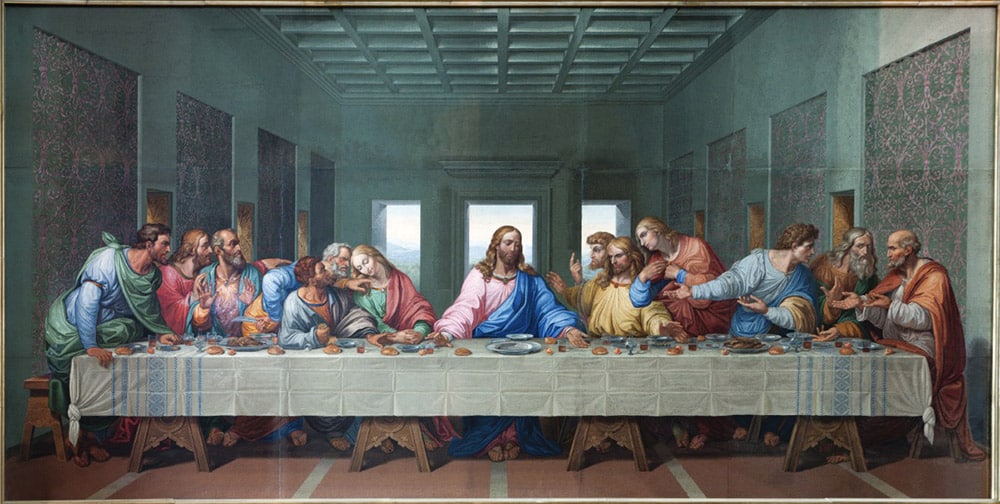
Last Supper
A mosaic of the Last Supper by Giacomo Raffaelli is displayed in Minoriten Church in Vienna. Shutterstock

President Abraham Lincoln’s proclamation inaugurating the annual celebration of Thanksgiving Day in the United States, in gratitude to God for his blessings, was dated Oct. 3, 1863 — right in the middle of the Civil War. One can only guess how many people, especially among those whose relatives had died in battle, questioned whether there were reasons to be thankful.

Lincoln, no doubt, wanted to stress that the terrible conditions of war did not obliterate the other realities of life. The defense of the union required extraordinary measures, but ordinary commerce and daily chores continued. Most people, spared the dangers of the battlefield, kept laboring at their crafts and tending to their families. Given these blessings, how could anyone fail to recognize God as their source and give him thanks?

But Lincoln knew that forgetting God was a powerful temptation — hence the reminder. Remembering God leads to hope, allowing people to see their lives in the broader context of eternal life. Those who had lost loved ones could look forward to a deeper peace and more lasting union with God. One could adopt a spirit of gratitude because God remains active in the world and draws mankind to himself. It is a truth that deserves, at the very least, an annual celebration of thanksgiving.

As we celebrate Thanksgiving once again, we would do well to heed the president’s words. We live at a time of intense polarization in matters of politics, religion and morality. Bitter disagreements fill the nation’s news media every day. Gratitude to God may be the last thing on people’s minds, yet his blessings can still be perceived for those open to his presence.

Believing in the Real Presence

Real Presence

Shutterstock

The Catholic Church can bear witness to God’s presence in this climate, even amidst its own severe trial. The evil committed by bishops and priests, including sex abuse, corrupt use of power and greed have produced a truly dark moment. It’s hard to give thanks during this time. Many people have even walked away from the Church. Yet despite this terrible crisis, God is not absent.

The light that dispels the darkness continues to be God’s presence (cf. Jn 1:1-5). For Catholics, his presence is made palpable through the Eucharist, “the source and summit of the Christian life … [in which] is contained the whole spiritual good of the Church, namely Christ himself” (Catechism of the Catholic Church, No. 1324). Jesus’ words remain true: “I am with you always, until the end of the age” (Mt 28:20).

Jesus, of course, is present in various ways: in the Church, in the poor and sick, at Mass, in the person of the minister, etc. “But ‘he is present … most especially in the Eucharistic species‘” — the consecrated bread and wine (CCC, No. 1373). His presence in the Eucharist is called “real,” not “to exclude the other types of presence as if they could not be ‘real’ too, but because [his presence in the Eucharist] is presence in the fullest sense: that is to say, it is a substantial presence by which Christ, God and man, makes himself wholly and entirely ‘present'” (CCC, No. 1374).

Recent polls show that far too many Catholics neither believe nor understand this teaching. One could argue whether it’s a cause or an effect of the current crisis in the Church, but the way out of the crisis certainly includes a renewed appreciation of the Lord’s presence in the Eucharist. When due attention is paid to this most sublime gift, the blessings of God stand out more boldly, a spirit of thanksgiving results and new life within the Church and even society becomes possible. Indeed, it was only after the apostles, hiding in the upper room out of fear of being crucified, encountered the risen Lord that they broke forth in thanksgiving and shared the Good News with the world, even in the face of death.

To appreciate the truth of the Real Presence, one must begin with the words of Jesus in the Scriptures. Because we live 2,000 years after Jesus’ ministry, we also benefit from the Church’s consistent teaching on the Real Presence during the same time span, which, for the sake of this article, can be divided into three periods: the first 900 years, the period from A.D. 850 to 1600, and modern times. Based on this evidence, we may expect to find direction on what it means to live in the light of the Real Presence.

Jesus preached the Real Presence

Eucharist

Shutterstock

Once Jesus began his public ministry, those who encountered him were amazed at his power and authority (cf. Mk 1:27-28). The Twelve Apostles dropped everything to become his disciples. As Jesus preached and performed mighty signs, great crowds followed him (cf. Mt 4:25, 8:1; Lk 14:25). Many wanted to make him king and hoped he would restore the eminence of Israel. But Jesus set his face on saving all people, from every nation. He said it would happen through a terrible, painful death. But he promised his disciples that he would be with them always.

The way Jesus would remain present puzzled his disciples. Jesus said it involved eating his body and blood. In fact, it was this teaching that raised objections among the crowds. “How can this man give us [his] flesh to eat?” (Jn 6:52). Jesus responds not by assuaging people’s concern, but by doubling down: “Amen, amen, I say to you, unless you eat the flesh of the Son of Man and drink his blood, you do not have life within you. Whoever eats my flesh and drinks my blood has eternal life, and I will raise him on the last day. For my flesh is true food, and my blood is true drink” (Jn 6:53-55).

Jesus’ words were so clear that “many [of] his disciples returned to their former way of life and no longer accompanied him” (Jn 6:66). The Twelve had no better idea than those who departed how Jesus would give them his body to eat, but they remained with him by faith (cf. Ecclesia de Eucharistia, No. 2).

It was only after the Resurrection, when they encountered the risen Lord and remembered his words, that the apostles (minus Judas) understood what Jesus had said (cf. Jn 2:22; Lk 24:8). It was the same for the two disciples walking to Emmaus who encountered the risen Lord along the way. At first they did not know it was Jesus, even as “he interpreted to them what referred to him in all the scriptures” (Lk 24:27). When they stopped for a meal, Jesus “took bread, said the blessing, broke it and gave it to them. With that their eyes were opened and they recognized him” (Lk 24:30-31).

The encounter features the same structure as the Mass: hearing the Scriptures and breaking the bread, or what we call the Liturgy of the Word and Liturgy of the Eucharist. The structure is found in the synoptic Gospels (cf. Mt 26:26-28; Mk 14:22-24; Lk 22:17-20) and First Corinthians as well (11:23-25). Called “institution narratives,” these passages established the Eucharist by Jesus’ command: “Do this in remembrance of me” (cf. 1 Cor 11:24).

After Jesus’ ascension the disciples began to devote themselves “to the teaching of the apostles and to the communal life, to the breaking of the bread and to the prayers” (Acts 2:42). In other words, they continued to perceive Jesus’ presence at Mass. Though they did not use the term “real presence,” they were convinced that they encountered the risen Lord, hearing his words and eating his body and blood.

The first 900 years of Christianity

The very first Christians, living in a dynamic relationship with the risen Lord, made quite a mark on society. Their way of life stressed love for each other and everyone else, including enemies. Many people were attracted by the joy and peace and mutual concern manifested in the lives of Christians. The numbers of believers increased, and the Faith continued to spread, even though during the first few hundred years Christians suffered persecution and martyrdom.

Constantine’s Edict of Milan (A.D. 313), which made Christianity legal in the Roman Empire, ended most persecution. Christians continued to celebrate the Eucharist and, until around the ninth century, enjoyed a period remarkably free from controversy regarding Christ’s presence. They took Jesus at his word, and they did not parse his presence at Mass in the same way future Christians would.

Regarding the Eucharist, all the early Church Fathers taught that the institution narratives, which were prayed at Mass, were to be accepted literally.

Having received the Lord and his many gifts, Christians could then share Jesus with others through love and service. The first 900 years of Christianity, while clearly setting the stage for a more theoretical articulation of the real presence of Jesus in the Eucharist, emphasized handing on the teaching of Christ and abiding in him.

The period from A.D. 850 to 1600

With the passing of almost a millennium, Christianity had grown exponentially, and its rites and teachings became part of the daily lives of Christians. With the Faith so settled, it is perhaps inevitable that interests and concerns would change. During A.D. 850 to 1600, the focus went from spreading the Faith to defending it.

Around the middle of the ninth century, a controversy regarding the Real Presence focused on the consecrated bread and wine. Opposing views took shape. Some said the Eucharist was the same body born of Mary. Others said it was the risen body seated at the right hand of the Father. Into this argument waded Berengarius of Tours (d. 1088), who, as in the latter position, emphasized the risen body of Christ. At the Sixth Council of Rome in 1079, Pope Gregory VII asked Berengarius to sign — and Berengarius did — a profession of faith that declared the Eucharist to be the true body of Christ born of Mary, which sits in heaven.

Later, Alan of Lille added the concepts of “accident” and “substance” to express the distinction between the appearance of bread and wine and the reality of Jesus’ body and blood. St. Thomas Aquinas adopted Alan’s words and, in a sense, canonized the terms. Meanwhile, with such intense focus on the Eucharistic species, people in the pews became more spectator than participant at Mass, to the point of not even receiving the Eucharist.

The next major moment comes with the Council of Trent, which met during 1545 to 1563. The council recognized the lack of participation by the people and encouraged them to receive Communion. But the main concern centered on answering the criticisms of the Protestant Reformation, especially those of major reformers, including Martin Luther, Huldrych Zwingli and John Calvin.

Trent responded with the following dogmatic definitions. For “presence”: In the sacrament of the Eucharist “the body and blood, together with the soul and divinity, of our Lord Jesus Christ and, therefore, the whole Christ is truly, really, and substantially contained” (CCC, No. 1374). For “transubstantiation”: “By the consecration of the bread and wine there takes place a change of the whole substance of the bread into the substance of the body of Christ our Lord and of the whole substance of the wine into the substance of his blood” (CCC, No. 1376).


The modern period

The Church’s teaching on the Real Presence has not changed in the modern period. But new challenges have arisen: the widespread disbelief in the Real Presence and the infrequent attendance at the Sunday liturgy among Catholics.

These challenges, though still persisting, have been answered by the Church through various magisterial documents. Three are particularly helpful in considering the Real Presence: Sacrosanctum Concilium (1963), Mysterium Fidei (1965) and Ecclesia de Eucharistia (2003).

Sacrosanctum Concilium, or the Constitution on the sacred liturgy, is one of the documents composed at the Second Vatican Council. It teaches that Christ is present in all the Church’s liturgical celebrations “but especially under the Eucharistic species” at Mass (No. 7). In order to reverse the trend of people being “silent spectators” (No. 48), the Mass was to be revised to achieve more easily the “devout and active participation by the faithful” (No. 50). The revision would include a “richer fare” of biblical readings (No. 51) and the use of the people’s “mother tongue” (No. 54). Sacrosanctum Concilium does not focus on the Real Presence, but it readies the people to perceive that mystery.

Two years after Sacrosanctum Concilium, Pope St. Paul VI reflected directly on the Real Presence in Mysterium Fidei. He does not offer a new teaching. Rather, he reaffirms and refers the faithful to the Council of Trent’s teaching on the Eucharist (cf. Nos. 24, 45-46).

Paul VI, however, did contribute a helpful clarification. While Jesus is present to the Church in various ways, he is present in the Eucharist in “a way that surpasses all the others” (No. 38): It is a real presence. This “presence is called ‘real’ not to exclude the idea that the others are ‘real’ too, but rather to indicate presence par excellence, because it is substantial and through it Christ becomes present whole and entire, God and man” (No. 39). What looks and tastes like bread and wine is now the real presence of Jesus: He is “present whole and entire in his physical ‘reality,’ corporeally present, although not in the manner in which bodies are in a place” (No. 46).

In Ecclesia de Eucharistia, Pope St. John Paul II also confirms the constant teaching of the Church on the Eucharist. Like Paul VI he directs readers to the Council of Trent, but he also recommends Mysterium Fidei (cf. No. 9). John Paul II echoes Paul VI in lamenting the lack of understanding of and devotion for the Eucharist, particularly its “sacrificial meaning” (No. 10). With Ecclesia de Eucharistia, he aims to rekindle “amazement” for the Eucharist (No. 6).

How to live in the light of the real presence

Ecclesia de Eucharistia sends us back to the Scriptures, which remain the foundational documents of our faith. They must also be our main reference point when deciding how to live in the light of the Real Presence.

PRAYER FOR THANKSGIVING
Almighty God,
we, your children, gather round our tables
this Thanksgiving
mindful of you.
The food and drink, the company of family and friends,
and all the stories we share,
recall your love, made present to us through Jesus.
May we give you thanks always
at the table of your Son
who offers his words and body and blood
for our salvation.
In him
may we anticipate your kingdom
through love and service now.
We ask this through the same Christ our Lord. Amen.
 

— David Werning, written for Our Sunday Visitor

Family prayer

Shutterstock

John Paul II notes that, whereas the synoptic Gospels recount the institution of the Eucharist, the Gospel of John brings out its “profound meaning” (No. 20). Knowing “that his hour had come to pass from this world” (Jn 13:1), Jesus gathers his disciples for a last supper and teaches them how to follow him. He removes his outer garments and washes the disciples’ feet — a job reserved for slaves. Then he says:

“Do you realize what I have done for you? You call me ‘teacher’ and ‘master,’ and rightly so, for indeed I am. If I, therefore, the master and teacher, have washed your feet, you ought to wash one another’s feet. I have given you a model to follow, so that as I have done for you, you should also do” (13:12-15).

John’s account of the washing of the feet provides a model for living in the truth of the Real Presence. If Jesus remains with us in the Eucharist, offering himself as our nourishment, and we receive the gift well, then with him we can love this world and anticipate the next. It is, perhaps, the best way to manifest one’s appreciation of the Real Presence (cf. Mysterium Fidei, No. 69).

We can do all those things Jesus taught us: feed the hungry, clothe the naked, forgive one another, grant mercy, work for justice. And we should give thanks. It’s true that we live at a time of great crisis in the Church (and in society), and therefore we experience sadness, disappointment and maybe even anger. May such feelings move us to conquer evil with the good rather than turn us away from Jesus and all his gifts.

As President Lincoln reminded the nation in the midst of the Civil War: Remember the blessings of God and be grateful for his providence. St. Paul offers similar advice: “In all circumstances give thanks, for this is the will of God for you in Christ Jesus” (1 Thes 5:18).

The Catholic Church has never ceased proclaiming the Real Presence of Jesus in the Eucharist, which Christ himself revealed. It remains the pledge of his fidelity. He is with us now and forever. Blessed are those who hear his word and act on it.

David Werning writes from Virginia.