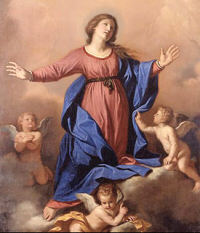
Showing posts with label Assumption. Show all posts

Saturday, August 15, 2026

Pope Leo delivers Angelus Address & Prayer for the Assumption in Castel Gandolfo 08.15.2026


Pope Leo blesses the faithful gathered at Castel Gandolfo for the Angelus on the Solemnity of the AssumptionPope Leo blesses the faithful gathered at Castel Gandolfo for the Angelus on the Solemnity of the Assumption  (@VATICAN MEDIA)

Pope at Angelus: Mary’s Assumption reveals our eternal destiny

Pope Leo XIV reflects on how Mary’s Assumption reveals humanity’s destiny of eternal life, and prays for those suffering in the Holy Land, Ukraine, Russia and earthquake-stricken Colombia.

By Vatican News

Pope Leo marked the Solemnity of the Assumption of the Blessed Virgin Mary by inviting the faithful to contemplate their ultimate destiny: the fullness of eternal life in God.

Addressing pilgrims gathered in Castel Gandolfo for his midday Angelus on Saturday, the Pope described the Assumption as a feast of great importance both for Catholic theology and for popular devotion.

He noted that the Solemnity is particularly cherished in communities whose cathedrals or parish churches are dedicated to Our Lady of the Assumption.

The Dormition of the Mother of God

Pope Leo reflected on two principal ways in which artists have depicted the mystery of the Assumption over the centuries.

The first and oldest tradition portrays the Dormition, or "falling asleep", of the Mother of God. In these images, Mary lies upon a catafalque, surrounded by the Apostles in prayer, while the risen Jesus holds her soul in His arms like a newborn child.

The image shows Christ coming to take His Mother into the glory of heaven, the Pope explained, fulfilling for her the promise He made to His disciples: "I will come again and will take you to myself, that where I am you may be also".

This ancient iconography highlights a central truth of the Christian faith: it is Christ, who died and rose again, who leads humanity towards the destiny for which it was created - eternal life.

Generations of believers have contemplated this mystery in icons of the Dormition, Pope Leo said, pointing in particular to the great apse mosaic in Rome’s Basilica of Saint Mary Major.

Assumed body and soul

A second artistic tradition, which developed later in the West, depicts Mary standing in heaven, surrounded by light, angels and saints.

At the centre is the glorified body of the Virgin, evoking the vision from the Book of Revelation of "a woman clothed with the sun, with the moon under her feet, and on her head a crown of twelve stars".

Some artists brought the two traditions together, portraying Mary in heavenly glory above an empty tomb filled with colourful flowers, as the Apostles look upwards.

This second model, the Pope explained, emphasises that Mary was assumed into heaven both body and soul, "in the entirety of her person".

The woman who gave flesh and blood to the Incarnate Word and followed Jesus to the point of complete union in His sacrifice of love was drawn by Him forever into glory.

An endless celebration

Pope Leo concluded by stressing that the Assumption also points towards the destiny awaiting all the faithful.

"The fullness of life, which we joyfully admire today in Mary, awaits us as well at the end of time", he said.

Quoting Saint Paul, the Pope recalled that the risen Christ will transform humanity’s lowly bodies to be like His glorious body, clothing what is perishable with incorruptibility and what is mortal with immortality.

Then, he said, with human flesh transformed by the Redeemer’s love, the faithful will live forever "in an endless celebration".

"Let us praise the Lord", Pope Leo concluded, "who has done great things in His and our Most Holy Mother!"

Prayers for peace and earthquake victims

Following the Angelus, Pope Leo entrusted to Mary’s intercession all those in need of hope and consolation. He prayed especially for the peoples of the Holy Land, Ukraine and Russia, as well as for Christians suffering discrimination or persecution.

The Pope also renewed his prayers for the people of Colombia affected by the recent earthquake, inviting everyone to invoke together: “Holy Mary, pray for us!”

Pope Leo XIV at Mass for the Assumption at St. Thomas of Villanova Church in Castel Gandolfo 08.15.2026


Pope: 'The purity of Mary's soul leads us toward glory of Heaven'

During Mass in Castel Gandolfo for the Solemnity of the Assumption of the Blessed Virgin Mary, Pope Leo XIV marvels how the Blessed Virgin Mary, through God's grace, leads us toward Heaven, insisting that love is "humanity’s most beautiful adornment," stressing that it "transfigures, transforms, ennobles and lifts us up, making us light, free and close to God, even amid life’s ups and downs."

By Deborah Castellano Lubov 

"For it is the purity of the soul that, in Mary — as in us — by the grace of God, illuminates and transfigures the whole person, leading us to the glory of Heaven."

Pope Leo XIV gave this reminder during Mass for the Solemnity of the Assumption of the Blessed Virgin Mary at the Pontifical Parish of Saint Thomas of Villanova in Castel Gandolfo on 15 August 2026.

READ POPE LEO XIV'S FULL HOMILY

The Holy Father began his homily by saying that it is with great joy that he celebrates the Solemnity of the Assumption with their parish community once again this year.

Blessed Mother assumed body and soul into heavenly glory

This Solemnity, the Pope recalled that the Magisterium of the Church teaches us that Mary, “having completed the course of her earthly life, was assumed body and soul into heavenly glory, and points out to us, in this Mystery, the fulfillment of the most perfect grace that God bestowed upon her at her Immaculate Conception.”

For this reason, Pope Leo noted, many works of art are inspired by the scene described in the passage from the Book of Revelation that they heard in the First Reading: “A woman clothed with the sun, with the moon under her feet,” signifying that in Mary’s heart, heaven and earth, time and eternity, meet.

Accordingly, he explained, these works depict her as a beautiful young woman physically rising from the earth toward the heavens at the end of her earthly life.

On the surface, the Pope acknowledged, this image seems to contrast with our experience of what the passing of the years does to us.

"As we age," the Pope said, "our bodies do not become more agile, but heavier; our skin does not become fresher but shows the signs of old age; our hair does not gain color and luster, but turns gray and then white. So, what do we have in common with the beautiful young woman depicted on the altarpieces of our churches?"


Papal Mass for the Solemnity of the Assumption (@Vatican Media)

Purity of the soul

To understand this, the Pope explained, we must unite the two signs of the incorrupt body of the Mother of God and her immaculate heart.

"For it is the purity of the soul that, in Mary — as in us — by the grace of God," he reiterated, "illuminates and transfigures the whole person, leading us to the glory of Heaven."

"The glorification of Mary, body and soul," Pope Leo underscored, "teaches us that our true beauty does not lie in hiding the signs of aging, but in revealing the signs of love that never end, and are even impressed on our flesh."

With this in mind, the Holy Father urged the faithful to reexamine many of the aesthetic standards, predominantly hedonistic and consumerist in nature, that the world imposes on us.

"These standards," he warned, "risk trapping us in burdensome expectations, causing us to waste precious energy on what does not really matter and does not last forever."

Small glimpses of Heaven

The Holy Father acknowledged how easy it is to see where true beauty lies and where, on the other hand, there is still a need for conversion, forgiveness and healing.

"If we truly wish to discover and nurture the divine beauty that surrounds us and for which we were made, and to share it with those around us, we must learn to see it in the wrinkles of an elderly person as in the tender face of a child, in the maturity of an adult as in the liveliness of a young person, in work clothes and tools as well as in festive decorations."

Moreover, Pope Leo noted, "we must listen to the unique love stories that each of these realities tells us, recognizing in them small glimpses of heaven."

"Love," the Pope therefore insisted, "is humanity’s most beautiful adornment," stressing that it "transfigures, transforms, ennobles and lifts us up, making us light, free and close to God, even amid life’s ups and downs."

Reflecting on the mystery of the Assumption of the Virgin, Pope Leo recalled that Saint Paul VI said that to understand its meaning, “we must transform the terms we use in earthly and temporal language into superlative and absolute ones […] to imagine the eternal on a small scale.”

The Pope also recalled how Pope Francis reflected on the encounter between the infinite and the finite in the Mother of God, writing: “Mary was able to turn a stable into a home for Jesus, with poor swaddling clothes and an abundance of love.”

Her innocent heart

Pope Leo explained that the miracle Mary, the maiden of Nazareth, experienced in "her innocent heart, which led her to the glory of Heaven, is a meeting of extremes," as she herself testifies in the inspired words of the Magnificat.

"In this canticle, through the humble expressions of her faith," Pope Leo marveled, "the Mother of God speaks to us in simple terms of the magnificent mysteries she experienced, such as God becoming man in her to save humanity, and the Eternal One revealing Himself within time to reopen the path to eternity for us."

At the same time, Pope Leo recalled, in her position as a “humble servant,” Pope Saint Paul VI said that Mary shows us the “humble dimension” in which we too can encounter the Lord.

The Holy Father said that we need not look far to find the sublimity of the Mystery we celebrate but can encounter it wherever there is true charity.

"For example," the Pope explained, we encounter it "in the eyes of a father and mother returning home after a long day, tired but happy to be with their children" and "in the faces of grandfathers and grandmothers who, despite the aches and pains of old age, are filled with unexpected energy as they care for their grandchildren."

He said that we can also see it in the commitment of young people who strive to grow in morality and sincerity, ready even to go against the grain of “what everyone else does.”

Finally, Pope Leo continued, it can be seen in the daily work of so many men and women who, with faith and dedication, help bring a little bit of Heaven to earth and the earth closer to Heaven.

Beautiful face of Our Lady of the Assumption transcends any possible representation, and is familiar

"Dear friends, the beautiful face of Our Lady of the Assumption is unique; it transcends any possible representation, and yet, at the same time, is familiar to us.

"Even at this very moment," Pope Leo pointed out, "we can see her face in the people who are close to us, such as the brothers and sisters with whom, in faith, we share the daily offering of our lives."

He noted that in her holy human nature, by the grace of God, "we also see our nature," and said that we, therefore, are also "called to live the same grace-filled life that she lived and to share in her glory."

The Pope recalled how St. Augustine, speaking of Christ’s Resurrection, urged the Christians of his time to make it the compass and focal point of their lives, when he said: “Christ rose from the dead so that He might never die again […]. Change course, follow the light! Begin to rise from the very place from which he rose”

With this in mind, Pope Leo told the faithful to accept the saint's invitation and follow the light of the Risen Lord, "changing course if necessary."

Finally, Pope Leo concluding his homily by inviting the faithful to join him "in looking to Mary, whom God has crowned with glory in body and soul, and whom He has given to us as Mother, guide, companion on our journey, and protector on the path to Heaven."

Pope Leo's Mass for the Solemnity of the Assumption (@Vatican Media)

Friday, August 14, 2026

August 15th: The Solemnity of the Assumption of Mary


Ordinary Time: August 15th

Solemnity of the Assumption of the Blessed Virgin Mary


Today the Church celebrates the Solemnity of the Assumption of the Blessed Virgin Mary, a Holy Day of Obligation. On November 1, 1950, Pius XII defined the dogma of the Assumption. Thus, he solemnly proclaimed that the belief whereby the Blessed Virgin Mary, at the close of her earthly life, was taken up, body and soul, into the glory of heaven, definitively forms part of the deposit of faith, received from the Apostles. To avoid all that is uncertain the Pope did not state either the manner or the circumstances of time and place in which the Assumption took place—only the fact of the Assumption of Mary, body and soul, into the glory of heaven, is the matter of the definition.


The Assumption
Now toward the end of the summer season, at a time when fruits are ripe in the gardens and fields, the Church celebrates the most glorious "harvest festival" in the Communion of Saints. Mary, the supremely blessed one among women, Mary, the most precious fruit which has ripened in the fields of God's kingdom, is today taken into the granary of heaven.
—Pius Parsch, The Church's Year of Grace

The Assumption is the oldest feast day of Our Lady, but we don't know how it first came to be celebrated.

Its origin is lost in those days when Jerusalem was restored as a sacred city, at the time of the Roman Emperor Constantine (c. 285-337). By then it had been a pagan city for two centuries, ever since Emperor Hadrian (76-138) had leveled it around the year 135 and rebuilt it as Aelia Capitolina in honor of Jupiter.

For 200 years, every memory of Jesus was obliterated from the city, and the sites made holy by His life, death and Resurrection became pagan temples.

After the building of the Church of the Holy Sepulcher in 336, the sacred sites began to be restored and memories of the life of Our Lord began to be celebrated by the people of Jerusalem. One of the memories about his mother centered around the "Tomb of Mary," close to Mount Zion, where the early Christian community had lived.

On the hill itself was the "Place of Dormition," the spot of Mary's "falling asleep," where she had died. The "Tomb of Mary" was where she was buried.

At this time, the "Memory of Mary" was being celebrated. Later it was to become our feast of the Assumption.

For a time, the "Memory of Mary" was marked only in Palestine, but then it was extended by the emperor to all the churches of the East. In the seventh century, it began to be celebrated in Rome under the title of the "Falling Asleep" ("Dormitio") of the Mother of God.

Soon the name was changed to the "Assumption of Mary," since there was more to the feast than her dying. It also proclaimed that she had been taken up, body and soul, into heaven.

That belief was ancient, dating back to the apostles themselves. What was clear from the beginning was that there were no relics of Mary to be venerated, and that an empty tomb stood on the edge of Jerusalem near the site of her death. That location also soon became a place of pilgrimage. (Today, the Benedictine Abbey of the Dormition of Mary stands on the spot.)

At the Council of Chalcedon in 451, when bishops from throughout the Mediterranean world gathered in Constantinople, Emperor Marcian asked the Patriarch of Jerusalem to bring the relics of Mary to Constantinople to be enshrined in the capitol. The patriarch explained to the emperor that there were no relics of Mary in Jerusalem, that "Mary had died in the presence of the apostles; but her tomb, when opened later . . . was found empty and so the apostles concluded that the body was taken up into heaven."

In the eighth century, St. John Damascene was known for giving sermons at the holy places in Jerusalem. At the Tomb of Mary, he expressed the belief of the Church on the meaning of the feast: "Although the body was duly buried, it did not remain in the state of death, neither was it dissolved by decay. . .. You were transferred to your heavenly home, O Lady, Queen and Mother of God in truth."

All the feast days of Mary mark the great mysteries of her life and her part in the work of redemption. The central mystery of her life and person is her divine motherhood, celebrated both at Christmas and a week later (Jan. 1) on the feast of the Solemnity of Mary, Mother of God. The Immaculate Conception (Dec. 8) marks the preparation for that motherhood, so that she had the fullness of grace from the first moment of her existence, completely untouched by sin. Her whole being throbbed with divine life from the very beginning, readying her for the exalted role of mother of the Savior.

The Assumption completes God's work in her since it was not fitting that the flesh that had given life to God himself should ever undergo corruption. The Assumption is God's crowning of His work as Mary ends her earthly life and enters eternity. The feast turns our eyes in that direction, where we will follow when our earthly life is over.


The feast days of the Church are not just the commemoration of historical events; they do not look only to the past. They look to the present and to the future and give us an insight into our own relationship with God. The Assumption looks to eternity and gives us hope that we, too, will follow Our Lady when our life is ended.


In 1950, in the Apostolic Constitution Munificentissimus Deus, Pope Pius XII proclaimed the Assumption of Mary a dogma of the Catholic Church in these words: "The Immaculate Mother of God, the ever-virgin Mary, having completed the course of her earthly life, was assumed body and soul into heaven."


With that, an ancient belief became Catholic doctrine, and the Assumption was declared a truth revealed by God.

—Excerpted from Fr. Clifford Stevens in Catholic Heritage

Thursday, August 13, 2026

Pope Leo XIV to spend the Assumption & Sunday at Castel Gandolfo


can Media)

Pope Leo returns to Castel Gandolfo for Assumption holiday weekend

Pope Leo XIV has returned to the hilltop town of Castel Gandolfo, where he will celebrate Mass and enjoy the cooler weather over the feast of the Assumption of Mary.

By Devin Watkins

The Holy See Press Office announced that Pope Leo XIV returned to Castel Gandolfo by car on Wednesday afternoon.

The Pope stayed at the papal summer residence in the hilltop town near Rome for several days in July. 

While there, he celebrated Mass in the local parish of St. Thomas of Villanova, visited the Vatican Observatory, and met with various local residents.

Pope Leo is scheduled to celebrate Mass again at St. Thomas of Villanova Parish on August 15, the Solemnity of the Assumption of the Blessed Virgin Mary, which marks the heart of the summer holiday season in Italy.

On Sunday, the Pope will travel to the nearby town of Albano to preside at Mass at the Sanctuary of Santa Maria della Rotonda.

He is expected to return to the Vatican on Tuesday, August 19, according to the Holy See Press Office.

Friday, August 15, 2025

Papal Angelus Address for the Solemnity of the Assumption


Pope Leo XIV prays the Angelus in front of the papal residence in Castel GandolfoPope Leo XIV prays the Angelus in front of the papal residence in Castel Gandolfo  (@VATICAN MEDIA)

Pope at Angelus: Mary is an icon of hope

During the Angelus prayer at Castel Gandolfo, Pope Leo XIV urges everyone as pilgrims on the journey of life to turn their gaze to Mary, the Mother of God.

By Kielce Gussie

After presiding over Mass on the Solemnity of the Assumption of Mary in Castel Gandolfo, Pope Leo XIV began his Angelus reflection by citing a document from the Second Vatican Council, which speaks about the Assumption of Mary. He highlighted that Mary “shines as an icon of hope for her pilgrim children throughout history.”

The Pope turned to Dante’s famous poem Paradiso and the prayer recited in the last canto. It praises the Virgin as “the living fountainhead of hope”. Pope Leo described Mary as a symbol of hope, which ties into the theme of this Jubilee Year—Pilgrims of hope.

He stressed that pilgrims need a goal to guide their journey, “a beautiful and attractive goal that guides their steps and revives them when they are tired, that always rekindles in their heart a desire and hope.”

The goal of this journey of life, the Pope reminded, is God and the human heart is drawn to the beauty of God.

Just as it is a mystery that Jesus became man, died, and rose again, the Pope reflected on the mystery of Mary as the mother of the Son of God. “It concerns a unique mystery of love, and thus of freedom.” Both Jesus and Mary, he recalled, said yes to their call in life. Mary’s entire life was a pilgrimage of hope with her son from birth to the heavenly homeland.

It is for this reason, Pope Leo said, when we face difficult times “as individuals, families and communities…let us lift our gaze, let us look at her, our Mother, and we will rediscover the hope that does not disappoint.”

Pope Leo XIV celebrates Mass for the Assumption in Castel Gandolfo


Pope Leo: Mary’s song, the Magnificat, strengthens our hope

During Mass in Castel Gandolfo for the Solemnity of the Assumption of the Blessed Virgin Mary, Pope Leo XIV marvels how Mary's 'yes' gives hope to us today, saying we celebrate the Paschal Mystery of Jesus, which changed the course of history.

By Deborah Castellano Lubov 

"Mary’s song, Magnificat, strengthens the hope of the humble, the hungry, the faithful servants of God." 

Pope Leo XIV gave this reminder during the Mass for the Solemnity of the Assumption of the Blessed Virgin Mary at the Pontifical Parish of Saint Thomas of Villanova in Castel Gandolfo on 15 August 2025.

The Holy Father began his homily by observing that although today is not Sunday, "we celebrate in another way the Paschal Mystery of Jesus, which changed the course of history."

READ POPE LEO XIV'S FULL HOMILY HERE

"In Mary of Nazareth," he continued, "we recognize our own history: the history of the Church, immersed in the common lot of humanity. By taking flesh in her, the God of life and of freedom has conquered death.


Pope Leo XIV celebrates Mass for the Solemnity of the Assumption of the Blessed Mother   (@Vatican Media)

The Pope recalled that on this Solemnity we contemplate how God overcomes death, yet never without us. "His is the Kingdom, but," he explained, "ours is the 'yes' to his love that can change everything." 

On the Cross, the Pope said, Jesus freely uttered that “yes” which would strip death of its power—the death that still spreads wherever our hands crucify and our hearts remain imprisoned by fear and mistrust. On the Cross, trust prevailed; so did love, which sees what is yet to come; and forgiveness triumphed.

That 'yes' still lives

The Pope recalled to those present in the parish that Mary was there by the Cross united with her Son. 

"In our day, we are like Mary whenever we do not flee, whenever we make Jesus’ 'yes' our own. 

"That 'yes,'" Pope Leo marveled, "still lives and resists death in the martyrs of our time, in witnesses of faith and justice, of gentleness and peace. Thus this day of joy becomes also a day that calls us to choose—how and for whom we shall live."

The Pope went on to remember how we listened to the Gospel passage on the Visitation, in which Saint Luke recorded "a decisive moment" in Mary’s vocation.  

Magnificat

As "we celebrate the crowning moment of her life," Pope Leo said, "It is beautiful to recall that day." 

While he observed that "every human story, even that of the Mother of God, is brief on this earth and comes to an end," he went on to reflect, "Yet nothing is lost. When a life ends, its uniqueness shines even more clearly." 

The Pope explained that Mary's Magnificat radiated the light of all her days, and that the surprising fruitfulness of barren Elizabeth confirmed Mary in her trust, for "it anticipated the fruitfulness of her 'yes,' which extends to the fruitfulness of the Church and of all humanity whenever God’s renewing Word is welcomed." 


God breaks through our despair

Reflecting on Friday's Solemnity, the Holy Father highlighted that the Resurrection enters our world even today.

"The words and choices of death may seem to prevail, but the life of God breaks through our despair through concrete experiences of fraternity and new gestures of solidarity," and "prior to being our final destiny, the Resurrection transforms—in soul and body—our dwelling on earth."

Hence, the Pope reflected, "Mary’s song, Magnificat, strengthens the hope of the humble, the hungry, the faithful servants of God."  

God's Word continues to be brought to light

Pope Leo reassured that despite something seeming impossible, God’s Word continues to be brought to light.  

"When bonds are born, with which we confront evil with good and death with life," he said, "we see that 'nothing will be impossible with God' (Lk 1:37)."

Pope Leo recalls poor and persecuted Christian communities

The Pope warned against when self-reliance prevails and consciences are dulled. "Instead of letting the old world pass away, one clings to it still, seeking the help of the rich and powerful, which often comes with contempt for the poor and lowly."

However, Pope Leo acknowledged, the Church lives in her fragile members, and she is renewed by their Magnificat.  

"Even in our own day, the poor and persecuted Christian communities, the witnesses of tenderness and forgiveness in places of conflict, and the peacemakers and bridge-builders in a broken world, are the joy of the Church," he reaffirmed, saying, "They are her enduring fruitfulness, the first fruits of the Kingdom to come."  

Let us be converted by their witness

Recalling that many of them, like the elderly Elizabeth and the young Mary, are women, "Paschal women, apostles of the Resurrection," Pope Leo implored, "Let us be converted by their witness!"

Addressing the faithful, Pope Leo stressed that "when in this life we 'choose life,' "we are right to see in Mary, assumed into heaven, our own destiny."

"She," the Pope continued, "is given to us as the sign that the Resurrection of Jesus was no isolated event, no mere exception."  

Mary: wondrous union of grace and freedom

Mary, the Pope said, is that wondrous union of grace and freedom, which urges each of us to have trust, courage, and participation in the life of God’s people," especially as she says, “He who is mighty has done great things for me” (Lk 1:49).

With this in mind, Pope Leo said, "may each of us know this joy and proclaim it with a new song. Let us not be afraid to choose life!" 

Even if "it may seem risky and imprudent.  Many voices whisper: “Why bother? Let it go. Think of your own interests,” he said; such suggestions are "voices of death," and we instead "are disciples of Christ." "It is His love that drives us—soul and body—in our time."

Pope Leo concluded by stressing that only when we, as individuals and as the Church, no longer live for ourselves, life spreads and life can prevail.

The Church and the History the Solemnity of the Assumption of the Blessed Virgin Mary

 The Fascinating History of the Feast of Mary’s Assumption

Assumption of the Virgin Mary fresco painting in San Petronio Basilica in Bologna, Italy.

On August 15, Catholics around the world mark the solemnity of the Assumption of Mary, commemorating the end of her earthly life and assumption into heaven.

But while the feast day is a relatively new one, the history of the holiday — and the mystery behind it — has its roots in the earliest centuries of Christian belief.

The Catholic Church teaches that when Mary’s earthly life ended, God assumed her, body and soul, into heaven.

The dogma of the Assumption of Mary — also called the “Dormition of Mary” in the Eastern Churches — has its roots in the early centuries of the Church.

While a site outside of Jerusalem was recognized as the tomb of Mary, the earliest Christians maintained that “no one was there,” theologian and EWTN News Vice President and Editorial Director Matthew Bunson explained.

According to St. John of Damascus, the Roman emperor Marcian requested the body of Mary, mother of God, at the Council of Chalcedon in 451.

St. Juvenal, who was bishop of Jerusalem, told the emperor that “Mary died in the presence of all the Apostles but that her tomb, when opened upon the request of St. Thomas, was found empty; wherefrom the Apostles concluded that the body was taken up to heaven,” the saint recorded.

By the eighth century, around the time of Pope Adrian, the Church began to change its terminology, renaming the feast day of the Memorial of Mary to the Assumption of Mary, Bunson noted.

The belief in the assumption of Mary was a widely-held tradition and a frequent meditation in the writings of saints throughout the centuries. However, it was not defined officially until the past century.

In 1950, Pope Pius XII made an infallible, “ex cathedra” statement in the apostolic constitution Munificentissimus Deus officially defining the dogma of the Assumption.

“By the authority of Our Lord Jesus Christ, of the Blessed Apostles Peter and Paul, and by our own authority, we pronounce, declare, and define it to be a divinely revealed dogma: that the Immaculate Mother of God, the ever Virgin Mary, having completed the course of her earthly life, was assumed body and soul into heavenly glory,” the pope wrote.

The decree was seen as the formalizing of long-held Christian teaching.

“We have throughout the history of the Church an almost universal attestation of this,” Bunson said of the Assumption.

“We have this thread that runs throughout the whole of the history of the Church in support of the dogma. That’s significant because it supports the tradition of the Church, but it also supports a coming to a deeper understanding of the teachings of the Church of how we rely upon the reflections of some of the greatest minds of our Church.”

What’s also notable about the dogma, he added, is that it “uses the passive tense,” emphasizing that Mary did not ascend into heaven on her own power, as Christ did, but was raised into heaven by God’s grace.

Today, the solemnity of the Assumption is marked as a major feast day and a public holiday in many countries. In most countries, including the United States, it is a holy day of obligation.

Bunson explained that on major feast days, it’s fitting to mark the significance of the feast as especially vital by emphasizing the necessity of celebrating the Eucharist that day.

“What is more fitting than on the Assumption of the Blessed Mother to, once again, focus on her Son, on the Eucharist?” he asked.

(Photo by Zvonimir Atletic/Shutterstock.)

The official promulgation of the Assumption in 1950 by Pope Pius XII:

Munificentissimus Deus (November 1, 1950)