Showing posts with label forgiveness. Show all posts

Tuesday, June 3, 2025

Special commemoration by Pope Leo XIV for the Greek Romanian "prophet of hope"


Pope Leo XIV honours Blessed Iuliu Hossu as a prophet of hope

Pope Leo XIV pays tribute to Blessed Iuliu Hossu, recalling his heroic defense of Jews during WWII and his unwavering faith under Communist persecution.

By Linda Bordoni

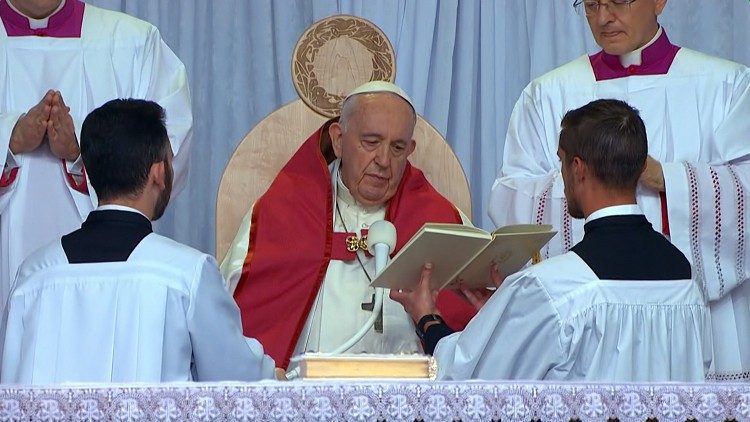
Presiding over a commemoration for Blessed Cardinal Iuliu Hossu, the Greek-Catholic Bishop of Cluj-Gherla and martyr for the faith, Pope Leo XIV upheld the Cardinal’s legacy of interfaith solidarity and forgiveness and encouraged believers to follow his example of hope, courage and mercy.

The ceremony, which took place on Monday afternoon in the Sistine Chapel, was held to mark the 5th anniversary of the late Pope Francis’ visit to Romania and the celebration in Freedom Square, Blaj, of the liturgy for the beatification of seven martyred Greek Catholic Bishops, including Iuliu Hossu. The initiative was agreed upon a year ago with the late Pope at the request of the Federation of Jewish Communities of Romania.

“Today, in a certain sense, he enters this Chapel,” Pope Leo said, referring to Cardinal Hossu, who was created cardinal in pectore by Saint Paul VI in 1969 while still imprisoned under the Communist regime in Romania. The Pope recalled the courage and constancy of the prelate who, even amid severe persecution, remained faithful to the Church of Rome.

Addressing participants, who included representatives of Romania’s Greek-Catholic Church, civil authorities, and the President of the Federation of Jewish Communities in Romania, Hon. Silviu Vexler, the Pope said Cardinal Hossu’s legacy is “a symbol of fraternity transcending all ethnic and religious boundaries.”


Commemoration of the Blessed Hossu   (@Vatican Media)

Defender of the oppressed

The Holy Father highlighted the ongoing process to bestow upon Cardinal Hossu the title of “Righteous Among the Nations”,  an initiative prompted by his heroic efforts to protect Jews in Northern Transylvania during the Nazi occupation between 1940 and 1944.

“At enormous risk to himself and to the Greek-Catholic Church,” Pope Leo noted, “Blessed Hossu undertook extensive activities on behalf of the Jews aimed at preventing their deportation.”

Quoting from a pastoral letter issued on 2 April 1944, the Pope gave voice to the cardinal’s call to his faithful:

“Our plea is addressed to all of you… to help the Jews not only with your thoughts, but also with your sacrifice, knowing that there is no act more noble to be carried out today than providing Christian and Romanian assistance, born of ardent human charity.”

The testimony of former Chief Rabbi Moshe Carmilly-Weinberger was also recalled, confirming that Cardinal Hossu’s interventions helped save thousands of Jewish lives.


Commemoration of the Blessed Hossu (@Vatican Media)

Faith rooted in forgiveness

The Pope described Cardinal Hossu as a “man of dialogue and a prophet of hope,” whose beatification by Pope Francis in 2019 affirmed his status as a martyr and model of Christian virtue.

Citing the beatified cardinal’s own words, “God has sent us into this darkness of suffering in order to offer forgiveness and to pray for the conversion of all,” Pope Leo highlighted the enduring power of forgiveness as a transformative force in the face of persecution.

“These words embody the spirit of the martyrs,” he said, “an unshakeable faith in God, devoid of hatred and coupled with a spirit of mercy that turns suffering into love for one’s persecutor.”

Witness for today

Pope Leo XIV drew a parallel between Hossu’s example and the teaching of Nostra Aetate, the Second Vatican Council’s declaration on the Church’s relation to non-Christian religions, written by Pope Paul VI, whose 60th anniversary is approaching.

“What he did for the Jews of Romania,” the Pope said, “today makes him a model of freedom, courage and generosity, even to the point of making the supreme sacrifice.”

Calling on the faithful to adopt Hossu’s episcopal motto, “Our Faith is Our Life”, as their own, Pope Leo offered a forceful appeal against all forms of violence, particularly those directed at the most vulnerable:

“Let us say ‘No!’ to violence in all its forms, and even more so when it is perpetrated against those who are defenseless and vulnerable, like children and families.”

The Pope concluded invoking God’s blessing on all present and expressed his hope that Cardinal Hossu’s example might continue to shine “as a beacon for today’s world.”

Wednesday, January 15, 2025

Jubilee 2025 encourages Cuba to release 553 prisoners


The US Embassy in HavanaThe US Embassy in Havana  (AFP or licensors)

Cuba to release prisoners ‘in the spirit of the Jubilee’

The Cuban government has announced a decision to release 553 prisoners “in the spirit of the Ordinary Jubilee of 2025 declared by His Holiness Pope Francis.”

By Christopher Wells

Cuba has announced that it will release from prison 553 people “convicted of various crimes.” The decision was communicated to Pope Francis earlier this month in a letter from Cuban president Miguel Díaz-Canel, who indicated that the release of prisoners was made “in the spirit of the Ordinary Jubilee of 2025.”

A statement from Cuba’s foreign ministry notes that the prisoner release takes place in the context of the “close and fluid relations with the Vatican State” and outlines contacts between the country and the Vatican over the course of the past few years.

The statement notes in particular the meeting between Pope Francis and President Díaz-Canel in August 2022, in which the plight of prisoners, as well as US policy toward Cuba, was discussed.

US lifts designation of Cuba as 'state sponsor of terrorism'

Cuba’s statement came after an announcement by the White House that President Joe Biden has notified Congress of his intent to lift the US designation of Cuba as a state sponsor of terrorism as part of a deal facilitated by the Church. The prisoners are expected to be released in the coming days and weeks, with some being granted their freedom before Biden’s term ends on 20 January.

Cuba’s statement on Tuesday said the country maintains “a respectful, frank, and constructive relationship with the Vatican and the Supreme Pontiff, which facilitates decisions such as the one recently taken.”

Pope Francis' Jubilee appeal for release of prisoners

In his Bull of Indiction for the Jubilee Year, Pope Francis proposed that “governments undertake initiatives aimed at restoring hope; forms of amnesty or pardon meant to help individuals regain confidence in themselves and in society; and programmes of reintegration in the community, including a concrete commitment to respect for law.”

Prisoner releases have also marked previous relations between Cuba and the Vatican. In 1998, when St John Paul II visited the island nation, Fidel Castro released around 200 people. Thousands of prisoners were granted their freedom on the eve of Benedict XVI’s visit to Cuba in 2012, and about 3,500 more ahead of Pope Francis’ Apostolic Journey in 2015.

In December 2014, diplomatic relations between Washington and Havana were restored, with then-US President Barack Obama and his Cuban counterpart Raúl Castro thanking Pope Francis for his contribution in reaching the agreement.

Friday, March 8, 2024

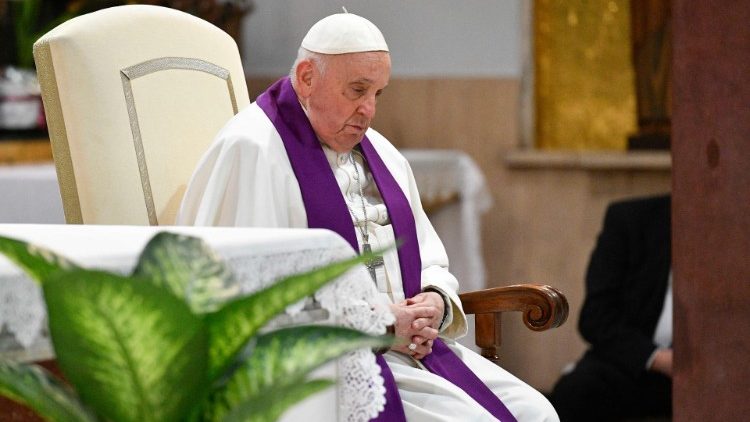
Lenten Penitential Service with Pope Francis presiding


Pope Francis presides at the penitential service that marks the beginning of this year's "24 Hours for the Lord"Pope Francis presides at the penitential service that marks the beginning of this year's "24 Hours for the Lord"  (Vatican Media)

Pope Francis: Put God’s forgiveness at the centre of the Church

Confession puts us back on the path of new life that began at Baptism, Pope Francis says during a Penitential Service in the Roman parish of St Pius V.

By Christopher Wells

Confession, the Sacrament of God’s forgiveness, allows us to start again on the journey of new life that began with our Baptism, Pope Francis said during a penitential service on Friday afternoon.

The celebration, which took place in the Roman parish of St Pius V, kicked off the annual “24 hours for the Lord,” a Lenten initiative established by Pope Francis with the aim of keeping churches open throughout the day to offer opportunities for prayer and confession.

'Walking in the new life'

In his reflection at Friday’s service, Pope Francis focused on the theme of this year’s event, “Walking in the new life.”

In the journey of our daily life, the Pope observed, we can often lose sight of the beauty of our new life in Christ, with harmful consequences for our relationships with God and with others. “We remain on our way, but we need a new signpost, a change of pace, direction to help us find again the way of our Baptism, our original beauty, the sense of going forward,” he said.

“Brothers and sisters,” Pope Francis continued, “what is the way to resume the path of new life? It is the way of God’s forgiveness.” God’s forgiveness “puts us back together again… cleanses us within, returning us to the condition of our baptismal rebirth.”

But, the Pope said, while it is necessary for us to have open and contrite hearts – like the leper who cried out to Jesus, “If you will, You can make me clean” – our own efforts are not enough. “Only God knows and heals the heart; only He can deliver it from evil.”

Pope Francis emphasized that this is what Jesus wants for us, so that we might be renewed, free, happy, and able to continue along the path of our new life.

The Sacrament at the foundation of Christian existence

“Let us not grieve Him, let us not put off our encounter with His forgiveness, for only if put back on our feet by Him can we get back on the road and see the defeat of our sin, wiped out forever,” the Pope said. “Let us not forsake God’s forgiveness, the Sacrament of Reconciliation,” which is not just a devotional exercise, but “the foundation of Christian existence.”

Pope Francis called on those who administer the Sacrament of Confession to “put God’s forgiveness back at the centre of the Church.” He invited priests to always grant forgiveness to those who ask for it, and to help those who might be afraid to confess their sins “to approach the Sacrament of healing and joy with confidence.”

Finally, Pope Francis reminded the faithful that Jesus can purify all our faults, inviting them to come to Confession with the prayer, “Jesus, I believe you can purify. I believe I need your forgiveness. Renew me, and I will walk again in new life.”

Pope Francis speaks of confession; moment of grace and forgiveness


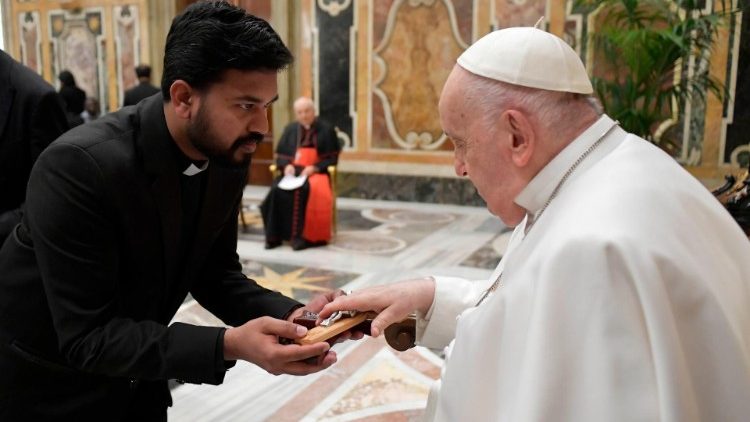
Pope Francis with participants in this year's course on the internal forumPope Francis with participants in this year's course on the internal forum  (Vatican Media)

Pope: Confession offers ‘unique moment of grace and God’s forgiveness’

Pope Francis meets with future priests in an annual course on the internal forum, and invites them to administer the Sacrament of Reconciliation with a focus on “the sweetness of God’s love.”

By Devin Watkins

“May this year of preparation for the Jubilee see the Father's mercy blossom in many hearts and places, and so God may be ever more loved, recognized, and praised.”

Pope Francis expressed that hope on Friday as he met with seminarians taking part in a course on the internal forum organized by the Apostolic Penitentiary.

The annual course seeks to guide priests and future priests studying in Rome in the art of administering the Sacrament of Reconciliation.

Experiencing ‘sweetness’ of God’s love

In his prepared remarks, the Pope told participants that their task is to help people who come for confession to experience “the sweetness of God’s love.”

“I encourage you,” he said, “to live each confession as a unique and unrepeatable moment of grace and to generously give the Lord's forgiveness, with affability, fatherhood, and I dare say, even with maternal tenderness.”

Pope Francis focused his reflections on three elements of the Act of Contrition, which penitents recite during confession before receiving absolution.

Repenting of our sins, not condemning ourselves in guilt

The Pope first spoke about “repentance,” saying it differs greatly from the psychological sense of guilt.

Repentance, he said, springs “entirely from the awareness of our misery in the face of God's infinite love and his limitless mercy.”

Christian repentance is not self-destructive but rather filled with confidence and trust in God’s forgiveness and fatherhood.

“The sense of sin is directly proportional to the perception of God's infinite love,” he said. “The more we feel his tenderness, the more we desire to be in full communion with Him, and the more evident the ugliness of evil in our lives becomes.”

Trusting in God’s goodness

Pope Francis then turned to the aspect of “trust,” as the Act of Contrition describes God as “all good and deserving of all my love.”

He noted that loving God above all things means putting God at the centre of our lives and entrusting everything to Him.

“This primacy,” he said, “animates every other love: for men and creation, because he who loves God loves his brother and seeks his good, always, in justice and peace.”

Resolving never to sin again, with God’s help

The Pope spoke finally about “resolution,” which is the penitent’s will not to fall again into the sin committed.

This firm will, he said, allows the Christian to pass from “attrition to contrition, from imperfect to perfect sorrow.”

The words—“I firmly resolve with the help of your grace to sin no more and to avoid the near occasion of sin”—express a resolution, not a promise, said the Pope.

“None of us can promise God never to sin again,” he added, “and what is required to receive forgiveness is not a guarantee of impeccability, but a current intention, made with the right intention at the moment of confession.”

Our commitment to never sin again, said the Pope, is accompanied by our request for God’s help, without whom “no conversion would be possible.”

God shines through in mercy

Mercy, concluded Pope Francis, wraps up the Act of Contrition and expresses an important divine trait.

“Lord, mercy, forgive me,” are the final words of the prayer, he said. “God is mercy; mercy is His name, His face. It is good for us to remember this, always: in every act of mercy, in every act of love, the face of God shines through.”

Monday, March 13, 2023

A timely reminder to be merciful, as your Heavenly Father is merciful


A prison in Tallahassee, FloridaA prison in Tallahassee, Florida 

‘Be merciful as your Heavenly Father is merciful’

To mark the 10th anniversary of Pope Francis’ pontificate, we share a story by Dale Recinella, a lay chaplain on Florida's death row, about how we are called to be merciful, even in the face of horrible crimes and what could seem like justifiable anger.

By Dale S. Recinella

I remember the day. I will never forget the moment the news came pouring over my car radio.  It was about 25 years ago at this time.

For a week the entire Jacksonville area (Northeast Florida) had been united in a massive search for an eight-year-old girl named Maddie Clifton. She had been out of her parents’ sight for only fifteen minutes. She had vanished into thin air. In her own neighborhood. Within steps of her own house. It was every loving parent’s worst nightmare.

Northeast Florida was covered with purple ribbons, the symbol of unity in the effort to find this beautiful little girl. One could feel the entire area praying with a single heart, breathing with a common breath, hoping with a shared faith.

I was driving to the death row prison on Highway 121 south. The spot in my drive to the prison when Sheriff Nat Glover announced a press conference updating tbe public on Maddie’s case was about halfway between Mudlake Road and the tri-county dump site, near the Baker-Union County line.. My radio was on.

Probably almost a million people were glued to their radio or their television right then, listening with one ear in the shadows of a shared fear. Sheriff Glover began in a low and forced gravely voice. We could all feel the pain he was stifling. Grief descended like a pall on northeast Florida.

Maddie’s body had been found. She had been murdered by the fourteen-year-old boy across the street. Her lifeless body was discovered hidden underneath his waterbed.

Tears welled from my eyes as my nails dug into the steering wheel. I could feel the scream and the rage in my spirit. It seemed to be my part of the shared agony wrenching our entire community.

Once in the prison parking lot, I seriously contemplated just turning around and going back home. What was the point? That morning, it seemed beyond my power to walk the distance to death row and pass out communion. That morning, it seemed beyond my strength or my ability to face men who had done such horrible things to others’ loved ones and to see the image of God in them.

But many years ago, a priest had taught me a prayer that was the antidote for such a perilous moment. “Jesus, move my feet.”

I said it. Jesus did it. And He carried me inside to minister to His children.

In the 25 years that have passed since my spiritual crisis in the death row parking lot, there has been a great deal of media coverage about the case. The young man who committed the crime was tried as an adult and sentenced to life in prison without possibility of parole.

The local press pandered the expected, dehumanizing him with adjectives like “monster” and disseminating quotes from local folks lamenting that the child murderer could not be “fried.” Just like me, many others had no strength in themselves to deal with such horrendous evil.

But through it all, one press item struck me the most, challenged me, humbled me more than any other. It was a letter to the editor of the local paper written by the aunt and uncle of the murdered 8-year old girl after the trial of the young man.

“Thank God that Joshua Phillips was too young by law for the death penalty….His mother states he is already a Christian….We pray this is so and that [his] eternity is secure in God….As for God being love, ‘administering justice’ while ‘willing to forgive,’ few have had the awful privilege of experiencing and coming to a fuller understanding of those attributes than our family.”

Our community members with the greatest claim to rage and vengeance had chosen to yield to God’s mercy. Evil had been vanquished. All of us who dared to look glimpsed the Light of the kingdom of God breaking in, overcoming evil by the doing of good.

Sunday, March 12, 2023

The most powerful and profound moments at St. Jane de Chantal Church

I made the statement at Mass this weekend that of all the powerful and profound moments experienced in my 27 years at St. Jane de Chantal Church, Friday night, the last night of our Mission that included Mass and a Healing Service, was the most powerful and profound.  Comparisons like this are truly human expressions of great sincerity but also can be awkward too.  I hope to explain.

First, some context.  Every year we work hard to prepare a Lenten Parish Mission at St. Jane.  Often, these are much-needed powerfully spiritual events.  We have been blessed with wonderful presenters including priests from the Fathers of Mercy, Fr. Cedric Pisegna who has a national TV show, and many more.  This year we had planned a Redemptorist Mission to be led by Father Peter Schavitz.  We were well on our way to building a committee, holding meetings and even meeting with Fr. Peter who flew in to help us plan.  Dates were set, promotional materials were being prepared.  Before 2022 would come to an end we received word that Fr. Peter was presented with a formidable health challenge and would not be traveling for some time.  We keep him in prayer.  Now, we are faced with a decision; do we hustle something last minute, do we just let it go given the circumstances, what to do?  

Enter in Fr. Anthony Odiong, a Priest of our own Archdiocese who happens to have a powerful teaching and healing ministry.  But by now, surely, he must be booked for the Lent that is about to begin in a month.  The reception I received from his parish staff was understanding and hopeful.  They would try hard to give us some dates.  And true to their word, Fr. Anthony would fit us in if we were ok with a Wednesday through Friday Mission.  Indeed, we were fine with that, and it got booked, March 8-10th.  The Mission theme would be simple: forgiveness, mercy and healing.  The last night would include a Mass followed by a healing service.  We were so thankful, relieved and full of anticipation.

We received word that Fr. Anthony's beloved mom had passed to the Lord and he would be returning to Africa for the funeral and be with family.  We were assured that he would arrange travel and all the details so he would not miss our Parish Mission.  So sure enough, on Wednesday evening, March 8th, Fr. Anthony was at St. Jane leading us in a discussion on forgiveness.  It was a powerful teaching.  The next evening, he used Scripture skillfully to teach us about mercy, reminding us that God IS mercy!  Then we arrived at Friday night.

We prayed Stations of the Cross first, a Friday night tradition during Lent, and followed with a Rosary.  Now when Fr. Anthony has a Healing Service, he has a large dedicated team who accompanies him.  Their support, in the form of fasting, praying and actively participating in the healing, was incredible and especially spiritual.  With Jesus on the altar in the monstrance to be adored, the healing begin.  And the healing continued for quite some time.  One by one, those in attendance felt the power of the Holy Spirit and the healing power of the great healer.  With music playing in the background, people were praying and praising and worshipping as many received healing.  It was prayerful, serene, peaceful and powerful.  I, along with everyone else was deeply touched by the power in the Church.  Wendy received healing prayers and a special anointing of the Holy Spirit.  To see her, and so many of our friends, filled with joy and peace and healing was so powerfully profound.  As I have stated before, the evening was most powerful and profound.

I have witnessed many profound moments in my home parish Church.  I joined this parish in 1996, fostered my vocation journey in this holy place, ordained a Deacon from this place and have served as Deacon here for all but four and a half years of my diaconate.  Every mass is, well, mass!!  Jesus becomes really, truly present at each and every Mass.  I have witnessed the Holy Spirit at many a Confirmation, watched young children receive Jesus in Holy Communion for the first time, baptized over a hundred new Christians in this very place and witnessed my fair share of weddings.  I have attended so many funerals, all tender and some raw and all so moving.  We recently had a funeral for the most beautiful, and perfect little 5-month-old.  Trust me, that was an impactful, powerful and spiritual moment.  

After many years I returned to the Sacrament of Reconciliation in this very church, returned to the Eucharist, learned about Adoration and Benediction, we said goodbye to my mom and Wendy's mom from this place.  Every time and in ways so numerous, I have been moved, encouraged, and strengthened in this holy place.  And still, I truly believe that this past Friday night was the most profound of countless profound, holy and spiritual experiences at venerable St. Jane de Chantal Church and Parish in beautiful downtown Abita Springs.

I cannot thank Fr. Anthony Odiong enough for his yes to our last-minute plea for help, for his Priesthood, his gift of preaching and teaching and his special gift of healing.  His openness to the Spirit is evident.  I also want to thank his entire team from St. Anthony of Padua Church in Luling.  They were true prayer-warriors and spirit filled people.  I want to thank our own Fr. Adoga who helped with confessions and healings. Thanks too to our Pastor, Fr. Ken Allen, for all his encouragement and support. And I want to thank the many parishioners who helped to support this important and powerful Parish Mission.

To God be the Glory and thanks to God for the gift of this holy Parish, our Priests and all those who call this place their spiritual home.  May we take to heart and take to others, the great lessons of forgiveness, mercy and healing, and to seek that one lost sheep that needs to be found.

St. Jane de Chantal, pray for us and help us to always Live Jesus.


Friday, July 29, 2022

The witness of evangelization, forgiveness and reconciliation of Pope Francis and the indigenous peoples of Canada


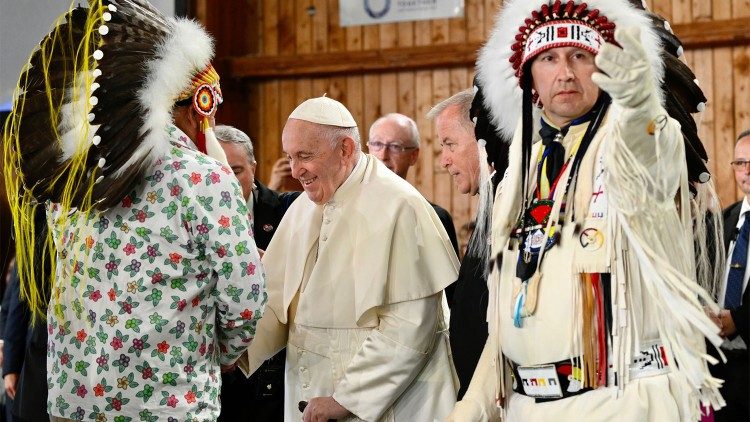
Pope Francis holds a meeting at Lac Ste. AnnePope Francis holds a meeting at Lac Ste. Anne EDITORIAL

Indigenous people, evangelization, and us

Our Editorial Director explores the road map charted by Pope Francis' speeches in Canada in light of Pope St. Paul VI's Evangelii nuntiandi and his own Evangelii Gaudium.

By Andrea Tornielli

The heart of Pope Francis' "penitential pilgrimage" to Canada has focused on his personal closeness to indigenous peoples and his request for forgiveness for the disasters wrought by the colonial mentality that sought to eradicate traditional cultures, including through the dramatic experiment of residential schools desired by the government and run by Christian churches.

Encounters with indigenous peoples marked every stage of the trip and were quite moving. The understandable focus on the suffering endured by indigenous people and the journey of reconciliation undertaken have overshadowed some valuable insights scattered throughout Pope Francis' speeches, which offer useful paths for evangelization today in every corner on earth.

After saying he felt ashamed of what happened when believers "became worldly, and rather than fostering reconciliation, they imposed their own cultural models," the Pope went on to emphasize that "this attitude dies hard, also from the religious standpoint." He thus shifted his reflection to the present day, drawing on the events of the past. That is, it is a mentality that is still present.

"It may seem easier to force God on people, rather than letting them draw near to God. This is contradictory and never works, because that is not how the Lord operates. He does not force us, he does not suppress or overwhelm; instead, he loves, he liberates, he leaves us free. He does not sustain with his Spirit those who dominate others, who confuse the Gospel of our reconciliation with proselytism. One cannot proclaim God in a way contrary to God Himself.”

Even today, says the Successor of Peter, there is a risk of confusing the proclamation of the Gospel with proselytism, because the temptation of power and the quest for social and cultural relevance, as well as projects for evangelization based on religious marketing strategies and techniques, are phenomena contemporary to our own times.

"While God presents Himself simply and quietly, we always have the temptation to impose Him, and to impose ourselves in His name. It is the worldly temptation to make Him come down from the cross and show Himself with power. Yet Jesus reconciles us on the cross, not by coming down from the cross."

Even today there is the temptation to manifest Jesus with the power and influence of the institution and its structures, with the appearance of projects that we think are working “without God, relying on human strength alone."

Instead, the way the Pope proposes is "not to decide for others, not to pigeonhole everyone within our preconceived categories, but to place ourselves before the crucified Lord and before our brothers and sisters, in order to learn how to walk together.”

This is the face of a Church that seeks to adhere more and more to the Gospel and which does not have a set of ideas and precepts to impose on people but knows how to be a welcoming home for all by witnessing to Jesus "as He desires, in freedom and charity."

Evangelizing in a time marked by secularism and indifference, Pope Francis reminds us, means offering the first Christian proclamation, because the joy of faith is not communicated "by presenting secondary aspects to those who have not yet embraced the Lord in their lives, or by simply repeating certain practices or replicating older forms of pastoral work.”

We need to find new ways and opportunities for listening, dialogue and encounter, leaving room for God and His initiative, not our own desire to be center stage, and thus facilitate a return "the simplicity and enthusiasm of the Acts of the Apostles.”

Tuesday, July 26, 2022

The poignant and sincere message of Pope Francis during a beautiful Mass celebrated in Edmonton, Canada today


Pope Francis presides at Holy Mass at the Edmonton Stadium in CanadaPope Francis presides at Holy Mass at the Edmonton Stadium in Canada 

Pope in Canada: Preserve your history to protect your future

During Mass celebrated at the Commonwealth Stadium in Edmonton on Tuesday - the feast day of Sts Joachim and Anne - Pope Francis reflects on the important role of grandparents in passing down the faith, and highlights the need to preserve the memory of those who preceded us.

By Benedict Mayaki, SJ

On the second day of his 5-day “Penitential Pilgrimage” to Canada, Pope Francis presided at the Holy Mass at the Commonwealth Stadium in Edmonton, with the presence of the faithful.

In the homily, the Holy Father invited everyone to think about their own grandparents, as the Church celebrates the feast day of Saints Joachim and Anne, in whose home the child Jesus came to know his relatives and “experienced the closeness, tender love and wisdom of His grandparents.”

Children of a history to be preserved

Pope Francis highlighted that we are children of a history that needs to be preserved – not isolated individuals - as no one comes into the world detached from others. Thus, our roots and families in which we grew up are part of a unique history that preceded us and gave us life.

In this light, “we did not choose that history” but “received it as a gift”, one we are to cherish. We are “descendants” of those who went before us and their “inheritance” which is “centered on righteousness, fidelity to God and His will.”

“We are here thanks to our parents, but also thanks to our grandparents, who helped us feel welcome in the world," the Pope said, adding they are the ones who love us unconditionally, without expecting anything back. Thanks to them, he continued, “we received a caress from the history that preceded us: we learned that goodness, tender love and wisdom are the solid roots of humanity.”

Further appreciating grandparents, the Pope said it is in their homes that many of us “breathed in the fragrance of the Gospel,” and discovered a “familiar” faith, through affection, encouragement, care and closeness.

He pointed out that it is in this way that Joachim and Anne loved Mary, and how Mary, in turn, loved Jesus, with a love that “never smothered Him or held Him back,” and the Pope invited everyone to learn not to pressure the consciences of others, or fail to love and respect those who preceded us or are entrusted to our care.

Preserving memory

Pope Francis enjoined everyone, on this note, to set aside a worthy space for preserving memory, and to remember those who went before us, insisting that we should “cultivate our roots to pray for and with our forebears, to dedicate time to remember and guard their legacy.” 

He encouraged us not to lose their memory, nor forget the history that gave birth to our own lives. Rather, we should remember those whose hands caressed us and who held us in their arms; “for in this history we can find consolation in moments of discouragement, a light to guide us, and courage to face the challenges of life.”

“Let us ask ourselves: are we children and grandchildren capable of safeguarding this treasure that we have inherited? Do we remember the good teachings we have received? Do we talk to our elders, and take time to listen to them?”

Authors of a history yet unwritten

In addition to being children of a history that needs to be preserved, we are authors of a history yet to be written, the Pope said, noting that we are marked by both light and shadows, and by the love we did or did not receive.

He added that this is the mystery of human life: we are someone’s children but we too are called to give life, as fathers, mothers and grandparents to someone else. We should, therefore, ask ourselves what kind of society we want to build and bequeath to those who come after us, in light of the much we have received from those who preceded us.

Using the image of the life-giving sap that travels from roots, to branches, leaves, flowers and to the fruit of a tree, Pope Francis said that authentic tradition is expressed in this vertical dimension – from the bottom up. He, thus, warned against falling into a “caricature of tradition” which is not vertical – from roots to fruits, but horizontal – forwards and backwards, saying that this only leads to a backwards culture, trapped in the mentality that says “we have always done it this way.”

What are we passing on to those after us?

Reflecting on the day’s Gospel reading, Pope Francis noted that Jesus tells his disciples that they are blessed because they can see and hear what prophets and righteous people could only long for – the Messiah that those who can see and hear are called to welcome and proclaim. Similarly, those before us passed on a passion, strength and flame that is up to us to reignite.

Likewise, our grandparents and elders “wanted to see a more just, fraternal and solidary world, and they fought to give us a future” and it is up to us not to let them down and to bear fruit, because “we are the branches that must blossom and spread new seeds of history.”

Highlighting the “unique and irreplaceable” role we all have in history, Pope Francis asked everyone to question what we are passing on to those who come after us and what kind of mark we will be leaving behind.

He added that the Lord does not want us to be mere critics of our system, closed and backwards looking, but rather “artisans of a new history, weavers of hope, builders of the future, peacemakers.”

“The real question is: am I giving life? Am I ushering into history a new and renewed love that was not there before? Am I proclaiming the Gospel in my neighbourhood? Am I freely serving others, the way those who preceded me did for me? What am I doing for our Church, our city, our society?”

A future where the elderly are not cast aside

Concluding, the Holy Father invoked the intercession of Saints Joachim to help us cherish the history that gave us life and “remind us of our spiritual duty to honour our grandparents and our elders, to treasure their presence among us in order to create a better future.”

The Pope prayed, in this light, for a future where the elderly are not cast aside because they are no longer useful and cannot produce, or one that is indifferent to the need of the aged to be cared for and listened.

He further prayed for a future in which “the history of violence and marginalization suffered by our indigenous brothers and sisters is never repeated.”

“That future is possible if, with God’s help, we do not sever the bond that joins us with those who have gone before us, and if we foster dialogue with those who will come after us,” the Pope said. “Young and old, grandparents and grandchildren, all together. Let us move forward together, and together; let us dream.”