Showing posts with label morality. Show all posts

Monday, January 19, 2026

Three U.S. Cardinals renounce war and call for human dignity and respect and religious liberty


File photo of the White House, in Washington, D.C.File photo of the White House, in Washington, D.C. 

Three US Cardinals: Foreign policy must respect human dignity, religious liberty

Ten days after Pope Leo XIV’s ‘State of the World’ address, American Cardinals Cupich, McElroy, and Tobin release a joint statement renouncing war and calling for US foreign policy to be based on peace and respect for human dignity and religious liberty.

By Devin Watkins

Three US Cardinals released a rare joint statement on Monday regarding American foreign policy, picking up several themes from Pope Leo XIV’s Address to the Diplomatic Corps accredited to the Holy See.

The statement was signed by Cardinal Blase Cupich, Archbishop of Chicago; Cardinal Robert McElroy, Archbishop of Washington; and Cardinal Joseph Tobin, Archbishop of Newark. (Read the original statement here)

“In 2026, the United States has entered into the most profound and searing debate about the moral foundation for America’s actions in the world since the end of the Cold War,” they wrote.

The Cardinals said recent events in Venezuela, Ukraine, and Greenland raise “basic questions about the use of military force and the meaning of peace.”

They highlighted the sovereign right of nations to self-determination, saying this principle appears increasingly fragile in the current conflictual geopolitics.


Efforts for just and sustainable peace have been subjected to partisanship, polarization, and destructive policies, despite peace being crucial to humanity’s well-being, said the three Cardinals.

“Our country’s moral role in confronting evil around the world, sustaining the right to life and human dignity, and supporting religious liberty are all under examination,” they noted.

Given this situation, the Cardinals said Pope Leo’s “State of the World” address on January 9 offers a “truly moral foundation” for international relations and a pathway for American foreign policy.

In his speech to diplomats, the Pope lamented the weakness of multilateralism and the failure of diplomacy to seek dialogue and consensus among opposing sides.

“War is back in vogue and a zeal for war is spreading,” said Pope Leo. “The principle established after the Second World War, which prohibited nations from using force to violate the borders of others, has been completely undermined. Peace is no longer sought as a gift and desirable good in itself… Instead, peace is sought through weapons as a condition for asserting one’s own dominion.”

Cardinals Cupich, McElroy, and Tobin recalled the Pope’s reference to Catholic teaching, which he said must protect the right to life since that right serves as the “indispensable foundation for every other human right.”

With him, they called for wealthy nations to provide humanitarian aid in order to safeguard human dignity of those who suffer and lamented the rise in violation of conscience and religious freedom in the name of ideological or religious purity.

The American Cardinals therefore called for a “genuinely moral foreign policy for our nation,” expressing their desire to build “a truly just and lasting peace,” which Jesus proclaimed in the Gospel.

“We renounce war as an instrument for narrow national interests and proclaim that military action must be seen only as a last resort in extreme situations, not a normal instrument of national policy,” they said. “We seek a foreign policy that respects and advances the right to human life, religious liberty, and the enhancement of human dignity throughout the world, especially through economic assistance.”

In conclusion, the three Cardinals said Pope Leo has offered the United States a prism through which to overcome the “polarization, partisanship, and narrow economic and social interests” that currently inhibit the country’s debate on its own moral foundation.

Wednesday, April 3, 2024

New document coming from Vatican covering topical moral questions


Vatican to publish document on ‘moral questions’ regarding human dignity, gender, surrogacy


The Vatican’s top doctrinal office next week will unveil a new declaration on the theme of human dignity, one that is expected to address a range of contemporary moral issues including gender ideology and surrogacy.  

The Holy See Press Office announced on Tuesday that the new document, titled Dignitas Infinita (“Infinite Dignity”) (On Human Dignity), will be debuted at a press conference held in Rome on April 8.

The conference will include presentations by Cardinal Víctor Manuel Fernández, the prefect of the Dicastery for the Doctrine of the Faith (DDF); Monsignor Armando Matteo, secretary for the doctrinal section of the DDF; and Professor Paola Scarcella of Rome’s Tor Vergata and LUMSA universities. 

In an interview with the National Catholic Register, CNA’s sister news partner, in early March, Fernández said there had been “several versions” of the text and that it was “almost finished” and would be published in “early April.” 

The cardinal’s comments came after he told Spanish news agency EFE in January that the text would address “not only social issues but also a strong criticism of moral questions such as sex-change surgery, surrogacy, and gender ideology.”

In recent months and years Pope Francis has spoken out strongly on these topics. In a January address to the ambassadors accredited to the Holy See, the pope called surrogacy “deplorable.”

In March, meanwhile, the Holy Father labeled transgender ideology as “the ugliest danger” today, one that “seeks to blur differences between men and women.” 

Since assuming the top spot at the DDF last September, Fernández has faced backlash over the December DDF document Fiducia Supplicans, which allowed for the “spontaneous” (nonliturgical) blessing of same-sex couples as well as those in “irregular” unions. 

The Argentine cardinal in his interview with EFE argued that “people who are concerned” about his work will “be put at ease” by the new document.  

Since the publication of Fiducia Supplicans, Pope Francis has publicly defended the directive on numerous occasions. In February he argued that individuals who are critical of blessings for homosexuals are guilty of “hypocrisy” if they are not similarly opposed to blessings for certain other types of sinners. 

Some of the strongest pushback against Fiducia Supplicans has come from the Symposium of Episcopal Conferences of Africa and Madagascar (SECAM) as well as from other Christian leaders with which the Church holds ecumenical dialogue. 

Tuesday, September 26, 2023

Alarming but not surprising: Americans have lower priority about marriage, children, traditional family


Is the era of the traditional family over in America? Survey suggests yes


Most Americans don’t place a high priority on marriage and children compared with their careers and friends, a new Pew Research Center survey says, and a large minority of Americans are pessimistic about the future of marriage and family.

Patrick T. Brown, a family policy expert and fellow at the Ethics and Public Policy Center, told CNA that the increasing number of people uninterested in having children or getting married “should help us recognize that we are entering a new era.”

“The Pew survey shows what I think a lot of [people] already feel: that the family, as an institution, is under threat, not least from a shifting cultural attitude that treats family and marriage as incidental to long-term well-being,” Brown said.

“The family used to be the core unit of society. Increasingly, it’s now a lifestyle choice. And troublingly, the Americans who could benefit most from the stability of marriage and family life — working-class individuals and those without a college degree — are the least likely to participate in its benefits,” he said.

The Pew Research Center survey of 5,073 U.S. adults took place from April 10–16. Respondents were part of the Pew Center’s American Trends Panel.

“There’s baseline support for a variety of family arrangements, but the public still favors some types of families over others,” the Pew Research Center said Sept. 14. “Families that include a married husband and wife raising children are seen as the most acceptable. At the same time, relatively few Americans say marriage and parenthood are central to living a fulfilling life.”

The Pew survey showed near-unanimous consensus on one point, with 90% saying that a husband and wife raising children together is “completely acceptable.” At the same time, 40% of Americans are pessimistic about the future of the institution of marriage and the family, compared with 26% who say they are optimistic and 29% who say they are neither.

White adults, older adults, and Republicans tend to be more pessimistic.

Only 26% of respondents said that having children is extremely or very important to “living a fulfilling life,” and only 23% said the same about being married. By comparison, 24% said having money was extremely or very important for fulfillment, 61% said this of having close friends, and 71% said this of having a job or career they enjoy.

Men were somewhat more likely than women to prioritize marriage and children, as were married people and parents.

Brown told CNA the survey responses show “the influence of a creeping materialism” and “the tendency to find meaning in career rather than family, community, or faith.”

“Obviously we should all be making the most of our talents, but any trend towards placing career over family life should be something that concerns people of faith,” Brown said.

Pew asked whether various family trends would have a positive or negative impact on the country’s future. Respondents generally preferred to say a trend would have neither a positive nor a negative impact.

About 49% of respondents said it is a negative trend to have fewer children raised by two married parents, while only 11% found this a positive trend. Another 36% said it’s a negative trend that fewer people are getting married, while 9% said this is positive. About 29% said it is a negative trend that more couples are living together without marrying, while 15% said this is positive.

As for the trend that people are having fewer children, 27% of Pew respondents thought this to be negative while 25% thought this to be positive. Respondents said this trend would have a good effect on the environment as well as women’s careers and job opportunities, but a negative effect on social security and the overall economy.

“Overall, there’s a lot here that should worry anyone who believes in the necessity and the vitality of the family,” Brown commented. The survey shows there is limited appeal to proposals to make it easier to have kids or to get married. For Brown, this “should underscore why the world needs the Church to spell out an attractive vision of family life, one that doesn’t rest on tired cliches from the 1950s or gets lost in the morass of today’s individualism.”

Respondents to the Pew Survey said their experience growing up with their own family was most formative for their views about what makes a good family arrangement: 69% said their experience had a fair amount or a great deal of influence over their views.

Only about 44% of respondents said their religious views had a fair amount or a great deal of influence over their family ideals. About 47% of Catholics said their religion has at least a fair amount of influence on their views, compared with 83% of white evangelicals, 62% of Black Protestants, and 48% of non-evangelical White Protestants.

“As Catholics, we will need to continue to explain the fundamental logic of the family as the key social institution geared towards the creation and formation of new human life,” Brown said. “That’s not a message many in our culture want to hear right now. But there’s also widespread discontent with what the sexual revolution has done to family life. You see it in discussions about online dating, porn, even things like commercial surrogacy.”

Regarding acceptable family types, the survey reported the greatest acceptance for a husband and wife raising kids together. Another 81% found it acceptable or completely acceptable for a husband and wife to choose not to have kids, and this situation was somewhat more acceptable than a single parent raising a child alone. A married same-sex couple not having children was accepted by 73% of Americans, about the same response to a cohabiting couple raising their children together, who in turn were more acceptable than a same-sex couple raising kids.

Democrats are more likely than Republicans to say many family types are acceptable, and women are more likely than men.

Brown said the survey responses suggest a desire to “live and let live,” and many may see the questions as judgmental. He countered: “It’s not being judgmental to say kids have better outcomes when they are raised by two parents.”

Pew’s survey indicated a small majority of Americans think unhappy couples stay married for too long, while under half say such couples get divorced too quickly. Though a majority of Pew respondents rejected open marriages, there was significant support for open marriages among those who self-identify as LGBT, cohabiting, and people under age 30.

“It’s always hard to tell how honest people are in these kind of emotionally-charged surveys,” Brown said. “But if it’s true that one-third of Americans find the idea of an open marriage morally acceptable, it just underscores how thin our understanding of marriage is in contemporary society.”

He suggested the subgroups most likely to view open marriages favorably may be the ones “least likely to have that traditional view of marriage in the first place.”

Friday, April 21, 2023

Belief in God and morality not always linked in this survey


Most adults in US, 16 other nations say belief in God, morality not always linked

Pew Research Center released the findings — that also hold true among most of those affiliated with a religion — from its Global Attitudes Survey.


April 20, 2023

(RNS) — Is a belief in God a prerequisite for being a moral person?

Most Americans say it is not, and majorities of adults in other countries with advanced economies agree.

Pew Research Center released the findings — that also hold true among most of those affiliated with a religion — from its Global Attitudes Survey on Thursday (April 20).

“(E)ven among people who are religiously affiliated, most do not think it is necessary to believe in God to have good values,” states the new report on questions asked in the spring of 2022. “In most countries surveyed, half or more of people who say they belong to a religion also say it is not necessary to believe in God to be moral.”

In the U.S., 56% of the religiously affiliated said morality and good values do not have to be linked with a belief in God. Globally, countries with the highest percentages of religiously affiliated people agreeing with that statement included Sweden (86%) and Australia (75%).

But differences are more striking in some countries whose general populations were surveyed.

While at least 60% of Europeans and North Americans do not say belief in God and morality must be linked, Israelis are more split on that, with 50% agreeing and 47% saying such a belief is essential. About one-fifth of Malaysians say people can be moral without a belief in God, while more than three-quarters disagree with that view.

Based on research in 16 countries beyond the U.S., a median of about two-thirds of adults say people can be moral without a belief in God, a bit higher than the U.S. share.

Across the globe, there are different views depending on religious and political affiliation.

In the U.S., about 9 in 10 who say religion is not at all important or not too important to them believe morality and belief in God do not need to be linked, but just half of those who think it is somewhat or very important to them agree.

Black Protestants (39%) and white evangelicals (42%) were least likely among Americans to say it’s not essential to believe in God to be moral, while the religiously unaffiliated (88%) were the group most in agreement with that stance.

Democrats and those who lean Democratic are more likely than their Republican counterparts to say it is not essential to believe in God to be moral (71% compared with 59%). Americans younger than 50 and older adults reflect a similar difference in response.

“In nearly every country where political ideology is measured, people who place themselves on the political left are more likely than those on the political right to say that belief in God is not necessary to have good values,” the report states.

“In addition, younger adults in about half of the countries surveyed are significantly more likely than older respondents to say that a belief in God is not connected with morality.”

More than 4 in 5 Greek adults younger than 30, for instance, unlink morality from a belief in God, in contrast with half of Greek adults who are 50 and older (84% compared with 51%). Substantial age differences also occur in Canada, Hungary, Italy, the Netherlands, Poland, Singapore and the United Kingdom.

Although the new report focused on countries with advanced economies, 2019 Pew research found that, among 34 nations, including some with developing or emerging economies, higher shares of people in nations with lower gross domestic products said believing in God was crucial for morality.

The new report’s findings were based on a survey of 3,581 U.S. adults from March 21-27, 2022, who took part in an online survey panel, with an overall margin of error of plus or minus 2.3 percentage points. Outside the U.S., the report relied on nationally representative surveys of an overall total of 18,782 adults from Feb. 14-June 3, 2022. In some countries the surveys were completed by phone and in others by face-to-face interviews or an online panel. The margin of error ranged from plus or minus 2.8 percentage points in Australia to plus or minus 4.5 percentage points in Hungary.

Thursday, March 23, 2023

No cold morality; give reasons for our hope: Pope Francis


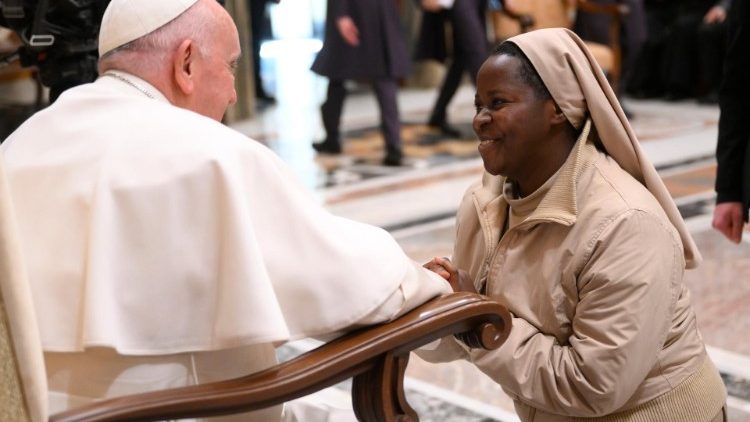
Pope Francis greets participants in conference at Alphonsian AcademyPope Francis greets participants in conference at Alphonsian Academy  (VATICAN MEDIA Divisione Foto)

Pope Francis: Beware of 'cold, desktop morality'

Amid today's vast challenges, Pope Francis calls for holding close to Christ and warns against a cold, desktop morality, when addressing participants in a two-day course on 'St. Alphonsus: Pastor of the Last and Doctor of the Church' at the Alphonsian Academy in Rome.

By Deborah Castellano Lubov

Pope Francis on Thursday warned against a cold, desktop morality, and called for giving reasons for our hope, as he addressed participants in a two-day course on 'St. Alphonsus: Pastor of the Last and Doctor of the Church' at the Alphonsian Academy in Rome.

The Alphonsian Academy is a Higher Institute of Moral Theology located in Rome, Italy, founded in 1949 by the Redemptorists. Since 1960, the Academy has specialized in moral theology as a part of the Faculty of Theology of the Pontifical Lateran University. As such, the Academy grants both licentiate and doctoral degrees in Moral Theology.

Alphonsian moral proposal

The Pope expressed his joy to welcome them at the end of their Conference on the relevance of the Alphonsian moral proposal and on the eve of the 75th anniversary of the foundation of the Pontifical Institute, which they will celebrate on 9 February 2024.

The Second Vatican Council, Pope Francis recalled, states that moral theology, nourished by Sacred Scripture, must help the faithful to understand the greatness of their vocation to bring the charity of Christ into the world.

“Every theological-moral proposal ultimately has this foundation: it is God's love that is our guide, the guide of our personal choices and our existential journey.”

"Consequently, moral theologians, missionaries, and confessors," the Pope said, "are called to enter into a living relationship with the People of God, taking on especially the cry of the least, to understand their real difficulties, to look at existence from their angle and to offer them answers that reflect the light of the Father's eternal love."

The Holy Father urged them to always stay close to the people, without pointing fingers, walking alongside them in their challenges and struggles.

Not a cold, desktop morality

Faithful to the Alphonsian tradition, the Holy Father noted, they seek to offer a proposal of Christian life that, "while respecting the demands of theological reflection, is not a cold, desk-top morality." The proposal they seek to offer, Pope Francis said, instead "responds to a pastoral discernment charged with merciful love, aimed at understanding, forgiving, accompanying, and above all integrating."

In keeping with the work of St Alphonsus, the Pope recalled their conference began by reflecting on conscience and the dynamism of its formation, and said this is an important theme.

"In fact," he continued, "in the complex and rapid change of epoch we are living through, only people endowed with a mature conscience will be able to exercise, in society, a healthy evangelical protagonism in the service of their brothers and sisters."

Giving reasons for our hope

Conscience, after all, the Pope observed, is the place where every man 'is alone with God, whose voice resounds in intimacy.' 

The Pope thanked them for their reflections on bioethics and social morality, stressing their timeliness more than ever.

“The environmental crisis, the ecological transition, war, a financial system capable of conditioning people's lives to the point of creating new slaves, the challenge of building brotherhood between people and between peoples: these issues must stimulate us to research and dialogue.”

In recent years," he said, "we have faced serious moral issues such as migration and pedophilia; today we see the urgency of adding others, such as profits concentrated in the hands of a few and the division of global powers." Even faced with these challenges, we are to face them "with confidence, ready to 'give a reason for the hope that is in us'." 

Pope Francis concluded by encouraging the Academy "to reconcile scientific rigour and closeness to the People of God, that it might give concrete answers to real problems, and that it might formulate humane moral proposals, attentive to the salvific Truth and the good of people."

“May the Holy Spirit help you to be formators of consciences, teachers of that hope which opens the heart and leads to God.”