Showing posts with label Matrimony. Show all posts

Thursday, November 9, 2023

Vatican responds to transsexual and homosexual persons receiving Baptism and witnessing Marriages


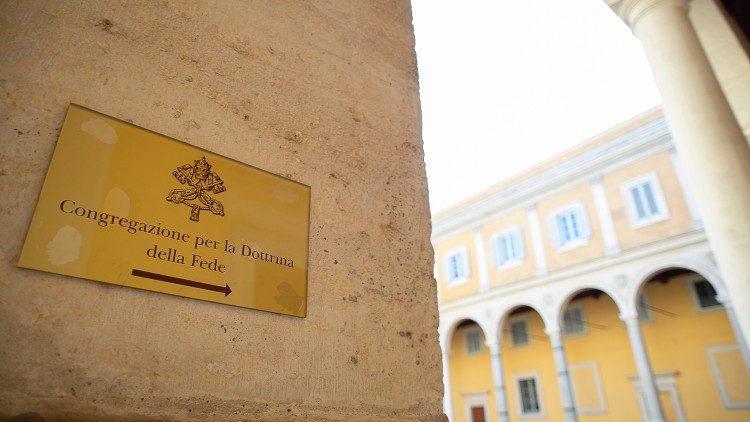
The offices of the Dicastery for the Doctrine of the Faith The offices of the Dicastery for the Doctrine of the Faith  

Transsexual and homosexual persons and the Sacraments

The Dicastery for the Doctrine of the Faith responds to questions concerning the participation of transsexual persons and persons with same-sex attraction in the Sacraments of Baptism and Matrimony and related ceremonies.

By Vatican News

Transsexual persons, even if they have undergone hormone therapy or sex reassignment surgery, may receive the Sacrament of Baptism “if there are no situations in which there is a risk of generating public scandal or confusion among the faithful”. The children of homosexual couples should be baptized even if they are born from a surrogate mother, provided there is a well-founded hope that they will be educated in the Catholic faith.

These clarifications were issued on Wednesday in a response to questions (dubia) submitted to the Dicastery for the Doctrine of the Faith (DDF) by Bishop José Negri of Santo Amaro, Brazil.

The document, signed by Cardinal Victor Manuel Fernandéz, the Prefect of the DDF, and approved by Pope Francis on 31 October, answered six questions concerning the possible participation of transsexual and homoaffective persons in the Sacraments of Baptism and Matrimony.

The answers “re-propose, in substance, the fundamental contents of what has already been affirmed in the past by the Dicastery concerning these matters.”

The DDF affirmed that transsexual persons, whether adults, children, or adolescents, can be baptized, provided they are “well-prepared and willing, and that there is no occasion of scandal."

In the case of doubts “about the objective moral situation in which a person finds themselves”, or concerning “their subjective dispositions towards grace” (and so also in situations where there does not appear to be an intention to amend), the DDF proposed certain considerations.

The Church teaches that when the Sacrament of Baptism “is received without repentance for grave sins, the subject does not receive sanctifying grace, although they do receive the sacramental character”, as we read in the Catechism. The indelible character “remains forever in the Christian as a positive disposition towards grace".

Quoting from St. Thomas and St. Augustine, the Dicastery recalls that Christ continues to seek the sinner, and when repentance comes, the sacramental character already received immediately disposes one to receive grace.

This is why, according to the document, Pope Francis has repeatedly said that the Church is not a “tollhouse” and, especially with regard to Baptism, the door should not be closed to anyone.

The question of whether a transsexual person can serve as a godfather or godmother at Baptism is more complicated. The Dicastery said that this “can be allowed under certain conditions," while noting that being a godparent is not a right. Therefore, it said, “pastoral prudence demands that it should not be allowed if there is a danger of scandal, undue legitimization, or confusion in the educational sphere of the ecclesial community”.

Concerning the possibility of a transsexual person serving as a witness to a marriage, the Dicastery noted that there is nothing “in current universal canonical legislation” and therefore it is permissible.

The DDF document went on to address several issues concerning homoaffective persons (that is, persons “who experience an exclusive or predominant sexual attraction toward persons of the same sex [CCC 2357])”.

The question was asked whether the children of homoaffective parents can be baptized, even if they were adopted or conceived through other methods, such as surrogate motherhood. The Dicastery replied: “In order for the child to be baptized, there must be a well-founded hope that he or she will be brought up in the Catholic religion”, citing the Code of Canon Law.

The document then addressed the case of a homosexual and cohabiting person who asks to be the godfather or godmother of a person to be baptized. The Dicastery said that in order to be a godparent, a person must lead “a life in conformity with the faith and the task he or she assumes”.

The case is different when two homosexual persons are involved in a relationship that does not consist simply of cohabitation, “but in a stable and declared relationship more uxorio [after the fashion of marriage] that is well known to the community”. The Dicastery for the Doctrine of the Faith said due prudence is necessary in such cases in order to “safeguard the Sacrament of Baptism and especially its reception, which is a precious good to be protected, since it is necessary for salvation.”

The Dicastery went on to say that consideration of “the genuine value the ecclesial community places on the duties of godfather and godmother, the role they play in the community, and the consideration they demonstrate with regard to the Church’s teaching” is also required.

The document suggested the possibility that “another person from the family circle might act as guarantor of the correct transmission of the Catholic faith to the baptized person.”

Further, it noted that the Church also offers the possibility, besides being a godparent, of assisting in the baptismal rite as a witness to the act of Baptism.

In response to a final question, the Dicastery said there is nothing to prevent a homoaffective person from being a witness to a marriage, even if that person is cohabitating.

The full text of the document, in Italian and Portuguese, can be found on the website of the Dicastery for the Doctrine of the Faith.

Saturday, September 9, 2023

Promoting the Sacraments of Service Holy Orders & Matrimony


Pope Francis attends a meeting with the Family Promotion Association "Marriage Encounter" at the VaticanPope Francis attends a meeting with the Family Promotion Association "Marriage Encounter" at the Vatican  (REUTERS)

Pope highlights role of family in promoting fraternity and societal cohesion

Pope Francis praises the 45-years of work of the Association for the Promotion of the Family to deepen Sacraments of Matrimony and Holy Orders, emphasising their role in realizing God's dream of unity and love.

By Francesca Merlo

The Association for the Promotion of the Family has been on a remarkable journey over the past 45 years, and has been committed to rediscovering and deepening the Sacraments of Matrimony and Holy Orders.

Pope Francis met with members of the Association in the Vatican on Saturday as part of their "Marriage Meeting".

"Marriage and Holy Orders," he said, "although in different ways and according to the charisma proper to each, are intimately linked because both manifest God's love, building up the Mystical Body of the Church."

These two sacraments, though distinct, are intimately connected by the concept of spousal love, revealing God's profound love for humanity.

God's dream of unity

Pope Francis began his address by discussing the theme chosen for the occasion, "We are God's dream."

He said the spousal charism of the association is a prophetic instrument in realizing God's dream. He highlighted that God's dream is rooted in Jesus' call for His disciples to remain connected to Him, like branches to a vine, and in His prayer to the Father to preserve their unity.

The Holy Father emphasized, "God's dream for us is this: to unite us in His love, in His communion, to make us discover the beauty of divine sonship and fraternity amongs ourselves." 

Service to the Church and society

The association's vital role is not confined to the Church alone but extends to society," he said.

By providing guidance and support to both married couples and priests, the association contributes significantly to the realisation of God's dream.

However, this service is not achieved through abstract theories or extensive words but through genuine, loving engagement with people's lives. "You do not do this with many words or abstract theories, but above all by entering lovingly into the reality of people's concrete lives," he said.

He emphasised that faith is primarily an experience of relationships and encounters, underscoring the importance of experiencing God's love in our relationships with one another.

A call to relationship and encounter

The association closely observes the intricate dialogues within marriages and the complex situations priests face, encouraging fruitful exchanges to learn the art of relationship and communion.

By doing so, they actively promote God's dream of spousal communion, even in a world that sometimes prioritises individualism over love, remarked the Pope. 

"In this way you carry forward God's dream, a dream of spousal communion, in a time that sometimes prefers to tread the swampy paths of individualism instead of venturing towards the splendid heights of love," he said.

A sign for the Church

Pope Francis praised the Association for the Promotion of the Family as a sign for the life of the Church, emphasising the need for greater reciprocity between gifts, charisms, and ministries.

"The exchange between spouses and pastors favors the evangelizing action that we urgently need today," he urged.

Relationships, particularly those that exemplify the beauty of human connections, serve as a powerful means of proclaiming the richness of the Gospel and the boundless love God has for all of His creation.

A future of generosity and passion

Bringing his address to a close, Pope Francis encouraged the association to persist in its mission with generosity and passion.

He invited them to share the experiences of married couples, priests, and religious individuals, opening their path to young people and engaged couples. And he emphasised the importance of being guided by the Holy Spirit, the love of God, in their endeavors.

Monday, November 7, 2022

When a weekend really comes together; thanking God for many blessings

 I hope you had a great weekend; I did, but I bet for many different reasons than perhaps you did.  In the idyllic small town I live and work in the buzz was the annual Fall Fest which brings locals and visitors to the park in the middle of town.  Of course, middle of town means about a block from our beloved and beautiful St. Jane de Chantal Church.  And we are just as busy as the comings and goings of our surroundings.  On Friday we have our 1st Friday all-day Adoration of the Blessed Sacrament with Benediction at 6 pm.  I normally preside at Benediction and share a homily/reflection focused on the Blessed Sacrament.  Being November, I was able to reflect on the unique connection of the Eucharist and those souls in Purgatory.  Thankfully, Benediction went on without any interference from all the frivolity going on down the street.  We also fared well for our rehearsal later in the evening for our Saturday afternoon wedding.  Now this will take a little more effort for keeping festival crowds away from the wedding logistics, mostly parking.

But lo and behold, come Saturday, after 45+ days of no rain, rain came and kept coming.  Now the rain was necessary and beneficial, but nobody wants rain to fall on their special event, be it a wedding or an outdoor festival.  So right on time, the rain ended before the closing acts at the park and the wedding of Wesley and Angela.  Our parking dilemma was solved by the much-appreciated volunteer efforts of local Knights of Columbus and help from the local town government.  The wedding was beautiful.  I really do love witnessing a wedding and preaching for the bride & groom.  As is always the case, it was both delightful and spiritually fulfilling to be there.  We pray for our newly married couple wishing them a lifetime of happiness.

So, what do you do on a Saturday evening in November after a beautiful wedding.  You settle in to watch the LSU/Alabama football game from Tiger Stadium in Baton Rouge.  Little did I know as I settled in what I was about to watch.  Alabama usually wins, is almost always the favorite and almost always much higher ranked than LSU.  The game was awesome from the beginning, my LSU Tigers playing great and leading much of the game.  When Alabama took a late lead then later tied the game after a brief LSU lead, you had to sigh, and wonder would this be another disappointing repeat.  After all, we go into overtime and Alabama scores first.  But then LSU scores on their first snap of OT and to the shock of all they decide to go for two.  One way or the other, this game was about to be over, one way or the other.  And with great joy and relief I watched the 2-point conversion work and yes, LSU beats Alabama.  Wow!  What a game.  And it came on the same night we "fall back" and gain an extra hour of sleep; I sure needed that too.

I was assigned the early mass on Sunday; 8 am and I was ready.  Mass was, as usual, awesome and I headed to Slidell, with Wendy, to pick up grandkid Brennan for a two-day visit.  She brings lots of joy and excitement to our house.  Her activities range from playing dolls, doing crafts to riding her little 4-wheeler.  I snuck away for a while to attend my church parish picnic which was very nice and well attended.  By 5 pm the sun was now setting, and a great weekend was over.  Giving thanks to God for great times and great memories made from days such as these.

Friday, June 24, 2022

Pope explains the importance and value of marriage


Pope tells cohabiting couple why they should marry


Kathleen N. Hattrup - published on 06/24/22

You don't get married to obey a rule, he says ...

Serena Zangla and Luigi Franco are an Italian couple who gave their testimony this week at the opening of the World Meeting of Families in Rome.

The couple has lived together for many years and they shared at the festival their decision and struggle to baptize their three boys, even though they aren’t married in the Church.

The Holy Father praised their decision to seek baptism for their children, particularly as it was based on the realization of their need for God’s help:

“It is true, we can have the loveliest dreams, the loftiest ideals, but in the end, we also discover – and this is wisdom – our own limitations, which we cannot overcome by ourselves but by opening ourselves to the Father, to his love and to his grace,” he told them.

Then, without mentioning their circumstances, the Pope changed topic a bit:

“We can say,” he began, “that whenever a man and a woman fall in love, God offers them a gift; that gift is marriage. It is a marvellous gift, which contains the power of God’s own love: strong, enduring, faithful, ready to start over after every failure or moment of weakness.”

The Holy Father went on to explain the reason that the Church invites people to marriage.

Marriage is not a formality you go through. You don’t get married in order to be ‘card-carrying’ Catholics, to obey a rule, or because the Church tells you to, or to have a party …

Solid as rock

Then the Pope described not only the beauty but the power of marriage:

No, you get married because you want to build your marriage on the love of Christ, which is solid as rock.

In marriage, Christ gives himself to you, so that you can find the strength to give yourselves to one another.

So take heart: family life is not “mission impossible”! By the grace of the sacrament, God makes it a wonderful journey, to be undertaken together with him and never alone. The family is not a lofty ideal that is unattainable in reality. God solemnly promises his presence in your marriage and family, not only on the day of your wedding, but for the rest of your lives. And he keeps supporting you, every day of your journey.

Wednesday, June 15, 2022

Announcing Catechumenate Itineraries for Married Life


Pope Francis blesses a newly-wed pregnant woman at a General AudiencePope Francis blesses a newly-wed pregnant woman at a General Audience  (Vatican Media)

Pope: ‘Church must walk closely with couples toward marriage’

Pope Francis pens the preface for guidelines to create “Catechumenal Itineraries for Married Life”, and urges the Church to help better prepare future spouses for marriage so as to avoid the suffering caused by broken families.

By Devin Watkins

The Dicastery for Laity, Family and Life on Wednesday released new pastoral guidelines for local Churches, which lay out a path toward the creation of “Catechumenal Itineraries for Married Life”.

Pope Francis wrote the preface for the Document, saying it represents a “fruit” of the Amoris Laetitia Family Year marking his Apostolic Exhortation on the family.

“The Church, in every age, is called to proclaim anew the beauty and abundance of grace contained in the Sacrament of Marriage and the family life which flows from it, especially to young people.”

Reducing number of null or failed marriages

The Pope said the Document charts a path toward a true “catechumenate”, based on the model of the ancient baptismal catechumenate for adults, in order to help them build their marriage on the rock of faith.

Many couples, he noted, receive only superficial preparation before their wedding and therefore risk setting their marriage on such weak foundations that it “falls apart in a short space of time and cannot withstand even the first inevitable crises.”

“Marriage failures bring with them great suffering and leave deep wounds in people. They become disillusioned, bitter and, in the most painful cases, even end up no longer believing in the vocation to love, inscribed by God Himself in the heart of the human being.”

Mother Church accompanies couples

In response, said Pope Francis, the Church must accompany couples who seek to marry in the Church, animated by a desire for justice.

Just as no mother plays favorites among her children, neither does the Church treat her children differently. Therefore, the Church must devote considerable time and energy to accompanying engaged couples toward marriage, as she does men who seek to become priests or women and men who enter religious life.

Married couples, he said, “are truly ‘guardians of life’, not only because they beget children, raise them, and accompany their growth, but also because they care for the elderly in their family, and devote themselves to the service of people with disabilities and frequently to people living in poverty with whom they come into contact.”

Walking stretch of road together

Pope Francis then repeated his desire for local Churches to set up a “true catechumenate for future spouses which includes all the steps of the sacramental path: time of preparation for marriage, its celebration, and the years immediately thereafter.”

“The goal is to walk an important stretch of road together with couples in the journey of life, even after the wedding, especially during moments of crisis or discouragement,” said the Pope.

Gift and responsibility

The Document, he added, is both a gift and a responsibility, because it offers a wealth of abundant material while requiring local Churches to adapt its guidelines into concrete programmes based on cultural sensibilities.

“I appeal to the docility, zeal, and creativity of the Church's pastors, and those who assist them, to increase the effectiveness of the vital and indispensable work of formation, proclamation, and accompaniment of families, which the Holy Spirit is asking us to carry out at this time.”

Pope Francis concluded his preface for the “Catechumenal Itineraries for Married Life” document by urging the Church’s pastors to be courageous in the face of this new responsibility.

“Let us put our minds and hearts at the service of future families,” he said. “I assure you that the Lord will sustain us, give us wisdom and strength, make our enthusiasm grow, and above all, allow us to experience the ‘delightful and comforting joy of evangelizing’, as we proclaim the Gospel of the family to new generations.”

Thursday, September 16, 2021

Pope Francis affirms marriage as one man, one woman


On same-sex unions, Pope says Church doesn’t have power to change sacraments


Kathleen N. Hattrup - published on 09/15/21

Pope Francis says there shouldn't be an imposition of what can't be part of the Church, by nature.

In his customary press conference on the return trip from Slovakia this September 15, Pope Francis was asked to comment on a resolution coming from Strasbourg regarding same-sex marriage.

“I have spoken clearly about this, no?,” he began. “Marriage is a sacrament. Matrimony is a sacrament. The Church does not have the power to change the sacraments as the Lord instituted them.”

The Pope then commented on civil laws that can offer certain rights and protections to same-sex couples or even other unions of people. The Pope mentioned as an example three widows who might want to join together by law to share inheritance, or have health care benefits.

Since facing the push for same-sex marriage as bishop of Buenos Aires, the Pope has spoken about the possibilities of such civil protections for homosexual couples.

It “is important that people be helped … but without imposing things that, by its nature, don’t go in the Church,” he said. “Marriage is marriage.”


Pope Francis urged that condemnation be avoided. “No, please! They are our brothers and our sisters and we must accompany them. But marriage as a sacrament is clear. It’s clear.”

“Matrimony as a sacrament is between man and woman,” the Pope said.

… Please, don’t make the Church deny her truth. Many, many people with a homosexual orientation approach the sacrament of penance to seek counsel from priests and the Church helps them move forward in their own lives. But the sacrament of marriage is something else.

Thursday, April 15, 2021

This is going to be a huge area of concern for the Catholic Church and the faithful who do not understand the authentic teaching


Students press Catholic colleges to respond to ban on same-sex blessings


Catholic college students across the United States have expressed disappointment in the Vatican's March 15 decree banning priests from blessing same-sex unions. At least eight college newspapers have featured op-eds in recent weeks criticizing the decree, with many demanding their institutions rebuke the Vatican.

In interviews with NCR, three LGBT Catholic university students echoed those sentiments. One initially worried the new statement from the Congregation for the Doctrine of the Faith might lead to judgment inside her family. Another worried about whether they might be able to marry one day.

Mia Laube CROP.jpg

Mia Laube, a student at the University of St. Thomas (Courtesy of Mia Laube)

Although the students recognize it is difficult for a Catholic university to issue a statement opposing the Vatican, they also want to see strong signs of support from their communities.

"When the pope says things that are potentially harmful to members of that Catholic institution and then the institution says or does nothing to protect its members, that is equally as damaging as if they were to come out and promote it themselves," said one of the students, an undergraduate at Creighton University in Omaha, Nebraska, who asked not to be named for fear of reprisal.

The two other students, from Fairfield University in Connecticut and the University of St. Thomas in St. Paul, Minnesota, described college experiences that have mostly been positive. The student from St. Thomas, Mia Laube, said: "For every wave of hate I have experienced, I have two waves of supporters saying, 'No, that's wrong, we don't want that here. We love you.' "

The Vatican decree told priests they could not offer blessings for same-sex couples because God "does not and cannot bless sin."

The student at Fairfield said she spoke with other members of her university's Gay-Straight Alliance about the decree. Some said it is an example of why they are not Catholic anymore.

In addition to Creighton, Fairfield and St. Thomas, students at Seton Hall University, Gonzaga University, St. Bonaventure University, St. Anslem College, Loyola Marymount University, St. Joseph's University and Mercyhurst University have protested the Vatican's decree in student newspaper articles or in op-eds.

The GLBTQ+ Leadership Council at Boston College drafted a petition that has garnered 275 signatures. It asks Boston's administration and its president, Jesuit Fr. William Leahy, to "clarify their position and to make a statement in support of Queer students and alumni."


Explaining St. Thomas' position, university vice president for mission Fr. Larry Snyder said in a statement to NCR: "We were very concerned about the hurt and pain they might be experiencing as a result of the [Congregation for the Doctrine of the Faith's] statement. Thus, we thought the most helpful approach was direct outreach to our LGBTQIA+ community to offer our support, accompany them and listen to their concerns."

Snyder said the university sponsored a discussion for LGBTQ community members and that administration met with the queer faculty and staff group.

Lydia Cooper, an English professor at Creighton and a faculty adviser for the campus Gay-Straight Alliance, told NCR she was worried the Vatican decree would lead Creighton to roll back its health insurance benefits for employees in same-sex unions. She was relieved to learn that will not happen.

"Thanks to Obergefell [v. Hodges], I am legally in a relationship," Cooper said, referring to the 2015 U.S. Supreme Court decision that legalized same-sex marriage across the country. "But the Catholic church wouldn't consider it a relationship."

Cooper said that without a response to the Vatican from Creighton, she feels left with "this sense that the institution is extremely tolerant but is not really in a place to actively support queer students."

Support, in the various forms it might come, is what LGBTQ students at Catholic institutions say they want most.

While the three students all said they feel mostly appreciated at their colleges as LGBTQ people, they have also dealt with situations that caused them discomfort. One mentioned a man who came to the University of St. Thomas campus to harass a gay adjunct professor. Another cited a comment from a student government candidate at Fairfield that offended LGBTQ students.

Whether or not their universities respond to the Vatican, there are other steps the students would like to see them take. Laube said she would like to see a physical space at St. Thomas for LGBTQ groups, similar to the university's Luann Dummer Center for Women.

The other two students are talking to their administrations about giving their Gay-Straight Alliance groups more freedom to hold events and to provide information to students about being Catholic and LGBTQ.

Said the Creighton student: "I feel that the institution needs to at least recognize that there is a disconnect, rather than assuming that there is harmony between both."

[Liam Adams is a Denver-based freelance reporter writing about religion. His work has also been featured in The Chronicle of Higher Education, Religion News Service, Sojourners, Baptist News Global and Christianity Today.]

Saturday, February 6, 2021

National Marriage Week begins tomorrow


National Marriage Week USA and World Marriage Day to be Celebrated February 7-14

FEBRUARY 5, 2021 BY PUBLIC AFFAIRS OFFICE

WASHINGTON— Each year, National Marriage Week USA and World Marriage Day provide an opportunity for the Catholic Church to focus on building a culture of life and love that begins with supporting and promoting marriage and the family. This year, National Marriage Week USA will be celebrated February 7-14 and World Marriage Day which is commemorated on the second Sunday of February will be celebrated on Sunday, February 14.

The theme for this year’s celebration of National Marriage Week, “To Have, To Hold, To Honor,” was announced by Archbishop Salvatore J. Cordileone of San Francisco, chairman of the U.S. Conference of Catholic Bishops’ (USCCB) Committee on Laity, Marriage, Family Life and Youth. The theme was chosen to highlight how married couples live and renew their wedding promises daily in the building up of the domestic Church in their homes, particularly as many couples and families have spent more time at home together this year.

Among the resources provided to dioceses for National Marriage Week are a preaching aid for priests, bulletin insert or flyer for parish bulletins, prayer intentions, and a seven-day at-home marriage retreat for married couples, available in English and Spanish. These resources are available for download at ForYourMarriage.org/celebrate-national-marriage-week/.

This year’s retreat features reflections on aspects of married life rooted in Sacred Scripture and the promises couples made to each other before God on their wedding day. The retreat, which runs from Feb. 7-14, offers married couples an opportunity to pray and reflect about their marriage in God’s plan.

Two events will be live-streamed on the USCCB’s Facebook page: a rosary led by Archbishop Cordileone for married and engaged couples on Wednesday, February 10 at 2:00 pm ET; and a conversation about Saint Joseph as a model of fatherhood and spousal love on Friday, February 12 at 2:00 pm ET.

The USCCB offers resources to the faithful for the promotion and defense of marriage as a lifelong union of one man and one woman through its dedicated websites ForYourMarriage.org, PorTuMatrimonio.org, and MarriageUniqueForAReason.org.

National Marriage Week USA, launched in 2010, is part of an international event seeking to mobilize individuals, organizations, and businesses in a common purpose to strengthen marriage in communities and influence the culture. For information and resources, visit: NationalMarriageWeekUSA.org. World Marriage Day was started in 1983 by Worldwide Marriage Encounter.

Wednesday, February 13, 2019

A marriage program that just might be a great idea; Three to Thrive

US: Texas Couple Implements Post-Cana Program

Three to Thrive Helps Faithful Catholic Couples in Early Years of Marriage

If there is one place in life where ideals and dreams must come to terms with reality it is in marriage.
Anyone who is married likely has experienced the jolting “what now” moment that comes after dating, the wedding, and the honeymoon.  It happens when the young couple is at home together, perhaps sitting over cups of coffee at the breakfast table and the reality of real life hits them directly in their until-now blissful faces.
The questions/complaints may start tumbling forth:
  • Why did you assume I would do the cooking – or that I know how to cook?
  • Are you still playing softball on Sundays?
  • What do you mean, we’re going to your mom’s for dinner Saturday?
  • Why should I do your laundry and ironing?
  • Well, in my family we take our shoes off and leave them by the back door.
  • Didn’t your parents ever teach you to pick up after yourself?
  • You never complained about my drinking when we were dating.
  • Why do I have to account for every penny I spend?
  • You want to put purple curtains in the living room?
  • And about the toilet seat…
The United State Conference of Catholic Bishops (USCCB) offers materials to address a variety of problems that can beset marriage: addiction, careers, conflict, death of a loved one, disillusionment, domestic violence, finances, household duties, illness, infertility, infidelity, in-laws, miscarriage, personality differences, pornography.
Young Catholic couples typically have received some level of marriage preparation and may have in mind the ideal of a loving, congenial marriage. But until you are actually there you really don’t know what to expect – and the toolbox to maintain and repair the marriage may be sparse.
Pope François © L'Osservatore RomanoCatholics have exceptionally high standards for marriage – perhaps the highest of any religion. Unfortunately, accompaniment of the couple after marriage is pretty much nonexistent. Pre-Cana courses are inconsistent in quality, depth, and fidelity to the teachings of the Church.
In his January 29, 2019, talk to the Tribunal of the Roman Rota, Pope Francis began his remarks by acknowledging the challenges marriages face:
“The society in which we live is increasingly secularized and does not favor the growth of faith, with the consequence that Catholic faithful struggle to bear witness to a style of life in accordance with the Gospel, also with regard to the sacrament of marriage.
“In such a context, it is necessary for the Church, in all her articulations, to act in harmony to offer adequate spiritual and pastoral support.”
Chelsea and Ryan Harkins, a young married couple and Regnum Christi members in Dallas, believe couples need “post-Cana” accompaniment. And they are doing something that grew from an idea they picked up in Fiji.
The mention of Fiji requires a little historical context.
In 2015, Chelsea and Ryan were part of a team of missionaries who traveled to Fiji to bring the message of St. John Paul II’s Theology of the Body (TOB) to the Archdiocese. Each of the missionaries was specially selected and had a background in TOB. The core of the program was forming trainers in two key areas: Theology of the Body; the other in natural family planning.
Chelsea and Ryan were not married at that time, although they had recently started dating. Each was selected for the Fiji mission because of their background.
Chelsea, who grew up in Houston, was a graduate of Texas Woman’s University, where she met Tammy Grady, a Consecrated Woman of Regnum Christi. Chelsea was a faithful Catholic who wanted to do more for the Church, so she devoted two years of her life as a Regnum Christi Mission Corps volunteer in the Philippines. After her service, she moved to Dallas to finish training as a physical therapist.
Ryan grew up in Mississippi and met Regnum Christi at an early age. He served as a Mission Corps volunteer, then spent seven years as a Legion seminarian, eventually discerning he was not called to the priesthood.  He moved to Dallas, taught high school theology for a bit, then became the executive director of Birth Choice Dallas, a pro-life pregnancy center.
Chelsea and Ryan connected in Dallas, dated, fell in love, married, and started a family; John Paul Harkins is a year old.
As they prepared for marriage, something they had observed in Fiji kept coming to mind.  Doing marriage preparation with Fr. Peter Hopkins, LC, only made the importance of proper formation for marriage loom even more vital. When Fr. Peter held a marriage retreat for Chelsea, Ryan, and other engaged couples, the idea for Three to Thrive became real.
Chelsea and Ryan had been impressed during the TOB mission that in Fiji, the bishop requires each Catholic couple who marry not only to attend a Pre-Cana program but to come back for a refresher course after five years of marriage.
There wasn’t such a thing in Dallas, so they invented it – with the help of some local clergy and a few marriage expert friends.
“We started Three to Thrive because we needed it,” Chelsea says. “And we have to check with each other regularly to make sure we’re practicing what we’re sharing with others.
“Couples have to learn that marriage isn’t just about personal fulfillment for them – it is for the kingdom of God. Jesus starting His public ministry at the wedding in Cana tells us the importance of marriage.  God wants us to create and redeem through marriage.  We have to ask God what he wants to create through our marriage, through the love He has given us to share.”
Ryan explains that Three to Thrive meets monthly with a combination of practical and spiritual topics, as well as couple testimonies. The program started small but now has reached more than 200 couples. Initial meetings were in the offices of Birth Choice but now they meet in parishes – and are an approved marriage enrichment program of the Archdiocese of Dallas.
Each monthly session is “stand-alone” so couples won’t miss out if they can come only occasionally. And they can choose topics that interest the most. Couples of any faith are welcome, but Chelsea and Ryan point out that Three to Thrive is “Unapologetically Catholic and orthodox in everything it presents.”
Perhaps the hottest topics are on issues related to family of origin. (That gets into some of the questions mentioned at the top of this article). Even two devout Catholics can feel a strain in marriage because their families imparted different values, styles, and habits on each of them.
Three to Thrive is more “preventative” than “corrective” for marriages. Still, some couples attend because they are struggling. In other cases, couples have seen family members and friends suffer failed marriages and want to make sure they avoid the problems that lead to divorce.
Chelsea and Ryan are blessed to have a team of people who help make the apostolate work. Still, it takes a lot of time and hard work on the part of Chelsea and Ryan to make the apostolate thrive. They lean heavily on the inspiration of the program’s patron Saint, John Paul II.
And as the name Three to Thrive implies, the Harkins always have a third partner in every part of their marriage: God.