Showing posts with label Stations of the Cross. Show all posts

Friday, May 1, 2026

US Bishops travel to the Deep South to discuss the legacy of racism and impacts on society, the legal system


A group of US BishopsA group of US Bishops 

Moved by pastoral letter against racism, US Bishops journey to Deep South

Krisanne Vaillancourt Murphy, director of a U.S. organization working to end the death penalty, accompanies several Bishops in their exploration of the connections between the legacy of racism in the United States and its impacts on the criminal legal system today.

By Krisanne Vaillancourt Murphy, Executive Director of Catholic Mobilizing Network*

Eight years ago, the United States Conference of Catholic Bishops (USCCB) authored a pastoral letter against racism. Open Wide Our Hearts: The Enduring Call to Love explores the questions “what is racism?” and “how do we overcome this evil?”

“Racism,” the bishops write, “is a life issue,” and “a perversion of the Lord’s will for men and women, all of whom were made in God’s image and likeness.” For a society to move on from the “social structures of injustice and violence that make us all accomplices in racism,” the way forward, the bishops said in their letter, must include meaningful, personal encounters:

“To work at ending racism, we need to engage the world and encounter others—to see, maybe for the first time, those who are on the peripheries of our own limited view.” (Open Wide Our Hearts)

Fast forward to just a few weeks ago. In March 2026, I had the privilege of traveling to the Deep South for such an “encounter” with six U.S. bishops, as well as staff and consultors from the USCCB’s Subcommittee for the Promotion of Racial Justice and Reconciliation. This Lenten Experience in Montgomery and Selma, Alabama was the second collaboration between Catholic Mobilizing Network and the USCCB to bring U.S. bishops to Alabama. In the 19th century, Montgomery was one of the most prominent slave-trading locations in the United States. In the 20th century, it became the cradle of the Civil Rights Movement.

The trip provided an opportunity to explore how the legacy of 400 years of slavery, lynching, and racial segregation continues to shape our justice system, and to engage in the restorative work of truth-telling and reconciliation in the United States.

I felt privileged to walk alongside these episcopal leaders as they lived out what they committed to eight years ago. Our experience in Alabama was a journey of truth-telling and an exploration into what is required of the Church, its leadership, and its faithful in order to be ministers of hope and reconciliation in the face of systemic racism in the United States.

Lenten Journey Reveals the Promise of Easter

It was no coincidence that this trip fell during the season of Lent. Our sojourn would be one of head and heart, of remembrance, repentance, prayer, and preparation for Easter’s renewal.

The first day of our journey included an unforgettable meeting with Bryan Stevenson, founder of Equal Justice Initiative (EJI) in Montgomery, Alabama whose decades of inspiring work has provided legal representation to people who have been wrongfully convicted, unfairly sentenced, or abused in state jails and prisons. EJI has become a lifeline for marginalized people in Alabama and a trailblazer in its effective legal and narrative change efforts. Through the development of “Legacy Sites” across the city of Montgomery, EJI elevates the connections between mass incarceration and excessive punishment and the entrenched challenges of racial and economic injustice.

As he expanded on issues of racism and injustice embedded within our criminal legal system, Mr. Stevenson explained how one of the most insidious consequences of the “cancer” of racism is the narrative of racial hierarchy and of Black inferiority. More specifically, he stated that the suspicion of dangerousness and guilt assigned to Black and Brown people is what drives over sentencing and overincarceration of people of color to this day. Just as Lent invites us to reflect on Jesus’ temptation by the devil while fasting in the desert, so too did our Lenten encounter with Mr. Stevenson bring to light how we face temptation today of racism’s social sin.

Against this backdrop, he spoke of Church leaders as key “facilitators of transformation” for society, because they know that confessing the truth and repenting from sin are what opens hearts to redemption and reconciliation. As the United States struggles to reckon with the legacy of slavery and the manifestations of racial injustice today, Mr. Stevenson encouraged us to help society to be set free from silence and engage in truth-telling, while always holding on to hope.


Our meeting with Mr. Stevenson was one of a dozen encounters on a 48-hour journey through Montgomery and Selma. We anchored ourselves throughout these encounters by praying the Stations of the Cross as we visited key sites of the U.S. Civil Rights Movement in the 1950s and 1960s — such as Rev. Martin Luther King Jr.'s parsonage — met with local leaders, and deepened our understanding of the realities of capital punishment today. With our eyes, ears, and our hearts, we contemplated Christ’s journey toward Calvary and reflected on the nearness of our Savior to the suffering we bore witness to.

As Catholics, we understand it is through the witness of the suffering of Christ’s passion that the light of Easter morning comes. The same is true about our Lenten experience in Montgomery and Selma.

Bishop Joseph Kopacz, Bishop of the Diocese of Jackson Mississippi shared, “We have to get to the truth, as Sister Thea Bowman would say, the truth of what the reality was, so that there can be reconciliation.”

In remembering the deep harm and raw pain of racial terror and structural racism, we also heard testimonies of the movement of the Holy Spirit and in the light of faith, resistance, and resilience.

“Despite all the struggles that people have faced in their lives, despite their sufferings and pains of the past,” reflected Bishop Felipe Pulido, Auxiliary Bishop of San Diego, “they still have faith in our Lord Jesus Christ, and that truly gave them hope and resilience to continue their lives.”

Surely, the Cross reveals the depth of God’s love and the empty tomb offers a sign of God’s saving power. Our faith rests in the assurance that life will always have its victory over death. Indeed, the commitment to make this truth-telling journey marked a profound act of Easter hope.

Steps of the Journey

In addition to meeting with EJI founder Bryan Stevenson, we visited all three Legacy Sites established by the organization: The Legacy Museum: From Slavery to Mass Incarceration, the National Memorial for Peace and Justice, and the Freedom Monument Sculpture Park, which honors the lives and memories of the 10 million Black people who were enslaved in the United States between 1619 and 1865.


Bishops on the Lenten experience celebrate Mass with Bishop Steven J. Raica of Birmingham, Alabama and pastor of Resurrection Catholic Parish.

Together we celebrated Mass in Catholic parishes and shared meals with pastors and local leaders — including individuals who have been active in the community since the Civil Rights Movement.

Fr. Manuel Williams, C.R., a Montgomery native and pastor of Resurrection Catholic Missions of the South shared his rich experiences of resilience and hope as a leader of a vibrant Catholic parish engaged in the ministries of education, evangelization, healthcare, social services, and advocacy. Fr. Andrew Jones, pastor of The City of Saint Jude — which was the final stop for the Selma to Montgomery marchers before arriving at the State Capitol on March 24, 1965 — told the history of his parish’s efforts to preserve the Church’s key role in the Civil Rights Movement and shared stories of how the parish expresses its commitment to human rights and social justice today.

These profoundly moving personal encounters were not easy. Bishop William Wack, Bishop of Pensacola-Tallahassee described it this way:

“Some the things that really affected me were seeing the sculptures and the art and the photographs of the true reality of slavery and racism and how that's led to a continuation through lynching and mass incarceration. Just seeing that and then talking to some people who were part of the Civil Rights Movement, you know, in the 50s and 60s, and hearing their voices, that was really important for me as well.”

What the Lord Requires

On the final morning of our trip, we stood at the base of hundreds of hanging steel columns, at the National Memorial for Peace and Justice. The columns stand as a visual reminder of the bodies left hanging in the horrific violence of 4,400 documented racial terror lynchings between 1877 and 1950. Again, we turned to the Passion, concluding with the final Station of the Cross.

We prayed together, recalling the inspiration provided in Open Wide Our Hearts:

“You have been told, O mortal, what is good, and what the Lord requires of you: only to do justice and to love goodness, and to walk humbly with your God” (Micah 6:8).

Bishop William A. Wack leads the Stations of the Cross at the foot of the Edmund Pettus Bridge, the site of the infamous 1965 “Bloody Sunday,” when voting rights marchers traveling from Selma to Montgomery were attacked by police.

As we work to “do justice,” the pastoral letter reminds us that justice is defined “where we are in right relationship with God, with one another, and with the rest of God’s creation.” Integral to this relational justice commitment is listening to the stories of those who are personally impacted by the sin of racism.

In the effort to “love goodness,” the letter invites us to consider the example of Christ’s suffering on the cross: “It is through his Cross that we learn the greatest lesson about love.” Reflecting on Christ’s own execution at the hands of the state offers an expansive understanding of love that seeks unity and restoration in the face of racial injustice, dehumanization, and division.

And in the effort to “walk humbly with God,” the letter encourages those in positions of Church leadership to “make formal visits to institutions of culture and learning” and to engage in meaningful experiences that deepen understanding of our nation’s complex racial history.

We are an Easter people living in the promise of the Holy Spirit. That is why we accompany one another in Alabama — in a prayerful posture of openness, encounter — and ask for God’s grace to become reconcilers in our wounded world. Our Lenten journey created a profound opportunity to remember our country’s deep wounds of racism. This time together helped us all see more clearly how systemic racism has given way to a pervasive narrative of revenge and retribution that marks our current criminal legal system.

With each Station of the Cross that we prayed throughout our journey, we recited: “Because by your holy cross you have redeemed the world.” This simple prayer reveals the depth of God’s love and His abundant mercy. And through it, our appreciation for this restorative truth-telling work grew within us. 

Gratefully, the light of the Resurrection illuminates our path to understanding the depths of suffering in a new way, so that we can spread the Good News of Easter as facilitators of transformation and of restoration, wherever the ravages of systemic racism persist today.

* Krisanne Vaillancourt Murphy is the Executive Director of Catholic Mobilizing Network, a national organization in the United States that mobilizes Catholics and people of goodwill to end the death penalty, advance justice solutions in alignment with Catholic values and promote healing through restorative justice approaches and practices. For more information and to join the movement, visit catholicsmobilizing.org.

Friday, April 3, 2026

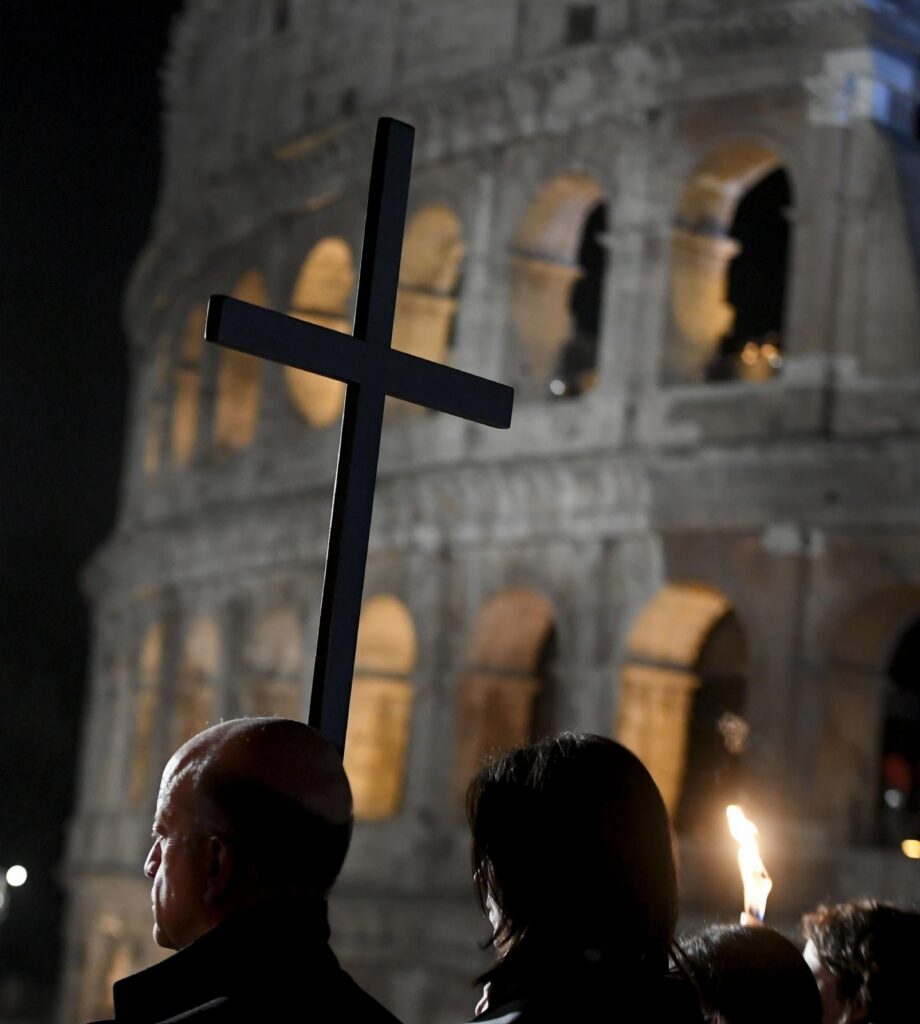
Pope Leo XIV led the Via Crucis by carrying the Cross at Rome's Colosseum


Pope Leo XIV carries Cross for Via Crucis at Colosseum in Rome

Pope Leo XIV leads the faithful at the Good Friday Way of the Cross by carrying the Cross throughout the Colosseum in Rome.

By Devin Watkins

Pope Leo XIV became the second Pope to carry the Cross for the entire Via Crucis on Good Friday at Rome’s Colosseum.

Joined by around 30,000 faithful and countless people across the world on social media, television, and radio, the Pope led the Way of the Cross through the candlelit ruins of the ancient Roman edifice, which witnessed the martyrdom of many early Christians.

Begun by the Emperor Vespasian and completed in 80 AD by the Emperor Titus, the largest ancient elliptical amphitheater was eventually consecrated as a Catholic church.

Each year, the Pope and the faithful of Rome gather at the Colosseum to make the spiritual pilgrimage through the fourteen Stations of the Cross that recall Jesus’ death and burial.

Pope Leo XIV followed in the footsteps of Pope St. John Paul II, who carried the Cross for the entire Via Crucis from 1980 until 1994.


Pope Leo carries the Cross inside the Colosseum (@Vatican Media)

As Pope Leo carried the Cross, passages from the Gospel were read, along with brief excerpts from the writing of St. Francis and meditations written by Franciscan Fr. Francesco Patton, the former Custos of the Holy Land.


In his meditations, Fr. Patton lays out St. Francis’ example of how Christians can incarnate the theological virtues of faith, hope, and love in the real world.

He takes us along Jesus’ original path through the narrow streets of Jerusalem up to Golgotha for His crucifixion and burial.

“As in the time of Jesus,” he says, “we find ourselves walking through a chaotic, distracting and noisy environment, surrounded by people who share our faith in Him, but also by those who deride or insult Him.”

“The Way of the Cross is not intended for those who lead a pristinely pious or abstractly recollected life,” says Fr. Patton. “Instead, it is the exercise of one who knows that faith, hope and charity must be incarnated in the real world”.

Over 30,000 people prayed the Stations of the Cross with Pope Leo near the Colosseum (@Vatican Media)


At each station, Fr. Patton decries the human presumption of power and our temptation to abuse it.

We see our revulsion of the Cross revealed and our desire to seek glory instead of humility.

As Jesus falls three times, Fr. Patton reminds us that we must trust in Him to lift us up to the Father through the powerlessness of love.

He points out how authoritarian regimes, the indifferent media, and our own morbid curiousity strip others naked and thereby debase our own human dignity.

As Mary witnesses her Son’s death, Fr. Patton recalls that women have always stayed alongside those who suffer, and we learn that our tears teach us to remain human.

Yet, he notes, in His death, Jesus returns to the Father and brings us with Him, entrusting us with the mission to preach His destruction of eternal death.

At the conclusion of the Way of the Cross, Pope Leo XIV prayed that Christians may respond to St. Francis’ invitation to “live our lives as a journey of ever-deepening participation in the communion of love.”

Watch the full video of the Via Crucis led by Pope Leo at Rome's Colosseum

Thank you for reading our article. You can keep up-to-date by subscribing to our daily newsletter. Just click here

Wednesday, April 1, 2026

Good Friday Stations of the Cross meditations


File photo of Fr. Francesco PattonFile photo of Fr. Francesco Patton  (AFP or licensors)

Fr. Patton: Good Friday meditations are not to judge, but to inspire change

Father Francesco Patton, author of the meditations for the Pope's Good Friday 'Via Crucis' at the Colosseum in Rome, notes that even today, many people are living a Way of the Cross.

By Roberto Cetera

“In the reflections and prayers, the inspiration from current reality and from concrete people is evident,” particularly from the sufferings of Christians in the Middle East due to the war.

In this way, Father Francesco Patton of the Order of Friars Minor, summarized the origin of the meditations written for the Way of the Cross that will be presided over by Pope Leo XIV at the Colosseum on Good Friday evening.

In the following interview with Vatican News, Fr. Patton, who served as the Custos of the Holy Land from 2016 until June 2025, explained how the Pope’s choice coincided with the eighth centenary of the death of St. Francis of Assisi.

Q: Father Patton, the Pope entrusted you with the writing of the meditations that will accompany the Good Friday Way of the Cross at the Colosseum. Is this an unequivocal sign of the Holy Father’s attention to the Holy Land and the tragedies afflicting the countries of the Middle East?

Since the day of his election, Pope Leo XIV has continuously invoked the gift of peace. He has expressed closeness and solidarity not only to the Holy Land but to all countries, peoples, and individuals suffering because of war.

This, after all, has been the Church’s line for over 100 years, since August 1, 1917, when Pope Benedict XV refused to bless the armies, defined the war being fought as an “useless slaughter,” and urged the leaders of the belligerent nations to reach a just and lasting peace through negotiation, respect for international law, the return of occupied territories, restoration of free movement, and disarmament to free resources to be invested in the common good and development.

Since then, the Church has always expressed closeness to populations devastated by war and repeatedly condemned armed conflicts, which continue to be an “useless slaughter.” Almost every Sunday after the Angelus and every Wednesday at the end of his catechesis at the General Audience, Pope Leo XIV has insisted on the necessity of achieving peace, not only in the Holy Land but in all countries currently involved in bloody wars.

Last Sunday, he used very strong words to reject violence perpetrated in the name of God, saying that God does not listen to the prayers of warmongers with hands stained with blood.

Q: I imagine receiving this invitation was a surprise for you.

A very big surprise, I would say. I was concretely contacted by the Secretariat of State, which told me that the Holy Father, in conjunction with the eighth centenary of the death of Saint Francis of Assisi, had instructed them to ask me to prepare the meditations.

The matter intimidated me but at the same time honored me.

Q: What inspired you most while writing these meditations?

I took inspiration from the Gospel texts, favoring the Evangelist St. John, who has a penetrating view of the mystery of the Lord’s Passion; and then from the “Writings” of Saint Francis, which are a treasure trove of Christian spirituality. In the reflections and prayers, it is evident that the inspiration also comes from current reality and from concrete people in whom, over these years, I have been able to see the characters of the Way of the Cross.

Where I speak about the suffering of mothers and women, women appear in watermark who have also been written about in L’Osservatore Romano and who today embody the figure of Mary, Veronica, and the women of Jerusalem.

Behind the reflection on the distorted conception of power and abuse of power there are international news events that are before everyone’s eyes; the Cyrenean has the face of many volunteers and humanitarian and communication workers whom I have met over these years and who risked their lives to care for someone or to make the truth known, without even being Christians.

The concrete situations named in the reflections do not want to trigger judgment on individual persons, but invite reflection, asking questions and — if necessary — even to change. The message is essentially religious and wants to express the closeness of Jesus Christ, as the incarnate Son of God, to every human person.

I tried to make the Way of the Cross at the Colosseum inspired by the Way of the Cross that we make every Friday along the Via Dolorosa and at the same time draw from the spirituality of Saint Francis to help believers “walk in the footsteps of Jesus” and non-believers discover that Jesus cares about each of us, and that in Him one can find hope and a reason for life even if it has been lost.

My desire is that, by encountering Jesus Christ and walking behind Him toward Calvary, every person may perceive His closeness and His love; perceive that Jesus Christ gave His life for each of us and wants to bring each of us “back to the Father” together with Him, to find life in its fullness thanks to Him and to live the human condition, which is finite and mortal, with the horizon of Easter, Resurrection, eternal life, and participation in God’s very life.

Q: Father Francesco, your custodial mandate has crossed through nine years of very serious events: the civil war in Syria, Covid, the war in Gaza. Now, at the end of your assignment, you have decided to remain as a simple friar in the Holy Land, on the mountain from which Moses could only see it. Why did you choose Mount Nebo?

More precisely, I offered my availability to live on Mount Nebo.After so many years spent in positions of authority and governance, I felt the need to return to living as a simple Minor Friar. Living in a small, somewhat peripheral fraternity allows me to recover a more regular rhythm of prayer, resume studying, serve pilgrims, and perform humble services.

Also, Mount Nebo has always had a great appeal to me, both because it is linked to the figure of Saint Moses, which is extraordinarily rich and that I like to deepen, and because this place was for centuries a Byzantine monastery and sanctuary, then swallowed up by historical events and left in ruins, and finally reborn a hundred years ago thanks to the friars of the Custody of the Holy Land, who here in Jordan were able to befriend the Bedouin family who owned it and who, after selling the site to the Custody in 1932, remained collaborating with us.

It is a meeting place for everyone and with everyone, frequented by Christians and Muslims alike, where all can breathe that climate of faith and peace it transmits, and where all can obtain “healing of body and soul,” as a pilgrim of the 5th century said.

Q: Christians in the Holy Land live a daily Way of the Cross, whose outcome increasingly is migration. How can one be the salt of the earth under those conditions?

It is very difficult, but not impossible. Christians living today in the Holy Land are very similar to the first generation of Christians; they have the same virtues and the same limits, and probably the same DNA. In any case, if 2000 years ago Jesus said to the few disciples He had: “Do not fear, little flock, for it has pleased your Father to give you the Hingdom’s mysteries,” it is because even then the disciples were statistically insignificant but had discovered the true meaning of life, that revealed by Jesus in the Sermon on the Mount, culminating in the Beatitudes, forgiveness of enemies, and mercy; that revealed through welcoming children, women, the poor, the sick, but also tax collectors, sinners, and prostitutes; that revealed by washing the feet of His own, then giving His life and conquering death for us.

Being Christians in the Holy Land — but in all parts of the world where Christians are few and/or persecuted — is a vocation and a mission: we are called to show the merciful face of God who welcomes every person without distinction of gender, nationality, or religion; and we are called — even in this way — to reveal the filial dignity of being created in the image and likeness of God that every person has, even those belonging to another people, even those who have erred, even those who have harmed me.

Q: Religions as instruments of peace. Yet, wars in the Middle East, unlike in past decades, increasingly have a religious reference. Even Israel, born in a secular Western-style context, today seems prey to a messianic fundamentalism. What happened?

What happened is what happened elsewhere, especially after the fall of the Berlin Wall: secular ideologies fell, and those in power began to exploit religions to create identities and opposition. We could say that the “zealots,” who at Jesus’ time justified violence in God’s name, have come back into fashion.

Today, “zealots” are everywhere: we find them in the Muslim world through a galaxy of armed fundamentalist movements; we find them in the Jewish world, well represented by settlers and those who politically support them locally and internationally; we also find them among Christians, who unfortunately invoke strange blessings going in the opposite direction to that indicated last Sunday by Pope Leo XIV and 2,000 years ago by Jesus in Gethsemane; we even find them in secular form in state laicisms that censor religious expressions in a discriminatory and persecutory way.

What is happening in Israel is not an anomaly but a global trend. In this context, the Church has a very important role to play, that of reiterating some evangelical cornerstones: one must give to Caesar what is Caesar’s but to God what is God’s.

This means desacralizing and secularizing political power while guaranteeing religious freedom for all. It is necessary to remove the ground from under both religious fundamentalism and the political exploitation of religion.

To do this, religious leaders of all religions must be convinced to cooperate in delegitimizing any exploitation of religion to justify violence. The principles laid down in the Document on Human Fraternity signed in Abu Dhabi by Pope Francis and the Grand Imam of Al-Azhar, and received in the encyclical Fratelli tutti, would be an excellent starting point for a kind of “UN” of religions.

Obviously, it is also necessary to educate the faithful in this perspective, knowing well that the “zealots” will strongly oppose this, citing religious reasons themselves.

Q: The Israeli-Palestinian conflict has lasted for 80 years now. 95% of today’s combatants have never known peace. I ask you very simply: will there ever be peace in the Holy Land?

Sooner or later there will be, inevitably, but the path will still be long; it will require a generational change, a change of political class (hoping not to go from the frying pan into the fire), and above all a cultural change. Today — unfortunately — there are no true prophets or men with a vision, but this is not a problem only in Israel and Palestine or the Middle East; it is a global problem. There are nonetheless positive signs in civil society.

I think of the movement started by the Israeli Maoz Inon and the Palestinian Aziz Abu Sarah, or the “Mothers Who Walk Barefoot for Peace,” or the “Women of Faith for Peace,” and many other small groups that are hoped to grow.

Our own schools are an example of education towards coexistence and fraternity. As I have repeatedly said over these years, there is also a political responsibility to introduce in the school system compulsory programs of education for respect and welcoming of the other, for conflict management and peace, following the model of what is done at Rondine, the citadel of peace in the Arezzo area. This is not only true for Israel and Palestine but also for European countries.

Pope Leo XIV will carry the cross himself at Rome's Stations of the Cross on Good Friday


Pope Leo XIV to carry cross at all 14 stations of Colosseum Way of the Cross on Good Friday


Pope Leo XIV waves to onlookers as he leaves an ecumenical Christian prayer service inside Rome's Colosseum Oct. 28, 2025. Pope Leo will carry the cross himself April 3, 2026, through all 14 stations of the Way of the Cross at Rome's Colosseum on the first Good Friday of his pontificate. (OSV News photo/Vatican Media)

(OSV News) — Pope Leo XIV will carry the cross himself through all 14 stations of the Way of the Cross at Rome’s Colosseum on the first Good Friday of his pontificate.

It will be the first time that a pope has carried the cross for every station in the Via Crucis since the tradition was revived at the site more than six decades ago.

The 70-year-old pope’s predecessors Pope Benedict XVI and St. John Paul II carried the cross only at the opening and closing of the Way of the Cross at the Colosseum. Pope Francis presided over the Via Crucis from the nearby Palatine Hill and in his final years did not attend at all due to declining health. 

Pope Leo XIV carries the Jubilee Cross as he walks to the altar before the start of a prayer vigil with young people gathered in Tor Vergata in Rome Aug. 2, 2025, during the Jubilee of Youth. Pope Leo XIV will carry the cross himself April 3, 2026, through all 14 stations of the Way of the Cross at Rome’s Colosseum on the first Good Friday of his pontificate. (CNS photo/Lola Gomez)


In 1756, Pope Benedict XIV dedicated the Colosseum to the memory of the passion of Christ and the early Christian martyrs, and the Stations of the Cross were regularly prayed in the Colosseum for about 100 years in the 18th and 19th centuries. St. John XXIII restored the Via Crucis tradition to the Colosseum with St. Paul VI making it a regular tradition in Rome.

Meditation text to be published April 3

The meditations for this year’s papal Stations of the Cross were written by Franciscan Father Francesco Patton, who served as custos of the Holy Land from 2016 to 2025. Often writing from Mount Nebo in Jordan, Father Patton has been a consistent voice on behalf of those suffering amid conflict and instability across the Middle East. The Holy See Press Office has said the texts will be published on the morning of Good Friday, April 3.

People representing different facets of the church and society carry the cross in procession during the Good Friday Way of the Cross service at Rome’s Colosseum March 29, 2024. Pope Leo XIV will carry the cross himself April 3, 2026, through all 14 stations of the Way of the Cross at Rome’s Colosseum on the first Good Friday of his pontificate. (OSV News photo/Vatican Media)

Last year’s Via Crucis meditations were written by the late Pope Francis following a prolonged hospitalization at Rome’s Gemelli Hospital, though he was ultimately unable to attend the Colosseum ceremony due to his health.

Pope Leo is also reviving another papal tradition for Holy Week on Holy Thursday, celebrating a public Mass of the Lord’s Supper at the Basilica of St. John Lateran, including the traditional washing of feet.

Pope Francis had broken with the practice of a public Holy Thursday papal Mass, choosing instead to celebrate the liturgy at prisons and wash the feet of inmates. Pope Leo’s return to St. John Lateran restores the public Easter Triduum liturgies to their traditional setting for the first time in years.

Courtney Mares is Vatican editor for OSV News. Follow her on X @catholicourtney. Vatican News contributed to this report.