Showing posts with label Easter. Show all posts

Saturday, April 11, 2026

April 12th: The 2nd Sunday of Easter IS Divine Mercy Sunday


Easter: April 12th

Second Sunday of Easter (or Sunday of Divine Mercy)


"I shall sing forever the Lord's mercy" (Ps 89 [88]).

Today is the Sunday of Divine Mercy, the Octave Day of Easter.

From Creation, God has revealed his nature as love itself, in Sacred Scripture and most perfectly in the life, Passion, death and Resurrection of his Son, Jesus. In his second encyclical, Dives In Misericordia (Rich in Mercy), Pope Saint John Paul II offers an extended meditation on the mystery of God’s mercy, which he calls “the greatest of the attributes and perfections of God” (Dives in misericordia, 13). He returned to this theme throughout his pontificate:

As a gift to humanity, which sometimes seems bewildered and overwhelmed by the power of evil, selfishness, and fear, the Risen Lord offers His love that pardons, reconciles, and reopens hearts to love. It is a love that converts hearts and gives peace. How much the world needs to understand and accept Divine Mercy!

Lord, who reveals the Father’s love by Your death and Resurrection, we believe in You and confidently repeat to You today: Jesus, I trust in You, have mercy upon us and upon the whole world.
—Pope John Paul II, Regina caeli message for Divine Mercy Sunday, April 3, 2005

The Divine Mercy Sunday origin is from a revelation to Saint Faustina, a Sister of Mercy in Poland who initiated the Divine Mercy devotion. Between 1930 and 1938 Jesus requested numerous times a Feast of Divine Mercy. On May 5, 2000, five days after the canonization of Saint Faustina, the Vatican decreed that the Second Sunday of Easter would henceforth be known as Divine Mercy Sunday.


Commentary on the Divine Mercy Sunday Mass Readings, Cycle A
The First Reading is taken from Acts 2:42-47. On Pentecost Sunday the Holy Spirit, as promised by Christ, descended on the Apostles with external signs which brought the people of Jerusalem in their hundreds to the Upper Room where the Apostles with external signs which brought the people of Jerusalem in their hundreds to the Upper Room where the Apostles lived. St. Peter addressed them and explained what had happened, with the result that “about three thousand souls were baptized and added that day” (Acts 2:41) to the Apostles and disciples, who formed the nucleus of the Christian Church.

In these six short verses of the second chapter of the Acts we are given a picture of the fervent religious life of the first Christian community. As would be expected, these Jerusalem Christians, having the Apostles still among them, and the memory of the resurrection and the descent of the Holy Spirit still fresh in their memories, were animated and moved by a deep religious fervor.

The Second Reading is from the First Letter of St. Peter 1:3-9. This first epistle of St. Peter has always been accepted as authentic, that is, it was written by St. Peter and most probably from Rome which he called “Babylon.” Tradition says he died a martyr there in 64 or 67. The letter, therefore, was written before 67 at the latest. It is in the form of an encyclical letter to the numerous churches of Asia Minor. Its purpose was to recall to the minds of these converts to the Church the basic doctrines of Christianity and to encourage them to endure any persecution that the faithful observance of their new religion might bring on them from their pagan or Jewish neighbors.
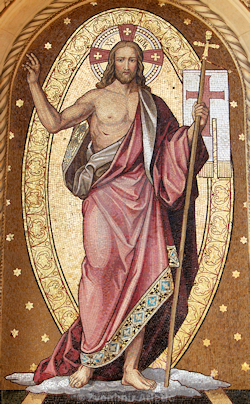
We have just celebrated the feast of the resurrection, and St. Peter’s words today are intended to remind us again of what that unique event means to us and to the Christian faith which we profess. It is the final and convincing proof of the Incarnation. The Christ who had been born as a baby of the Virgin Mary, had lived in Nazareth, had preached the message of salvation, had died on the cross, was none other than what he had said he was, the divine Son of God. He had come to give mankind life and “abundant” life—an eternal life hereafter in the kingdom of his Father.

The first converts to Christianity had grasped this truth, this consoling knowledge, and they rejoiced in it “with unutterable and exalted joy.” We, too, have grasped this truth; we, too, know that through the Incarnation, death and resurrection of Christ, we have been made heirs to an “inheritance which is imperishable, undefiled and unfading.” But do we always let this consoling knowledge, this Christian conviction, govern and regulate our daily lives and actions?

The things of this world are very close to us and hard to ignore. Heaven seems very far away, and may seem to be something we can worry about later. The joys and pleasures of this passing life are very attractive because they surround us so closely now—the thought of the true, unending pleasure and happiness, much as it satisfies and answers to our innate human, intellectual desires and ambitions, can easily be pushed into the background by the hustling and bustling of the present, temporary attractions.

Let us remember that “our faith is more precious than gold”: let us never forget these words of St. Peter.

The Gospel is read for all years (Cycles A, B and C) and is taken from John 20:19-31. Last Sunday’s gospel, also taken from St. John, described the first hint at the resurrection which the Apostles received. Peter and John, convinced that the body had not been taken away, because the winding sheets were left behind, were beginning to believe. But the others were skeptical, the two disciples on the way to Emmaus paid no heed to the women’s story, and Thomas refused to believe the testimony of the other ten, even when this present appearance of our Lord had convinced them.

It may surprise and amaze us that the Apostles were so reluctant to believe that Christ had risen from the dead, to live forever in glory with his Father in heaven. But we must remember that during their two or three years with him they saw nothing in him but a mere man, one with divine powers, but yet a man; certain prophets of the old covenant had some such powers also. Christ had “emptied himself” of his divine nature, and he had foretold his resurrection many times. But that he could be really God, as well as man, was something they could not then grasp, and if he was a mere man death had to be the end.

Their slowness of faith had its value for the future Church and for all of us. If they had been expecting the resurrection, and anxiously looking forward to it, people could say that they imagined it, that they persuaded themselves it had happened. Indeed, there have been men proud of their acuteness of judgment, who have said that the story of the resurrection is a story of mass hallucination, although all the evidence proves the opposite. Their conviction that it could not happen, could not be removed from their minds except by impressive evidence that it had. Hallucination is born in a mind already excepting and hoping for the imagined fact.

We can thank the Apostles and especially Thomas, the last to give in, that our faith in the resurrection and divine glorification of Christ is that much the stronger. Our Christianity which would have ended before the first Easter week had passed, if Christ had not risen in glory, spread rapidly to the then known world and is still spreading because its author was none other than Christ “our Lord and our God.” How prophetic were the words of the Gamaliel at the meeting of the Sanhedrin which tried to prevent the Apostles from preaching the new Christian faith: “if this plan or work is of men, it will overthrown; but if it is of God, you will not be able to overthrow it” (Acts 5:38-39).
—Excerpted from The Sunday Readings , Cycle A, by Fr. Kevin O'Sullivan, O.F.M.


Second Sunday of Easter or Divine Mercy Sunday
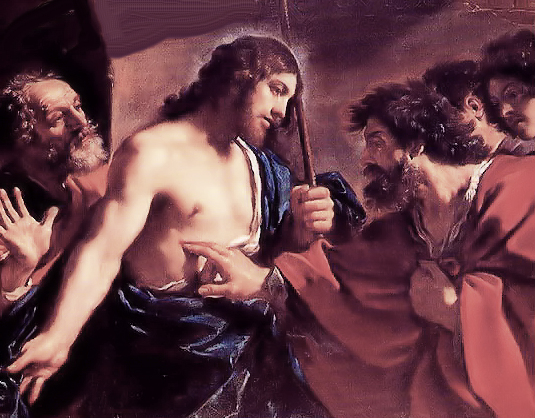
The Holy Gospel that the Liturgy presents to us on this second Sunday of Easter, is one of the most well known, discussed, and appreciated—the meeting of the Risen Lord with St Thomas. The Fathers of the Church have given us numerous insights into this Gospel text. Likewise, it is has proven the inspiration to the numerous artists who have physically represented the events of this Gospel in order to give us a clear idea of what happened, ‘eight days after’ the first apparition of the Risen One, to the disciples congregated in the cenacle.

Jesus’ response to Thomas, after he recognized Him as ‘My Lord and my God’, has a mysterious fascination that must relate not so much to the disciples—those who ‘have seen’—but rather to those, like us, who were added to their number afterwards. ‘You have come to believe because you have seen me. Blessed are those who have not seen and have believed.’ (Jn 20:29)

The attention that these words evoke seems yet more paradoxical if we remember that the Lord had proposed, to the same author of the Gospel, what can be justly referred to as the Christian method, ‘come and see’ (Jn 1:39). How can we possibly reconcile these two phrases by Jesus that form the ideal setting for the whole of the fourth Gospel? Perhaps, in the end, the Lord decided to change His method? What do the words ‘have not seen’ really mean?

The timely recollection of the ‘eight days after,’ which is the Sunday after the Resurrection, permits us to tie our reflection to one of the most significant Eucharistic hymns composed by another Thomas, St Thomas Aquinas. In the Adore Te Devote, which refers to the Eucharist, we read: ‘Sight, touch, taste are all deceived in their judgement of you. But hearing suffices firmly to believe’. Combining these words with today’s Gospel we can justly affirm that the experience ‘to see’ was not denied to us, but it is in contrast with the Apostle Thomas’ physical experience, who was able to put his own finger into the holes in Christ’s hands and side, whilst we can only comprehend it in the faith which is guarded and transmitted by the Church, our Mother and Teacher.

That which we ‘have not seen’ is therefore the glorious Body of the Risen One. However, today we have the ability to ‘listen’ to the Word of God and the Magisterium of the Church and so we can ‘see’ the real Body of Christ which is the Eucharist. We can ‘see’ His Mystical Body which is the Church. We can ‘see’ Him in our lives and in the lives of our many brothers who, after meeting the Lord in a real but mysterious way, are united to Him in His Spirit!

Like Thomas, Christ calls us to fill the holes left by the instruments of the passion in His Body with our own hands so that our lives and the verbal witness that we give proclaim His Resurrection. Our senses could betray us, but we know that we have met the Risen One and we have recognized Him!

The certain hope that Peter, who betrayed the Lord three times for fear of death, proclaims to us with the words, ‘rejoice with an indescribable and glorious joy’ (1 Peter 1:8), become fully comprehensible because blessed are they that ‘have not seen’ the Risen Lord, but seeing the joy of His disciples ‘have believed’ in Him!
—From the Congregation for the Clergy


Jesus to Sr. Faustina
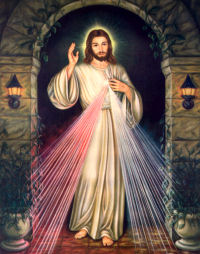
On one occasion, I heard these words: "My daughter, tell the whole world about My inconceivable mercy. I desire that the Feast of Mercy be a refuge and shelter for all souls, and especially for poor sinners. On that day the very depths of My tender mercy are open. I pour out a whole ocean of graces upon those souls who approach the fount of My mercy. The soul that will go to Confession and receive Holy Communion shall obtain complete forgiveness of sins and punishment. On that day all the divine floodgates through which graces flow are opened. Let no soul fear to draw near to Me, even though its sins be as scarlet. My mercy is so great that no mind, be it of man or of angel, will be able to fathom it throughout all eternity. Everything that exists has come forth from the very depths of My most tender mercy. Every soul in its relation to Me will contemplate My love and mercy throughout eternity. The Feast of Mercy emerged from My very depths of tenderness. It is My desire that it be solemnly celebrated on the first Sunday after Easter. Mankind will not have peace until it turns to the Fount of My Mercy.

"[Let] the greatest sinners place their trust in My mercy. They have the right before others to trust in the abyss of My mercy. My daughter, write about My mercy towards tormented souls. Souls that make an appeal to My mercy delight Me. To such souls I grant even more graces than they ask. I cannot punish even the greatest sinner if he makes an appeal to My compassion, but on the contrary, I justify him in My unfathomable and inscrutable mercy. Write: before I come as a just Judge, I first open wide the door of My mercy. He who refuses to pass through the door of My mercy must pass through the door of My justice.

"From all My wounds, like from streams, mercy flows for souls, but the wound in My Heart is the fountain of unfathomable mercy. From this fountain spring all graces for souls. The flames of compassion burn Me. I desire greatly to pour them out upon souls. Speak to the whole world about My mercy."
—Excerpted from Diary of Sr. M. Faustina Kowalska

Wednesday, April 8, 2026

Easter Wednesday Papal General Audience 04.08.2026


Pope at Audience: 'Holiness is not a privilege for the few'

Pope Leo XIV continues his catechesis series on the Dogmatic Constitution 'Lumen gentium,' and reminds us that holiness 'is not a privilege for the few,' but for all the baptized, and 'is manifested in our daily life every time we receive it with joy and respond to Him.'

By Deborah Castellano Lubov

"Holiness is not a privilege for the few, but a gift that commits every baptized person to strive for the perfection of charity, that is, the fullness of love towards God and towards one’s neighbour."

Pope Leo XIV expressed this during his weekly General Audience in the Vatican on Wednesday morning, continuing his catechesis series on the Second Vatican Council and its documents, and citing the Dogmatic Constitution Lumen gentium on the Church.

READ POPE LEO'S FULL CATECHESIS HERE

The Pope this week continued reflecting on the Constitution and recalled how Lumen gentium dedicates an entire chapter, the fifth, to the universal vocation to holiness of all the faithful, insisting that every one of us is called to live in the grace of God, practising the virtues and imitating Christ.

He began by pointing out that the highest level of holiness, as in the early days of the Church, is martyrdom, the “supreme witness of faith and charity,” and for this reason, the Council text teaches that every believer must be ready to confess Christ even unto blood, "as has always been the case and continues to be so today."

This readiness to bear witness, the Pope said, is realized every time Christians leave signs of faith and love in society.


Pope Leo at General Audience (@Vatican Media)

Fostering a holy life

Pope Leo reminded those gathered that all the sacraments, and in a preeminent way the Eucharist, "are nourishment that fosters a holy life, assimilating every person to Christ, the model and measure of holiness."

The Pope said that Jesus sanctifies the Church, adding that, "holiness is, from this point of view, His gift, which is manifested in our daily life every time we receive it with joy and respond to Him with commitment."

The Holy Father recalled that Saint Paul VI, in his 20 Oct. 1965 General Audience, taught that the Church, to be authentic, requires that all the baptized must “be holy, that is, truly worthy, strong and faithful children of hers.”

This, Pope Leo reminded, is realized as an inner transformation, whereby the life of every person is conformed to Christ by virtue of the Holy Spirit.

Called to a serious change of life

He recalled that Lumen gentium describes the holiness of the Catholic Church as one of her constitutive characteristics.

This, he clarified, does not mean that she is so in a full and perfect sense, but that she is called to confirm this divine gift during her pilgrimage towards the eternal destination, walking “amid the persecutions of the world and the consolations of God.”

The sad reality of sin in the Church, that is, in all of us, Pope Leo said, invites each person to carry out a serious change of life, entrusting ourselves to the Lord, who renews us in charity. "It is precisely this infinite grace, which sanctifies the Church, which delivers a mission to us to carry out day after day: that of our conversion."


Pope Leo XIV delivers catechesis at General Audience (@Vatican Media)

"Therefore, holiness," he added, "does not only have a practical nature, as if it were reducible to an ethical commitment, however great, but concerns the very essence of Christian life, both personal and communal."

Not shackles, but liberating gifts

In this regard, the Pope remembered in a special way those men and women who consecrate their lives to God through the evangelical counsels: poverty, chastity and obedience, which express their complete trust in God’s providence, modelled on Christ’s gift of himself to the Father with a pure heart.  

"These three virtues," he insisted, "are not rules that shackle freedom, but liberating gifts of the Holy Spirit, through which some of the faithful are wholly consecrated to God."

Poverty, he said, expresses complete trust in Providence, freeing one from calculation and self-interest; obedience takes as its model the self-giving that Christ offered to the Father, freeing one from suspicion and domination; chastity is the gift of a heart that is whole and pure in love, at the service of God and the Church.

"By conforming to this style of life," the Holy Father marveled, "consecrated persons bear witness to the universal vocation of holiness of the entire Church, in the form of radical discipleship."

And thus, he said, "the evangelical counsels manifest full participation in the life of Christ, unto the Cross: it is precisely by the sacrifice of the Crucified One that we are all redeemed and sanctified!"

No human experience God does not redeem

By contemplating this event, Pope Leo insisted, "we know that there is no human experience that God does not redeem: even suffering, lived in union with the passion of the Lord, becomes a path of holiness."

"Thus," the Pope suggested, "the grace that converts and transforms life strengthens us in every trial, pointing us not toward a distant ideal, but towards the encounter with God, who became man out of love."

Pope Leo XIV concluded by imploring the Blessed Mother, the all-holy Mother of the Incarnate Word, to always sustain and protect our journey.

Tuesday, April 7, 2026

A week of appealing for peace, rejection of war; a consistent faith-filled message from Pope Leo XIV


Pope Leo XIV in St. Peter's Square on Easter SundayPope Leo XIV in St. Peter's Square on Easter Sunday  (@Vatican Media)

The “non-violent” power of Easter in Pope Leo’s appeals for peace

Throughout Holy Week and Easter, Pope Leo XIV made numerous appeals for peace, offering the world an impassioned plea not to be overcome by indifference but to firmly believe in “God who rejects war.”

By Isabella H. de Carvalho and Edoardo Giribaldi

As violence and war plague countries across the world, and news headlines report increasing tensions and rising death tolls every day, Pope Leo XIV's incessant appeals for peace rang out during the liturgies and celebrations that marked Holy Week and the Easter Triduum, as he emphasized Christ’s Resurrection and triumph over death.

“Brothers and sisters, this is our God: Jesus, King of peace. A God who rejects war, whom no one can use to justify war,” he said in his homily on Palm Sunday, which marked the beginning of the most important week of the year for Catholics.    

From highlighting how God does not listen to the prayer of those who wage war and whose “hands are full of blood" on Palm Sunday; to carrying the weight of people’s suffering by carrying the cross during the Via Crucis at the Colosseum on Good Friday; to calling those who have weapons to lay them down during the Urbi et Orbi message; Pope Leo’s words were invariably addressed to those who have the power to put an end to conflicts, and his thoughts were with those who are suffering under the effects and threat of violence. 

Those who take the sword will perish by sword

Holy Week opened with Pope Leo XIV presiding over the Palm Sunday Mass in St. Peter’s Square on March 29. Before him were 40,000 faithful and 120,000 olive branches, raised to symbolize that gentle peace of which Jesus, the King of peace, the Pope recalled, "offers himself to embrace humanity, even as others raise swords and clubs.

It is to them that the Pope addressed the same words spoken by Christ when one of his disciples, according to the Gospel, drew a weapon to defend him: “Put your sword back into its place, for all who take the sword will perish by the sword.”

Jesus “did not arm himself, or defend himself, or fight any war,” the Pope said. "Rather than saving Himself, He allowed Himself to be nailed to the cross, embracing every cross borne in every time and place throughout human history.”


the faithful with olive branches on Palm Sunday in St. Peter's Square (@Vatican Media)

Good cannot come from abuse of power

During the Chrism Mass on Holy Thursday, celebrated in St. Peter’s Basilica, Pope Leo instead invoked a peace that touches every dimension of human existence, especially “in this dark hour of history” in a world “torn apart by the powers that ravage it.”

“Neither in the pastoral sphere nor in the social and political spheres can good come from abuse of power,” he said.

“The imperialist occupation of the world is thus disrupted from within; the violence that until now has been the law is unmasked,” he continued, adding that "the poor, imprisoned, rejected Messiah descends into the darkness of death, yet in so doing he brings a new creation to light.”

Christ gives us an example of self-giving, service and love

Then, during the Mass of the Lord’s Supper in the Basilica of St. John Lateran in Rome, Pope Leo XIV washed the feet of young priests he himself had ordained almost a year earlier.

He explained how this gesture recalls God’s purificatory power, as he washes not only the blood of conflicts but also the distorted images they produce, such as “idolatry and blasphemy.” This act also purifies “our image of humanity,” the Pope insisted.

“For we tend to consider ourselves powerful when we dominate, victorious when we destroy our equals, and great when we are feared,” he emphasized. But, he continued, "in contrast, as true God and true man, Christ offers us the example of self-giving, service, and love.”

Pope Leo washes the feet of several young priests (@Vatican Media)

Following in Christ’s footsteps

The Pope’s appeals for peace throughout Holy Week pointed to the ongoing dichotomy between evil and love. Similarly, the meditations written by Father Francesco Patton, former Custos of the Holy Land, for the Way of the Cross at the Colosseum, presided over by the Pope, echoed this same tension.

Father Patton retraced the path walked by Jesus among those who shared his faith and those “who deride or insult him,” while emphasizing that “such is the reality of our daily life.”

The Pope also recalled this same path traced by following in Jesus’ “footsteps,” while reciting the prayer Omnipotens composed by St. Francis of Assisi, together with about 30,000 faithful at the Colosseum on Good Friday night.

Pope Leo during the Way of the Cross at the Colosseum (@Vatican Media)

God does not want our death

Darkness—as a prelude to Easter morning—accompanied instead the vigil in St. Peter’s Basilica, which was filled with 6,000 people. God “does not desire our death,” Pope Leo underlined in the face of narratives of conflict that reduce victims to mere numbers.

“Man can kill the body, but the life of the God of love is eternal life, which transcends death and which no tomb can imprison,” he said.

Leo XIV urged the creation of a “new world of peace and unity,” starting from humanity’s failures, as he referred to the sea through which God freed the Israelites from slavery in Egypt. An element that the Pope described as a “gateway to a new life of freedom,” but also “a place of death.”

Meanwhile, news articles reported on yet another tragedy in the Mediterranean as a boat departing from Libya was shipwrecked, and at least 70 people were killed or went missing. The survivors were taken to Lampedusa—an Italian island in the Mediterranean at the crossroads of migration routes—which the Pope will visit on July 4.

The Easter Vigil in St. Peter's Basilica (@Vatican Media)

“The Lord is alive and remains with us”

On the morning of Easter Sunday, Pope Leo XIV then celebrated Mass in St. Peter’s Square under a clear sky and in the presence of 60,000 faithful. He emphasized how “death is always lurking”:

“We see it present in injustices, in partisan selfishness, in the oppression of the poor, in the lack of attention given to the most vulnerable. We see it in violence, in the wounds of the world, in the cry of pain that rises from every corner because of the abuses that crush the weakest among us, because of the idolatry of profit that plunders the earth’s resources, because of the violence of war that kills and destroys.”

However, he reiterated how one can—and must—accept the Easter invitation to “lift our gaze (...) so that we may discover that Jesus’ tomb is empty, and therefore in every death we experience there is also room for new life to arise,” beyond tombs and suffering.

“The Lord is alive and remains with us,” he said. “Through the cracks of resurrection that open up in the darkness, he entrusts our hearts to the hope that sustains us: the power of death is not the final destiny of our lives.”

St. Peter's Square during the Easter Sunday Mass (@Vatican Media)

“The power with which Christ rose is entirely non-violent” 

Lastly, in Pope Leo’s traditional Urbi et Orbi (‘To the City and the World’) message, he issued a final exhortation to not remain indifferent to what is occurring in the world:

“We are growing accustomed to violence, resigning ourselves to it, and becoming indifferent. Indifferent to the deaths of thousands of people. Indifferent to the repercussions of hatred and division that conflicts sow. Indifferent to the economic and social consequences they produce, which we all feel.”

Instead, he pointed to how “the power with which Christ rose is entirely nonviolent,” and the battles of the world should be overcome with this example of Easter, through hands that embrace and that do not take up arms.

An appeal that also reverberated in the appeal Leo XIV addressed to Donald Trump and world leaders last Tuesday in Castel Gandolfo:

“Come back to the table, to dialogue. Let's look for solutions to problems; let's look for ways to reduce the amount of violence that we're promoting so that peace—especially at Easter—might reign in our hearts."

Sunday, April 5, 2026

To the city & the world; Pope Leo delivers his Easter Urbi et Orbi


Urbi et Orbi: Pope urges world leaders to lay down weapons

On Easter Sunday, Pope Leo appeals to world leaders to choose “not to dominate others, but to encounter them”. He also announces that he will lead a prayer vigil for peace next Saturday, April 11th, in Saint Peter’s Basilica.

By Joseph Tulloch

Pope Leo XIV has called on world leaders to lay down their weapons and choose “encounter” over domination.

“Let those who have weapons lay them down!”, the Pope urged on Easter Sunday in his traditional Urbi et Orbi (‘To the City and the World’) message.

Speaking to the tens of thousands of pilgrims gathered in St Peter's Square, Pope Leo urged "those who have the power to unleash wars" to choose peace. 

This should not be a peace “imposed by force”, he stressed, but one achieved through dialogue – “not with the desire to dominate others, but to encounter them”.

READ THE FULL TEXT OF THE URBI ET ORBI MESSAGE


Pope Leo greets the crowds gathered for the Urbi et Orbi address (@Vatican Media)

The 'globalization of indifference'

Pope Leo warned that the world is “growing accustomed to violence”.

We are “becoming indifferent”, he said, not only to the deaths of thousands of people, but to the “hatred and division” war causes, as well as its “economic and social consequences”.

Borrowing a phrase from the late Pope Francis, Pope Leo warned of the “ever-increasing ‘globalization of indifference’”.

“We cannot continue to be indifferent!”, he urged. “We cannot resign ourselves to evil!”.

For this reason, he said, he would be leading a prayer vigil for peace next Saturday, April 11th, in St Peter’s Basilica.


Pope Leo blesses the crowds (@Vatican Media)


Nonviolence and 'true strength'

At Easter, the Pope said, Jesus won victory over death, and thereby “defeated once and for all the ancient adversary, the prince of this world”.

However, Pope Leo stressed, the power with which Christ won this victory is “entirely nonviolent”, based on a love which “creates and generates”, “forgives and redeems”.

This spirit of love and forgiveness, he said, is the “true strength” that establishes peace, and fosters relationships amongst individuals and societies.


Flowers in St Peter's Square during the Urbi et Orbi blessing (@Vatican Media)


Inner peace

Bringing his Urbi et Orbi message to a close, the Pope stressed that Easter peace is not merely “the silence of weapons” but also an inner peace which “touches and transforms the heart of each one of us”.

“Let us allow ourselves to be transformed by the peace of Christ”, Pope Leo urged, entrusting to the Lord "all hearts that suffer and await the true peace that only he can give.”

Highlights of Easter Sunday Mass, "Urbi et Orbi" Message and Blessing

Thank you for reading our article. You can keep up-to-date by subscribing to our daily newsletter. Just click here

The beauty, hope and joy of the Easter Resurrection at Holy Mass with Pope Leo XIV


Pope Leo: Easter opens us up to hope that never fails

At the Easter Sunday Mass, Pope Leo reminds us that the Easter proclamation that Christ is risen from the dead "opens us up to a hope that never fails, to a light that never fades, to a fullness of joy that nothing can take away: death has been conquered forever; death no longer has power over us!"

Vatican News

Presiding over the Easter Sunday Mass in Saint Peter's Square with over fifty thousand faithful gathered, Pope Leo XIV explained how all creation today is "resplendent with new light" and we rejoice as "a song of praise rises from the earth ... Christ is risen from the dead, and with him, we too rise to new life!"

Easter brings fullness of joy

The Easter proclamation "embraces the mystery of our lives and the destiny of history," the Pope explained. And even into the depths of death when we can feel overwhelmed, Easter opens us up "to a hope that never fails, to a light that never fades, to a fullness of joy that nothing can take away" as "death has been conquered forever" and no longer has power over us.

READ THE FULL TEXT OF THE POPE'S HOMILY HERE

40th anniversary of Dutch flowers

The Easter celebration took place in a Saint Peter's Square adorned with over 65 thousand tulips, daffodils, hyacinths; 7,800 flowers of various types, along with over 1,200 plumosa and long willow catkin branches.


Thousands of flowers from the Netherlands adorning Saint Peter's Squares (@Vatican Media)

This year marks the 40th year that the Netherlands have offered this floral gift to the Pope at Easter. The initiative has been promoted by Dutch florists and volunteers in collaboration with the Dutch Bishops' Conference and the "Bloemenpracht Rome" Foundation.


Easter Sunday, Saint Peter's Square (@VATICAN MEDIA)


Challenged to embrace hope

Continuing his homily, the Pope acknowledged that the Easter message of hope and light is not always easy to accept, since the power of death constantly threatens us both interiorly and externally.

From within, the weight of our sins can prevent us "from 'spreading our wings' and taking flight" or suffering can cause us to lose hope and "feel as if we have ended up in a tunnel with no end in sight."

Externally, death is daily in front of our eyes - "present in injustices, in partisan selfishness, in the oppression of the poor, in the lack of attention given to the most vulnerable."  The violence in our world and the wounds it causes are for all to see, he went on to say, "in the cry of pain that rises from every corner because of the abuses that crush the weakest among us, because of the idolatry of profit that plunders the earth’s resources, because of the violence of war that kills and destroys."

Pope Leo on Easter Sunday, Saint Peter's Square  (@VATICAN MEDIA)

Lift our gaze, open our hearts

Easter calls on us to "lift our gaze and open our hearts," the Pope explained, as "the Lord is alive and remains with us."

“Through the cracks of resurrection that open up in the darkness, he entrusts our hearts to the hope that sustains us: the power of death is not the final destiny of our lives. We are all directed, once and for all, on the path to fulfilment, because in Christ we also have risen.”

Quoting words from Pope Francis' first Apostolic Exhortation, Evangelii Gaudium, Pope Leo echoed its affirmation that the resurrection of Christ “is not an event of the past; it contains a vital power which has permeated this world. Where all seems to be dead, signs of the resurrection suddenly spring up. It is an irresistible force. Often it seems that God does not exist: all around us we see persistent injustice, evil, indifference and cruelty.  But it is also true that in the midst of darkness something new always springs to life and sooner or later produces fruit” (n. 276).


Easter Sunday, Saint Peter's Square (@Vatican Media)


New life dawns for humanity

The Risen Christ gives us certain hope, the Pope concluded, and the Resurrection "proclaims that a new life, stronger than death, is now dawning for humanity." 

“Easter is the new creation brought about by the Risen Lord; it is a new beginning; it is life finally made eternal by God’s victory over the ancient enemy. We need this song of hope today. It is ourselves, risen with Christ, who must bring him into the streets of the world. Let us then run like Mary Madgalene, announcing him to everyone, living out the joy of the resurrection, so that wherever the specter of death still lingers, the light of life may shine.”

Watch the full video of the Easter Sunday Mass in Saint Peter's Square

Thank you for reading our article. You can keep up-to-date by subscribing to our daily newsletter. Just click here