Showing posts with label immigration. Show all posts

Saturday, September 26, 2026

Pope Leo XIV visits a social integration center in Paris named for St. Bakhita


Pope at Maison Bakhita: ‘No one is so poor as to have nothing to give’

Pope Leo XIV visits the ‘Maison Bakhita’ social integration center in Paris and encourages everyone to enjoy life in abundance by sharing our God-given spiritual and material gifts.

By Devin Watkins

On Saturday, the second day of his Apostolic Journey to France, Pope Leo XIV paid a visit to the Maison Bakhita center in Paris, which offers support and social integration services to migrants and refugees.

Speaking to people assisted by the center, the Pope expressed his gratitude to the Archdiocese of Paris, which runs the facility, and the many volunteers and staff who offer “welcome, a listening ear, formation, and friendship.”

He pointed to the center’s patron saint, St. Josephine Bakhita, a former slave who became a religious sister in Italy, as an inspiration to recognize “the fundamental role of women in building a civilization of love, which is an alternative to a culture that tears communities apart and leaves cities sick with loneliness.”

“When we look closely, the history of the Church and of humanity is not written by those who give the impression of winning by imposing themselves and ‘dominating the room,’ but by those who “make room,” initiate processes of peace, build trust, and encourage life,” he said.

Read the full text of the Pope's address

Pope Leo said St. Bakhita shows us how to look past our modern economy that can enslave to see those who are invisible and honor the “immeasurable dignity of every brother and sister.”

The poor, he said, are not a sociological category for Christians but “the very flesh of Christ,” who invites us to practice charity and to love them.


Pope Leo visits the Maison Bakhita integration center (@Vatican Media)

The Pope encouraged everyone to exchange both spiritual and material gifts which we have received from God.

“No one is so poor as to have nothing to give; no one is so rich as to have nothing to receive,” he said. “There is life in abundance wherever each person’s limitations become an opening to the mysterious presence of others, in whom the Other par excellence—the God of life—draws near.”

By sharing with one another, we move past the hardship that sin has introduced into history and learn that redemption is an ongoing process open to all.

Every member of the Christian body has need of every other member, said the Pope, citing St. Paul’s Letter to the Corinthians (1 Cor 12:21-22).

As he spoke to Christians residing in one of the richest and most culturally diverse cities of the ancient Roman world, St. Paul noted that God has arranged things so that the greater honor belongs to the “inferior member, that there may be no dissention within the body, but the members may have the same care for one another.”

In conclusion, Pope Leo XIV thanked the Maison Bakhita and all Christians who carry out similar works of charity throughout France.

“Continue to bear witness,” he said, “to that care for one another which, through fraternal welcome, programs of formation, and dialogue with the city, elevates the spirit and makes the world more humane.”

Thursday, September 10, 2026

USCC appeals to Supreme Court to uphold human dignity of non-citizens


U.S. bishops urge Supreme Court to rule against indefinite detention of noncitizens

The bishops argue that strong due process protections are consistent with American principles and good governance in accordance with Catholic teaching.


Detainees stand by a window inside the federal immigration center at Delaney Hall, where ICE is housing detained immigrants, on May 26, 2026, in Newark, New Jersey. | Credit: Adam Gray/Getty Images


Tyler Arnold

September 9, 2026

The U.S. Conference of Catholic Bishops (USCCB) is asking the U.S. Supreme Court to rule in favor of stronger due process rights for noncitizens who are facing deportation proceedings and against indefinite detention without judicial review.

In a legal filing to the Supreme Court, the USCCB and the Catholic Legal Immigration Network (CLINIC) argued that stronger due process protections would help uphold the human dignity of noncitizens and safeguard the common good, based on Catholic teaching.

The bishops sent the petition in relation to the ongoing case Genalo v. Keisy G.M., in which a U.S. permanent resident from the Dominican Republic argues that Immigration and Customs Enforcement (ICE) violated his Fifth Amendment right to due process.

Keisy G.M., whose full name is not public, was detained for 21 months. Although he did appear before a judge, he did not receive a bond hearing to determine whether he could be released on bond.

In spite of his permanent residency status, he faced deportation proceedings after he was convicted of felonious assault. He was later pardoned by the State of New York, ending the threat of deportation.

Dignity of the human person

In their legal brief, the bishops argued that due process protections are consistent with the law, American tradition, and Catholic teaching, saying “executive detention has never been wholly insulated from judicial scrutiny,” adding that “this accords with Catholic social teaching, which recognizes both the legitimate authority of the state and the dignity of the individual.”

“Indefinite confinement without individualized review by a neutral tribunal is anathema to our constitutional system and the ordered liberty it enshrines,” the bishops said. “The consequences of abandoning that system are severe and concrete.”

“Prolonged detention can cost people their jobs, homes, health, and the ability to participate meaningfully in their own legal proceedings,” they said. “It can separate parents from children, destabilize entire families, and inflict harms that cannot be undone by eventual release. Although such detention may at times be necessary to further important state interests, such as ensuring public safety, it must be subject to justification before a neutral tribunal.”

In the court filing, they cited Pope John XXIII’s 1963 encyclical Pacem in Terris, which teaches that “the common good is best safeguarded when personal rights and duties are guaranteed.”

Quoting from the document, they said authorities must “ensure that these rights are recognized, respected, co-ordinated, defended and promoted, and that each individual is enabled to perform his duties more easily” because “safeguard[ing] the inviolable rights of the human person” and “facilitat[ing] the performance of his duties” is “the principal duty of every public authority.”

The bishops also quoted Archbishop Paul Gallagher, the Holy See’s secretary for relations with states, from his statement during the general debate at the opening of the 80th session of the United Nations General Assembly’s high‑level week.

In his statement, Gallagher said the “principles of equality before the law, accountability, the equitable application of the law, the separation of [four] powers, legal certainty, due process, the prevention of arbitrariness, as well as transparency in both procedural and legal matters, must always be observed.”

“Those principles,” the bishops continued, “are effectuated by procedures that require the government to justify significant deprivations of liberty based on individualized circumstances rather than categorical assumptions.”

Oral arguments for the case are scheduled for Oct. 13. Keisy G.M. is represented by the American Civil Liberties Union (ACLU) and other civil liberties organizations.

Thursday, August 13, 2026

If you like stats and polls, this article is for you. Who holds Pope Leo XIV in favorable vs unfavorable status?


One Year In, Pope Leo XIV Reveals Political Divides Among U.S. Catholics


Madelyn Snodgrass


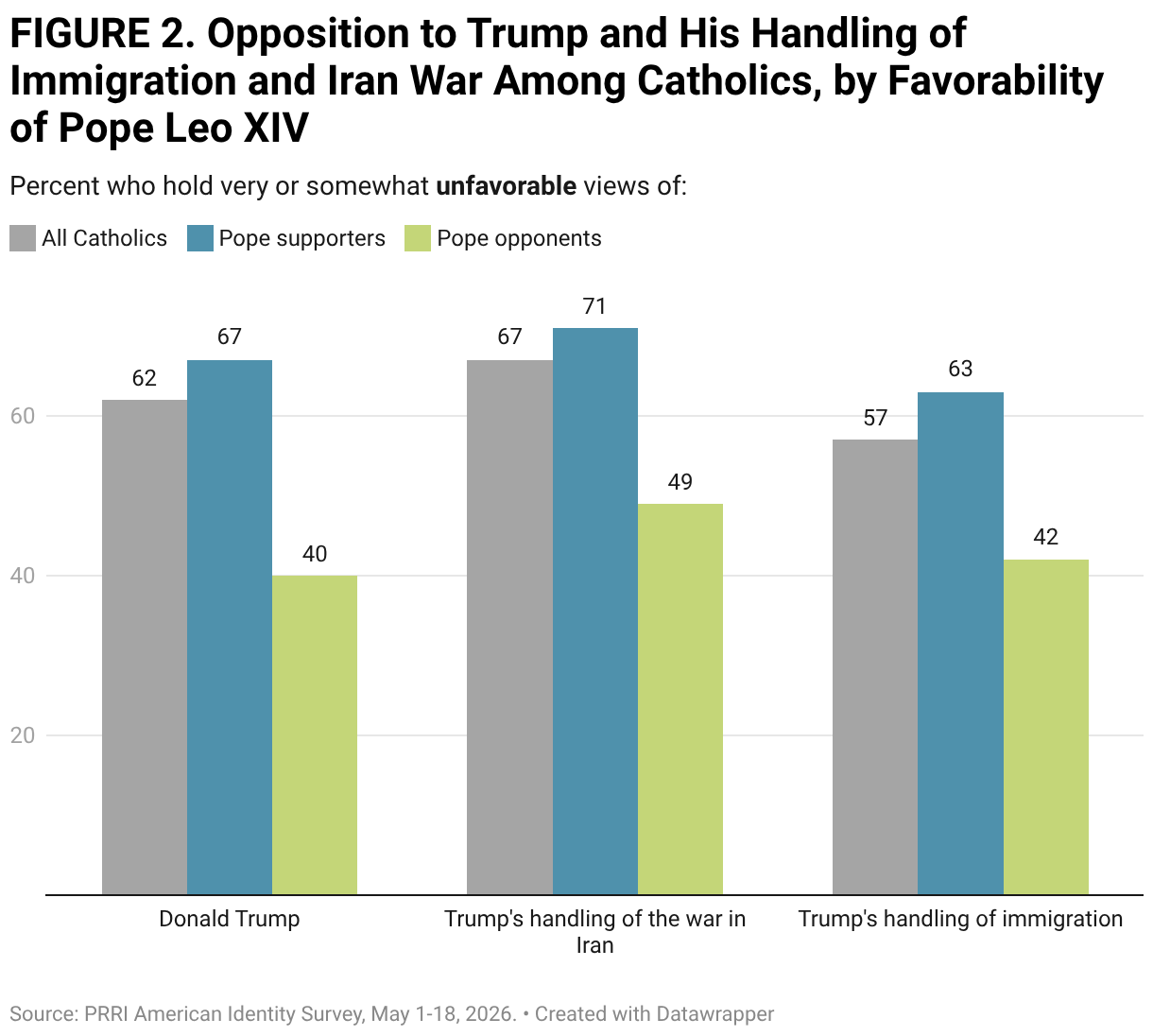
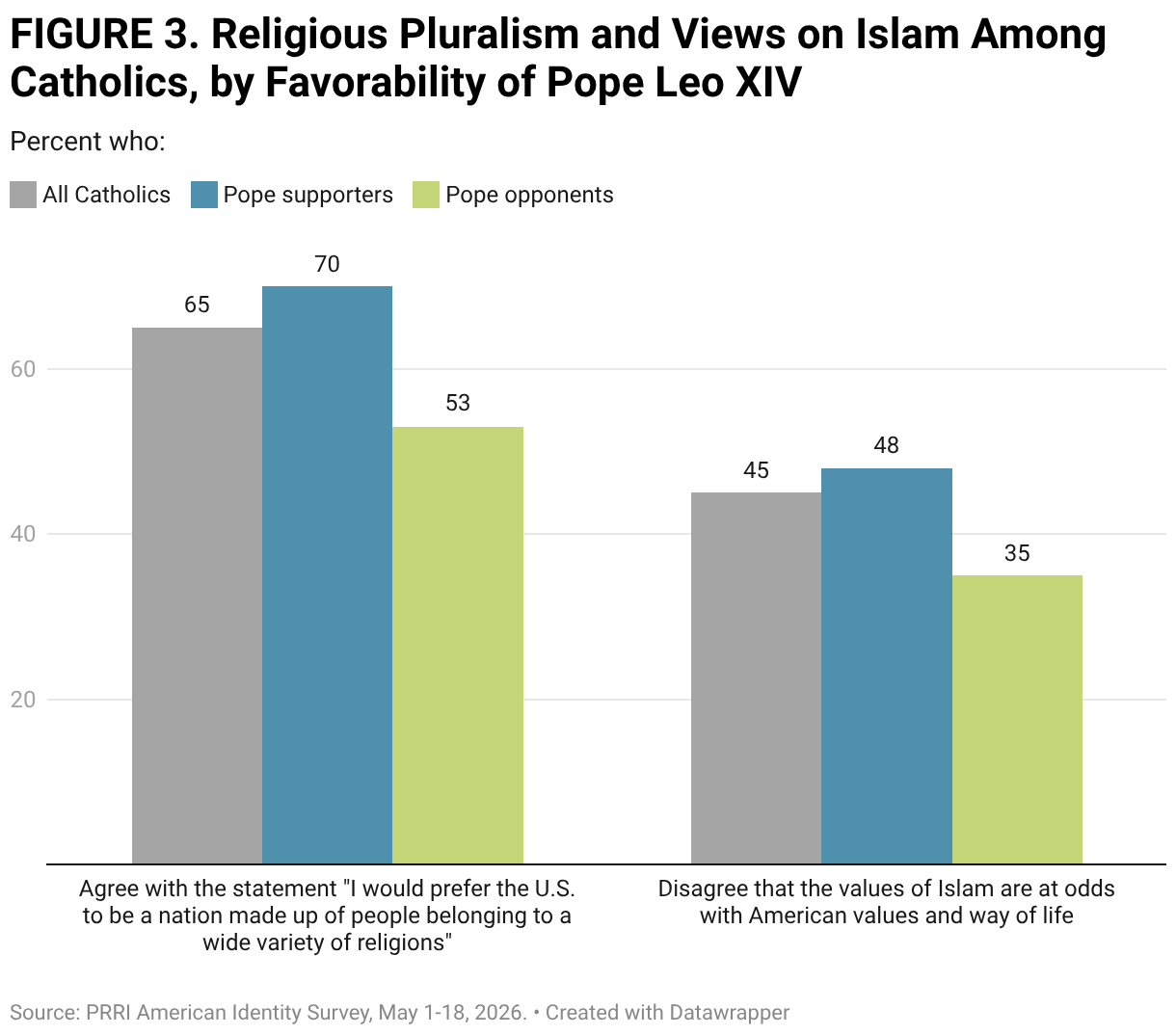
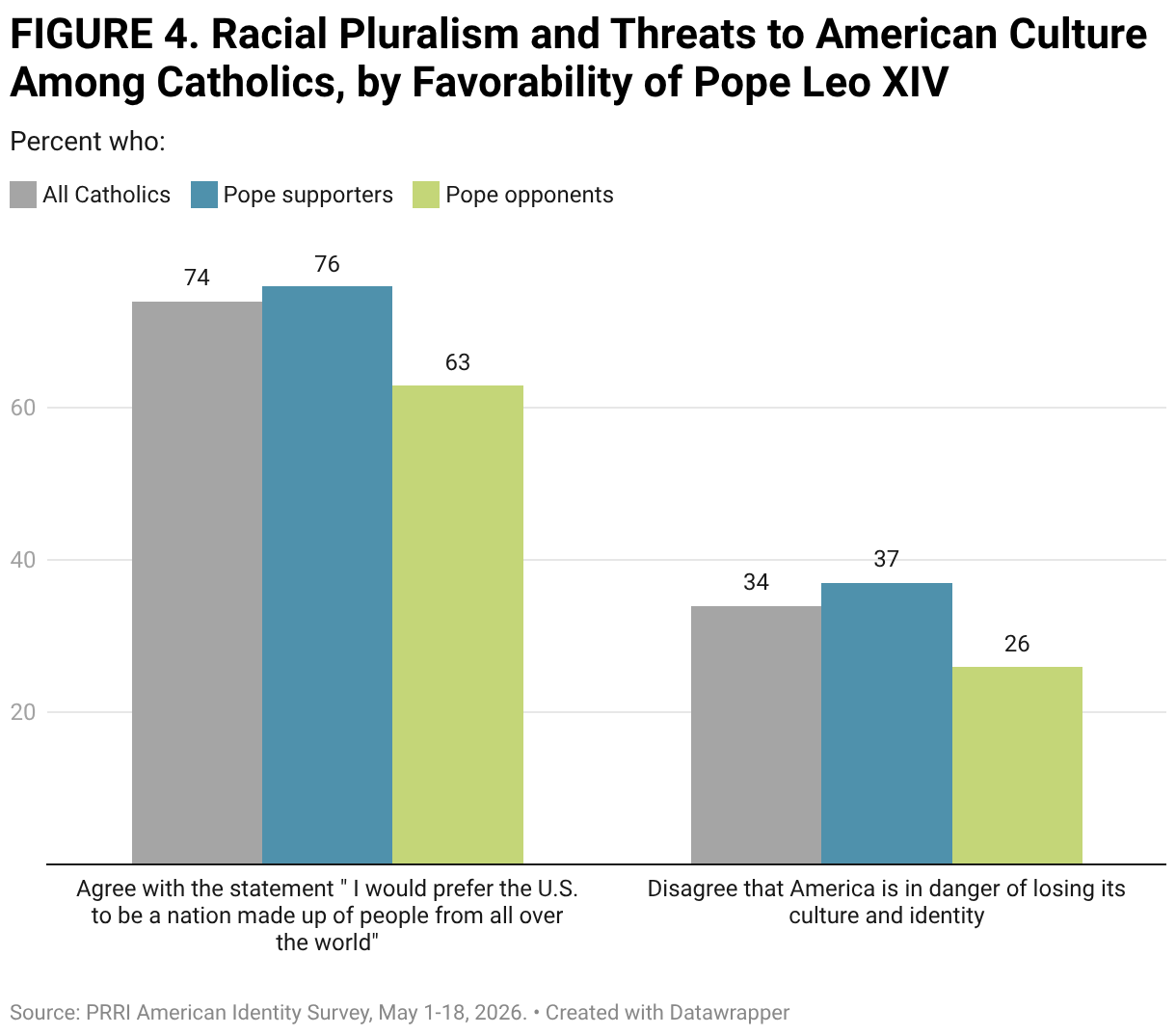
In his first year as the leader of the Roman Catholic Church, Pope Leo XIV has taken clear stances on many issues, including the U.S. immigration system and the war in Iran. This Spotlight Analysis examines American Catholics’ views of Pope Leo XIV, the political and demographic differences between those who support and oppose the American-born Pope, and how these two groups differ in their views of President Trump and his political agenda, religious and racial pluralism, and the state of American democracy.

Seven in Ten U.S. Catholics Hold Favorable Views of Pope Leo XIV

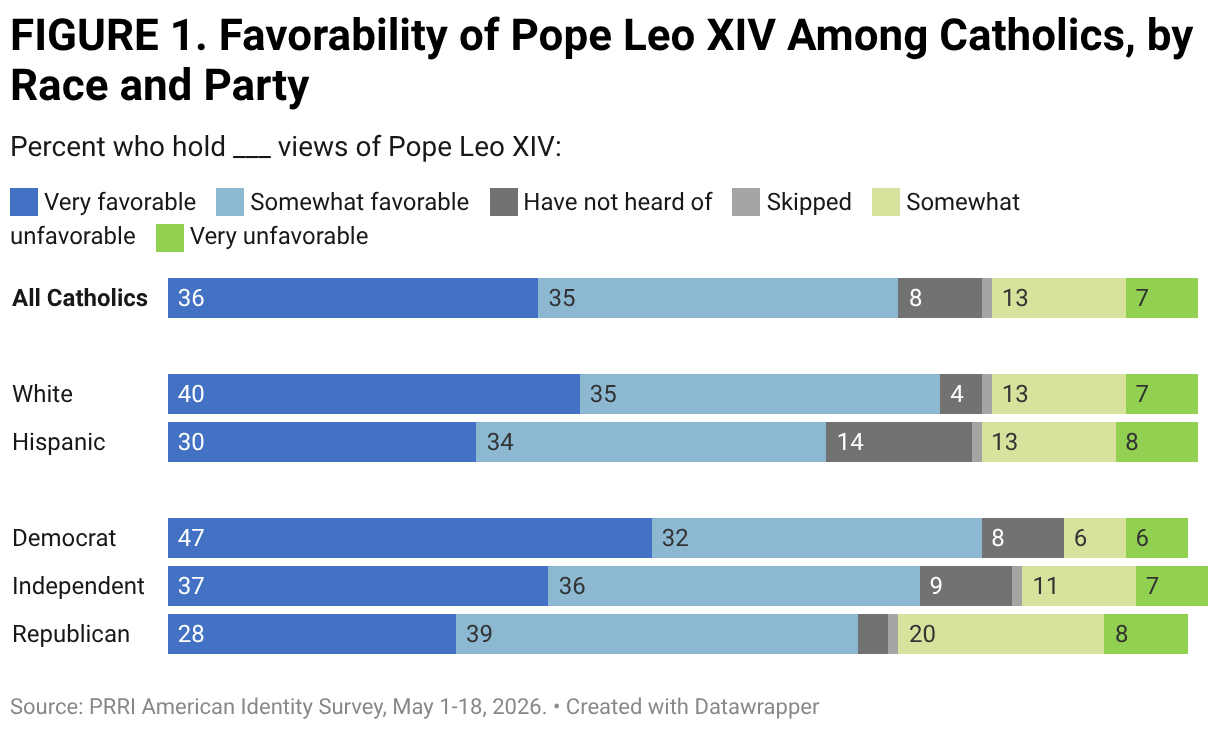
A slim majority of Americans (56%) hold very or somewhat favorable views of Pope Leo XIV, while one-quarter of Americans (27%) view him unfavorably and more than one in ten (15%) have not heard of him. Among Catholics, the share of those who hold favorable views of the Pope is much higher, at 71%. White Catholics are significantly more likely to view Leo favorably than Hispanic Catholics (75% vs. 64%). By contrast, Hispanic Catholics are three times as likely as white Catholics to say they have not heard of him (14% vs. 4%). Catholic Democrats are significantly more likely than Catholic Republicans to hold favorable views of the Pope (79% vs. 67%); around three-quarters of Catholic independents (73%) also view him favorably.

FIGURE 1. Favorability of Pope Leo XIV Among Catholics, by Race, Party, and Age

Percent who hold ___ views of Pope Leo XIV: