Showing posts with label Mary. Show all posts

Wednesday, October 7, 2026

One more appeal from Pope Leo XIV to pray the Rosary especially for peace


Pope: Mary is ‘safe refuge’ amidst life’s difficulties

Pope: Mary is ‘safe refuge’ amidst life’s difficulties (VATICAN MEDIA)

Pope: Mary is ‘safe refuge’ amidst life’s difficulties

At the General Audience, Pope Leo XIV renews his invitation to pray the Rosary, echoing the appeal he made in Lourdes to ask Mary for peace in the world, especially during the month of October.

By Edoardo Giribaldi

Traditionally invoked as a “safe refuge amid life’s difficulties,” Mary is a source of consolation for a world wounded by war, Pope Leo said on Wednesday.

Speaking at the General Audience, the Pope once again urged the faithful to turn to her with the prayer of the Rosary.

He did so on Wednesday, as the Church celebrated the liturgical memorial of Our Lady of the Rosary.

From the steps of St Peter’s Square, the Pope’s voice echoed the appeal he made at last Sunday’s Angelus, a call which he had already made a week earlier, on 27 September, in Lourdes.

In his greeting to Portuguese-speaking faithful, the Pope referred to another Marian liturgical memorial, that of Our Lady of Aparecida, patroness of Brazil, which is celebrated on 12 October. “To her maternal intercession I entrust you and your families. May Our Lady always watch over you,” Pope Leo said.

Addressing Chinese-speaking pilgrims, he pointed to Mary as a “refuge and strength in moments of difficulty and suffering.”


A month of prayer

In France, the Pope had invited the faithful to pray the rosary throughout October, “with the particular intention that wars may end and peace be established among peoples in conflict.”

He called for this prayer to be translated into action, accompanied by “concrete acts of penance and mercy” and a commitment to “always promote dialogue and reconciliation.”

“Grant us peace!”

On the first day of this month, dozens of Hail Mary's rose from the Vatican Gardens, carrying with them the Pope’s plea, voiced in unison with more than 700 children: “Grant us peace!”

Voices from every corner of the world have joined them in recent days, praying for weapons to fall silent.

The event was organized by the “A Million Children Pray the Rosary” initiative, coordinated by the pontifical foundation Aid to the Church in Need and inspired by the words of Padre Pio: “If a million children pray the Rosary together, the world will change.”

Tuesday, October 6, 2026

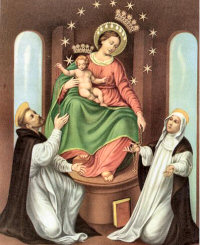
October 7th is the Memorial of Our Lady of the Rosary


   Ordinary Time: October 7th


   Memorial of Our Lady of the Rosary


facebook sharing button Share
twitter sharing button Post
linkedin sharing button Share
pinterest sharing button Pin
email sharing button Email
sharethis sharing button

MASS READINGS

October 07, 2026 (Readings on USCCB website)


COLLECT PRAYER

Memorial of Our Lady of the Rosary: Pour forth, we beseech you, O Lord, your grace into our hearts, that we, to whom the Incarnation of Christ you Son was made known by the message of an Angel, may, through the intercession of the Blessed Virgin Mary, by his Passion and Cross be brought to the glory of his Resurrection. Who lives and reigns with you in the unity of the Holy Spirit, God, for ever and ever.


The Memorial of Our Lady of the Rosary was instituted to honor Mary for the Christian victory over the Turks at Lepanto on October 7, 1571. Pope St. Pius V and all Christians had prayed the Rosary for victory. The Rosary, or the Psalter of the Blessed Virgin Mary, is one of the best prayers to Mary, the Mother of God.

Pope Benedict XVI invited all families to pray the Rosary for the intentions of the Pope, the mission of the Church and peace. "It is as if every year Our Lady invited us to rediscover the beauty of this prayer, so simple and profound." The Rosary, a "contemplative and Christocentric prayer, inseparable from the meditation of Sacred Scripture," is "the prayer of the Christian who advances in the pilgrimage of faith, in the following of Jesus, preceded by Mary," said the Pontiff.

Our Lady of the Rosary
This feast was instituted by Pope St. Pius V in thanksgiving for the great naval victory over the Turks at the battle of Lepanto on this day in the year 1570, a favor due to the recitation of the Rosary. This victory saved Europe from being overrun by the forces of Islam.

Lepanto, perhaps the most complete victory ever gained over the Ottoman Empire, on October 7, 1571, is commemorated by the invocation "Help of Christians," inserted in the Litany of Loretto. At Belgrade, the Turks were defeated on the Feast of Our Lady ad Nives in 1716. A second victory gained that year on the Octave of the Assumption determined Pope Clement XI to command the Feast of the Rosary to be celebrated by the universal Church. Leo XIII added the invocation "Queen of the most Holy Rosary, pray for us," to the Litany of Loretto. The Feast is in reality a great festival of thanksgiving for the signal and countless benefits bestowed on Christendom through the Rosary of our blessed Queen.

In modern times successive popes have urged the faithful to pray the Rosary. It is a form of contemplative prayer, mental and vocal prayer, which brings down God’s blessing on the Church. It is a biblically inspired prayer that is centered on meditation on the salvific mysteries of Christ in union with Mary, who was so closely associated with her Son in his redeeming activity.

Highlights and Things to Do:


  • Saturday, September 26, 2026

    Pope Leo XIV makes it to Lourdes Saturday evening entrusting France to Mary


    Pope Leo XIV during his Saturday evening visit to pray at the Grotto of the Apparitions of Massabielle LourdesPope Leo XIV during his Saturday evening visit to pray at the Grotto of the Apparitions of Massabielle Lourdes

    In Lourdes Pope Leo entrusts France to the Virgin Mary

    Just after arriving in the Marian pilgrimage city of Lourdes, Pope Leo XIV went to the heart of the shrine to pray to the Virgin Mary at the Grotto of Massabielle, surrounded by thousands of faithful. Kneeling in prayer, the Pope asked for “the gift of fraternal harmony” for the host country and also entrusted to Mary the personal prayers of those who are sick and suffering.

    By Olivier Bonnel in Lourdes

    When the Air France plane carrying the Pope from Paris landed at precisely 7 p.m. at Tarbes-Lourdes Airport, the bells of the Pyrenean city began ringing loudly. Leo XIV was welcomed as he stepped off the plane by Bishop Jean-Marc Micas before taking his place in a Renault bearing the license plate SCV1. As he entered the city of Lourdes, the crowd grew denser behind the security barriers. Shortly before reaching the shrine, the Pope got out to greet the city's mayor, Thierry Lavit. From a bridge over the Gave de Pau, temporarily renamed the “Leo XIV Bridge” for the occasion, the Holy Father unveiled a statue and signed the visitors' book while a choir sang Pyrenean songs.

    The Pope then completed his journey to the shrine in the popemobile, where the crowd's cheers turned into jubilation, accompanied by “Ave Maria” sung by the thousands of faithful present. The singing then gave way to an intense silence as Leo XIV knelt at the foot of the grotto, where Bernadette Soubirous first saw a “lady in white” in 1858.

    “The gift of fraternal harmony”

    Still accompanied by the Bishop of Lourdes, the Holy Father then touched the wall of the grotto and drank a glass of water from the spring, thus responding to the Virgin's instruction to Bernadette: “Go and drink at the spring and wash yourself there.” Like millions of pilgrims, Leo XIV became, from his very first moments in Lourdes, a “pilgrim among pilgrims.” He then read a prayer to the Virgin, weighing every word carefully.

    “Our Lady of Lourdes, the Immaculate Conception, in this blessed place you spoke with such gentleness and tenderness to Saint Bernadette, a humble daughter of the French people, to convey to the world a radiant message of prayer, conversion and hope,” he said, praying to Our Lady “for France.”

    “Grant its people the gift of fraternal harmony, so that they may build a harmonious society that banishes all violence and hatred, and allows everyone to work, to start a family and to live life to the fullest in peace and serenity. May the most disadvantaged and the poorest always be supported. Obtain for France wise and generous leaders, ready to make sacrifices, capable of responding to challenges, and eager to serve the common good.”

    In a supplication resembling a universal prayer, the Pope asked that the Virgin Mary to protect the people of her host country and enlighten its leaders, asking Mary to obtain “wise and generous leaders, ready to make sacrifices, capable of responding to challenges, and eager to serve the common good.” These words are consistent with the speeches he delivered in Paris.

    Rejecting the logic of war

    Pope Leo XIV also expressed the wish that the Virgin may enlighten French authorities and leaders so that they may "keep France at peace within the family of nations, and may they make her voice heard in promoting the defense of fundamental human rights and peace in the world, rejecting the mentality of war once and for all.” The Pope also asked that the prayers rising from the grotto might renew “the faith and fervor of Christian families.”

    In his prayer, the Holy Father also gave voice to the prayers of people from around the world who come to kneel in Lourdes, "especially those of the sick and suffering, as well as all those who accompany them, who have come together to find strength and healing.”

    This first solemn moment at the Shrine of Lourdes concluded with a gesture of devotion traditionally reserved for sovereign pontiffs: the presentation of a golden rose as a gift to the Virgin Mary.

    On Sunday, Pope Leo XIV will continue his pilgrimage at the Shrine of Lourdes, where he will celebrate Mass and take part in the candlelight procession.

    Monday, September 14, 2026

    Tuesday is the Memorial of Our Lady of Sorrows


    Ordinary Time: September 15th

    Memorial of Our Lady of Sorrows


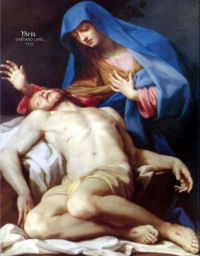
    Today is the Memorial of Our Lady of Sorrows. Devotion to the Seven Sorrows of Our Lady has its roots in Sacred Scripture and in Christian piety, which always associates the Blessed Mother with her suffering Son. Today's feast was introduced by the Servites in order to intensify devotion to Our Lady's Sorrows. In 1817 Pius VII—suffering grievously in exile but finally liberated by Mary's intercession—extended the feast to the universal Church.


    Our Lady of Sorrows
    This feast dates back to the 12th century. It was especially promoted by the Cistercians and the Servites, so much so that in the 14th and 15th centuries it was widely celebrated throughout the Catholic Church. In 1482 the feast was added to the Missal under the title of "Our Lady of Compassion." Pope Benedict XIII added it to the Roman Calendar in 1727 on the Friday before Palm Sunday. In 1913, Pope Pius X fixed the date on September 15. The title "Our Lady of Sorrows" focuses on Mary's intense suffering during the passion and death of Christ. "The Seven Dolors," the title by which it was celebrated in the 17th century, referred to the seven swords that pierced the Heart of Mary. The feast is like an octave for the birthday of Our Lady on September 8th.
    —Excerpted from Our Lady of Sorrows by Fr. Paul Haffner (Inside the Vatican, September 2004)

    This feast is dedicated to the spiritual martyrdom of Mary, Mother of God, and her compassion with the sufferings of her Divine Son, Jesus. In her suffering as co-redeemer, she reminds us of the tremendous evil of sin and shows us the way of true repentance. May the numerous tears of the Mother of God be conducive to our salvation; with which tears Thou, O God, art able to wash away the sins of the whole world.

    As Mary stood at the foot of the Cross on which Jesus hung, the sword of sorrow Simeon had foretold pierced her soul. Below are the seven sorrows of Mary:

    1. The prophecy of Simeon, (Luke 2:25-35)
    2. The flight into Egypt, (Matthew 2:13-15)
    3. Loss of the Child Jesus for three days, (Luke 2:41-50)
    4. Mary meets Jesus on his way to Calvary, (Luke 23:27-31; John 19:17)
    5. Crucifixion and Death of Jesus, (John 19:25-30)
    6. The body of Jesus being taken from the Cross (deposition from the Cross), (Psalm 130; Luke 23:50-54; John 19:31-37)
    7. The burial of Jesus, (Isaiah 53:8; Luke 23:50-56; John 19:38-42; Mark 15:40-47)

    Symbols and Representation: heart pierced with a sword; heart pierced by seven swords; winged heart pierced with a sword; flowers: red rose, iris (meaning: "sword-lily"), cyclamen

    Friday, September 11, 2026

    On Saturday we remember the Most Holy Name of Mary


    Most Holy Name of Mary: What's In a Name?

    By Jennifer Gregory Miller 

    facebook sharing button Share
    twitter sharing button Post
    linkedin sharing button Share
    pinterest sharing button Pin
    email sharing button Email
    sharethis sharing button

    September 12 marks the Optional Memorial of the Most Holy Name of the Blessed Virgin Mary, a few days following the Memorial of her Nativity. This feast is the counterpart of the Optional Memorial of the Most Holy Name of Jesus. Honoring the Holy Name of Mary as a feast was originally established around 1513, with variations on the date through the centuries. It was removed during the reform of the General Roman Calendar in 1969 but restored by St. John Paul II as an optional memorial in 2002.

    There are two simple points of this feast to draw home today: the honoring of the name of Mary, and also understanding the importance of a name through our baptism.

    Revering the Holy Names of Jesus and Mary

    It is of such importance that we honor Jesus and His Holy Name. Our main inspiration comes from St. Paul to the Philippians 2:9-11:

    Because of this, God greatly exalted him and bestowed on him the name that is above every name, that at the name of Jesus every knee should bend, of those in heaven and on earth and under the earth, and every tongue confess that Jesus Christ is Lord, to the glory of God the Father.

    Reverence is extended for the Blessed Virgin Mary and her name. The Catholic Encyclopedia explains that "[w]e venerate the name of Mary because it belongs to her who is the Mother of God, the holiest of creatures, the Queen of heaven and earth, the Mother of Mercy....[T]he feast commemorates all the privileges given to Mary by God and all the graces we have received through her intercession and mediation."

    The Roman Missal includes directives to bow our heads in reverence at the names of Jesus, Mary, and the Saint of the Day when they are mentioned in the prayers of the liturgy. 

    In the 18th century the Divine Praises or Laudes Divinae were added to the prayers at Benediction but can be prayed many times in reparation for the many abuses to the name of Jesus and Mary. Included in the litany, we proclaim, “Blessed be the name of Mary, Virgin and Mother."

    As we are continuing Our Lady's Thirty Days, we can think of simple ways to honor Our Lady today. One idea is designing and coloring a monogram of Mary, such as beautiful "M". Even the image of the back of the Miraculous Medal could be inspiration for contemplation of Our Lady's Name.

    Our Name and Baptism

    With my apologies to Shakespeare, this feast day and the Holy Name of Jesus helps us focus on the importance and significance of our own personal names. We are reminded of our reception of the sacrament of Baptism when we were given our name in Christ, which is more significant than our civil name.

    How does the Church guide us in choosing names? Canon 761 of the 1917 Code of Canon Law stated, "Pastors should take care that a Christian name is given to those whom they baptize; but if they are not able to bring this about, they will add to the name given by the parents the name of some Saint and record both names in the book of baptisms." The 1983 Code of Canon Law which is currently in effect still stresses the importance of a Christian name, Can. 855: "Parents, sponsors and parish priests are to take care that a name is not given which is foreign to Christian sentiment."

    So much thought and time goes into naming our children. We talk about passing on family names and perhaps naming after important people in our lives. Sometimes the meaning of the name is taken into consideration. We are attracted to some names and repulsed by others. We even try out the initials to make sure they flow well.

    Even since Biblical times, the naming of a child was of utmost importance. With the founding of Christianity and the spilling of the blood of the martyrs, the tradition of naming children after saints was two-fold: asking for intercession from the saint for the child, and also a saint for the child to emulate. Earlier this week on the feast of the Birth of Mary, I emphasized the connection with the family of Christ. Our Christian names after saints indicate that association with our brothers and sisters in Christ.

    So at this feast of the Holy Name of Mary, we praise her greatness and seek her aid at the invocation of her holy name. We also consider our own Christian name, which was conferred at our baptism, when we became part of this family of Christ. Through the intercession of Mary and our patron saints, may we deepen our love of Christ our brother and love for our family in Christ, the Mystical Body of Christ.

    Wednesday, September 9, 2026

    Pope Leo XIV has Wednesday meeting with the Focolare Movement


    Pope Leo XIV meets with Bishops associated with the Focolare Movement on September 9, 2026Pope Leo XIV meets with Bishops associated with the Focolare Movement on September 9, 2026  (@Vatican Media)

    Pope: Emphasis on individual freedom makes us less free to be ourselves

    Pope Leo XIV tells Bishops associated with the Focolare Movement that our modern emphasis on individual freedom can in reality make us less free to be our genuine selves or follow our highest ideals.

    By Devin Watkins

    Pope Leo XIV met on Wednesday with Bishops associated with the Focolare Movement, formally known as the Work of Mary, founded in Italy in 1943 by Chiara Lubich.

    In his address, the Pope said the bishops’ encounter expresses their collegial affection as friends of the Focolare Movement, noting that they hail from various countries and social situations.

    Pope Leo praised their focus on “Giving Witness to Unity,” saying the theme of unity is dear to his heart.

    “In an age sadly marked by increasing polarization,” he said, “our Lord enabled [Chiara Lubich] to give witness to both the sense and service of unity, thus becoming a sign for her own and future generations.”

    The Church continues to bear this task, added the Pope, saying he recalls the “prejudice, racism, religious intolerance, and even violence” that the bishops face in their countries.

    In the West, he noted, the formerly stable networks of family, friendship, and community are succumbing to deep fragmentation.

    As societies become more marked by individualism, freedom is increasingly presented as “absolute autonomy,” so that people may pursue happiness “without any moral, natural, or even human limits.”

    “And yet we observe a paradox,” said Pope Leo. “For all the emphasis on individual freedom, people today frequently feel less free to be their genuine selves or follow their highest ideals, out of a hidden fear of being judged or of not fitting in.”

    This loss of openness to others worsens our sense of disunity and indeed takes away our happiness, which the Pope said we find only in communion with the Triune God.

    “In revealing the heart of the Father, Christ shows us the deepest meaning of our existence, of our relationships, and the path to happiness,” he said. “Through the gift of the Spirit, we have become children of God, sharers in the divine life”.

    By embracing our communion as children of God in Christ, we take part in the Church’s mystery of communion and act as a sign of leaven and unity in our world.

    In conclusion, Pope Leo XIV invited the bishops associated with the Focolare Movement to bear witness to “this longed-for unity of the human family.”

    “The answer to the sad divisions that plague our world,” he said, “lies not in forming more committees or launching more projects, but in going back to the source of our unity in the Holy Trinity.”

    Tuesday, September 8, 2026

    Pope Leo XIV celebrated Mass at Genazzano Monday evening on the eve of Mary's birthday


    Pope celebrates Our Lady of Good Counsel with an appeal to cultivate peace

    Pope Leo XIV returns to the Shrine of Our Lady of Good Counsel in Genazzano on Monday evening, to celebrate Mass on the eve of the Nativity of the Blessed Virgin Mary and invite Christians to contemplate Mary's quiet presence and become servants of peace.

    By Vatican News

    “Let us allow peace to grow within us,” the Pope said during his homily as he presided over Mass at the Augustinian shrine dedicated to Our Lady of Good Counsel, “It will blossom in the world.”

    Returning to the sanctuary in Genazzano, southeast of Rome, Pope Leo recalled that he had felt “a deep desire” to come there just days after his election to the papacy in May 2025. Mary, he said at the time, had accompanied him throughout his life “with her maternal presence, with her wisdom, and with the example of her love for her Son, the Son who is always at the center of my faith.”

    Now, celebrating the Vigil of Mary's birth, he said he was once again entrusting to Mary “what is still born in this poor and magnificent humanity: fragile like a shoot, but a sign of God's faithfulness.”

    Mary and the power of a quiet presence 

    The Pope's homily focused on the apparent paradox of Mary's place in salvation history: a woman whose life changed the course of history, yet whose presence in the Gospel is marked by simplicity and silence.

    Reflecting on the writings of St Thomas of Villanova, the Augustinian friar and bishop, Pope Leo asked why the Evangelists provide so little detail about Mary's birth, childhood and daily life, despite her unique place in the story of salvation.

    St Thomas himself wondered why the Evangelists had written at length about John the Baptist and the Apostles but had said so little about Mary. Pope Leo quoted his question: “Why, I ask, have you deprived us of such great joy by your silence?”

    Yet, the Pope said that silence offers an important lesson for believers.

    “We are, in fact, ‘fellow citizens with the saints and members of the household of God’,” he said, adding that Mary teaches an intelligence that “converses with God,” asks questions and treasures events by connecting them in her heart.

    In Matthew's account, Mary does not speak in the passage proclaimed at the Mass. Yet her presence, together with the presence of Christ within her, is enough to change the course of events.

    “The simple presence of Mary – and of the Son within her – moves the whole of history,” Pope Leo said.

    Her presence changes Joseph's expectations, decisions and actions, he continued. “In Mary, salvation finds a home: God with us!”

    God's way is 'simpler and quieter'

    The Pope then reflected on the mystery celebrated in the feast of Mary's birth.

    “It is impossible to become accustomed to it!” he said. A child is born who will become “the Mother of her Creator, the Mother of God who saves.”

    And yet, he observed, Mary is born simply as a child, “like the daughters and granddaughters whom we hold in our arms.”

    “We have noble and lofty titles for her, of Lady and Queen,” he said, “but God's way has been and remains simpler and quieter, yet no less powerful and transformative.”

    The same path is revealed in Christ, he continued, noting that “In Jesus Christ, God chose the most humble historical circumstances and the humblest of creatures to manifest the originality of his Kingdom, in which arrogance has no place and omnipotence is creation, service and care for life.”

    Not fantasy, but prophecy

    Pope Leo then returned to St Thomas of Villanova's invitation to contemplate Mary inwardly, even though Scripture does not provide a detailed portrait of her life.

    St Thomas wrote that the Holy Spirit did not describe Mary in Scripture but instead “waited for you to paint her inwardly,” the Pope recalled.

    “In contemplative prayer, what the world does not tell us, but already exists, takes shape; what is still invisible, but already possesses a new kind of strength,” he explained, adding that, “This is not fantasy, but prophecy.”

    Such prophetic vision, he added, is needed “in times of destruction and uncertainty,” so that Christians can recognize God's work and serve it.

    “Let peace grow within us”

    From Mary's hidden strength, Pope Leo turned to the need for peace. Recalling the prophet Micah's vision of Bethlehem as the birthplace of a king of peace, he highlighted the biblical promise, noting that the prayer of the day's liturgy asks that the celebration of Mary's birth increase peace within believers.

    “Yes, we want to imagine peace – to broaden the boundaries of our understanding and paint it in our souls – in order to recognize that it already exists, to welcome it and to serve it,” he said.

    Peace, he continued, is “the gift of God, the breath of the Risen One, the work of the Holy Spirit.”

    “Let us allow peace to grow within us,” he said. “It will blossom in the world. And the Mother of Good Counsel will accompany us in this mission.”

    A place close to Pope Leo's heart

    Pope Leo has a longstanding connection with the shrine in Genazzano, which he first visited as a young student in Rome in the early 1980s and where he returned over the years as Prior General of the Augustinian Order, Bishop of Chiclayo and later Cardinal. His Augustinian Province of Chicago is itself dedicated to Our Lady of Good Counsel.

    His first visit to the shrine as Pope came just two days after his election, on 10 May 2025. Before appearing on the central loggia of St Peter's Basilica on the day of his election, he had also prayed before an image of Our Lady of Good Counsel in the Pauline Chapel of the Apostolic Palace.

    The shrine itself has been entrusted to the Augustinians since the 14th century. According to tradition, on 25 April 1467, an image of the Virgin Mary appeared on a wall of the church while it was still under construction. Two Albanian pilgrims later recognized it as the image venerated in Shkodër, Albania, which had disappeared from its original location.

    The image has attracted generations of pilgrims and several Popes, including Urban VIII, Pius IX, John XXIII and John Paul II. Following that tradition, a new painting depicting Pope Leo praying before Our Lady of Good Counsel was unveiled at the shrine during his September 7 visit.