Showing posts with label Archbishop Timothy Dolan. Show all posts

Tuesday, February 21, 2023

Sign of the times? Catholic school closures in New York


Citing finances, N.Y. Archdiocese to close 12 schools at end of academic year
 
New York School closings
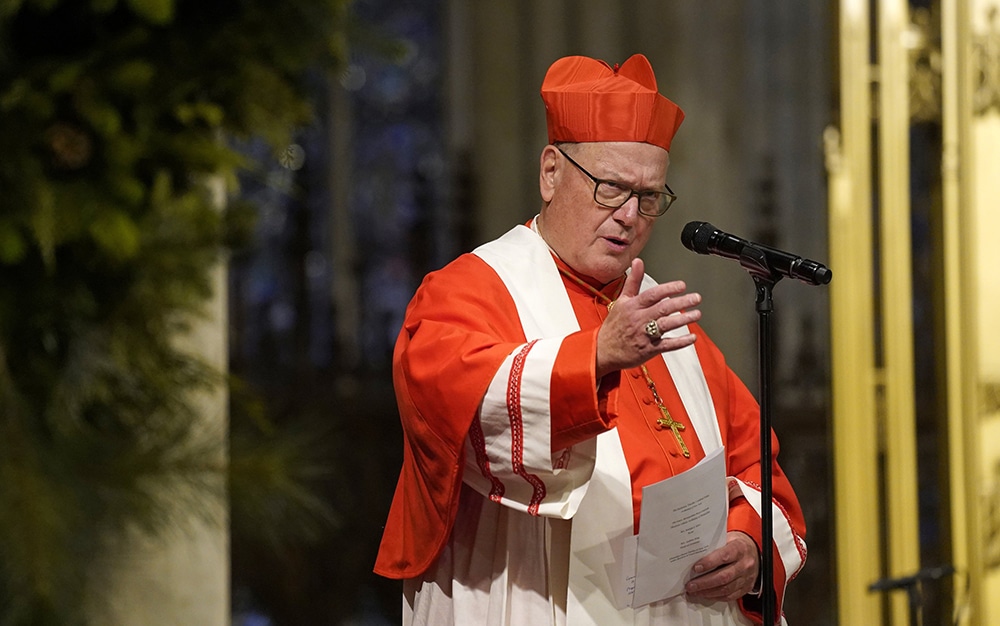
New York Cardinal Timothy M. Dolan is seen at St. Patrick's Cathedral in New York City Feb. 18, 2023. The New York Archdiocese has announced that 12 of its Catholic schools will close at the end of the 2022-23 academic year and four others will be merged into two schools due to the financial outlook for these schools. (OSV News photo/Gregory A. Shemitz)

NEW YORK (OSV News) — The Archdiocese of New York has announced that 12 of its Catholic schools will close at the end of the 2022-23 academic year and four others will be merged into two schools due to the schools’ financial outlook.

“Shifting demographics and lower enrollment made worse by the pandemic” have had a “detrimental” impact on the involved schools’ “financial stability,” the archdiocese stated.

“It is never a good day when we announce closures to any of our beloved schools, but the goal is always to strengthen the remaining institutions and preserve Catholic education in New York for decades to come,” New York Cardinal Timothy M. Dolan said in a Feb. 15 statement.

Five schools in the New York borough of Manhattan will close, as will six in the Bronx borough, and one in the Staten Island borough. The four schools that will be merged into two are in the Bronx.

Cardinal Dolan said the archdiocese will provide “educational guidance and pastoral support to all those affected to ensure all children will be warmly welcomed into a nearby Catholic school. … With hard work and God’s blessings, we will come out on the other side.”

The Office of the Superintendent of Schools said it “will work closely” with each family affected by the closures or mergers to help them find a neighboring Catholic school for their children for the fall.

“We understand these are challenging times for many families, and this is indeed a sad day for everyone in our Catholic schools community,” said Michael J. Deegan, archdiocesan superintendent of schools, in a statement. “I personally mourn the loss of every one of our great schools.”

But “as we process this news, we must resolve that the great tradition of Catholic education in New York will continue,” he said, adding the archdiocese will help students who want to continue their Catholic education “to find a seat at another excellent school in the archdiocese.”

Deegan’s office said it would work with the teachers’ union to help faculty at the closing and merging schools to find a new job within the archdiocesan school system.

Friday, December 2, 2022

Bishops' response to Senate's passage of the misnamed Respect for Marriage Act


‘Gravely disappointed’: U.S. bishops respond to passage of the same-sex marriage act


Today the U.S. bishops responded to the U.S. Senate’s passage of the Respect for Marriage Act, saying society “has lost sight of the purpose of marriage.”

Bishop Robert Barron, chairman of the U.S. Conference of Catholic Bishops’ (USCCB) Committee on Laity, Marriage, Family Life, and Youth, strongly condemned the bill’s passage.

“We are gravely disappointed that the misnamed Respect for Marriage Act passed the Senate and continue to call for its rejection,” Barron wrote.

The Respect for Marriage Act passed the Senate Tuesday, redefining marriage to include unions between homosexual couples and mandating that all states must recognize homosexual marriages. The bill passed with bipartisan support, with 12 Republicans voting in favor. As passed by the Senate, the bill enshrines into law and expands the Supreme Court’s ruling in Obergefell v. Hodges, which legalized homosexual marriage across the nation.


Barron wrote that “decades of social and legal developments have torn sexuality, childbearing, and marriage from each other in the public consciousness.” In his statement, Barron called to mind Pope Francis’ 2016 address in which he said, “We can hardly stop advocating marriage simply to avoid countering contemporary sensibilities … We would be depriving the world of values that we can and must offer.”

Barron stated that Christians must share the truth of marriage as “a lifelong and exclusive union, a complete and mutual gift of the husband and wife to each other for their good and for the procreation and education of children, [and] is essential to the common good.”

In addition to contributing to the “diminishment of the sacredness and integrity of marriage in our society,” the act’s passage threatens religious freedom in the U.S., the statement said.

“This bill fails to include clear, comprehensive, and affirmative conscience protections for religious organizations and individuals who uphold the sanctity of traditional marriage,” Barron wrote.

Having passed the Senate, the Respect for Marriage Act will return to the U.S. House of Representatives for a vote on the amendments added by the Senate.

The U.S. bishops stated in a November letter to Congress that the bill’s amendments do not sufficiently protect those with religious objections.

“The amended Act will put the ministries of the Catholic Church, people of faith, and other Americans who uphold a traditional meaning of marriage at greater risk of government discrimination,” the letter stated.

The November letter, penned jointly by Barron and Cardinal Timothy Dolan of the Archdiocese of New York, posited that “the bill will be used to argue that the government has a compelling interest in forcing religious organizations and individuals to treat same-sex civil marriages as valid.”

While stating that “we affirm our respect for the dignity of all engaged in this debate,” Barron reaffirmed the U.S. bishops’ continued opposition to the Respect for Marriage Act.

Wednesday, October 19, 2022

Catholic Project study reveals Priests trust in Bishops has eroded


Study reveals priests’ trust in bishops has eroded


A new study released today by the Catholic Project at the Catholic University of America reveals a deep crisis in priests’ confidence in the leadership of the U.S. bishops. Overall, only 24% of priests across America express confidence in the “leadership and decision-making” of the bishops.

The new research initiative, titled the National Study of Catholic Priests, is based on 3,516 responses from 10,000 diocesan and religious priests. Stephen White, director of the Catholic Project told Our Sunday Visitor: “The goal of this study is to better understand how our priests are doing.” “In particular,” White continued, “we wanted to better understand how the abuse crisis, and the Church’s response to that crisis, has affected trust between priests and bishops.”

In an early letter of support for the project, Cardinal Wilton Gregory of Washington and Cardinal Timothy Dolan of New York write, “[The study] is an ambitious project with the goal of ascertaining the overall well-being of the American presbyterate with a particular emphasis on how the two decades since the Dallas Charter have affected relationships and trust between priests and bishops.”

Perhaps surprisingly, overall priests report remarkable well-being. Using the Harvard Flourishing Index — a comprehensive quantitative measurement index — the study found that on average, priests scored 82 out of 100. This average, the study reports, is “relatively high in comparison to the general population.” One priest said in an interview conducted by the study, “I feel remarkably fulfilled in my life as a priest. I mean, just being able to minister to people, being able to love them. Being able to be Christ for them. It’s just, it’s such a beautiful life.” Despite finding “ample evidence” of “challenges and stress,” only 4% of priests report considering departing from ministry.

One of the most significant findings of the study is the disparity of burnout indicators between diocesan and religious priests. “Our study finds that 45% of priests report at least one symptom of ministry burnout, which is unevenly distributed between diocesan (50%) and religious (33%) priests, and only 9% exhibit severe burnout,” an initial report says.

The study found another disparity between religious and diocesan priests: trust in leadership. While 67% of religious priests express confidence in their major superior, fewer than half (49%) of diocesan priests express trust in their own diocesan bishop. This factor of trust significantly impacts priests’ well-being. The study found that “An erosion of trust between a priest and his bishop is associated with an 11.5% reduction in that priest’s level of well-being.”

According to the new survey, 90% of priests “see their dioceses as having a strong culture of child safety and protection.” Since the adoption of the Dallas Charter, the 2002 national policy implemented by the U.S. bishops for the protection of minors, a culture of fear has grown among priests. In the present climate, the study found that “82% of priests regularly fear being falsely accused of sexual abuse.”

Furthermore, in the case of a false accusation, only 36% of diocesan priests report that they would be provided with sufficient resources by the diocese to defend themselves in court. Only 51% of diocesan priests believe they would have the support of their diocesan bishop in such a case. Again the discrepancy between religious and diocesan priests is significant, since 85% of religious priests believe they would be given sufficient resources for legal defense and 86% report that they believe they would have the support of their major superior.

Going forward, the study concludes by proposing three significant steps to improve priests’ trust in the bishops. First, priests report desiring a father figure, rather than an administrator. While 70% of bishops reported seeing themselves as a father to their priests, only 28% of priests report they consider their bishop a father. Second, priests desire great transparency around processes like making assignments and the review process for allegations of abuse. And finally, priests desire to see bishops held accountable in order to rebuild trust with priests and laity alike.

“Every Catholic I know, from the lay faithful to the bishops, wants to support our priests,” says White. “To do that well, we need to better understand both how priests are flourishing and how they are struggling. My hope for this study is that it will help do just that.”

Monday, October 17, 2022

Eucharistic Procession through the streets of busy mid-town Manhattan


Eucharistic procession takes Christ, his Gospel through Manhattan’s streets


Seminarians lead a eucharistic procession as it passes Radio City Music Hall in New York City Oct. 11, 2022. The procession, which followed Mass at Sacred Heart of Jesus Church and traveled a mile-long route through Midtown Manhattan, concluded at St. Patrick's Cathedral, where New York Cardinal Timothy M. Dolan led Benediction. The liturgical events were affiliated with the Napa Institute's Principled Entrepreneurship Conference taking place in New York City Oct. 11-12. (CNS photo/Gregory A. Shemitz)


By: Catholic News Service

Date: October 13, 2022

NEW YORK (CNS) — A eucharistic procession through Midtown Manhattan Oct. 11, the Mass that preceded it and the adoration that followed fittingly marked the 60th anniversary of the opening of the Second Vatican Council “in a particularly eucharistic way,” said Father Roger Landry.

The council was “convened in order to reinvigorate the church’s mission to sanctify the world and bring Christ and his Gospel even to those corners considered most forlorn,” said the priest.

He was the main celebrant and homilist for the Mass, celebrated at the Church of the Sacred Heart of Jesus in the New York borough of Manhattan.

“The fathers of Vatican II repeatedly declared that Jesus in the holy Eucharist is the source and summit, root and center of the Christian life and of everything the church does,” Father Landry said in his homily.

“All the main teachings of the council — on the primacy of the word of God, on the universal call to holiness, on authentic Christian humanism, on the vocation of the laity, on religious freedom and on relations with other religions — can all be looked at through a eucharistic lens,” he said.

A eucharistic procession takes Jesus Christ “out into the world he redeemed,” he said. It proclaims Jesus, “by our joyful witness, devout prayers and enthusiastic singing to be really, truly and substantially among us,” and invites others “to join us in following him who is the Way,” he continued.

“Our world needs Jesus Christ just as much as ever and as Catholics we cannot keep the treasure of our eucharistic Lord within our churches and tabernacles. The love of Christ, and the love of others, compels us to bring him out and share him,” added Father Landry, who is a chaplain at Columbia University.

After the early evening Mass, the eucharistic procession of priests, seminarians, women religious and laypeople traveled a mile-long route through Midtown Manhattan. Father Landry processed holding a monstrance containing the Blessed Sacrament, as did Father Sean Suckiel, pastor of Holy Family Church in the New York borough of Queens.

The procession concluded at St. Patrick’s Cathedral, where New York Cardinal Timothy M. Dolan led Benediction.

The liturgical events were affiliated with the Napa Institute’s Principled Entrepreneurship Conference taking place in New York City Oct. 11-12. The Busch School of Business at The Catholic University of America in Washington was a conference sponsor.

In his homily, Father Landry noted that the day’s eucharistic events also were taking place within the context of the three-year National Eucharistic Revival of the Catholic Church in the United States.

The U.S. bishops planned the revival “to stimulate greater eucharistic knowledge, faith, amazement, love, life and mission,” he said, adding that “there are various important parts of the revival.”

“One is to help all Catholics better understand and live the Mass. Another is greater eucharistic discipleship, shown in a particular way by spending time with Jesus in eucharistic adoration,” he said.

“A third is eucharistic charity, as we imitate Jesus in giving our body and blood, our time, money and talents, out of love for those Jesus loves,” Father Landry said. “And a fourth is a more ardent eucharistic apostolate, in which we infectiously share our eucharistic faith with others.”

Launched June 19, the feast of Corpus Christi, the revival is a three-year initiative of the U.S. Conference of Catholic Bishops to revitalize Catholics’ understanding of and love for the Real Presence in the Eucharist.

“Today we take the Lord out to what St. John Paul II famously called the ‘capital of the world,'” Father Landry said about the procession to follow through Manhattan’s streets. “We accompany him, just like the apostles, the disciples and huge crowds used to accompany him as he journeyed to preach, teach, heal, forgive, feed and save.”

“In those tightly packed Middle Eastern crowds, some would just bump into him unchanged,” he explained, “but others would reach out to touch him with faith, like the woman with a hemorrhage for 12 years,” who was cured after touching the edge of Christ’s cloak.

“Others, like Zacchaeus, would climb trees to see him,” Father Landry added. “Others, hearing Christ was passing by, would cry out from the side of the road, ‘Jesus, Son of David, have mercy on me!'”

Wednesday, September 28, 2022

Cardinals discuss Catholic hospital care for transgender patients but no to gender transition procedures


HEALTH-CORONAVIRUS/BRITAIN-VACCINE

Cupich & Dolan: Transgender patients receive equal care in Catholic hospitals

American Cardinals Blase Cupich and Timothy Dolan affirm the high quality of care transgender patients receive in Catholic hospitals, while expressing concern over a new federal rule which would force faith-based health care facilities to perform gender transition procedures.

By Devin Watkins

The Archbishops of Chicago and New York have issued a joint statement in reaction to a newly-proposed federal rule which would force Catholic health care facilities to offer gender transition procedures.

The rule proposed on 25 July 2022 by the US Department of Health and Human Services (HHS) seeks to implement Section 1557 of the Affordable Care Act, specifically to “solidify protections against discrimination on the basis of sex including sexual orientation and gender identity”, according to the HHS website.

High-quality Catholic health care for everyone

In a statement published by America Magazine, Cardinal Blase Cupich of Chicago and Cardinal Timothy Dolan of New York affirm their wholehearted support for “all efforts to ensure that everyone, without exception, receives the best health care that is their due.”

They note that 1 in 7 Americans who visit a hospital will receive care in a Catholic facility, equaling over 115 million visits every year.

“They do so knowing they will receive excellent medical care and be treated with dignity, respect and welcome,” say the Cardinals. “That is true for all people who come to us, no matter their age, sex, racial or ethnic background, or religion.”

Transgender patients also receive the same quality of care as everyone else, affirm the two Cardinals.

“Catholic hospitals do not discriminate against anyone and to do so would be offensive to the embracing and expansive healing ministry of Jesus Christ.”

Forcing doctors to violate their consciences

At the same time, Cardinals Dolan and Cupich allege that the HHS-proposed rule would coerce Catholic facilities and staff to violate their consciences.

“Under this new proposed rule, it would be considered discrimination for a health care facility or worker to object to performing gender transition procedures, regardless of whether that objection is a matter of sincerely held religious belief or clinical judgment.”

The Cardinals say the rule represents “government coercion that intrudes on the religious freedom of faith-based health care facilities” and thereby threatens the conscience rights of those who consider such procedures contrary to their own beliefs.

Even people of no faith, note the Cardinals, may object to gender transition procedures, and should not therefore be expected to “violate their consciences as a condition of employment.”

Objection to procedure, not the person

Cardinals Cupich and Dolan then reaffirm their belief that objecting to such procedures in no way constitutes discrimination, also because those same Catholic hospitals and doctors offer the same quality of care for transgender patients.

“The focus of such an objection is completely on the procedure, not the patient.”

The American Cardinals note that the proposed rule fails to codify “the rights of faith-based providers to decline procedures based on conscience, as other federal laws do.”

Rather, they say, the rule allows the HHS to decide if it can force facilities to “violate their beliefs.”

In conclusion, Cardinals Dolan and Cupich uphold every American’s right to receive high-quality health care which respects “the life and dignity of every person”.

Tuesday, August 30, 2022

Cardinal Dolan checks in from Rome meeting of Cardinals


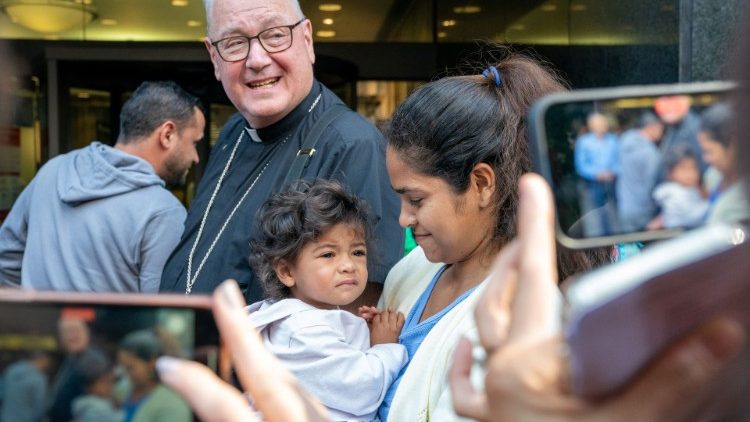
Cardinal Timothy Dolan greets migrant families outside of Catholic Charities of New YorkCardinal Timothy Dolan greets migrant families outside of Catholic Charities of New York  (David Dee Delgado)

Cardinal Dolan on Curia Reform meeting: an opportunity to learn from those 'on front lines'

In an interview with Vatican News, Cardinal Timothy Dolan, Archbishop of New York, calls Pope Francis' meeting of the world's Cardinals to study the Roman Curia reform 'extraordinarily uplifting'; and, as the war wages in Ukraine, praises the encounter as an opportunity to learn from the service of those Cardinals on the front lines.

By Deborah Castellano Lubov

As the war wages on in Ukraine, Cardinal Timothy Dolan, Archbishop of New York, says another advantage of this meeting Pope Francis summoned of the world's Cardinals is to be with Cardinals who are on the front lines, to hear about the challenges they face, and to learn from their service.

In an interview with Vatican News on Monday, Cardinal Dolan, who serves as Chair of the Catholic Near East Welfare Association (CNEWA), reflected on the first day of the two-day encounter in the Vatican to discuss reform of the Roman Curia, and specifically highlighted the solidarity of the Cardinals in combating war and helping those in need.

Pope Francis requested that the world's Cardinals should gather in the Vatican on 29-30 August to reflect on the recently-published Apostolic Constitution Praedicate Evangelium on reforming the Roman Curia.


According to UN statistics from July, at least 12 million people have been forced to flee their homes since the outbreak of the war, with at least 5 million fleeing outside Ukraine to bordering nations, and at least 7 million displaced inside the war-torn nation.

Since Russia invaded Ukraine, some 2 million Ukrainians have found welcome in Poland, and numerous others in Hungary, Slovakia, and other bordering nations. Some Ukrainians have started to return to their country.

Listening to Cardinals on 'front lines'

Cardinal Dolan told Vatican News that after his own visit to Ukraine and the bordering nations, that being among the other Cardinals of the Universal Church, and those closest to the conflict, has been particularly meaningful.

"That's another great advantage of being here," the Cardinal said.

"The Cardinals, by their very nature, mirror the Church Universal, the catholicity of the Church. To be with them now, to talk to Cardinal Péter Erdő of Budapest, as they have been so extraordinarily generous and welcoming, to be with Cardinal Stanisław Dziwisz in Krakow, where they have been welcomed by the people of Poland, close to 4 million refugees."

“To be with these Cardinals who are on the front lines and to hear the challenges, but also to see how uplifting it is to be in service and to hear them so grateful for the solicitude of the world. That's very good.”

During an earlier visit to Rome, in April - his first since the outbreak of the pandemic - Cardinal Dolan sat down with Vatican News to discuss his upcoming journey to meet with suffering Ukrainian refugees and bring them, and those welcoming them, aid.

'Extraordinarily uplifting' encounter in the Vatican

On Monday evening, the Cardinal of New York also gave his impressions of the discussions taking place among the Cardinals, and in their small groups, calling it a "beautiful experience."

"It is a beautiful experience of something that is in danger of becoming too theoretical, namely, collegiality, apostolic fraternity, synodality. No, we experience it there," he said.

“We talk as friends, as brothers, with immense charity and deep love for the Church about very practical issues. It has been extraordinarily uplifting.”

He expressed his appreciation for the encounter.

"I'm glad this has taken place. You look forward to it," but, to some extent, he suggested, out of a sense of duty.

"But I said, 'wow', duty is rewarded because this is a very good thing."

Boots on the ground, wishing to help

Cardinal Dolan's visit to Ukraine and border countries earlier this year was because the Archbishop of New York is ex-officio the chairman of the board of CNEWA.

CNEWA was founded a century ago by Pope Pius XI to assist Eastern-rite Catholics, who very often live in persecuted areas and often are under great stress.

There are many Eastern-rite Catholics in the Middle East, India, Ukraine, and in Central and Eastern Europe.

For that occasion, he told Vatican News, "we are very active, having boots on the ground, and wish to bring them alms, the gifts that Catholic people have given us to help these people. We want to just embrace them and say, 'We love you. We have not forgotten about you. We want to pray with you, encourage you and help.'"

Tuesday, August 2, 2022

U.S. Bishops to Congress: Protect human life, promote the health and safety of the family. work for the common good


US Bishops urge Congress to work to protect life, promote common goodUS Bishops urge Congress to work to protect life, promote common good 

US Bishops urge Congress to work to protect life, promote common good

Four American Bishops who chair committees of the USCCB are advocating for legislation that protects human life and promotes the health, safety and support of the family, proposing that Catholic social teaching shows the way to a better society in the wake of the US Supreme Court’s 24 June Dobbs v. Jackson ruling.

By Fr. Benedict Mayaki, SJ

The Bishops of the United States are calling on Congress to “seize this hopeful moment” to work together to protect the dignity of every human person and the common good, in the wake of the Supreme Court’s decision in Dobbs v. Jackson Women’s Health Organization which “presents a historic opportunity to reshape society for the better.”

In a statement on Monday, the Bishops express concern that since the 24 June Dobbs ruling, Congress has been taking up legislative proposals that are “harmful to the common good” and have not taken any action on the measures that the U.S Conference of Catholic Bishops (USCCB) has previously endorsed and continues to support which “would help to build up a culture of life.”

The US Supreme Court’s Dobbs ruling overturned the 1973 ruling in Roe v. Wade which legalized abortion nationwide. The Dobbs decision returned the regulation of abortion to the states.

Protecting all human life

The Bishops propose that reshaping society begins with the recognition that “human life is an inestimable gift from God with an inalienable right to life deserving of full legal protection.”

Also, they uphold that the family, founded upon the love and mutual self-gift of husband and wife, “is the first building block of society, and that raising children is both a great gift and a lifelong responsibility.”

In this light, “a principled commitment to being pro-life entails a commitment both to protecting all human life, especially the most vulnerable, and to advancing policies that help families to flourish,” the Bishop Chairmen said, urging that “the health, safety, and support of the family should be the focus of all good policymaking.”

Catholic social teaching shows a better way

The Bishops air their worry that since the Apex court’s 24 June decision, members of Congress have focused on legislation that “places no value on the lives of children until their moment of birth, severs sex and marriage from their meaning, promotes using people as means to ends, and would strip rights of conscientious objection from those who oppose these hallmarks of the throwaway culture.”

In fact, the US House of Representatives has passed, and the Senate may soon reconsider a series of bills, including the Women’s Health Protection Act, the Respect for Marriage Act, and the Right to Contraception Act, and is advancing appropriations bills that exclude longstanding provisions prohibiting federal taxpayer funding for abortion and protecting the conscience rights of healthcare providers.

To counter this, the Bishops uphold that “Catholic social teaching shows the way to a better place—a society marked by justice, mutual support, civility, friendship, mercy, and love—than where Congress is now leading,” the prelates added, as they called for legislation that would build " a culture of life."

Such bills, in the USCCB’s assessment, include, the Pregnant Workers Fairness Act; an expanded child tax credit, including for pregnant moms; the Adoption Tax Credit Refundability Act; the PFAS Action Act; and a federal paid family leave policy.”

This legislation, the Bishops say, provide support “for the health and wellbeing of pregnant and parenting women, assistance with nutrition and affordable housing, environmental restrictions on chemicals that cause birth defects, and provisions to assist low-income families.” 

Care for creation, supporting families

The American Bishops go on to welcome the “meaning consideration of needed investments in care for our common home” and stress that “care for creation is also integral to care for human life.”

Finally, they called on families and individuals, civil society, businesses, religious groups, government and members of Congress to ask themselves “how they are supporting families at this moment, particularly around welcoming new life and raising children through adulthood.”

The Monday statement was signed by Archbishop William E. Lori of Baltimore, chairman of the U.S. Conference of Catholic Bishops’ (USCCB) Committee on Pro-Life Activities, Cardinal Timothy M. Dolan of New York, chairman of the USCCB’s Committee for Religious Liberty, Archbishop Salvatore J. Cordileone of San Francisco, chairman of the USCCB’s Committee on Laity, Marriage, Family Life & Youth, and Archbishop Paul S. Coakley of Oklahoma City, chairman of the USCCB’s Committee on Domestic Justice and Human Development.