Showing posts with label New Year. Show all posts

Thursday, January 1, 2026

Sunday Papal Angelus on New Year's Day 01.01.2026


Pope: Start today to build a year of peace

At his first Angelus greeting of 2026, Pope Leo urges everyone to “build a year of peace, by disarming our hearts and refraining from every form of violence.”

By Kielce Gussie

Greeting around 40,000 people gathered in Saint Peter’s Square on the first day of 2026, Pope Leo XIV extended his heartfelt wishes for peace and every good to them. He also shared his best wishes to the President of the Italian Republic, Sergio Mattarella.

In his words following the recitation of the Angelus prayer, the Pope pointed out that for the last 58 years—at the wish of Pope Saint Paul VI in 1968—January 1st has been celebrated as the World Day of Peace. In his own message for that day, Pope Leo recalled the greeting “the Lord suggested” to him after being elected to the papacy: “Peace be with you all!” 

This peace, he continued, “is unarmed and disarming, which comes from God, a gift of his unconditional love, and is entrusted to our responsibility.”

Call to a new year of peace

With this responsibility, the Holy Father challenged everyone, with Christ’s grace, to start today to “build a year of peace, disarming our hearts and refraining from all violence.”

He acknowledged that many people and organizations around the world already dedicate themselves to ending violence and have created countless initiatives for building peace. Specifically, the Pope highlighted a national march which took place on the evening of 31 December in Catania, Italy, as well as a march to be held by members of the Community of Sant’Egidio.

Finally, he took a moment to greet students and teachers from Richland, New Jersey, in the United States.

Recalling the 800th anniversary of the death of Saint Francis of Assisi, Pope Leo closed his Angelus greetings with the Saint's blessing taken from Sacred Scripture: “The Lord bless you and keep you; the Lord make his face to shine upon you, and be gracious to you; the Lord lift up his countenance upon you, and give you peace.”

The Pope added his own wishes that Mary, the Mother of God “guide us on our journey in the new year.”

Wednesday, December 31, 2025

January 1st: The Solemnity of Mary, Mother of God and the Octave Day of Christmas


Christmas: January 1st

Solemnity of the Blessed Virgin Mary, the Mother of God, The Octave Day of the Nativity of the Lord (Christmas)


The Church celebrates the Solemnity of Mary, the Holy Mother of God, our Lady's greatest title. This feast is the Octave Day of Christmas. In the current liturgical Calendar only Christmas and Easter enjoy the privilege of an octave.

It is also the World Day of Peace.

"Mary, the all-holy ever-virgin Mother of God, is the masterwork of the mission of the Son and the Spirit in the fullness of time. For the first time in the plan of salvation and because his Spirit had prepared her, the Father found the dwelling place where his Son and his Spirit could dwell among men. In this sense the Church's Tradition has often read the most beautiful texts on wisdom in relation to Mary. Mary is acclaimed and represented in the liturgy as the "Seat of Wisdom."
—Catechism of the Catholic Church 721

The Word Took Our Nature from Mary
The Apostle tells us: The Word took to himself the sons of Abraham and so had to be like his brothers in all things. He had then to take a body like ours. This explains the fact of Mary’s presence: she is to provide him with a body of his own, to be offered for our sake. Scripture records her giving birth and says: She wrapped him in swaddling clothes. Her breasts, which fed him, were called blessed. Sacrifice was offered because the child was her firstborn. Gabriel used careful and prudent language when he announced his birth. He did not speak of “what will be born in you” to avoid the impression that a body would be introduced into her womb from outside; he spoke of “what will be born from you” so that we might know by faith that her child originated within her and from her.

By taking our nature and offering it in sacrifice, the Word was to destroy it completely and then invest it with his own nature and so prompt the Apostle to say: This corruptible body must put on incorruption; this mortal body must put on immortality.

This was not done in outward show only, as some have imagined. This is not so. Our Savior truly became man, and from this has followed the salvation of man as a whole. Our salvation is in no way fictitious, nor does it apply only to the body. The salvation of the whole man, that is, of soul and body, has really been achieved in the Word himself.

What was born of Mary was therefore human by nature, in accordance with the inspired Scriptures, and the body of the Lord was a true body: It was a true body because it was the same as ours. Mary, you see, is our sister, for we are all born from Adam.

The words of Saint John: The Word was made flesh, bear the same meaning, as we may see from a similar turn of phrase in Saint Paul: Christ was made a curse for our sake. Man’s body has acquired something great through its communion and union with the Word. From being mortal, it has been made immortal; though it was a living body it has become a spiritual one; though it was made from the earth it has passed through the gates of heaven.

Even when the Word takes a body from Mary, the Trinity remains a Trinity, with neither increase nor decrease. It is forever perfect. In the Trinity we acknowledge one Godhead, and thus one God, the Father of the Word, is proclaimed in the Church.
—Excerpted from a letter by St. Athanasius

Solemnity of Mary, the Holy Mother of God, Octave Day of Christmas—Day Eight
Although New Year's Day is not celebrated by the Church, this day has been observed as a Holy Day of Obligation since early times for this feast. Each family and country has different traditional foods to eat on New Year's Day, with lentils being the main superstition: ill luck befalling those who do not eat lentils at the beginning of the year.

New Year's is a day of traditional hospitality, visiting and good cheer, mostly with a secular view, but there is no reason that this day, too, could not be sanctified in Christ.

Solemnity of the BVM, Mother of God: O God, who through the fruitful virginity of Blessed Mary bestowed on the human race the grace of eternal salvation, grant, we pray, that we may experience the intercession of her, through whom we were found worthy to receive the author of life, our Lord Jesus Christ, your Son. Who lives and reigns with you in the unity of the Holy Spirit, God, for ever and ever.


New Year's Day indeed is a Catholic Holy Day of Obligation


Why is New Year’s Day a holy day of obligation?

A person wearing 2026 glasses watches as organizers of the upcoming ball drop on New Year's Eve perform a confetti test in New York City's Times Square Dec. 29, 2025. (OSV News photo/Adam Gray, Reuters)


Q: If the church’s new year begins on the first Sunday of Advent, then why is the secular New Year’s Day (Jan. 1) a holy day of obligation?

A: You are correct that the church’s liturgical new year begins usually in late November with the first Sunday of Advent, and you are likewise correct that in the United States and for the universal church in general, Jan. 1 is a holy day of obligation (see Canon 1246 of the Code of Canon Law).

But January 1 is not a holy day of obligation because of the civil new year, but because it is the feast of Mary, the Mother of God.

Recognizing Jesus’ divine nature and Mary’s role in Jan. 1 solemnity

“Mother of God” — also known by the theological Greek term “Theotokos,” or “God-bearer” — is an ancient title for Our Lady which not only references her own great dignity, but further points to deeper Catholic teachings on Jesus’ identity and the nature of the most Holy Trinity.

Although this title had been in use among the Christian faithful long before then, formal endorsement of the practice of calling Mary the “Mother of God” is most closely associated with the Council of Ephesus in the year 431 A.D. Among other things, the Council of Ephesus refuted the Nestorian heresy.

The Nestorian heresy is named after the fifth-century bishop Nestorius, who argued that Mary should be considered the mother of only Jesus’ human nature, because to say that she was the mother of Jesus’ divine nature would seem to imply that she herself was divine.

Nestorius preached against the use of the term “Theotokos” in favor of the title “Christotokos,” or “mother of Christ.” However, this was problematic because it undermined the church’s doctrine on the “hypostatic union,” or the teaching that Jesus has two natures — a divine and a human nature — fully “united in the one person of God’s Son” (See the Catechism of the Catholic Church, 481).

To make a long story short, the Council of Ephesus formally declared Nestorius a heretic. The council clarified that because Jesus’ two natures were distinct but not separated into different persons, and since Mary was the mother of the person of Jesus in His human nature, she was also the mother of Him in His divine nature. Hence, she can, in this specific sense, rightly be called the “mother of God”: not because Mary was herself the source of Jesus’ divinity, but because she bore to the world the man who was also God.

Marian solemnity celebrated in octave of Christmas

It’s fitting that in our current calendar we observe the solemnity of Mary, the Mother of God on the eighth day after Christmas. In our Catholic liturgical tradition, especially important feasts like Christmas and Easter are celebrated for eight days. This is called an “octave,” and it gives us the space to fully ponder the mystery of faith being celebrated, often in its many various nuances and facets.

The fact that we commemorate Mary as the Mother of God in the octave day of Christmas reminds us, as the Catechism puts it, that “the Incarnation is therefore the mystery of the wonderful union of the divine and human natures in the one person of the Word” (CCC 483).

On a side note, there is one Catholic custom that is specifically tied to the civil celebration of the new year. Provided the other usual conditions for obtaining an indulgence are met, Catholics can earn an indulgence on Dec. 31 if they devoutly pray or chant the “Te Deum” prayer.

This is an ancient hymn of thanksgiving which today is most often prayed as part of the Liturgy of the Hours on Sundays and major feast days but is to be prayed on Dec. 31 as a way to thank God for the blessings and graces of the past year. Similarly, a Catholic can earn a second indulgence on Jan. 1 for praying the “Veni Creator Spiritus,” a prayer asking for the Holy Spirit’s light and guidance.

Jenna Marie Cooper, who holds a licentiate in canon law, is a consecrated virgin and a canonist whose column appears weekly at OSV News. Send your questions to CatholicQA@osv.com.

First Vespers on the eve of the Solemnity of Mary, mother of God, closes out the 2025 calendar


Pope Leo reads his homilyPope Leo reads his homily  (@Vatican Media)

Pope Leo: Jubilee Year ‘a powerful sign of a new world’

In a homily delivered at the final liturgy of the year, Pope Leo reflects on “the mystery of Christ, which points to a plan for human history” - a plan that stands in stark contrast to “armed strategies, concealed beneath hypocritical rhetoric.”

By Vatican News

On Wednesday, 31 December, the last day of the year, Pope Leo XIV presided over the First Vespers of the Solemnity of Mary, Mother of God, his final celebration of 2025.

In St. Peter’s Basilica in Rome, with roughly 5,500 of the faithful in attendance, the Pope said that the evening’s liturgy possesses “a singular richness that flows both from the awe-inspiring mystery it celebrates and from its place at the end of the civil year.”

God’s plan for the world

“When the fullness of time had come, God sent his Son, born of a woman, born under the law, to redeem those who were under the law, so that we might receive adoption as sons.” This biblical passage from Saint Paul’s Letter to the Galatians, read out during the vespers, was at the centre of Pope Leo’s homily.

The Pope said that this way of presenting the mystery of Christ “calls to mind a great plan for human history—a mysterious plan, but one with a clear center, like a high mountain lit by the sun in the midst of a dense forest: the ‘fullness of time.’”

Today, in a society weighed down by the burden of sin, we keenly feel “the need for a wise, benevolent, merciful plan”, the Pope said.

However, he warned, there are other plans at work in the world: “strategies aimed at conquering markets, territories, and spheres of influence; armed strategies, concealed beneath hypocritical rhetoric, ideological proclamations, and false religious motives.”


The Jubilee: A time of grace

In St Peter’s Basilica, speaking before the recitation of the traditional thanksgiving hymn of the Te Deum, Pope Leo expressed his gratitude to God for the “gift of the Jubilee, which has been a powerful sign of his plan of hope for humanity and for the world.”

He also offered thanks to all those who, throughout the months and days of 2025, worked at the service of pilgrims to make Rome more welcoming.

This hospitality was, Pope Leo said, the wish Pope Francis expressed a year ago. “I would like it to continue to be so—and I would even say, all the more so after this period of grace”.

The city of Rome and the blood of the martyrs

Pope Leo noted that “the Jubilee is a great sign of a new world, renewed and reconciled according to God’s plan.”

And “within this plan, Providence has reserved a special place for this city of Rome—not because of its glories, not because of its power, but because Peter and Paul and so many other martyrs shed their blood here for Christ. That is why Rome is the city of the Jubilee”.

Pope Leo expressed the hope that the city would take care of the poor and weak: “May this city, animated by Christian hope, be at the service of God’s plan of love for the human family.”

Following the liturgy, the Pope then went out to St. Peter’s Square to pray before the nativity scene there and to greet the faithful and pilgrims who had gathered.

Wednesday, January 1, 2025

January 1st Papal Angelus Address


Pope at Angelus: Safeguard life to build a civilisation of peace

During the midday Angelus on the New Year's Day Solemnity of the Blessed Virgin Mary, the Mother of God, Pope Francis prays that Mary may "teach us to keep the joy of the Gospel in our hearts and bear witness to it in the world."

By Thaddeus Jones

Pope Francis led the midday Angelus prayer in a crowded Saint Peter's Square on New Year's Day, reflecting on the "surprise and the joy of Christmas." The Pope recalled today's Gospel that narrates the arrival of the shepherds in the grotto in Bethlehem after witnessing the proclamation of the angels telling them about the newborn saviour, Messiah, and Lord. The Pope described this encounter which "fills everyone with wonder", as they saw with their own eyes the infant Jesus, and they experienced "the heart of Mary, who kept and reflected on all these things."

The Pope offered his reflections following the traditional morning Mass over which he presided for the Solemnity of the Blessed Virgin Mary, the Mother of God, and the January 1st World Day of Peace.

“God saves”

Recalling the Hebrew meaning of Jesus,  “God saves”, the Pope explained how this is exactly what the Lord will do and came into the world to accomplish by offering us His very life. 

“God chose to be born for us: Jesus is the revelation of His eternal love, which brings peace into the world.”

The heart of Mary

The Pope then explained how the heart of Mary "corresponds to the newborn Messiah, who manifests the mercy of the Father." Her immaculate heart is the ear that listened to the proclamation of the Archangel Gabriel, and the hand of the bride given to Joseph, as well as the embrace experienced by Elizabeth in her old age, the Pope added.

“In Mary’s heart beats the hope of redemption and salvation for every creature.”

A mother's heart

Observing how mothers always have their children at heart, the Pope said on this New Year's Day dedicated to peace, we should remember mothers in a special way, those who "rejoice in their heart" and those who bear "a heart full of suffering, because their children have been taken away by violence, by arrogance, by hatred."

“How beautiful is peace! And how inhuman is war, which breaks the hearts of mothers!”

Living the joy of the Gospel

In conclusion, the Pope suggested we carry out our own introspection on these themes, first looking at our ability to remain in silence contemplating the birth of Jesus and how we try to cherish in our own hearts the wonderous reality and message of goodness and salvation. Also, he recommended we reflect on how we can reciprocate such a great gift by freely offering gestures of peace, forgiveness, reconciliation.

“May Mary, the Holy Mother of God, teach us to keep the joy of the Gospel in our hearts and bear witness to it in the world.”

Papal Mass for the Solemnity of Mary Mother of God; entrust 2025 to Mary


Pope Francis invites us to cherish life and entrust 2025 to Mary

Mary “immerses us once more in the mystery of Christmas” and leads us to Jesus, says Pope Francis, as he celebrates Mass for the Solemnity of the Most Holy Mother of God.

By Christopher Wells

Pope Francis marked the beginning of 2025 with the celebration of Mass for the Solemnity of Mary, the Most Holy Mother of God.

In his homily, the Holy Father said that “like a Mother,” Mary points us to her Son and leads us to Jesus.

The mystery of Christmas

Today’s feast, he said, “immerses us once more in the mystery of Christmas” – a mystery summed up in the Second Reading, where St Paul tells us that “God sent forth His Son, born of a woman.” These words “echo in our hearts today” and “remind us that Jesus, our Saviour, became flesh and is revealed in the frailty of the flesh.”

That Jesus was born of a woman reminds us “that God became truly man through a human womb” – showing us that God is not simply “some vague religious feeling or fleeting emotion,” but “has a face and a Name, and calls us to have a relationship with Him.”

Jesus, the Pope said, “is one of us, and thus is able to save us.”


Jesus shows us the face of God

St Paul’s words also “speak to us about the humanity of Christ” who is “revealed in the frailty of flesh.” Jesus’ coming as a tiny baby, through the Virgin Mary, reveals how God chooses to act: “through littleness and hiddenness.” Jesus, the Pope said, “revealed God’s love in the beauty of His humanity, dwelling in our midst, sharing our daily life… by the frailty of His humanity and His concern for the weak and vulnerable, Jesus shows us the face of God.”

Pope Francis invited us to “entrust this new year to Mary, the Mother of God,” with the hope that we might learn, “like her” to protect “the precious gift of life.”

Cherishing all human life

Today, the Pope continued, on this World Day of Peace, “all of us are invited to take up the summons that flow from the maternal heart of Mary: to cherish life, to care for life, to restore dignity to the lives of everyone ‘born of woman,’ for this is the basis for building a culture of peace.”

This, he said, is the reason for his appeal “for a firm commitment to respect the dignity of human life from conception to natural death.”

“Let us entrust to Mary this new Jubilee Year,” the Holy Father concluded. “Let us entrust to her our questions, our worries, our sufferings, our joys and all the concerns that we bear in our hearts. Let us entrust to her the whole world, so that hope may be reborn and peace may finally spring up for all the peoples of the earth.”

Tuesday, December 31, 2024

A New Year begins and the Church turns to Mary, the Mother of God as the Octave of Christmas concludes


Mary the Blessed Virgin


Feastday: January 1
Patron: of all humanity
Birth: September 8, Nativity of Mary
Death: August 15, Assumption of Mary


Mary, also known as St. Mary the Virgin, the Blessed Virgin Mary, Saint Mary, Mary Mother of God or the Virgin Mary is believed by many to be the greatest of all Christian saints. The Virgin Mother "was, after her Son, exalted by divine grace above all angels and men."

Mary is venerated with a special cult, called by St. Thomas Aquinas, hyperdulia, as the holiest of all creatures. The main events of her life are celebrated as liturgical feasts of the universal Church.

Mary's life and role in the history of salvation is foreshadowed in the Old Testament, while the events of her life are recorded in the New Testament. Traditionally, she was declared the daughter of Sts. Joachim and Anne. Born in Jerusalem, Mary was presented in the Temple and took a vow of virginity. Living in Nazareth, Mary was visited by the archangel Gabriel, who announced to her that she would become the Mother of Jesus, by the Holy Spirit.

She became betrothed to St. Joseph and went to visit her cousin, Elizabeth, who was bearing St. John the Baptist. Acknowledged by Elizabeth as the Mother of God, Mary intoned the Magnificat.

When Emperor Augustus declared a census throughout the vast Roman Empire, Mary and St. Joseph went to Bethlehem, his city of lineage, as he belonged to the House of David. There Mary gave birth to Jesus and was visited by the Three Kings.

Mary and Joseph presented Jesus in the Temple, where St. Simeon rejoiced and Mary received word of sorrows to come later. Warned to flee, St. Joseph and Mary went to Egypt to escape the wrath of King Herod. They remained in Egypt until King Herod died and then returned to Nazareth.

Nothing is known of Mary's life during the next years except for a visit to the Temple of Jerusalem, at which time Mary and Joseph sought the young Jesus, who was in the Temple with the learned elders.

The first recorded miracle of Jesus was performed at a wedding in Cana, and Mary was instrumental in calling Christ's attention to the need. Mary was present at the Crucifixion in Jerusalem, and there she was given into John the Apostle's care. She was also with the disciples in the days before the Pentecost, and it is believed that she was present at the resurrection and Ascension.

No scriptural reference concerns Mary's last years on earth. According to tradition, she went to Ephesus, where she experienced her "dormition." Another tradition states that she remained in Jerusalem. The belief that Mary's body was assumed into heaven is one of the oldest traditions of the Catholic Church.

Pope Pius XII declared this belief Catholic dogma in 1950. The four Catholic dogmas are: Mother of God, Perpetual virginity of Mary, the Immaculate Conception and Assumption of Mary. The feast of the Assumption is celebrated on August 15. The Assumption was the bodily taking up of the Virgin Mary into Heaven at the end of her earthly life. According to Pope Pius XII, the Virgin Mary "having completed the course of her earthly life, was assumed body and soul into heavenly glory."

In 1854, Pope Pius IX proclaimed the dogma of the Immaculate Conception - that Mary, as the Mother of the Second Person of the Holy Trinity, was free of original sin at the moment of her conception. The feast of the Immaculate Conception is celebrated on December 8. The birthday of Mary is an old feast in the Church, celebrated on September 8, since the seventh century.

Other feasts that commemorate events in the life of the Blessed Virgin Mary are listed in the Appendices. Pope Pius XII dedicated the entire human race to Mary in 1944. The Church has long taught that Mary is truly the Mother of God .

The Blessed Virgin Mary may be taken as a patroness of any good activity, for she is often cited as the patroness of all humanity. Mary is also associated with protecting many occupations and locations.

St. Paul observed that "God sent His Son, born of a woman," expressing the union of the human and the divine in Christ. As Christ possesses two natures, human and divine, Mary was the Mother of God in his human nature.

This special role of Mary in salvation history is clearly shown in the Gospel where she is seen constantly at her son's side during his soteriological mission. Because of this role, exemplified by her acceptance of Christ into her womb, her offering of him to God at the Temple, her urging him to perform his first miracle, and her standing at the foot of the Cross at Calvary Mary was joined fully in the sacrifice by Christ of himself.

Pope Benedict XV wrote in 1918: "To such an extent did Mary suffer and almost die with her suffering and dying Son; to such extent did she surrender her maternal rights over her Son for man's salvation, and immolated him - insofar as she could in order to appease the justice of God, that we might rightly say she redeemed the human race together with Christ."

Mary is entitled to the title of Queen because, as Pope Pius XII expressed it in a 1946 radio speech, "Jesus is King throughout all eternity by nature and by right of conquest: through him, with him, and subordinate to him, Mary is Queen by grace, by divine relationship, by right of conquest, and by singular election."

Mary possesses a unique relationship with all three Persons of the Trinity, thereby giving her a claim to the title of Queenship. She was chosen by God the Father to be the Mother of his Son; God the Holy Spirit chose her to be his virginal spouse for the Incarnation of the Son; and God the Son chose her to be his mother, the means of incarnating into the world for the purposes of the redemption of humanity.

This Queen is also our Mother. While she is not our Mother in the physical sense, she is called a spiritual mother, for she conceives, gives birth, and nurtures the spiritual lives of grace for each person. As Mediatrix of All Graces, she is ever present at the side of each person, giving nourishment and hope, from the moment of spiritual birth at Baptism to the moment of death.

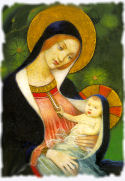
In art, Mary is traditionall portrayed in blue. Her other attributes are a blue mantle, crown of 12 stars, pregnant woman, roses, and/or woman with child.

Hundreds of thousands of pieces of Marian artwork and sculptures have been created over the years from the best and most brilliant artists, like Michelangelo and Botticell, to simple peasant artists. Some of the most early examples of veneration of Mary is documented in the Catacombs of Rome. Catacomb paintings show Mary the Blessed Virgin with her son.

The confidence that each person should have in Mary was expressed by Pope Pius IX in the encyclical Ubipriinum : "The foundation of all our confidence. . . is found in the Blessed Virgin Mary. For God has committed to Mary the treasury of all good things, in order that everyone may know that through her are obtained every hope, every grace, and all salvation. For this is his will, that we obtain everything through Mary."

Monday, January 1, 2024

Before the New Year begin the praying of 1st Vespers and Te Deum


Pope at Te Deum: May our hearts be filled with gratitude and hope

Pope Francis presides over the traditional end of the year celebration of First Vespers on the Solemnity of Mary, Mother of God, and the singing of the Te Deum, the Church’s solemn hymn of Thanksgiving for the past year, taking place in Saint Peter's Basilica on New Year's Eve.

By Thaddeus Jones

Pope Francis led the 31 December evening celebration of First Vespers on the Solmenity of Mary, Mother of God, and the singing of the Te Deum hymn of Thanksgiving for the past year, in Saint Peter's Basilica. Around 6,500 participants gathered in the Basilica for the traditional end-of-the-year celebration. Many others awaited the Pope outside the Basilica following the celebration as he made his traditional in-person visit to the Nativity Scene in Saint Peter's Square next to the tall Christmas tree.

In his homily for the occasion, Pope Francis reflected on gratitude and hope and how faith enables us to live both differently from a worldy mentality. That is because "faith in Jesus Christ, God incarnate, born of the Virgin Mary, gives a new way of experiencing time and life" helping us be grateful to God and see the future with hope that goes beyond a feeling of satisfaction and optimism. 

Giving thanks to God

While most people may give thanks on the last night of the calendar year, sometimes the "essential dimension" is missing, that of our relationship with God and our brothers and sisters, the Pope said. He explained how in this liturgy, culminating in the great hymn of thanksgiving, Te Deum laudamus, our faith-inspired "praise, wonder, gratitude" comes with the celebration of the Lord's birth and learning from the Virgin Mother, Mary.

Gratitude in our hearts

The Pope suggested we think about the immense gratitude in Mary's heart as she looked upon the newborn Jesus, the astounding depth of the experience as the Mother of God, knowing with Joseph where the Child came from, yet His "breathing, crying, needing to eat, to be covered, cared for." 

Pilgrims of hope

The Church learns gratitude, but also hope, the Pope explained, as Mary was full of hope, filled with grace, and therefore abounding in trust and hope. And this is not just optimism, but "faith in God who is faithful to his promises," a faith that "takes the form of hope" in the dimension of time in which we are journeying. "The Christian, like Mary, is a pilgrim of hope."

Jubilee 2025

The Pope then recalled that the theme of the Jubilee 2025 is precisely, "Pilgrims of Hope." He conveyed his wish that Rome prepare to be a "city of hope" with the good witness of the Church and civil communities together, "a witness that, more than in events, consists in the style of life, the ethical and spiritual quality of our living together."

As a simple example, he suggested that a good welcome should be assured for those visiting Saint Peter's Basilica which draws people of all nationalities, cultures and religions. Also, he suggested it would be good if the elderly and those with physical challenges might be able to visit and appreciate the beauty of Rome's perennial and universal historic center, matched with greater functionality and living conditions for citizens and visitors.

Prayerful preparation

In conclusion, the Pope recalled how a pilgrimage, especially a unique one like that of the Jubilee, calls for good preparation ahead of it. And that is why 2024 will be dedicated to prayer. The Blessed Mother can teach us much here, he added, as we can "live each day, each moment, each effort with our inner gaze turned to Jesus. Joys and sorrows, satisfactions and challenges. All in the presence and with the grace of Jesus, the Lord. All with gratitude and hope."