Showing posts with label Immaculate conception. Show all posts

Monday, December 8, 2025

On the Solemnity of the Immaculate Conception Pope Leo XIV delivers Angelus Address


Pope at Angelus: Believe as Mary believed, say ‘yes’ to God

On the Solemnity of the Immaculate Conception, Pope Leo XIV prays the Angelus and invites the faithful to believe as Mary did, and to welcome Christ into their lives.

By Isabella H. de Carvalho

On Monday, December 8, Solemnity of the Immaculate Conception, Pope Leo XIV encouraged the faithful to believe in God as the Blessed Virgin Mary did and thus give “our generous assent to the mission to which the Lord calls us”.

He spoke to the crowds gathered in St. Peter’s Square for the recitation of the Angelus prayer on this feast day, where the Church celebrates how Mary, at the moment of her conception, was preserved from original sin by a unique grace from God, given in view of the future merits of Christ’s redemption.

“The ‘yes’ of the Mother of the Lord is wonderful, but so also can ours be, renewed each day faithfully, with gratitude, humility and perseverance, in prayer and in concrete acts of love, from the most extraordinary gestures to the most mundane and ordinary efforts and acts of service,” the Pope emphasized.

“In this way, Christ can be known, welcomed and loved everywhere, and salvation can come to everyone.”

The Pope leaves us free to accept what he gives us

In his address, the Pope highlighted how the Lord gave the Virgin Mary “the extraordinary grace of a completely pure heart” in light of the coming of Christ. As the Angel Gabriel greeted her by saying “Hail, full of grace: the Lord is with you,” she discovered and welcomed her mission “with the wonder typical of the humble,” the Pope continued.

“With faith she responded with her ‘yes’: ‘Behold, I am the handmaid of the Lord; let it be to me according to your word’,” the Pope explained, citing the Gospel of Luke, verse 38.

He emphasized how this grace was able to bear fruit in Mary “because she, in her freedom, welcomed it, embracing the plan of God.” “The Lord always acts in this way: he gives us great gifts, but he leaves us free to accept them or not,” the Pope insisted.

He, in fact, cited St. Augustine, who said “we also believe, because that which came to be [in her] can also benefit us.” Pope Leo thus encouraged the faithful to believe simply as the Blessed Virgin did and welcome whatever mission God calls one to.

The importance of our Baptism

The Pope also highlighted the importance of the sacrament of Baptism in allowing Jesus to enter one’s life: “The miracle, which took place at Mary’s conception, was renewed for us in Baptism: cleansed from original sin, we have become children of God, his dwelling place and the temple of his Spirit.”

He explained that just as Mary, “by means of a special grace,” was able to welcome Christ in herself and then bring him to others, so too the sacrament of Baptism allows Jesus “to live in us and allows us to live united with him, to cooperate in the Church, each according to his or her condition, for the transformation of the world.”

Afternoon appointment in Piazza di Spagna

After having greeted various groups present in St Peter's Square, the Pope reminded the faithful that during the afternoon, he would pay homage to the Virgin Mary at the feet of the Spanish Steps in Rome, where a statue of Our Lady stands.

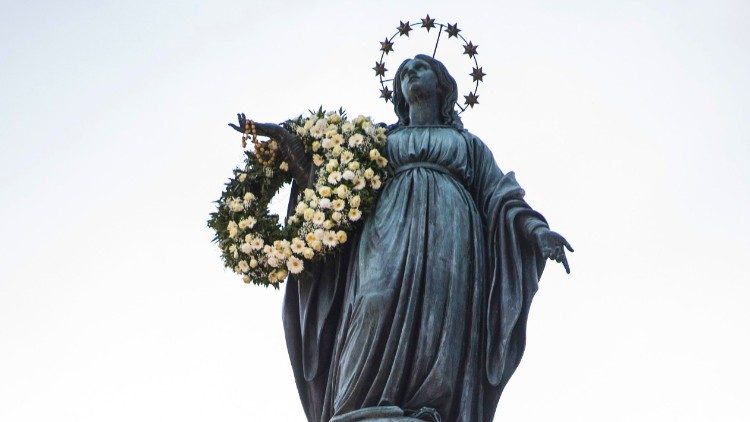
Every year, on the feast of the Immaculate Conception, the Pope crosses the city bringing a basket of flowers that he lays at the base of the column on which she is placed. Earlier in the day, a team of firemen take their own posy of flowers to the top of the 27-meter column and place it in her arms.

Pope Leo XIV continues Papal Tradition of Praying at the Immaculate Conception monument in Rome


Pope Leo offers a bouquet of flowers at the base of the 12 meter tall column of the Virgin MaryPope Leo offers a bouquet of flowers at the base of the 12 meter tall column of the Virgin Mary  (@Vatican Media)

Pope Leo: Blessed Virgin Mary, watch over this humanity

Continuing a decades-old tradition of paying homage to the statue of the Immaculate Conception in Rome, Pope Leo prays at the foot of the 12-meter column on top of which the figure of the Virgin Mary is placed, and lays a wreath at the base.

By Kielce Gussie

Within 100 years of the proclamation of the dogma of the Immaculate Conception, the tradition of sending flowers to the statue of the Blessed Virgin Mary in the Piazza di Spagna in Rome had begun with Pope Pius XII. A few years later in 1958, Pope Saint John XXIII went to Piazza di Spagna and placed a basket of white roses at the foot of the statue.


Pope Leo made his way through the streets of Rome in the popemobile to the Piazza di Spagna  (@Vatican Media)

Continuing this decades-old practice started by his predecessors, Pope Leo XIV marked 8 December—the Solemnity of the Immaculate Conception—with a visit to the Piazza di Spagna.

A moment for Mary

As the Holy Father arrived in the Piazza di Spagna, the choir and assembly sang a Marian hymn entitled “You rise more beautiful than the dawn”. The Vicar of Rome, Cardinal Baldassare Reina and the Mayor of Rome, Roberto Gualtieri, welcomed the Pope as he arrived.

After an opening prayer, Pope Leo offered a bouquet of flowers at the base of the 12 meter (39-foot) tall column of the Immaculate Virgin and the choir prayed the Litany of the Blessed Virgin Mary in song.

This tradition dates back to the 1900s (@Vatican Media)


Then the Pope offered a prayer dedicated to the Virgin:

Hail, O Mary! Rejoice, full of grace, filled with that grace which, like a gentle light, makes radiant all those on whom the presence of God shines. The Mystery has wrapped you round from the beginning; from your mother’s womb it began to accomplish great things in you, things that soon asked for your consent—that “Yes” which inspired so many other “yeses.”

Immaculate one, Mother of a faithful people, your purity bathes Rome in eternal light, your path fills its streets with a fragrance sweeter than the flowers we offer you today. Many pilgrims from all over the world, O Immaculate Virgin, have walked the streets of this city throughout history and in this jubilee year. A humanity tested, at times crushed, humble as the very earth from which God shaped it and into which He does not cease to breathe His life-giving Spirit.

Look, O Mary, upon so many sons and daughters whose hope has not been extinguished: may what your Son has sown in them take root and grow—He, the living Word, who in each person asks to grow still more, to take on flesh, face, and voice. May jubilee hope blossom in Rome and in every corner of the earth, hope in the new world God is preparing, of which you, O Virgin, are like the bud and the dawn. After the holy doors, may other doors now open—doors of homes and oases of peace where dignity may flourish again, where people may learn nonviolence and the art of reconciliation.


May the kingdom of God come—the newness you longed for so deeply and to which you opened yourself completely, as a child, as a young woman, and as mother of the nascent Church. Inspire new insights in the Church that journeys in Rome and in the particular Churches which, in every context, gather up the joys and hopes, the griefs and anxieties of our contemporaries—especially the poor and all those who suffer.

May baptism continue to bring forth men and women holy and immaculate, called to become living members of the Body of Christ—a Body that acts, consoles, reconciles, and transforms the earthly city in which the City of God is being prepared. Intercede for us, grappling with changes that seem to find us unprepared and powerless. Inspire dreams, visions, and courage—you who know better than anyone that nothing is impossible for God, and also that God does nothing alone.

Set us on our way, with the haste that once moved your steps toward your cousin Elizabeth, and with the trembling eagerness with which you became an exile and pilgrim—to be blessed, yes, but blessed among all women, first disciple of your Son, mother of God-with-us. Help us to be always a Church with and among the people, leaven in the dough of a humanity crying out for justice and hope. Immaculate one, woman of infinite beauty, watch over this city, over this humanity. Point them to Jesus, lead them to Jesus, present them to Jesus. Mother, Queen of Peace, pray for us.

Before departing the Piazza, Pope Leo spent time greeting a number of the 30,000 people gathered for the event—a number of children, the elderly and the sick.

Sunday, December 7, 2025

December 8th: The Solemnity of the Immaculate Conception of the Blessed Virgin Mary


What is the feast of the Immaculate Conception?


Stained Glass in the Church of Tervuren, Belgium, depicting Mother Mary and the Dogma of the Immaculate Conception

While most consistently church-going Catholics will know this, it is a common misconception (pun intended) that the Feast of the Immaculate Conception—the Holy Day of Obligation taking place December 8—refers to the conception of Jesus.

It’s easy to understand why. Jesus was conceived by the Holy Spirit in the womb of the Virgin Mary. That is certainly immaculate. However, the Feast of the Immaculate Conception actually refers to the conception of Mary—that she was preserved as a perfect vessel for God to enter the world, free from original sin.

The Catholic doctrine of Mary’s sinless birth is an important distinguisher of the Catholic Church from the Eastern Orthodox churches and offers the most complete, theologically sound interpretation of Scripture from the very beginning.

Two key verses set the stage for the doctrine. The first comes early in Genesis: “I will put enmity between you and the woman, and between your offspring and hers; he will crush your head, and you will strike his heel” (Genesis 3:15). This verse is often referred to as the “protoevangelium,” the first prophecy referring to Jesus’ redemption of humanity after our fall. The Catholic Church identifies Mary as the woman, the “new Eve,” a belief posited by the earliest Church fathers, such as Saint Irenaeus, the bishop of Lyon in the second century. He wrote in his work Against Heresies that Mary reverses the fall caused by Eve’s disobedience because Mary “was obedient and became the cause of salvation for herself and the whole human race.” Saint Irenaeus’ teaching was rooted in Saint Paul’s doctrine of Christ as the “Last Adam,” thus implying Mary as the “New Eve.”

The second verse forming the basis of Mary’s Immaculate Conception comes from the Gospel of Luke, with the angel Gabriel’s greeting to Mary: “Hail, full of grace, the Lord is with you” (Luke, 1:28). The phrase “full of grace,” which is now part of the Hail Mary prayer, is translated from the Greek phrase kecharitōmenē, which is a perfect passive participle that conveys a permanent and enduring state of grace for Mary, implying that she had always been in a state of grace and was not touched by Original Sin. Additionally, the word was used in place of a name or title for Mary, further strengthening the belief that her role in Salvation was specially ordained by God from the beginning.

Thus, the idea that Mary was born without sin was a part of Catholic teaching from the first century and onward. However, an important debate took place in the Middle Ages—how could Mary be free from original sin while still needing redemption through Christ? This was important because, unlike Jesus, Mary was not divine and therefore was in need of salvation. Yet, if she was born without sin, why would she need salvation? This deadlock prevented the doctrine from being formally adopted by the Church for many years.

The resolution came from Franciscan Friar John Duns Scotus (Scotus coming from the Latin Scotia, referring to his native Scotland) in the early 13th Century. Scotus defended the Immaculate Conception by arguing that Mary was essentially preemptively redeemed by Christ. He referred to this as a “preservative” redemption and articulated that this was indeed a “more perfect form” of redemption, because it was better to preserve one from sin than to save them after it has occurred. Furthermore, this “preservative” redemption only serves to further exalt Christ as Redeemer, while rightfully acknowledging Mary’s reliance on His salvation.

Scotus’ elegant solution properly exalted Jesus as Savior and proved Mary as Immaculately Conceived, while maintaining centuries of Catholic canon. Scotus was so persuasive in his defense of the Immaculate Conception that the University of Paris, where he taught, officially adopted his argument.

Understanding the implications of the Immaculate Conception is not only important for comprehending the Catholic Church’s Mariology, but also to properly conceiving something of the nature of God—as much as we are able to do so.

In other words, it is important to distinguish that God is not “bound” by some force or circumstance outside of His control, in the sense that He could not enter the world except through a perfect vessel. Rather, the Immaculate Conception was a “fitting” gift made for the Second Eve—whom God knew would be faithful, because of His perfectly just nature—as an adornment of the even more gracious gift of the Incarnation. Put simply, the Immaculate Conception occurred because God is perfect and just—not because it was a constraint.

While his argument still generated dissent among certain groups of the clergy for centuries, Scotus’ interpretation became the most prevalent and popularly accepted reasoning for the Immaculate Conception. It was not, however, definitively declared as a dogmatic teaching of the Church until Pope Pius IX’s decree in the papal bull Ineffabilis Deus, issued in 1854.

Just four years later, in the Marian apparition at Lourdes, Bernadette Soubirous reported that the Blessed Mother announced herself as “The Immaculate Conception,” seemingly offering confirmation from heaven that the dogma was appropriate.

Thursday, December 4, 2025

Pope Leo XIV will continue a papal tradition in Rome for the Solemnity of the Immaculate Conception


The statue of Our Lady with a wreath of flowers for the Solemnity of the Immaculate Conception in 2017The statue of Our Lady with a wreath of flowers for the Solemnity of the Immaculate Conception in 2017 

Pope Leo to continue traditional visit for Immaculate Conception

On the Solemnity of the Immaculate Conception, Pope Leo XIV will continue the papal tradition of visiting the statue of the Blessed Virgin Mary near Rome’s Spanish Steps.

By Vatican News

Tradition and devotion intertwine in the “homage” or veneration paid to the Blessed Virgin Mary, on the occasion of the solemnity of the Immaculate Conception, celebrated each year on 8 December.

Each year, representatives of the city and various religious and civic organisations pray and offer flowers at the statue of the Virgin in Piazza Mignanelli, near the famous Spanish Steps in the heart of Rome. This year, Pope Leo XIV will take part in the traditional act of devotion, following in the footsteps of his predecessors, including Benedict XVI and St John Paul II.

Last year, on 8 December 2024, it was Pope Francis who prayed at the feet of Mary and entrusted to her the upcoming Jubilee, “a message of hope for humanity tried by crises and wars.” Now, just a few weeks before the conclusion of the Holy Year, Pope Leo returns to the feet of Our Lady.

Pope Leo’s visit

In a statement issued on Wednesday, the Vicariate of Rome announced that, as is tradition, the first to leave flowers at the statue of the Immaculate Conception will be the fire brigade, who, at 7 a.m., will climb to the top to place their wreath of flowers on the Virgin's arm.

In the afternoon, at 4 p.m., the Pope will arrive and be welcomed by the Cardinal Vicar of the Diocese of Rome, Baldo Reina, and Rome’s mayor, Roberto Gualtieri. He will pause in prayer at the foot of the 12-metre-high column, at the top of which stands the statue of Our Lady, and leave a wreath of flowers.

The Solemnity will feature a series of events throughout the day: at 8:30 a.m., the Vatican Gendarmerie band will perform a hymn to the Madonna; then the parish of Sant'Andrea delle Fratte, the Sovereign Order of Malta, the Legio Mariae, the Circolo S. Pietro, the Don Gnocchi Foundation, Unitalsi, and various educational institutions will perform.

At 9 a.m., in the church of Trinità dei Monti, there will be Mass, presided over by Monsignor Francesco Pesce, diocesan representative for social and labour pastoral care, with workers from several Roman companies.

A novena to Mary

The Conventual Friars Minor (Franciscans) of the Basilica of the Twelve Holy Apostles will also be hosting various events throughout the day. Among other things, the church hosts the oldest novena to the Immaculate Conception in Rome: from 29 November to 7 December, every day at 5:45 pm, the Rosary in the Church, followed by the singing of various litanies; then, at 6.30 pm, Mass is introduced by the singing of “Tota Pulchra”, composed by the Conventual Franciscan Alessandro Borroni.

Each day of the novena will see a different Cardinal presiding over the main Mass in the Basilica.

Sunday, December 8, 2024

With the Immaculate Conception transferred to December 9th; how about a little tutorial


Mary’s Perfect ‘Yes’: Why the Immaculate Conception Was Fitting for Salvation


COMMENTARY: The ‘singular grace and privilege’ of the New Eve was God’s preparation for her fiat.


Immaculate Conception. Guido Reni, 1627. (photo: Metropolitan Museum of Art in New York / Public Domain )

This year is the 170th anniversary of the promulgation of the dogma of the Immaculate Conception by Pope Pius IX in his encyclical Ineffabilis Deus (1854), which declared that the Virgin Mary, “from the first moment of her conception … was, by the singular grace and privilege of Almighty God, and in view of the merits of Jesus Christ, Savior of Mankind, kept free from all stain of original sin.” 

And of course, it was just four years later in 1858 when Mary appeared to the young French peasant girl Bernadette Soubirous at Lourdes, and declared to her, “I am the Immaculate Conception” in a manner that indicated she was offering this as a definitive title for her deepest identity. 

What the Immaculate Conception Means 

Many Protestants, and indeed not a few Catholics, confuse the dogma of Mary’s Immaculate Conception with the virginal conception and birth of Jesus. And so we need to be very clear about what it is we are celebrating this Dec. 8. 

In essence, what we are commemorating is the affirmation that Mary was sinless throughout her entire life, and that this began at the very moment of her conception. From the beginning of her existence, God engraced her fully and preserved her soul from any “stain” of original sin, thus preserving her from the spiritual and moral entropy it creates in all the rest of us. 

What this means is that Mary was not only without sin, but that she was free from all disordered concupiscence in her life and was not prone to any inherent moral weaknesses of any kind. She was granted the grace of living in the presence of God through an immediacy in her soul that allowed her to live a life of perfect, ongoing, moral and spiritual integrity. 

However, she, like her son, had to live within the regime of sin created by the Fall, and she too was the target of the Tempter’s outward assault on her inner holiness. She too was capable of suffering (“A sword will pierce your soul,” Luke 2:35).  

But she, unlike Eve, persevered to the end. Eve was also created without concupiscence and without sin, and yet she still freely chose to sin. But Mary did not sin, and thus she is the “New Eve” who is now the mother to all the baptized who have sacramentally died and risen with Christ. She is the living Ark of the Covenant whose very body was the nurturing home to the flesh of her Son, and not a mere box that was a passive repository for the stones of the Law.  

Two Common Misunderstandings 

But let us be clear about a few things that are often misunderstood. 

First, Mary did need to be “saved” by Christ insofar as she, too, would have been born with original sin had God not preveniently applied the merits of Christ’s atoning death to her. Christ alone is the human being who did not need to be saved from original sin.  

Mary is not, therefore, some kind of goddess figure who, in a sense, stands side by side with Christ as the feminine consort to his masculinity, as one often saw in ancient paganism where male and female deities were portrayed as divine duos that exemplified the masculine and feminine principles of existence. There is no hint of that in the biblical Revelation, and certainly, the dogma of Mary’s Immaculate Conception is in no way a divinizing of Mary or an exempting of her from the economy of salvation completed by Christ. 

Second, the theological reason her Immaculate Conception is “fitting” in the economy of salvation is not rooted in the idea that Jesus, being sinless, could not have been conceived by someone who was a sinner. Such reasoning suggests he could have been “contaminated” by her sinfulness, either in utero or during his upbringing. But this logic would require that Mary herself be conceived and raised by a sinless person, and her mother, St. Anne, as well — leading to an endless regress of sinless ancestors. 

Why the Immaculate Conception Is Fitting 

The issue, therefore, is not one of contamination or the theological impossibility of the sinless savior being born of a sinful mother. The answer as to the fittingness of the Immaculate Conception in the economy of salvation can be seen in the Church’s selection of the Gospel of Luke’s account of the Annunciation for the liturgical celebration of the event (1:26-38).  

The Church is highlighting the fact that the purpose behind the Immaculate Conception was precisely to prepare Mary for this moment. To make her fiat — “May it be done to me according to your word” — the perfect “Yes” to God and the perfect covenant response to God’s many overtures to Israel.  

This covenant aspect is precisely why Mary’s perfect fiat is so central to the narrative of salvation and thus, to our understanding of the nature of Revelation and the Tradition that flows out of it. God would not enter fully into human history until Israel freely and fully accepted God’s overtures of grace in the Abrahamic and Mosaic covenants. But due to sin, Israel could not give that perfect and free “Yes” to God.  

Truths about God had indeed been revealed to Israel, but they were theological truths that were constitutively relational insofar as their entire internal structure and logic tied “truth” to the very mystery and personhood of God — a God who desired communion with his creatures. Thus, God could not force or coerce a free response out of Israel to his “truth” without violating the very internal logic of that truth. The communion he sought was a free one, born in the heart, and not merely a forensic application of the various “obligations” of the Law.  

How often did the prophets drive this point home in their insistence that God desires not sacrifices of bulls and sheep, but a humble heart that freely embraces his love? And is this not what made Israel’s covenants with Yahweh so radically different from the ancient Mesopotamian treaties that emphasized strictly forensic and servile obedience to the king in exchange for favorable treatment? 

The Quiet ‘Yes’ That Shook Creation 

Mary is thus, as Cardinal Joseph Ratzinger pointed out, the “Daughter Zion” who represents all of Israel — indeed all of humanity as well — when she, in her sinlessness, offers to God the first fully and truly free “Yes” to his request to be allowed into human history in a complete way. And the importance of her “Yes” can be seen in the fact that after she utters it, the narrative tersely, but sweetly, ends: “Then the angel departed from her” (Luke 1:38). 

The world took no notice of her “Yes,” uttered as it was in the quiet solitude of her home in Nazareth. Caesar slept soundly without disturbance. But Heaven shook, its portals opened to the earthly depths below, and the angels wept for joy. 

As the future Pope Benedict XVI notes, the term the Angel Gabriel applies to Mary in his greeting, which we translate as “full of grace,” was the Greek term kecharitomene, which means one who has been uniquely favored with a fullness of divine grace. It was a term associated with the “Daughter Zion” motif of the Old Testament. Cardinal Ratzinger therefore makes the point that Luke is portraying Mary here as the typological fulfillment of all of God’s covenant expectations of Israel: 

“The salutation to Mary (Luke 1:28-32) is modeled closely on Zephaniah 3:14-17: Mary is the daughter Zion addressed here, summoned to ‘rejoice’, informed that the Lord is coming to her. Her fear is removed, since the Lord is in her midst to save her. … In the address of the angel, the underlying motif in the Lucan portrait of Mary surfaces: she is in person the true Zion, toward whom hopes have yearned throughout all the devastations of history. She is the true Israel in whom Old and New Covenant, Israel and Church, are indivisibly one. She is the ‘people of God’ bearing fruit through God’s gracious power.” 

Therefore, as we celebrate this beautiful feast of the Church this year, let our prayer also be that of Mary, our Mother: “May it be done to me according to your word.” And with her fiat centered in our spiritual lives, let us “allow” the Holy Spirit into our souls “to make straight the way of the Lord.” 

Sunday Angelus Address 12.08.2024


Pope: Place your hopes in God's infinite mercy

At the Sunday Angelus Pope Francis encourages us to open our hearts and minds to the Lord Jesus, born of Mary Immaculate, as we ask for her intercession so that the Lord might come and dwell in our lives.

By Thaddeus Jones

Speaking to the crowds gathered in Saint Peter's Square for the Sunday Angelus on today's Solemnity of the Immaculate Conception, Pope Francis reflected on today's Gospel which recounts "one of the most important and beautiful moments in the history of humanity: the Annunciation." The Blessed Virgin Mary gives her “yes” to the Archangel Gabriel permitting the Incarnation of the Son of God, Jesus. The Pope describes this scene as one of great wonder and emotion "because God, the Most High, the Omnipotent, by means of the Angel dialogues with a young girl from Nazareth, asking for her collaboration for His plan of salvation."

Divine and human encounter

Recalling Michelangelo's famous masterpiece in the Sistine Chapel of the scene of the creation of Adam, where the finger of the heavenly Father touches the finger of the man, the Pope explained how here also human and the divine encounter each other when the Virgin Mary pronounces her “yes”. She came from a small remote village and "on her answer depends the fate of humanity, which can smile and hope again, because its destiny has been placed in good hands."

"Full of Grace"

Mary is “full of grace” as the Archangel Gabriel greets her, the Pope recalled, as she is "the Immaculate, entirely at the service of the Word of God, always with the Lord, to whom she entrusts herself completely." Her blessedness will be celebrated by all generations, the Pope said, and may we too "rejoice because the Immaculate has given us Jesus our salvation!"

Where do I place my hope?

The Pope then suggested we ask ourselves where we place our hopes - in money, powerful friends, or rather "in God's infinite mercy?" In our world ravaged by wars and emphasizing efforts to possess and dominate, promoting shiny false models for happiness, "Where is the treasure of my heart," the Pope asked. Should we not embrace "the fact that God loves me freely, that His love always goes before me, and is ready to forgive me when I return repentant to Him," the Pope asked in conclusion.

Jubilee of hope

As we approach Jubilee 2025 and the opening of the Holy Door in the coming weeks, the Pope prayed that we may also open our hearts and minds to the Lord Jesus, born of Mary Immaculate, and may we implore her intercession. And he encouraged everyone to go to Confession during these days as the Sacrament that can really help us open our hearts to the Lord who always, always forgives us.