Showing posts with label vocations. Show all posts

Wednesday, September 30, 2026

A boom in vocations to the Priesthood in Archdiocese of Baltimore


Archbishop William E. Lori prays as 12 candidates to the transitional diaconate kneel during their ordination Mass May 16, 2026, at the Cathedral of Mary Our Queen in Homeland. They are expected to be ordained priests in 2027, the largest number of priests ordained for the Archdiocese of Baltimore in a single year in more than half a decade. (Kevin J. Parks.CR Staff)

With 66 seminarians in formation, Archdiocese of Baltimore sees vocations surge 


By


The Archdiocese of Baltimore is preparing for a milestone not seen in more than half a century: the ordination of 12 new priests in a single year.

One seminarian is expected to be ordained in January and 11 more in June, as the archdiocese’s number of men in priestly formation continues to climb.
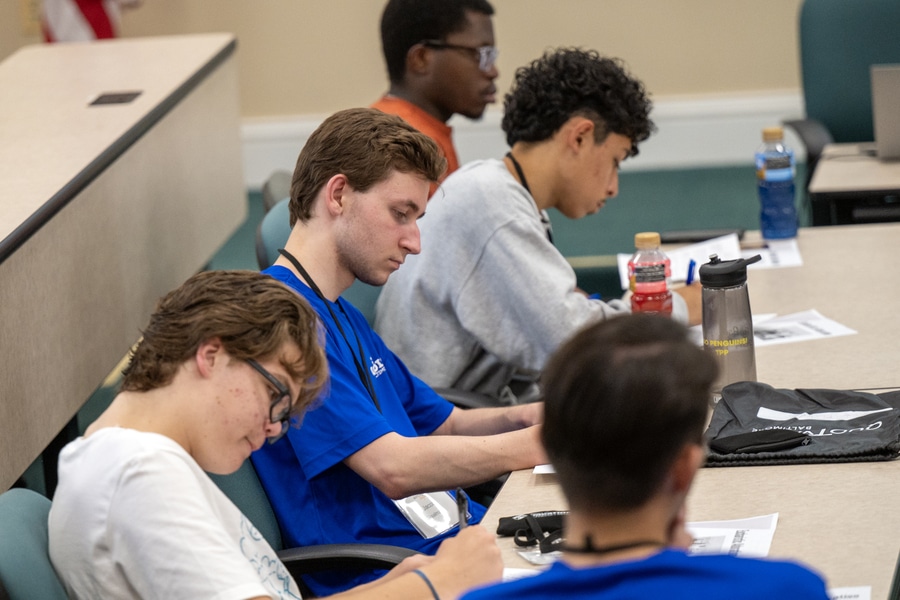
Jacob Paalmana, a member of the Class of 2026 at Chesterton Academy of Annapolis, along with fellow recent high school graduates, take notes during a talk on June 18 by Father Erik Arnold, pastor of St. John the Evangelist in Severna Park. The discussion focused on relationships and was part of the Quo Vadis Beyond experience for recent high school graduates at St. Mary’s Seminary and University in Roland Park. (Kevin J. Parks/CR Staff)

The archdiocese now has 66 seminarians in formation, with 14 men entering this year alone. Representing 14 different parishes and ranging in age from 17 to 36, the newest seminarians are part of a yearslong increase that Church leaders attribute to prayer, intentional vocational outreach and stronger support from parishes.

The total number of seminarians is up from 28 in 2007 and 52 in 2020.

For Archbishop William E. Lori, who has led the archdiocese for 14 years, the growth is among the great joys of his tenure.

“This has not been sudden,” said Archbishop Lori, who ordained five men to the priesthood this year. “It’s been building every year, and this is due to a lot of people praying before the Blessed Sacrament. It’s due to a good vocations team. It’s also due to pastors who are encouraging vocations in their parishes – and to parents who are generously open to the possibility that their son might have a priestly vocation.”

The surge has filled both of the archdiocese’s propaedeutic houses, in Emmitsburg and Baltimore, to capacity. Three of this year’s new seminarians will spend their propaedeutic year – a foundational period of prayer, discernment and human formation – at the Basilica of the National Shrine of the Assumption of the Blessed Virgin Mary in Baltimore instead, taking part in the Source of All Hope urban missionary program serving people experiencing homelessness.
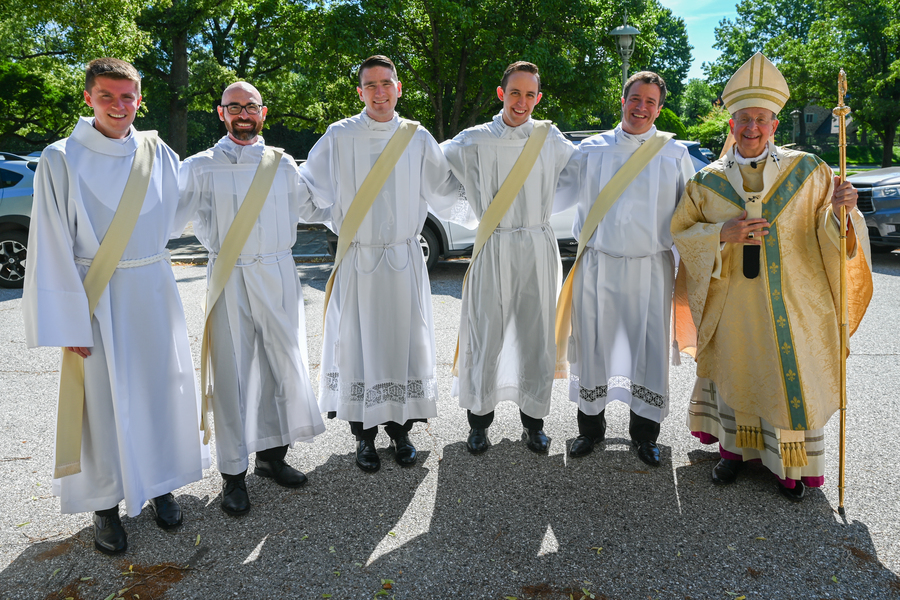
Archbishop William E. Lori poses with the five men ordained to the priesthood June 20, 2026, at the Cathedral of Mary Our Queen in Homeland. There will be 12 men ordained to the priesthood next year. (Kevin J. Parks/CR Staff)

Father Steven Roth, vocations director and associate vicar for clergy for the archdiocese, said the growing number of men discerning the priesthood is encouraging, but he’s even more proud of the caliber of those stepping forward. 

“These are hardworking, talented guys who really could do anything else, and they’re freely choosing to discern whether the Lord is calling them to be a priest,” Father Roth said.

The influx is already changing pastoral life in the archdiocese, allowing new placements in ministries that have gone without priests for years – including high school and college chaplaincies and parishes that haven’t had an associate pastor in a generation.

Depending on a man’s educational background, formation for the priesthood can take up to nine years, Father Roth said. The lengthy process reflects the Church’s desire to form the whole person.

Alongside academic studies, seminarians receive spiritual direction, gain experience in parish ministry and meet regularly with priests and formators as they discern their vocation. They undergo background checks before being accepted into the program.
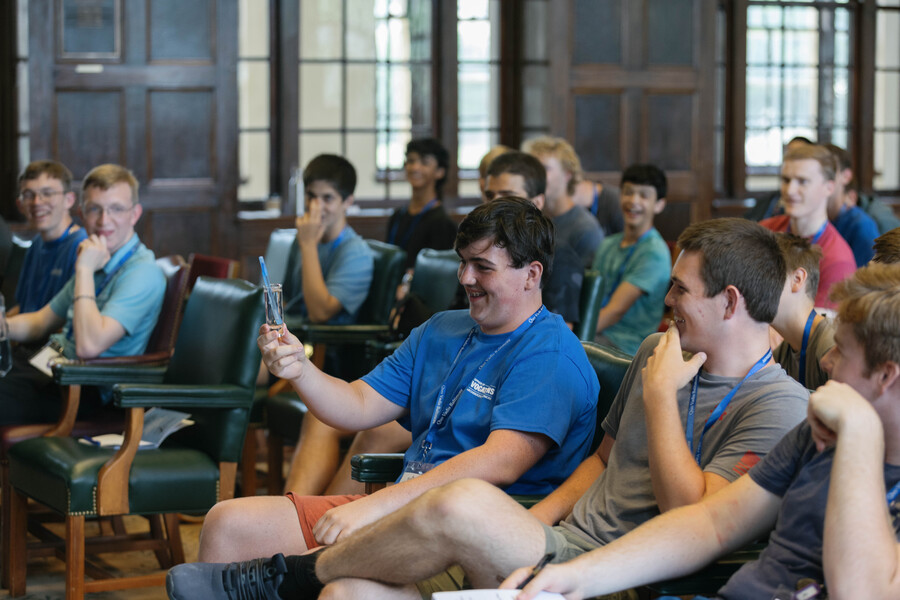
Participants of the Quo Vadis Beyond experience laugh together during a discussion at St. Mary’s Seminary and University in Roland Park. (Stephen Herrera/Special to the Catholic Review)

Formation is also a time of discernment, Father Roth explained, both for the Church and for the seminarians. The goal is to give men the time and support they need to understand God’s call and prepare for ministry.

“We don’t rush it,” Father Roth said. “By the time that the Lord is calling them to be a priest, they’re ready and capable and able to say yes to that call.”

Father Roth is assisted by Father Lenin Suarez, associate director of vocations, whom Father Roth said has been building up the office’s online resources. In an increasingly digital age, the goal is to make essential information available to men discerning a vocation before they ever sit down with a priest – giving them a way to work through questions they might be hesitant to raise in person.

Veimar Martinez, 18, a parishioner of St. John in Westminster and a graduate of Westminster High School, is among the archdiocese’s newest seminarians.

Serving as an usher at his home parish was “life-changing,” he said, giving him an inside look at both the parish’s inner workings and the liturgy itself. He later became involved with the Boys and Girls Club, working with young people from a range of backgrounds.
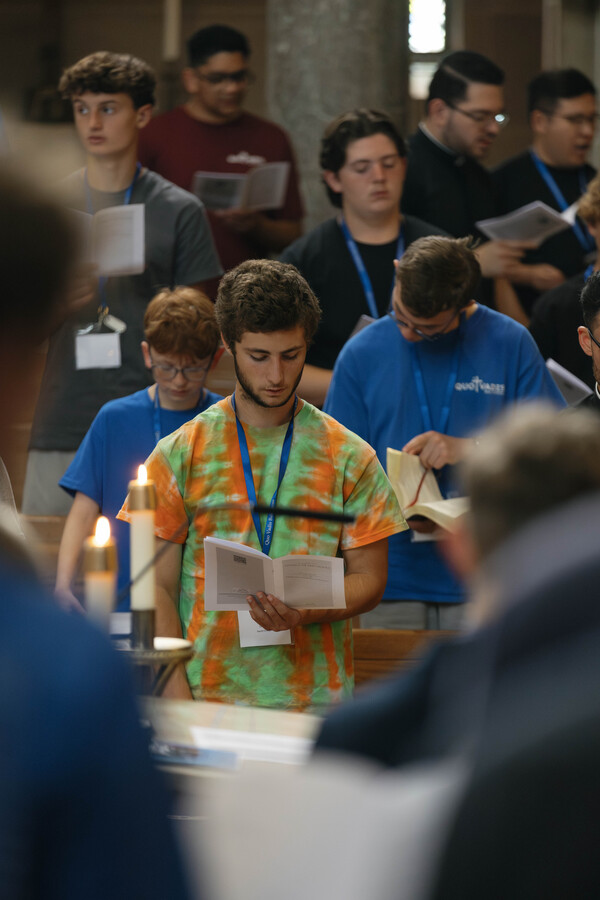
Young men gather during the Quo Vadis Beyond experience for recent high school graduates at St. Mary’s Seminary and University in Roland Park. (Stephen Herrera/Special to the Catholic Review)

“A full circle for me was that my mom taught me my faith, and then here I am teaching other kids the faith,” Martinez said.

He traces his first step toward discernment to 2024, when a confession led to a penance of an hour in eucharistic adoration.

“I felt I was in a relatively rough spot at the time, and then when I stepped in there, everything I felt was like a weight was lifted off me,” he said. “It felt lighter. I felt warm. I felt loved in that room, and eucharistic adoration is something that’s very important to me.”

Father Roth pointed to archdiocesan programs including the Quo Vadis retreat, designed to help young men listen for God’s voice, and a new offshoot introduced this year, Quo Vadis Beyond, aimed at recent high school graduates.

Those efforts are reaching an increasingly diverse group of young men.

For the first time in many years, two African Americans have entered priestly formation. While several Black men from Africa have been ordained to the priesthood for the Archdiocese of Baltimore in recent years, it has been more than three decades since an African American was ordained for the archdiocese. 

Father Roth recalled a visit with young African American parishioners years ago. They told him they hadn’t realized they were needed and they didn’t know they were wanted.
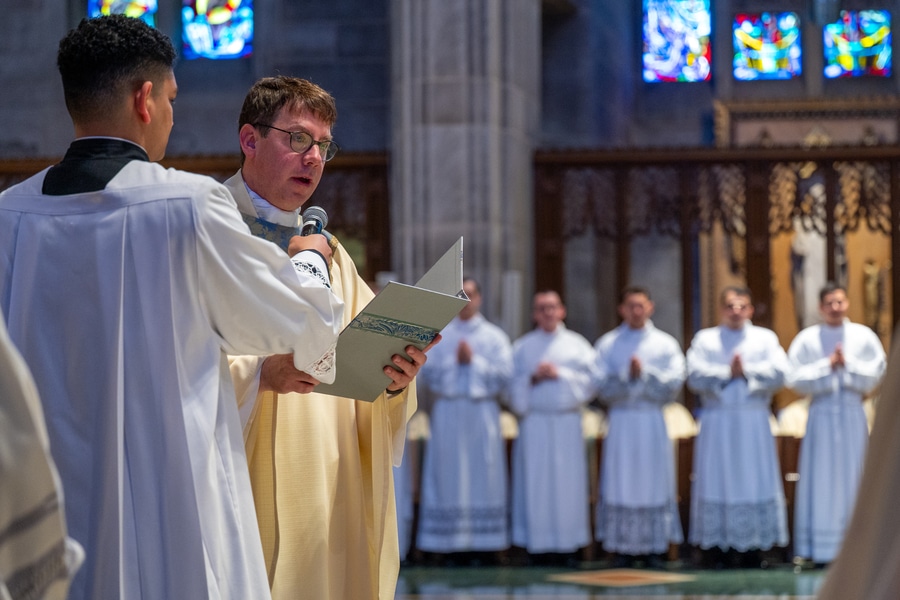
Father Steven Roth, vocations director and associate vicar for clergy, presents 12 seminarians to be ordained to the transitional diaconate May 16, 2026, at the Cathedral of Mary Our Queen in Homeland. (Kevin J. Parks/CR Staff)

“I thought we really need to fix this,” he said. “We have such a diverse archdiocese that we celebrate, and I just want to be sure that our clergy reflects that diversity.”

Despite the growth, Father Roth warned that now is not the time to “rest on our laurels.” He encouraged constant prayer for religious vocations and said he sees every Catholic as a vocations director.

“I would encourage people that when they’re at church, at Mass or different events, and they see a young person who they think has the qualities that they like – that they see in their pastor as well – to not be afraid to go up to the person and say, ‘Have you ever thought about becoming a priest?'” he said. 

Jenna Mattern contributed to this story.

Monday, August 17, 2026

The story of vocation growth & success from Charlotte, North Carolina and Kansas & Virginia too


‘It’s always the Holy Spirit’: Meet 3 dioceses seeing large numbers of priestly ordinations

Multiple dioceses throughout the U.S. are bucking national trends and seeing large numbers of men discern into the priesthood.


Seminarians in the Diocese of Charlotte stand together prior to their ordination, March 14, 2025. | Credit: Photo courtesy of the Diocese of Charlotte


Daniel Payne

August 16, 2026

What drives a young man to discern into the priesthood — a supportive family, a vibrant parish, a proactive pastor, an outspoken bishop?

Father John Eckert’s response: “Yes.”

Eckert, the vocations director for the Diocese of Charlotte, North Carolina, chuckled a little when describing the myriad paths that a young man may take when finding his way to holy orders. But, he said, “it’s always the Holy Spirit at work. It’s always cooperating with the grace of God.”

The Charlotte Diocese is among those in the U.S. seeing high numbers of seminarians and priestly ordinations. The diocese in western North Carolina saw a record 10 young men ordained to the priesthood earlier in 2026; that followed six ordinations in 2025 and seven in 2024.

“We’re blessed in the Diocese of Charlotte,” Eckert said. “It’s a beautiful moment.”

The priest just wrapped up his first full year as vocations director there. He said one of the strengths of the diocese is in its vibrant faith life, which he attributed partly to the “evangelical Bible-belt roots” of the region.

“This is Billy Graham territory,” he joked.

The diocese itself bears out that witness, he said. “The Church is growing like crazy down here,” he said. “We have wonderful families. We have faithful, hardworking priests. We’ve had five bishops who keep on striving to bear the Gospel message and bring that to every corner of the diocese.”

The growing ranks of the priesthood is proof of that high spirit, though Eckert said it can be tricky to tease out just what contributes to years of high ordinations. One of the diocese’s strengths, he said, is its own “in-house college seminary.”

“It’s so wonderful that if we have a young man interested in the priesthood, we can actually just bring him to this place and show him where the initial years of formation will take place,” he said.

The school offers prospective seminarians a chance to see “a group of men living this out, being very intentional about their prayer life, striving to grow in love of Our Lord.”

Charlotte Bishop Michael Martin, OFM Conv, told EWTN News that when seeing such high levels of devotion to the priesthood, “we often have to just marvel at God’s work.”

Priests in the diocese, he said, excel at offering candidates to the priesthood “the opportunity to see a healthy, holy, good person that they can see themselves becoming.”

Families, meanwhile, have become “far more open” to communicating to their sons that they would be “honored to see [them] consider the priesthood.”

“That dynamic has come about because the presbyterate gives a good example,” the bishop said. “It makes families, and parents in particular, more willing to be able to create that environment in their own families.”

Both Martin and Eckert said that at a certain point Church leaders simply have to acknowledge the work of the Holy Spirit. “To fully try to understand it is important,” Martin said, “but in some ways it’s best just to appreciate and enjoy it and be grateful for it.”

Eckert, meanwhile, cited as an example 1 Corinthians 3:6, in which Paul tells the Church at Corinth about its faith: “I planted, Apollos watered, but God gave the growth.”

The priest spoke joyfully about his work in the diocesan vocations office, though he downplayed his own role in bringing men to holy orders. He recounted with a laugh what a speaker told a group of vocations directors at a recent conference: “Gentlemen, get over yourselves. Nobody ever entered seminary because of their vocations director.”

Priestly vocation ‘seen as a natural, fulfilling life’

Father Garett Burns, the director of vocations promotion in the Diocese of Wichita, Kansas, admitted that the Midwestern diocese is “blessed with a strong culture of vocations.”

“For example, this past May six men were ordained to the priesthood,” he said. “We’ve been blessed to generally have a steady number of ordinations each year. There have been 22 priestly ordinations since 2020 and 44 priestly ordinations in the last 10 years. We will begin this academic year with 50 seminarians in formation.”

He said that it is “difficult to capture succinctly” why a diocese might have such abundant vocations, describing every Catholic’s vocation as a “mystery of grace.” But he said promoting vocations throughout every aspect of Church life — including in families, schools, and parishes — has borne steady fruit.

The diocese has an abundance of Eucharistic adoration, he said, including perpetual adoration. Such chapels present opportunities for young people to spend time in silence before Christ, he said, and “these moments are where vocations grow and flourish.”

Priests and bishops in the diocese, meanwhile, are “deeply committed to the Lord.”

“When priests love their priesthood and enjoy each other, that is attractive to young men,” he said. A local seminary program has also borne fruit, he said, allowing young men to form a close, core connection with the Church “at home.”

The priest said he hesitates to offer advice to other dioceses, admitting that there is “no universal solution” given the unique histories, gifts, and challenges of each diocese. But expanding opportunities for Eucharistic adoration, he said, offers “one viable option that promises to deepen the culture of vocations.”

Father Noah Morey, the vocations director in the Diocese of Arlington, Virginia, echoed the assessment of his fellow vocations directors: “It’s not just one thing, it’s everything,” he told EWTN News.

The Arlington Diocese saw seven new priests ordained in 2026; it recorded 12 ordinations in 2025. Morey noted that when it comes to ordinations, “it’s not about numbers, it’s about quality.” But he said the Arlington Diocese has a “strong culture of vocations” that has helped produce exemplary priests over the years.

The diocese has promoted vocations since its founding in 1974. Its first leader, Bishop Thomas Welsh, “really fostered that culture” in part by bringing a Poor Clares monastery to the diocese.

“Our bishops have all taken a hands-on approach of fostering vocations in young men from a young age,” Morey said. Bishops in Arlington regularly attend seminary events and meet personally with aspiring priests, he said.

Eucharistic adoration is prolific throughout the diocese, meanwhile; several years ago, Morey said, current Bishop Michael Burbidge asked every pastor in the diocese to institute 40 hours of Eucharistic adoration annually.

The diocese also holds St. Andrew dinners several times a year, which allows young men to speak to both the bishop and diocesan priests about their potential discernment.

“I tell the young men, it’s a very low-commitment event — you’re not signing your life away!” he said. “You just show up for a free dinner with the bishop.”

A yearly “Quo Vadis?” summer camp offers another opportunity for young men to have face-to-face discernment with Church leaders.

An active, vibrant priesthood in the diocese also helps foster vocational discernment, he said. “If a young man sees a priest who’s in love with the Lord, that’s really attractive to the priesthood,” he said.

And faith-filled and encouraging families are equally to credit for fostering vocations in young men, Morey continued.

He offered a baseball analogy to describe the process by which young men find their way to the priesthood. “The families are the starting pitchers,” he said. “The priests are the middle relievers. And the vocations director is the closer.”

Globally the Church has continued to see lower vocations; the most recent data shows a continued drop in priests, with significant declines in Europe and the Americas, though Africa and Asia saw notable increases.

In the first 15 months of his pontificate Pope Leo XIV has continued to emphasize the importance of vocations. In June 2025 he told vocations ministers at the Vatican that their job consisted of “forming men capable of loving, listening, praying, and serving as a community.”

The pope said God “continues to call and remains faithful to his promises.” He urged leaders to help bring about the creation of appropriate conditions “to hear [God’s] voice.”

In Charlotte, Bishop Martin said the best response to an increase in vocations is to be both joyful for the gift and determined to help it flourish.

“There’s something in God’s design that’s beyond even what I can say,” he said. “I can provide some insights, but at the end of the day, this is the work of the Holy Spirit.”

Eckert, meanwhile, said an increase in vocations is a blessing no matter where it develops.

“The job that I think we all have is being intentional in our discipleship of Jesus Christ,” he said. “I pray for myself and all my brother vocations directors out there. Whether it happens in Peoria or it happens in Charlotte, it’s good for all of us.”

Friday, July 17, 2026

A look at the health of the Permanent Diaconate via the Diocese of Brooklyn


Officials Confident Deacon Formation Is Keeping Pace with Retirements


The Diocese of Brooklyn ordained 11 men to the permanent diaconate in 2025 (above), part of a formation program that Father Joseph Gibino said remains strong and well-positioned to meet future needs. (Photo: Johnathon Tigsi)

WINDSOR TERRACE — Future ordinations of permanent deacons in the Diocese of Brooklyn are expected to keep pace with deacons aging out of their active ministries, said Father Joseph Gibino, director of the diaconate. 

According to information from the diocese, there are 202 permanent deacons in Brooklyn and Queens; 140 of whom are actively serving, with the remaining 62 in a “senior” deacon status. 

Meanwhile, five-year deacon-formation classes locally are filled with the desired number of candidates who must meet requirements set by the Church. However, according to Father Gibino, the diocese is a trendsetter in deacon formation. 

“Our requirements are a little more strict than some others, but we still are getting 12 to 15 in the class,” he said. “So, we’re doing quite well in terms of the diaconate.” 

RELATED: Brooklyn Bishop Robert Brennan Ordains 11 New Members to Permanent Diaconate

Permanent deacons are ordained by the Church to perform some of the same duties as priests, such as witnessing weddings or performing baptisms, except that they can be married and have children. They can’t, however, celebrate Mass or hear confessions. 

They also differ from “transitional” deacons who are seminarians serving the final year of formation prior to their ordination into the priesthood. 

In May, the Center for Applied Research in the Apostolate (CARA) at Georgetown University and the United States Conference of Catholic Bishops (USCCB) jointly reported that an all-time high was recorded in the total number of permanent deacons in the U.S. — 21,562 of them. 

The report noted that of these deacons,14,879 (69%) are actively serving, including the 570 men ordained in 2025, 11 of whom were from the Diocese of Brooklyn. But further analyses in the Catholic media outlets noted there is a possibility that the record-high could be offset by annual retirements and deaths. 

Still, Father Gibino and Deacon George Velez, coordinator of clergy personnel, expressed confidence in the diocese’s current pace of ordinations.  

Father Gibino explained that class sizes are set based on the available resources — including seminary faculty and priestly “mentors” — needed to train and educate the candidates. The ordinations are usually held every other year in the spring or fall. 

“So, right now, we have two classes,” Father Gibino said. “We have the Class of 2027, who will be ordained at the end of October 2027. And we have the Class of 2030, who would be ordained either in October or November of 2030. 

“And then, we will begin the interview process this fall for those who would be the class of 2032.”  

Deacon Velez added that the class sizes do not represent the number of men who want to become deacons. 

“The 13 to 15 — that’s not how many men are applying,” Deacon Velez said. “It’s how many men are being accepted.” 

Not everyone who applies comes in, at least not on their first try, which is what happened to him. 

“I think what’s happening in the Diocese of Brooklyn is that the scrutiny is getting better,” Deacon Velez said. 

Father Gibino agreed. 

“We have a rather well-thought-out program,” he said, “and we’ve added some things that other dioceses have not.”  

For example, Father Gibino said, the diocese prefers to have deacons with children to begin formation when their kids are teenagers. This, he said, alleviates concerns about childcare and early child development. 

Deacon Velez offered his story as a “case in point.” 

He described how he first applied for the diaconate in 2005 when he was seven years married with five children between the ages of 6 and newborn. 

“The response was ‘Hold off at this time; be a dad,’ ” Deacon Velez recalled. “They said, ‘You have a primary responsibility of being a husband and father, and because they’re so young, it would be wrong for us to pull you away from the family.’ ” 

Deacon Velez thus became an example of how not every applicant is accepted into the formation program on the first attempt. But his second try was in 2017, at which time he succeeded. 

“At that time,” he said, “all my children were much older.” 

Father Gibino noted that exceptions are sometimes made for candidates and their wives who can demonstrate that their childcare issues are adequately covered. 

“We take that really seriously, that children have real needs, and we need to be cognizant of those needs,” Father Gibino said. 

The Diocese of Brooklyn has also added a requirement that candidates have at least a bachelor’s degree when applying to the program, so they can proceed with their graduate degree pursuits. 

Father Gibino noted that if their undergraduate work lacks coursework in theology or philosophy, “we can fill in those pieces.” 

“But,” he added, “they need to be able to move into a graduate theological program.” 

Father Gibino said the language skills of the diaconate reflect the cultural diversity of the “Diocese of Immigrants.” 

“We have the United Nations in our diaconate,” he said. “Right now, in formation we have deacons who speak Lithuanian, Polish, Spanish, Chinese, Haitian (Creole), Italian, and English.” 

Still, the ability to speak English is a requirement for entering the formation program. 

“We cannot teach or form in all these different languages,” Father Gibino explained. “We can get a spiritual director or a mentor, but it is impossible because we’re paired with St. Joseph Seminary, and there are limitations of resources.” 

Deacon Velez estimated that about a third of the current deacons speak Spanish, which is a unique distinction for the diocese. Its deacons include men of diverse heritages from countries throughout Latin America, such as Mexico, Colombia, Guatemala, Peru, Ecuador, and Nicaragua. 

Deacon Velez added that the draconite also includes speakers of French, Mandarin, Cantonese, Korean, and Tagalog, to name a few. 

Father Gibino also noted that while some deacons are older, they can still serve. 

According to the USCCB, permanent deacons are expected to step down from formal, full-time administrative and parish assignments at age 75. 

But they can also enter “senior deacon” status, which allows them to keep preaching, baptizing, and assisting at the altar if their health allows and the bishop approves. 

Father Gibino indicated that more requirements might be added in the future. 

“Each year, as we do the end-of-the-year review, we find more areas that we probably need to work on,” he said. “That’s the caveat I always like to give — as good as I think our program is, there’s always room for improvement.”