Showing posts with label retreat. Show all posts

Friday, February 27, 2026

The 10th and final Lenten retreat reflection for the Pope, Cardinals in Rome and the Dicastery's by Bishop Varden


2026.02.22 Inizio Esercizi Spirituali

Lenten Retreat: Bishop Varden reflects on 'De consideratione'

Bishop Erik Varden delivers his tenth reflection at the Spiritual Exercises in the Vatican for Pope Leo XIV, Cardinals residing in Rome, and heads of Dicastery's, focusing on the theme of 'On Consideration'. The following is a summary of his reflection.

By Bishop Erik Varden, OCSO*

St. Bernard wrote a treatise On Consideration. It enjoyed the widest circulation of any of his works. This may seem odd, for the text is in essence a letter addressed to a specific person in a singular predicament. Bernard wrote it for a confrère of his, an Italian monk named Bernardo dei Paganelli who, already a priest of the church of Pisa, had entered Clairvaux in 1138.

In 1145 Paganelli became Pope Eugene III.

While contemplation deals with truths already known, consideration, in Bernard’s vocabulary, seeks truth in contingent human affairs, where it can be difficult to notice. It can be defined as ‘thought searching for truth, or the searching of a mind to discover truth.’

Considering the problems of the Church, Bernard offers no institutional remedies. He rather advises Eugene to surround himself with good people. The better the Church’s central offices are run, the greater the benefit will be for the Church worldwide.

The qualities Bernard asks him to look out for and cultivate are immortal. Needed are collaborators ‘of proven sanctity, ready obedience, and quiet patience; […] catholic in faith, faithful in service; inclined towards peace, and desirous of unity; […] farsighted in counsel, […] industrious in organization […], modest in speech’.

Such people ‘habitually devote themselves to prayer, and in every undertaking place more confidence in it than in their own industry or labor. Their arrival is peaceful, their departure unassuming.’

In so far as the Church operates in these terms will she reflect the organization of the angels’ hierarchies. Whoever considers her then will see her principal mission: that of giving God glory.

To consider earthly necessities rightly, we must seek, through them, what is above. This is not, Bernard tells Eugene, somehow to ‘go into exile: to consider in this way is to return to one’s homeland’.

Bernard asks himself: What is God? Omnipotent will, benevolent virtue, unchangeable reason. God is ‘supreme blessedness’ who, for love, wishes to share his divinity with us. He has created us to desire him. He broadens us to receive him, justifies us to merit him. He leads us in justice, molds us in benevolence, enlightens us with knowledge, preserves us unto immortality.

Whatever else prelates have to think about, and it is much, they must consider these things first. Thereby their consideration of practical matters, too, will be illumined, ordered, blessed.

A prelate must, in Bernard’s view, be principled, holy, and austere. But he should also be the Bridegroom’s friend, delighting in sharing that friendship with others.

Augustine liked to describe episcopal office as a sarcina, a legionary’s bundle. It is a raw image conceived by one who knew the desolation and fear of campaigns in the North African desert. He goes on, though, to improvise on his own set theme. Though the pastoral burden does have a fearful aspect, it is fearful only if we fail to notice who puts the burden on our shoulders. For it is no less a participation in the sweet yoke of Christ, who lets us discover that the cross-bar entrusted to us is luminous and light, that a share in it is joyful.

Augustine once wrote: ‘Perduc sarcinam tuam quia levis est si diligis gravis si odisti‘, that is: ‘Bear your own load to the end. If you love it, it will be light. If you hate it, it will be heavy.’

‘Yours, good Jesus’, wrote Bernard in his Life of St Malachy the Irishman, ‘is the deposit which has been entrusted to us; yours the treasure hidden in our possession, to be given back at the time you shall ordain for its reclaiming.’

* Bishop Erik Varden, Bishop of Trondheim, Norway, was asked to preach the 2026 Spiritual Exercises for Pope Leo XIV, Cardinals residing in Rome, and the heads of Dicastery's of the Roman Curia, which runs from Sunday, February 22, to Friday, February 27. Here is the link to his website.

Monday, February 23, 2026

Pope Leo XIV, Cardinals and Dicastery leadership on Lenten retreat with Bishop Varden


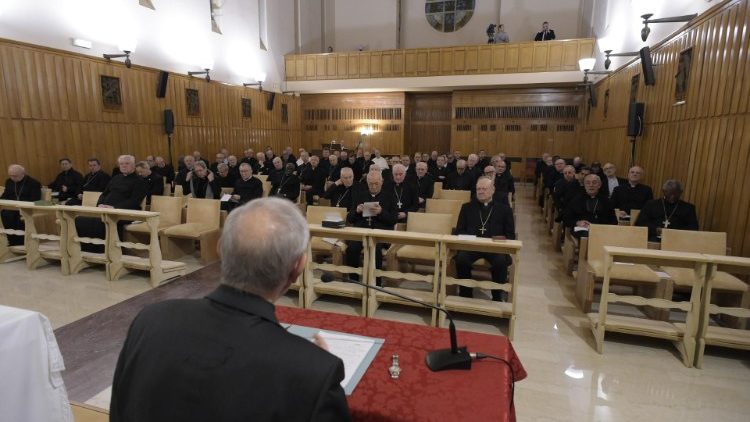
Lenten Spiritual Exercises begin in the Vatican (22 February 2026)Lenten Spiritual Exercises begin in the Vatican (22 February 2026)  (@Vatican Media)

Lenten Retreat Preacher opens Spiritual Exercises in the Vatican

The Lenten Spiritual Exercises for Pope Leo XIV, Cardinals residing in Rome, and heads of Dicasteries open on Sunday afternoon with the meditation of Trappist Bishop Erik Varden on the theme of “Entering Lent.”

By Deborah Castellano Lubov

The Spiritual Exercises for Lent in the Vatican began Sunday, February 22, at 5 p.m. in the Pauline Chapel, in the presence of Pope Leo XIV, Cardinals residing in Rome, and heads of Dicasteries.

The annual Lenten Exercises will be preached by Bishop Erik Varden, on the theme “Illuminated by a Hidden Glory.” The Cistercian of the Strict Observance (Trappists) has served as Bishop of Trondheim in Norway since 2019.

On Sunday, he delivered his first reflection on the theme “Entering Lent,” publishing a summary of the discourse on his website.

From Monday, February 23, until its conclusion on February 27, Bishop Varden will preach two meditations each day, one at 9:00 a.m., preceded by Mid-Morning Prayer, and at 5:00 p.m., followed by Eucharistic Adoration and Vespers.

Two meditations on Saint Bernard are scheduled: “Saint Bernard, the Idealist” and “Saint Bernard, the Realist,” scheduled for the afternoon of February 26. Other themes include: God’s help; Becoming free; The splendor of truth; A thousand will fall; “I will glorify Him”; The angels of God; On consideration; concluding with the final meditation focused on “Communicating hope.”

In his remarks at the beginning of the Spiritual Exercises on Sunday, Bishop Varden stresses that Lent confronts us with essentials: "it takes us, materially and symbolically, into a space stripped of superfluities."

He notes that things apt to distract us, even things wholesome in themselves, are removed for a season, and reiterates how we are to embrace an abstinence of the senses.

In particular, the Preacher underscores that Christians are to battle against vices and harmful passions, but to pursue and be people of peace.

Before concluding, Bishop Varden cites St Bernard of Clairvaux as a model, who understood "what it means to live by grace as we fight evil, foster good, uphold truth, and follow the exodus path from unfreedom towards the land of promise..."

"He summons us," the Preacher concludes, "to loving and clear-headed discipleship."

Sunday, October 1, 2023

While in Rome Synod participants are on retreat


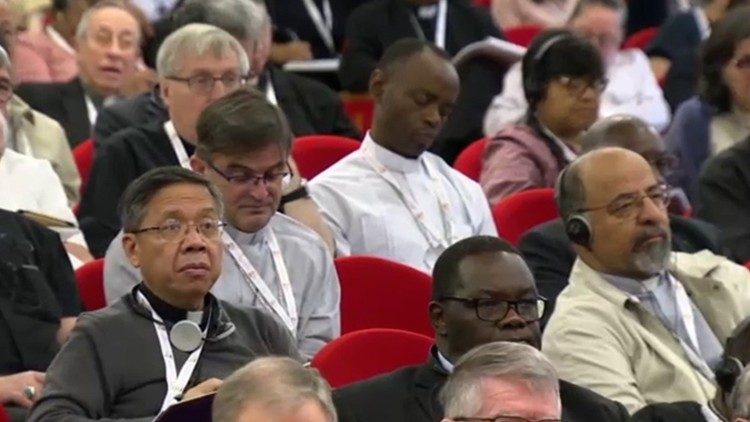
Some of the Synod participants on retreat in the Fraterna Domus retreat house in Sacrofano, outside of Rome.Some of the Synod participants on retreat in the Fraterna Domus retreat house in Sacrofano, outside of Rome. 

Synod participants on retreat in Sacrofano

From 30 September to 3 October, the members, delegates and special invitees for the XVI Ordinary Assembly of the Synod of Bishops are spending time in prayer at Fraterna Domus retreat house. Meditations and reflections are being live-streamed.

Vatican News

Synod members, fraternal delegates and special invitees are taking part in a retreat from 30 September to 3 October, prior to the opening of the XVI Ordinary General Assembly of the Synod of Bishops on 4 October. The retreat is taking place at Fraterna Domus retreat house in Sacrofano, about 30km outside Rome. Synod participants arrived on Saturday evening after taking part in the Ecumenical Prayer Vigil "Together". They will remain in retreat until Tuesday evening.

Their days open with Morning Prayer, or Lauds, at 8:45am during which Benedictine nun and former abbess Mother Maria Ignazia Angelini will provide a brief meditation. Former Master of the Order of Preachers, Father Timothy Peter Joseph Radcliffe, will preach two meditations in the morning (at 9:30 and at 11:30 on Sunday; at 9:15 and 11:30 on Monday and Tuesday). Retreatants will have time for silent personal prayer as well.

In the afternoon, group conversations in the Spirit will take place. Holy Mass is preceded by a second meditation preached by Mother Maria Ignazia Angelini held at 6:45pm, followed by dinner.

Sunday 1 October

The theme for Mother Angelini's meditation during Morning Prayer was "To walk together, meeting Jesus the rejected stone is necessary". 

Father Timothy Radcliffe's first meditation focused on "Hoping Against Hope". His second meditation was entitled "At home in God and God at home in us" and was interrupted so the retreatants could participate in the recitation of the Angelus with Pope Francis (Part two).

Prior to the beginning of Holy Mass, Mother Maria Ignazia Angelini offered a meditation based on the Gospel for the Twenty-sixth Sunday in Ordinary Time, prefaced by a quotation from Saint Thérèse of Lisieux, whose liturgical memoral falls on 1 October.


At 6:45pm, Holy Mass on Sunday evening was celebrated by Bishop Raymond Poisson, Bishop of Saint-Jérôme - Mont-Laurier in Canada and President of the Canadian Conference of Catholic Bishops. Bishop Poisson's short homily reflected on all three of the readings.

Sunday, February 26, 2023

The Pope and his closest collaborators at Vatican are off for a week of prayer and spiritual retreat


Pope and collaborators begin week of prayer


Kathleen N. Hattrup - published on 02/26/23

The Pope's activities will be suspended this week as he spends a few days on spiritual retreat.


Pope Francis, the cardinals in Rome, the heads of Dicasteries, and the Superiors of the Roman Curia will be taking a week of prayer. Their normal activities are suspended.

While the Pope is not gathering with his collaborators for a retreat in common, he is inviting them to “undertake a period of Spiritual Exercises in a personal way, suspending work activities and gathering themselves in prayer from the afternoon of Sunday 26 February until the afternoon of Friday 3 March, the first week of Lent.”

This week, all the Holy Father’s engagements, including the General Audience on Wednesday 1 March, will be suspended.

Monday, January 23, 2023

Once again Pope Francis will do a private Lenten retreat


Pope Francis to do private Lenten retreat in 2023


Like the two years’ prior, Pope Francis and the Roman Curia will again do the Vatican’s annual Lenten retreat on an individual basis.

The Vatican said Friday that Pope Francis had invited cardinals living in Rome and the heads of dicasteries to participate in the spiritual exercises “in a personal way” during the first full week of Lent Feb. 26-March 3.

During that week, all of Pope Francis’ appointments will be canceled, including the Wednesday general audience of March 1, the Vatican announced.

The pope asked the superiors of the Roman Curia to suspend their work activities and to use the five days for prayer.

This is the third year the Lenten spiritual exercises, formerly organized as a group retreat, will take place in a private manner.

In 2021 and 2022, the Vatican cited the COVID-19 pandemic as the reason for the change.

In 2020, a strong cold kept Pope Francis from joining the cardinals and leaders of the Roman Curia at a retreat house outside of Rome.

The practice of the pope going on a Lenten retreat with the heads of Vatican dicasteries began around 90 years ago under Pope Pius XI. The spiritual exercises were held in the Vatican, but starting in Lent 2014, Pope Francis chose to hold the retreat in Ariccia, about 16 miles southeast of Rome.

Wednesday, March 4, 2020

No General Audience today so here is something from the Curia's Lenten Retreat

Spiritual Exercises Of The Roman Curia 2020 © Vatican Media

Lenten Retreat: Reflection on Resistance to Grace and Idolatry

March 3 Homilies

In the third and fourth meditations of the Roman Curia’s Spiritual Exercises in Ariccia, Italy, the preacher, Jesuit Father Pietro Bovati, reflected on resistance to grace and on sin, reported Vatican News.
Pope Francis, who is recovering from a cold, followed the March 3 meditations from the Vatican’s Casa Santa Marta.
“Pharaonic Model”
 In the first meditation of March 3, 2020, the Jesuit preacher pointed out that in Exodus, with Moses, no is said to the “pharaonic model,” which held that the good is the good of the Egyptians, but the God of Israel promotes “a radical change of perspective, when He highlights the rights of foreigners, of the oppressed and of the exploited.”
Reflecting on the Readings of the day, which narrate episodes of Exodus, together with Matthew’s Gospel and the Psalms, Father Bovati put his listeners on guard about the risk of “resisting grace and opposing the Spirit.” In the “language of the Spirit,” others are first and the first are the last, and, “resistance to grace is expressed in fact in the rejection of this inversion of values (. . .).
The Pharaoh “represents the embodiment of power as a destructive power against opponents.” A tyranny that is also reflected in the contemporary reality and is a source “of great suffering for men.” “Be careful of responding with the same arms of today’s “pharaohs.’ In fact, every form of prideful arrogance must be totally uprooted form our life, leaving room for meekness, martyrdom.”
Disobedience to God
 The priest explained that in the contemporary world a different form of arrogance has developed, which rejects obedience to God and to His prophets.” It is a “rejection of God as evident affirmation of atheism, considered almost as the only reasonable option, as religious indifference, as ethical relativism, and as any other lifestyle that becomes an absolutization of one’s feeling, one’s opinion, one’s choices” and, to opposes it implies, for Christians, marginalization.
In this connection, Father Bovati invited to reflect on this phenomenon of disobedience, to understand its causes and rejection of grace.
Paladins of the Established Order
 There is another complex way of resistance to grace, that of those that, like Pharaoh, “erect themselves as paladins of the established order, of the canonized form of the law, of the present-day practice, considered the only perfect and immutable expression of the good and, therefore, they oppose the changes required by the prophets, disdained with insolent titles such as ”madmen, visionaries, undisciplined, turbulent, heretical.”
The preacher stressed that “it’s not enough to appeal to Tradition, to what has always been done, what in the past was considered valid,” rejecting “the ferments of reform, of theological and institutional renewal, and faulting “a priori the proposals for change in the different ambits of the life of the Church, in the liturgy, in catechetical practice, in pastoral” ministry.
Other Temptations
 Sin, the preacher stressed, also consists in the absolutization of the productive system as sole value. Given this reality, the priest spoke about “the temptation to live tranquilly, as well as the acceptance of the abuse of power, which is considered preferable to a courageous liberating act,” with all the risks that this implies.
The preacher then referred to the Gospel parable of the sower, stating that the “resistance to grace” then “takes the form of jealousies of those that have a greater gifts than ours; or pride, thinking that we are better than others because we produce more fruit,” or are content with giving some fruit, ”perhaps presented as a form of modesty and humility, but which “should be considered as an insidious resistance to grace, which doesn’t allow love to grow or a growing service of donation.”
Idolatry
 In the next meditation, the theologian reflected further on sin, not as a transgression of God’s Law, but as a “lack of faith.” The first Commandment refers to not having other gods, and idolatry continues being “a capital sin denounced in the whole tradition of the Old Testament.”
The sin of idolatry is “a sin that can’t be cured because it’s not recognized, more than that, it denies it.” Therefore, “it’s like the sin against the Spirit, without remedy. And, in this line, he referred to hypocrisy as shown in Matthew’s Gospel. ”Hypocrisy is unable to judge, unable to know true discernment. It’s blind, it doesn’t know justice, mercy, fidelity identifies goodness with material practices and compliances.”
Drawing on chapter 32 of the Book of Exodus, the Jesuit referred to the people’s adoration of the golden calf in connection with the phenomenon of idolatry, the desire for certainties, the preference to “see” rather than to listen to the voice of the invisible God. However, if belief is substituted by knowledge, if one ceases to adhere to God, one ends up believing that one possesses the truth, instead of seeking it and listening to it with humble docility.
The Way to Overcome Blindness
 Applying the image of the golden calf to our days, Father Bovati called attention to the importance given today to the public image in the present virtual world in which we live, in which frequently we become followers of an idolatrous object.
Therefore, the priest also warned against the risk of practicing worship that, although in theory is devout and splendid, in its execution is unable to receive the Word of God, which is transforming. “Well-done ceremonies aren’t sufficient if they aren’t based on genuine prayer, which is, first of all, to listen to God.”
Finally, he referred to Matthew’s Gospel, in particular, the temptation in the desert, in which “Jesus came out victorious and teaches us the way to overcome our blindness. And Psalm 106 also reminds us that in the history of Israel, God always intervenes with gestures of salvation.

Tuesday, March 3, 2020

Without being physically present, the Pope's annual Lenten retreat is underway

Fr Bovati preaches to the Roman Curia in Ariccia Fr Bovati preaches to the Roman Curia in Ariccia  (Vatican Media)


Papal retreat: Moses, an example of intimate friendship with God


Pope Francis sends a letter to the retreat director for the Roman Curia’s Spiritual Exercises, as Fr Pietro Bovati launches into his reflections on Moses, who enjoyed intimate friendship with God.


By Devin Watkins
Even though he is following the Spiritual Exercises from the Casa Santa Marta due to a cold, Pope Francis kicked off the annual retreat in Ariccia with a letter sent to Jesuit Fr Pietro Bovati.
In it, the Pope extended his prayer and blessings to the retreat director and the Roman Curia.
“I am accompanying you from here,” he wrote. “I will do the Exercises in my room, following Fr Bovati’s preaching, to whom I extend my gratitude. I pray for you. Please, pray for me.”

Day 1: Receptive to divine revelation

Fr Bovati, the Secretary of the Pontifical Biblical Commission, gave his first reflection on Sunday evening, introducing the theme: “The bush was on fire (Ex 3:2) – The encounter between God and man in light of the book of Exodus, the Gospel of Matthew, and the prayer of the Psalms.”
He told members of the Roman Curia gathered at the Divine Master House in Ariccia that the Old Testament story of Moses is an invitation to “rest in receptivity of Divine Revelation”.

Model of prayer

Moses, said Fr Bovati, always set aside part of his day to spend time in the meeting tent where the Lord would speak to him “face to face”.
Authentic prayer, he added, is an encounter with the “fire” that makes us capable of carrying out our prophetic mission of witness.
Fr Bovati said he chose Moses as a type of “icon” for the papal retreat because Moses was obedient to the Lord. He took off his sandals before the burning bush to recognize that “one must not go elsewhere: there is no path, direction, or preference other than Christ.”

Day 2: Journey of desire

On Monday morning, the retreat director focused his reflections on readings from Exodus 2:1-10; Matthew 1:18-25; Psalm 139.
Fr Bovati again took up the theme of Moses’ example of prayer in the meeting tent, which he described as “a journey of desire”.
When Moses entered the tent, a column of cloud would descend on the entrance, in a sign that the Lord had drawn near to him.
This, said Fr Bovati, “upsets the widely circulated idea that identifies prayer with the words a person directs toward the Lord.” Rather, “authentic prayer is fundamentally a prophetic experience, one in which the human creature can listen to the voice of the Lord in silence.”

Burning but not consumed

Fr Bovati went on to recall Moses’ experience of the bush that was on fire but not consumed.
He said it represents “the human person in all their fragility, weakness, and misery – like that of the bush – which however is invested with an enduring force of life: the fire.”
“It is not simply a matter of refreshing our soul’s fervor through some appropriate devotional exercises. Rather, it means taking on a renewed commitment to truth, with a sincere openness of heart to the gift that Jesus came to bring into the world. ‘I have come to set the earth on fire, and how I wish it were already blazing!’”