Showing posts with label prisoners of war. Show all posts

Saturday, August 1, 2026

Pope Leo XIV: "no prison is deep enough to separate a person from the love of God." Remembering Communist prison camp in Albania


Cardinal Ernest Simoni celebrates Mass at the former prison camp of Spaç, in AlbaniaCardinal Ernest Simoni celebrates Mass at the former prison camp of Spaç, in Albania 

Pope to Cardinal Simoni: No prison can separate a person from God's love

Pope Leo XIV sent a message to 97-year-old Cardinal Ernest Simoni, who yesterday morning, Friday 31 July, presided over the Mass at the former prison camp of Spaç, Albania, in memory of those who suffered or lost their lives there. During the communist regime, the Cardinal spent most of his 18-year sentence of forced labour in the camp, where he celebrated Mass in secret.

By Fabrizio Peloni 

“No chain is strong enough to imprison a conscience enlightened by the Gospel; no night is so long that it can prevent the dawn the Lord prepares for His children; and no prison is deep enough to separate a person from the love of God.”

With these words, echoing Saint Paul’s Letter to the Romans (8:35–39), Pope Leo XIV addressed a message to Albanian Cardinal Ernest Simoni and to all those who took part in the Mass the Cardinal presided over on Friday morning, 31 July, at the former prison camp of Spaç, in remembrance of those who suffered or died there.

A site where many bore the cross of injustice

“That place, deeply engraved in the memory of the Albanian people, remains one of the most painful chapters in the nation’s history. Spaç was a place where many carried the heavy cross of injustice,” the Pope wrote in the message, which was read at the conclusion of Mass.

The Holy Father recalled that “the blood of those who suffered and died among those mountains has watered that land, making it a silent witness to fidelity, courage and hope.”

A witness to persecution under the communist regime

Cardinal Simoni, now 97, returned to the camp where he spent most of his 18 years in prison “to celebrate the Sacrifice of Christ, which transformed the Cross from a sign of death into the promise of life,” Pope Leo wrote.

The Albanian Cardinal experienced first-hand the persecution of the communist regime. Initially sentenced to death as an enemy of the people, his sentence was later commuted to imprisonment in various labour camps, where he endured years of forced labour.

“I risked my life every time I celebrated Mass”

Cardinal Simoni recalled that during his imprisonment, he celebrated Mass from memory in Latin, noting, "I risked my life each time." He also said he heard confessions and distributed Holy Communion in secret.

Explaining that he baked the bread using flour cooked over makeshift stoves and used juice squeezed from grapes for the Eucharistic celebration, he recognized, “If they had found me, they would have hanged me immediately."

In fact, during Friday’s Mass, the Cardinal showed those present the miner’s helmet he wore as a young priest when he was sent to work underground in the mines.

The Pope’s prayer for those buried in unmarked graves

Reflecting on those years of persecution, Pope Leo wrote, “Who knows how many prayers rose to Heaven from that place? How many supplications were whispered in silence? How many faces, marked by hardship and deprivation, entrusted their final hope to the Lord?”

The Pope joined in prayer for each of those men and women, many of whom were buried in unmarked graves, where no one was able to mourn them or lay a flower in their memory.

He prayed that “their memory may remain alive and serve as a constant reminder to new generations of the inviolable dignity of every human person, the value of freedom, and the commitment to peace.”

Monday, August 11, 2025

From the Diocese of Lafayette LA and the WW2 Musuem in New Orleans, Father Joseph Lafleur, Chaplain to WW2 POW's


Father Lafleur: Forgotten story of chaplain to POWs in WWII and his ‘incredible selflessness’


Father Joseph Verbis Lafleur, a World War II chaplain who gave his life while saving others on a Japanese prison ship, is seen in this undated photo. He died Sept. 7, 1944, when a U.S. submarine torpedoed the Japanese ship that he and over 700 fellow prisoners of war were aboard in the Indian Ocean. A priest of the Diocese of Lafayette, La., he is a candidate for sainthood and has the title "Servant of God." (OSV News photo/courtesy Diocese of Lafayette)


(OSV News) — There was nothing elegant about St. Peter’s in Chains, the small chapel where Servant of God Father Joseph Verbis Lafleur celebrated Christmas Eve Mass on Dec. 24, 1942.

It was a simple wooden hut, built in the middle of a Japanese prisoner of war camp, where Father Lafleur was being held prisoner.

Father Lafleur, ordained for the Diocese of Lafayette, Louisiana, on April 2, 1938, had enlisted as a military chaplain in early 1941 and was assigned to serve the U.S. Air Corps 19th Bombardment Group, stationed in the Philippines.

Two years later, he was captured by the Japanese during the early days of America’s involvement in World War II and was sent to a prisoner of war camp.

Eventually, Father Lafleur died when a U.S. submarine sank an unmarked Japanese prisoner of war transport, the SS Shinyo Maru, which was carrying U.S. prisoners of war to the mainland, killing all but 60 of the prisoners.

Recently, Michael Bell, executive director of the of the Jenny Craig Institute for the Study of War and Democracy at the National World War II Museum in New Orleans, began researching Father Lafleur’s life and service and presented his findings during a special reception on July 31.

“Father LaFleur is part of this unique experience of World War II, being stationed in the Philippines at the beginning of the war and then being sent to a prisoner of war camp and dying on a transport ship,” Bell told OSV News. “He also went to seminary here in New Orleans so he is this hometown hero. I pass that seminary, going to Mass on Sunday.”

On Dec. 8, 1941, sirens blared across Clark Field in the Philippines, a U.S. military base. Simultaneously, on what was Dec. 7 due to the international date line, a Japanese aircraft carrier group had launched an air assault on the U.S. base at Pearl Harbor, Hawaii, marking the beginning of the United States’ involvement in World War II.

Father Lafleur, the base’s chaplain watched as Japanese planes dropped bombs and strafed the U.S. airfield. Seeing wounded soldiers, the chaplain jumped into action.

“Without regard for his personal safety, Father Lafleur is going from wounded soldier to soldier, providing comfort or helping evacuate him to safety and he really becomes an inspiration, not just for those he helped, but even for the leaders of that unit,” Bell said. “It starts to show this incredible selflessness when, you know, by all accounts, everybody else is taking cover and he is out there helping people.”

Father Lafleur’s example of selflessness continued when, after the attack, he was given the opportunity to evacuate to Australia. The chaplain, however, vowed to stay with his men, telling commanders that he will not leave until everybody else has been evacuated.

Thus, Father Lafleur retreated with the remaining soldiers to the Bataan Peninsula where they attempted to ward off the invading Japanese forces. However, their efforts stalled and on May 7th, 1942, Lafleur and the 19th bombardment group surrendered to the Japanese.

Yet the tale of Father Lafleur’s heroism had only just begun.

Father LaFleur was sent to Davao Penal Colony, a Japanese prisoner of war camp in the Philippines where he endured harsh living conditions and violent prison guards.

“The conditions get worse and worse over time,” Bell said. “Whatever food they had begins to dwindle and by mid-summer 1942, the Japanese become very violent. If American or Filipino prisoners escape or try to escape, they will do retribution against the other prisoners by punishing them or even executing some.”

Yet, Father Lafleur attempted to keep spirits high by providing the sacraments and being a listening ear to his fellow prisoners. Shortly after his arrival to Davao, Father Lafleur and other prisoners begin constructing a small wooden hut to serve as a chapel which they dub “St. Peter in Chains.”

There, they celebrated 1942 Christmas Eve Mass.

“One of the accounts suggests that as Father Lafleur is celebrating Mass, a couple of the other prisoners were so inspired that they pulled out an American flag they had been hiding and unfurled the flag and held it up, during this midnight Mass,” Bell said. “It becomes this huge inspiration for all of these prisoners to persevere.”

Shortly thereafter, the Japanese began selecting prisoners to be sent to Lasang, a nearby work camp. Lafleur, still recovering from a severe bout of malaria, volunteered to go, believing that to be where God was calling him to serve.

There, he remained until August of 1944.

With American forces rapidly closing in, the Japanese began sending American prisoners of war to camps on other Japanese controlled islands via “hell ships.”

Father Lafleur and 750 other Americans were loaded onto one of these hell ships, the SS Shinyo Maru, where they were stuffed into two cramped, below deck compartments with minimal ventilation, no toilets and barely enough room for each prisoner to sit down.

The men turn to Father Lafleur for spiritual guidance and encouragement as they suffer in the sweltering heat and complete darkness.

“One account that was shared with us recalls a soldier, who was suffering, finds Lafleur in the hold and asks, ‘Padre, can you please pray for me? Lafleur listens to him and tells him to say an act of contrition, and then almost simultaneously, the Japanese actually open the hatch,” Bell said. “Before that they are in this incredible heat, and now they have sunlight and a breeze.”

Tragically, on Sept. 7, 1944, a US submarine fired upon the unmarked Japanese vessel.

“When the ship is hit, the Japanese begin shooting at the Americans as they try to come out of the hold and they begin throwing grenades into the hold,” Bell said. “The account states that Father Lafleur is there, constantly trying to help people up and out, without regard to his own survival or safety.”

In the end, he helped 83 men escape but the transport ship snapped in half and sank to the bottom of the Pacific with Father Lafleur still onboard.

For years, Father Lafleur’s story remained largely forgotten, only to be recalled in official US reports, the testimony of his fellow prisoners, and within the Diocese of Lafayette, which opened his cause for canonization Sept. 5, 2020.

After learning about Father Lafleur’s story, Bell knew that he wanted to know the full picture and share it with the world. He believes that Lafleur is an example of selflessness that can be a model for all.

“What is incredible with Father Lafleur’s story is that consistent selflessness,” Bell said. “It is a selflessness beyond being. It is this model of ultimate self-sacrifice that can be an example and model for all.”

Jack Figge writes for OSV News from Kansas.

Saturday, June 29, 2024

Rejoicing in release of 10 Ukrainian POW's; Pope calls for world-wide release of all prisoners of war


Ukrainian citizens who returned from Russian captivity, 25 JuneUkrainian citizens who returned from Russian captivity, 25 June 

Pope prays for worldwide release of prisoners of war

Pope Francis appeals for an end for all wars, and in celebrating the return of Ukrainian prisoners of war, asks that all prisoners, everywhere, be able to go home.

By Francesca Merlo

As Ukraine and the Holy See celebrate the release of ten Ukrainian prisoners by Russian forces, Pope Francis prayed that "all prisoners of war return home soon".

At the end of his Angelus prayer for the solemnity of Saints Peter and Paul on Saturday, 29 June, the Holy Father's thoughts, in particular, turned to the two Greek-Catholic priests who were released as part of the prisoner swap. 


On Friday evening, Fathers Ivan Levytskyi and Bohdan Heleta, both members of the Congregation of the Most Holy Redeemer, were released by Russia along with eight others in a prisoner exchange with Ukraine.

Pope Francis on Saturday also invited all those present to pray together that all prisoners return home. At the same time, he reflected "with pain" on the "brothers and sisters suffering because of war".

"Let us think of all the people wounded or threatened by the fighting", said the Pope, asking that God may "free them and sustain them in the struggle for peace". 

Sunday, May 12, 2024

Pope Francis offers to facilitate prisoner exchange between Russia and Ukraine


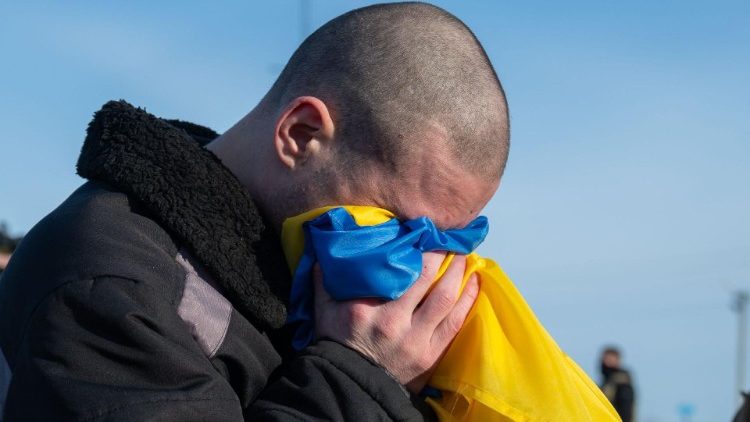
File photo of a former Ukrainian prisoner of war reacting after a prisoner exchangeFile photo of a former Ukrainian prisoner of war reacting after a prisoner exchange 

Pope: Holy See ready to facilitate exchange of Russian and Ukrainian prisoners of war

Pope Francis renews his appeal for an exchange of Russian and Ukrainian prisoners of war, assuring the Holy See’s readiness to facilitate efforts in this regard.

By Linda Bordoni

Pope Francis has again appealed for a “general exchange of all prisoners between Russia and Ukraine.”

Speaking during the Regina Caeli on Ascension Sunday, the Pope noted that his appeal falls on the Solemnity of the Ascension of the Risen Lord “who wants us to be free, and who sets us free.”

He went on to assure all parties involved that the Holy See remains ready to facilitate every effort in this regard, especially for those who are seriously wounded and sick.”

And he renewed his constant appeal for prayers for peace: “Let us continue to pray for peace, in Ukraine, in Palestine, in Israel, in Myanmar… let us pray for peace!” he said.

Past prisoner exchanges

So far, Russia and Ukraine have conducted over 50 prisoner exchanges since the beginning of the war, involving several thousand prisoners whom both sides have released.

Last January, Ukrainian President, Volodymyr Zelensky mentioned that some 3,000 Ukrainian soldiers have been liberated following these agreements.

Papal appeals

As Pope Francis himself said, he has raised an appeal to this effect on many and various occasions.

During his “Urbi et Orbi” address this Easter, on March 31st: " My thoughts go especially to the victims of the many conflicts worldwide, beginning with those in Israel and Palestine, and in Ukraine. May the risen Christ open a path of peace for the war-torn peoples of those regions.  In calling for respect for the principles of international law, I express my hope for a general exchange of all prisoners between Russia and Ukraine: all for the sake of all”!

Just last month during his General Audience on April 17th, he said: " And our thoughts, at this moment, [the thoughts] of all of us, go to the peoples at war. Let us think of the Holy Land, of Palestine, of Israel. We think of Ukraine, martyred Ukraine. Let us think of the prisoners of war... May the Lord move wills so they may all be freed. And speaking of prisoners, those who are tortured come to mind. The torture of prisoners is a horrible thing. It is not human. Let us think of so many kinds of torture that wound the dignity of the person, and of so many tortured people... May the Lord help everyone and bless everyone."

A constant commitment

And during a meeting with Jesuits in September 2022 when he travelled to Kazakhstan, the Holy Father spoke about his commitment towards the liberation of prisoners saying: "Some Ukrainian envoys came to me. Among them, the vice-rector of the Catholic University of Ukraine, accompanied by the advisor for religious affairs of the President, an evangelical. We talked, discussed. A military leader who deals with prisoner exchanges also came, always with the religious advisor of President Zelensky. This time they brought me a list of over 300 prisoners. They asked me to do something to facilitate an exchange. I immediately called the Russian ambassador to see if something could be done, if a prisoner exchange could be expedited."

Pope Francis has also entrusted Cardinal Matteo Zuppi with undertaking humanitarian missions to war-torn nations and tasked him, amongst other responsibilities, with focusing on the exchange of prisoners and the repatriation of Ukrainian children from Russia.

Bull of Indiction of the Jubilee

The just-proclaimed Bull of Indiction of the 2025 Jubilee contains an urgent call to provide hope to those who live in difficult conditions: "During the Holy Year, we are called to be tangible signs of hope for those of our brothers and sisters who experience hardships of any kind. I think of prisoners who, deprived of their freedom, daily feel the harshness of detention and its restrictions, lack of affection and, in more than a few cases, lack of respect for their persons. I propose that in this Jubilee Year governments undertake initiatives aimed at restoring hope; forms of amnesty or pardon (...) In every part of the world, believers, and their Pastors in particular, should be one in demanding dignified conditions for those in prison, respect for their human rights...“

Appeal of the Head of the Ukrainian Greek Catholic Church

In his message for Easter according to the Julian calendar, celebrated on 5 May, His Beatitude Sviatoslav Shevchuk, head of the Ukrainian Greek Catholic Church, reiterated the Pope's appeal: "The words of Pope Francis regarding the exchange of all for all, expressed during the Latin rite Easter, have left a deep mark in the hearts of Christians both in Ukraine and in Russia. Today, more than ever, we not only want to hear the words and the appeal of Pope Francis, but we want his words on the 'all for all' exchange to become for us an imperative, a call to concrete actions."

In particular, the Major Archbishop of Kyiv-Galicia requested the release of three categories of prisoners of war: military women, healthcare workers, and also captured priests. He recalled that currently about eight thousand military personnel and around 1,600 Ukrainian civilians are detained in Russia.

Wednesday, April 17, 2024

Pope Francis focuses on and prays for all prisoners of war


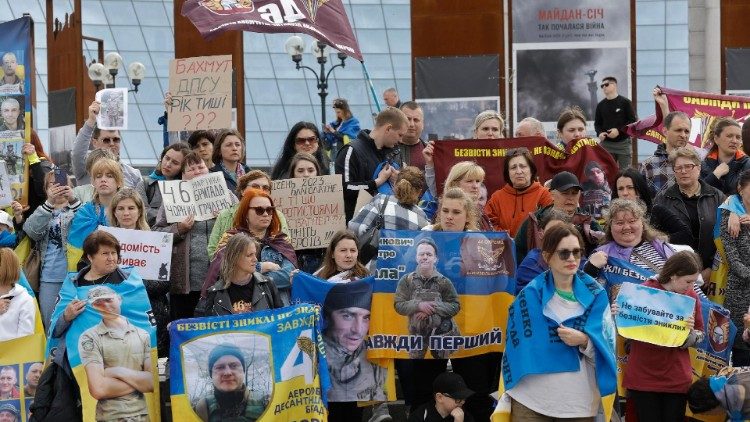
Rally in Kyiv calls for return of Ukrainian prisoners of warRally in Kyiv calls for return of Ukrainian prisoners of war  (ANSA)

Pope Francis appeals for release of prisoners of war

Pope Francis turns his attention to prisoners of war, prays for their freedom and denounces the tortures many of them are subjected to.

By Linda Bordoni

Pope Francis on Wednesday highlighted the plight of prisoners of war in conflict-stricken countries.

“Our thoughts, at this moment, [the thoughts] of all of us, go to the peoples at war,” he said, speaking off-cuff at the end of the General Audience.

“We think of the Holy Land, of Palestine, of Israel. We think of Ukraine, tormented Ukraine. We think of the prisoners of war...”

And raising an appeal for their liberation, the Pope said: May the Lord move wills so they may all be freed”

“May the Lord move wills so they may all be freed.”

Adding to his appeal Pope Francis had special thoughts for those prisoners who are subjected to torture.

“The torture of prisoners is a horrible thing, it is not human,” he decried, “We think of so many kinds of torture that wound the dignity of the person, and of so many tortured people... May the Lord help everyone and bless everyone.”

“We think of so many kinds of torture that wound the dignity of the person.”