Showing posts with label Albania. Show all posts

Saturday, August 1, 2026

Pope Leo XIV: "no prison is deep enough to separate a person from the love of God." Remembering Communist prison camp in Albania


Cardinal Ernest Simoni celebrates Mass at the former prison camp of Spaç, in AlbaniaCardinal Ernest Simoni celebrates Mass at the former prison camp of Spaç, in Albania 

Pope to Cardinal Simoni: No prison can separate a person from God's love

Pope Leo XIV sent a message to 97-year-old Cardinal Ernest Simoni, who yesterday morning, Friday 31 July, presided over the Mass at the former prison camp of Spaç, Albania, in memory of those who suffered or lost their lives there. During the communist regime, the Cardinal spent most of his 18-year sentence of forced labour in the camp, where he celebrated Mass in secret.

By Fabrizio Peloni 

“No chain is strong enough to imprison a conscience enlightened by the Gospel; no night is so long that it can prevent the dawn the Lord prepares for His children; and no prison is deep enough to separate a person from the love of God.”

With these words, echoing Saint Paul’s Letter to the Romans (8:35–39), Pope Leo XIV addressed a message to Albanian Cardinal Ernest Simoni and to all those who took part in the Mass the Cardinal presided over on Friday morning, 31 July, at the former prison camp of Spaç, in remembrance of those who suffered or died there.

A site where many bore the cross of injustice

“That place, deeply engraved in the memory of the Albanian people, remains one of the most painful chapters in the nation’s history. Spaç was a place where many carried the heavy cross of injustice,” the Pope wrote in the message, which was read at the conclusion of Mass.

The Holy Father recalled that “the blood of those who suffered and died among those mountains has watered that land, making it a silent witness to fidelity, courage and hope.”

A witness to persecution under the communist regime

Cardinal Simoni, now 97, returned to the camp where he spent most of his 18 years in prison “to celebrate the Sacrifice of Christ, which transformed the Cross from a sign of death into the promise of life,” Pope Leo wrote.

The Albanian Cardinal experienced first-hand the persecution of the communist regime. Initially sentenced to death as an enemy of the people, his sentence was later commuted to imprisonment in various labour camps, where he endured years of forced labour.

“I risked my life every time I celebrated Mass”

Cardinal Simoni recalled that during his imprisonment, he celebrated Mass from memory in Latin, noting, "I risked my life each time." He also said he heard confessions and distributed Holy Communion in secret.

Explaining that he baked the bread using flour cooked over makeshift stoves and used juice squeezed from grapes for the Eucharistic celebration, he recognized, “If they had found me, they would have hanged me immediately."

In fact, during Friday’s Mass, the Cardinal showed those present the miner’s helmet he wore as a young priest when he was sent to work underground in the mines.

The Pope’s prayer for those buried in unmarked graves

Reflecting on those years of persecution, Pope Leo wrote, “Who knows how many prayers rose to Heaven from that place? How many supplications were whispered in silence? How many faces, marked by hardship and deprivation, entrusted their final hope to the Lord?”

The Pope joined in prayer for each of those men and women, many of whom were buried in unmarked graves, where no one was able to mourn them or lay a flower in their memory.

He prayed that “their memory may remain alive and serve as a constant reminder to new generations of the inviolable dignity of every human person, the value of freedom, and the commitment to peace.”

Saturday, March 29, 2025

Pope seeks closer relationship with Orthodox in Albania


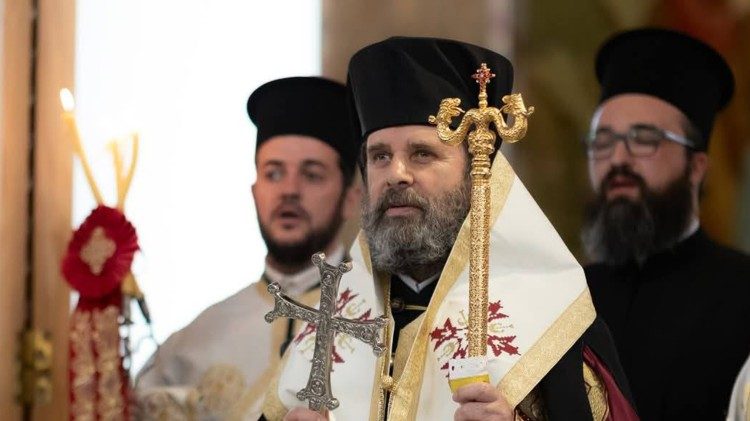
His Beatitude Joan, Archbishop of Tirana, Durrës, and All AlbaniaHis Beatitude Joan, Archbishop of Tirana, Durrës, and All Albania 

Pope Francis hopes for closer ties with Orthodox Church of Albania

As His Beatitude Joan is enthroned as the Archbishop of Tirana, Durrës, and All Albania, Pope Francis expresses his hopes for renewed commitment to deepening relations between the Catholic Church and the Autocephalous Orthodox Church of Albania.

By Devin Watkins

The Holy See sent a delegation to the enthronement of His Beatitude Joan as Archbishop of Tirana, Durrës, and All Albania, which took place in Tirana on Saturday.

Archbishop Flavio Pace, Secretary of the Dicastery for Promoting Christian Unity led the delegation, accompanied by Msgr. Andrea Palmieri, Undersecretary of the same Dicastery, and Msgr. Ionuţ Paul Strejac, Chargé d’Affaires ad interim of the Apostolic Nunciature in Tirana.

Pope Francis sent a letter to Archbishop Joan to extend his “fraternal greetings in the love of Christ.”

“In expressing my spiritual closeness,” wrote the Pope, “I assure you of my prayers that God the Father, source of all good, will grant you the abundant gifts of the Holy Spirit as you guide the flock entrusted to your care.”

He recalled Archbishop Joan’s predecessor, His Beatitude Anastas, whose apostolic zeal “left a deep and lasting legacy on Albania.”

“Anastas distinguished himself by his commitment to the peaceful coexistence of men and women belonging to different Churches and religious traditions,” said the Pope, “and he contributed significantly to the improvement of relations between our Churches.”

Pope Francis went on to invite Archbishop Joan to continue to foster dialogue as a way to overcome divisions and seek full communion among Christians.

“In these difficult times marked by war and violence,” he said, “it is ever more urgent that Christians bear credible witness to unity, so that the world may fully embrace the Gospel message of fraternal solidarity and peace.”

The Pope noted that Christians bear responsibility for showing the world the “real communion, if alas not yet complete, that already unites us.”

“It is my heartfelt hope,” wrote Pope Francis, “that under your paternal guidance, relations between the Church of Albania and the Catholic Church will develop further, seeking new forms of fruitful cooperation in proclaiming the Gospel, serving those most in need and renewing our commitment to resolving the issues that still separate us through the dialogue of charity and truth.”

In conclusion, the Pope assured Archbishop Joan of his prayers for his ministry and extended to him “a fraternal embrace in Christ our Lord.”

Thursday, January 16, 2025

Interreligious dialogue fosters peaceful coexistence, says Pope


Pope Francis  meeting the delegation of the Bektashi Community  in AlbaniaPope Francis meeting the delegation of the Bektashi Community in Albania  (VATICAN MEDIA Divisione Foto)

Pope: ‘Religions must work together to seek bridges of peace’

Pope Francis meets in the Vatican with a delegation of the Muslim Bektashi Order of Dervishes from Albania and highlights the critical role of interreligious dialogue in building a peaceful coexistence among peoples.

By Lisa Zengarini

Pope Francis reiterated on Thursday that interreligious dialogue and cooperation are more necessary than ever in a world marred by conflict and division.

A shared commitment to dialogue for a more fraternal world 

“Whenever religious leaders gather in a spirit of mutual respect and commit themselves to fostering a culture of encounter through dialogue, mutual understanding, and cooperation, our hope for a better and more just world is renewed and confirmed”, the Pope said as he met in the Vatican with a delegation of the Bektashi Order of Dervishes from Albania.  

The Bektashis are a renowned Muslim Sufi Order that originated in 13th-century Anatolia, in modern-day Turkiye, and became widespread in the Ottoman Empire, extending to Albania and the Albanian populations in Kosovo, Macedonia, and Montenegro.

The order is renowned for its focus on love, tolerance, and spiritual enlightenment and entertains friendly relations with the Catholic Church and the Holy See through the Dicastery for Interreligious Dialogue.


Fraternal relations against the logic of violence and discord

Pope Francis described these relations as a “blessing” and expressed trust that they will grow stronger “serving fraternity and peaceful coexistence among peoples.”

Addressing the delegation led by His Grace Haxhi Baba Edmond Brahimaj, the Pope remarked that in a world marred by the “logic of violence and discord”, religious convictions can help us to instead “embrace more clearly the fundamental values of encounter, friendship, and collaboration in the pursuit of the common good” which, he said, are “intrinsic to our shared humanity.”

Pope Francis recalled with gratitude the several occasions of fraternal encounter between the Betktashi Community and the Catholic Church, including  Prayer for Peace in the Balkans in 1993, during the war in former Yugoslavia, and the 2011 World Day of Prayer for Peace in Assisi,  remarking that, along with other Muslims, Christians, and all other believers in Albania, it “can serve as a bridge of reconciliation and mutual enrichment” not only in their country but also between the East and the West.

“I am convinced that the Bektashi Community, along with other Muslims, Christians, and all other believers in Albania, can serve as a bridge of reconciliation and mutual enrichment not only within your country but also between the East and the West.”

The unique role of interreligious dialogue in building a future of peace

Concluding Pope Francis reaffirmed that, despite the present challenges, interreligious dialogue has a “unique role in building a future of reconciliation, justice, and peace that the peoples of the world, and especially young people, so ardently desire.”

Tuesday, November 8, 2016

38 new "blesseds" for the Church, all martyrs from Albania

38 Martyrs of 20th-Century Albania Declared Blessed
Cardinal Amato: Persecutions dissolve into nothingness, but the testimony of martyrs endures
Simoni. Albania.
Mimmo Muolo
Thirty-eight martyrs killed between 1945 and 1974 by the Communist regime were beatified Saturday in the city of Shkodër in northwestern Albania.
The ceremony took place in the Square of St. Stephen’s Cathedral and was presided over by Cardinal Angelo Amato, prefect of the Congregation for the Causes of Saints.
Pope Francis referred to the beatification during his Angelus address on Sunday, saying the martyrs “preferred to suffer imprisonment, torture and eventually death, in order to remain faithful to Christ and the Church.”
“Their example,”  he said, “helps us find strength in the Lord that supports us in times of trouble and inspires acts of kindness, forgiveness and peace.”
In the beatification homily, Cardinal Amato referred to how persecutions end, but the witness of the martyrs endures.
“While the persecutors dissolve like so many black shadows which are lost forever in the darkness of eternal oblivion,” he said, “martyrs are guiding lights that shine in the sky of humanity, showing the true face of  man’s goodness, his profound identity created in the image of God.”

Vatican Radio offered a summary of the testimonies of some of the martyrs:
Father Anton Zogaj was shot on a beach near Durres after refusing to divulge confessional secrets.
Father Lazer Shantoja, a nationally admired poet, was shot in the head after being forced to crawl in excruciating pain when his arms and legs were broken under torture.
Archbishop Nikolle Vincenc Prennushi of Durres, who died of torture and exhaustion in 1949, two years into a 20-year hard labor sentence as an “agent of foreign powers.”
Bishop Frano Gjini of Lezhe, who died in 1948 declaring his “spirit and heart are with the Pope,” according to the execution record.
Father Shtjefen Kurti was sentenced and shot for “reactionary anti-state activities” in 1971 after secretly baptizing another convict’s child at a labor camp.
Father Giovanni Fausti, Italian vice provincial of Albania’s Jesuit order, was beaten and spat at by communist onlookers during his trial and execution.
The list also features two priests drowned in 1948 when their heads were forced down in a prison cesspit with rifle butts; several foreign clergy, including one who was shot for giving last rites to a wounded fugitive; and three lay Catholics including 22-year-old Franciscan novice, Sister Maria Tuci, who died in Shkoder’s civic hospital after being tied in a sack and tortured.
Archbishop Angelo Massafra of Shkoder, President of the Albanian Bishops’ Conference, reportedly said the list of martyrs had been agreed upon after Church consultations in 1994 and 2000, but added that many others could also be declared blessed in the future.
Related: Remember the Priest Who Made Francis Cry in Albania? He’s the Only Non-Bishop on the List of New Cardinals
Around 130 Catholic priests were executed or died through imprisonment, alongside thousands of lay Christians, under Communist rule in Albania, which lasted from 1944 to 1991.
Catholics currently make up a tenth of Albania’s population of 2.9 million, according to a 2011 census, making them the second largest religious group after Muslims, many of whom also died under Communist rule.