Showing posts with label General Audience Pope Francis. Show all posts

Wednesday, April 16, 2025

Weekly prepared catechesis for Wednesday General Audience


File photo of one of Pope Francis' General AudiencesFile photo of one of Pope Francis' General Audiences  (VATICAN MEDIA Divisione Foto)

Pope Francis: Have we strayed? Our loving Father waits for us

In Pope Francis' prepared catechesis for the weekly General Audience, which was not held due to his ongoing convalescence, he recalls the parable of the Prodigal Son and reassures us faithful that no matter how far we have strayed, our loving Father waits for us with open arms.

By Deborah Castellano Lubov

"We can have hope because we know the Father is waiting for us..."

As Pope Francis recovers in the Vatican after being discharged from Rome's Gemelli Hospital on Sunday, 23 March, he offered this comforting reminder in the text he had prepared for the Wednesday General Audience, which he asked the Holy See Press Office to publish.

Since his medical team discharged the Pope, recommending two months of rest for a proper convalescence, the Press Office continues to distribute the catecheses prepared for the Audience, as it did during his hospitalization. 

The Prodigal Son

In his catechesis, focusing on encounters in Jesus' life, the Pope reflected on the parable of the Prodigal Son, revealing God’s boundless mercy as a father welcomes his wayward child home.

The Gospel, Pope Francis underscores, offers a message of hope, "because it tells us that no matter how or where we’ve gotten lost, God always comes looking for us!"

“No matter how or where we’ve gotten lost, God always comes looking for us!”

"Maybe we’ve gone astray like a sheep that wandered off the path to graze, or fell behind due to exhaustion," he acknowledges, but this does not prevent or impede the Lord seeking us.

When we have made mistakes, such experiences, Pope Francis recognizes, often "give rise to a distorted belief within us—that we can only be in a relationship as servants, as if we have to atone for some guilt or as if true love doesn’t exist."

What true love looks like

"Only those who truly love us," he suggests, "can free us from this false view of love," noting, "in our relationship with God, we experience just that."

The Pope also discusses the lessons faithful can learn regarding the older son, who, the Pope observes, always stayed home with the father, yet was distant from him.

Leaves the door open for us

"Yet when you remain in a relationship unwillingly," Pope Francis warns, "you begin to harbor anger, which sooner or later explodes." Paradoxically, he points out, it’s the older son who ends up at risk of being left outside, because he doesn’t share in the father’s joy.

Regardless, the Holy Father reminds that his father also goes out to meet him, without scolding or lecturing him. "He just wants him to feel loved," and therefore, the Pope notes, "invites him in and leaves the door open."

"That door remains open for us, too," the Holy Father reassures, "And this is precisely the reason for our hope: we can have hope because we know the Father is waiting for us, sees us from afar, and always leaves the door open."

“That door remains open for us, too”

Pope Francis concludes by calling on all faithful to ask themselves: "where are we in this beautiful story? And let us ask God the Father for the grace to find our way home, too."

Wednesday, April 9, 2025

Wednesday General Audience Catechesis by Pope Francis


File photo of one of Pope Francis' General AudiencesFile photo of one of Pope Francis' General Audiences  (Vatican Media)

Pope Francis: We must release all burdens holding us back from God

In Pope Francis' prepared catechesis for the weekly General Audience, which was not held due to his ongoing convalescence, he urges the faithful to give up all burdens weighing down their hearts, in order to experience the peace and joy that comes from the Lord's unconditional love.

By Deborah Castellano Lubov

As Pope Francis recovers in his residence at the Casa Santa Marta after being discharged from Rome's Gemelli Hospital on Sunday, 23 March, he has called on us faithful to let go of all which is getting in the way of our welcoming God's incredible love for us.

The Pope did so in the text that had been prepared for the Wednesday General Audience, which he asked the Holy See Press Office to publish.

Since his medical team discharged the Pope, recommending two months of rest for a proper convalescence, the Press Office continues to distribute the catecheses prepared for the Audience, as it did during his hospitalization. 

In his catechesis, focusing on encounters in Jesus' life, the Pope reflected on the biblical episode of the rich man recounted in the Gospel of St. Mark.

In Mark 10:17–22, a man runs up to Jesus and asks, “Good Teacher, what must I do to inherit eternal life?” Jesus reminds him of the commandments, and tells him to sell everything he has, give it to the poor, and then follow Him. The man, overwhelmed and unable to do so, goes away saddened.

Possibility for true happiness

The Holy Father reminds the faithful how Jesus' love offered the man the possibility to start over, and renew his life.

Jesus "loved him,” the Pope underscored, noting, "Jesus loves this man even before inviting him to follow." "He loves him just as he is," he stressed, marveling that "Jesus’ love is freely given—the exact opposite of the logic of merit that worries this man."

"We are truly happy," the Holy Father continued, "when we realize we are loved this way: freely, by grace."

“We are truly happy when we realize we are loved this way: freely, by grace”

'Sell' all weighing us down

To fill that lacking or emptiness inside of us, the Pope went on to stress, "we must not try to 'buy' recognition, affection, or esteem; rather, we must 'sell' everything that weighs us down, in order to free our hearts. The Pope lamented that the rich man ends up alone because "the weights in his life keep him anchored in port."

"Sometimes we think things are treasures, but," the Holy Father reminded, "they are only burdens holding us back."

“Sometimes we think things are treasures, but they are only burdens holding us back”

Pope Francis concluded by calling on all faithful to entrust to the Heart of Jesus all "those who are sad and undecided," so "they may feel the loving gaze of the Lord, who is moved with tenderness when he looks into our hearts."

Wednesday, April 2, 2025

Weekly General Audience with Pope not held today; catechesis released to the public


File photo of one of Pope Francis' General AudiencesFile photo of one of Pope Francis' General Audiences  (Vatican Media)

Pope: Even if you fear you're incapable of changing, don't lose hope

Pope Francis released his catechesis for the weekly General Audience, which was not held as he recovered at Casa Santa Marta. Remembering the tax collector Zacchaeus, he urges the faithful never to lose hope even if they feel incapable of change.

By Deborah Castellano Lubov

As Pope Francis recovers in his residence at the Casa Santa Marta after being discharged from Rome's Gemelli Hospital on Sunday, 23 March, he has called on the faithful to never lose hope, even when we feel incapable of change.

The Pope did so in the text that had been prepared for the Wednesday General Audience, which he asked the Holy See Press Office to publish.

Since his medical team discharged the Pope, recommending two months of rest for a proper convalescence, the Press Office continues to distribute the catecheses prepared for the Audience, as it did during his hospitalization. 

Lost his way

In his catechesis, focusing on encounters in Jesus' life, the Pope reflected on the biblical episode of the tax collector Zacchaeus recounted in the Gospel of St. Luke.

Zacchaeus, in a sense, the Pope suggested, had lost his way. "Perhaps he made wrong choices, or maybe life placed him in situations from which he struggled to escape." He seemed to gain wealth at the expense of others.

Refuse to give up

When he heard that Jesus was passing through the city, the Holy Father recalled, Zacchaeus had the desire to see Him. Despite limitations, given his great desire, the Pope noted, he did not give up.

"You find a solution," the Pope said, "However, it requires courage and a willingness to disregard social conventions, embracing the simplicity of a child and not worrying too much about one's image."

This, he said, is what Zacchaeus did; "like a child," he climbed a tree. "Yet with the Lord," he continued, "the unexpected always happens: Jesus, upon reaching the spot, looks up. Zacchaeus feels exposed and probably expects a public rebuke.

"The crowd might have hoped for that as well, but they are left disappointed," for Jesus, he recalled, asked Zacchaeus to come down immediately, "almost surprised to find him in the tree, and said, 'Today I must stay at your house!'"

God seeks the lost

"God," the Holy Father marveled, "cannot pass by without seeking out those who are lost," pointing to how Luke highlighted the joy in Zacchaeus's heart.

“God cannot pass by without seeking out those who are lost”

"It is the joy," he said, "of one who feels seen, recognized, and above all, forgiven." Jesus' gaze, he stressed, is not one of reproach but of mercy. "It is a mercy that we sometimes struggle to accept, especially when God forgives those whom we think do not deserve it."

Concrete resolution and new beginning

Zacchaeus, the Holy Father recalled, "was not only a man of desire but also one who took concrete steps. His resolution was not vague or abstract; it started from his own history: he examined his life and identified the point from which to begin his change."

In this context, the Pope urged, "Let us learn from Zacchaeus not to lose hope, even when we feel sidelined or incapable of change." 

Finally, Pope Francis concluded by inviting all faithful to nurture their desire to see Jesus, and above all, to let themselves "be found" by the mercy of God, "Who always comes to seek us, no matter where we have lost our way."

Wednesday, March 26, 2025

Today's General Audience Catechesis released by the Vatican Press Office


File photo of one of Pope Francis' General AudienceFile photo of one of Pope Francis' General Audience  (Vatican Media)

Pope Francis: Even if we hit rock bottom, God lets us start over with Him

Pope Francis releases his catechesis for the weekly General Audience, which was not held as he recovers from bilateral pneumonia, and recalls that it is never too late to consign everything to God and start anew in our journey.

By Deborah Castellano Lubov

As Pope Francis recovers in his residence at the Casa Santa Marta after being discharged from Rome's Gemelli Hospital on Sunday, he has called on the faithful to never lose hope, for God always grants us the possibility of starting over.

The Pope did so in the text that had been prepared for the Wednesday General Audience, which he asked the Holy See Press Office to publish.

Since his medical team discharged the Pope calling for two months of rest for a proper convalescence, the Press Office continues to distribute the catecheses prepared for the Audience, as it did during his hospitalization. 

In his catechesis, focusing on encounters in Jesus' life, the Pope focused on the biblical episode of the Samaritan Woman recounted in the Gospel of St. John.

At our 'crossroads'

The Samaritan woman meets Jesus at a well, where He asks her for water and reveals that He is the Messiah. Through their conversation, He exposes her past and offers her "living water," symbolizing eternal life. Transformed by this encounter, she leaves her water jar, runs to her village, and brings others to Jesus.

After contemplating the encounter between Jesus and Nicodemus, who went in search of Jesus, and the Samaritan woman, the Pope observed that we are reflecting on moments where Jesus shows that He is waiting "right there," at that "crossroads" in our life.

He recognized how this could have been somewhat shocking for the Samaritan woman, who likely felt ashamed of her life. "Perhaps she felt judged, condemned, and not understood," said the Pope, recalling that she had had five husbands and now was with a sixth who was not her husband. 

“She felt judged, condemned, not understood... She had had five husbands and now was with a sixth man.”

To go to Galilee from Judea, he observed, Jesus would have had to choose another road and not pass through Samaria. Yet, Pope Francis marveled, "He wants to pass through there, and stops at that very well, right at that time!"

Jesus waiting when we've lost all hope

This, the Pope underscored, shows how "Jesus waits for us" and "lets Himself be found precisely when we think that there is no hope left for us."

“Jesus waits for us and lets Himself be found precisely when we think that there is no hope left for us.”

"He helps her to reread her history, which is complicated and painful," the Pope said, recalling how she discovers that the Messiah loves her.

The Pope asked, "What proclamation could she have brought, if not her experience of being understood, welcomed, forgiven?" He added that this "should make us reflect on our search for new ways to evangelize."

Leaves behind her troubled life

Just like a person in love, the Samaritan forgets her water jar, leaving it at Jesus’ feet. "The weight of that jar on her head, every time she returned home," the Pope recognized, "reminded her of her condition, her troubled life. But now the jar is left at Jesus’ feet."

At this point, he noted, "the past is no longer a burden; she is reconciled," noting, "it is like this for us too."

"To go and proclaim the Gospel," the Holy Father said, "we first need to set down the burden of our history at the feet of the Lord, to consign to Him the weight of our past."

“We first need to set down the burden of our history at the feet of the Lord, to consign to Him the weight of our past.”

"Dear brothers and dear sisters," the Holy Father underscored, "let us not lose hope! Even if our history appears burdensome, complicated, perhaps even ruined to us, we always have the possibility of consigning it to God and setting out anew on our journey."

Finally, Pope Francis concluded by reassuring, "God is merciful, and awaits us always!"

“Even if our history appears burdensome, complicated, perhaps even ruined to us, we always have the possibility of consigning it to God and setting out anew on our journey.”

Wednesday, March 19, 2025

Today's Papal teaching from the Wednesday General Audience


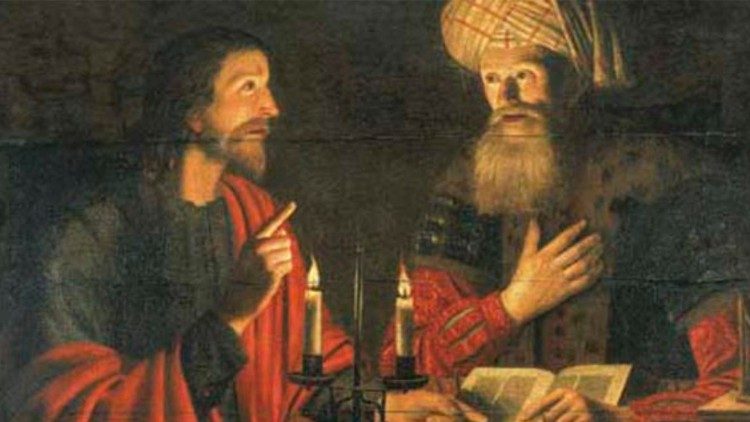
Jesus' encounter with NicodemusJesus' encounter with Nicodemus

Pope Francis: Nicodemus finds hope in encounter with Jesus

As he recovers in hospital, Pope Francis has released his catechesis for the weekly General Audience, reflecting on Jesus' encounter with Nicodemus, who eventually found the courage to ask Pilate for Jesus' body.

By Christopher Wells

Pope Francis on Wednesday began a series of reflections on Jesus’ encounters with various individuals in the Gospel, as part of his larger catechetical cycle on the life of Jesus our hope.

“There are encounters that enlighten life and bring hope,” the Pope writes, beginning with the meeting of Jesus and Nicodemus, “a man whose story shows it is possible to come out of the darkness and find the courage to follow Christ.”

Jesus illuminates the darkness of the heart

In the Gospel of St John, Nicodemus, a pharisee and a leader of the Jewish people, first comes to Jesus in the night, but ultimately comes boldly to Pilate to request Jesus’ body after the crucifixion.

Pope Francis explains that in John’s Gospel, the night likely symbolizes the darkness of the doubts in Nicodemus’ heart. “If you are in the dark,” he says, “of course you look for the light... Nicodemus therefore seeks Jesus because he has sensed that He can illuminate the darkness of his heart.”

At first, however, Nicodemus cannot understand what Jesus tells him “because he continues to think with his own logic and categories... he feels the need for change, but does not know where to start.”

Finding new ways to love

Pope Francis says, “This happens to all of us at some point in our lives.” Life, he says, “lies in the ability to change in order to find a new way of loving,” which Jesus calls “a new birth” in His conversation with Nicodemus.

“If we allow the Holy Spirit to generate new life in us, we will be born again,” the Pope says. “We will rediscover the life that perhaps was fading within us.”

Nicodemus “shows us that this change is possible,” the Pope concludes. Although we sometimes fear change, the Holy Spirit encourages us to face our fears. “Nicodemus, like all of us, can look on the Crucified One, the One who defeated death, the root of all our fears,” Pope Francis says. “Let us lift up our gaze to the One they have pierced; let us also be met by Jesus; in Him we find the hope to face the changes in our lives and be born again.”

As Pope Francis is continuing his recovery from pneumonia in Rome’s Gemelli Hospital, the text of Wednesday’s reflection for the General Audience was released by the Holy See Press Office.

Wednesday, March 5, 2025

Text for today's General Audience released by the Vatican as Pope Francis continues recovery


File Photo: The Paul VI Hall during one of the Pope's previous General AudiencesFile Photo: The Paul VI Hall during one of the Pope's previous General Audiences  (Vatican Media)

Pope Francis: Like Mary and Joseph, let's search for the Lord with hope

In the text of his catechesis for his General Audience, Pope Francis calls on all faithful to seek the Lord, as Mary and Joseph did when they set out to find their 12-year-old son, Jesus, in the temple.

By Deborah Castellano Lubov

“Like Mary and Joseph, full of hope, let us also set out in search of the Lord, who cannot be contained within our limited expectations...”

This was the central theme of Pope Francis' prepared text for his General Audience, originally scheduled for 5 March. Although the Audience was cancelled, the Holy Father chose to have the Holy See Press Office publish his message.

Continuing his catechetical cycle on “Jesus Christ, Our Hope,” Pope Francis dedicated his reflection to the childhood of Jesus, focusing in particular on the episode in which, at the age of twelve, He remained in the Temple without informing His parents. Mary and Joseph, overcome with anxiety, searched for Him for three days before finally finding Him.

The Holy Father marveled that this account presents us with a very interesting dialogue between Mary and Jesus, which helps us reflect on Mary's journey.

Mary as a pilgrim of hope

Stressing that her journey certainly was not an easy one, the Pope explained that that Mary undertook “a spiritual itinerary” during which, her understanding of her Son’s mystery consistently grew.

As he went on to recall the various stages of the Blessed Mother’s journey throughout the Lord’s life, he noted how, throughout it all, she remained “a pilgrim of hope".

The Blessed Mother Mary, Pope Francis highlighted, is His first disciple. He adds that she nurtured him, helped Him grow, and followed Him, allowing herself to be shaped by the Word of God before anyone else.

The Pope then quoted Pope Benedict XVI, who said "We see how completely at home Mary is with the Word of God..." Noting she "is completely imbued with the Word of God," Benedict had explained, "she is able to become the Mother of the Word Incarnate."

However, this unique communion with the Word of God, Pope Francis pointed out, did not spare her the struggle of a demanding "apprenticeship."

The Blessed Mother's fear of losing her Son

The experience of losing site of Jesus at the age of twelve during the annual pilgrimage to Jerusalem frightened Mary so much, the Pope suggested, that she, in a sense, became the “spokesperson” for both herself and Joseph in reproaching their son.

“Mary and Joseph,” he acknowledged, “experienced the pain of parents who lose a child". Believing that Jesus was with their relatives in the travelling caravan, they went on without concern. But after an entire day without seeing Him, anxiety set in, and they began a desperate search, retracing their steps.

“Returning to the Temple, they discovered that the one whom they had, until recently, seen as a child in need of protection, had suddenly matured,” said the Pope. They noticed he had become capable of engaging in discussions on the Scriptures, “holding His own” in debates with the teachers of the Law.

Surpassing comprehension

Pope Francis went on to recall that in response to his mother’s reproach Jesus replied simply, saying he was conducting His Father’s “business.” However, the Pope observed, Mary and Joseph did not understand. “The mystery of God made child surpassed their comprehension.”

“His parents,” the Pope recognized, “wanted to protect their precious Son under the wings of their love; but Jesus,” he continued, “instead, wanted to live out His vocation as the Son of the Father, serving Him and immersing Himself in His Word.”

Finally, and with this in mind, the Pope urged the faithful to seek the Lord like Mary and Joseph did, and to do so full of hope.

Wednesday, February 26, 2025

Vatican releases the Pope's Wednesday General Audience catechesis


Armenian icon of the Presentation of Jesus in the TempleArmenian icon of the Presentation of Jesus in the Temple 

Pope Francis: Let us imitate Simeon and Anna, pilgrims of hope

In the catechesis prepared for the General Audience scheduled for February 26, Pope Francis reflects on the Presentation in the Temple and invites us to imitate Simeon and Anna as model “pilgrims of faith”.

By Christopher Wells

Despite the cancellation of Wednesday morning’s General Audience, Pope Francis continues to teach from his hospital room, with the Vatican releasing the prepared text of the Pope’s catechesis.

Continuing the catechetical cycle on “Jesus Christ, our hope”, the Holy Father reflects on the mystery of the Presentation of Jesus in the Temple forty days after His birth. The Presentation demonstrates Mary and Joseph’s obedience to Jewish Law, and show them not only “integrating” Jesus into a family, a people, and a covenant, but also caring for His growth as they themselves grow “in their comprehension of a vocation that far surpasses them”.

Pope Francis then turns his attention to the two other figures present in the Temple: the elderly Simeon and Anna.

A witness of faith, hope, and love

Simeon, longing for the fulfilment of God’s promises to Israel, is inspired to take the Child Jesus in his arms and is consoled at seeing the Saviour of Israel. He expresses his feelings “in a canticle full of heartfelt gratitude, which in the Church has become the prayer at the end of the day”: the Nunc dimittis, which begins, “Now, O Lord, you let your servant go in peace, according to your word…”

Simeon, the Pope said, is “a witness of faith received as a gift and communicated to others; ... a witness of the hope that does not disappoint; ... a witness of God’s love, which fills the human heart with joy and peace”.

Hope rekindled in our hearts

Alongside Simeon, Anna, a widow entirely dedicated to service and prayer, also sees salvation in the Child Jesus. At the sight of the Child, the Pope explained, “Anna celebrates the God of Israel, who has redeemed His people in that very Child, and tells others about Him, generously spreading the prophetic word”.

Pope Francis continued, “The song of redemption of two elders thus emits the proclamation of the Jubilee for all the people and for the world. Hope is rekindled in hearts in the Temple of Jerusalem because Christ our hope has entered it”.

Pilgrims of hope

Pope Francis concluded his reflection by inviting the faithful to imitate Simeon and Anna, “these pilgrims of hope”, who are able to see beyond appearances “who know how to welcome God’s visit with joy and rekindle hope in the hearts of brothers and sisters”.