Showing posts with label World War II. Show all posts

Monday, August 11, 2025

From the Diocese of Lafayette LA and the WW2 Musuem in New Orleans, Father Joseph Lafleur, Chaplain to WW2 POW's


Father Lafleur: Forgotten story of chaplain to POWs in WWII and his ‘incredible selflessness’


Father Joseph Verbis Lafleur, a World War II chaplain who gave his life while saving others on a Japanese prison ship, is seen in this undated photo. He died Sept. 7, 1944, when a U.S. submarine torpedoed the Japanese ship that he and over 700 fellow prisoners of war were aboard in the Indian Ocean. A priest of the Diocese of Lafayette, La., he is a candidate for sainthood and has the title "Servant of God." (OSV News photo/courtesy Diocese of Lafayette)


(OSV News) — There was nothing elegant about St. Peter’s in Chains, the small chapel where Servant of God Father Joseph Verbis Lafleur celebrated Christmas Eve Mass on Dec. 24, 1942.

It was a simple wooden hut, built in the middle of a Japanese prisoner of war camp, where Father Lafleur was being held prisoner.

Father Lafleur, ordained for the Diocese of Lafayette, Louisiana, on April 2, 1938, had enlisted as a military chaplain in early 1941 and was assigned to serve the U.S. Air Corps 19th Bombardment Group, stationed in the Philippines.

Two years later, he was captured by the Japanese during the early days of America’s involvement in World War II and was sent to a prisoner of war camp.

Eventually, Father Lafleur died when a U.S. submarine sank an unmarked Japanese prisoner of war transport, the SS Shinyo Maru, which was carrying U.S. prisoners of war to the mainland, killing all but 60 of the prisoners.

Recently, Michael Bell, executive director of the of the Jenny Craig Institute for the Study of War and Democracy at the National World War II Museum in New Orleans, began researching Father Lafleur’s life and service and presented his findings during a special reception on July 31.

“Father LaFleur is part of this unique experience of World War II, being stationed in the Philippines at the beginning of the war and then being sent to a prisoner of war camp and dying on a transport ship,” Bell told OSV News. “He also went to seminary here in New Orleans so he is this hometown hero. I pass that seminary, going to Mass on Sunday.”

On Dec. 8, 1941, sirens blared across Clark Field in the Philippines, a U.S. military base. Simultaneously, on what was Dec. 7 due to the international date line, a Japanese aircraft carrier group had launched an air assault on the U.S. base at Pearl Harbor, Hawaii, marking the beginning of the United States’ involvement in World War II.

Father Lafleur, the base’s chaplain watched as Japanese planes dropped bombs and strafed the U.S. airfield. Seeing wounded soldiers, the chaplain jumped into action.

“Without regard for his personal safety, Father Lafleur is going from wounded soldier to soldier, providing comfort or helping evacuate him to safety and he really becomes an inspiration, not just for those he helped, but even for the leaders of that unit,” Bell said. “It starts to show this incredible selflessness when, you know, by all accounts, everybody else is taking cover and he is out there helping people.”

Father Lafleur’s example of selflessness continued when, after the attack, he was given the opportunity to evacuate to Australia. The chaplain, however, vowed to stay with his men, telling commanders that he will not leave until everybody else has been evacuated.

Thus, Father Lafleur retreated with the remaining soldiers to the Bataan Peninsula where they attempted to ward off the invading Japanese forces. However, their efforts stalled and on May 7th, 1942, Lafleur and the 19th bombardment group surrendered to the Japanese.

Yet the tale of Father Lafleur’s heroism had only just begun.

Father LaFleur was sent to Davao Penal Colony, a Japanese prisoner of war camp in the Philippines where he endured harsh living conditions and violent prison guards.

“The conditions get worse and worse over time,” Bell said. “Whatever food they had begins to dwindle and by mid-summer 1942, the Japanese become very violent. If American or Filipino prisoners escape or try to escape, they will do retribution against the other prisoners by punishing them or even executing some.”

Yet, Father Lafleur attempted to keep spirits high by providing the sacraments and being a listening ear to his fellow prisoners. Shortly after his arrival to Davao, Father Lafleur and other prisoners begin constructing a small wooden hut to serve as a chapel which they dub “St. Peter in Chains.”

There, they celebrated 1942 Christmas Eve Mass.

“One of the accounts suggests that as Father Lafleur is celebrating Mass, a couple of the other prisoners were so inspired that they pulled out an American flag they had been hiding and unfurled the flag and held it up, during this midnight Mass,” Bell said. “It becomes this huge inspiration for all of these prisoners to persevere.”

Shortly thereafter, the Japanese began selecting prisoners to be sent to Lasang, a nearby work camp. Lafleur, still recovering from a severe bout of malaria, volunteered to go, believing that to be where God was calling him to serve.

There, he remained until August of 1944.

With American forces rapidly closing in, the Japanese began sending American prisoners of war to camps on other Japanese controlled islands via “hell ships.”

Father Lafleur and 750 other Americans were loaded onto one of these hell ships, the SS Shinyo Maru, where they were stuffed into two cramped, below deck compartments with minimal ventilation, no toilets and barely enough room for each prisoner to sit down.

The men turn to Father Lafleur for spiritual guidance and encouragement as they suffer in the sweltering heat and complete darkness.

“One account that was shared with us recalls a soldier, who was suffering, finds Lafleur in the hold and asks, ‘Padre, can you please pray for me? Lafleur listens to him and tells him to say an act of contrition, and then almost simultaneously, the Japanese actually open the hatch,” Bell said. “Before that they are in this incredible heat, and now they have sunlight and a breeze.”

Tragically, on Sept. 7, 1944, a US submarine fired upon the unmarked Japanese vessel.

“When the ship is hit, the Japanese begin shooting at the Americans as they try to come out of the hold and they begin throwing grenades into the hold,” Bell said. “The account states that Father Lafleur is there, constantly trying to help people up and out, without regard to his own survival or safety.”

In the end, he helped 83 men escape but the transport ship snapped in half and sank to the bottom of the Pacific with Father Lafleur still onboard.

For years, Father Lafleur’s story remained largely forgotten, only to be recalled in official US reports, the testimony of his fellow prisoners, and within the Diocese of Lafayette, which opened his cause for canonization Sept. 5, 2020.

After learning about Father Lafleur’s story, Bell knew that he wanted to know the full picture and share it with the world. He believes that Lafleur is an example of selflessness that can be a model for all.

“What is incredible with Father Lafleur’s story is that consistent selflessness,” Bell said. “It is a selflessness beyond being. It is this model of ultimate self-sacrifice that can be an example and model for all.”

Jack Figge writes for OSV News from Kansas.

Wednesday, June 5, 2024

Pope Francis marks anniversary of End of Nazi occupation of Rome


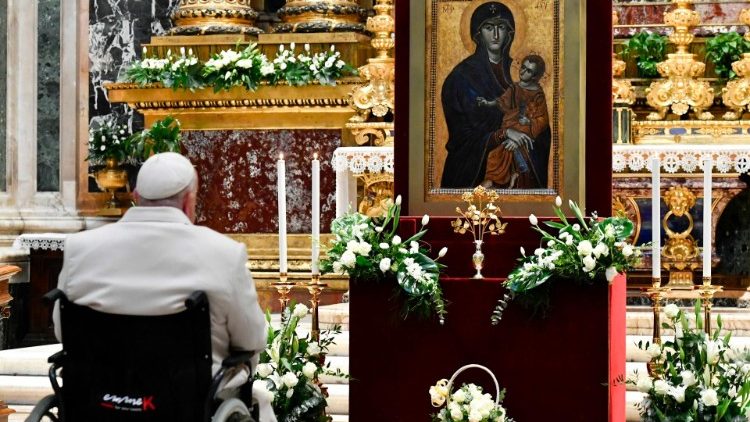
The Pope prays in front of the Salus Populi Romani in the Basilica of Santa Maria MaggioreThe Pope prays in front of the Salus Populi Romani in the Basilica of Santa Maria Maggiore  (Vatican Media)

Pope recalls end of Nazi occupation of Rome

Pope Francis writes a letter to mark the 80th anniversary of the vow made in Rome in front of the Marian icon ‘Salus Populi Romani’ after the city was liberated from the Nazis.

By Vatican News

This is the first time the event has been commemorated in this way, writes the Pope in his letter to the Viceregent of Rome, Auxiliary Bishop Baldassare Reina, which was published on Tuesday evening. 

On 4 June 1944, the people of Rome, together with their bishop, Pope Pius XII, implored Our Lady to save the city when a direct clash between the German army and the Anglo-American Allies was imminent and the city was facing "the nightmare of Nazi devastation".

Eighty years later, this is an occasion, the Pope said, “to pray for the victims of the Second World War and to reflect anew on the terrible scourge of war.”

“We cannot and must not give in to the logic of weapons!”

The innocent victims of wars in Ukraine, Palestine and Israel, Sudan, Myanmar and elsewhere challenge “the conscience of all”, the Pope wrote: “We cannot and must not give in to the logic of weapons!”

Everyday peacemakers

Peace is a gift from God, but it needs people who are willing to accept it “and commit themselves to being builders of reconciliation and witnesses of hope”, Pope Francis wrote.

He expressed his hope that the commemoration of the vow he made to Our Lady 80 years ago would inspire Romans “to be architects of true peace everywhere and to revive fraternity as an essential condition for the resolution of conflicts and hostilities”.

The Pope urged for a peaceful attitude in everyday life: it is a matter, he said, of advocating good relations between people “with courage and gentleness” and “reconciling tensions in the family, at work, at school and among friends”.

The Pope’s devotion to the Salus Populi Romani

In the eleven years of his pontificate, Francis has done much to revitalise devotion to the Marian icon Salus Populi Romani (‘Salvation of the Roman People’).

He regularly visits the image, which is kept in the Basilica of Santa Maria Maggiore, before and after journeys abroad, as well as on the Feast of the Conception on 8 December.

He often has it brought to the Vatican for his liturgies.

Most recently, this Roman icon of the Virgin Mary could be seen behind the Pope on Corpus Christi, when he gave the Eucharistic blessing at the end of the procession in front of Santa Maria Maggiore.

“The most important events in the religious and civil life of Rome found their echo in front of this image”

For centuries, the Pope writes in his letter, the image of the Virgin Mary has been “alive in the hearts of Romans”, who invoked her in prayer during epidemics, natural disasters and wars. “The most important events in the religious and civil life of Rome found their echo in front of this image,” said the Pope.

Thus, Romans also entrusted themselves to Maria Salus Populi Romani as they feared the destruction of their city by the Nazi occupiers in 1944.

4 June 1944: The peaceful liberation of Rome

On 4 June 1944, Rome was the first capital to be freed from Nazi occupation, and, contrary to fears, this was done without fighting.

Some contemporary witnesses considered it a miracle that the city was not devastated, especially as the Americans had bombed and completely destroyed Montecassino on 15 February.

The Vatican and Pope Pius XII (1939-1958) persuaded Field Marshal Albert Kesselring to declare Rome an ‘Open City’, a place that is not defended and therefore may not be attacked.

Thursday, March 14, 2024

Pope to beatify a priest and 15 nuns all martyred during World War II


2022.10.27 croce - fede

Pope recognizes martyrdom of priest, 15 nuns killed during World War II

Pope Francis authorizes the promulgation of several decrees recognizing the martyrdom of a priest guillotined in Nazi Germany and 15 German-born nuns killed in the Soviet Union, as well as miracles attributed to three Venerables.

By Vatican News

Among the soon-to-be Beatified are 16 martyrs, killed out of hatred for the faith under Nazism and Soviet communism. The group includes a priest guillotined in Nazi Germany and 15 nuns of German origin killed by soldiers of the Red Army or who died in concentration camps in Soviet Russia.

On Thursday, Pope Francis met with Cardinal Marcello Semeraro, Prefect of the Dicastery for the Causes of Saints, and authorized the promulgation of the decrees related to 25 Catholic women and men.

The decrees include recognition of the martyrdom of 15 German-born women religious who were serving in Poland during the invasion by the Red Army.

Sr. Christophora Klomfass and her 14 companions of the Congregation of the Sisters of St. Catherine, Virgin and Martyr (CSC) died in 1945.

The nuns were killed out of hatred for the faith by Soviet soldiers, enduring rape, torture, and death due to hardship, maltreatment, or diseases in concentration camps in Soviet Russia. As a fierce sign of contempt for the Christian faith, their tormentors often cut and tore their religious clothing.

A priest for peace and ecumenism during Hitler's time

Fr. Max Josef Metzger, a German diocesan priest and founder of the Secular Institute Societas Christi Regis, was killed on April 17, 1944, in Nazi Germany.

The priest was active in pacifist and ecumenical movements, and in 1917 he founded the Universal Peace League of the White Cross. Ten years later, he participated as a Catholic observer at the Lausanne Assembly, which gave rise to the Ecumenical Council of Churches.

Upon the rise of Nazism, he spoke out openly against Hitler. He was first arrested in 1939 and a second time in 1943.

Sentenced to death, he was guillotined on April 17, 1944, in the Brandenburg-Görden prison. He was aware that his commitment to peace and ecumenism, as well as his refusal of the Nazi regime in the name of Christ, could cost him his life.

The other future Beatified

Pope Francis also recognized miracles attributed to the intercession of three Venerables, clearing the way for their beatification.

Among the future new Beatified is also the Patriarch of Antioch of the Maronites, Stephane Douayhy, Lebanese, who lived in the 17th century (1630-1704). He performed an intense work of assistance to the poor and in favor of ecumenical dialogue between East and West.

The Pope also cleared the way for the beatification of Venerable José Torres Padilla, a Spanish diocesan priest, co-founder of the Congregation of the Sisters of the Company of the Cross (1811-1878), and Venerable Camillo Costa de Beauregard, a French diocesan priest (1841-1910), nicknamed the "father of orphans" for founding the Le Bocage orphanage in Chambery.

Seven new Venerables

The seven new venerables are:

-  Geervaghese Thomas Panickaruveetil Mar Ivanios, Archbishop of Trivandrum of the Syro-Malankara Catholic Church, founder in 1919 of the Congregations of the Order of the Imitation of Christ Bethany Ashram and the Sisters of the Imitation of Christ Bethany Madhom, a pioneer of ecumenism in India and first bishop of the Syro-Malankara Catholic Church;

-  Brazilian Fr. Liberio Rodrigues Moreira, (1884-1980) who spent his life for the sick and the poor and lived with deep Christian spirit the trials of life, tireless adorer of the Eucharist;

-  Professed layman Antonio Tomičić, (1901-1981) a Croatian of the Order of Friars Minor Capuchin, who during the years of communism, when wearing religious signs in public provoked ridicule and hostility, never took off his habit, enduring public insults and persevering, with firm trust in the Lord, in his quest for the needs of the brothers;

-  Italian laywoman and mother Maddalena Frescobaldi Capponi, (1771-1839) founder of the Congregation of the Passionist Sisters of St. Paul of the Cross;

-  Maria Alfinda Hawthorne, (1851-1926) founder of the Dominican Sisters of Saint Rose of Lima, born in the mid-19th century to a Protestant family in the US state of Massachusetts and became Catholic in Europe along with her husband, from whom she separated due to his alcoholism, then dedicating herself to the service of Christ in cancer patients;

-  Angelina Pirini, (1922-1940) lay leader of the parish Catholic Action in Celle di Sala di Cesenatico in Emilia Romagna died in 1940;

-  Elisabetta Jacobucci, (1858-1939) professed sister of the Institute of the Alcantarine Franciscan Tertiaries, lived at the turn of the 19th and 20th centuries. She was always willing to accept the most humble tasks, and managed to combine the ascetic aspect of the contemplation of the Passion with an intense charitable apostolate for orphans and the elderly.

Friday, September 8, 2023

More truth revealed in Catholic role in saving Jews throughout Rome during WWII


Catholic-Jewish research backs reports Catholic convents sheltered 3,000-plus Roman Jews during WWII


BY NICOLE WINFIELD
Updated 3:07 PM CDT, September 7, 2023

ROME (AP) — Researchers have discovered new documentation that substantiates reports that Catholic convents and monasteries in Rome sheltered Jews during World War II, providing names of at least 3,200 Jews whose identities have been corroborated by the city’s Jewish community, officials said Thursday.

Researchers from the Pontifical Biblical Institute, Israel’s Yad Vashem Holocaust research institute and Rome’s Jewish community released the findings at an academic workshop Thursday held at the Museum of the Shoah, part of Rome’s main synagogue.

The documentation doesn’t appear to shed any new light on the role of Pope Pius XII during the Nazi occupation of Rome, including whether he directed Catholic institutions to shelter Jews. Historians have long debated Pius’ legacy, with supporters insisting he used quiet diplomacy to save Jewish lives and critics saying he remained silent as the Holocaust raged across Europe, and even as Roman Jews were rounded up and deported from the Vatican’s backyard in 1943.

Rather, the new documentation provides names and addresses of Romans who were sheltered in Catholic institutions during the war, which had only previously been reported in vague terms and numbers by Italy’s preeminent historian of the period, Renzo de Felice, in a 1961 book, according to a joint statement from the Pontifical Biblical Institute, Yad Vashem and Rome’s Jewish community.

The documentation was discovered in the archives of the Biblical Institute, which is affiliated with the Jesuit-run Pontifical Gregorian University. It lists more than 4,300 people who were sheltered in the properties of 100 women’s and 55 men’s Catholic religious orders. Of those, 3,600 are identified by name, and research in the archives of Rome’s Jewish community “indicates that 3,200 certainly were Jews,” the statement said.

“Of the latter it is known where they were hidden and, in certain circumstances, where they lived before the persecution. The documentation thus significantly increases the information on the history of the rescue of Jews in the context of the Catholic institutions of Rome,” the statement said.

The names are not being released to protect the privacy of the people and their descendants, it added.

It is unclear whether any of the Jews listed were baptized. Recently opened Vatican archives of the Pius papacy suggest that the Vatican worked hardest to save Jews who had converted to Catholicism or were children of Catholic-Jewish mixed marriages, according to the book “The Pope at War,” by Brown University anthropologist David Kertzer.

Claudio Procaccia, in charge of the cultural department of Rome’s Jewish community, said the documentation doesn’t provide any information as to whether the Jews identified had been baptized. But he stressed that the lists provided an important “new element in understanding qualitatively and quantitatively” who was sheltered, where and their origins.

“This is a very important step,” he said in an interview after the workshop, adding that further research was necessary to corroborate further the names listed and their histories, including with other lists in other archives. He noted that discrepancies are likely to emerge down the line since it is known that some people pretended to have Jewish last names to find shelter in Catholic convents, even if they weren’t necessarily Jewish.

Procaccia noted that the Jewish community in 2013 published its own research into the fate of Jews during the Nazi occupation of Rome, entitled “After October 16,” the date in 1943 when more than 1,000 of Rome’s Jews were rounded up and, two days later, deported to Auschwitz.

Iael Nidam Orvieto, director of Yad Vashem’s International Institute for Holocaust Research and an expert on the Jews of Italy during the Holocaust, said the new documentation adds new information but also poses new questions that require further investigation. One of those questions is why the list was even compiled by an Italian Jesuit at the Pontifical Biblical Institute immediately after the liberation of Rome.

“We find houses, even cloisters, that hid entire families, while others hid only a few,” Nidam Orvieto said in a statement to The Associated Press released by Yad Vashem. “There are many more questions we ask but we must remember that while this impressive document lists thousands of Jews who found refuge in religious institutions across Rome, it lacks the names of those who were refused assistance and their fate during the Holocaust.”

“We must therefore study this document in the correct context, taking into account all the factors that influenced this activity,” she added, saying researchers were only at the start of an ongoing project.

The Rev. Dominik Markl, a Jesuit professor at the Pontifical Biblical Institute and University of Innsbruck who helped coordinate the research, said he was moved by the fates of the people named in the documents, “those threatened to be murdered because of the persecution by the Nazi regime, and the many anonymous religious sisters and priests who risked their own security to help them survive.”

In comments to AP, Markl noted the significance of the joint research between Catholic and Jewish scholars on a fraught issue which has long divided scholars and often strained relations between Rome’s Jewish community and the Holy See.

“We are extremely grateful for the collaboration with the Jewish Community of Rome and Yad Vashem, which is promising to lead towards a more profound understanding of the history of the Shoah in Rome and beyond,” he said.

Wednesday, February 15, 2023

Entire Polish family, mom & dad and all 7 children to be beatified for faith that led to their martyrdom at the hand of the Nazis


Beatification date announced for married couple with seven children martyred by Nazis


Wiktoria Ulma with six of her children. | The Ulma Family Museum of Poles Saving Jews in World War II

The beatification date has been announced for Józef and Wiktoria Ulma and their seven children, who were killed by the Nazis for hiding a Jewish family in their home in Poland.

The Archdiocese of Przemyska announced Tuesday that the entire Ulma family — including one unborn child — will be beatified on Sept. 10.

Cardinal Marcello Semeraro, the prefect of the Vatican Dicastery for the Causes of Saints, will preside over the beatification ceremony in Markowa, the village in southeast Poland where the Ulma family was executed in 1944.

Pope Francis recognized the martyrdom of the couple and their children in a decree signed in December. The World Holocaust Remembrance Center has honored the Ulmas as Righteous Among the Nations for the sacrifice of their lives.

Early on March 24, 1944, a Nazi patrol surrounded the home of Józef and Wiktoria Ulma on the outskirts of the village of Markowa in southeast Poland. They discovered eight Jewish people who had found refuge on the Ulma farm and executed them.

The Nazi police then killed Wiktoria, who was seven months pregnant, and Józef. As children began to scream at the sight of their murdered parents, the Nazis shot them too: Stanisława, age 8, Barbara, 7, Władysław, 6, Franciszek, 4, Antoni, 3, and Maria, 2.

Father Witold Burda, the postulator for the Ulma family, has said that a Bible was found inside the Ulma house in which the parable of the Good Samaritan had been underlined in a red pen.

The postulator added that Józef and Wiktoria were known in their community for being “willing to help anyone who knocked on their door.”

“They built their family on the foundation of faith with fidelity to the two essential commandments: the commandment to love God and the commandment to love one’s neighbor,” Burda said.

Tuesday, December 7, 2021

Remember Pearl Harbor


World War II Veterans Tour Pearl Harbor During 80th Anniversary Pearl Harbor RemembranceWorld War II Veterans Tour Pearl Harbor During 80th Anniversary Pearl Harbor Remembrance  (Public Domain)

Remembering Pearl Harbor 80 years on

The United States on Tuesday marks the 80th anniversary of the Japanese attack on the U.S. naval base in Pearl Harbor, Hawaii, an event which led the country to formally enter the Second World War

By Vatican News staff reporter

On 7 December 1941, the Japanese attacked the U.S. naval base in Pearl Harbor, Hawaii killing 2,390 Americans.

The US President at the time, Franklin D. Roosevelt proclaimed the act "a date which will live in infamy.”

The base was attacked by 353 Imperial Japanese aircraft launched from six aircraft carriers. All eight U.S. Navy battleships were damaged, with four sunk. A number of battleships were later raised and were used to fight in the war, with the exception of USS Arizona.

On Monday evening, a memorial ceremony was held at Pearl Harbor to honour the 58 servicemen who died aboard the battleship USS Utah, the first ship hit in the attack.

Members of the U.S. Navy, veterans, friends and family members gathered as the names of those who died were read out, each accompanied by a toll of a bell.

Valour, Sacrifice, and Peace

President Joe Biden and his wife on Tuesday marked the 80th anniversary of the attack on Pearl Harbor with a visit to the World War II Memorial in the capital Washington

Survivors were also expected to gather later Tuesday in Pearl Harbor to remember those killed 80 years ago and observe a minute of silence at 7.55 local time, the exact moment of the attack. The theme for this year’s National Pearl Harbor Remembrance Day Commemoration is Valour, Sacrifice, and Peace

The goal of the commemoration “is to ensure that future generations will understand the valor and legacy of those who perished and those who fought throughout the war.”

Eye witness account

Herb Elfring who is now 99, nearly didn’t live through the attack. “It was just plain good to get back and be able to participate in the remembrance of the day,” he said.

Elfring was in the Army and was part of the California National Guard at the time of the attack.

He recalled Japanese planes flying overhead and bullets shelling his Army base at Camp Malakole, a few miles down the coast from Pearl Harbor.

Women and the war

A number of women who helped the war effort by working in factories have come to Hawaii to participate in the memorial this year. Mae Krier, now 95, built B-17s and B-29 planes at a Boeing plant in Seattle. She noted that it took the world a while to credit women for their work in the war. “We fought together as far as I’m concerned… And so of course, I’ve been fighting hard for that, to get our recognition,” she said.

Pearl Harbor Memorial

The USS Arizona Memorial at Pearl Harbor in Honolulu marks the resting place of 1,102 of the 1,177 Sailors and Marines who lost their lives on the USS Arizona during the attack on Pearl Harbor and commemorates the events of that day.

This year's ceremony takes place as a strong storm packing high winds and extremely heavy rains hits Hawaii; however, there were no plans to cancel the event.

The United States defeated Japan in August 1945, days after U.S. atomic bomb attacks on Hiroshima and Nagasaki killed tens of thousands.