Showing posts with label Communism. Show all posts

Saturday, August 1, 2026

Pope Leo XIV: "no prison is deep enough to separate a person from the love of God." Remembering Communist prison camp in Albania


Cardinal Ernest Simoni celebrates Mass at the former prison camp of Spaç, in AlbaniaCardinal Ernest Simoni celebrates Mass at the former prison camp of Spaç, in Albania 

Pope to Cardinal Simoni: No prison can separate a person from God's love

Pope Leo XIV sent a message to 97-year-old Cardinal Ernest Simoni, who yesterday morning, Friday 31 July, presided over the Mass at the former prison camp of Spaç, Albania, in memory of those who suffered or lost their lives there. During the communist regime, the Cardinal spent most of his 18-year sentence of forced labour in the camp, where he celebrated Mass in secret.

By Fabrizio Peloni 

“No chain is strong enough to imprison a conscience enlightened by the Gospel; no night is so long that it can prevent the dawn the Lord prepares for His children; and no prison is deep enough to separate a person from the love of God.”

With these words, echoing Saint Paul’s Letter to the Romans (8:35–39), Pope Leo XIV addressed a message to Albanian Cardinal Ernest Simoni and to all those who took part in the Mass the Cardinal presided over on Friday morning, 31 July, at the former prison camp of Spaç, in remembrance of those who suffered or died there.

A site where many bore the cross of injustice

“That place, deeply engraved in the memory of the Albanian people, remains one of the most painful chapters in the nation’s history. Spaç was a place where many carried the heavy cross of injustice,” the Pope wrote in the message, which was read at the conclusion of Mass.

The Holy Father recalled that “the blood of those who suffered and died among those mountains has watered that land, making it a silent witness to fidelity, courage and hope.”

A witness to persecution under the communist regime

Cardinal Simoni, now 97, returned to the camp where he spent most of his 18 years in prison “to celebrate the Sacrifice of Christ, which transformed the Cross from a sign of death into the promise of life,” Pope Leo wrote.

The Albanian Cardinal experienced first-hand the persecution of the communist regime. Initially sentenced to death as an enemy of the people, his sentence was later commuted to imprisonment in various labour camps, where he endured years of forced labour.

“I risked my life every time I celebrated Mass”

Cardinal Simoni recalled that during his imprisonment, he celebrated Mass from memory in Latin, noting, "I risked my life each time." He also said he heard confessions and distributed Holy Communion in secret.

Explaining that he baked the bread using flour cooked over makeshift stoves and used juice squeezed from grapes for the Eucharistic celebration, he recognized, “If they had found me, they would have hanged me immediately."

In fact, during Friday’s Mass, the Cardinal showed those present the miner’s helmet he wore as a young priest when he was sent to work underground in the mines.

The Pope’s prayer for those buried in unmarked graves

Reflecting on those years of persecution, Pope Leo wrote, “Who knows how many prayers rose to Heaven from that place? How many supplications were whispered in silence? How many faces, marked by hardship and deprivation, entrusted their final hope to the Lord?”

The Pope joined in prayer for each of those men and women, many of whom were buried in unmarked graves, where no one was able to mourn them or lay a flower in their memory.

He prayed that “their memory may remain alive and serve as a constant reminder to new generations of the inviolable dignity of every human person, the value of freedom, and the commitment to peace.”

Tuesday, June 3, 2025

Special commemoration by Pope Leo XIV for the Greek Romanian "prophet of hope"


Pope Leo XIV honours Blessed Iuliu Hossu as a prophet of hope

Pope Leo XIV pays tribute to Blessed Iuliu Hossu, recalling his heroic defense of Jews during WWII and his unwavering faith under Communist persecution.

By Linda Bordoni

Presiding over a commemoration for Blessed Cardinal Iuliu Hossu, the Greek-Catholic Bishop of Cluj-Gherla and martyr for the faith, Pope Leo XIV upheld the Cardinal’s legacy of interfaith solidarity and forgiveness and encouraged believers to follow his example of hope, courage and mercy.

The ceremony, which took place on Monday afternoon in the Sistine Chapel, was held to mark the 5th anniversary of the late Pope Francis’ visit to Romania and the celebration in Freedom Square, Blaj, of the liturgy for the beatification of seven martyred Greek Catholic Bishops, including Iuliu Hossu. The initiative was agreed upon a year ago with the late Pope at the request of the Federation of Jewish Communities of Romania.

“Today, in a certain sense, he enters this Chapel,” Pope Leo said, referring to Cardinal Hossu, who was created cardinal in pectore by Saint Paul VI in 1969 while still imprisoned under the Communist regime in Romania. The Pope recalled the courage and constancy of the prelate who, even amid severe persecution, remained faithful to the Church of Rome.

Addressing participants, who included representatives of Romania’s Greek-Catholic Church, civil authorities, and the President of the Federation of Jewish Communities in Romania, Hon. Silviu Vexler, the Pope said Cardinal Hossu’s legacy is “a symbol of fraternity transcending all ethnic and religious boundaries.”


Commemoration of the Blessed Hossu   (@Vatican Media)

Defender of the oppressed

The Holy Father highlighted the ongoing process to bestow upon Cardinal Hossu the title of “Righteous Among the Nations”,  an initiative prompted by his heroic efforts to protect Jews in Northern Transylvania during the Nazi occupation between 1940 and 1944.

“At enormous risk to himself and to the Greek-Catholic Church,” Pope Leo noted, “Blessed Hossu undertook extensive activities on behalf of the Jews aimed at preventing their deportation.”

Quoting from a pastoral letter issued on 2 April 1944, the Pope gave voice to the cardinal’s call to his faithful:

“Our plea is addressed to all of you… to help the Jews not only with your thoughts, but also with your sacrifice, knowing that there is no act more noble to be carried out today than providing Christian and Romanian assistance, born of ardent human charity.”

The testimony of former Chief Rabbi Moshe Carmilly-Weinberger was also recalled, confirming that Cardinal Hossu’s interventions helped save thousands of Jewish lives.


Commemoration of the Blessed Hossu (@Vatican Media)

Faith rooted in forgiveness

The Pope described Cardinal Hossu as a “man of dialogue and a prophet of hope,” whose beatification by Pope Francis in 2019 affirmed his status as a martyr and model of Christian virtue.

Citing the beatified cardinal’s own words, “God has sent us into this darkness of suffering in order to offer forgiveness and to pray for the conversion of all,” Pope Leo highlighted the enduring power of forgiveness as a transformative force in the face of persecution.

“These words embody the spirit of the martyrs,” he said, “an unshakeable faith in God, devoid of hatred and coupled with a spirit of mercy that turns suffering into love for one’s persecutor.”

Witness for today

Pope Leo XIV drew a parallel between Hossu’s example and the teaching of Nostra Aetate, the Second Vatican Council’s declaration on the Church’s relation to non-Christian religions, written by Pope Paul VI, whose 60th anniversary is approaching.

“What he did for the Jews of Romania,” the Pope said, “today makes him a model of freedom, courage and generosity, even to the point of making the supreme sacrifice.”

Calling on the faithful to adopt Hossu’s episcopal motto, “Our Faith is Our Life”, as their own, Pope Leo offered a forceful appeal against all forms of violence, particularly those directed at the most vulnerable:

“Let us say ‘No!’ to violence in all its forms, and even more so when it is perpetrated against those who are defenseless and vulnerable, like children and families.”

The Pope concluded invoking God’s blessing on all present and expressed his hope that Cardinal Hossu’s example might continue to shine “as a beacon for today’s world.”

Friday, March 10, 2023

Allegation when St. JPII was Archbishop of Krakow seems to be based on a Communist secret police campaign


Polish Bishops: New Allegation That John Paul II Covered Up Sex Abuse Is Based on Reports From Communist Secret Police

The Polish Bishops’ Conference says that ‘further archival research’ is needed to fairly assess a new allegation, based on communist secret police records, made in a documentary. Previous allegations were refuted by investigative journalists late last year.


The Polish Bishops’ Conference says that “further archival research” is needed to fairly assess a new allegation, based on communist secret police records, that St. John Paul II covered up child sexual abuse by a priest while serving as the archbishop of Krakow, Poland, prior to becoming pope.

The allegation was included in a documentary broadcast March 6 on Polish television channel TVN24.

The same TV report also cited two other instances where St. John Paul II, then Archbishop Karol Wojtyla, allegedly relocated Father Eugeniusz Surgent and Father Jozef Loranc to new parishes despite being aware that they had been accused of sexually abusing minors. However, those allegations, first made by a Dutch journalist on Dec. 2 of last year, were quickly refuted later that month by a pair of investigative journalists, the Polish bishops noted in a statement released March 7.

The journalists, Tomasz Krzyżak and Piotr Litka, found that St. John Paul II did not cover up any abuse and consistently acted against such cases during his time as archbishop of Krakow from 1964 to 1978.

The two reporters countered the claim that Archbishop Wojtyla covered up the sexual abuse by Father Surgent, noting that the priest was from the Diocese of Lubaczów rather than the Archdiocese of Krakow. They said Archbishop Wojtyla made several decisions regarding Father Surgent “within his competencies,” but ultimately left “the final word on possible sanctioning of the priest to his ordinary, the bishop of Lubaczów.”

In the case of Father Loranc, the two reporters stated that Archbishop Wojtyla removed the priest from the parish, suspended him, and then forced him to live in a monastery where the civil authorities ultimately arrested him. When he was released from prison, he was again allowed to celebrate Mass but was not allowed to return to the “canonical mission of catechesis of children and youth” or the ministry of the confessional, according to the investigation.

“Two of the cases presented … had already been known to the public for several months thanks to the journalistic work of editors Tomasz Krzyżak and Piotr Litka, which was based mainly on an analysis of the files of state criminal proceedings available in the archives of the Institute of National Remembrance,” Father Adam Zak and Father Piotr Studnicki said in a joint statement on behalf of the Polish Bishops’ Conference. “The findings have already been widely reported.”

Father Zak is the coordinator of the Polish Bishops’ Conference for the Protection of Minors and Father Studnicki is the director of the Office of the Delegate of the Polish Bishops’ Conference for the Protection of Children and Youth.

A third allegation, which is an alleged cover-up of sexual abuse allegedly committed by Father Boleslaw Saduś, is a new claim that was not addressed in prior reporting. The documentary alleges that Archbishop Wojtyla knew Father Saduś was accused of sexually abusing young boys but recommended him to a diocese in Austria without noting this information.

However, this third case “was presented not on the basis of a prosecutorial or judicial investigation but on the files of the security services of the People’s Republic of Poland,” the Polish Bishops’ Conference statement noted. “On the basis of the sources presented in the film, it is impossible to determine the qualification of the acts attributed to Father Saduś.”

The Security Service was the secret police and counter-espionage agency for the atheistic communist government that ruled Poland and sought to subvert and control the Catholic Church in the country.

Fathers Zak and Studnicki also noted that there is “much greater social awareness of the consequences of sexual abuse” today and that the Church has “developed procedures and ways to respond and help.”

“To all those who were harmed in this way by the clergy years ago and still bear the consequences of the evil experienced, we as the Church provide acceptance, listening, and support,” the priests continued. “For details, visit zgloskrzywde.pl. Whereas, determining the role and a fair assessment of the decisions and actions of the Ordinary of the Archdiocese of Krakow Karol Wojtyła, as well as a fair explanation of the allegations against Cardinal Adam Sapieha, requires further archival research.”

Sunday, September 23, 2018

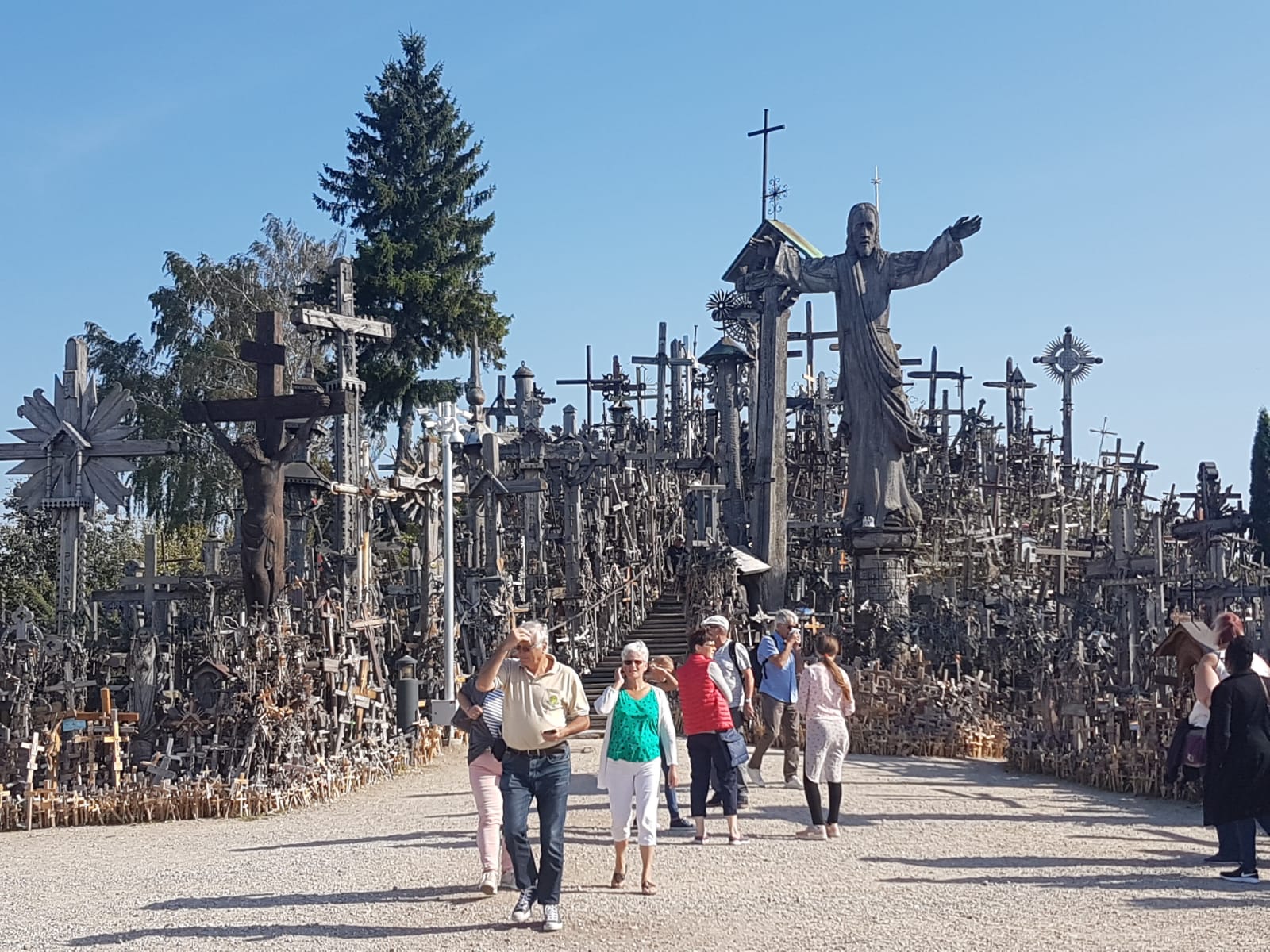
While Pope visits Lithuania a look at the inspirational Hill of Crosses

LITHUANIAN SPECIAL: The Hill of Crosses: Not Only Holy Place, But Symbolizes Struggle to Keep the Faith Alive When Was Under Communism

‘Religious freedom, like all other freedoms, must be respected and protected’

To be called a “hill” in Lithuania, it needs to be just a few feet tall, since the landscape, woods and meadows are flat as far as the eye can see. The location of the Hill of the Crosses is not far from the northern Lithuanian city of Siauliai. Someone traveling to Lithuania that wants to understand the country, cannot miss going to the Hill of Crosses.
And indeed “many people, may pilgrims, come here from all over the world to experience the holiness of the place, many pilgrims! From Poland, Spain, Italy, even from Asia,” says Father Andrius Dobrovolska, a priest involved in its history since the visit of Pope St. John Paul II.
The reason for the name is soon told: today, the crosses piled on this little hill, they say, are about 100,000, even if they are unable to count those that had been removed numerous times during Communism and the replaced, little by little, time and time again.
Numbers aside, it is the story that counts, even if the beginnings are rather obscure. Perhaps a votive offering for a miraculous recovery was the first ‘cross’ planted here. Soon the crosses became tens, hundreds, until, after the end of the Second World War, Lithuania fell under atheistic Soviet Communist control.
“The Hill of Crosses is from one point of view a holy place, and on the other, a symbolic place, representing the struggle of the Lithuanians during the Communist period, to keep their faith alive. It became a kind of battlefield because the Communists were constantly trying to destroy it, to break down the crosses, but the people put it back at night. That’s why it’s a symbol of the struggle for independence.”
At least four times, the Communists removed all the crosses, but each time after, there was a new flowering of crosses. The people were not deterred. When the long-awaited independence brought with it religious freedom, the Polish Pope John Paul II decided that such a tenacious faith deserved the Pope’s homage, with a historic visit, dated September 1993; and the photos of the Polish Pope walking among those thousands of crosses have made the story of that extraordinary pontificate too.
“John Paul II came here, he celebrated mass, it was autumn like now, but it was very cold, so he thought it would be nice to have a place for the pilgrims, so that they would have some shelter, even in the case of cold, rain …” recalled Father Andrius.
Hence the request to the Franciscans, to found the convent which now stands next to the hill, where Father Andrius lives together with two other Franciscans, who are busy welcoming hundreds of visitors every day. The story tells that the idea of ​​the convent came to the traveler Pope just a week later, visiting the Sanctuary of La Verna, in Italy.
“The stigmata are the symbol of the cross,” Father Andrius explains, “so St. John Paul II clearly thought that there was a relationship between these two places, because this is the hill of crosses, and La Verna as it is known is the place where St. Francis received the stigmata.”
Then with the passing of the years, the other installations arrived like parking lots, toilets, souvenir shops, since there is now no tourist guide that does not recommend a visit here. Among other things, with many of the crosses being artistically of value, the Hill is also a UNESCO World Heritage Site. But above all they remind those who arrive here were also by chance, believer and Christian or not, a great truth. A tourist says so simply: “religious freedom, like all other freedoms, must be respected and protected.”