Showing posts with label Ukraine. Show all posts

Sunday, November 1, 2026

Pope Leo XIV on Sunday appeals for peace in Ukraine


The evacuation of civilian people from the city of OleshkyThe evacuation of civilian people from the city of Oleshky (ANSA)

Pope appeals for dialogue and concrete initiatives for peace in Ukraine

Pope Leo XVI upholds a humanitarian ceasefire in the Russian-occupied Ukrainian town of Oleshky and appeals for cooperation and dialogue for peace.

Vatican News

Pope Leo XIV on Sunday appealed to those responsible for the ongoing war in Ukraine for “greater willingness to engage in dialogue and lead to new concrete initiatives for peace.”


Speaking during his Angelus address in St Peter’s Square, the Pope recalled an extraordinary operation which followed diplomatic efforts and led to the evacuation of hundreds of civilians this week from the Russian-occupied Ukrainian town of Oleshky under a rare humanitarian ceasefire.

“In recent days, a humanitarian operation has been carried out to assist the civilian population in the city of Oleshky, he said, adding, “I hope that the cooperation between the parties, which made this necessary gesture of humanity possible, will foster a greater willingness to engage in dialogue and lead to new concrete initiatives for peace.

And he entrusted to the Virgin Mary, “Queen of Peace and Queen of All Saints, all those throughout the world who are suffering because of war.”

Humanitarian ceasefire

The extraordinary humanitarian operation followed diplomatic efforts involving Pope Leo XIV and U.S. First Lady Melania Trump. The American First Lady helped broker the agreement, while Pope Leo XIV personally appealed to the Russian leader to allow humanitarian assistance and civilian evacuations.

Alongside the evacuations, desperately needed food, drinking water, and medical supplies were also delivered to residents who remained in Oleshky.

The exact number evacuated has not been disclosed for security reasons, although Melania Trump indicated that more than 750 people could be evacuated.

Saturday, October 24, 2026

Pope Leo's Papal Almoner headed to Ukraine this week to bring help and spiritual closeness


Ukrainians awaiting aidUkrainians awaiting aid 

Papal Almoner to travel to Ukraine to bring Pope’s closeness

Archbishop Luis Marín de San Martín, Prefect of the Dicastery for the Service of Charity, is preparing to undertake a mission to Ukraine from 27 to 30 October, with the full involvement of both the Ukrainian Greek Catholic Church and the Latin-rite Church.

By Benedetta Capelli

Archbishop Luis Marín de San Martín, Prefect of the Dicastery for the Service of Charity, is preparing to bring Pope Leo’s closeness to Ukraine, especially to those suffering from the dramatic consequences of the war, which has now been going on for more than four years and eight months.

The Prefect will depart on 27 October and return on the 30th, accompanied by the Dicastery’s Undersecretary, Professor Massimo Ralli.

The mission seeks to give concrete expression to the Pope’s commitment to peace and follows the telephone calls he made, including one while he was in the hospital, to Russian President Vladimir Putin and subsequently to Ukrainian President Volodymyr Zelenskyy.

Pope's closeness

These conversations aimed to secure a solution to the difficult humanitarian situation in Oleshky, which is under siege by Russian forces and where the population has been reduced to starvation.

The Pope continues to show concern for the painful situations endured by so many people.

For this reason, the Papal Almoner will travel to offer comfort by visiting several communities in the cities of Kyiv, Zaporizhzhia, Dnipro and Fastiv.

The trip will be marked by a spirit of fraternity and will involve both the Ukrainian Greek Catholic Church and the Latin-rite Church, which are jointly participating in this mission of solidarity.

Collection for Ukraine

Meanwhile, a special collection for the Ukrainian population, organised by the Apostolic Almonry, is continuing at the Vatican.

At the Governorate courtyard, donations can be delivered from yesterday until Saturday at 1pm local time. Items being collected include winter clothing and warm blankets, sleeping bags, canned food, and household linens such as towels and bed sheets.

This is an opportunity for employees of the Holy See to bring relief to those severely affected by the conflict, particularly in preparation for the winter.

Dicastery Prefect Archbishop Luis Marín de San Martín wished to express his gratitude to “all those who wish to take part, conveying through prayer and concrete assistance our closeness to those who suffer,” expressing “the hope that the Lord will soon grant the gift of peace.”

A smattering of hope in the ongoing, never-ending Russian war against Ukraine; Pope Leo IV helped


Power blackout in KyivPower blackout in Kyiv (REUTERS)

Humanitarian truce announced for Ukrainian city of Oleshky

Ukraine and Russia confirm an agreement on a local ceasefire in Oleshky, where civilians face a severe food crisis. US mediation, involving First Lady Melania Trump, proved instrumental in securing the agreement. President Zelensky also confirms new trilateral talks with the United States and Russia in Abu Dhabi in November.

By Stefano Leszczynski

News of a truce in Oleshky, which could take effect next Tuesday, has come just a week after Pope Leo XIV appealed for a humanitarian ceasefire in the Ukrainian city.

During a telephone conversation with Russian President Vladimir Putin from Rome’s Gemelli Hospital, where he was receiving treatment, the Pope highlighted the humanitarian situation in the city in the Kherson region. He stressed the urgent need for a truce to allow food and medical aid to reach civilians and enable their safe and voluntary evacuation.

On Monday, the Pope also spoke by telephone with Ukrainian President Volodymyr Zelensky. That conversation likewise focused on the situation in Oleshky and the need for a humanitarian truce.

Kyiv and Moscow confirm ceasefire

The Ukrainian Parliament’s Commissioner for Human Rights, Dmytro Lubinets, confirmed the truce, thanking US First Lady Melania Trump for her role in securing the ceasefire.

Describing the humanitarian mission as complex, he wrote on Telegram that “the operation will take place in stages”, stressing that Ukraine “has done and is doing everything possible to save the people in Oleshky”.

Russia’s armed forces will observe a ceasefire from the early hours of Tuesday, 27 October, to facilitate the humanitarian operation near Oleshky, towards Kherson, according to General Valery Gerasimov, Chief of the General Staff and Deputy Defence Minister.

An earlier announcement had given Thursday, 29 October, as the start date.

Melania Trump’s role in mediation

Just hours before General Gerasimov’s announcement, Kremlin spokesperson Dmitry Peskov confirmed the agreement on a truce in Oleshky to allow humanitarian aid deliveries and the evacuation of civilians.

The White House had first announced the agreement, giving 29 October as the date on which the ceasefire would begin.

Kyiv agrees to Abu Dhabi talks

President Zelensky has confirmed that delegations from Ukraine, Russia and the United States will meet in Abu Dhabi, in the United Arab Emirates, in the first half of November.

The new round of trilateral talks, to be held at working-group level, marks a further effort to resume direct dialogue between Moscow and Kyiv, with Washington’s mediation, and bring an end to hostilities.

The Ukrainian President’s announcement followed talks earlier in the day with US envoys Steve Witkoff and Jared Kushner, who met with President Putin in recent days.

The Kremlin had already signalled that negotiations could resume, expressing its willingness to return to the negotiating table after 10 November.

Zelensky insists on security guarantees

The prospect of renewed diplomatic talks has not, however, changed Kyiv’s conditions for a possible peace agreement.

President Zelensky reiterated that any agreement must include robust international security guarantees to protect Ukraine against further Russian aggression.

He also stressed the need to secure at least ten years of funding to sustain Ukraine’s armed forces.

Security guarantees therefore remain a central issue in the negotiations, alongside territorial questions and arrangements for implementing any eventual ceasefire.

Monday, October 19, 2026

Pope Leo XIV called Ukraine President Zelensky hoping humanitarian aid gets through to Oleshky


Pope Leo and President Zelensky during an audience in Castel Gandolfo, July 2025Pope Leo and President Zelensky during an audience in Castel Gandolfo, July 2025 (VATICAN MEDIA)

Pope Leo speaks with President Zelensky, calls for humanitarian aid

In a telephone conversation with the Ukrainian President, Pope Leo XIV expresses his hope for cooperation to allow food and medical aid to reach civilians in Oleshky, in the Kherson region, and for their safe evacuation.

Vatican News

The Holy See Press Office has announced that Pope Leo XIV and Ukrainian President Volodymyr Zelensky spoke over the telephone on Monday, 19 October.

During the conversation, according to a statement, "the Holy Father recalled the grave situation in the city of Oleshky, in the Kherson region, and made reference to the request for a humanitarian ceasefire that he had presented to the President of the Russian Federation".

The Pope also expressed his hope that "cooperation between both parties will allow for the delivery of food and medical aid", as well as for the "voluntary and safe evacuation of the civilian population".

Finally, the Holy Father reaffirmed the Holy See's commitment to promoting dialogue and peace.

Friday, October 16, 2026

Despite still being hospitalized, Pope Leo XIV calls Russian President Putin demanding a humanitarian cease-fire in Oleshky in Ukraine


View of St. Peter's BasilicaView of St. Peter's Basilica (REUTERS)

Pope urges humanitarian ceasefire in Oleshky in call with Russian President

Speaking by phone with Russian President Vladimir Putin, Pope Leo XIV expresses his "deep concern about the grave humanitarian situation in the city of Oleshky, in the Kherson region," and calls for a ceasefire to allow the delivery of humanitarian aid.

Vatican News

The Holy See Press Office released a statement on Friday afternoon, saying that Pope Leo XIV spoke by telephone with Vladimir Putin, President of the Russian Federation.

"During the conversation, the Holy Father expressed his deep concern about the grave humanitarian situation in the city of Oleshky, in the Kherson region, and called for a ceasefire to allow the delivery of food and medical assistance, and the voluntary and safe evacuation of the civilian population," said the statement.

"Finally, the Holy Father reaffirmed the Holy See’s commitment to promoting dialogue and peace," it concluded.

Pope Leo has been in Gemelli Hospital since Tuesday when he underwent an operation which removed the lower lobe of his right lung.

He previously spoke by phone with President Putin on June 4, 2025. The city of Oleshky lies along the frontline of the Russian-occupied Kherson region, on the banks of the Dnieper River

Tuesday, September 22, 2026

Along with rest of the world, the Vatican has eyes on the 81st General Assembly of the United nations


UN Headquarters in New YorkUN Headquarters in New York 

United Nations: 81st General Assembly opens in New York

The world’s major powers gather at the United Nations headquarters in New York. At the heart of the agenda are major global issues, including the ongoing conflicts in the Middle East and Ukraine, alongside the challenges facing the global economy and the issue of artificial intelligence.

By Paola Simonetti

The atmosphere is one of “an era of profound uncertainty,” in the words of UN Secretary-General Antonio Guterres, as the 81st United Nations General Assembly opens its debate on Tuesday, September 22. Heads of state and government from around the world are taking part, addressing international challenges ranging from security and geopolitical tensions to economic issues and artificial intelligence.

Following the Secretary-General’s opening report on the state of the world, Brazilian President Luiz Inácio Lula da Silva will, as is tradition, be the first speaker, followed by US President Donald Trump. Other world leaders will then take the floor, including Iranian President Masoud Pezeshkian and Ukrainian President Volodymyr Zelenskyy, who is expected to meet with Trump today.

The ongoing conflicts

The high-level debate will continue through September 26. The war in Ukraine, now in its fifth year, Israel’s military operations in Gaza, and the hostilities between the United States and Iran will be among the most prominent issues. The latter conflict has a significant impact on oil prices and disrupts shipping through the Strait of Hormuz in the Gulf and the Bab al-Mandeb Strait in the Red Sea. The conflict in Sudan is also on the agenda.

Regarding the confrontation between Washington and Tehran, France has announced that it is working on a new UN Security Council resolution aimed at reopening the Strait of Hormuz and ensuring freedom of navigation.

Expectations are generally realistic, with few anticipating any major breakthroughs. There is, however, considerable attention on what will happen away from the spotlight of the General Assembly chamber—namely, the bilateral meetings focused on the ongoing conflicts. A meeting between UN Secretary-General Guterres and Russian Foreign Minister Sergei Lavrov is already scheduled for September 24.

The crucial issue of AI

For the first time in its history, the General Assembly has also placed artificial intelligence at the top of its agenda—seeking a global agreement to establish limits on its development and use. Guterres has included AI among the “three existential threats” of our time, alongside the climate crisis and growing inequality.

Who will not attend

The list of absentees is also notable. Russian President Vladimir Putin, Italian Prime Minister Giorgia Meloni, and Indian Prime Minister Narendra Modi will not attend. Chinese President Xi Jinping has sent a delegate, although he is nevertheless expected to hold a direct meeting with Trump in Washington.

Sunday, September 6, 2026

At Angelus today Pope Leo asks for prayers for the suffering Ukrainian people


Firefighters at an apartment building hit during a Russian drone strikeFirefighters at an apartment building hit during a Russian drone strike 

Pope Leo: ‘My heart goes out’ to suffering Ukrainian people

Pope Leo XIV once again renews his calls for an end to violence in Ukraine, and laments the “violent attacks that have recently struck various cities and civilian infrastructure in Ukraine, causing the deaths of innocent people.

By Christopher Wells

Pope Leo XIV on Sunday said he has been following, “with a heavy heart” the news of intensified attacks on Ukrainian cities and civilian infrastructure that have caused the deaths of innocent people.

Russia has increased strikes on Ukraine, including on civilian targets, throughout the summer. In recent weeks, more Russian air attacks have been hitting their targets as Ukraine is running critically low on Western supplied air defence systems such as the Patriot surface-to-air missile defence system.

In the past few days, dozens of people, mostly civilians, have been killed in Ukraine by Russian missile and drone attacks. Although Russia claims strikes are aimed at military targets, recent attacks have left apartment buildings, private homes, and public transit routes in major population centres in ruins.

‘My heart goes out to the suffering of the people’

In his remarks following the weekly Angelus, Pope Leo said, “My heart goes out to the suffering of the people, who have been living in distress and fear for years.”

He renewed once again his appeal “to end the violence and halt the destruction, and to open hearts to dialogue, and peace.”


US envoys arrive in Kyiv for talks with Volodymyr Zelensky


Hopes for a diplomatic solution

In particular, the Holy Father expressed his hope that “the efforts being made in recent days to resume negotiations will bear concrete fruit and pave the way for diplomacy.”

US envoys Steve Witkoff and Jared Kushner travelled to Russia for talks on Saturday with Russian President Vladimir Putin, who launched the full-scale invasion of Ukraine in 2022 after years of low-level conflict. The two envoys are set to meet with Ukrainian President Volodymyr Zelensky in Kyiv on Sunday.

Pope Leo concluded his remarks on Sunday by calling for prayers “that harmony may prevail in all the conflicts of the world.”

Monday, August 24, 2026

Meanwhile, the reality for Catholics in Ukraine still suffering from war


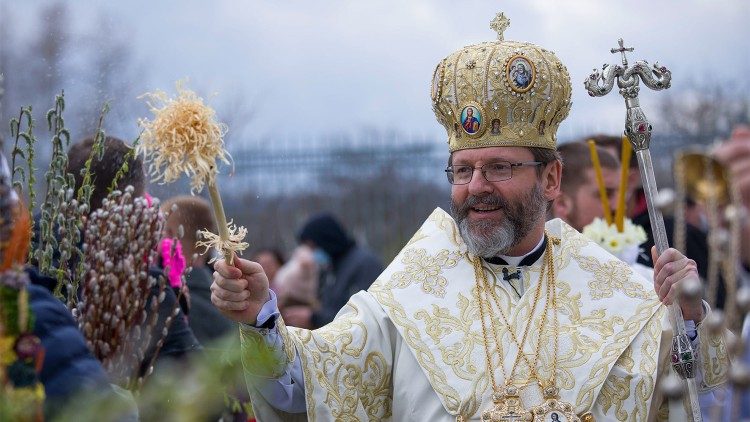
Major Archbishop Sviatoslav ShevchukMajor Archbishop Sviatoslav Shevchuk 

Major Archbishop Shevchuk: Freedom must never be taken for granted

On the day the country celebrates 35 years of independence, the head of the Ukrainian Greek Catholic Church, Major Archbishop Sviatoslav Shevchuk, tells Vatican News about the suffering inflicted on the population by the war and issues a renewed, heartfelt appeal to all the nations of the world for their solidarity.

By Father Taras Kotsur

The Major Archbishop of the Ukrainian Greek Catholic Church, His Beatitude Sviatoslav Shevchuk, lists the figures for July 2026, the “bloodiest month” of four and a half years of war, which has already exacted an unspeakable toll in human lives and destruction.

In the following interview with Vatican News, he condemns the cruelty of the war and the ethical consequences produced by technology, in which the eye of a drone that can precisely see whom it is about to strike makes the notion of “accidental” civilian casualties not only tragic but unacceptable.

He speaks with Vatican Media as Ukraine marks 35 years of independence from Soviet totalitarianism, and emphasizes the value of freedom.

Your Beatitude, it is a great pleasure to hear from you again, especially in this context, when every day we hear of continuing and intense attacks on the Ukrainian capital, including strikes on the part of the city where your cathedral and residence are located. How are you experiencing the current situation?

All of us spent this night in the air-raid shelter, as we have on the nights before, because unfortunately the number of drones and missiles being launched over our heads is increasing. Lately, each month has become bloodier than the one before. For example, according to the United Nations monitoring mission, July was the bloodiest month since March 2022, which was the month with the highest number of casualties during these four and a half years of war. Official statistics say that in July alone, 437 civilians were killed and 2,610 were wounded, with the highest number of children killed and wounded since April 2022.

All the experts who are trying to understand what is happening say that this war is increasingly becoming a high-tech war involving highly sophisticated weapons. Some speak of a “war of the cities.” Why? Because, in practice, the possibility of advancing along the battle line has come to a halt. Advancing along the front has become increasingly impossible and extremely costly for the Russian army. So they are trying to strike civilians, increasing the suffering of people who live especially in the large cities. This is why the capital of Ukraine has become the number-one target. When people try to find historical parallels, many say that what is unfolding in Ukraine is very similar to the Iran-Iraq War of the 1980s, which was truly a war between two peoples who were unable to achieve victory along the front line and therefore sought to increase the suffering of civilians. The other very serious characteristic, from a moral and ethical point of view, is that the high technology being developed uses not only artificial intelligence to determine the point of attack for drones. Today, these deadly drones—and also missiles, which are becoming increasingly sophisticated in targeting civilians—have been equipped with cameras. So an operator guiding a missile or a drone in real time can see the people he is killing.

It is impossible to say that civilian casualties are accidental, unintended victims. For example, the other day a bus was struck in the city of Kherson. Not only the people traveling on that bus were killed, but also people who happened to be nearby. It is obvious that the operator of that drone could see the people he was killing. This is truly a very serious moral problem. It is said that today Russia is seeking to use the suffering of civilians, and even fear itself, as a weapon. What they have been unable to achieve on the battlefield, they are trying to accomplish through this terror inflicted on the major cities. This war is also seeking to turn people's exhaustion, their suffering, including their spiritual suffering, into an instrument of political pressure. Obviously, this is changing the face of the war, which remains, in every respect, a sacrilegious war. Every act of this kind is a crime both against international humanitarian law and against the moral law governing armed conflicts. This is the situation we have been experiencing, especially in the capital, over these past months and days.

In this situation, what does it mean to celebrate 35 years of independence, which coincide precisely with four and a half years since the beginning of this atrocious aggression?

For us, celebrating Ukraine's Independence Day means, first and foremost, thanking the Lord for the gift of freedom, of which the independent Ukrainian state is the guarantor. For Christians, love of one's homeland cannot turn into idolatry of the state. A state governed by the rule of law is an important instrument for protecting human dignity, freedom, the common good, and the people's right to life. Love for one's homeland is not hatred of others; rather, it is the willingness to assume responsibility for one's people and to serve them. Therefore, for us, this day commemorating Ukrainian independence is a day of prayer and reflection on how, today, we must not only defend our freedom but also positively build our future. These days we are also constantly speaking about national unity, because it is a unity around certain fundamental values. The state is an instrument for serving the common good and the dignity of the human person, for ensuring survival, for living freely, and for building our society in peace. Obviously, on this day we will all pray for an end to the war. We know that not only Ukraine's independence is a gift from God, but peace is also a gift from God. We will all be united in prayer, but also in our service to the common good, in our service of saving human lives, especially in the context of the war we are experiencing today

You have spoken about the gift of freedom. In this context, I would like to ask you something personal. You were born during the period of totalitarianism. Your priestly formation began in underground seminaries. What do these 35 years of freedom mean to you personally, especially when you look at young people today, who are already the second generation to have been born during this period of independence?

I had the experience of living through the moment when the totalitarian communist state, which sought to control even people's minds and wills, collapsed into pieces. At that moment, we understood that freedom does not simply mean the possibility of being free externally. We understood that freedom is a spiritual and moral category. I remember that even in the Soviet Union, we Catholic Christians who lived underground were freer than the communist leaders, because we carried this freedom of the children of God in our hearts. And precisely thanks to this ability to be free—to have the courage to think differently from what was imposed by the state communist ideology—the freedom to make decisions, to decide freely, but always according to the criteria of Christian discernment—this, for us, during the Soviet era, was a spiritual school of freedom. Then, when this totalitarian state collapsed, we were able to transmit this inner freedom that we had carried within us into the context of Ukrainian civil society. And so we truly became the leaven of the new society. Our Church truly became an agent of the transformation of Ukrainian society from a post-communist, post-Soviet colonial country into a democratic country. Obviously, this journey will never be something accomplished once and for all. Every day we must demonstrate this Christian freedom and continue on our journey. But here I understood something very profound that belongs to the Byzantine spiritual and theological tradition: freedom is something greater than mere free will. Freedom is the fruit of a good choice, a choice grounded in truth. If I make the right choice, if I choose fundamental values, if I choose what is good, then my free will—which is a potentiality of freedom—is transformed into an experience of freedom. Therefore, helping people make the right choices is a path toward authentic freedom. Not license, not anarchy, but a freedom that is always connected with responsibility and the common good. It is obvious that this understanding of freedom is very much sought after in Ukraine today. It is interesting to note that many of our young men who were prisoners of war, who endured terrible torture while in Russian captivity and were subsequently liberated, said that they felt freer even with their hands bound than those who were torturing them. Why? Because those Russian officers were truly prisoners of their own intellectual frameworks. They were afraid of their superiors. They were afraid of ending up in prison themselves for failing to obey the orders they had received blindly. And our soldiers, at those moments, felt freer even with their hands bound. Why? Because they had made their choice. The right choice. The choice that is always based on truth and on the defense of people's lives. This is our experience from the time of the Soviet Union. It is our experience of a society rebuilding itself after the fall of state totalitarianism. And this is the freedom that the Ukrainian people are seeking to defend and to build ever more deeply in their own free and independent country.

What could be the message of the Ukrainian people to today's world, where we can observe a certain crisis of democracy, with authoritarian tendencies growing in different parts of the world, even in places where one would least expect them?

Do not grow tired of being free! In my view, this crisis of democratic values is connected to a certain crisis of personal responsibility for one's own country. Everyone wants to shift their responsibility onto the shoulders of others. And sometimes people look for a scapegoat, a politician or an autocrat who can take upon themselves the personal duties that each of us has toward our homeland and our country. Sometimes people want to be relieved of the need to think and discern. They want someone else to think, discern, and decide for them. This is a form of infantilism, because that is how children behave when they think that it is always someone else who should build a better future for them. The flight from responsibility, in my view, is one of the great scourges of modern democracies. That is why I am struck by the fact that today the Church is increasingly becoming a guarantor and defender of democratic values, because the Church affirms the dignity of every human person. It is precisely the Church that is protecting human beings, within today's culture, from dehumanization at every level, beginning today with the challenge posed by artificial intelligence. It is precisely the Church that says that no one should have the right to steal other people's dreams and hopes for their future for the sake of their own interests. On the contrary, we ourselves are the builders of our own lives and our own future. Do not be afraid to be free. This is the fundamental message that Ukraine can send to the whole world today. Even if this freedom has to be defended. Because freedom cannot be taken for granted. Those who are unwilling to take the risk of embracing freedom and living as free men and women are not worthy of this gift of freedom.

As a pastor of a portion of the faithful in Ukraine and also in other parts of the world, what appeal would you like to address to the universal Church on the occasion of this anniversary of independence?

The highest expression of freedom is the human being's capacity to love. To love God and to love one's neighbor. Today in Ukraine, we see that the national unity that led us toward national independence can be defended only through mercy: the capacity to empathize with those who suffer, the capacity to show mercy toward those who make mistakes, but also our capacity to do good to our neighbor. Therefore, we must not forget that the greatest experience of freedom comes when we love God and our neighbor. I would like to thank all those who, on Ukraine's Independence Day, August 24, will join us in prayer. I would like to recall that the All-Ukrainian Council of Churches has issued an appeal to the World Council of Churches, and has also written a letter to Pope Leo and to all men and women of good will, asking them to observe August 24 as a day of prayer for peace in Ukraine. All of us in Ukraine will be united in prayer on that day. We, the heads of Churches and religious organizations, will gather in the oldest cathedral in Eastern Europe, Saint Sophia Cathedral in Kyiv. There is an eleventh-century mosaic of the Oranta, the Praying Virgin Mary. Before this mosaic of the Kyiv Oranta, we will pray for peace. We ask for your solidarity and unity in prayer, but also in humanitarian action, which for us today is an excellent way of demonstrating our love for God and for our neighbor.