Showing posts with label Jewish Christian relationships. Show all posts

Thursday, October 22, 2026

Pope Leo XIV addresses the American Jewish Committee; we must reject all forms of religious and ethnic hatred


Pope Leo XIV meets with members of the American Jewish CommitteePope Leo XIV meets with members of the American Jewish Committee (VATICAN MEDIA)

Pope to American Jewish Committee: ‘We reject together all forms of hatred’

Addressing a delegation of the American Jewish Committee, Pope Leo XIV encourages everyone to work together to promote human dignity, defend religious freedom, and reject all forms of religious and ethnic hatred and discrimination.

By Deborah Castellano Lubov

“Rooted in our shared spiritual heritage, this friendship also calls us to defend human dignity, serve the poor, protect religious freedom and promote justice and peace.”

Pope Leo XIV expressed this to members of the American Jewish Committee at the Vatican on Thursday.

The Holy Father began by saying it was a pleasure to welcome them to the Vatican on this day when the Church remembers in a special way his beloved predecessor, Pope St. John Paul II, whose efforts contributed so greatly to fostering friendship between Jews and Catholics.

Addressing the Board of Governors of the Committee in 1995, he observed that “dialogue between Christians and Jews must find eloquent expression in the life of both our communities.”

These words, Pope Leo suggested, remain relevant today, as reflected in the organization’s longstanding commitment to dialogue and cooperation with the Catholic Church.

Total rejection of religious and ethnic hatred and discrimination

The Pope expressed gratitude to all who continue to build relationships, grounded in sincerity and mutual respect, between their respective communities and who work together to promote human dignity and protect religious freedom.

Rooted in our shared spiritual heritage, the Pope observed, this friendship also calls Christians and Jews to defend human dignity, serve the poor, protect religious freedom and promote justice and peace.

“Essential to this commitment,” Pope Leo said, “is the rejection of all forms of religious and ethnic hatred and discrimination.”

On the occasion of the sixtieth anniversary of the Conciliar Declaration Nostra aetate, the Pope recalled how he affirmed that “the Church does not tolerate anti-Semitism and fights against it, on the basis of the Gospel itself.”

Commitment to fraternity especially urgent

“Differences of opinion, however profound,” he continued, “must never give rise to prejudice and hostility, which undermine the moral foundations of society.”

The Pope stressed that in a world wounded by violence and mistrust, this commitment to fraternity is “especially urgent.”

Indeed, Pope Leo XIV concluded, “the witness of our fraternity, which I hope we will be able to show with effective gestures, will certainly contribute to building a more peaceful world, something that all men and women of good will desire in their hearts.”

Monday, June 15, 2026

Pope Leo XIV revisits Nostra aetate, rejects antisemitism

Pope Leo meets with representatives of the United Jewish Appeal - Federation of New YorkPope Leo meets with representatives of the United Jewish Appeal - Federation of New York  (@Vatican Media)

Pope Leo: 'Nostra aetate took a firm stand against antisemitism'

Pope Leo XIV meets with representatives of the United Jewish Appeal-Federation of New York on Monday, thanking the organization for work to help vulnerable populations, and stressing that in a world still wounded by division and conflict, the Vatican II Declaration 'Nostra aetate' called us "to move beyond past misunderstandings toward collaboration for the common good."

By Deborah Castellano Lubov

"Recognizing the inherent dignity of all men and women, Nostra aetate took a firm stand against antisemitism and declared that the Church rejects all forms of discrimination or harassment because of race, color, condition of life or religion."  

Pope Leo XIV gave this reminder when meeting with representatives of the United Jewish Appeal-Federation of New York on Monday morning in the Vatican.

Gratitude for helping vulnerable populations

The Holy Father welcomed them recalling that their organization serves as an instrument of global Jewish philanthropy, providing humanitarian aid and social services to vulnerable populations, including to the poor, refugees, the elderly, and people with disabilities, in New York, Israel and in more than seventy other countries. 


 Pope Leo meeting with representatives of the Federation (@Vatican Media)

"These efforts," Pope Leo said, "reflect a clear recognition of human dignity and fraternity, resonating with the Church’s own commitment to integral human development and the call to love our neighbor."

He recalled that this shared commitment carries special meaning in light of the common history of Christians and Jews and their spiritual ancestry in Abraham, Isaac, Jacob and Joseph.

Nostra aetate

The Holy Father pointed to the 1965 landmark document of the Second Vatican Council, the Declaration Nostra aetate on the relation of the Church to non-Christian religions, whose sixtieth anniversary the Church celebrated last year.

He said it “opened up a new horizon of encounter, respect and spiritual hospitality,” and affirmed, among other things, "the truth that we belong to one human family," and condemned antisemitism and all discrimination or harassment because of race, color, condition of life or religion.

Working for the common good together

"In a world still wounded by division and conflict," Pope Leo emphasized, "it called us to move beyond past misunderstandings toward collaboration for the common good."

With this sentiment, Pope Leo went on to describe service to the poor, marginalized and powerless "as a means of encountering the sacred," noting that through them, the Divine voice continues to speak to us. 

As the Holy Father drew his address to a close, he thanked them for their dedication to assisting the poor and needy, confronting hatred and intolerance, and working to build a better world for all. 

"May your mission," he said, "strengthen dialogue, deepen mutual understanding and contribute to the peace so greatly needed in our world."

Tuesday, April 28, 2026

Cardinal Pizzaballa reflects on the role of Jerusalem, the Holy Land to promote peace and healing wounds caused from conflict


Cardinal Pizzaballa at Easter Sunday Mass in 2025Cardinal Pizzaballa at Easter Sunday Mass in 2025 

Cardinal Pizzaballa: Jerusalem is called to heal the world’s wounds

In a new pastoral letter, the Latin Patriarch of Jerusalem reflects on the war in the Holy Land, saying that the conflict has “brought one era to a close and opened another, doing so in the worst possible way.”

By Beatrice Guarrera

How should Christians live in the midst of the conflict currently afflicting the Holy Land?

That is the question at the heart of a new pastoral letter from the Latin Patriarch of Jerusalem, Cardinal Pierbattista Pizzaballa. Released today, Monday 27th April, the letter is entitled “They returned to Jerusalem with great joy: A proposal for living the vocation of the Church in the Holy Land.”

To heal the world’s wounds

The vocation of Jerusalem, Cardinal Pizzaballa observes in the text, is to heal the world’s wounds. The Patriarch’s reflection revolves around the image of the Biblical city of Jerusalem, which “signifies coexistence and relationship, both civil and religious.”

The letter is structured in three parts: the first is an assessment of the current state of the region, the second a vision for the Church of Jerusalem, and the third reflects on the pastoral implications on parishes, families, schools, and institutions.

Pizzaballa emphasizes that the letter does not contain strictly political analysis: it is “political” only in a broader sense, insofar as it concerns our remaining, as Christians, within the polis, or actually existing world, while always oriented toward the true and definitive Polis, the heavenly Jerusalem.

Watershed events

Patriarch Pizzaballa begins with October 7 and the war in Gaza — “watershed events that brought one era to a close and opened another, doing so in the worst possible way.”

“What we are experiencing is not merely a local conflict,” he says. “The local conflict is the symptom of a much deeper crisis, a global paradigm shift. For decades, the international community, and particularly the Western world, believed in an international order based on rules, treaties, and multilateralism … Today, everyone seems to have woken up to the weakness in this system.”

“We are witnessing a renewed reliance on the use of force as a decisive means for resolving disputes,” Pizzaballa writes. “War has become the object of an idolatrous cult”

The consequences of chaos

In a war also waged with words and images, the Patriarch notes, it is increasingly difficult to distinguish “news from propaganda”.

The Patriarchate of Jerusalem has experienced the consequences of this chaos, he writes, in the dissolution of relationships poisoned by hatred and mistrust, and fragmentation into enclaves and identity bubbles amplified by social media algorithms.

Among the negative effects is also a crisis of interreligious dialogue: “The Holy Places, which should be spaces for prayer, are becoming battlegrounds about identity. Sacred texts are invoked to justify violence, occupation, and terrorism.”

“I believe this abuse of God’s name is the gravest sin of our time,” Pizzaballa writes.

The image of the Holy City

In response to the situation, Pizzaballa says, the Church of Jerusalem “has made its voice heard, attempting to speak a word of truth – honest, clear, with parrhesia (boldness) – even amidst this chaos, often at the cost of misunderstanding.”

But, he adds, he wonders if this has been enough – or whether, “in this most challenging period, have we at times chosen prudence and sought institutional survival, sacrificing our prophetic witness? … It is a question that haunts me every day, and one that is never easy to answer.”

One must also ask what God’s will for Jerusalem is, Pizzaballa writes. Jerusalem is “not just a matter of political boundaries or technical arrangements”, but “its main identity – the most important characteristic of the city and of the entire Holy Land – is that of being the place of God’s revelation, the place where faiths are at home.”

Ignoring this “vertical” dimension of the Holy Land, the “religious and spiritual sensitivity of the communities that belong to it” is “the deepest reason for the failure of the coexistence agreements that have taken place in recent decades,” the Patriarch emphasizes.

Pastoral implications

At the pastoral level, Pizzaballa stresses the primacy of liturgy and prayer. Equally fundamental is the role of families as workshops of education in coexistence and respect, where the past can be transmitted to children in sorrow and truth, without inculcating feelings of hatred and revenge.

Christian schools should be understood as “workshops of a new humanity”, where children are educated to reread history with eyes free from resentment, Cardinal Pizzaballa writes. Hospitals and social services—places where welcome, dialogue, and healing are already lived realities—must be supported.

The Patriarch says that an important role also belongs to the elderly, who are living memory; to the young, who are prophecy; and to priests and religious, who are faithful points of reference for the community and models of possible coexistence.

Finally, Cardinal Pizzaballa says, interreligious dialogue also remains “a vital necessity.”

Like the disciples after the Ascension

Bringing the letter to a close, Patriarch Pizzaballa writes that it is essential to reject “any complicity with the culture of violence,” while making room for trust. How is all this possible? The answer is simple: it is not - "At least, not alone. But we are not alone.”

Jesus awaits us, the Patriarch says, in our parishes, in our faith communities, in our groups and ecclesial movements. “In the end, what sustains us is not our own strength, but the joy of the Gospel,” he emphasizes.

“Let us return to Jerusalem with joy,” Pizzaballa concludes. “Let us return to our lives with passion. Let us carry in our hearts God’s dream for God’s City, and let us allow that dream to become, step by step, day by day, our very lives.”

Friday, October 3, 2025

Cardinal Nichols of England & Wales shares prayer, support and encouragement with the Jewish Community after act of terrorism


Aftermath of the Manchester synagogue attackAftermath of the Manchester synagogue attack  (Temilade Adelaja)

Cardinal Nichols decries attack on Manchester synagogue

Cardinal Vincent Nichols, President of the Catholic Bishops’ Conference of England and Wales, reassures Jewish community of his prayers after the terror attack on the Heaton Park Hebrew Congregation Synagogue, saying such tragedies 'cannot be tolerated,' that he is 'shocked to the core,' and that all have a duty to show 'no place for such violence' in society.

By Deborah Castellano Lubov

“The killing of two Jewish worshippers, the injuries inflicted on others, and the attempt to drive a car into a crowd in Manchester today are expressions of utter hatred that must not be tolerated in this land. That such an attack is directed at the Jewish community, and on Yom Kippur, this most solemn of days, shocks me to the core.”

The attack, which occurred on Yom Kippur, the holiest day on the Jewish calendar, resulted in the deaths of two worshippers and injuries to several others. The assailant also reportedly attempted to drive a car into a crowd.

Elder brothers in faith

Cardinal Nichols, in his statement released Thursday, assured the Jewish community of his prayers and solidarity in the wake of the tragedy, as he recalled the deep spiritual ties between Christians and Jews.

“Jewish and Christian people are closely bound together in our common faith in God,” he said. “Indeed, in the Catholic tradition, Jewish people are held to be the ‘elder brothers’ in faith of our Christian family.”

Such violence and inhumanity 'have no place'

He emphasized that such violence must have no place in society.

“My prayers, and those of the Catholic community, are heartfelt and profound — for those who have died, the bereaved, the injured, and those who will feel less safe tonight,” he said.

“It is a duty of us all," he insisted, "to work together to ensure a more cohesive and respectful society, one in which such violence and inhumanity have no place.”

Local Bishop John Arnold of Salford and Bishop Patrick McKinney of Nottingham, the Lead Bishop for Interreligious Dialogue, released statements condemning the attack and calling for prayer and unity.

Monday, September 22, 2025

A Pope (the Bishop of Rome) and the Chief Rabbi of Rome promoting peace


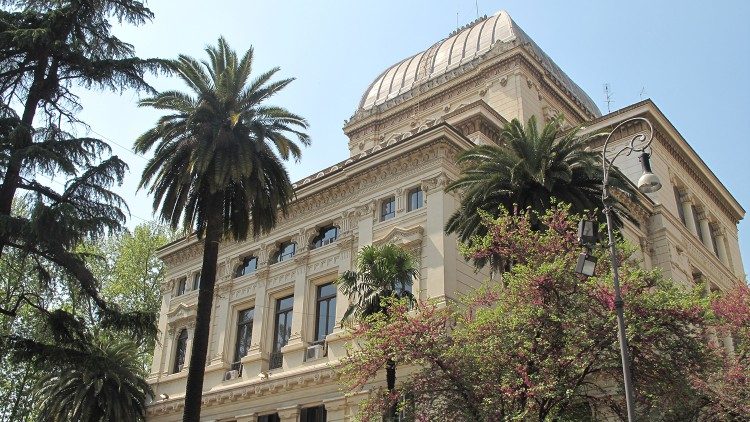
The Synagogue in RomeThe Synagogue in Rome  (©CdG - stock.adobe.com)

Pope invites Rome’s Jewish community to promote peace

Pope Leo XIV sends a telegram to the Chief Rabbi of Rome on the occasion of Rosh Ha-Shanah, Yom Kippur, and Sukkot, expressing gratitude for mutual bonds of friendship and inviting the Jewish community to always promote peace.

By Vatican News

Pope Leo XIV on Monday reached out to Rome’s Jewish community as it prepares to celebrate Rosh Ha-Shanah, the Jewish New Year; Yom Kippur, the Day of Atonement; and Sukkot, the Feast of Tabernacles.

In a telegram addressed to Dr Riccardo Di Segni,  Chief Rabbi of Rome, the Pope extends his greetings to the entire Jewish Community of Rome.

“I recall with gratitude your presence at the beginning of my Petrine ministry this past May 18,” he writes.

And he expressed his wish that the Lord may “accompany all our efforts to deepen the bonds of friendship between us, in the city of Rome and throughout the world.”

The Holy Father concludes by invoking God for “the gift of peace and an unceasing desire to promote it always.”

“May the Eternal, in His great goodness, be close to your community and accompany all our efforts to deepen the bonds of friendship between us, in the city of Rome and throughout the world. May God, in His infinite mercy, grant us the gift of peace and an unceasing desire to promote it always.”

Monday, May 19, 2025

Pope Leo XIV meets with delegations of non-Catholic


Pope Leo XIV meets with representatives of various Churches and religions on MondayPope Leo XIV meets with representatives of various Churches and religions on Monday  (@Vatican Media)

Pope Leo XIV: Now is the time for dialogue and building bridges

On the day after the Mass for the Inauguration of his Petrine Ministry, Pope Leo XIV greets delegations from non-Catholic Churches, ecclesial communities, and other faith traditions, recalling his predecessor’s commitment to ecumenism and interreligious dialogue.

By Christopher Wells

Pope Leo XIV held a special audience on Monday for ecumenical and interreligious delegations that took part in the Solemn Mass for the Inauguration of his Petrine Ministry.

In his address, the Holy Father highlighted Pope Francis’ emphasis on universal fraternity, continuing the initiatives of previous popes, especially St John XXIII.

Pope Francis, “the Pope of Fratelli tutti, promoted both the ecumenical path and inter-religious dialogue,” Pope Leo said, “above all by cultivating interpersonal relations, in such a way that, without taking anything away from ecclesial bonds, the human trait of the encounter was always valued. May God help us to treasure his witness!”

True unity is unity in faith

Speaking first to other Christian Churches and ecclesial communities, Pope Leo XIV took note of the 1,700th anniversary of the Council of Nicea, emphasizing that unity among Christians “can only be unity in faith.”

He added that the pursuit of full and visible communion of all Christians is one of his priorities as Bishop of Rome.

At the same time, he recalled the close links between ecumenism and synodality, and assured the delegations of his commitment to follow Pope Francis in “promoting the synodal character of the Catholic Church.”

A common path in the spirit of human fraternity

Turning to representatives of non-Christian religious traditions, Pope Leo XIV said our “common path” can and must be understood to involve everyone, “in a spirit of human fraternity.”

Today, he said, “is the time for dialogue and building bridges.”

The Holy Father looked back again at his immediate predecessor, calling to mind “the remarkable efforts made by Pope Francis in favour of interreligious dialogue.”

Citing the Document on Human Fraternity, Pope Leo said, “Through his words and actions, [Pope Francis] opened new avenues of encounter, to promote ‘the culture of dialogue as the path; mutual collaboration as the code of conduct; reciprocal understanding as the method and standard.’”

Relations with Judaism, Islam, and other religious traditions

Following the path laid out by Vatican II’s document on interreligious relations (Nostra aetate), Pope Leo also highlighted the “spiritual heritage shared by Christians and Jews,” and emphasized the importance of theological dialogue between the communities, even in times of “conflicts and misunderstandings.”

The Pope went on to note “the growing commitment to dialogue and fraternity” that marks relations between the Catholic Church and Muslims, saying an approach based on “mutual respect and freedom of conscience” is “a solid basis for building bridges between our communities.”

Finally, addressing representatives of other traditions, including Hinduism, Buddhism, Jainism, and others, Pope Leo expressed gratitude for their contributions to peace “in a world wounded by violence and conflict.”

At the same time, he conveyed his hopes that, by working together, religious believers can help to say “no” to war, to the arms race, and to an unjust economy; and “yes” to peace, to disarmament, and to integral development.

Building a more peaceful world

Pope Leo XIV concluded his discourse by sharing his conviction that “the witness of our fraternity… will certainly contribute to building a more peaceful world, something that all men and women of good will desire in their hearts.”

And he invited the delegations to “invoke God’s blessings in our hearts,” praying that “His infinite goodness and wisdom help us to live as His children and as brothers and sisters to each other, so that hope may grow in the world.”