Showing posts with label Cardinal Pizzaballa. Show all posts

Tuesday, April 28, 2026

Cardinal Pizzaballa reflects on the role of Jerusalem, the Holy Land to promote peace and healing wounds caused from conflict


Cardinal Pizzaballa at Easter Sunday Mass in 2025Cardinal Pizzaballa at Easter Sunday Mass in 2025 

Cardinal Pizzaballa: Jerusalem is called to heal the world’s wounds

In a new pastoral letter, the Latin Patriarch of Jerusalem reflects on the war in the Holy Land, saying that the conflict has “brought one era to a close and opened another, doing so in the worst possible way.”

By Beatrice Guarrera

How should Christians live in the midst of the conflict currently afflicting the Holy Land?

That is the question at the heart of a new pastoral letter from the Latin Patriarch of Jerusalem, Cardinal Pierbattista Pizzaballa. Released today, Monday 27th April, the letter is entitled They returned to Jerusalem with great joy: A proposal for living the vocation of the Church in the Holy Land.”

To heal the world’s wounds

The vocation of Jerusalem, Cardinal Pizzaballa observes in the text, is to heal the world’s wounds. The Patriarch’s reflection revolves around the image of the Biblical city of Jerusalem, which “signifies coexistence and relationship, both civil and religious.”

The letter is structured in three parts: the first is an assessment of the current state of the region, the second a vision for the Church of Jerusalem, and the third reflects on the pastoral implications on parishes, families, schools, and institutions.

Pizzaballa emphasizes that the letter does not contain strictly political analysis: it is “political” only in a broader sense, insofar as it concerns our remaining, as Christians, within the polis, or actually existing world, while always oriented toward the true and definitive Polis, the heavenly Jerusalem.

Watershed events

Patriarch Pizzaballa begins with October 7 and the war in Gaza — “watershed events that brought one era to a close and opened another, doing so in the worst possible way.”

“What we are experiencing is not merely a local conflict,” he says. “The local conflict is the symptom of a much deeper crisis, a global paradigm shift. For decades, the international community, and particularly the Western world, believed in an international order based on rules, treaties, and multilateralism … Today, everyone seems to have woken up to the weakness in this system.”

“We are witnessing a renewed reliance on the use of force as a decisive means for resolving disputes,” Pizzaballa writes. “War has become the object of an idolatrous cult”

The consequences of chaos

In a war also waged with words and images, the Patriarch notes, it is increasingly difficult to distinguish “news from propaganda”.

The Patriarchate of Jerusalem has experienced the consequences of this chaos, he writes, in the dissolution of relationships poisoned by hatred and mistrust, and fragmentation into enclaves and identity bubbles amplified by social media algorithms.

Among the negative effects is also a crisis of interreligious dialogue: “The Holy Places, which should be spaces for prayer, are becoming battlegrounds about identity. Sacred texts are invoked to justify violence, occupation, and terrorism.”

“I believe this abuse of God’s name is the gravest sin of our time,” Pizzaballa writes.

The image of the Holy City

In response to the situation, Pizzaballa says, the Church of Jerusalem “has made its voice heard, attempting to speak a word of truth – honest, clear, with parrhesia (boldness) – even amidst this chaos, often at the cost of misunderstanding.”

But, he adds, he wonders if this has been enough – or whether, “in this most challenging period, have we at times chosen prudence and sought institutional survival, sacrificing our prophetic witness? … It is a question that haunts me every day, and one that is never easy to answer.”

One must also ask what God’s will for Jerusalem is, Pizzaballa writes. Jerusalem is “not just a matter of political boundaries or technical arrangements”, but “its main identity – the most important characteristic of the city and of the entire Holy Land – is that of being the place of God’s revelation, the place where faiths are at home.”

Ignoring this “vertical” dimension of the Holy Land, the “religious and spiritual sensitivity of the communities that belong to it” is “the deepest reason for the failure of the coexistence agreements that have taken place in recent decades,” the Patriarch emphasizes.

Pastoral implications

At the pastoral level, Pizzaballa stresses the primacy of liturgy and prayer. Equally fundamental is the role of families as workshops of education in coexistence and respect, where the past can be transmitted to children in sorrow and truth, without inculcating feelings of hatred and revenge.

Christian schools should be understood as “workshops of a new humanity”, where children are educated to reread history with eyes free from resentment, Cardinal Pizzaballa writes. Hospitals and social services—places where welcome, dialogue, and healing are already lived realities—must be supported.

The Patriarch says that an important role also belongs to the elderly, who are living memory; to the young, who are prophecy; and to priests and religious, who are faithful points of reference for the community and models of possible coexistence.

Finally, Cardinal Pizzaballa says, interreligious dialogue also remains “a vital necessity.”

Like the disciples after the Ascension

Bringing the letter to a close, Patriarch Pizzaballa writes that it is essential to reject “any complicity with the culture of violence,” while making room for trust. How is all this possible? The answer is simple: it is not - "At least, not alone. But we are not alone.”

Jesus awaits us, the Patriarch says, in our parishes, in our faith communities, in our groups and ecclesial movements. “In the end, what sustains us is not our own strength, but the joy of the Gospel,” he emphasizes.

“Let us return to Jerusalem with joy,” Pizzaballa concludes. “Let us return to our lives with passion. Let us carry in our hearts God’s dream for God’s City, and let us allow that dream to become, step by step, day by day, our very lives.”

Monday, March 30, 2026

All Holy week and Easter celebrations now allowed at the Church of the Holy Sepulchre


Detail of the interior of the Church of the Holy Sepulchre in JerusalemDetail of the interior of the Church of the Holy Sepulchre in Jerusalem 

Jerusalem: Easter celebrations ensured at Holy Sepulchre

The Latin Patriarchate of Jerusalem and the Custody of the Holy Land say an agreement has been reached with Israeli authorities to ensure the celebration of Easter celebrations at the Church of the Holy Sepulchre. Restrictions linked to the ongoing conflict, however, remain in place, and liturgies will be streamed for the faithful around the world.

Vatican News 

In a joint statement, the Latin Patriarchate of Jerusalem and the Custody of the Holy Land confirm that “all matters concerning the Holy Week and Easter celebrations at the Church of the Holy Sepulchre have been addressed and resolved in coordination with the relevant authorities.”

“In agreement with the Israeli Police, access for representatives of the Churches has been secured in order to conduct the liturgies and ceremonies and to preserve the ancient Easter traditions at the Church of the Holy Sepulchre,” the statement adds.

The agreement follows the incident that occurred on Sunday when the Latin Patriarch of Jerusalem, Cardinal Pizzaballa and Fr Francesco Ielpo, Custos of the Holy Land, were stopped by Israeli police outside the church as they were planning to hold a Mass to mark the start of Holy Week.

Cardinal Pizzaballa's office said it was "the first time in centuries" a Latin Patriarch had been turned away from the holy site on Palm Sunday.

Celebrations to be streamed

The joint statement also says that “in light of the current state of war, existing restrictions on public gatherings remain in force.”

For this reason, the Churches will provide live streaming of liturgies and prayers, allowing the faithful in the Holy Land and throughout the world to participate spiritually.

The religious authorities go on to express gratitude to Isaac Herzog, President of the State of Israel, for his timely and decisive intervention, and extend their thanks to heads of State and officials who acted promptly, many of whom personally expressed their closeness and support.

Religious freedom as a universal value

The statement strongly emphasises that “religious faith constitutes a supreme human value, shared by all religions, Jews, Christians, Muslims, Druze and others. Especially in times of hardship and conflict, such as those presently endured, safeguarding the freedom of worship remains a fundamental and shared duty.”

Ongoing dialogue and hope for peace

The ecclesiastical authorities express the hope that appropriate solutions will continue to be found “enabling prayer to take place in places of worship, particularly in the Holy Places, of all religions,” balancing security needs with the right to religious practice, which is fundamental for hundreds of millions of faithful worldwide.

Thus, the Church maintains ongoing dialogue with the authorities, including the Israeli Police, while renewing its prayer for an end to the war that is deeply affecting the entire region.

“The Latin Patriarchate of Jerusalem and the Custody of the Holy Land reaffirm their commitment to dialogue, mutual respect, and the preservation of the Status Quo,” the statement concludes.

Sunday, March 29, 2026

Israeli police prevent Cardinal Pizzaballa and the Custos of the Holy Land from even entering the Church of The Holy Sepulchre in Jerusalem


Church of Holy Sepulchre in JerusalemChurch of Holy Sepulchre in Jerusalem 

Israeli police stop Latin Patriarch from entering Church of Holy Sepulchre

In a joint press release, the Latin Patriarchate of Jerusalem and the Custos of the Holy Land report they were blocked from entering the Church of the Holy Sepulchre in Jerusalem by Israeli police, calling it "a manifestly unreasonable and grossly disproportionate measure."

Vatican News

The Latin Patriarchate of Jerusalem and the Custody of the Holy Land have released a joint statement stating that, on the morning of Palm Sunday, the Latin Patriarch of Jerusalem, Cardinal Pierbattista Pizzaballa, together with the Custos of the Holy Land, Fr. Francesco Ielpo, OFM, the official Guardian of the Church of the Holy Sepulchre, were prevented from entering the Church of the Holy Sepulchre in Jerusalem, as they made their way to celebrate the Palm Sunday Mass.

Released on Sunday, the statement said both Church leaders were stopped en route by Israeli police, "while proceeding privately and without any characteristics of a procession or ceremonial act" and were forced to turn back.

"For the first time in centuries, the Heads of the Church were prevented from celebrating the Palm Sunday Mass at the Church of the Holy Sepulchre," the statement noted.

It described the event as "a grave precedent" and disregarding "the sensibilities of billions of people around the world who, during this week, look to Jerusalem."

Blocked despite compliance with restrictions

The statement said the Patriarch and the Custos of the Holy Land have acted with full responsibility since the start of the war, complying with all restrictions requiring that public gatherings be cancelled, attendance prohibited, and arrangements be made to broadcast the celebrations to hundreds of millions of faithful worldwide "who, during these days of Easter, turn their eyes to Jerusalem and to the Church of the Holy Sepulchre."

"Grossly disproportionate measure"

Preventing the entry of Cardinal Pizzaballa and Fr. Ielpo, who hold the highest ecclesiastical responsibility for the Catholic Church and Holy Places, "constitutes a manifestly unreasonable and grossly disproportionate measure."

The joint statement further underscored that "this hasty and fundamentally flawed decision, tainted by improper considerations, represents an extreme departure from basic principles of reasonableness, freedom of worship, and respect for the Status Quo."

The Patriarch and Custos both expressed their "profound sorrow" to the Christian faithful in the Holy Land and around the world "that prayer on one of the most sacred days of the Christian calendar has thus been prevented."

Monday, March 23, 2026

Palm Sunday Procession in Jerusalem is now a victim of the Iran conflict: CANCELLED


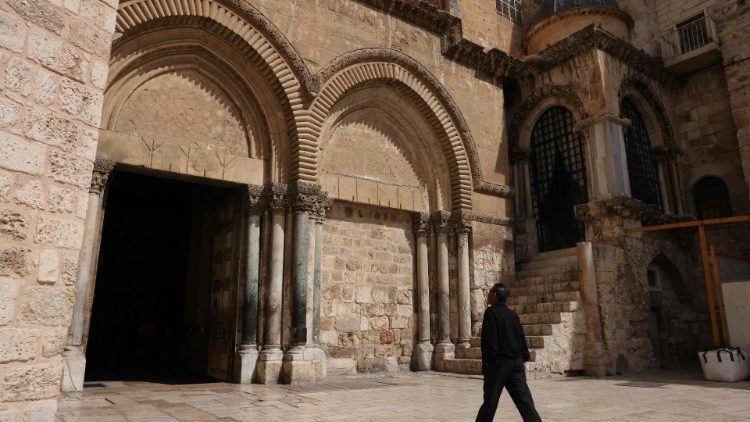
The entrance to the Church of the Holy Sepulchre in Jerusalem The entrance to the Church of the Holy Sepulchre in Jerusalem   (AFP or licensors)

Palm Sunday procession in Jerusalem cancelled due to war

The Latin Patriarchate of Jerusalem cancels this year’s Palm Sunday procession from the Mount of Olives to Jerusalem, due to the ongoing war in the Middle East.

By Beatrice Guarrera

Cardinal Pierbattista Pizzaballa, Latin Patriarch of Jerusalem, has announced that the traditional Palm Sunday procession, which goes from the Mount of Olives up to Jerusalem, has been cancelled and will be replaced by a moment of prayer for the city at a location yet to be determined.

In a statement, the Cardinal explained that the Chrism Mass of Holy Thursday, usually held in the Basilica of the Holy Sepulchre, has been postponed to a later date, as soon as the situation allows and possibly within the Easter season.

Ordinary public celebrations will not be possible

“The restrictions imposed by the conflict and the events of recent days do not bode well for any imminent improvement,” the Cardinal highlighted.

“In constant dialogue with the competent authorities, together with the other Christian Churches, we are evaluating how, in the ways to be agreed upon, we can celebrate the central Mystery of our salvation in the heart of our Churches," he said.


Cardinal Pizzaballa underlined that the situation is constantly evolving, making it impossible to provide definitive indications for Holy Week celebrations. He said the Patriarchate will be forced to organize events day by day.

“It is already clear, however, that ordinary celebrations open to all cannot take place,” the Cardinal continued, explaining the decision to cancel the Palm Sunday procession and postpone the Chrism Mass.

However, the statement did specify that the Patriarchate's churches remain open, and parish priests and clergy will do their best to encourage prayer and the participation of the faithful in Easter celebrations.

Another wound caused by the conflict

"Due to the war, this year we were unable to experience the traditional Lenten journey in Jerusalem, with the solemn celebrations at the Holy Sepulcher and in the Holy Places of the Passion," the statement explained.

“Though we were able to pray and prepare personally, we felt the loss of the community journey towards Easter,” said Cardinal Pizzaballa.

“The harshness of this time of war, which affects us all,” he continued, “today bears the added burden of not being able to celebrate Easter together and with dignity.”

“This is a wound that adds to the many others inflicted by the conflict. But we must not allow ourselves to be discouraged. Though we may not gather as we would like, let us not give up prayer.”

Prayer for peace on Saturday, March 28

The Cardinal recalled Jesus’ words from Chapter 18, verse 1, of the Gospel of Luke: “Pray always and do not lose heart.” He invited people to make up for these restrictions with moments of prayer in families and religious communities.

In particular, he invited everyone to unite in prayer on Saturday, March 28, by reciting the Rosary to ask for peace and serenity, especially for those suffering because of the conflict.

“We will do so with humble hearts, certain that our prayer, even while we are physically distant, is capable of drawing upon the strength of God's love, which unites us in a spirit of hope and trust,” the Cardinal insisted.

Although prayer is already widespread, he proposed a special day in which people can feel united, despite all being in their own places.

“We desire peace, first and foremost, for our troubled hearts. Only prayer can give it,” the Cardinal wrote.

No darkness can have the last word

On Good Friday, Catholic faithful across the world will be invited to support the Holy Land through the traditional collection. The local community prepares to experience this special liturgical time with the Cardinal’s words:

“Easter, which we celebrate in the name of Christ's passion, death, and resurrection, reminds us that no darkness, not even that of war, can have the last word. The empty tomb is the seal of the victory of life over hatred, of mercy over sin. Let us allow this certainty to illuminate our steps and sustain our hope.”


Prayer continues in the Holy Places

In recent days, the Custody of the Holy Land issued a statement explaining that the Franciscan friars present at the Holy Sepulchre "have never ceased, day or night, to carry out the scheduled celebrations, the rites, the daily processions, and the liturgical prayers according to the provisions of the Status Quo.”

“Even during these days,” the statement said, “although access to the Basilica is restricted to the faithful for security reasons, prayer continues unceasingly in the Holy Places.”

The centuries-long presence of the Custody in the Holy Land, and the prayer that rises there every day, is offered in the name of the whole Church and for the good of all humanity, the statement explained.

“In particularly dramatic moments such as those we are now experiencing, this presence intends to make visible the faith, hope, and supplication of every baptized person, so that from these Holy Places a prayer for peace and reconciliation among peoples may continue to rise.”