Showing posts with label Cardinal Vincent Nichols. Show all posts

Friday, December 19, 2025

New Archbishop appointed in Westminster, England


File photo of Archbishop Richard MothFile photo of Archbishop Richard Moth 

Pope Leo appoints Richard Moth as new Archbishop of Westminster

Pope Leo XIV accepts the resignation of Cardinal Vincent Nichols and appoints Richard Moth as the new Archbishop of Westminster, in Great Britain.

Vatican News

On Friday, Pope Leo XIV accepted the resignation from the pastoral governance of the Metropolitan Archdiocese of Westminster, England, presented by Cardinal Vincent Gerard Nichols.

The Pope also appointed Archbishop Richard Moth to shepherd the Archdiocese of Westminster, according to the Holy See Press Office.

Archbishop Moth has previously served as Bishop of Arundel and Brighton since March 2015.

Brief biography

Charles Phillip Richard Moth was born on 8 July 1958 in Chingola, Zambia. He completed his primary and secondary studies in Catholic schools in Kent.

He received priestly formation at St John’s Seminary in Wonersh, Surrey and, at the Université Saint-Paul of Ottawa, where he obtained a Licentiate in Canon Law.

He was ordained a priest on July 3, 1982 for the Metropolitan Archdiocese of Southwark.

Archbishop Moth held several offices as a priest, including Parochial Vicar; Judge of the Metropolitan Tribunal of First Instance of Southwark; Chaplain of the Army Medical Corps in Kennington; Private Secretary to the Archbishop; Master of Liturgical Celebrations; Director of the Vocations Office and Vice-Chancellor; President of the Metropolitan Tribunal of Second Instance of Southwark.

In 2001, he was appointed Vicar General of the Metropolitan Archdiocese of Southwark and Prelate of Honour, and he served as Parish Administrator of Holy Cross, Plumsteas.

In 2006, he became the Parish Administrator of St Joseph’s, St Mary’s, Cray.

On July 25, 2009, Archbishop Moth was elected Military Ordinary for Great Britain, receiving episcopal consecration on September 29.

On March 21, 2015, Pope Francis transferred him to the See of Arundel and Brighton.

Thursday, October 23, 2025

Ecumenical Prayer Service with Pope Leo XIV, King Charles, Queen Camilla in the beautiful Sistine Chapel


Pope Leo XIV joined King Charles III and Queen Camilla of England in Midday prayer in the Sistine Chapel.Pope Leo XIV joined King Charles III and Queen Camilla of England in Midday prayer in the Sistine Chapel.  (@Vatican Media)

King Charles attends ecumenical prayer service in Sistine Chapel

King Charles III and Queen Camilla join Pope Leo XIV in the Sistine Chapel for Midday Prayer as part of their official state visit to the Vatican – marking a historic moment in Anglican-Catholic relations.

By Kielce Gussie

After a meeting in the Apostolic Palace earlier in the morning, Pope Leo XIV, King Charles III and Queen Camilla of Great Britain gathered together for an ecumenical prayer service in the Sistine Chapel. They were joined by the Most Reverend Stephen Cottrell, the 98th Archbishop of York and the Primate of England – the second-most senior bishop in the Church of England.

The Pope and Archbishop led a midday prayer comprising psalms and a Gospel reading. Michaelangelo's frescoed chapel was filled with a number of ecumenical guests, including the Archbishop of Westminster and President of the Catholic Bishops’ Conference of England and Wales, Cardinal Vincent Nichols, and the Archbishop of St Andrews and Edinburgh, Leo Cushley, representing the Scottish episcopate.

A historic visit

This visit marked a historic moment in Anglican-Catholic relations—one that has not occurred in 500 years. Two themes marked the journey: Christian unity and care for the environment.

Originally scheduled for April, the visit was cancelled due to Pope Francis’ ill health. One of its goals was to highlight the shared commitment of King Charles and the Argentine Pope to the care of Creation — ten years after the publication of the encyclical Laudato si’. 


Two themes marked the visit: Christian unity and care for the environment.   (@Vatican Media)

Moreover, the ecumenical prayer service, held in Latin and English, built upon the good relations between the Vatican and the United Kingdom. It also fulfilled a wish of King Charles, who, as Supreme Governor of the Church of England, has long been committed to interfaith engagement.

A bridge between two faiths

From the opening hymn of the prayer service, the theme of Christian unity and ecumenism was evident. The original text was written by St. Ambrose of Milan, Doctor of the Church. It was translated by St. John Henry Newman, who was an Anglican for half of his life before converting to Catholicism.

King Charles had attended the canonization ceremony of the English theologian in 2019. St. John Henry Newman is set to be declared a Doctor of the Church on 1 November by Pope Leo.

The Sistine Chapel hosted the ecumenical prayer service presided over by Pope Leo (@Vatican Media)


Continuing this atmosphere of communion, the chapel was filled with the voices of the Lay Clerks of St. George’s Chapel at Windsor Castle and the Children of the Chapel Royal of St. James’ Palace – both invited by King Charles and Queen Camilla – together with the Sistine Chapel Choir. The three groups chanted and sung the hymn and psalms of midday prayer.

As the organ signaled the end of the prayer service, Pope Leo exited the Sistine Chapel side-by-side with King Charles.

Friday, October 3, 2025

Cardinal Nichols of England & Wales shares prayer, support and encouragement with the Jewish Community after act of terrorism


Aftermath of the Manchester synagogue attackAftermath of the Manchester synagogue attack  (Temilade Adelaja)

Cardinal Nichols decries attack on Manchester synagogue

Cardinal Vincent Nichols, President of the Catholic Bishops’ Conference of England and Wales, reassures Jewish community of his prayers after the terror attack on the Heaton Park Hebrew Congregation Synagogue, saying such tragedies 'cannot be tolerated,' that he is 'shocked to the core,' and that all have a duty to show 'no place for such violence' in society.

By Deborah Castellano Lubov

“The killing of two Jewish worshippers, the injuries inflicted on others, and the attempt to drive a car into a crowd in Manchester today are expressions of utter hatred that must not be tolerated in this land. That such an attack is directed at the Jewish community, and on Yom Kippur, this most solemn of days, shocks me to the core.”

The attack, which occurred on Yom Kippur, the holiest day on the Jewish calendar, resulted in the deaths of two worshippers and injuries to several others. The assailant also reportedly attempted to drive a car into a crowd.

Elder brothers in faith

Cardinal Nichols, in his statement released Thursday, assured the Jewish community of his prayers and solidarity in the wake of the tragedy, as he recalled the deep spiritual ties between Christians and Jews.

“Jewish and Christian people are closely bound together in our common faith in God,” he said. “Indeed, in the Catholic tradition, Jewish people are held to be the ‘elder brothers’ in faith of our Christian family.”

Such violence and inhumanity 'have no place'

He emphasized that such violence must have no place in society.

“My prayers, and those of the Catholic community, are heartfelt and profound — for those who have died, the bereaved, the injured, and those who will feel less safe tonight,” he said.

“It is a duty of us all," he insisted, "to work together to ensure a more cohesive and respectful society, one in which such violence and inhumanity have no place.”

Local Bishop John Arnold of Salford and Bishop Patrick McKinney of Nottingham, the Lead Bishop for Interreligious Dialogue, released statements condemning the attack and calling for prayer and unity.

Tuesday, October 15, 2024

Culture and politics just love to push assisted dying/suicide


Assisted dying bill in the UK is a 

‘slippery slope,’ cardinal says


Cardinal Vincent Nichols of Westminster is pictured in a May 19, 2022, photo. Cardinal Nichols has joined leading Catholic politicians and pro-life groups in calling on U.K. Catholics to take immediate and urgent action to oppose an assisted suicide bill that he says will strike "fear and trepidation" in vulnerable people. (CNS photo/Paul Haring)


(OSV News) — Cardinal Vincent Nichols of Westminster has joined leading Catholic politicians and pro-life groups in calling on U.K. Catholics to take immediate and urgent action to oppose an assisted suicide bill that he says will strike “fear and trepidation” in vulnerable people.

Labour Member of Parliament Kim Leadbeater is proposing a bill that would give terminally ill people in England and Wales the right to end their life. It will be introduced to the House of Commons Oct. 16, with a vote to take place Nov. 29.

The issue was last voted on in 2015, when MPs roundly rejected assisted suicide, with 118 votes for and 330 against.

In a pastoral letter to be read aloud in parishes in his London-based Diocese of Westminster Oct. 12-13, Cardinal Nichols, president of the Bishops’ Conference of England and Wales, said that “this proposed change in the law may be a source of relief to some. But it will bring great fear and trepidation to many, especially those who have vulnerabilities and those living with disabilities.”

Current U.K. law states that euthanasia and assisted suicide are illegal, with those found guilty facing up to 14 years in prison. While the contents of the new bill are as yet unknown, it is believed that it will offer terminally ill adults with six months or less to live the option of ending their lives with medical assistance.

Leadbeater said that the proposed bill will only apply to adults who are suffering from terminal illnesses. “I’m really clear. This is about people who are terminally ill”, she told Sky News Oct. 3.

However, many expressed great concern when the British media reported that a group of 54 cross-party MPs are already calling for the assisted suicide bill to be applied to those who are “incurably suffering” as well as to those who are terminally ill.

Cardinal Nichols shared his own concerns about the reality of the “slippery slope” — a movement toward increasingly widening interpretations of the law, based on evidence from places across the world where assisted suicide has been legalized.

“The evidence from every single country in which such a law has been passed is clear,” he said. “That the circumstances in which the taking of a life is permitted are widened and widened, making assisted suicide and medical killing, or euthanasia, more and more available and accepted.”

Cardinal Nichols, who called for improved palliative care and hospice provision, urged Catholics to not stay silent on the issue, but to play an active part through prayer and discussions with family, friends and colleagues.

He also called on the faithful write to their MPs to express their opposition to the assisted suicide law. “Be careful what you wish for,” he warned. “The right to die can become a duty to die; being forgetful of God belittles our humanity.”

Cardinal Nichols pointed out that questions raised by the assisted suicide legislation strike at the heart of “how we understand ourselves, our lives, our humanity,” and underlined Catholic teaching on the human person. He said that “every human being is made in the image and likeness of God. That is the source of our dignity and it is unique to the human person. The suffering of a human being is not meaningless. It does not destroy that dignity.”

Assisted suicide has become a major issue in the U.K. after popular journalist and television presenter Esther Rantzen, who has terminal cancer, called for a vote on assisted suicide earlier this year. Prime Minister Keir Starmer, who personally supports a change in the law, promised Rantzen that he would give MPs a free vote on the issue if he became prime minister, which happened when Labour won the general election July 4.

However, Catholic Lord David Alton, like Cardinal Nichols, warned Starmer that the “floodgates” will open, and vulnerable people will be at risk, if the law is passed in the same way as other jurisdictions.

“Before the U.K. Parliament opens the euthanasia floodgates,” he said, “it should first dispassionately consider outcomes in jurisdictions that have ditched protection of the vulnerable with ineffective safeguards. MPs should put their energy into better palliative care.”

One of the places Alton was referring to is the Netherlands, where euthanasia has been legal since 2002. Twenty-four confirmed cases of euthanasia have taken place where the individuals concerned were diagnosed with autism or having a learning disability.

In Canada, euthanasia and assisted suicide were legalized in 2016 on the condition that the death of applicants should be “reasonably foreseeable.” In 2021, this condition was repealed. With a provision to exclude those with mental illness due to expire earlier this year, in February lawmakers delayed expanding euthanasia and assisted suicide on the grounds of mental health alone to March 2027.

Lord Alton instead called for “more hospice care at home and an ethos which upholds human dignity and the sanctity of life.”

Cardinal Nichols also shared his worries “for all medical professionals,” warning that their roles will change profoundly, which he described as “a slow change from a duty to care to a duty to kill.”

Meanwhile, Bishop Mark Davies of Shrewsbury will also urge Catholics at Oct. 13 Masses to resist moves in Parliament to legalize assisted suicide.

In a pastoral letter to be read out across the diocese, Bishop Davies will warn the faithful that a forthcoming Bill on “assisted dying” — an euphemism for assisted suicide or euthanasia — threatens “a momentous change to society in both its care and attitude to the sick and the aged,” the diocese said i an Oct. 11 statement.

In his letter, Bishop Davies predicts dire consequences if Parliament chooses a “dark and sinister path” toward a society in which the medical profession will be asked to assist in the killing of their patients.

“As we see populations ageing across western countries with a diminished number of younger people to support them, this is an especially dangerous moment for politicians to open the door to euthanasia: the medical killing of the sick, the disabled and the elderly,” Bishop Davies wrote in a letter.

“We already hear of a social duty to end our lives when we become a burden to others. This is not the kind of society in which we would wish to grow old or become vulnerable,” he said.

Andy Drozdziak writes for OSV News from Barnard Castle, England.

Tuesday, February 6, 2024

Head of Catholic Church in U.K. prays for King Charles III


English cardinal offers prayers for King Charles III after cancer diagnosis


Cardinal Vincent Nichols of Westminster offered prayers for King Charles III after Buckingham Palace announced Monday that the king would step away from some public duties amid treatment for cancer.

“I am saddened to learn that King Charles is now facing a time of treatment for cancer. On behalf of the entire Catholic Community in England and Wales, I offer His Majesty our warmest wishes and assurance of steadfast prayers for his full and speedy recovery. God bless the King,” Nichols, who heads the Bishops’ Conference of England and Wales, said in a Feb. 5 X post. 

King Charles, 75, underwent treatment recently for an enlarged prostate, and an unspecified cancer was discovered during that treatment, according to a statement from Buckingham Palace. The king remains “wholly positive about his treatment,” which has already begun, the statement said. The statement did not say what kind of cancer or at what stage it is. 

“His Majesty has chosen to share his diagnosis to prevent speculation and in the hope it may assist public understanding for all those around the world who are affected by cancer,” the statement concluded. 

King Charles ascended to the throne in 2022 following the death of his mother, Elizabeth II, and was crowned last spring. 

The English monarch is supreme governor of the Church of England, which broke away from the Catholic Church in 1534 under King Henry VIII. At his coronation last May, during which Charles took an oath to uphold the Protestant faith, Cardinal Nichols was the first Catholic prelate to take part in the coronation since the Reformation, offering a blessing after the crowning. 

Monday, October 9, 2023

Churches call for de-escalation of military activities post terrorist attack in Israel


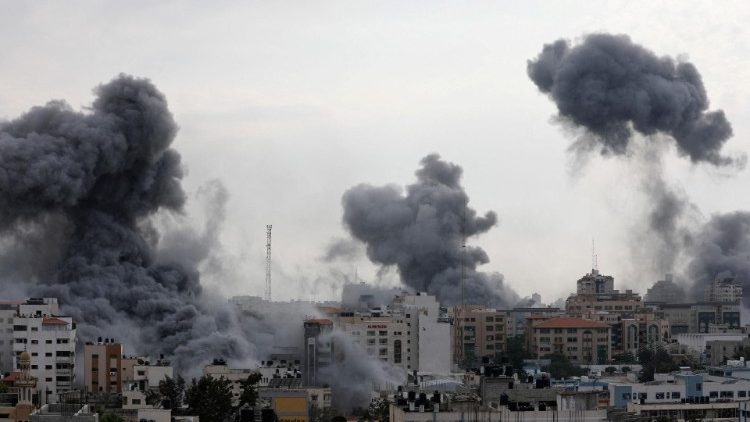
Smoke rises following Israeli strikes in GazaSmoke rises following Israeli strikes in Gaza 

Churches call for de-escalation in Holy Land after Hamas attack

Following the large-scale attack on Israel by Palestinian Hamas militants, the Patriarchs and heads of Churches in Jerusalem call for the immediate cessation of all violence and military activities, reiterating that everything is lost with war.

By Lisa Zengarini

Pope Francis’ impassioned appeal for peace in the Holy Land during the Angelus on Sunday is one of the several voices from Churches around the world calling for an immediate de-escalation of the violence unleashed on 7 October by an Hamas attack which prompted Israel to issue an official declaration of war (“Operation Swords of Iron”).

Death toll rising

The Palestinian Islamist organization’s unprecedented land-sea-air military operation (“Al-Aqsa Storm”), considered to be the deadliest terrorist attack on Israel in its modern history, reportedly killed some 700 Israelis, including many civilians, while around 100 were taken hostage.

The Palestinian death toll in Israeli retaliatory strikes has risen to over 400, and more than 2,750 people have been wounded. Tens of thousands (70,000 according UNRWA, the UN agency that provides essential services to Palestinians) in the Hamas-controlled Gaza Strip have fled their homes.

Military activities harming both Palestinian and Israeli civilians

Along with Latin Patriarchate of Jerusalem, which has also called for preserving the Status Quo in all the Holy Places in the Holy Land, and in Jerusalem in particular, Patriarchs and Heads of Churches in the Holy City have joined in urging for the immediate “cessation of all violent and military activities that bring harm to both Palestinian and Israeli civilians”.

The Church leaders also expressed their solidarity with the people of the region, “who are enduring the devastating consequences of continued strife.”


In a statement issued in the wake of “Al-Aqsa Storm”, they “unequivocally condemn any acts that target civilians, regardless of their nationality, ethnicity, or faith”, saying that “such actions go against the fundamental principles of humanity and the teachings of Christ, who implored us to ‘love your neighbour as yourself’."

Lasting solutions for peace in the Holy land

The Church leaders in Jerusalem further implored political leaders and authorities “to engage in sincere dialogue, seeking lasting solutions that promote justice, peace, and reconciliation for the people of this land, who have endured the burdens of conflict for far too long.”

They also urged the international community “to redouble its efforts to mediate a just and lasting peace in the Holy Land, based on equal rights for all and on international legitimacy.”

WCC: Violence can't provide path to peace or justice

These words are echoed by the World Council of Churches (WCC), which has appealed urgently “for an immediate cessation of this deadly violence, for Hamas to cease their attacks and ask both parties for de-escalation of the situation.”

“We are deeply concerned about the imminent risks of spiralling conflict between Israel and Palestinian armed groups, and of the inevitably tragic consequences for the people of the region – Israelis and Palestinians alike – following a period of escalating tensions and violence in the West Bank and Jerusalem,” said WCC general secretary Rev. Prof. Dr. Jerry Pillay in a statement.

“The current attacks threaten only more violence; they cannot provide a path to peace or to justice”, Pillay added, urging all WCC member Churches to join in prayer for a just peace in the Holy Land and “in solidarity with all the people affected and threatened by violence.”

Cardinal Nichols: Violence is never a solution

Cardinal Vincent Nichols, the Archbishop of Westminster and president of the Bishops' Conference of England and Wales (CBCEW), for his part, has reiterated that “Violence is never a solution. Retribution is never a contribution to peace."

He also invited the faithful to pray “so that the Holy Spirit may bring peace in the Holy Land, for all who have lost their lives and for the immediate release of those taken hostage, especially for the small but active Catholic community in Gaza City who at this moment will be reaching out courageously to their neighbours, trying to offer shelter and support.”

Fr. Romanelli (Gaza): everything can be lost with war 

Father Gabriel Romanelli, the parish priest of the Holy Family, the only Catholic parish in the Gaza serving some 1,000 Catholics, told Fides agency that the prevailing sentiment of the Gazawi people is a feeling of uncertainty on what is going to happen next, in light of what happened in the past, in similar, but less serious circumstances.

“In the face of all this,” said the Argentinian-born priest, “Pope Pius XII’s appeal before the outbreak of the Second World War continually comes to mind: nothing is lost with peace, everything can be lost with war."