reflections, updates and homilies from Deacon Mike Talbot inspired by the following words from my ordination: Receive the Gospel of Christ whose herald you have become. Believe what you read, teach what you believe and practice what you teach...
At the conclusion of the General Audience, Pope Leo XIV appealed to all sides in the Tigray region to halt hostilities, recalling that only sincere commitment can lay the foundations for lasting peace. Speaking to Polish pilgrims, he recalled the beatification, 30 years ago, of the 13 Greek Catholic martyrs of Pratulin, who were killed for defending their belonging to the Catholic Church and entrusted their intercession to “the cause of the unity of Christ’s disciples.”
By Alessandro Di Bussolo
Pope Leo is following “with deep concern” the situation in Tigray, a region of Ethiopia, and in the neighboring areas of Afar and Amhara, “where hostilities have once again broken out.” In English, at the end of the General Audience, before greeting the Italian faithful, he delivered this appeal to the parties involved in the conflict:
“I extend my heartfelt plea to all parties to choose the path of dialogue. Armed conflict never solves problems but only worsens them, leaving in its wake a trail of death, destruction, and resentment. Only honest engagement can lay the foundations for lasting peace.”
The Pope’s “fervent hope” is that the international community “will offer its generous and timely contribution, to ensuring that all humanitarian aid be provided to those in need.”
The situation in Tigray today
The situation in Tigray has become increasingly tense. In recent hours, the Tigray People’s Liberation Front (TPLF), the region’s main political force, which fought against the federal government during the 2020–2022 Tigray War, and the Tigray Defense Forces (TDF), the Tigrayan military forces that fought the Ethiopian army during that same war, have intensified conflict with Ethiopian military forces.
Numerous clashes have been reported along the Tekeze River, west of Tigray, in the Wolkayt area, on the border with the Afar region, and in various parts of Amhara.
Expansion of the fighting
The death toll has yet to be independently verified. According to the Ethiopian army, 700 Tigrayan fighters were reportedly killed over two days.
Médecins Sans Frontières (Doctors Without Borders) reported that between September 22 and 25, more than 400 wounded people arrived at hospitals in Korem and Alamata, while another 300 were admitted to hospitals in Suhul and Shire, in northwestern Tigray.
In the areas hardest hit by the conflict, the delivery of humanitarian aid also remains difficult: many roads have been cut off, while in the north, internet and telephone connections have been completely disrupted, making it impossible for aid workers to coordinate their efforts.
Politically, the Ethiopian government accuses neighboring Eritrea of supporting the TPLF and other opposition forces, while the Eritrean government strongly denies any involvement in the escalation of violence.
Meanwhile, the European Union has once again described the situation as rapidly deteriorating, both politically and militarily, announcing immediate diplomatic and humanitarian measures in an attempt to halt the resumption of the conflict, which risks setting the entire region ablaze
Pope: May France remain a champion of peace and multilateralism
In his first public address in France, Pope Leo XIV upholds the Catholic Church’s contribution to French society and encourages the country to work for a peace that is unarmed and disarming.
By Devin Watkins
Pope Leo XIV met privately with French President Emmanuel Macron at the Élysée Palace on Friday morning, just after his arrival in Paris for his four-day Apostolic Journey to France.
The Pope then addressed the authorities, civil society, and diplomatic corps, recalling his own French heritage and assuring the nation of his prayers.
He recalled that France has served as a cultural, artistic, and spiritual beacon for Europe and the world for centuries.
“The many brilliant French scholars who were also faithful Catholics demonstrates clearly how the sciences and the arts, literature, and philosophy can contribute to the good of humanity when they are directed toward the pursuit of beauty, goodness and truth, that the world may have life,” said the Pope.
He expressed appreciation for the mastery shown by French architects and artists in rebuilding the Cathedral of Notre-Dame after the 2019 fire.
Calling it an “impressive technical achievement,” the Pope said the reconstruction of Notre-Dame showed that something considered irreparably destroyed can be reborn through mutual cooperation.
Pope Leo said France bears deep Christian roots and the nation’s soul draws from Christianity “a rich spiritual, cultural, intellectual, artistic, and missionary élan (spirit).”
In 16th-century humanism, French philosophers united the ancient Greek and Roman heritage with the Christian faith and promoted the recognition of human rights based on the nature of the human person, especially religious freedom.
Pointing to France’s national motto, he said liberty, equality, and fraternity “refer to universal ethical imperatives that also find in the Gospel message an inexhaustible source of inspiration and fulfillment.”
Pope Leo then noted his focus in Magnifica Humanitas on artificial intelligence, saying respect for human dignity and our fundamental rights and freedoms must keep pace with societal change and technological progress.
“If we are to avoid losing our humanity amid a ‘paradise of machines’ invading and conditioning our daily lives,” he said, “there is an urgent need for education in ethical discernment and the capacity to acknowledge the moral good.”
Turning to France’s “rich and varied social fabric,” the Pope praised the efforts of Catholic men and women who continue to care for the welfare of the poor and underprivileged.
The Church, he added, seeks to be “the living face of God’s own mercy and compassion,” recalling the charitable legacy of St. Vincent de Paul.
Pope Leo XIV noted that our modern sensibilities seek to eliminate every form of suffering, saying this tendency often “brings the risk of self-delusion.”
“When science and technology are not guided by a deeper wisdom,” he said, “they can offer immediate solutions that apparently address people’s wishes and their pain, but can seriously divert them from the greater good to which they aspire.”
Mutual respect and the protection of every human life is a duty borne by every person, he said, noting that it begins with conversion of heart and mind and requires selfless commitment to the good of others.
Pope Leo encouraged Christians to engage in public service guided by the light of faith, noting that authentic secularity does not exclude religion but values it as an “educational resource.”
He thanked France for its support for education and humanitarian work in the Middle East, especially an initiative to help finance over 260 schools and universities.
The Pope recalled the ongoing effects of conflict and the scourge of war in land of the Prince of Peace’s birth.
“We cannot remain indifferent in the face of their pain, which offends human dignity and cries out to God for justice,” he said.
Pope Leo also called for nuclear weapons to be banned and for justice and right reason to prevail, since peace “is not a balance of power” but is rather built each day through dialogue and justice.
In conclusion, Pope Leo XIV urged the French Republic to “remain a tireless champion of peace and multilateralism”.
“May France, faithful to its traditional values, work for a peace that is unarmed and disarming, and responsibly offer its unique contribution to that goal,” he said. “May your liberty grow in constant concern for the common good.”
Pope: Remembering the tragedy of 9/11 urges us to work for peace
Pope Leo XIV prays for those who lost their lives in the 9/11 terror attacks and appeals for prayers for peace for our war-torn world.
Vatican News
“Two days ago marked the twenty-fifth anniversary of the September 11th terrorist attacks in the United States of America,” said Pope Leo XIV in English as he addressed the faithful after the Angelus prayer on Sunday.
Almost 3,000 people died in coordinated terror attacks on New York, Washington, D.C., and Pennsylvania, and hundreds have died since of 9/11-related illnesses.
Speaking from the balcony overlooking St Peter’s Square, he said he renews his prayers “for those who lost their lives and for those who continue to bear the wounds of that tragic day.”
Appeal for prayers for peace in the world
And urgently the Pope added: “At a time when conflict and violence afflict so many of our brothers and sisters, I invite everyone to pray that the Lord will bestow his gift of peace upon the world.”
Switching to Italian, he noted that the tragic event of twenty-five years ago drives us to “renew our commitment to peace, first and foremost with prayer, that we entrust to the intercession of the Virgin Mary.”
The Popes and 9/11: Christ’s light in history’s darkest hour
Twenty-five years after the 9/11 attacks on the United States, we recall the words of successive Popes who have repeatedly appealed for peace and reconciliation, reminding us that even in the face of unspeakable horror, evil and death do not have the final word.
By Isabella Piro
On September 11, 2001, the United States had just been struck by four suicide attacks that claimed nearly 3,000 lives in different parts of the country.
Pope John Paul II was at Castel Gandolfo when he received a telephone call from the Director of the Holy See Press Office, Joaquín Navarro-Valls, informing him of what had happened. Deeply shaken, the Pope immediately withdraws to pray in the private chapel of the Apostolic Palace.
He then sent a telegram expressing his condolences and closeness to US President George W. Bush.
It consisted of six lines written in block capitals—the style of official communications—but Pope John Paul II’s words are profoundly human and express the grief of the entire world. He speaks of “unspeakable horror,” describes the terrorist attacks as “inhuman,” and calls it a “dark and tragic moment” in history.
An affront to human dignity
The following day was Wednesday, and the General Audience was held in St Peter’s Square. At the request of the Bishop of Rome, there was no applause, and the faithful remained in solemn silence.
“Yesterday was a dark day in the history of humanity, a terrible affront to human dignity,” John Paul II said, before voicing the question in everyone’s heart: “How is it possible to commit acts of such savage cruelty?”
The answer to such cruelty, he continued, lies in Christ, the foundation of hope, who ensures that evil and death do not have the final word.
John Paul II in prayer
Not revenge, but unity and dialogue
Meanwhile, the 180th Ordinary General Chapter of the Order of Saint Augustine was taking place in Rome. Among those attending was the American priest Father Robert Francis Prevost, the future Pope Leo XIV, who was elected Prior General on September 14, his birthday.
It therefore fell to him to preside over the closing Mass on September 21 in the Church of Santa Maria del Popolo.
“We cannot fail to remember the tragic events that shook the United States on September 11,” he said in his homily. “The violence that the world witnessed last week in the United States is a tragic expression of a series of problems that are becoming increasingly acute everywhere. Hatred and violence will continue to grow as long as so many people are forced to live in extreme poverty and are oppressed by so many forms of injustice.”
“While many seek revenge,” he concluded, “Augustinians must bear witness to the Gospel and to its values of unity, dialogue, peace, and reconciliation.”
Savagery of terrorism overcome by love
A year later, Pope John Paul II continued to make tireless appeals for peace.
On Wednesday, September 11, 2002, during the General Audience, the Pope recalled the “savage attack” of twelve months earlier, the collapse of the Twin Towers, and the lives of so many innocent people swallowed by the rubble.
He firmly reiterated that terrorism “is and will always be a manifestation of inhuman ferocity” and that oppression, armed violence and war are choices that sow and produce only hatred and death.
“Reason and love,” he concluded, “are the only valid means for overcoming and resolving disputes between individuals and peoples.”
Courage to work for peace
The peace invoked by Pope John Paul II found renewed expression in the prayer of his successor, Pope Benedict XVI.
On April 20, 2008, during his Apostolic Journey to the United States, Pope Benedict visited Ground Zero.
Where the Twin Towers once stood, there was a deep void, almost a metaphor for the abyss of evil. Yet all around it is a construction site—a symbol of hope being reborn and rebuilding what was destroyed.
In silence, the Pope lit a candle in memory of the victims. He then knelt and asked God to bring peace to a violent world and to grant humanity the wisdom and courage to work tirelessly for a world in which genuine peace and love reign among nations and in every human heart.
Pope Benedict XVI prays at Ground Zero
Every human life is precious
Three years later, on September 11, 2011, the tenth anniversary of the terrorist attacks, Pope Benedict XVI sent a letter to the President of the United States Conference of Catholic Bishops, Archbishop Timothy Dolan of New York, who would be created a Cardinal the following February.
Recalling the “brutal assault” of ten years earlier, Pope Benedict described it as a tragedy made even more grave by the perpetrators’ claim that they were acting in God’s name.
He firmly stressed that no circumstances can ever justify acts of terrorism. Every human life, he said, is precious in God’s sight, and no effort should be spared in promoting genuine respect throughout the world for the inalienable rights and dignity of every individual and people.
A palpable grief that cries out to heaven
Pope Francis also visited Ground Zero, which has since become a memorial consisting of two large pools of flowing water, each occupying the footprint of one of the Twin Towers.
The names of the 2,974 victims, representing 90 different nationalities, are inscribed along their edges.
During an interreligious meeting held there on September 25, 2015, Pope Francis described the 9/11 attacks as “a senseless act of destruction” and spoke of a palpable, searing grief that left people stunned and cries out to heaven.
The water flowing through the pools, he said, recalls all those lives that fell victim to people who believed destruction was the only way to resolve conflicts.
Yet the logic of violence, hatred, and revenge can produce only pain, suffering, destruction, and tears. Life, he said, is destined to triumph over the prophets of destruction and death, just as reconciliation and unity will triumph over hatred and division.
“Let us implore from on high the gift of commitment to the cause of peace,” the Bishop of Rome concluded. “Peace throughout this world which God has given us as the home of all and a home for all. Simply peace.”
Pope Francis pays tribute to the victims of the attacks at Ground Zero on September 25, 2015
Never again against one another!
When it comes to peace, “we cannot be indifferent or neutral,” Pope Francis said again on September 11, 2021.
The occasion was the G20 Interfaith Forum in Bologna, held under the theme “Time to Heal: Peace among Cultures, Understanding between Religions.”
In a message to participants, the Pope once again insisted: “Not neutral, but taking a stand for peace! Let us invoke the ius pacis—the right of everyone to resolve conflicts without violence.”
“No more war, no more against others, no more without others!” he concluded, because ultimately “young people and history will judge us on this.”
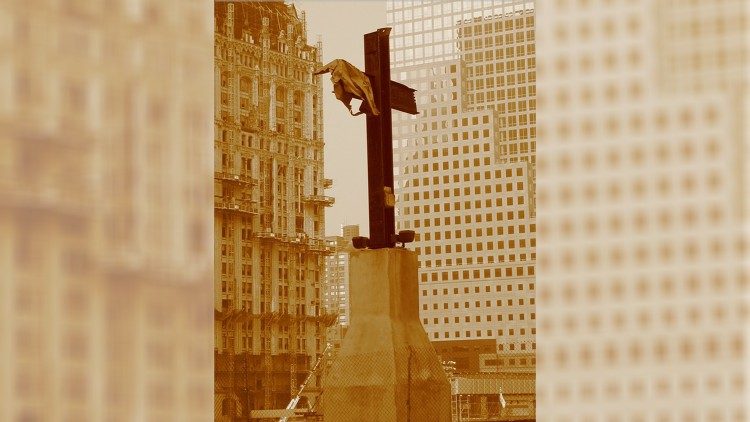
The"Cross at Ground Zero", a steel beam in the shape of a cross from the World Trade Center site that is part of the permanent exhibition of the 9/11 Museum Memorial (ANSA)
Remembering 9/11, 25 years later: 'We are never alone'
Twenty-five years after the terrorist attacks killed almost 3,000 people in New York, Pennsylvania, and Washington D.C., Archbishop Ronald Hicks of New York recalls the faith that helped people through that day, highlights the memorials to mark the anniversary, and stresses that even in “our tragedies…we are never alone.”
By Kielce Gussie
“Everyone I've talked to remembers exactly where they were 25 years ago,” says Archbishop Ronald Hicks of New York, referring to the anniversary marking a quarter of a century since the attacks of September 11, 2001.
FILE PHOTO: Workmen beginning the task of dismantling the destroyed remains of the 7 World Trade Center building in New York, USA on 17 September 2001 (ANSA)
Whether you were working, in school, or not yet born, the events of that day changed aspects of the world.
For Archbishop Hicks, September 11, 2001, started in the classroom during his graduate studies as a priest in the Archdiocese of Chicago, Illinois. He remembers how the entire class sat in disbelief after learning the news.
It was an event that affected not only the places where the planes crashed—New York, Washington D.C., and Pennsylvania—but the thousands of people whose lives would never be the same.
Faith in the midst of terror
On a day filled with terror, sadness, and shock, faith, too, was found amid the rubble.
Not only did people find faith on 9/11, but Archbishop Hicks highlights how it became something to rely on. “At the core, when everything is falling apart, people go right back to God, to faith, to hope, to those core things that hold us together as a people,” he explains.
More than 2,900 people were killed on that day alone. Out of the thousands of first responders who charged into the World Trade Center, the Pentagon, and the field in Pennsylvania, hundreds died selflessly trying to save others.
Father Mychal Judge, the chaplain for the New York Fire Department, was one example of these core values in action. “I think what you saw in Father Judge is what happened to so many people,” Archbishop Hicks underlines. “When there's a need, you jump in, and you don't hesitate, and you help…he lost his life, but that is sacrificial love.”
Father Judge became the first certified fatality of the attacks. His name is among the other 2,976 persons forever immortalized in the memorial—made from the steel of the twin towers—in New York.
A community unites
In the city where the two World Trade Center towers once stood, acts of remembrance, services, Masses, and memorials will commemorate the anniversary—from walks of remembrance and wreath-laying ceremonies to dedications and light tributes.
Family members of victims of the attacks on the World Trade Center place flowers in one of two pools in the shapes of the footprints left by the two World Trade Center towers at Ground Zero (ANSA)
But exactly at 8:46 am—the moment 25 years ago when the first plane hit the North Tower—all the church bells in the city will ring as New York goes quiet.
It will be a moment “to stop, to listen, to pray, to not forget, and to do so as a community together with God,” Archbishop Hicks explains.
The archdiocese also held a vigil Mass on the evening of September 10 at St. Patrick’s Cathedral in the heart of New York City. In the packed church were family members of victims of 9/11, representatives of the New York Police and Fire departments, Port Authority, emergency service workers, civic leaders, humanitarian organizations, priests, and lay people.
The Tribute in Light installation is illuminated over the lower Manhattan skyline ahead of the 25th anniversary of the September 11, 2001, in New York
Archbishop Hicks describes the support this unity brings, especially to those who are still grieving 25 years on. “It takes a long time with something of this magnitude. So, coming together in faith and at the Mass, that helps.”
Peace is fragile
Remembering the events of September 11, 2001, also reminds us that peace is fragile. It can only be accomplished if people join together to work for it, overcoming disagreements and challenges.
The attacks ushered in a period of tension. They fractured a sense of fraternity and shed doubts on the sense of stability and peace so painstakingly built after the end of the Cold War.
Just eight weeks after the attacks, St. Pope John Paul II highlighted dialogue as “essential for overcoming tragic conflicts inherited from the past, and for ensuring that ‘the name of the one God become increasingly what it is: a name of peace and a summons to peace.’”
Seven years later, standing at the site of the World Trade Center, Pope Benedict XVI prayed for peace in our violent world. “Comfort and console us, strengthen us in hope, and give us the wisdom and courage to work tirelessly for a world where true peace and love reign…”
In 2015, Pope Francis marveled at how such love was shown on that tragic day, remarking on how “here, amid pain and grief, we also have a palpable sense of the heroic goodness which people are capable of, those hidden reserves of strength from which we can draw. In the depths of pain and suffering, you also witnessed the heights of generosity and service. Hands reached out, lives were given.”
The Mass at St. Patrick’s, 25 years after the attacks, was an example of the dialogue and fraternity the pontiffs called for to achieve peace in the world but also in our countries, cities, and families. Catholics, rabbis, imams, Protestant ministers, interreligious and ecumenical groups were all present in the Cathedral, praying and hoping together.
FILE PHOTO: St. Patrick's Cathedral in New York City, New York (2020 Getty Images)
“[Dialogue] begins with us. We might disagree on a number of issues. It could be about theology, ecclesiology, [or] politics. But we have to take the first step to at least stand together, and to really follow the example of peace,” the archbishop of New York points out.
His entire homily at St. Patrick's centered on the fact that healing and grieving take time. They cannot be swept away. They cannot be ignored. But hope, the archbishop says, is eternal.
“God is with us in the good, in the bad. He is with us in our tragedies, in our joys. We are never abandoned. We are never alone. God was with us 25 years ago. God has been with us during these 25 years. God is with us today. God will continue to be with us tomorrow.”
“We are never abandoned. We are never alone. God was with us 25 years ago. God has been with us during these 25 years. God is with us today. God will continue to be with us tomorrow.”