Showing posts with label Wales. Show all posts

Friday, October 3, 2025

Cardinal Nichols of England & Wales shares prayer, support and encouragement with the Jewish Community after act of terrorism


Aftermath of the Manchester synagogue attackAftermath of the Manchester synagogue attack  (Temilade Adelaja)

Cardinal Nichols decries attack on Manchester synagogue

Cardinal Vincent Nichols, President of the Catholic Bishops’ Conference of England and Wales, reassures Jewish community of his prayers after the terror attack on the Heaton Park Hebrew Congregation Synagogue, saying such tragedies 'cannot be tolerated,' that he is 'shocked to the core,' and that all have a duty to show 'no place for such violence' in society.

By Deborah Castellano Lubov

“The killing of two Jewish worshippers, the injuries inflicted on others, and the attempt to drive a car into a crowd in Manchester today are expressions of utter hatred that must not be tolerated in this land. That such an attack is directed at the Jewish community, and on Yom Kippur, this most solemn of days, shocks me to the core.”

The attack, which occurred on Yom Kippur, the holiest day on the Jewish calendar, resulted in the deaths of two worshippers and injuries to several others. The assailant also reportedly attempted to drive a car into a crowd.

Elder brothers in faith

Cardinal Nichols, in his statement released Thursday, assured the Jewish community of his prayers and solidarity in the wake of the tragedy, as he recalled the deep spiritual ties between Christians and Jews.

“Jewish and Christian people are closely bound together in our common faith in God,” he said. “Indeed, in the Catholic tradition, Jewish people are held to be the ‘elder brothers’ in faith of our Christian family.”

Such violence and inhumanity 'have no place'

He emphasized that such violence must have no place in society.

“My prayers, and those of the Catholic community, are heartfelt and profound — for those who have died, the bereaved, the injured, and those who will feel less safe tonight,” he said.

“It is a duty of us all," he insisted, "to work together to ensure a more cohesive and respectful society, one in which such violence and inhumanity have no place.”

Local Bishop John Arnold of Salford and Bishop Patrick McKinney of Nottingham, the Lead Bishop for Interreligious Dialogue, released statements condemning the attack and calling for prayer and unity.

Monday, September 8, 2025

The King of England, Charles, to attend Catholic Mass & Funeral


King Charles to be first monarch in 400 years at Catholic funeral in UK

Charles will attend a Requiem Mass at Westminster Cathedral — the largest Catholic church in England and Wales — for the Duchess of Kent who died on Thursday aged 92

Lottie Hayton

Roya Nikkhah


With the Duchess of Kent’s death, the duke, 89, is now the oldest member of the royal family


DAVID JONES/PA

The Queen, the Prince and Princess of Wales alongside most members of the royal family will also attend the service on September 16 at Westminster Cathedral, near The Passage, its linked homeless shelter where the duchess used to volunteer.

It is understood the Duke of Sussex, who is scheduled to be in the UK from Monday to Thursday this week, will decide in the coming days whether to also attend.

The Duchess’s widower, the Duke of Kent, is Queen Elizabeth’s cousin and grandson of George V and is now the oldest member of the royal family at 89.

Catherine Pepinster, former editor of the Catholic weekly, The Tablet, and author of Defenders of the Faith: the British monarchy, religion and the Coronation, said: “The funeral will be of great historical significance.

“There were signs of rapprochement between the monarchy and the Catholic Church under Elizabeth II — she met many popes — but was careful not to attend a Catholic Mass in this country.
“The King and the heir to the throne attending Mass in Britain — that is of an entirely different order. This is a huge step forward in ecumenical relations.”

While the King has previously attended Mass, he has never done so in Britain. For example, he attended the canonization in Rome of John Henry Newman in 2019 and the funeral of Pope John Paul II in 2005. In April, Charles and Camilla also met Pope Francis privately at the Vatican during their Italy state visit, and prayed with him, just days before he died.

Queen Elizabeth II attended the Catholic state funeral of King Baudouin of the Belgians, in St Michael’s Cathedral in Brussels, in 1993.

The Duke and Duchess of Kent married at York Minster in 1961

Lord Nicholas Windsor, the duchess’s youngest son is a Catholic convert and the Earl of St Andrews, her oldest son is married to Sylvana Tomaselli, a Catholic.

The British monarchy’s complex relationship with Catholicism began with Pope Clement VII’s 1527 refusal of Henry VIII’s request for a divorce from Catherine of Aragon in order to marry Anne Boleyn.
In 1534, Henry formalised England’s schism from Rome with the Act of Supremacy. During the reigns of his children Edward VI and Elizabeth I, Protestant zeal grew and Elizabeth became the first Supreme Governor of the Church of England.

Pepinster said: “From the time of Elizabeth I, monarchs have been expected to stand up for the Church of England and reject the Church of Rome.”

The Duchess of Kent was received into the Catholic church in January 1994 by Cardinal Basil Hume, then Archbishop of Westminster, after consulting the Queen. The Act of Settlement of 1701 barred royals who became or married Catholics from the line of succession but the Duke of Kent was unaffected by his wife’s decision because she was Protestant at the time of their marriage in 1961.

In an interview given [to The Daily Telegraph] in 1997, the duchess described the decision as “fairly impulsive”. “I am not going to pretend that it was anything to do with reading the Bible. It had a great deal to do with people I met.”

Katharine, who is said to have gained the late Queen’s approval, added: “I do love guidelines, and the Catholic Church offers you guidelines. I have always wanted that in my life: I like to know what is expected of me.”

Her announcement emphasized that her decision was not connected to controversy about the ordination of women in the Church of England which was raging at the time. The Archbishops of Canterbury and York issued a joint statement that said it was the decision “of a devout Christian on a spiritual journey”.

Tuesday, October 15, 2024

Culture and politics just love to push assisted dying/suicide


Assisted dying bill in the UK is a 

‘slippery slope,’ cardinal says


Cardinal Vincent Nichols of Westminster is pictured in a May 19, 2022, photo. Cardinal Nichols has joined leading Catholic politicians and pro-life groups in calling on U.K. Catholics to take immediate and urgent action to oppose an assisted suicide bill that he says will strike "fear and trepidation" in vulnerable people. (CNS photo/Paul Haring)


(OSV News) — Cardinal Vincent Nichols of Westminster has joined leading Catholic politicians and pro-life groups in calling on U.K. Catholics to take immediate and urgent action to oppose an assisted suicide bill that he says will strike “fear and trepidation” in vulnerable people.

Labour Member of Parliament Kim Leadbeater is proposing a bill that would give terminally ill people in England and Wales the right to end their life. It will be introduced to the House of Commons Oct. 16, with a vote to take place Nov. 29.

The issue was last voted on in 2015, when MPs roundly rejected assisted suicide, with 118 votes for and 330 against.

In a pastoral letter to be read aloud in parishes in his London-based Diocese of Westminster Oct. 12-13, Cardinal Nichols, president of the Bishops’ Conference of England and Wales, said that “this proposed change in the law may be a source of relief to some. But it will bring great fear and trepidation to many, especially those who have vulnerabilities and those living with disabilities.”

Current U.K. law states that euthanasia and assisted suicide are illegal, with those found guilty facing up to 14 years in prison. While the contents of the new bill are as yet unknown, it is believed that it will offer terminally ill adults with six months or less to live the option of ending their lives with medical assistance.

Leadbeater said that the proposed bill will only apply to adults who are suffering from terminal illnesses. “I’m really clear. This is about people who are terminally ill”, she told Sky News Oct. 3.

However, many expressed great concern when the British media reported that a group of 54 cross-party MPs are already calling for the assisted suicide bill to be applied to those who are “incurably suffering” as well as to those who are terminally ill.

Cardinal Nichols shared his own concerns about the reality of the “slippery slope” — a movement toward increasingly widening interpretations of the law, based on evidence from places across the world where assisted suicide has been legalized.

“The evidence from every single country in which such a law has been passed is clear,” he said. “That the circumstances in which the taking of a life is permitted are widened and widened, making assisted suicide and medical killing, or euthanasia, more and more available and accepted.”

Cardinal Nichols, who called for improved palliative care and hospice provision, urged Catholics to not stay silent on the issue, but to play an active part through prayer and discussions with family, friends and colleagues.

He also called on the faithful write to their MPs to express their opposition to the assisted suicide law. “Be careful what you wish for,” he warned. “The right to die can become a duty to die; being forgetful of God belittles our humanity.”

Cardinal Nichols pointed out that questions raised by the assisted suicide legislation strike at the heart of “how we understand ourselves, our lives, our humanity,” and underlined Catholic teaching on the human person. He said that “every human being is made in the image and likeness of God. That is the source of our dignity and it is unique to the human person. The suffering of a human being is not meaningless. It does not destroy that dignity.”

Assisted suicide has become a major issue in the U.K. after popular journalist and television presenter Esther Rantzen, who has terminal cancer, called for a vote on assisted suicide earlier this year. Prime Minister Keir Starmer, who personally supports a change in the law, promised Rantzen that he would give MPs a free vote on the issue if he became prime minister, which happened when Labour won the general election July 4.

However, Catholic Lord David Alton, like Cardinal Nichols, warned Starmer that the “floodgates” will open, and vulnerable people will be at risk, if the law is passed in the same way as other jurisdictions.

“Before the U.K. Parliament opens the euthanasia floodgates,” he said, “it should first dispassionately consider outcomes in jurisdictions that have ditched protection of the vulnerable with ineffective safeguards. MPs should put their energy into better palliative care.”

One of the places Alton was referring to is the Netherlands, where euthanasia has been legal since 2002. Twenty-four confirmed cases of euthanasia have taken place where the individuals concerned were diagnosed with autism or having a learning disability.

In Canada, euthanasia and assisted suicide were legalized in 2016 on the condition that the death of applicants should be “reasonably foreseeable.” In 2021, this condition was repealed. With a provision to exclude those with mental illness due to expire earlier this year, in February lawmakers delayed expanding euthanasia and assisted suicide on the grounds of mental health alone to March 2027.

Lord Alton instead called for “more hospice care at home and an ethos which upholds human dignity and the sanctity of life.”

Cardinal Nichols also shared his worries “for all medical professionals,” warning that their roles will change profoundly, which he described as “a slow change from a duty to care to a duty to kill.”

Meanwhile, Bishop Mark Davies of Shrewsbury will also urge Catholics at Oct. 13 Masses to resist moves in Parliament to legalize assisted suicide.

In a pastoral letter to be read out across the diocese, Bishop Davies will warn the faithful that a forthcoming Bill on “assisted dying” — an euphemism for assisted suicide or euthanasia — threatens “a momentous change to society in both its care and attitude to the sick and the aged,” the diocese said i an Oct. 11 statement.

In his letter, Bishop Davies predicts dire consequences if Parliament chooses a “dark and sinister path” toward a society in which the medical profession will be asked to assist in the killing of their patients.

“As we see populations ageing across western countries with a diminished number of younger people to support them, this is an especially dangerous moment for politicians to open the door to euthanasia: the medical killing of the sick, the disabled and the elderly,” Bishop Davies wrote in a letter.

“We already hear of a social duty to end our lives when we become a burden to others. This is not the kind of society in which we would wish to grow old or become vulnerable,” he said.

Andy Drozdziak writes for OSV News from Barnard Castle, England.

Sunday, October 13, 2024

A great prison ministry initiative from the Jesuits in England and Wales


October 13 marks Prisoners' Sunday - a day dedicated to prisonersOctober 13 marks Prisoners' Sunday - a day dedicated to prisoners 

Prisoners’ Sunday: Offering retreats for rehabilitation

October 13 marks Prisoners' Sunday. For the Jesuit Institute in England and Wales, the mission of Prisoners’ Sunday extends far beyond this one day. Through the retreats they offer for prisoners and staff, they accompany the men and women in prisons as often as possible.

By Kielce Gussie

October 13 marks Prisoners’ Sunday—a day dedicated to inmates and their families. The Jesuit Institute in the Province of England and Wales lives out the essence of this day through their Prison Project. The mission is to accompany the men and women in prisons, offering them time for prayer and discussions about God in the form of a retreat.

From a pandemic to a mission

Begun during the COVID19 pandemic to offer support for prison chaplains, the Prison Project quickly adapted to being retreats for inmates. The Jesuit Institute works together with prison chaplains to offer inmates and staff time for reflection and prayer.

The project extends beyond the Catholic Church as the Jesuits work with the Anglican and Free church traditions to obtain security clearance to work in prisons. The length and type of each retreat vary based on the security measures of the prisons. For example, one might be a week-long guided prayer experience, while another is a group-based encounter.


Retreats and rehabilitation

Local chaplains work with the heads of the prisons to coordinate the retreats, which are part of the rehabilitation process. Many times, these retreats are an “oasis on normality” for these prisoners, John Green with the Jesuit Institute says, because they can talk about relationships, family, faith, and other topics that are usually “off-the-table.” The retreats also provide inmates with the tools they need to respond to loneliness and challenges.

Once a prisoner completes their sentence, they can participate in online retreats, specifically geared towards helping them during the transition. The Prison Project also highlights the dignity of each person through simple initiatives, such as providing inmates with better décor and giving them CDs to help them in their prayer life.

Pope Francis and prisoners

Throughout his pontificate, Pope Francis has repeatedly dedicated time and prayers for prisoners: from advocating for the rights of prisoners to the tradition of washing the feet of 12 inmates every Holy Thursday. He has called for greater dignity to be shown to prisoners and for better conditions in the facilities.

During the Jubilee of Mercy in 2016, the Pope dedicated a Sunday to prisoners, encouraging everyone to remember those imprisoned.

Pope Francis washing the feet of prisoners in Rome


Having a day dedicated to inmates like Prisoners’ Sunday is important, Mr. Green explains, because it helps “call to mind this aspect of the Church’s work” because often inmates, their families, and prison chaplains “are out of sight, out of mind.”

Saturday, March 4, 2023

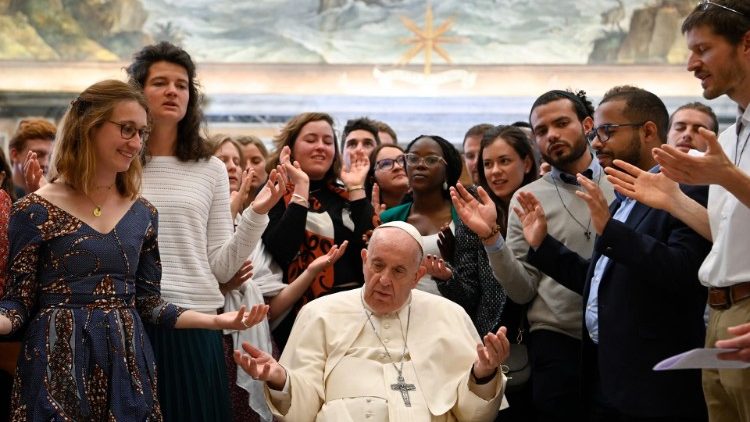
Pope Francis sends encouragement and prayers to the young Catholics from England and Wales


File photo of Pope Francis praying with young peopleFile photo of Pope Francis praying with young people  (Vatican Media)

Pope to young UK Catholics: ‘Dare to testify to Christian ideals’

Pope Francis sends a message to young Catholics gathered in London for the 2023 Flame Congress, and urges them to dare to be different as they walk in friendship with Christ.

By Devin Watkins

Tens of thousands of young Catholics from across England and Wales gathered at the OVO Arena Wembley, in London, for the 5th CYMFed Flame Congress on Saturday.

The event was held 150 days before the 37th World Youth Day—to be held in Lisbon, Portugal, on 1-6 August 2023—under the theme “Rise Up!”, an echo of the WYD Scripture passage: “Mary arose and went with haste”.

Set free by the Gospel

Pope Francis sent his greetings and encouragement to participants in the youth rally on Saturday.

In a message signed by Cardinal Secretary of State Pietro Parolin, the Pope assured the young Catholics of his “spiritual closeness” and prayed that “Almighty God will richly bless their time together”.

He expressed his hopes that “through adoration, music, testimonies, and the sharing of friendship with Christ and with one another, all present will grow strong in faith and love and bear witness courageously to the Gospel message that sets us free.”

Beauty of generosity

The Pope also urged them to hasten to respond to the Lord’s call to follow Him, as did Mary the Mother of God.

“Dare to be different [and] point to ideals other than those of this world, testifying to the beauty of generosity, service, purity, perseverance, forgiveness, fidelity to our personal vocation, prayer, the pursuit of justice and the common good, love for the poor, and social friendship.”

Pope Francis wrapped up his message by entrusting the young English and Welsh Catholics and their families “to the intercession of Our Lady of Walsingham” and offered them his “blessing as a pledge of wisdom, joy, and peace in Jesus the Lord.”

Rising up as young Catholics

According to the event’s website, Flame 2023 is an opportunity to “Rise up after the pandemic, Rise up as young Catholics, Rise up—as Mary did—for the surprising and beautiful adventure that is our Catholic faith.”

Guest speakers include Filipino-born Cardinal Luis Antonio Tagle, Pro-Prefect of the Dicastery for Evangelization, and Australian-born Archbishop Timothy Costelloe of Perth.