Showing posts with label Cardinal Zuppi. Show all posts

Monday, July 27, 2026

The Vatican explores a Papal visit to Ukraine


Vatican weighing papal trip to Ukraine

The Holy See’s foreign minister said it is evaluating the timing and conditions for a possible visit to the country by Pope Leo XIV.

Archbishop Paul Richard Gallagher, the Holy See’s secretary for relations with states and international organizations, meets with Ukrainian President Volodymyr Zelenskyy in Kyiv on July 20, 2026. | Credit: Embassy of Ukraine to the Holy See.

Victoria Cardiel
July 24, 2026 at 10:30 AM ET

The Vatican will study the conditions needed for a possible trip by Pope Leo XIV to Ukraine, Archbishop Paul Richard Gallagher said following a six-day pastoral and diplomatic mission to the war-torn country.

Gallagher, the Holy See’s secretary for relations with states and international organizations, said the possibility of a papal visit was among the questions he heard most frequently during his stay.

“Almost everyone I met asked me that question. My answer is very simple. The Holy Father takes this invitation very seriously,” Gallagher told Vatican Media in Kraków, Poland, before returning to Rome.

“For our part, we will continue to study the conditions necessary to determine the right time and the most appropriate way for such a visit to bear the greatest possible fruit for Ukraine and for peace in the world,” he said.

Gallagher spent six days in Ukraine, which has been at war since 2014 and has endured Russia’s full-scale invasion since February 2022. He held political, institutional, and Church meetings and took part in several pastoral events.

He met Ukrainian President Volodymyr Zelenskyy in Kyiv on July 20. Zelenskyy expressed gratitude for the Holy See’s continuing support for Ukraine amid the war with Russia.

The principal purpose of Gallagher’s visit was to participate in celebrations marking the 35th anniversary of the restoration of the Latin Catholic Church’s structures at the Marian shrine of Berdychiv. Thousands of faithful attended the celebrations July 19.

Gallagher said Ukrainian authorities had expressed appreciation for the Holy See’s support.

“In our meetings with the authorities, we encountered profound gratitude for the Holy Father’s appeals and his words, and that is a source of encouragement for us,” he said.

“They feel supported by the closeness shown first by Pope Francis and now by Pope Leo. This encourages the Holy See to renew its commitment to dialogue with the international community and with the Russian authorities, and to continue its humanitarian efforts, such as the mission entrusted to Cardinal Matteo Maria Zuppi, who continues working for the return of children, prisoners, and civilians.”

Pope Leo XIV has received several official invitations to visit Ukraine. Zelenskyy renewed the invitation during a conversation with the pope on Good Friday.

During that exchange, Pope Leo expressed his closeness to the Ukrainian people amid the suffering caused by the war and emphasized the urgency of ensuring humanitarian assistance. He also expressed his hope for an end to hostilities and a just and lasting peace with Russia.

A just and lasting peace

Asked about the prospects for a ceasefire, Gallagher said he had seen a strong willingness on the Ukrainian side to work toward that goal.

“During these days I have seen a strong determination on the Ukrainian side to work towards that goal. It is difficult for me to say whether this can be achieved in the immediate future, but we must continue to work in that direction,” he said.

“At the same time, as we saw at the shrine of Berdychiv — and as the history of this remarkable place of Marian devotion reminds us, renowned for many reported healings — we should never rule out the possibility of a miracle.”

Gallagher also reflected on what he had witnessed during the mission.

“For me, this has been a profoundly positive experience. Beyond the logistical effort and the long journey required to reach Ukraine, it has allowed me to touch the reality of today’s world with my own hands,” he said.

“We must remember that not everyone lives as we do in Italy or in my native England. There is a dark and troubling reality in our world today. We must not give in. In our own way, we too are called to strive, doing our part with the means available to us, in order to build peace.”

Zuppi’s humanitarian mission

Gallagher’s visit followed Cardinal Matteo Maria Zuppi’s second mission to Ukraine as Pope Leo XIV’s special envoy.

The archbishop of Bologna completed four days of meetings in Lviv and Kyiv focused on prisoner exchanges, the return of Ukrainian children taken to Russia, and the delivery of humanitarian assistance.

Zuppi met civil and religious authorities, officials responsible for prisoner exchanges and relatives of military personnel and civilians being held in Russia.

Among his principal meetings was an encounter with Ukrainian Foreign Minister Andrii Sybiha, who thanked the Holy See for its humanitarian efforts and requested its support in achieving a comprehensive and lasting peace.

Sybiha also raised Kyiv’s concerns about civilians detained in Russian territory and called for a humanitarian corridor to assist thousands of people in the Russian-occupied communities of Oleshky and Hola Prystan in the Kherson region.

Prisoners were a central focus of the mission. Proposals discussed included a possible comprehensive exchange of prisoners of war, continued efforts to locate missing people, and measures to facilitate the return of civilians.

The parties also discussed the situation of Ukrainian children taken illegally to Russia, an issue in which the Holy See has been involved for years through diplomatic and humanitarian initiatives.

Another topic was the protection of the Kyiv-Pechersk Lavra, a UNESCO World Heritage Site that has recently been damaged amid attacks connected to the war. Ukrainian authorities consider its preservation and restoration a priority.

This story was first published by ACI Prensa, the Spanish-language sister service of EWTN News. It has been translated and adapted by EWTN News English.

Thursday, June 5, 2025

Pope Leo XIV spoke by phone with Russian President Putin


Images from the ongoing warImages from the ongoing war  (ANSA)

Pope Leo XIV speaks by phone with Russian President Putin

Speaking by phone with President Vladimir Putin, Pope Leo XIV urges Russia to take a step that favours peace, underlining the importance of dialogue.

By Vatican News

On Wednesday afternoon, Pope Leo XIV and Russian President Vladimir Putin spoke by phone, focusing especially on the war in Ukraine.

Matteo Bruni, Director of the Holy See Press Office, told reporters that the Pope and the President discussed the humanitarian situation, as well as the need to facilitate aid where necessary.

"The Pope made an appeal for Russia to take a gesture that would favor peace, emphasizing the importance of dialogue to create positive contacts between the parties and seek solutions to the conflict," said the statement.

Pope Leo XIV and President Putin also discussed the ongoing efforts for prisoner exchanges and the value of the work that Cardinal Matteo Maria Zuppi, Archbishop of Bologna, is doing in this regard.

"Pope Leo made reference to Patriarch Kirill, thanking him for the congratulations received at the beginning of his pontificate, and underlined how shared Christian values can be a light that helps to seek peace, defend life, and pursue genuine religious freedom," said Mr. Bruni.

Thursday, January 16, 2025

Israel, Hamas ceasefire; cause for rejoicing especially for Gaza Catholics

 Israel, Hamas reach ceasefire, hostage agreement, as Gaza Catholics rejoice


Supporters of Israeli hostages, who were kidnapped during the deadly Oct. 7 2023, attack by Hamas, react to a Gaza ceasefire deal as they attend a protest in Tel Aviv, Israel, Jan. 15, 2025, that was organized to demand a deal to bring every hostage home at once. (OSV News photo/Ronen Zvulun, Reuters)


(OSV News) — After more than a year of war and thousands killed or wounded, negotiators representing Israel and Hamas agreed to a ceasefire deal.

A six-week initial ceasefire phase and the gradual withdrawal of Israeli forces from the Gaza Strip are included in the accord.

The agreement, announced Jan. 15 following several months of negotiations brokered by Egypt, Qatar and the United States, also included a deal that would see the release of Israeli hostages in exchange for Palestinian prisoners.

Although negotiators have reached an agreement, the deal has yet to be ratified by the Israeli parliament. As of publishing time, neither Israel or the Palestinian Authority had issued an official statement announcing the deal.

Speaking at the Jan. 15 press briefing at the White House, President Joe Biden acknowledged that the deal has been a team effort of the outgoing and incoming administration.

“In these past few days, we’ve been speaking as one team,” Biden said.

“We’re handing off to the next team a real opportunity for a brighter future in the Middle East,” Biden says. “I hope they take it.”

Hostages and Missing Families Forum

The Hostages and Missing Families Forum, a group representing the families of 98 Israeli hostages taken by Hamas, welcomed news of the agreement “with overwhelming joy and relief.”

While hailing the deal as a significant step forward, the group acknowledged “deep anxiety and concerns” over the “possibility that the agreement might not be fully implemented, leaving hostages behind.”

“We urgently call for swift arrangements to ensure all phases of the deal are carried out,” the group said. “We will not rest until we see the last hostage back home,” they said as people were seen rejoicing on the streets of Tel Aviv, Reuters news agency reported.

SIR, the news service of the Italian bishops’ conference, reported celebrations also erupting in Gaza following news of the ceasefire.

Gaza Pastor and Parishioners’ Hopes

Father Gabriel Romanelli, pastor of Holy Family Parish in Gaza, said that people were beginning “to nurture the hope of returning to their homes — for those who still have them — and understanding what is left and how to rebuild.”

“For everyone, it also means returning to live without the constant nightmare of planes, bombs, fighting, and violence,” he told SIR. “Everyone hopes the truce holds, although we know it will be a very long and complicated path.”

Father Romanelli said the parish will celebrate a Mass of thanksgiving for the ceasefire and that the faithful will continue to pray “for all those working to provide relief to the people.”

In a statement published not long after news of the agreement, Biden, who will officially end his term Jan. 20, confirmed that he “laid out the precise contours of this plan” which was endorsed “unanimously by the UN Security Council.”

While he welcomed the news, the president remembered the lives of those killed during Hamas’ Oct. 7, 2023, attack and the “many innocent people killed in the war that followed,” also referring to the suffering of Palestinians during his subsequent White House press briefing as “hell.”

“Too many innocent people have died; too many communities. have been destroyed,” Biden said.

Trump and ‘Peace Through Strength”

President-elect Donald Trump, who is set to be sworn in as president in less than a week, took to his social media platform, Truth Social, and seemingly took credit for the “EPIC ceasefire agreement.”

The deal, he said, “could have only happened as a result of our Historic Victory in November, as it signaled to the entire World that my Administration would seek peace and negotiate deals to ensure the safety of all Americans, and our Allies.”

Trump said his upcoming administration would work closely with Israel to ensure that Gaza “NEVER again becomes a terrorist safe haven” and that “we will continue promoting PEACE THROUGH STRENGTH,” he said, capitalizing certain words.

“This is only the beginning of great things to come for America, and indeed, the World,” Trump wrote. “We have achieved so much without even being in the White House.”

Pope’s Calls for Ceasefire 

Although the Vatican has yet to release a statement regarding the deal, the announcement comes after Pope Francis made multiple calls for an end to the conflict in the Holy Land, and in other parts of the world.

“Let us pray that the fighting will cease on every front, and that there will be a decisive effort for peace and reconciliation,” the pope said during his Angelus address Jan. 1, adding that “War is always a defeat,” and thanking those “in the many areas of conflict who work for dialogue and negotiations.”

Following an event in Rome, Italian Cardinal Matteo Zuppi of Bologna, president of the Italian bishops’ conference, who also serves as the pope’s special envoy for peace in Ukraine, reacted to news of the ceasefire, and expressed his hope that “it will serve to prevent further suffering.”

“Let us trust in peace,” the cardinal said, according to SIR.

Hamas’ brutal attack on southern Israeli communities on Oct. 7, 2023, killed 1,200 Israelis, with over 250 taken hostage, and a subsequent Israel-Hamas war in the Gaza Strip killed 46,600 people, according to the Gaza Health Ministry, run by Hamas. Women, children and older people account for just over half of identified victims.

Junno Arocho Esteves writes for OSV News from Malmö, Sweden.

Monday, October 14, 2024

Pope Francis send Cardinal Zuppi to Moscow seeking peace with Ukraine


Cardinal Matteo Zuppi celebrates Mass in Moscow on June 29, 2023Cardinal Matteo Zuppi celebrates Mass in Moscow on June 29, 2023  (ANSA)

Cardinal Zuppi visits Moscow as papal envoy to seek peace in Ukraine

Italian Cardinal Matteo Zuppi begins a visit to Moscow as part of the mission entrusted to him by Pope Francis to seek a path to peace in Ukraine and to facilitate the reunification of Ukrainian children with their families and the exchange of prisoners-of-war.

By Devin Watkins

Pope Francis' special envoy to pursue peace in Ukraine began his second visit to Moscow, Russia's capital, on Monday.

The Pope named Cardinal Matteo Maria Zuppi, Archbishop of Bologna and President of the Italian Bishops' Conference, as his special envoy in June 2023.

According to Matteo Bruni, Director of the Holy See Press Office, Cardinal Zuppi's visit falls within his mission as the Pope's envoy.

The Italian-born Cardinal will meet with Russian authorities and "assess further efforts to facilitate the reunification of Ukrainian children with their families and the exchange of prisoners, with a view to achieving the much-hoped-for peace," said Mr. Bruni.

Previous visits as part of peace mission

Cardinal Zuppi began his peace mission with a visit to Ukraine on June 5-6, 2023, where he met with President Volodymyr Zelensky and several other high-level officials

The Cardinal then visited Russia on June 28-30, 2023, meeting with Russian Orthodox Patriarch Kirill, as well as government officials, including Yuri Ushakov, Assistant to the President of the Russian Federation for Foreign Policy Affairs, and Maria Lvova-Belova, Commissioner to the President of the Russian Federation for Children’s Rights.

On July 17-19, 2023, he traveled to Washington, D.C., and met with US President Joe Biden, delivering him a letter from Pope Francis.

Cardinal Zuppi also visited Beijing on September 13-15, 2023, meeting with Li Hui, China’s Special Representative for Eurasian Affairs at the Ministry of Foreign Affairs.

Monday, June 17, 2024

Cardinal Zuppi in Bethlehem witnesses the unacceptable suffering of innocent children


Cardinal Zuppi at the Caritas Baby Hospital in BethlehemCardinal Zuppi at the Caritas Baby Hospital in Bethlehem 

Cardinal Zuppi in Bethlehem: The suffering of children in unacceptable

Cardinal Matteo Zuppi visits the Caritas Baby Hospital in Bethlehem and highlights the urgent need for a ceasefire in Gaza in light of the unacceptable suffering of children amid ongoing violence.

By Vatican News

The Caritas Baby Hospital in Bethlehem is celebrating 71 years of active service this year.

As the war in Gaza rages on, adding to the already difficult situation in the region, over 410,000 children under the age of 18 are subjected to challenging conditions in many fields.

Cardinal Matteo Zuppi, Archbishop of Bologna and President of the Italian Bishops' Conference, has just returned from a visit to the Holy Land where he visited the paediatric hospital in Bethlehem. Accompanied by 160 pilgrims from his diocese, Cardinal Zuppi was greeted on 15 June by Shireen Khamis, from the hospital’s press office.

The difficulties caused by war

Khamis explained to Cardinal Zuppi that “the war makes it even harder for families to bring their children here for treatment”.

“In the first three months of the conflict, 7,000 children were unable to receive the care they needed due to the numerous Israeli checkpoints. Moreover, the war has deepened the already severe economic crisis. Many families, deprived of income from tourism and pilgrimages, cannot afford medical care", she explained.

Despite these hardships, the Caritas Baby Hospital remains steadfast in its mission. “In mid-March”, Khamis told the visiting Cardinal, “we welcomed 68 children from the Gaza Strip. They are now under the care of SOS Children's Villages, with medical treatment provided by our hospital”.

A source of comfort

Cardinal Zuppi visited the patients and their parents, offering them words of comfort. He also took the time to converse with the dedicated medical staff. “This is a place where the immense suffering of children is met with compassion and care. But we must recognise that not every child is so fortunate,” he noted.

“We must begin here to understand what the most vulnerable need to ensure they receive all they are entitled to. The suffering of children is unacceptable, and we must work to make adults understand this.”

Remember all children

The Cardinal emphasised the importance of remembering all children affected by conflict, citing the tragic deaths of Israeli children in October and the ongoing deaths and casualties among Palestinian children in Gaza over the past eight months.

He recalled hearing firsthand from some of the patients about horrific experiences in Gaza, "such as undergoing amputations without anaesthesia.” 

Cardinal Zuppi went on to stress that “we must strive to create a future that is possible for these children. By looking into their eyes, we understand our responsibilities. Hatred, the relentless logic of violence, and the failure to recognise the suffering of others while focusing only on our own pain—all these perpetuate further violence and claim more innocent lives, especially among children".

Finally, Cardinal Zuppi highlighted the essence of his visit saying he strives, “to understand these pains and confront them with a united love, by being close, offering help, and praying fervently for the courage to achieve a ceasefire and urgently pursue dialogue.”

Tuesday, December 12, 2023

The Vatican tackles some difficult questions about cremation


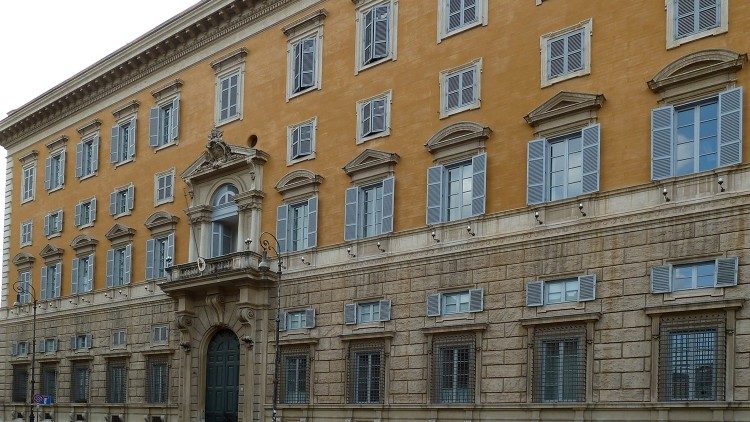
The offices of the Dicastery for the Doctrine of the FaithThe offices of the Dicastery for the Doctrine of the Faith 

Dicastery for the Doctrine of the Faith responds to questions about cremation

Cardinal Matteo Zuppi asks whether it is possible to keep the ashes of the deceased in common places similar to ossuaries and whether it was possible to keep a small portion of the ashes in a place significant to the deceased.

By Vatican News

In response to questions proposed by Archbishop Matteo Zuppi, the Dicastery for the Doctrine of the Faith affirms it is possible to arrange a sacred place “for the commingled accumulation and preservation of the ashes of the baptized,” that is, a communal cinerary where the individual ashes are poured out. The Archbishop of Bologna has submitted two questions to the Dicastery concerning the disposition of the remains of believers who have been cremated. The response to the second question says ecclesiastical authorities may also consider and evaluate the request of family members to keep a portion of a deceased person’s ashes in a place significant to the history of the person who died. The full text of the Dicastery's response can be found on the Vatican website.

Cardinal Zuppi presented the questions in light of the increasing number of people who choose cremation for their deceased loved ones and then choose to disperse the ashes in nature. The questions were also motivated by the desire that “economic reasons” suggested by the lower cost associated with scattering ashes “not prevail”; and by the desire to provide indications “regarding what to do with the ashes once the term for their preservation has expired”, with the intention not only of corresponding with the requests of family members, but “more importantly, with the Christian proclamation of the resurrection of the body and the respect due to it.”

The first question, then, was: “Taking into account the canonical prohibition against scattering the ashes of the deceased, is it possible to prepare a defined and permanent sacred place for the commingled accumulation and preservation of the ashes of the baptized, indicating the basic details of each person so as not to lose the memory of their names, similar to what occurs in ossuaries, where the mineralized remains of the deceased are cumulatively deposited and preserved?” The second question was, “Can a family be allowed to keep a portion of their family member’s ashes in a place that is significant for the history of the deceased?”

In a text signed by Prefect, Cardinal Victor Fernandez, and approved by Pope Francis on 9 December, the Dicastery responds in the affirmative to both questions.

First of all, it recalls that according to the 2016 Instruction Ad resurgendum cum Christo (no. 5), “ashes must be kept in a sacred place, such as a cemetery, or in an area dedicated to this purpose, provided that it has been so designated by the ecclesiastical authority.” The reasons for this choice are cited, namely the need to ensure “that they are not excluded from the prayers and remembrance of their family or the Christian community,” and to prevent “the faithful departed from being forgotten, or their remains from being shown a lack of respect,” as well as preventing “any unfitting or superstitious practices.”

The document goes on to recall that “faith tells us that we will be raised with the same bodily identity, which is material […] even though that matter will be transfigured, freed from the limitations of this world.” In this sense, “the resurrection will be ‘in this flesh in which we now live’.” But this transformation “does not imply the recuperation of the identical particles of matter that once formed the human being’s body.” Therefore, “the body of the resurrected person will not necessarily consist of the same elements that it had before it died. Since it is not a simple revivification of the corpse, the resurrection can occur even if the body has been totally destroyed or dispersed. This helps us understand why, in many cinerary urns, the ashes of the deceased are conserved together and are not stored separately.”

The Dicastery goes on to emphasize that “The ashes of the deceased person, moreover, come from the material remains that were part of the person’s historical journey—so much so that the Church shows particular care and devotion concerning the relics of the saints. This attention and remembrance also leads us to have an attitude of sacred respect toward the ashes of the deceased, which we conserve in a sacred place suitable for prayer…”

In response to Cardinal Zuppi’s question, then, the Dicastery replies that “a defined and permanent sacred place can be set aside for the commingled accumulation and preservation of the ashes of deceased baptized persons, indicating the identity of each person so as not to lose the memory of their names.” The Church, therefore, admits the possibility of putting the ashes into one common place, as happens with ossuaries, while preserving the memory of each deceased individual.

In response to the second question, the Dicastery states, “The ecclesiastical authority, in compliance with current civil norms, may consider and evaluate a request by a family to preserve in an appropriate way a minimal part of the ashes of their relative in a place of significance for the history of the deceased person, provided that every type of pantheistic, naturalistic, or nihilistic misunderstanding is ruled out and also provided that the ashes of the deceased are kept in a sacred place.”

In response to a question from Vatican Media, the Dicastery explained that the intervention and assessment of the ecclesiastical authority is not only canonical but also pastoral in nature, to help the family discern what choices to make, while taking all considerations into account.

As some civil legislation forbids the division of the ashes of the deceased, the Dicastery explained that the second question emerged from a dialogue between bishops from several different countries to which Cardinal Zuppi gave voice. The Dicastery’s response considered the possibility from a theological rather than a civil point of view, as was later clarified in the reply.