Showing posts with label death. Show all posts

Friday, November 7, 2025

Why are Catholic funerals way down when Catholic population is up


Why Are Fewer Catholics Having Church Funerals?

Despite its enormous significance, skipping a funeral Mass and instead opting for a graveside service or ‘celebration of life’ for a loved one has become increasingly common among U.S. Catholics.


Funeral Masses commit loved ones to God in prayer. (photo: Josh Applegate/Unsplash)

Death awaits at the end of every human life, and this profound event is also the entry point to the final judgment by Jesus that will determine the permanent destination of every human soul: heaven or hell.

The Catholic Church consequently has always emphasized the crucial importance of celebrating a funeral Mass, since it is the instrument through which recently departed souls can be commended to the care of God — and assisted by the prayers of their families and friends — on their final journey.

Yet despite its enormous significance, skipping a funeral Mass and instead opting for a graveside service or “celebration of life” for a loved one has become increasingly common among U.S. Catholics.

“There has been an overall steady decline in the number of Catholic funerals reported annually by dioceses in The Official Catholic Directory (OCD),” Father Thomas Gaunt, executive director of the Center for Applied Research in the Apostolate (CARA), told the Register.

From 2001 to 2024, while the total Catholic population rose 9.3%, from 60.6 million to 66.3 million, the reported number of Catholic funerals (funeral Masses, funeral services and burials combined) fell 30.3%, from 503,733 to 350,755. 

Graphic shows the decline in Catholic funerals (funeral Masses, funeral services and burials combined).(Photo: Jonah McKeown/National Catholic Register)

There has been a similar drop among baptisms, first Communions and weekly Mass attendance during the same period. 

Why the drop? “There are various theories proposed to explain this decline but no hard data,” Father Gaunt replied, adding that “CARA has been interested in researching this for a number of years.”

But anecdotal evidence points to a significant contributor to this trend: Children of devout Catholics are not having Catholic funeral rites for their parents.

Those ministering to grieving families have taken note of this trend.

Certified funeral service practitioner Michael Johnston of Divine Mercy Funeral Home in Fort Wayne, Indiana, which consists of two funeral homes and a Catholic cemetery, certainly has. 

While the trend is less pronounced at his funeral home, which is owned by the Diocese of Fort Wayne-South Bend, “our area, in general, is seeing more and more people going toward a service outside the church and more of a ‘celebration of life,’ which I find interesting because I consider a funeral Mass to be a celebration of life. When I write an obituary, I say ‘a funeral Mass will be celebrated.’”

Added Johnson, “It does seem that more and more people are trending toward a funeral home service or more of a secular service than the traditional religious service that’s been practiced over the years.”

He posits the change might have to do with cremation. “Cremation affords people the opportunity of convenience,” he said, as families can wait weeks or even months and have something informal to mark a loved one’s passing.

Denver’s Response

In Denver, Oblate Father Paul Nguyen, pastor of Holy Ghost Church, finds people opting out of having funeral Masses, but “it’s not an overwhelming trend,” he said. “We still see a fair amount of funeral Masses requested here in Denver.” Some also opt for a graveside service at a Catholic cemetery.

“But the problem that we run into, and more of a change, is the vigil service. A lot of people are not doing the wake. They’ll come an hour early for the funeral Mass, and it’s [wake and funeral] in one shot. We’re also seeing a lot higher incidence of cremations and a fairly low rate of a plan for burying or placing those remains in a columbarium or mausoleum. People are keeping the ashes at home or family members are taking turns.” 

This practice is against Catholic teaching, which communicates that all remains should be buried.

The pastor, who resides in a state that has seen an uptick in human composting and scattering of ashes in the mountains or lakes, explained these are undignified practices that do not honor the deceased. “We counsel against that if we hear about it and encourage them to bury those remains in a sacred place,” he said. 

To counter this trend, a Catholic cemetery in Denver offers an annual free burial of cremated remains in the Crypt of All Souls, including a memorial Mass. Courtesy of this service, Father Nguyen said, people are “able to have a little more closure and finality of the grieving process.” 

Father Kevin Bowman, pastor of St. Joseph Catholic Church in Fort Wayne, Indiana, finds fewer funeral Masses “is definitely the case.” 

“It’s a huge shift from what it used to be in Catholic culture,” he told the Register. “The norm was always the funeral Mass and then the burial.”

He believes COVID was the starting point for when “people have been opting out of Masses.” But he emphasized there are many different reasons why.

“I would say the top reasons are adult children no longer embrace the Catholic faith that they were raised in, either because of marriage situations or they just decide to step away from organized religion,” Father Bowman said. 

He described one situation with the family requesting “an expedited service” and asking him to “abbreviate” the Mass. That shifted the service to a funeral home, to which he agreed. That then changed to a graveside service. “They gave me about five minutes at the graveside. That’s what we ended up with.” 

Father Bowman observed, “It’s not so much Dad’s or Mother’s or grandparents’ wishes, but what the survivors are willing to do.”

The pastor also mentioned another longtime tradition that some families insist on while others sidestep — mourners praying the Rosary at the funeral parlor. He attributes a decline in the prayerful custom to the mixed marriages with non-Catholics. He said while some families have maintained their Catholic identity that way, many have had to accommodate or feel that they must accommodate non-Catholic partners, children and relatives.

“To have a family that has remained very strong and Catholic, rooted in Catholic tradition is rare today, I would dare say,” he told the Register.

Education Is Key

In Arizona, Harry Antram oversees the Diocese of Phoenix Catholic Cemeteries and Funeral Homes, operating six cemeteries and two funeral homes in central and northern Arizona. There, 65% of Catholic burials are preceded by a funeral Mass. 

The diocese established the Catholic funeral homes to ensure the proper handling of Catholic services for the deceased. Antram, who is the organization’s president and CEO, believes many of the problems stem from Catholics today not being catechized about how to handle death, about the sanctity of the body and why the remains should be treated with respect even when considering cremation. 

“That’s why we take time to try to educate families that the greatest gift that you can give your loved one is the funeral Mass,” he told the Register. 

“We have found, contrary to what society is telling us, that Catholics want to know what they don’t know. Many Catholics come in and say, ‘Well, this is what we want,’ and we explain what the Church’s desire is, and they say, ‘Yes, we want to follow.’ Catholic families are yearning to be educated.”

This is evident when Antram works with families who do not want to honor the prearrangements for a funeral Mass. Antram has shown families what their mother or father planned in writing, how they took precious time to go through readings and music that they wanted at the Mass. “Oftentimes, that changes them,” Antram explained. “They say, ‘I didn’t realize they really wanted it that badly.’”

His detailing of Church teaching has even prompted sacramental moments: Children who had not been in church in years requested confession before Mass so they could receive the Eucharist at their parent’s funeral.

The mission of the diocesan funeral homes is “really to educate Catholic families,” he underscored. “That is why it’s so important for Catholic dioceses to look into funeral homes. So many of them have cemeteries, but not many of them have funeral homes. We, as Catholics, have an excellent format to basically create this mission within the Church to really educate Catholic families.”

Looking at the current trend, Michael Johnston also sees hopeful signs. At a recent conference with the National Funeral Directors Association, one item discussed was generational trends for funeral arrangements. “We’re starting to see millennials make funeral arrangements now, and we seem to be trending back more conservative,” he said. “I think we’re going to see this revert again.”

That’s welcome news to Antram. “That’s our faith. You’re offering that Mass as a final send-off for your loved one in prayer that hopefully they’re on their journey to the heavenly Kingdom.”

Wednesday, October 23, 2024

Pope Francis continues to express sadness over the number of innocent deaths in on-going wars


Pope Francis reiterates that 'war does not forgive'Pope Francis reiterates that 'war does not forgive'  (AFP or licensors)

Pope: 'Palestine is suffering inhumane attacks'

Pope Francis reiterates his appeal for peace in the world, saying the fatality statistics coming from Ukraine are “terrible" and that Palestine is suffering "inhumane attacks."

By Kielce Gussie

At the end of his Wednesday General Audience, Pope Francis once again made an appeal for peace in the world.

The Pope explained he had received statistics on the number of deaths in Ukraine, calling it “terrible.”

Last month, the Wall Street Journal released information stating the number of fatalities reached one million people—both Ukrainian and Russian. Ukrainian officials reported that more than 12,000 civilians had been killed in the month of June alone.

Do not forget nations facing violence

In his appeal, Pope Francis reiterated that “war is a defeat from the very beginning” and that it “does not forgive.”

"Let us pray to the Lord for peace; may He give peace to all, to all of us," he said. "And let us not forget Myanmar; let us not forget Palestine, which is suffering inhumane attacks; let us not forget Israel, and let us not forget all nations at war."


The UN’s Acting Under-Secretary-General for Humanitarian Affairs and Emergency Relief Coordinator reported that no food has entered Gaza since October 2, adding that food supplies are running low.

Pope Francis also lamented the massive financial outlay on arms manufacturing, which he said “yields the most profit today.”

This, he said, “is a statistic that should frighten us.”

The global arms trade was valued at just under 100 billion euros in 2021, according to the most recently available data.

Tuesday, December 12, 2023

The Vatican tackles some difficult questions about cremation


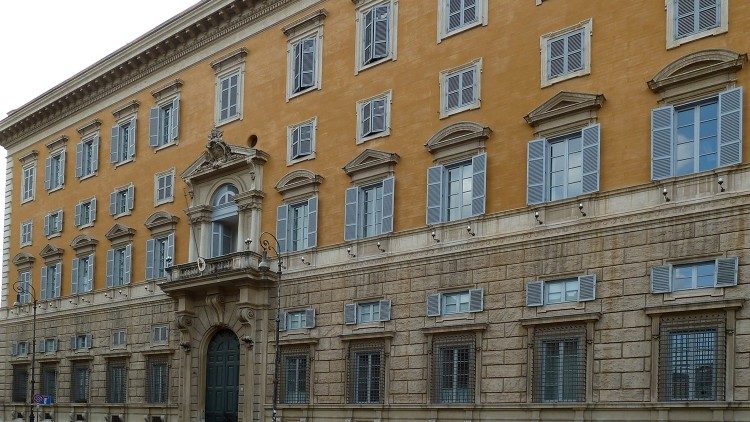
The offices of the Dicastery for the Doctrine of the FaithThe offices of the Dicastery for the Doctrine of the Faith 

Dicastery for the Doctrine of the Faith responds to questions about cremation

Cardinal Matteo Zuppi asks whether it is possible to keep the ashes of the deceased in common places similar to ossuaries and whether it was possible to keep a small portion of the ashes in a place significant to the deceased.

By Vatican News

In response to questions proposed by Archbishop Matteo Zuppi, the Dicastery for the Doctrine of the Faith affirms it is possible to arrange a sacred place “for the commingled accumulation and preservation of the ashes of the baptized,” that is, a communal cinerary where the individual ashes are poured out. The Archbishop of Bologna has submitted two questions to the Dicastery concerning the disposition of the remains of believers who have been cremated. The response to the second question says ecclesiastical authorities may also consider and evaluate the request of family members to keep a portion of a deceased person’s ashes in a place significant to the history of the person who died. The full text of the Dicastery's response can be found on the Vatican website.

Cardinal Zuppi presented the questions in light of the increasing number of people who choose cremation for their deceased loved ones and then choose to disperse the ashes in nature. The questions were also motivated by the desire that “economic reasons” suggested by the lower cost associated with scattering ashes “not prevail”; and by the desire to provide indications “regarding what to do with the ashes once the term for their preservation has expired”, with the intention not only of corresponding with the requests of family members, but “more importantly, with the Christian proclamation of the resurrection of the body and the respect due to it.”

The first question, then, was: “Taking into account the canonical prohibition against scattering the ashes of the deceased, is it possible to prepare a defined and permanent sacred place for the commingled accumulation and preservation of the ashes of the baptized, indicating the basic details of each person so as not to lose the memory of their names, similar to what occurs in ossuaries, where the mineralized remains of the deceased are cumulatively deposited and preserved?” The second question was, “Can a family be allowed to keep a portion of their family member’s ashes in a place that is significant for the history of the deceased?”

In a text signed by Prefect, Cardinal Victor Fernandez, and approved by Pope Francis on 9 December, the Dicastery responds in the affirmative to both questions.

First of all, it recalls that according to the 2016 Instruction Ad resurgendum cum Christo (no. 5), “ashes must be kept in a sacred place, such as a cemetery, or in an area dedicated to this purpose, provided that it has been so designated by the ecclesiastical authority.” The reasons for this choice are cited, namely the need to ensure “that they are not excluded from the prayers and remembrance of their family or the Christian community,” and to prevent “the faithful departed from being forgotten, or their remains from being shown a lack of respect,” as well as preventing “any unfitting or superstitious practices.”

The document goes on to recall that “faith tells us that we will be raised with the same bodily identity, which is material […] even though that matter will be transfigured, freed from the limitations of this world.” In this sense, “the resurrection will be ‘in this flesh in which we now live’.” But this transformation “does not imply the recuperation of the identical particles of matter that once formed the human being’s body.” Therefore, “the body of the resurrected person will not necessarily consist of the same elements that it had before it died. Since it is not a simple revivification of the corpse, the resurrection can occur even if the body has been totally destroyed or dispersed. This helps us understand why, in many cinerary urns, the ashes of the deceased are conserved together and are not stored separately.”

The Dicastery goes on to emphasize that “The ashes of the deceased person, moreover, come from the material remains that were part of the person’s historical journey—so much so that the Church shows particular care and devotion concerning the relics of the saints. This attention and remembrance also leads us to have an attitude of sacred respect toward the ashes of the deceased, which we conserve in a sacred place suitable for prayer…”

In response to Cardinal Zuppi’s question, then, the Dicastery replies that “a defined and permanent sacred place can be set aside for the commingled accumulation and preservation of the ashes of deceased baptized persons, indicating the identity of each person so as not to lose the memory of their names.” The Church, therefore, admits the possibility of putting the ashes into one common place, as happens with ossuaries, while preserving the memory of each deceased individual.

In response to the second question, the Dicastery states, “The ecclesiastical authority, in compliance with current civil norms, may consider and evaluate a request by a family to preserve in an appropriate way a minimal part of the ashes of their relative in a place of significance for the history of the deceased person, provided that every type of pantheistic, naturalistic, or nihilistic misunderstanding is ruled out and also provided that the ashes of the deceased are kept in a sacred place.”

In response to a question from Vatican Media, the Dicastery explained that the intervention and assessment of the ecclesiastical authority is not only canonical but also pastoral in nature, to help the family discern what choices to make, while taking all considerations into account.

As some civil legislation forbids the division of the ashes of the deceased, the Dicastery explained that the second question emerged from a dialogue between bishops from several different countries to which Cardinal Zuppi gave voice. The Dicastery’s response considered the possibility from a theological rather than a civil point of view, as was later clarified in the reply.

Tuesday, November 16, 2021

The last 4 things


The 4 Last Things, 4 times each day


Reflection on Heaven, hell, death, and judgment isn't just for November, or the hour of death.

It’s November, the month where we pray for the dead and remember the four last things: Heaven, hell, death and judgment.

Actually, the four last things are so important that the Catholic Church has built opportunities to remember them into our lives. Here are four ways the Church puts the four last things before us each day.

First, the Mass is a visit to heaven.

“The heavens open and multitudes of angels come to assist in the Holy Sacrifice of the Mass,” said St. Gregory the Great

The Church doesn’t just say that Mass is a “foretaste” of heaven; it says that it is a place where heaven comes down to meet us. 

Everyone is there. We gather first of all with Christ, the “principal agent of our Eucharistic assembly” we gather also with the Church — “not only the members still here on earth, but also those already in the glory of heaven.” Also, “Mary is present, with the Church and as the Mother of the Church, at each of our celebrations of the Eucharist,” said St. John Paul II. 

The Mass as Heaven on Earth is the subtitle of Scott Hahn’s The Lamb’s Supper. “When we begin to see that heaven awaits us in the Mass, we begin already to bring our home to heaven,” he writes, “And we begin already to bring heaven home with us.”

Second, the Rosary warns again and again about hell.

In the Rosary, we go through the four last things again and again, asking Mary to “pray for us sinners now and at the hour of our death” and placing ourselves in the presence of “Our Father who art in Heaven,” at whose judgment we hope he will “forgive us our trespasses,” and “deliver us from evil.”

It is the final evil of hell we need to be delivered from.

“Following the example of Christ, the Church warns the faithful of the ‘sad and lamentable reality of eternal death,’ also called ‘hell,’” says the Catechism. “Our freedom has the power to make choices for ever, with no turning back,” it adds.

C.S. Lewis warns, “The safest road to hell is the gradual one — the gentle slope, soft underfoot, without sudden turnings, without milestones, without signposts.”

Our Lady of Fatima agreed, and put signposts up for us in the Rosary, teaching three shepherd children to add this prayer after each decade of the rosary: “O my Jesus, forgive us our sins. Save us from the fires of hell. Lead all souls to heaven, especially those in most need of thy mercy.”

Third: Judgement and the Examination of Conscience.

We will each be judged one day when “the glorious Christ will reveal the secret disposition of hearts and will render to each man according to his works, and according to his acceptance or refusal of grace,” says the Catechism.

It is a longstanding practice of Catholics to prepare for that moment nightly with an examination of conscience — reviewing our lives and naming our sins — and an examination of conscience is required for the sacrament of confession.

When it is done properly, “The examination of conscience never induces despair, always hope,” said Fulton Sheen.

I switch between six different ways of doing this: reviewing the seven capital sins, St. Paul’s description of love, the Ten Commandments, Jesus’s statements about the purpose of life, and examining my relationship with God, others and self.

Last: Night prayer is a nightly memento mori, a reminder of death.

“Keep death daily before your eyes,” St. Benedict says in his Rule, and his monastic movement helped shape the Liturgy of the Hours such that it is a lifetime in miniature each day. 

At Night Prayer, Catholics pray using Simeon’s words from the Gospel of Luke. It had been revealed to him that he would not die before seeing the Messiah. Seeing the infant Jesus he prayed, “Now you may let your servant go in peace,” for “my own eyes have seen the salvation which you have prepared in the sight of every people.” 

By recalling his words each night before we enter the unconsciousness of sleep, we practice the attitude we should have before our final unconsciousness in death. 

Then, the last thing we pray each night is the “Salve Regina,” calling upon the queen of heaven for mercy. As St. Thomas Aquinas put it, “As sailors are guided by a star to the port, so are Christians guided to heaven by Mary.”