Showing posts with label Bethlehem. Show all posts

Thursday, December 25, 2025

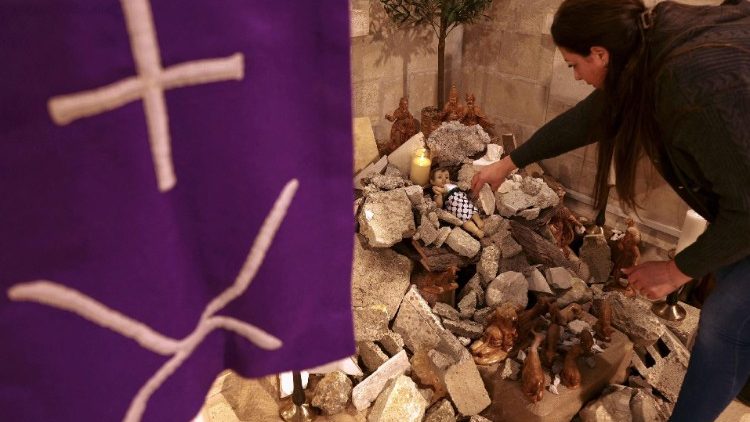
A joy-filled Christmas celebration in Bethlehem for the 1st time in 2 years


The Christmas tree in Bethlehem and the arrival of Cardinal PizzaballaThe Christmas tree in Bethlehem and the arrival of Cardinal Pizzaballa  (© archivio di padre Jerzy Kraj)

Bethlehem celebrates 1st Christmas in two years

A 15-metre Christmas tree lights up Manger Square in front of the Church of the Nativity in Bethlehem this year after a two-year pause from all festivities in solidarity with the city’s fellow Palestinians in Gaza.

By Linda Bordoni and Jean-Charles Putzolu in Bethlehem

Celebrations are resuming across the West Bank as a fragile truce holds in the Gaza Strip, where hundreds of thousands of people are facing the winter in makeshift tents and remain in urgent need of basic assistance.

Cardinal Pierbattista Pizzaballa, recently returned from a visit to the Church of the Holy Family in Gaza—the enclave’s only Catholic parish, where he conveyed the closeness and solidarity of the Catholic Church—opened the Christmas celebrations in Jesus’ birthplace by making the traditional procession from Jerusalem to Bethlehem.

Upon his arrival in Manger Square, the Latin Patriarch of Jerusalem said he brought greetings from Gaza’s small Christian community, which, he noted, is animated by a strong desire to rebuild. He also expressed the hope for a Christmas marked by light.

The resumption of Christmas celebrations in Bethlehem carries significance on several levels. On the one hand, there is hope that the U.S.-backed peace initiative that led to the ceasefire may offer Palestinians the opportunity to move forward with reconstruction plans. On the other hand, it revives expectations that Bethlehem’s residents may gradually return to work, as 85 per cent of local families depend directly or indirectly on tourism, which came to a halt during the war.

Hotel owners and staff, shopkeepers selling religious articles, taxi drivers, restaurant owners, and tour guides have seen their livelihoods largely disappear over the past two years. Bethlehem has been among the hardest-hit cities in the West Bank, lacking a strong industrial base, significant commercial activity, agricultural capacity, or a large public-sector workforce.

These difficulties are compounded by challenges affecting the wider West Bank, including Israel’s revocation of entry permits for most seasonal Palestinian workers to its territory and settlements, as well as the partial payment of salaries to Palestinian Authority employees.

Despite these hardships, the population continues to demonstrate resilience and hope. Speaking to Vatican Radio’s Jean-Charles Putzolu, Bethlehem’s Mayor, Maher Nicola Canawati, said that the renewed celebrations are meant to restore hope after a prolonged period of hardship.

“After two years of silence,” the Mayor said, “we believe we have reignited the spirit of Christmas, because the people of Bethlehem needed hope—hope for a better tomorrow. And that is exactly what we have done.”

He explained that the message being sent from Bethlehem is addressed not only to Palestinians, but to the entire world. “It is a message that the Palestinian people are ready for peace. The Palestinian people love life,” he said, adding that the city is once again ready to welcome visitors. “Bethlehem is safe, hotels are open, and we are ready to receive everyone.”

Mayor Canawati also underlined that the celebrations are shared by all Palestinians, regardless of religious affiliation. “It feels like a feast for all Palestinians, not only for Christians,” he said. “We are one people—Christians, Muslims, and Samaritans. We love each other, we love peace, and we are ready for justice, peace, and a lasting peace in our country.”

Sunday, October 5, 2025

Between Mass and the Sunday Angelus, Pope Leo XIV shares remarks


Pope Leo at the Mass on October 5thPope Leo at the Mass on October 5th  (@Vatican Media)

Pope calls on world leaders to commit to Gaza peace deal

Speaking at the close of Mass in St Peter’s Square, Pope Leo condemns both the “immense suffering” of Gazans and the rise of “antisemitic hatred” worldwide and expresses his hope that an Israel-Hamas peace deal will be finalized “as soon as possible”.

By Joseph Tulloch

Pope Leo XIV has called on political leaders to “commit themselves” to the ongoing Israel-Hamas peace negotiations, which he said have recently shown “significant steps forward”.

The Pope expressed his hope that the deal would be finalized “as soon as possible” and urged his listeners to “remain united in prayer” for a “just and lasting peace”.

In his remarks, delivered at the close of Mass in St Peter’s Square, the Pope said he “continue[d] to be saddened” by the “immense suffering” of Palestinians in Gaza, and greeted a group of pilgrims from Bethlehem.

He also voiced his concern over “the rise of antisemitic hatred in the world”, mentioning in particular Thursday’s attack on a synagogue in Manchester, England.

READ THE FULL TEXT OF POPE LEO’S REMARKS HERE


Pope Leo greets the crowds gathered for Mass (@Vatican Media)


Church is 'entirely missionary'

In his remarks, delivered at the end of Mass for the Jubilee of Missionaries and Migrants, Pope Leo also thanked attendees for their presence, despite the light rain. 

“The Church is entirely missionary,” Pope Leo said, noting that “our missionary and migrant brothers and sisters remind us of this.”

He added that “no one should be forced to flee, nor exploited or mistreated because of their situation as foreigners or people in need!  Human dignity must always come first.”

Finally, the Pope also said he was praying for the victims of the 6.9 magnitude earthquake that struck the Philippines on Tuesday.

“I express my closeness to the dear Filipino people,” he said, urging those faced with danger to “remain united and supportive”.

Thursday, September 4, 2025

From Gaza: "it's truly inhumane" and "there will be no Christians left"


Fr. Ibrahim Faltas describes the crisis in Gaza and BethlehemFr. Ibrahim Faltas describes the crisis in Gaza and Bethlehem (AFP or licensors)

Fr. Faltas on Gaza: ‘It’s truly an inhumane situation'

During a visit to Italy, Franciscan friar Ibrahim Faltas illustrates the terrible situation the people of the Holy Land region are living in, and warns that if things continue as they are, “there will truly be no Christians left.”

By Kielce Gussie

“The situation in Gaza is terrible”, Fr. Ibrahim Faltas, a Franciscan friar of the Custody of the Holy Land, said during a visit to Italy during which he participated in several events, including a meeting with the Mediterranean Youth Council.


Speaking to Toscana Oggi—a weekly Italian publication—Fr. Faltas reflected on the current situation in Gaza.

Deprived of everything

“People continue to die – from hunger, thirst, and the heat,” he said, calling the situation inhumane. And poignantly, the Franciscan priest asked two questions: “Where is the international community? Where are human rights?”

On 1 September, Fr. Faltas explained that schools were reopened throughout the Holy Land, in Bethlehem and Jerusalem. However, in Gaza, children have been out of school for two years.

“They are deprived of everything — education, healthcare. There are no doctors, no medicine”, he said, adding that even playing is impossible for these children. They “have known nothing but war, fleeing, hiding, destruction, and rubble.”


Fr. Faltas during a visit to Rome in 2024

However, Fr. Faltas stressed, the humanitarian crisis is not limited to Gaza: “Bethlehem has become an open-air prison.” He pointed out that with the checkpoints closed, people who used to work in Israel pre-war with daily work permits are now unable to do so. They cannot work or leave. People whose livelihoods depended on tourism have not worked in two years.

The Christian community in Bethlehem is also suffering as some 185 families have left, that's more than 700 people, Fr. Faltas explained. He warned that “if things continue like this, there will truly be no Christians left.”

A strong gesture of hope

In the midst of the horrors of war, Fr. Faltas also recounted an act of hope and solidarity. In June, the bishops from Tuscany made a pilgrimage to Jerusalem and Bethlehem, which the Franciscan priest described as “courageous” and an important, impactful gesture for the Christians living in the region. He shared that the bishops’ visit “gave hope to the people there: "Everyone appreciated the visit – people still remember it.”

Monday, December 23, 2024

The Latin Cardinal Patriarch of Jerusalem presides at mass in the Gaza Strip


Mass in Gaza presided over by Patriarch Pizzaballa with the community led by parish priest Fr. Gabriel RomanelliMass in Gaza presided over by Patriarch Pizzaballa with the community led by parish priest Fr. Gabriel Romanelli 

Patriarch Pizzaballa visits Gaza Christians

The Latin Patriarch of Jerusalem Cardinal Pierbattista Pizzaballa enters the Gaza Strip and presides at Mass with the parish community of Fr. Gabriel Romanelli. The Patriarch: "We are proud of you because you have remained what you are: Christians with Jesus." On Tuesday he will go to Bethlehem for the celebration of Christmas Mass at St Catherine's.

By Roberto Cetera

"The whole world is with you" the Patriarch of Jerusalem Cardinal Pierbattista Pizzaballa said this morning while visiting the parish of the Holy Family in Gaza. He visited the small Christian community in the Gaza Strip who have taken refuge in the parish compound for more than 14 months. It was the first light of dawn when the Patriarch left Jerusalem to enter Gaza, escorted by Israeli soldiers, through the Eretz crossing.

The visit was eagerly awaited by the faithful who hoped to be able to celebrate Christmas with their bishop in an atmosphere of serenity and joy, at least for one day. This is the second time that Cardinal Pizzaballa has managed to enter Gaza and visit the community led by the parish priest Fr. Gabriel Romanelli, following his visit on 16 May last. To ensure maximum security on the route, news of the visit was only given after arrival in the community.


Solidarity with Gaza Christians

Cardinal Pizzaballa then presided over the Mass, celebrated with white vestments in a foretaste of Christmas joy. During the Mass he also imparted the Sacrament of Confirmation to a number of young people.

In his homily, the Patriarch congratulated the resilience of the Christian community: "You are the light of our Church and Christmas is precisely the feast of Light," the Light that is Jesus, and "Jesus who, never forget, is also here with you." "We are proud of you," continued the Cardinal, “not because of anything in particular, but because you have remained what you are: Christians with Jesus”. And again, "just as all the people of the world, not only Christians, are with you, so too you can give something to the world that looks at you, bringing the light of Christ to everyone with your example."

Visit to Bethlehem

After his visit to Gaza, the day after tomorrow, Christmas Eve, the Patriarch will make his solemn entry into Bethlehem, where he will be welcomed by another suffering community and where he will celebrate Christmas Eve Mass in St. Catherine's Church.

Monday, June 17, 2024

Cardinal Zuppi in Bethlehem witnesses the unacceptable suffering of innocent children


Cardinal Zuppi at the Caritas Baby Hospital in BethlehemCardinal Zuppi at the Caritas Baby Hospital in Bethlehem 

Cardinal Zuppi in Bethlehem: The suffering of children in unacceptable

Cardinal Matteo Zuppi visits the Caritas Baby Hospital in Bethlehem and highlights the urgent need for a ceasefire in Gaza in light of the unacceptable suffering of children amid ongoing violence.

By Vatican News

The Caritas Baby Hospital in Bethlehem is celebrating 71 years of active service this year.

As the war in Gaza rages on, adding to the already difficult situation in the region, over 410,000 children under the age of 18 are subjected to challenging conditions in many fields.

Cardinal Matteo Zuppi, Archbishop of Bologna and President of the Italian Bishops' Conference, has just returned from a visit to the Holy Land where he visited the paediatric hospital in Bethlehem. Accompanied by 160 pilgrims from his diocese, Cardinal Zuppi was greeted on 15 June by Shireen Khamis, from the hospital’s press office.

The difficulties caused by war

Khamis explained to Cardinal Zuppi that “the war makes it even harder for families to bring their children here for treatment”.

“In the first three months of the conflict, 7,000 children were unable to receive the care they needed due to the numerous Israeli checkpoints. Moreover, the war has deepened the already severe economic crisis. Many families, deprived of income from tourism and pilgrimages, cannot afford medical care", she explained.

Despite these hardships, the Caritas Baby Hospital remains steadfast in its mission. “In mid-March”, Khamis told the visiting Cardinal, “we welcomed 68 children from the Gaza Strip. They are now under the care of SOS Children's Villages, with medical treatment provided by our hospital”.

A source of comfort

Cardinal Zuppi visited the patients and their parents, offering them words of comfort. He also took the time to converse with the dedicated medical staff. “This is a place where the immense suffering of children is met with compassion and care. But we must recognise that not every child is so fortunate,” he noted.

“We must begin here to understand what the most vulnerable need to ensure they receive all they are entitled to. The suffering of children is unacceptable, and we must work to make adults understand this.”

Remember all children

The Cardinal emphasised the importance of remembering all children affected by conflict, citing the tragic deaths of Israeli children in October and the ongoing deaths and casualties among Palestinian children in Gaza over the past eight months.

He recalled hearing firsthand from some of the patients about horrific experiences in Gaza, "such as undergoing amputations without anaesthesia.” 

Cardinal Zuppi went on to stress that “we must strive to create a future that is possible for these children. By looking into their eyes, we understand our responsibilities. Hatred, the relentless logic of violence, and the failure to recognise the suffering of others while focusing only on our own pain—all these perpetuate further violence and claim more innocent lives, especially among children".

Finally, Cardinal Zuppi highlighted the essence of his visit saying he strives, “to understand these pains and confront them with a united love, by being close, offering help, and praying fervently for the courage to achieve a ceasefire and urgently pursue dialogue.”

Tuesday, December 5, 2023

Advent 2023 in Bethlehem much quieter due to ongoing conflict between Israel and Hamas


PHOTOS: Bethlehem welcomes Advent 2023 with quieter procession, still with hope


The silver star marking the place where Jesus was born, in the Grotto of the Nativity, inside the Basilica of the Nativity in Bethlehem. Dec. 2, 2023. Credit: Marinella Bandini

On Dec. 2, like every evening before Advent, the city where Jesus was born welcomed the custos of the Holy Land, Father Francesco Patton, and the Franciscan friars for their annual procession into the city of Bethlehem.

This year, however, due to the ongoing conflict, the solemnity of the event has taken on a more sober tone, in line with the directives of the patriarchs and heads of the churches in Jerusalem, to “forego any unnecessarily festive activities” and “focus more on the spiritual meaning of Christmas.” 

The procession of scouts — usually consisting of several hundred men, women, and children from all over Palestine who process in with the custos — was reduced to a small group, the music of drums and bagpipes gave way to a religious silence, and the flag-throwers lowered their flags. Even the streets and Manger Square — typically crowded with local believers and pilgrims — were empty. The only note of joy came from the children of Terra Sancta College in Bethlehem, which is under the custody of the Holy Land, who welcomed the small procession with cheers and applause.

Earlier that Saturday morning, a procession of vehicles with the custos of the Holy Land left Jerusalem and before entering Bethlehem made a stop at the Greek Orthodox Monastery of St. Elias (Mar Elias), built in the sixth century at the site where the prophet Elijah is said to have taken refuge in his flight (see 1 Kings 19:1–7)

This piece of land still belongs today to the Palestinian municipality of Beit Jala and, until the Six-Day War in 1967, was located on the so-called Green Line, which marked the border between Israel and Palestine and served as the entry point from Jerusalem into the Palestinian Territories. 

For the first time, the civil and religious authorities of Beit Jala were not present to greet the custos, signaling a protest against the war and an expression of solidarity with the people of Gaza. Instead, the custos briefly greeted the military personnel of the Coordination of Government Activities in the Territories (Cogat), including some Christians.

The procession of vehicles entered Bethlehem through a gateway that was opened for the occasion and then passed through an entrance in the separation wall at the location of the Tomb of Rachel. Here, the Jews venerate the burial place of the matriarch of the Jewish people. This is a small strip of land inside Bethlehem, under Israeli control, completely surrounded by the wall.

The Christian churches of the Holy Land maintain the right to pass through this route during the solemn entrances to Bethlehem by the custos of the Holy Land and the Latin, Greek Orthodox, and Armenian patriarchs.

In an interview the evening before with a few media outlets, including CNA, the custos of the Holy Land emphasized the significance of this passage.

“For me, it is the most meaningful gesture, even more so than when everything proceeds smoothly and with the utmost solemnity. It means continuing to affirm that even a wall can be crossed. It is a sign that sooner or later, there will be no more walls, and in a context like the one we are experiencing, marked by conflict and confrontation between the two populations, it takes on an even greater significance,” he said.

The custos and the Franciscan friars were welcomed by the scouts at the beginning of Star Street, winding through the heart of Bethlehem — the route traditionally believed to have been taken by the Magi. The custos then walked the short distance to Manger Square, where he was greeted by local authorities — the mayor, the governor, the chief of police, and the military commander. 

At the entrance of the Basilica of the Nativity, the custos was then welcomed by Greek Orthodox and Armenians representatives. After entering the basilica, he proceeded to the Latin part of the complex, the Church of St. Catherine, where he venerated the relic of the holy cradle of the Child Jesus, donated to the Custody of the Holy Land by Pope Francis in 2019.

The following day, with the celebration of the first vespers of Sunday, Dec. 3, the Advent season and a new liturgical year for the Catholic Church officially began. The custos and the Franciscan friars processed into the Grotto of the Nativity, where they venerated the place where the Son of God was born as a man, now marked by a silver star.

A few steps away is the manger where Jesus was laid immediately after birth. Here, the custos lit the first candle of the Advent wreath.

The Church of St. Catherine was filled with local worshippers for the celebration of the solemn Mass of the first Sunday of Advent. 

“Thank you for being the Christian presence in Bethlehem,” Patton said at the beginning of the Mass, greeting those in attendance. “We hope to see pilgrims again soon, but you are the Church of Bethlehem, the living stones.”

Two baby girls made their entrance into the Church for the first time, approximately 40 days after their birth — a tradition still observed in this land. One of them was welcomed by the custos during the offertory.

The theme of hope was the focus of the custos’ reflection during his homily.

“We need hope because the reality in which we find ourselves makes us fear for the future of our community and our families,” he said. He then referenced the word of God that had just been proclaimed:

“The prophet Isaiah reminds us that God continues to come to meet us because he loves us with all the strength and tenderness of a father. The second reading also nourishes our Christian hope because it makes us look beyond the difficulties of the present and reminds us of the ultimate destination of our arduous earthly pilgrimage, the ‘manifestation of Our Lord Jesus Christ.’”

Friday, November 10, 2023

More perspective from Catholic pastor serving in Gaza


Fr. abriel Romanelli, parish priest of the Holy Family in GazaFr. abriel Romanelli, parish priest of the Holy Family in Gaza 

Fr. Romanelli: life in Gaza has never been peaceful

Father Gabriel Romanelli is the parish priest of Gaza Holy Family Parish. The Argentinian-born priest who has been serving in the Strip for several years is stranded in Bethlehem, in the West Bank. In an interview with the Osservatore Romano he speaks about the hardships endured by the Palestinian civilians, and in particular of the small Christian community in the Strip.

By  Roberto Cetera – Jerusalem  


Father Romanelli was in Bethlehem to buy some medicine for a nun when Hamas attacked Israel on October 7, and since then hasn’t been able to return to Gaza. He has occasionally managed to communicate with the Holy Family Parish, currently sheltering 700 displaced people and to keep updated on the developments there.

However, he would prefer to return immediately to his flock.   “It is much harder for me to be stranded here than under the bombs in Gaza", he says.

Speaking  with the Osservatore Romano in Jerusalem about the dramatic events of the past month, the Argentinian  priest of  the Institute of the Incarnate Word explains   that since he started working in Gaza several years ago life has never been peaceful for the Gazan population in the blockaded Strip, including some 1000 Christians.

Father Gabriel tell us: what was your daily life like in Gaza until October 7th?

It wasn't a peaceful life. It was an ordinary extraordinariness. They say now that the war began on October 7, but we have always experienced a climate of war. Of course, not as tragic as what we are suffering now, but in Gaza living with with sirens and explosions is a routine.

With me and Father Jusuf, there are the nuns of our own congregation, then 5 nuns of Mother Teresa, who have been doing extraordinary work for 50 years with the sick and disabled in particular, and then the Sisters of the Rosary of Jerusalem who work at the local school and in the parish. Since I have been the parish priest of Gaza, I have seen so many wars that I could no longer say the number: some lasting two or three days which statistics don't ‘count’ as wars. It’s like a surreal story, because on the one hand you have all the activities you find in every part of the world, offices, businesses, shops, and on the other hand, every now and then the sirens, the bombs, the impossibility to move freely make your life impossible.

Even our life as religious follows this dichotomy: on the one hand, we have the daily Mass, the hour of Eucharistic adoration, spiritual care, and on the other an intense social activity to assist the suffering and the poor, and with young people, often until 11pm. And then we have our educational activity: though small, the Catholic community runs three schools, attended mainly by Muslims.

What is the social status of the Catholic community?

It is difficult to say, because, despite their small number, Christians are divided into three groups, depending on their origin. The first group is that of the Palestinians who have always lived in Gaza. They are generally relatively wealthy, traders and professionals. This group that has decreased over the years because many have emigrated.

Then there is a second group is that of the refugees who arrived after the 1948 war: they came from Jerusalem, Tel Aviv, Jaffa, Ashkelon. Some of them managed to create a role for themselves in society despite having arrived as refugees with only a suitcase. When they arrived, the Catholic Church helped them integrate,  in fact even today (there are only 11 families left) they live in a small neighbourhood which is called the Christian neighbourhood, where Caritas and the Thomas Aquinas Centre for the formation of young Christians have their headquarters. When they arrived they were first  housed in the church. Some of them, who are old now, were born in the church or in the courtyard in front.

Finally, there is a third, more recent group that arrived in 1993, 30 years ago. After the Oslo Accords, Arafat sent a number of public officials to Gaza, many of them Christians, to ensure the administrative management of the Strip under the PLO government.

With the change of government in 2007, because of their loyalty to Mahmud Abbas, they were stripped of their duties, and now, although they remain employees of the central government of Ramallah, they receive only part of their salaries. Today they represent the weakest segment of our community.

Yes, perhaps the social status of Christians in Gaza is slightly better than other inhabitants of the Strip, but this is mainly due to social relief network set up by the Church. The Catholic Church is small but has an effective aid network.

How small? How many Christians are there exacrly in Gaza?

I update statistical data every year at Christmas, based on Church registers. Last year Christians numbered 1,017. Of these, there are only 135 Latin Catholics, religious included.

Then we have a range of different situations: there are many mixed marriages between Latins and Orthodox, Orthodox who consider themselves Catholic. Many Orthodox participate in our parish groups. We have ten parish groups.

Our Church is already ecumenical: It is a bottom-up ecumenism that is more widespread and practical than theological disputes. So, we are a total of a thousand people out of a population of almost two and a half million inhabitants amounting to 0,0 per cent something.

Despite this small number, however, as I said, we run three schools, and more than ten ambulances equipped by Caritas. During the pandemic more than 60% of Covid cases in Gaza were treated by our Caritas, more than the Gaza Ministry of Health and that of the central government.

We have three charitable works: two homes for disabled run by the Sisters of Mother Teresa, one children and one for adults.

And then we have a home for what we call the "butterfly children", that is, children affected by epidermolysis bullosa, which is an untreatable syndrome which makes the skin fragile to the point of bleeding and causing the formation of blisters all over the body. It is a genetic pathology caused by endogamy: in Palestine, marriages between blood relatives are still frequent.

We also have Caritas, the St. Anthony group for the poor.  In short, there are several  initiatives to support the poorest and the sick. Obviously, all these activities are not addressed only to our small community, but to the entire population, regardless of religious affiliation. Everyone benefits.

Here, from this point of view, I would like to ask you: how are Catholics seen by the Muslim majority?

They are generally well considered. I hope this war does not also ruin relations between people. I can say that we have never had major problems with interreligious relations. Some expressions of radicalism have never caused us real damage.

You have lived in Gaza for many years, can you tell us how you have seen the progressive Islamization of the conflict? Palestinians didn’t have a fundamentalist tradition in past.

What you say is true, even in my experience in Gaza I was able to observe this process which had already begun in the last years of the Palestinian Authority administration. I remember that immediately after the current group took over, the observance of the Haram, the prohibitions of the Islamic code of conduct, were introduced. Then over time, especially after the Muslim Brotherhood lost power in Egypt, the pressure decreased.

However, you must consider - I say this especially for your Western readers - that throughout the Middle East there is a different perception of the religious dimension. The people here are much more religious. As I sometimes say: in the Middle East even atheists believe.

In the past, for example, in the Palestinian leadership there were convinced communists who were also fervent and devout Christians. When I was in Beit Jala there was a staunch communist leader who bowed and wanted to kiss my hand every time we met.  I said to him: ‘What are you doing?’ and he replied to me ‘But father, this hand raises the cup of the Lord, the Blood of Christ, every morning!’.

The Middle East is like that. Returning to your question, I couldn't tell you to what extent the Islamization of society has occurred, whether by convention or imposition, the only thing I can say is that radicalization also feeds on the injustice of the conditions of life.

Let me make it clear.  Been born in Gaza, cannot be considered a crime. Sixteen years of embargo, is like being in a prison. There has been only one way out of the enclave towards Egypt, but why emigrate to Egypt if your family relationships are in Bethlem, Jerusalem, Hebron? I realize that the whole situation is complex and difficult, but unless the solution of the problem of people's freedom of movement remains on  the top of the list, all the other problems become minor.

Even more so if peace is the priority: a peaceful life here is impossible. Every day you don't know if you will be able to go to work or school the following day. And every day you don't know when electricity will be turned off. Because, already in ‘normal’ conditions we only have four hours of electricity a day. You don't know when to cook, turn on the washing machine, charge your phone, watch the news on television, and every day those four hours change, they are never the same.

Everyone in Gaza is trying to self-produce energy with renewables, but now the bombings have put out of order the rooftop systems. We are lucky in our church because we have 8 hours, because our roofs are full of solar panels, and people come to us to charge their phones. Can you imagine what it means to live for 16 years with 4 hours of electricity a day? Maybe from 4 to 7 in the morning.

And then, there is another problem: water. Little and of poor quality. Most of the population of Gaza has a problem with water. In short, 'ordinary' life in Gaza is not 'ordinary' at all.

We occasionally manage to communicate with our flock in Gaza these days, when the lines are active. And it is heart-breaking to see these 700 men, women, elderly people and children who have been crammed inside the church for 32 days now.

At the beginning there were around 500 but  after the bombing of the Orthodox Church of San Porphirious  another 200 joined them. With that bombing our community became even smaller: as I told you we were 1017, now we are 999. Eighteen are no longer here, they ended up under the rubble of ‘collateral damage’. I knew all eighteen of them, I knew their stories, their lives, their loved ones.

Pope Francis' phone calls have an enormous value for all of them. He spoke to you  too.

Yes, and he spoke to me with the care and concern of a father. Being both Argentinians we spoke in Porteño (the Buenos Aires dialect, ed.).

Being a minority is tough everywhere, being a minority in the Middle East is tougher, being a minority in Gaza is much, much tougher. The majority around us is not hostile to us but ignores our existence.

Our parish is named after the Holy Family, because this Strip was trampled by the steps of Jesus, Mary, and Joseph, fleeing towards Egypt. And today we too are on the run, from fear, from oppression.