Showing posts with label cremation. Show all posts

Tuesday, December 12, 2023

The Vatican tackles some difficult questions about cremation


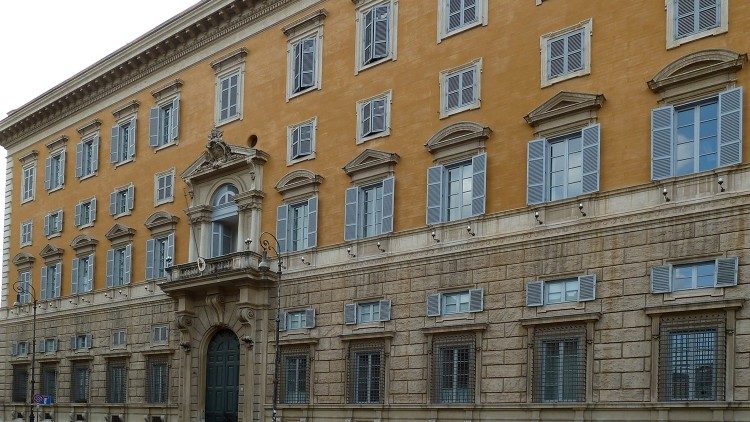
The offices of the Dicastery for the Doctrine of the FaithThe offices of the Dicastery for the Doctrine of the Faith 

Dicastery for the Doctrine of the Faith responds to questions about cremation

Cardinal Matteo Zuppi asks whether it is possible to keep the ashes of the deceased in common places similar to ossuaries and whether it was possible to keep a small portion of the ashes in a place significant to the deceased.

By Vatican News

In response to questions proposed by Archbishop Matteo Zuppi, the Dicastery for the Doctrine of the Faith affirms it is possible to arrange a sacred place “for the commingled accumulation and preservation of the ashes of the baptized,” that is, a communal cinerary where the individual ashes are poured out. The Archbishop of Bologna has submitted two questions to the Dicastery concerning the disposition of the remains of believers who have been cremated. The response to the second question says ecclesiastical authorities may also consider and evaluate the request of family members to keep a portion of a deceased person’s ashes in a place significant to the history of the person who died. The full text of the Dicastery's response can be found on the Vatican website.

Cardinal Zuppi presented the questions in light of the increasing number of people who choose cremation for their deceased loved ones and then choose to disperse the ashes in nature. The questions were also motivated by the desire that “economic reasons” suggested by the lower cost associated with scattering ashes “not prevail”; and by the desire to provide indications “regarding what to do with the ashes once the term for their preservation has expired”, with the intention not only of corresponding with the requests of family members, but “more importantly, with the Christian proclamation of the resurrection of the body and the respect due to it.”

The first question, then, was: “Taking into account the canonical prohibition against scattering the ashes of the deceased, is it possible to prepare a defined and permanent sacred place for the commingled accumulation and preservation of the ashes of the baptized, indicating the basic details of each person so as not to lose the memory of their names, similar to what occurs in ossuaries, where the mineralized remains of the deceased are cumulatively deposited and preserved?” The second question was, “Can a family be allowed to keep a portion of their family member’s ashes in a place that is significant for the history of the deceased?”

In a text signed by Prefect, Cardinal Victor Fernandez, and approved by Pope Francis on 9 December, the Dicastery responds in the affirmative to both questions.

First of all, it recalls that according to the 2016 Instruction Ad resurgendum cum Christo (no. 5), “ashes must be kept in a sacred place, such as a cemetery, or in an area dedicated to this purpose, provided that it has been so designated by the ecclesiastical authority.” The reasons for this choice are cited, namely the need to ensure “that they are not excluded from the prayers and remembrance of their family or the Christian community,” and to prevent “the faithful departed from being forgotten, or their remains from being shown a lack of respect,” as well as preventing “any unfitting or superstitious practices.”

The document goes on to recall that “faith tells us that we will be raised with the same bodily identity, which is material […] even though that matter will be transfigured, freed from the limitations of this world.” In this sense, “the resurrection will be ‘in this flesh in which we now live’.” But this transformation “does not imply the recuperation of the identical particles of matter that once formed the human being’s body.” Therefore, “the body of the resurrected person will not necessarily consist of the same elements that it had before it died. Since it is not a simple revivification of the corpse, the resurrection can occur even if the body has been totally destroyed or dispersed. This helps us understand why, in many cinerary urns, the ashes of the deceased are conserved together and are not stored separately.”

The Dicastery goes on to emphasize that “The ashes of the deceased person, moreover, come from the material remains that were part of the person’s historical journey—so much so that the Church shows particular care and devotion concerning the relics of the saints. This attention and remembrance also leads us to have an attitude of sacred respect toward the ashes of the deceased, which we conserve in a sacred place suitable for prayer…”

In response to Cardinal Zuppi’s question, then, the Dicastery replies that “a defined and permanent sacred place can be set aside for the commingled accumulation and preservation of the ashes of deceased baptized persons, indicating the identity of each person so as not to lose the memory of their names.” The Church, therefore, admits the possibility of putting the ashes into one common place, as happens with ossuaries, while preserving the memory of each deceased individual.

In response to the second question, the Dicastery states, “The ecclesiastical authority, in compliance with current civil norms, may consider and evaluate a request by a family to preserve in an appropriate way a minimal part of the ashes of their relative in a place of significance for the history of the deceased person, provided that every type of pantheistic, naturalistic, or nihilistic misunderstanding is ruled out and also provided that the ashes of the deceased are kept in a sacred place.”

In response to a question from Vatican Media, the Dicastery explained that the intervention and assessment of the ecclesiastical authority is not only canonical but also pastoral in nature, to help the family discern what choices to make, while taking all considerations into account.

As some civil legislation forbids the division of the ashes of the deceased, the Dicastery explained that the second question emerged from a dialogue between bishops from several different countries to which Cardinal Zuppi gave voice. The Dicastery’s response considered the possibility from a theological rather than a civil point of view, as was later clarified in the reply.

Tuesday, October 25, 2016

New norms issued today for Catholic funerals involving cremation

With New Cremation Norms, CDF Aims To Bury (Questions Over) Ashes
Given the rather fevered interest over yesterday's heads-up in the side-feed – and, above all, the pastoral import as cremation (long a forbidden option) becomes an increasingly common practice in Catholic funerals – below is the English text of the CDF instruction Ad resurgendum cum Christo ("To Rise With Christ"), released at Roman Noon this Tuesday on burial rites involving the ashes/cremains of the deceased.

As with any binding Curial document governing the life of the church, the following was explicitly approved by the Pope and published on his orders.... Yet as the note's most prominent proviso – an almost airtight prohibition on the scattering of ashes following a funeral liturgy – notably overrides a 2008 guidance on the question from the Italian bishops, who will enforce the new norms is anyone's guess.

Here, the complete text (with footnotes):
Instruction Ad resurgendum cum Christo
regarding the burial of the deceased
and the conservation of the ashes in the case of cremation


1. To rise with Christ, we must die with Christ: we must “be away from the body and at home with the Lord” (2 Cor 5:8). With the Instruction Piam et Constantem of 5 July 1963, the then Holy Office established that “all necessary measures must be taken to preserve the practice of reverently burying the faithful departed”, adding however that cremation is not “opposed per se to the Christian religion” and that no longer should the sacraments and funeral rites be denied to those who have asked that they be cremated, under the condition that this choice has not been made through “a denial of Christian dogmas, the animosity of a secret society, or hatred of the Catholic religion and the Church”.1 Later this change in ecclesiastical discipline was incorporated into the Code of Canon Law (1983) and the Code of Canons of Oriental Churches (1990).

During the intervening years, the practice of cremation has notably increased in many countries, but simultaneously new ideas contrary to the Church’s faith have also become widespread. Having consulted the Congregation for Divine Worship and the Discipline of the Sacraments, the Pontifical Council for Legislative Texts and numerous Episcopal Conferences and Synods of Bishops of the Oriental Churches, the Congregation for the Doctrine of the Faith has deemed opportune the publication of a new Instruction, with the intention of underlining the doctrinal and pastoral reasons for the preference of the burial of the remains of the faithful and to set out norms pertaining to the conservation of ashes in the case of cremation.

2. The resurrection of Jesus is the culminating truth of the Christian faith, preached as an essential part of the Paschal Mystery from the very beginnings of Christianity: “For I handed on to you as of first importance what I also received: that Christ died for our sins in accordance with the scriptures; that he was buried; that he was raised on the third day in accordance with the scriptures; that he appeared to Cephas, then to the Twelve” (1 Cor 15:3-5). Through his death and resurrection, Christ freed us from sin and gave us access to a new life, “so that as Christ was raised from the dead by the glory of the Father, we too might walk in newness of life” (Rm 6:4). Furthermore, the risen Christ is the principle and source of our future resurrection: “Christ has been raised from the dead, the first fruits of those who have fallen asleep […] For as in Adam all die, so also in Christ shall all be made alive” (1 Cor 15:20-22).

It is true that Christ will raise us up on the last day; but it is also true that, in a certain way, we have already risen with Christ. In Baptism, actually, we are immersed in the death and resurrection of Christ and sacramentally assimilated to him: “You were buried with him in baptism, in which you were also raised with him through faith in the power of God, who raised him from the dead” (Col 2:12). United with Christ by Baptism, we already truly participate in the life of the risen Christ (cf. Eph 2:6).

Because of Christ, Christian death has a positive meaning. The Christian vision of death receives privileged expression in the liturgy of the Church: “Indeed for your faithful, Lord, life is changed not ended, and, when this earthly dwelling turns to dust, an eternal dwelling is made ready for them in heaven”.2 By death the soul is separated from the body, but in the resurrection God will give incorruptible life to our body, transformed by reunion with our soul. In our own day also, the Church is called to proclaim her faith in the resurrection: “The confidence of Christians is the resurrection of the dead; believing this we live”.3

3. Following the most ancient Christian tradition, the Church insistently recommends that the bodies of the deceased be buried in cemeteries or other sacred places.4 In memory of the death, burial and resurrection of the Lord, the mystery that illumines the Christian meaning of death,5 burial is above all the most fitting way to express faith and hope in the resurrection of the body.6 
The Church who, as Mother, has accompanied the Christian during his earthly pilgrimage, offers to the Father, in Christ, the child of her grace, and she commits to the earth, in hope, the seed of the body that will rise in glory.7

By burying the bodies of the faithful, the Church confirms her faith in the resurrection of the body,8 and intends to show the great dignity of the human body as an integral part of the human person whose body forms part of their identity.9 She cannot, therefore, condone attitudes or permit rites that involve erroneous ideas about death, such as considering death as the definitive annihilation of the person, or the moment of fusion with Mother Nature or the universe, or as a stage in the cycle of regeneration, or as the definitive liberation from the “prison” of the body. Furthermore, burial in a cemetery or another sacred place adequately corresponds to the piety and respect owed to the bodies of the faithful departed who through Baptism have become temples of the Holy Spirit and in which “as instruments and vessels the Spirit has carried out so many good works”.10

Tobias, the just, was praised for the merits he acquired in the sight of God for having buried the dead,11 and the Church considers the burial of dead one of the corporal works of mercy.12 
Finally, the burial of the faithful departed in cemeteries or other sacred places encourages family members and the whole Christian community to pray for and remember the dead, while at the same time fostering the veneration of martyrs and saints.

Through the practice of burying the dead in cemeteries, in churches or their environs, Christian tradition has upheld the relationship between the living and the dead and has opposed any tendency to minimize, or relegate to the purely private sphere, the event of death and the meaning it has for Christians.

4. In circumstances when cremation is chosen because of sanitary, economic or social considerations, this choice must never violate the explicitly-stated or the reasonably inferable wishes of the deceased faithful. The Church raises no doctrinal objections to this practice, since cremation of the deceased’s body does not affect his or her soul, nor does it prevent God, in his omnipotence, from raising up the deceased body to new life. Thus cremation, in and of itself, objectively negates neither the Christian doctrine of the soul’s immortality nor that of the resurrection of the body.13

The Church continues to prefer the practice of burying the bodies of the deceased, because this shows a greater esteem towards the deceased. Nevertheless, cremation is not prohibited, “unless it was chosen for reasons contrary to Christian doctrine”.14 In the absence of motives contrary to Christian doctrine, the Church, after the celebration of the funeral rite, accompanies the choice of cremation, providing the relevant liturgical and pastoral directives, and taking particular care to avoid every form of scandal or the appearance of religious indifferentism.

5. When, for legitimate motives, cremation of the body has been chosen, the ashes of the faithful must be laid to rest in a sacred place, that is, in a cemetery or, in certain cases, in a church or an area, which has been set aside for this purpose, and so dedicated by the competent ecclesial authority. From the earliest times, Christians have desired that the faithful departed become the objects of the Christian community’s prayers and remembrance. Their tombs have become places of prayer, remembrance and reflection. The faithful departed remain part of the Church who believes “in the communion of all the faithful of Christ, those who are pilgrims on earth, the dead who are being purified, and the blessed in heaven, all together forming one Church”.15

The reservation of the ashes of the departed in a sacred place ensures that they are not excluded from the prayers and remembrance of their family or the Christian community. It prevents the faithful departed from being forgotten, or their remains from being shown a lack of respect, which eventuality is possible, most especially once the immediately subsequent generation has too passed away. Also it prevents any unfitting or superstitious practices.

6. For the reasons given above, the conservation of the ashes of the departed in a domestic residence is not permitted. Only in grave and exceptional cases dependent on cultural conditions of a localized nature, may the Ordinary, in agreement with the Episcopal Conference or the Synod of Bishops of the Oriental Churches, concede permission for the conservation of the ashes of the departed in a domestic residence. Nonetheless, the ashes may not be divided among various family members and due respect must be maintained regarding the circumstances of such a conservation.

7. In order that every appearance of pantheism, naturalism or nihilism be avoided, it is not permitted to scatter the ashes of the faithful departed in the air, on land, at sea or in some other way, nor may they be preserved in mementos, pieces of jewelry or other objects. These courses of action cannot be legitimized by an appeal to the sanitary, social, or economic motives that may have occasioned the choice of cremation.

8. When the deceased notoriously has requested cremation and the scattering of their ashes for reasons contrary to the Christian faith, a Christian funeral must be denied to that person according to the norms of the law.16

The Sovereign Pontiff Francis, in the Audience granted to the undersigned Cardinal Prefect on 18 March 2016, approved the present Instruction, adopted in the Ordinary Session of this Congregation on 2 March 2016, and ordered its publication.

Rome, from the Offices of the Congregation for the Doctrine of the Faith, 15 August 2016, the Solemnity of the Assumption of the Blessed Virgin Mary.

Gerhard Card. Müller
Prefect

Luis F. Ladaria, SJ
Titular Archbishop of Thibica
Secretary

Sunday, November 2, 2014

For Catholics, Cremation ok, scattering ashes no, keeping ashes at home no. Read all about it.

Changing Catholic Attitudes about Cremation

November 03, 2012
Since the ban on cremations was lifted in the 1960s, the practice has been on the rise among Catholics.
Cremation of human remains was prohibited by Catholic authorities for much of the history of the Church. Today, it is not only allowed, but growing in popularity among the faithful, according to Monica Williams, Director of Cemeteries for the Archdiocese of San Francisco. Nearly a third of Catholic families in the archdiocese opt for cremation, she said, as more people come to accept it.
“It takes time for family traditions to change,” Williams said. “More people are choosing cremation as an alternative.”
While full-body burial remains the Church’s preferred choice, there are practical reasons for cremation. Cost is one; cremation can shave thousands off the $6,000-8,000 cost of burial. Another is that families can inter cremated remains in family plots, which have limited space. Some argue it is a more ecologically-friendly choice, Williams said, as less open space and materials are required for cremation.
Church permits cremation
Cremation is the process of reducing a body to bone fragments through the application of intense heat. The bone fragments are then pulverized, placed in a container and returned to the family. Regarding its morality, the Catechism of the Catholic Church devotes a single sentence to cremation: “The Church permits cremation, provided that it does not demonstrate a denial of faith in the resurrection of the body” (no. 2301).
The United States Conference of Catholic Bishops, while noting that cremation is permitted, stresses that the Church holds a preference for full-body burial. The USCCB explained, “The Church’s reverence and care for the body grows out of a reverence and concern for the person whom the Church now commends to the care of God.… The human body is so inextricably associated with the human person that it is hard to think of a human person apart from his or her body.”
Church authorities banned the practice of cremation centuries ago to counter the ancient Roman practice of cremating the body as a rejection of the existence of an afterlife.  Scripture teaches that man is made in the image and likeness of God (Genesis 1:26-27), and therefore the body must be respected in both this life and the next. The body is a temple of the Holy Spirit, and therefore, must be treated with respect.
While cremation was common in the ancient world, by the fifth century it had been largely abandoned in the Roman Empire due to Christian influence. Today more than a third of Americans opt for cremation; some nations, like Japan, have a nearly 100 percent cremation rate.
In 1963, the Vatican lifted the cremation ban. Since 1997, cremated remains have been allowed to be present at funeral Masses, and are given the same respect as remains in a casket. Cremated remains must be buried, just like a body, in a cemetery, crypt, or other appropriate burial place. Scattering ashes or keeping them at home is not permitted.
As more residents of the Archdiocese of San Francisco opt for cremation, it has had one effect on the six archdiocesan cemeteries with open space: it has slowed down the rate at which they are filling up. The 300 acres of Holy Cross Cemetery in Colma—the Archdiocese’s oldest and largest cemetery—are less than half full and now can accept remains for another 300 years, Williams estimates. Holy Cross is celebrating the 125th anniversary of its opening, and is the final resting place for about 400,000 individuals, including many of the Bay Area’s most prominent citizens, such as baseball legend Joe DiMaggio.
St. Dominic’s columbarium
The San Francisco archdiocese’s cemeteries are not the only sites approved for internment of cremated remains. Historic St. Dominic’s Church recently built a columbarium, a facility used for internment of urns with cremated remains. It is the only Catholic church in the city of San Francisco to house a columbarium. Three hundred twenty niches were built, enough for the remains of 640 people. It is located near the altar area.
The columbarium was the idea of parishioners, who approached the pastor, Father Xavier Lavagetto, according to parishioner and volunteer Judie Doherty. One of the driving factors behind the building of the columbarium was that many parishioners, including Doherty, had the cremated remains of relatives at home. Many of these parishioners are elderly, she said, unable to make regular trips to Holy Cross or other cemeteries.
In Doherty’s case, she was keeping the remains of her mother, who died four years ago. “I love her, and I wanted her near me,” Doherty said.
She was initially unaware of the Church’s prohibition against keeping cremated remains at home, but, in time, the wisdom of the Church’s position dawned on her. “When I die, what happens to the remains of my mother?” she reflected.
Doherty did much of the initial research for the St. Dominic’s columbarium, and remains an active volunteer in the project. About 100 people have purchased spaces, she said, which range in cost from $4,000-$15,000. “Many people in the parish are grateful for the opportunity to keep the remains of their loved ones in their home parish,” she said.
Catechetical moment
The Diocese of Madison, Wisconsin, has much more rural space than San Francisco, and the situation for burials is far different. It only has three diocesan cemeteries, and 120 parish cemeteries. Some parishes have columbaria as well. Five years ago, Madison’s Bishop Robert Morlino commissioned a study assessing the management of the diocese’s places of burial. Grant Emmel, who is involved with special projects for the diocese, oversaw the study. The issue of cremation came up during the assessment.
“For us, it is a catechetical moment,” Emmel said. “What does our faith teach? At the end of the world, the dead will rise and our cemeteries will be emptied. Our Lord is coming back for our bodies and will return them to us.”
The diocese wanted to teach parishioners about the dignity of the body—which includes the proper laying of the body to rest—and the broader teaching of the Resurrection. “We live in a secular world that is cost-conscious,” Emmel said. “Many people don’t look at cremation as the proper way to care for the body after death, but as merely an economic decision.”
He noted that in areas where the Catholic faith is stronger, cremation is chosen less frequently. Depending on the region of Madison, cremations make up 20 to 40 percent of all burials.  
However, Emmel noted, there are also Catholics who have their loved ones cremated but do not bring them to cemeteries for burial. As in other dioceses, Madison is concerned with what Catholics are doing with these cremated remains. “People bring grandma’s remains home in an urn and keep them on a coffee table. That’s not right,” Emmel said. “If you had a full-body burial, would you bring grandma home in a casket and keep it in your living room? Both are human remains, and should be laid to rest properly.”
Cemeteries are hallowed ground, where individuals are fittingly memorialized. They are also places families can go to remember and pray for those they love. “Cemeteries should be important to us because members of our families are there,” Emmel said. “Their care, and the properly laying to rest of our deceased, whether full body or cremated remains, should be important to us.”
Bishop Morlino stressed, “We care for the body as heaven-bound. The body, which is corruptible, is going to put on incorruptibility…and immortality, and will be glorified.”
The bishop said that the body’s destiny is heaven, not the grave. “We’re not disposing of the body in the grave…we’re allowing it to rest in order to have it raised up,” he said. “God has further use of that body. It is not a throw-away.”
The Church’s belief in the Resurrection is why it forbids such practices as scattering human remains, which Bishop Morlino described as “trying to do something poetic with them to make someone feel good.” He continued, “God has a place [for the body] in heaven. … It is especially important to remind people of this in November, the month of the Holy Souls.”
Follow our Catholic traditions
The Diocese of Phoenix has six cemeteries and one mortuary. It has 1,800 burials annually, and about 350 funerals. Nearly 40 percent opt for cremation, due to the lower cost, changing attitudes about cremation, and the ease of transporting remains. None of Phoenix’s parishes has a columbarium.
The increasing demand for cremation has posed some financial challenges to the diocese. Much of its cemetery land was purchased decades ago before cremation was widespread; today, less of the land is needed and lower revenues are coming in to main the cemeteries, reported Gary Brown, the diocese’s executive director of cemeteries and mortuaries.
Additionally, as in San Francisco and Madison, many in Phoenix take remains home, or scatter or divide them up.
Brown recalled a recent “gift” to Catholic Charities of the diocese. Someone donated an urn with human remains, saying he no longer wanted to keep them at his house. Brown saw to it that they were properly interred. “This type of thing happens too often,” he said. “We’re trying to reach out to people in an effort to prevent this behavior.”
The diocese recently released new guidelines on cremation for parishioners. “Bishop Thomas Olmsted [the Ordinary of the Phoenix diocese] has made it clear how human remains should be handled,” Brown said. “It’s important to him that we follow our Catholic traditions.”
Brown agrees with Emmel on another benefit of using Catholic cemeteries: “Having a place to visit is important to families when they’ve lost someone.”
The Archdiocese of Atlanta does not operate cemeteries of its own; Catholics bury their deceased in private cemeteries with Catholic sections. The Diocese of Savannah-Atlanta originally encompassed the entire state of Georgia, and Atlanta became its own diocese in 1956. The population of the archdiocese has grown rapidly in recent years, and increasing land costs prevented the archdiocese from purchasing significant acreage for cemeteries near its population centers (the nearest Catholic cemetery may be a two-to-three-hour drive from these centers).
In an effort to serve the Catholic population’s needs, several parishes have built columbaria and memorial gardens for cremated remains. Such sites must be built with approval of the archbishop; the chief concern being if a parish with a columbarium were to close, the remains of the deceased would have to be relocated.
Deacon Ray Egan, who oversees issues related to burials and cemeteries for the archdiocese, noted that while traditional burial of the deceased is still the preferred choice among Atlanta Catholics, the number of cremations is “creeping up” to around 20 percent.
As cremation grows in popularly, Deacon Egan echoed the concerns of other dioceses. “We also want people to understand that they should give the same respect to cremated remains as they would to a body,” he said.