Showing posts with label hunger. Show all posts

Monday, June 22, 2026

Pope Leo XIV visits the World Food Program


Pope Leo XIV speaks at the headquarters of the World Food Programme in RomePope Leo XIV speaks at the headquarters of the World Food Programme in Rome  (@Vatican Media)

Pope to WFP: Conflicts are 'fed' more readily than people are nourished

Pope Leo XIV visits the UN World Food Programme headquarters in Rome and insists that food, water, and healthcare cannot be subordinated to geopolitical interests, calling for nations to work together with renewed multilateralism.

By Deborah Castellano Lubov

"Together, we share the urgent task of confronting hunger and malnutrition, while also tackling the underlying structural causes that sustain them. To meet this task effectively, we must examine the challenges before us, their underlying causes, and the paths toward lasting solutions."

Pope Leo XIV expressed this during his address to the Executive Board of the United Nation's World Food Programme at its Rome headquarters on Monday.

READ POPE LEO XIV'S FULL ADDRESS AT WFP

In his remarks, he stressed that multilateralism is essential and that basic needs like water, food, and healthcare cannot be subordinated to geopolitical interests.

The Pope thanked the intergovernmental institution for its dedication to saving lives in emergency situations and providing food assistance amid conflicts and natural disasters, noting their institution’s commitment resonates profoundly with the Catholic Church’s mission to uphold human dignity and to foster fraternity, rooted in the Gospel’s call to love our neighbor.

Today, he observed, crises have evolved from isolated events into persistent realities, marked by prolonged conflicts, chronic food insecurity, economic volatility, and growing climate vulnerabilities.

This reality, he noted, raises a fundamental question of "what configuration of the global order is capable of producing, reproducing, and, at times, normalizing such conditions?"

He said the issue is no longer limited to how to intervene, but rather "extends to understanding why the system constantly produces the very problems it is then forced to correct."

Increasingly fragmented international order

He lamented that the international order has become increasingly fragmented, arising in part from the crisis of the multilateral system, observing that states have increasingly allocated their resources towards national security, economic growth, and domestic stability, disregarding the close link between these issues and multilateral cooperation.

This trend, the Holy Father noted, reveals a striking paradox, where "unprecedented global productive capacity exists alongside expanding zones of extreme vulnerability."

"It is precisely within the gap between acknowledgement in principle and prioritization in practice," he continued, "that we witness the progressive bureaucratization of solidarity alongside the quiet commodification of human life."

On the one hand, he said, humanitarian action is increasingly burdened by bureaucratic procedures that can delay assistance to those in need, but on the other, access to essential goods, including food, is too often influenced by economic or strategic considerations.

Conflicts are “fed” more readily than people are nourished

As a result, he lamented, those who do not generate quantifiable value risk becoming invisible.

"This twofold dynamic," he lamented, "creates a serious ethical challenge: the human person is no longer consistently placed at the center of international action."

In this context, Pope Leo said, it is important to acknowledge, as Pope Francis had emphasized, "that whereas forms of aid and development projects are obstructed by involved and incomprehensible political decisions, skewed ideological visions and impenetrable customs barriers, weaponry is not.”

"In effect," the Pope said, "conflicts are “fed” more readily than people are nourished. This reality reflects not only operational shortcomings but also a fundamental imbalance in political and moral priorities."

WFP's presence helps prevent crises from deteriorating

The Pope recalled that consequences extend well beyond those immediately affected.

More than merely a humanitarian concern, hunger, Pope Leo said, erodes social cohesion, heightens the risk of conflict, and fuels forced migration.

From this perspective, he underscored that humanitarian action is not extraneous to the international order and highlighted the global community’s responsibility to strengthen solidarity, resist exclusion, and recognize the inherent God-given dignity of every person.

"Beyond managing crises, therefore, international institutions embody a principle of shared responsibility and affirm that the international community is bound together by concern for those in the most vulnerable situations."

In this sense, he stated, "the World Food Programme is more than a political, economic, or technical actor; it is a concrete expression of international solidarity. Indeed, where national institutions recede and community networks disintegrate, its presence helps to prevent humanitarian crises from deteriorating into irreversible collapse."

Renewed commitment to multilateral cooperation

For this reason, he stressed that a renewed commitment to multilateral cooperation is essential.

"I wish to appeal to the governments and peoples of the world," he said, "to renew and strengthen their commitment, to increase the resources dedicated to combating hunger and its root causes, and to remove the obstacles that prevent aid from reaching those in need. At the same time, such support should also strengthen engagement with the Church and civil society. Reinforcing the capacities of all these actors together will multiply our collective effectiveness in the fight against hunger."

Implementing this appeal, he insisted, effectively requires reducing unnecessary bureaucracy so that transparency and accountability serve people rather than impede assistance. In situations where governments lack effective territorial control or humanitarian access is restricted, he added, trusted local partners become indispensable.

Supporting the Catholic Church's humanitarian efforts

Noting that the Catholic Church—through parishes, dioceses, Caritas agencies, and other faith-based initiatives—often reaches vulnerable populations in areas inaccessible to international actors, the Pope encouraged the World Food Programme and its partners to continue supporting these efforts.

He stressed that meeting dietary needs not only alleviates suffering but also addresses underlying causes of geopolitical instability, for "food security is an essential component of global and integral security."

In this regard, he praised the World Food Programme's extension beyond emergency response operations to work on long-term initiatives, such as programs that provide meals to schoolchildren.

Credibility of international cooperation itself at stake

Before drawing his address to a close, the Pope gave a stark warning.

"What is at stake," he said, "is not only the effectiveness of an agency, but also the credibility of international cooperation itself," as he observed that their organization demonstrates that a renewed path is possible.

However, he insisted that this requires the resolve to simplify what has become overly complex, to prioritize what is essential, and to ensure that no person is forgotten.

Finally, Pope Leo concluded, praying that God bless their efforts, "so that all may receive their daily bread and live in dignity."

Thursday, April 30, 2026

Pope Leo XIV releases his May prayer intention for all those who are hungry


Pope's May prayer intention: 'That everyone might have food'

Pope Leo XIV releases his prayer intention for the month of May and invites Catholics to pray that everyone might have food, as he highlights how millions of brothers and sisters continue to suffer from hunger while so much food is wasted.

By Deborah Castellano Lubov

Pope Leo XIV has urged Catholics across the globe to join him this May in praying that everyone might have food.

He released the monthly “Pray with the Pope” video on Thursday, which is prepared by the Pope’s Worldwide Prayer Network.

In his prayer, the Pope recognized with sorrow that millions of brothers and sisters continue to suffer from hunger.

Lamenting that so many goods are wasted at our tables, Pope Leo prayed that the Lord may "awaken in us a new awareness: that we learn to give thanks for every food, to consume simply, to share with joy, and to care for the fruits of the earth as a gift from You, destined for all, not just a few."

He prayed that Jesus make us capable of "transforming the logic of selfish consumption into a culture of solidarity," through our communities by promoting concrete gestures, including awareness campaigns, food banks, and a sober and responsible lifestyle.

"You who sent us Your beloved Son Jesus, broken bread for the life of the world," Pope Leo prayed, "give us a new heart, hungry for justice and thirsty for fraternity."

Pope Leo concluded by praying, "may no one be excluded from the common table, and may Your Spirit teach us to see bread not as an object of consumption but as a sign of communion and care. Amen."

A global issue

According to the World Food Programme’s 2026 Global Outlook, 318 million people will face food crisis or even worse situations this year.

The agency warns that the conflict in the Middle East could push an additional 45 million people into facing dire hunger before the middle of this year.

In a press release accompanying the video, Fr. Cristóbal Fones, international director of the Pope’s Worldwide Prayer Network, said the intention is very significant.

“This intention," he said, "comes from the Pope’s heart. It pains him deeply that so many people in the world cannot access something as essential and human as food. This is why he is asking everyone not to remain indifferent but to take decisive action, first with prayer, then with concrete gestures of solidarity.”

Pray with the Pope
 

In the name of the Father, and of the Son, and of the Holy Spirit. Amén.

Lord of creation,
You gave us the fertile earth and, with it, our daily bread,
as a sign of Your love and providence.

Today we recognize with sorrow
that millions of brothers and sisters continue to suffer from hunger,
while so many goods are wasted at our tables.

Awaken in us a new awareness:
that we learn to thank for every food,
to consume simply,
to share with joy,
and to care for the fruits of the earth as a gift from You,
destined for all, not just a few.

Good Father,
make us capable of transforming the logic of selfish consumption
into a culture of solidarity.
May our communities promote concrete gestures:
awareness campaigns, food banks,
and a sober and responsible lifestyle.

You who sent us Your beloved Son Jesus,
broken bread for the life of the world,
give us a new heart, hungry for justice and thirsty for fraternity.
May no one be excluded from the common table,
and may Your Spirit teach us to see bread
not as an object of consumption,
but as a sign of communion and care.

Amen.

Thursday, October 16, 2025

Pope Leo XIV marks World Food Day: "Defeating hunger is the path to peace"


Pope Leo XIV addresses FAO on World Food DayPope Leo XIV addresses FAO on World Food Day  (@Vatican Media)

Pope Leo XIV: ‘Defeating hunger is the path to peace’

Pope Leo XIV visits the headquarters of the Food and Agriculture Organization (FAO) in Rome to mark World Food Day and the 80th anniversary of the organization’s founding. In his address he reaffirms the Holy See’s closeness to the institution and calls for a shared global commitment to end hunger and malnutrition.

By Linda Bordoni

Sandwiched between the Caracalla Baths, the Aventine Hill and the Circus Maximus and the high Roman ideals they represent, the FAO headquarters in Rome is a microcosm that represents the world. Its mission to defeat hunger, food insecurity, and malnutrition in a sustainable way, upholding the dignity of every human being, resonates in a world where conflict, the climate crisis, forced migration and a widening gap between the rich and poor casts doubt on the goodwill of the international community to place the human person above profit in the name of justice and peace.

That’s what Pope Leo XIV did on Thursday morning when he addressed a star-studded audience of UN and world leaders and goodwill ambassadors gathered at FAO to mark World Food Day and the organization’s 80th anniversary.

 “We cannot be content with proclaiming values; we must embody them,” he said, calling for a renewed ethical foundation: “Slogans do not lift people from misery. We must place the human person above profit and guarantee food security, access to resources, and sustainable rural development.”

His visit, in the footsteps of all his predecessors starting with Pope Paul VI in 1970, provided him with the occasion to renew the Holy See’s long-standing support for the UN agency and to urge the international community to redouble its efforts to eradicate hunger, malnutrition, and food insecurity — evils he described as “a moral wound that afflicts the whole human family.”


Pope Leo XIV at FAO (@VaticanMedia)

“Whoever suffers from hunger is my brother”

Choosing to speak both in Spanish and in English, the Pope said that the fight against hunger “is not only a political or economic task but a profoundly human and moral duty.”

“Whoever suffers from hunger is not a stranger,” he said. “He is my brother, and I must help him without delay.”

He recalled that eighty years after the FAO’s creation, millions of people still lack adequate food and nutrition.

“Ending these evils,” he said, “requires the contribution of all: governments, institutions, civil society, and every individual person.”

A collective moral failure

Citing current data that show over 673 million people go to bed hungry and 2.3 billion lack a nutritious diet, the Pope said these are not abstract numbers but “broken lives and mothers unable to feed their children.”

He denounced “an economy without a soul” and a system of resource distribution that leaves vast populations in misery, calling the persistence of hunger in an age of abundance “a collective moral failure and a historical fault.”

“Food must never be a weapon”

Pope Leo expressed deep concern that food is once again being used as a weapon of war, calling this a “cruel strategy that denies men, women, and children their most basic right — the right to life.”

Recalling the UN Security Council’s past condemnation of starvation as a war crime, he lamented that “this consensus seems to have faded.” The silence of those dying of hunger, he said, “cries out in the conscience of humanity,” urging all nations to act decisively.

“Hunger is not humanity’s destiny but its downfall,” the Pope said. “It is not just a problem to be solved; it is a cry that rises to heaven.”

An ethical vision of politics

The Pope did not neglect to reaffirm a concept that was dear to his predecessor, Pope Francis, who never tired of pointing out that to throw food away means to throw people away.

He too condemned the waste of food while others starve and urged world leaders to end “outrageous paradoxes” and to “awaken from the lethargy that dulls our compassion.”

“Water is life, water is food”

Referring to this year’s World Food Day theme, the Pope said the message — “Water is life, water is food. Leave no one behind” — calls all people to act together.

“At a time marked by division and indifference, unity through cooperation is not just an ideal but a duty,” he said. “Only by joining hands can we build a future in which food security is a right, not a privilege.”

He paid special tribute to women, whom he described as “the silent architects of survival, the first to sow hope and the careful stewards of creation.” Recognizing their contribution, he said, is “not only a matter of justice, but a guarantee of a more humane and lasting food system.”

Renewing multilateral cooperation

Pope Leo reaffirmed the importance of multilateralism and dialogue among nations, urging that the voices of the poor be heard directly. “We must build a vision that allows every actor in the international community to respond effectively to the genuine needs of those we are called to serve,” he said.

He also made a heartfelt appeal for the many peoples suffering hunger and violence in Ukraine, Gaza, Haiti, Afghanistan, Mali, the Central African Republic, Yemen, and South Sudan, insisting that “the international community cannot look the other way.”

“Give them something to eat”

Ending his address, the Holy Father quoted Jesus’ words to His disciples, “Give them something to eat” (Mk 6:37).  This Gospel command, he added, “remains a pressing challenge for the international community.”

“Do not tire of asking God,” he concluded, “for the courage and the energy to work for a justice that will yield lasting and beneficial results. You can always count on the solidarity of the Holy See and of the entire Church, which stands ready to serve the poorest and most disadvantaged throughout the world.”

Thursday, September 4, 2025

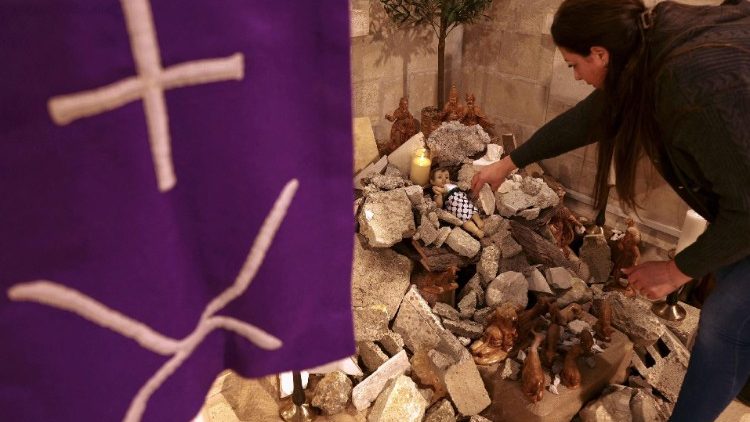
From Gaza: "it's truly inhumane" and "there will be no Christians left"


Fr. Ibrahim Faltas describes the crisis in Gaza and BethlehemFr. Ibrahim Faltas describes the crisis in Gaza and Bethlehem (AFP or licensors)

Fr. Faltas on Gaza: ‘It’s truly an inhumane situation'

During a visit to Italy, Franciscan friar Ibrahim Faltas illustrates the terrible situation the people of the Holy Land region are living in, and warns that if things continue as they are, “there will truly be no Christians left.”

By Kielce Gussie

“The situation in Gaza is terrible”, Fr. Ibrahim Faltas, a Franciscan friar of the Custody of the Holy Land, said during a visit to Italy during which he participated in several events, including a meeting with the Mediterranean Youth Council.


Speaking to Toscana Oggi—a weekly Italian publication—Fr. Faltas reflected on the current situation in Gaza.

Deprived of everything

“People continue to die – from hunger, thirst, and the heat,” he said, calling the situation inhumane. And poignantly, the Franciscan priest asked two questions: “Where is the international community? Where are human rights?”

On 1 September, Fr. Faltas explained that schools were reopened throughout the Holy Land, in Bethlehem and Jerusalem. However, in Gaza, children have been out of school for two years.

“They are deprived of everything — education, healthcare. There are no doctors, no medicine”, he said, adding that even playing is impossible for these children. They “have known nothing but war, fleeing, hiding, destruction, and rubble.”


Fr. Faltas during a visit to Rome in 2024

However, Fr. Faltas stressed, the humanitarian crisis is not limited to Gaza: “Bethlehem has become an open-air prison.” He pointed out that with the checkpoints closed, people who used to work in Israel pre-war with daily work permits are now unable to do so. They cannot work or leave. People whose livelihoods depended on tourism have not worked in two years.

The Christian community in Bethlehem is also suffering as some 185 families have left, that's more than 700 people, Fr. Faltas explained. He warned that “if things continue like this, there will truly be no Christians left.”

A strong gesture of hope

In the midst of the horrors of war, Fr. Faltas also recounted an act of hope and solidarity. In June, the bishops from Tuscany made a pilgrimage to Jerusalem and Bethlehem, which the Franciscan priest described as “courageous” and an important, impactful gesture for the Christians living in the region. He shared that the bishops’ visit “gave hope to the people there: "Everyone appreciated the visit – people still remember it.”

Thursday, August 14, 2025

Pope Leo XIV pleads to end the war in Ukraine, end the hunger and suffering in Gaza, free the Israeli hostages


Pope Leo XIV has returned to Castel Gandolfo for a second period of a summer break until August 19Pope Leo XIV has returned to Castel Gandolfo for a second period of a summer break until August 19  (AFP or licensors)

Pope: Stop war in Ukraine and hunger in Gaza, may hostages be freed

As he arrived at the Villa Barberini in Castel Gandolfo, Pope Leo XIV spoke about ceasefire talks for Ukraine, a resolution of the humanitarian crisis in Gaza, and the release of Israeli hostages.

By Vatican News

Pope Leo XIV spoke on the ceasefire and peace agreement in Ukraine, a resolution of the humanitarian crisis and hunger in Gaza, and the release of Israeli hostages there.

These objectives of the Holy See's “soft diplomacy” for issues that “cannot be resolved through war,” were expressed by the Pope on Wednesday afternoon.

He shared this message with journalists upon his arrival in Castel Gandolfo on 13 August where he will spend a second period of a summer break until August 19.

While greeting the many people gathered to welcome him at the gates of Villa Barberini — his residence during these days — the Pope responded to questions from media reporters about international current events.

Always seek dialogue, diplomatic efforts

When asked what he expects from the upcoming 15 August summit between U.S. President Donald Trump and Russian President Vladimir Putin, Leo XIV replied: “We must always seek a ceasefire. The violence, the many deaths, must stop. Let’s see how they can come to an agreement. Because after all this time, what is the purpose of war? We must always seek dialogue, diplomatic efforts, not violence, not weapons.” 

And when asked if he is concerned about the possibility of the population of Gaza being deported, the Pope said: “Very much (concerned). The humanitarian crisis must be resolved. We cannot go on like this. We know the violence of terrorism, and we honor the many who have died, as well as the hostages — they must be freed. But we must also think of the many who are dying of hunger.”

Problems that cannot be solved by war

Finally, when asked what the Holy See is doing to stop these and other conflicts, the Pope responded: “The Holy See cannot stop them... but we are working, let’s say, on ‘soft diplomacy,’ always inviting, encouraging the pursuit of nonviolence through dialogue and seeking solutions — because these problems cannot be solved by war.”

May God grant peace to all peoples

Earlier on Wednesday morning during the General Audience in Paul VI Hall, when greeting Polish pilgrims, the Pope called attention to populations in countries afflicted by war and violence: “Plead with God to grant peace to all peoples who are experiencing the tragedy of war.” The Pope’s appeal was inspired by Saint Maximilian Maria Kolbe, the Polish Franciscan who died in the Auschwitz concentration camp after volunteering to take the place of a father of a family condemned to die by starvation.

Mass and Angelus at Castel Gandolfo

During this second summer break at the Villa Barberini residence, Leo XIV will have several public celebrations. On Friday 15 August, the Feast of the Assumption of the Blessed Virgin Mary, the Pope will celebrate Mass at 10:00 a.m. at the Parish of Saint Thomas of Villanova in Castel Gandolfo, and at 12:00 noon will lead the recitation of the Angelus prayer from the entrance of the Apostolic Palace, in Piazza della Libertà, also in Castel Gandolfo.

In Albano: Mass and lunch with the poor of Caritas

On Sunday, 17 August, at 9:30 a.m., Pope Leo XIV will celebrate Mass at the shrine of Santa Maria della Rotonda in Albano Laziale, together with the poor assisted by the diocesan Caritas and its help. At 12:00 noon he will again lead the Angelus in Piazza della Libertà in Castel Gandolfo.

Finally, he will share lunch with the poor and those assisted by Caritas at the Borgo Laudato si’ located within the Pontifical Villas.