Showing posts with label Archbishop Paglia. Show all posts

Tuesday, May 27, 2025

Pope Leo XIV appoints new head for Pontifical Academy for Life replacing Archbishop Paglia


Msgr. Renzo PegoraroMsgr. Renzo Pegoraro 

Msgr. Renzo Pegoraro appointed President of Pontifical Academy for Life

Pope Leo XIV appoints Monsignor Renzo Pegoraro, an expert in medicine and bioethics, as President of the Pontifical Academy for Life, expressing his heartfelt gratitude to Archbishop Vincenzo Paglia for his years of service.

By Vatican News

Pope Leo XIV has appointed Msgr. Renzo Pegoraro as the new President of the Pontifical Academy for Life (PAV), who has served as the Academy’s Chancellor since September 2011.

Msgr. Pegoraro, a bioethicist with a medical degree, succeeds Archbishop Vincenzo Paglia, who turned 80 on April 21.

In an Academy-issued statement, Msgr. Pegoraro expressed, "I thank Pope Leo XIV for appointing me as President of the Pontifical Academy for Life." 

"The work done over these years alongside Archbishop Vincenzo Paglia, and previously with Bishop Ignacio Carrasco de Paula," said the Italian-born priest, "has been both fascinating and stimulating, in line with the operational and thematic directions of the late Pope Francis."

Expert in medicine and bioethics

Born in the northern Italian city of Padua on June 4, 1959, Msgr. Pegoraro would later be ordained a priest on June 11, 1989. He was incardinated in the Diocese of Padua.

He earned a degree in Medicine and Surgery in 1985 from the University of Padua, and, in 1990, he received a Licentiate in Moral Theology from the Pontifical Gregorian University in Rome.

He also has a Postgraduate Diploma in Bioethics from the Catholic University of the Sacred Heart.

The new President of the Academy for Life has served as Secretary General of the Lanza Foundation in Padua and as a Professor of Bioethics at the Theological Faculty of Triveneto.

Since 2000, he has been a professor of Nursing Ethics at the "Bambino Gesù" Pediatric Hospital in Rome.

From 2010 to 2013, he was president of the European Association of Centers of Medical Ethics.

Msgr. Pegoraro has published several books, articles, and essays.

Pope thanks Archbishop Paglia for service

In a letter signed by Cardinal Secretary of State Pietro Parolin, as reported in the Pontifical Academy for Life's statement, Pope Leo XIV expresses to Archbishop Paglia “his heartfelt thanks” for the service he rendered since 2016 as President of the Pontifical Academy for Life and as Grand Chancellor of the Pontifical John Paul II Theological Institute for Marriage and Family Sciences.

Friday, August 9, 2024

The Catholic Church stands firm against euthanasia, assisted suicide


Archbishop Paglia with Pope Francis at a private audience on August 8Archbishop Paglia with Pope Francis at a private audience on August 8 

Archbishop Paglia confirms Church’s opposition to euthanasia, assisted suicide

The President of the Pontifical Academy for Life, Archbishop Vincenzo Paglia, reaffirms the Church’s opposition to euthanasia and assisted suicide, in response to media reports about the "Small Lexicon on the End-of-Life.”

By Salvatore Cernuzio

The Church is absolutely opposed to assisted suicide and euthanasia and defends the right to life of every person, especially the most vulnerable, while fostering collaboration with politics on end-of-life issues.

Archbishop Vincenzo Paglia, President of the Pontifical Academy for Life, offered that clarification on a few points in the "Small Lexicon on the End-of-Life," an 88-page glossary published by the LEV (Vatican Publishing House) regarding ethical issues related to end-of-life debates ranging from euthanasia and assisted suicide to palliative care and cremation.

Published in early July, the pamphlet has recently come under scrutiny after some media outlets highlighted what they saw as "openings" by the Holy See.

In reality, Archbishop Paglia explained to Vatican News in the following interview, these are indications rooted in the last 70 years of papal and Church teaching.

On Thursday morning, the Archbishop delivered a copy of the "Lexicon" to Pope Francis, who received him in audience at the Apostolic Palace.

Q: Archbishop Paglia, today you met with the Pope and presented the “Small Lexicon on the End-of-Life.” What did Pope Francis, who has consistently advocated for the defense of life at all stages, say about it?

Pope Francis reiterated his appreciation for the work being carried out by the Pontifical Academy for Life. Indeed, the end-of-life issue is complex, and the Church has a rich Magisterium from Pius XII in 1957 to today.

Life must be defended throughout its entirety, not just at particular moments. The right to life must be especially defended, particularly for the weak, to counter the “throwaway culture” that hides behind the claim of self-sufficiency and autonomy of today’s men and women.

Q: There are claims that this vademecum represents a shift by the Holy See toward allowing the suspension of nutrition and hydration. Is this true?

I recall that Pius XII in 1956 – as noted in the Lexicon – affirmed the permissibility of suspending ventilation under certain serious conditions. And already in 2007, the Congregation for the Doctrine of the Faith recognized that such treatments could be lawfully discontinued (or not started) when they entail “excessive burden or significant physical discomfort.”

These are two criteria that are part of the definition of disproportionate treatments, which are to be suspended. It is an evaluation that always requires the involvement of the sick person, as much as is possible. The Lexicon should be read in its entirety.

Q: Does anything change regarding euthanasia and assisted suicide? Some media outlets have suggested that the Small Lexicon on the End-of-Life masks a favorable judgment on these issues.

The Church reiterates its absolute opposition to any form of euthanasia and assisted suicide. This is also my conviction, even if some want to make me say otherwise.

However, the Church also invites reflection on how unreasonable obstinacy (therapeutic stubbornness) is not an expression of truly patient-centered medicine and care. Death is unfortunately a dimension of life. It is inevitable.

Certainly, we must never shorten the duration of life, but neither should we stubbornly obstruct its course in every possible way. We are fragile. And this is why we must take care of one another.

We must commit ourselves much more than we normally do to accompany people in the final stages of their existence, knowing that for us believers, death is not the last word!

Q: The Lexicon talks about “legislative mediations.” What are considered acceptable?

There are no "acceptable mediations" a priori. On fundamental and delicate end-of-life issues, it is desirable to achieve the highest possible common consensus, which respectfully considers different sensitivities and religious beliefs. This is the task of politics.

The Church can collaborate for the common good of society. It is the Church's role to form consciences rather than to draft laws.

Saturday, September 30, 2023

Effort to end death penalty in Louisiana has full Catholic support


Vatican, other faith leaders join in push for end of death penalty in Louisiana


(RNS) — The Vatican has joined U.S. faith leaders and anti-death penalty activists in supporting the Louisiana governor’s desire to clear the death row cells in his state.

Gov. John Bel Edwards, a Catholic Democrat, called in August for the Louisiana Board of Pardons to reconsider applications for clemency of 56 prisoners on the state’s death row. While the state has only executed one person in two decades, Louisiana, along with 26 other states in the U.S., still permits the death penalty.

Twenty applications have been scheduled for clemency hearings in the next two months by the Louisiana Board of Pardons. Only one person on death row is not among the state’s clemency requests, NPR reported

“Much like you, the Catholic Church believes that our society can only benefit from the rehabilitation of individuals who have been convicted of crimes,” wrote Archbishop Vincenzo Paglia, president of the Vatican’s Pontifical Academy for Life, in a Tuesday (Sept. 26) letter. “We respectfully urge you to exercise all powers vested in your office to encourage the Board of Pardons to docket the 36 remaining applicants.”

Paglia added: “We think that the clearing of Louisiana’s death row would be a monumental step towards the abolition of the death penalty, that would deserve to be also an example to other states.”

The day before the Vatican letter, a coalition of death penalty opponents, including Faith Leaders of Color Coalition, the American Civil Liberties Union and Amnesty International USA, made a similar plea to the governor, describing racial inequities in the use of the death penalty in the state.

“In Louisiana, Black people make up only one-third of the State’s population, yet account for over 67 percent of capital cases in the state,” they wrote in a letter to Edwards and the pardon board. “Clemency today remains the most powerful tool available to correct past injustices and ensure no one tomorrow is executed based on a system, built in a bygone era, which we now recognize to be broken, racist, and faulty.”

In his last state of the state address to Louisiana’s Legislature in April, Edwards, whose term ends in January, called for the first time on its members to eliminate the state’s death penalty.

“We all know our criminal justice system is far from perfect — but the death penalty is final,” he said. “We know in 2023 the death penalty isn’t necessary for public safety; and perhaps most importantly, it is wholly inconsistent with Louisiana’s pro-life values as it quite literally by definition promotes a culture of death.”

He expressed support for legislation introduced by Democratic state Rep. Kyle Green that later was defeated.

“We had many people testify in the Louisiana House of Representatives in favor of a change in state law, but that bill never got out of committee,” New Orleans Catholic Archbishop Gregory Aymond told his archdiocesan newspaper in a recent interview. “We will continue to advocate for the end to capital punishment in the state.”

Louisiana Attorney General Jeff Landry, recalling the murder victims of some on death row, filed a Sept. 20 suit against the Board of Pardons for what his office described as a “short-circuiting” of procedures.

“The Board of Pardons should not sacrifice the rule of law, the rights of victims, and the public’s participation simply to achieve the Governor’s political objective,” Landry said in a statement. “The laws on our books must be enforced and proper procedure must be followed.”

But some statewide and national groups, including the Catholic Mobilizing Network, have long advocated for the death penalty’s end.

Krisanne Vaillancourt Murphy, executive director of the Catholic Mobilizing Network, joined the Vatican agency in supporting the governor’s efforts against capital punishment.

“The last lethal injection in Louisiana took place in 2010,” she said. “It is long past time for Louisiana to take capital punishment off its books.”

Friday, September 22, 2023

New participants added to Synod including two bishops from China


Synod 2023: Participants to include two bishops from mainland China, Archbishop Paglia


Two bishops from mainland China and Archbishop Vincenzo Paglia of the Pontifical Academy for Life are among several additions to who will participate in the Synod on Synodality assembly next month.

The leadership of the synod on Thursday released the final list of participants for the first session of the assembly, which will begin Oct. 4 and end Oct. 28.

Bishop Giuseppe Yang Yongqiang of Zhoucun in Shandon Province and Bishop Antonio Yao Shun of Jining, in the Autonomous Region of Inner Mongolia, were nominated by Pope Francis from a list approved by the Chinese government, Bishop Luis Marín de San Martín, undersecretary of the synod, told journalists Sept. 21.

The two bishops from mainland China are late additions and will participate together with Archbishop Stephen Chow of Hong Kong and Bishop Norbert Pu of Kiayi, Taiwan, who were already on a list of synod members published by the Vatican in July.


Two Chinese bishops also took part in the 2018 youth synod.

Archbishop Paglia, who leads the Vatican academy on life issues, was also added to the list of synod members as a pontifical nomination.

Cardinal Luis Ladaria, who recently concluded his term as prefect of the Dicastery for the Doctrine of the Faith, will no longer participate in the synodal assembly, San Martín said, noting that Ladaria had asked Pope Francis directly to withdraw.

The Vatican also published Thursday a general schedule for the October assembly, which will begin with an opening Mass in St. Peter’s Square on Oct. 4 and close with Mass in St. Peter’s Basilica on Oct. 29.

Each week’s work will include a day off for participants on Sunday, as well as Masses and other times of prayer, including a half-day pilgrimage, praying the rosary in the Vatican Gardens, and a prayer service dedicated to migrants and refugees.

On Oct. 28, members with voting rights will express their approval or disapproval of a document summarizing the three and a half weeks of proceedings.

The other new additions to the synod assembly are:

  • Cardinal Paulo Cezar Costa of Brasilia from the episcopal conference of Brazil

  • Sister Mary Theresa Barron, OLA, president of the International Union of Superiors General

  • Sister Maria Nirmalini, AC, superior general of the Sisters of the Apostolic Carmel

  • Margaret Karram, president of the Focolare Movement

Newly added as experts and facilitators:

  • Andrew Spiteri from Australia

  • Sister Christina Danel, superior general of the Congregation of Xavières, from France

  • Péter Szabó from Hungary

  • Eva Gullo from Italy

  • Father Mario Antonelli from Italy

Friday, May 19, 2023

Vatican directing Pro-Life initiatives through the lens of Humane Vitae


Archbishop Vincenzo PagliaArchbishop Vincenzo Paglia 

Archbishop Paglia on relevance of 'Humanae vitae' today

The President of the Pontifical Academy of Life offers his thoughts on a bioethical perspective that he says calls for a worldwide alliance among all the sciences for the future of the planet and humanity.

By Vatican News

A two-day Congress organized by the Jérôme Lejeune International Chair of Bioethics opened on Friday, 20 May on the subject “Humanae Vitae, the audacity of an Encyclical on Sexuality and Procreation”.  In his introductory greeting to the assembly, Cardinal Luis Francisco Ladaria Ferrer, Prefect of the Dicastery for the Doctrine of the Faith, emphasized the importance, value, and timeliness of Humanae Vitae, commending the gathering’s planned in-depth study of the subject. As well, in a message delivered to the Congress, Cardinal Matteo Maria Zuppi, President of the Italian Bishops Conference, wrote that “We need your serious reflection on the problems created by the differences between what the Magisterium of the Church says about the creation of new life and what we see in the everyday lives of not only the wider society but of Catholics as well.”

With respect to the importance of the Encyclical today, we raised a number of questions with Archbishop Vincenzo Paglia, President of the Pontifical Academy for Life.

Your Excellency, in the past you have said that bioethics requires a reflection on all aspects of life.  Today we have to deal with rescuing both our planet and humanity as a whole.  Bioethics calls for a worldwide alliance among all the sciences, because the future of the planet and of humanity must be dealt with in a holistic way.  In this context, looking at Church teaching, what is your assessment of Humanae Vitae, 55 years after its publication?

Let me focus on a critical element.  The Encyclical gave new and crucial emphasis to the synergistic connection between sexuality, married love, and generation.  This connection is found particularly in Article 9 of the document where St. Paul VI describes the four fundamental “characteristics” of married love:  it is “fully human” that is, both sensual and spiritual”; it is “total” that is, a “very special form of personal friendship; it is “faithful and exclusive until death”; it is “fruitful”. Real married love resolves at a stroke the age-old uneasiness between the “ends” of marriage – the primary end, which is having and raising children (prolis generatio et educatio), and the secondary end, which is mutual support and sexual comfort (mutuum adiutorium and remedium concupiscentiae).  Fruitfulness that produces a new generation was conceived as intrinsic to married love, not simply a later addition. As we have wisely come to understand, we have to continue interrogating Humane Vitae for a deeper understanding of the connection that ties sexuality, married love and generation together, a connection made clearer by a personalist approach.  That’s why I believe continued reflection on the subject is very important, as are wide-ranging discussions.  Indeed Pope Francis, speaking about contraception, has said that “…the duty of theologians is research, theological reflection, you cannot do theology with a “no” in front of it.  Then it is up to the Magisterium to say no, you've gone too far, come back, but theological development must be open, that's what theologians are for  (Press conference, July 29, 2022).

What is the message and value of the encyclical?

The recognition of the unbreakable connection between married love and generation in Humanae Vitae does not mean that every marital act must necessarily bear fruit. With this affirmation, the Encyclical adopts the opening of Pius XII's famous Allocution to Midwives in 1951. It is for this reason that, proceeding from the felicitous expression found in the Vatican Council Constitution Gaudium et Spes (GS 50 and 51), St. Paul VI recognizes that procreation must be “responsible” and – as is well known – points to natural methods as the way to exercise this responsibility.  After that, in the Post-Synodal Apostolic Exhortation Familiaris Consortio, St. John Paul II points out how theological reflection is called to study further both the anthropological and moral meaning of the choice of the rhythm method, beyond mere biology. “The choice of the rhythm method brings with it the acceptance of a woman’s monthly cycles and thus acceptance of dialogue, reciprocal respect, shared responsibility, and self-control”. (FC 32).

In Article 14 of the Encyclical, Paul VI states that any action specifically intended to prevent procreation is not permissible. A prohibition that is considered to have created “distance” between the faithful and the Magisterium. What is your opinion about it?

I am in agreement with every provision of Humanae Vitae.  You will find no one who defends life more fiercely and tenaciously than I do. I think that this Encyclical must be read today for the value it has in today’s circumstances, which concentrate on the generativity of human relationships.  We are facing epochal challenges.  In the Sixties, the “pill” was considered a total evil. Today, we face even greater dangers.  All human life is at risk if we don’t stop spiralling conflict, the arms race, if we don’t stop destroying the environment.  What I would like to see is an approach that integrates Humanae Vitae with the encyclicals of Pope Francis (and St. John Paul II) and with Amoris Laetitia, and that opens up a new era of integral humanism.  Integral, not just out-of-context quotes.  Moreover, as Cardinal Zuppi writes in his message to the Humanae Vitae Congress, it is “…very important to avoid working within closed and homogenized circles.  In the end, that kind of approach does no more than reinforce the shared views of the participants, without any trace of sincere and authentic dialogue.”  This is true because – I repeat – today the challenge of continuing, protecting, and developing, human life, must be faced and met everywhere, just as Laudato Si' and Fratelli Tutti teach us.

In your opinion, is there a thread that connects Humane Vitae with Amoris Laetitia?  What is it?

It's family.  As the paradigm for the generation of all fundamental anthropological relationships, the family is clearly the “engine of history.”  It is an authentic school of life, open to society and to the world, a “laboratory” of human relations and civic responsibility.  Thus, from generation to generation, the family opens the individual up to the world and teaches the way to live in it.  That way is the opposite of ownership of persons and despotic domination.  It is a gift and responsibility, according to the model of that integral ecology that Pope Francis outlined in the Encyclical Laudato si’.  It is through this optic that we can understand the firm bond between the family and the Church.  Pope Francis speaks about this in Chapter III of Amoris Laetitia, where he states that “…the Church is a family of families” (AL 87) and adds: “…the Church is good for the family, and the family is good for the Church.” (87)

Tuesday, April 25, 2023

Pontifical Academy clarifies stance on assisted suicide


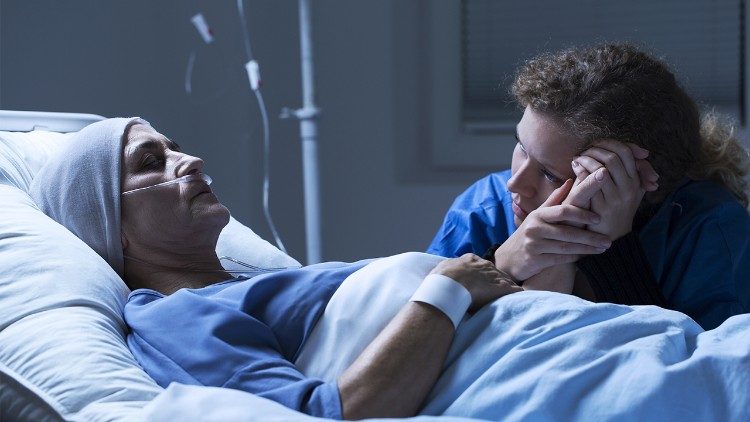
Accompaniment of the sick in the final phase of lifeAccompaniment of the sick in the final phase of life 

Archbishop Paglia clarifies stance on assisted suicide

Archbishop Vincenzo Paglia reiterates his opposition to "euthanasia" and assisted suicide and clarifies remarks about the legal status of the practice in Italy.

By Christopher Wells

Archbishop Vincenzo Paglia, the President of the Pontifical Academy for Life, has clarified earlier remarks concerning the legal status of medically assisted suicide in Italy, insisting that he fully adheres to the Church’s definitive magisterial teaching opposing the practice. 

“Archbishop Vincenzo Paglia, President of the Pontifical Academy for Life, in full conformity with the Church’s Magisterium, reaffirms his ‘No’ to euthanasia and assisted suicide.”

The clarification, in a statement issued by the Pontifical Academy, comes in response to “incorrect interpretations” of the Archbishop’s thoughts following a speech given by the PAV president last week in Perugia, Italy. In a speech devoted to the entire subject of end-of-life care, the Archbishop referenced the specific legal situation of assisted suicide in Italy.

Assisted suicide in Italy a crime

In 2019, Italy’s Constitutional Court ruled that in some cases and under certain conditions it is possible to request the indirect help of doctors to end one’s own life. Effectively, while assisted suicide remains a crime, it would no longer be penalized if specific conditions are met.

In his address last week, Archbishop Paglia explained that it is important that assisted suicide remain a crime in Italian law, which the Constitutional Court sentence recognizes. However, because the Court has asked Parliament to legislate concerning the issue, the Archbishop gave his opinion that a “legislative initiative” along the lines proposed by the Senate – maintaining medically-assisted suicide as a crime while de-penalizing it in certain circumstances – might be a possible solution to the legal question.

The statement from the PAV insists that any legal compromise would in no way involve a change in the moral stance towards assisted suicide.

No one left alone

The statement goes on to say that “any further elaboration is uncalled for,” stating, “On the scientific and cultural level, Archbishop Paglia has always supported the need for accompaniment of the sick in the final phase of life, using palliative care and loving personal attention, to ensure that no one is left to face alone the illness and suffering, and difficult decisions, that the end of life brings on.”

Tuesday, March 15, 2022

No to war and warmly welcome refugees from Ukraine


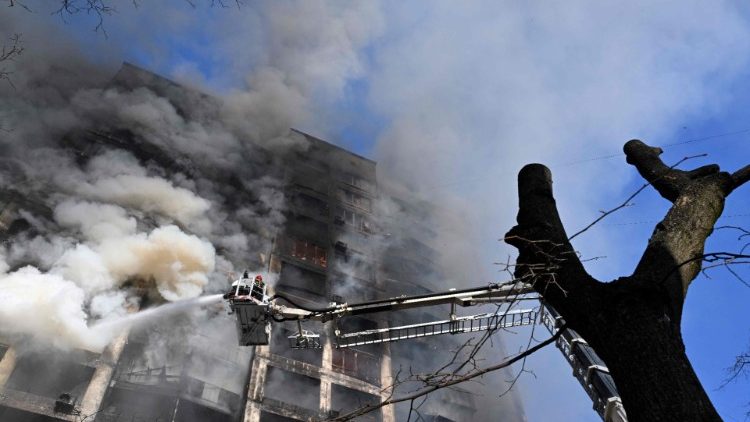
Extinguishing a building fire after a bombardmentExtinguishing a building fire after a bombardment  (AFP or licensors)

Archbishop Paglia: 'May war in Ukraine cease and Europe welcome refugees'

The President of the Pontifical Academy for Life, Archbishop Vincenzo Paglia, offers a reflection on the war in Ukraine, underscoring Pope Francis' "no" to war and appeal for negotiation.

By Tiziana Campisi

Archbishop Vincenzo Paglia is calling on world leaders to create a "far-sighted policy to be able to point a way forward for all humanity."

The President of the Pontifical Academy for Life said Europe needs to imagine and build a different future, so that the conflict in Ukraine will be the last and serve as an example on the need to search and identify new ways of coexistence among peoples.

Archbishop Paglia offered a reflection on the war in Ukraine in an article published on Tuesday by the Italian newspaper "Il Riformista", in which he underscores the heartfelt appeal of Pope Francis last Sunday at the Angelus, saying 'In the name of God, stop this massacre!' 

Wise and renewed Europe

Archbishop Paglia says "we need an effective and useful political farsightedness, so that we come out of this trial with a renewed, wise, long-lasting European plan."

“It seems to me that there are no alternatives: Europe is one; it has two lungs, certainly, East and West have common characteristics and different ones, but it is always about Europe.”

The Archbishop added that we must "speak of a Jewish-Christian Europe," as John Paul II often termed it. 

Fair political solution that respects rights

For the president of the Pontifical Academy for Life, "it is indispensable to rethink a future that embraces Europe from the Atlantic to the Urals."

“The Europe of NATO, the European Union, the G-7 that sometimes becomes G-8, must be redesigned with different political solutions, under the auspices of political, economic, financial and cultural project that includes all countries, no one excluded.”

Europe should bring together the people of the future requires a "political solution that is fair, concrete, respectful of international law and rights," Archbishop Paglia stresses.

"We should really and decisively focus on negotiations, the instrument used by people throughout history to come up with solutions," he says.

Archbishop Paglia then points out that the world is still experiencing "a pandemic that has not yet been defeated," "an environmental and climate crisis" that will have consequences for everyone, and "a change of era at the level of new technologies" having profound impacts on all.

He concludes that weapons and war are not the answer to solving our problems.