reflections, updates and homilies from Deacon Mike Talbot inspired by the following words from my ordination: Receive the Gospel of Christ whose herald you have become. Believe what you read, teach what you believe and practice what you teach...
Sts. Augustine Zhao Rong, priest and Companions, Chinese Martyrs
The gospel first arrived in the vast and powerful “Middle Kingdom,” or China, in the 6thcentury via Syria, with different emperors in turn permitting and suppressing the small community of faith planted there. Evangelization in the modern age began in earnest in the 16thcentury with the arrival of European missionaries such as the Jesuit Matteo Ricci, who painstakingly learned the language and customs of these immensely cultured people. By the 17thcentury, not a few Chinese had embraced the Lord Jesus Christ and his gospel. Over the next several centuries, they would testify to their commitment to him with their blood.
The protomartyr of China
The first Chinese martyr was in fact a Spanish Dominican friar, Fr. Francisco Fernandez de Capillas, who was captured in 1647 in Fu’an, in a wave of anti-Christian persecution. From prison, he wrote, “I am here with other prisoners and we have developed a fellowship. They ask me about the gospel of the Lord…. I live here in great joy … knowing that I am here because of the Lord Jesus Christ. The pearls I have found here these days are not always easy to find.” Those “pearls” were open hearts, people hungry for God. When, in 1648, Fr. de Capillas was beheaded, sealing the transformation of the Spanish priest into a Chinese saint, his spiritual children would show their worth. They followed him: 120 martyrs between 1648 and 1930, of which 87 were native-born Chinese Christians and 33 were foreign-born missionaries from various religious communities.
The soldier turned priest
In the late 1700’s, after the death of a number of Chinese lay catechists who refused to renounce the faith even under torture, a Chinese soldier experienced a turn of events that transformed him into the name and the face of a vast company of his fellow countrymen who had encountered the Lord. It happened that Zhao Rong was assigned to the company of guards sent to escort the French missionary, Bishop John Gabriel Taurin Dufresse, on the long journey to his execution in Beijing. There was something about this foreigner’s bearing, his patience in the face of suffering and imminent death, that struck the soldier. He began to listen to this leader of an outlawed faith. Soon, the soldier asked for baptism, taking the name Augustine. The foreign-born priest was killed, but he had a spiritual son: Augustine Zhao Rong asked for holy orders, becoming the first Chinese-born diocesan priest. In 1815, Fr. Augustine followed his spiritual father to torture and martyrdom.
“I am a Christian”
If the blood of the martyrs is the seed of the Church, as Tertullian stated in antiquity, the Church was taking deep root in this ancient land. Waves of persecution followed, each of which brought with it new martyrs, up through the anti-imperialist and anti-Christian Boxer Rebellion of the beginning of the 20th century. The foreign-born martyrs sealed their embrace of this land and people with their blood so completely that, like Fr. de Capillas, they are counted among the Chinese saints. The 87 Chinese-born martyrs were men, women and children – the youngest was 9 years old and the oldest was 79 – from all walks of life. They were Chinese priests who rose up in Fr. Augustine Zhao Rong’s footsteps, lay catechists, merchants, cooks, farmers, and an adolescent boy who, at the threat of being flayed alive, exclaimed, “Every piece of my flesh… will tell you that I am a Christian.” Many were offered freedom if they would apostatize, and refused.
There could be no greater proof that the Church was alive in China, or that the Lord had Chinese-born servants filled with courage and love. “Where I am, there will my servant be” (Jn 12:26), he had promised. This vast company of Chinese martyrs were with him, loving their Lord, their land and their culture unto the shedding of blood. Pope John Paul II beatified them together in the year 2000.
Bishop of the Apostolic Prefecture of Xinxiang consecrated in China
On Friday, December 5, the episcopal ordination of Bishop Francis Li Jianlin took place.
Vatican News
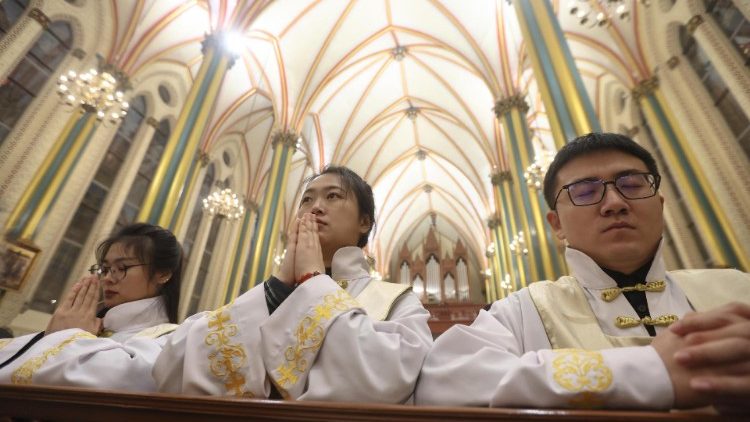
On Friday, 5 December 2025, the episcopal ordination of Bishop Francis Li Jianlin took place. He was appointed Bishop of the Apostolic Prefecture of Xinxiang (Henan Province, China) by Pope Leo XIV on 11 August 2025, with his candidacy approved within the framework of the Provisional Agreement between the Holy See and the People’s Republic of China and following the acceptance of the resignation from pastoral governance submitted by Bishop Joseph Zhang Weizhu.
Curriculum vitae
Francis Li Jianlin was born on 9 July 1974 in the city of Huixian, Henan Province, into a Catholic family. From September 1990 to June 1999, he completed the formation and discernment path in preparation for the priesthood, first at the seminary in Zhengding and then at the seminary in Yixian (Hebei). On 23 July 1999, he received priestly ordination from Bishop Nicola Shi Jingxian of Shangqiu, for the Apostolic Prefecture of Xinxiang. From July 1999 to June 2000, he served as Parish Priest of Qinyang. In 2000, he was entrusted with the formation of seminarians and religious in the jurisdiction. Since 2011, he has held the office of Parish Priest in Jiaozuo.
Pope Leo sees role as one of building bridges, avoiding polarization
A new biography of Pope Leo, “Leo XIV: Citizen of the World, Missionary of the 21st Century,” contains the full text of the interview granted by the Holy Father to Elise Ann Allen, covering a wide range of topics, including the tragedy of Gaza, the Church’s policy on China, the role of women, the Church’s welcome of those who identify as LGBTQ+, the clerical abuse crisis, the financial situation of the Holy See, artificial intelligence, and fake news.
By Salvatore Cernuzio
In his first full interview since his election, Pope Leo responded to questions on topics as diverse as the quest for peace in Ukraine and “terrible situation in Gaza”; to the role of women in the Church and the Church’s relationship with the LGBTQ+ community; to the clerical abuse and the reform of the Roman Curia.
The interview was granted to Elise Ann Allen for her biography of the Holy Father, León XIV: ciudadano del mundo, misionero del siglo XXI (“Leo XIV: Citizen of the World, Missionary of the XXI Century”), which published Thursday with Penguin Peru. Allen is a senior correspondent for CruxNow.com, an independent online Catholic news site, which published the full text of the interview with Pope Leo in a series of articles also released on Thursday.
The role of the papacy
Asked about how he sees the papacy, Pope Leo highlighted the “pastoral part” of his new role, especially the “outreach to people of all ages.” “I appreciate everyone, whoever they are, what they come with, and I listen to them… So, there’s an aspect of being pastor of the universal Church that I think is very significant, and I think one of the things people appreciate is that,” he said.
He said does not feel overwhelmed by the decisions that will need to be taken in the coming months and years, while acknowledging that internal Church governance is a big part of his role as pope.
What is new, he said, is his role as a world leader. “I’m learning a lot about how the Holy See has had a role in the diplomatic world for many years,” he said. “I’ve always tried to stay up on the news, but the role of pope is certainly new to me.” Here, too, he said, “I’m learning a lot and feeling very challenged, but not overwhelmed.
The tragedy of Gaza
One of the first questions for the Pope concerned the situation in Gaza. Even though there has been some pressure on Israel from the United States, and despite some “very clear statements” recently from President Trump, the Pope said, “there has not been a clear response in terms of finding effective ways to alleviate the suffering of the people, the innocent people in Gaza, and that is obviously of great concern.”
The Pope highlighted the needs of Gazans, and especially the children of the enclave. “They're going to need a lot of help, medical assistance as well as humanitarian aid to really turn that situation around, and right now it still looks very, very grave,” he said. “It’s just so horrible to see the images that we see on television, hopefully something will turn this around.”
Pope Leo worried aloud about growing numb to the pain. “That’s a sort of a human response,” he said, “because you can only stand so much pain.” Human beings, and especially Christians, must not grow numb and must not ignore the situation, he said. Instead, “somehow, we have to continue to push, to try and make a change here.”
The word “genocide”
Concerning the use of the word “genocide” with regard to the tragedy of Gaza, which is “being thrown around more and more,” the Pope emphasized that “officially, the Holy See does not believe that we can make any declaration at this time about that.”
He explained, “There's a very technical definition about what genocide might be, but more and more people are raising the issue, including two human rights groups in Israel have made that statement.”
Relations with China
Staying in the realm of geopolitics, Pope Leo was also asked about “another global actor,” China. He said that “in the short term, I will continue the policy that the Holy See has followed for some years now,” adding that he “in no way” pretends “to be wiser or more experienced” than his predecessors.
For some time now, he said, he has been “in ongoing dialogue” a number of Chinese people with various perspectives, and he is trying “to get a clearer understanding of how the Church can continue the Church’s mission, respecting both culture and the political issues,” while also “respecting a significant group of Chinese Catholics who for many years have lived some kind of oppression or difficulty in living their faith freely, and without taking sides.”
At the same time, he admits, “It’s a very difficult situation.”
U.S. politics
Asked about the significance, “on the geopolitical level,” of being the first Pope from the United States, Pope Leo responded by saying, “First of all, I hope that it will make a difference eventually with the bishops of the United States.”
With regard to “some of the things that have been said” about the U.S. episcopate and the relationship between the Church and politics,” the Pope said, “The fact that I am American means, among other things, that people cannot say, as they did with Francis, ‘he does not understand the United States, he simply does not see what is happening.’”
However, Pope Leo stated clearly, “I don’t plan to get involved in partisan politics.”
With regard to the relationship with President Donald Trump, the Pope expressed his opinion that “it would be much more appropriate for the leadership in the Church within the United States to engage him, quite seriously.” However, he said, “if or when there were specific issues” where it was possible to engage with Trump, “I would have no problem doing so.”
Pope Leo mentioned, as an example, Francis’ letter, issued near the end of his pontificate about the treatment of migrants, saying, “I was very happy to see how the American bishops picked that up, and some of them were courageous enough to go with that.” He explained, “I think that approach, in general, is a better approach, that I would engage with the bishops primarily.”
He later acknowledged that “the United States is a power player on the world level,” and said, “we have to recognize that, and sometimes decisions are made more based on economics than on human dignity and human support, but [we have to] continue to challenge and to raise some questions” to determine the “best way” to respond.
The Pope noted that Trump himself had recently stated that a meeting between the two was not on the agenda, but added, “his brother’s a nice guy” – a reference to Pope Leo’s older brother Louis, who was received in the Oval Office a few days after the Conclave. “One of my brothers has met him and has been very open about his political viewpoints,” Pope Leo confirmed.
Later in the interview, he speaks about his brother again, when describing his relationship with his family. He said he and his brothers, Louis and John, “are still very close, even though one is far on one end politically, we’re in different places.”
The abuse crisis in the Church
A large part of the conversation is dedicated to the “crisis” of clerical sexual abuse in the Church. Pope Leo acknowledged that it is a “real crisis,” saying “victims must be treated with great respect and with an understanding that those who have suffered very deep wounds because of abuse, sometimes carry those wounds for their entire life.
Pope Leo cites statistics showing that “over 90% of people who come forward and make accusations” are “authentic victims.” In other words, they do not make things up.
However, he said, “there have also been proven cases of some kind of false accusations,” and some priests have had their lives “destroyed because of that.” An accusation “does not take away the presumption of innocence,” the Pope insisted, adding, “So, priests have to be protected, or the accused person has to be protected, their rights have to be respected.” Still, he recognized, “even saying that at times is cause of greater pain for the victims.”
In any case, he continued, citing the “very good insight” of Francis, “the issue of sexual abuse cannot become the centre focus of the Church.” After noting that the “vast majority” of people committed to the Church have never abused anyone, he continued, “We can’t make the whole Church focus exclusively on this issue, because that would not be an authentic response to what the world is looking for in terms of the need for the mission of the Church.”
The Church’s approach to the LGBTQ+ community
The Pope was also asked about two of the “hot-botton” issues that arose in the Synod on Synodality: the role of women in the Church’s approach to the LGBTQ+ community.
With regard to the latter, Pope Leo explained that he does not have “a plan at the moment,” but added that he does not want “to continue to polarize or promote polarization in the Church.”
Pope Leo said he embraces Francis’ message of welcome to all, “todos, todos, todos.” “Everyone’s invited in,” he said, “but I don’t invite a person in because they are or are not of any specific identity. I invite a person in because they are a son or daughter of God. You’re all welcome, and let’s get to know one another and respect one another.”
Referring to the the Declaration Fiducia supplicans: On the pastoral meaning of blessings, Pope Leo emphasized that the document “basically says, of course we can bless all people, but it doesn’t look for a way of ritualizing some kind of blessing because that’s not what the Church teaches.”
He acknowledges that some people “want the Church doctrine to change, want attitudes to change.” However, he said, “I find it highly unlikely, certainly in the near future, that the church's doctrine in terms of what the church teaches about sexuality, what the Church teaches about marriage, [will change].”
Pope Leo notes that he has already spoken about marriage, “as did Pope Francis when he was pope, about a family being a man and a woman in solemn commitment, blessed in the sacrament of marriage.”
The role of women in the Church
Nor does he think the Magisterium will change the Church’s position on the ordination of women. Specifically with regard to the possibility of ordaining women as deacons, the said, “I, at the moment, don’t have an intention of changing the teaching of the Church on the topic.”
At the same time, Pope Leo said, “I hope to continue in the footsteps of Francis, including in appointing women to some leadership roles at different levels in the Church's life, recognizing the gifts that women have that can contribute to the life of the Church in many ways.”
The financial situation of the Holy See
Concerning the financial situation of the Holy See, Pope Leo said, “I don’t know how I’m going to handle it yet, but I’m getting some clear ideas.”
He points to several specific issues, including the 60 million euro profit reported by the Administration of the Patrimony of the Apostolic See (APSA) in their 2024 financial report.” At the same time, he noted concerns about the pension fund for Vatican employees (“that must be looked at”) and how the Covid crisis affected the Vatican Museums, “one of the most significant sources of income for the Vatican.”
Pope Leo warned, however, that “we must avoid the kinds of wrong choices that were made in recent years,” mentioning the purchase of a building in London that became the centre of a court case that attracted “great publicity.” “How many millions were lost because of that!” the Pope lamented.
At the same time, he noted the “significant steps” already taken during Francis’s pontificate to impose a new system of checks and balances. However, he added, “I’m not saying we can relax and say the crisis is over. I don't think the crisis is over, I think we have to continue to work on this, but I'm not losing sleep over it, and I think that it's important that we communicate a different message.
Curia reforms
On the topic of the reform of the Roman Curia, Pope Leo noted that, “as in any human organization, there are positive things and there are things that need to be improved,” highlighting in particular the importance of “continuing to break down or transform the isolated manner in which each dicastery works.” He expressed concern about a kind of “silo mentality,” which at times has led to a lack of dialogue and communication, and has sometimes been a “great limitation and harm for the governance of the Church.”
The Latin Mass
Pope Leo also responded to the question of the “Traditional Latin Mass,” saying “part of that issue, unfortunately, has become – again, part of a process of polarization – people have used the liturgy as an excuse for advancing other topics. It’s become a political tool, and that’s very unfortunate.”
He acknowledged that he has not yet been able “to really sit down with a group of people who are advocating for the Tridentine Rite,” but said, “there’s an opportunity coming up soon, and I’m sure there will be occasions for that.” He added, “But that is an issue that I think also, maybe with synodality, we have to sit down and talk about.”
Fake news and Artificial Intelligence
Beyond the ecclesial sphere, the interview with Pope Leo also addressed issues including the prevalence of “fake news”, which he calls “destructive;” and the issue of artificial intelligence.
Concerning the latter, the Holy Father worried about “extremely rich people who are investing in artificial intelligence” while “totally ignoring the value of human beings and of humanity.”
“I think the Church has to speak up there,” he said, in which “extremely wealthy people” are investing, while completely ignoring “the value of human beings.” “If the Church doesn't speak up, or if someone doesn't speak up about that – but the Church certainly needs to be one of the voices here – the danger is that the digital world will go on its own way and we will become pawns, or left by the wayside.”
Asked about the problems of so called “deep fakes,” Pope Leo recalled being asked for permission to create an “artificial Pope” so that anyone could have a personal audience with the pontiff. “I said: ‘I’m not going to authorize that,’” and added, “If there’s anybody who should not be represented by an avatar, I would say the Pope is high on the list.”
Vatican News - English Section staff reporters contributed to this report. The full text of the interview, broken up into several articles, can be found on the Crux website, www.cruxnow.com.
Pope Leo XIV has created a new Catholic diocese in northern China with the same name as one established decades ago by Beijing without Vatican approval, underscoring ongoing tensions over how China has redrawn Catholic diocesan borders independently of Rome.
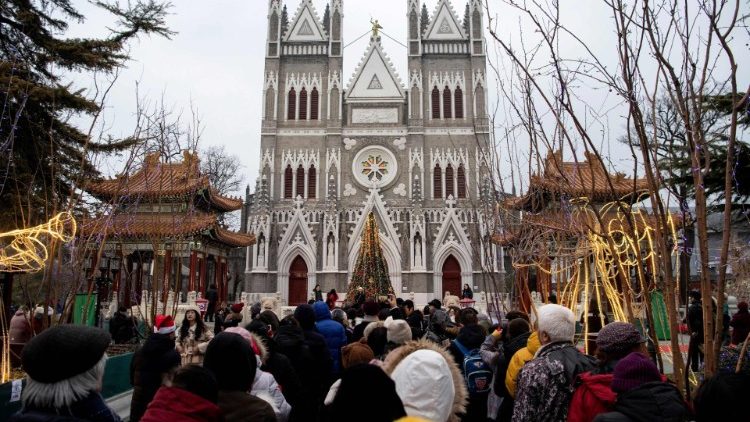
The Vatican announced Wednesday that the pope has suppressed two historic dioceses of Xiwanzi and Xuanhua — both erected in 1946 by Pope Pius XII — and replaced them with the Diocese of Zhangjiakou. The see of the new diocese is based in the city of Zhangjiakou, where China’s state-controlled Catholic association set up its own diocese in 1980 using boundaries never recognized by the Holy See.
Notably absent from the Vatican’s announcement was any mention of Bishop Augustine Cui Tai, 75, the longtime underground bishop of Xuanhua, the diocese Pope Leo XIV suppressed. Cui has been subjected to repeated detention, house arrest, and forced labor over the past three decades, according to a recent report.
Pope Leo XIV appointed a new bishop to lead the Diocese of Zhangjiakou in Hebei province, Father Joseph Wang Zhengui, who was selected within the framework of the Holy See’s provisional agreement with the Chinese government on the appointment of bishops, also referred to as the Vatican-China deal.
The Vatican announcement came hours after Wang, 62, was consecrated bishop of Zhangjiakou on Sept. 10 in a Mass at the Church of the Holy Family in Zhangjiakou attended by about 300 Catholics, 50 priests, and senior Chinese Patriotic Catholic Association leaders. The Vatican said that Pope Leo had appointed Wang on July 8.
“In order to promote the pastoral care of the Lord’s flock and to attend more effectively to its spiritual welfare, on July 8, 2025, Pope Leo XIV decided to suppress the dioceses of Xuanhua and Xiwanzi in mainland China, which were established on April 11, 1946, by Pope Pius XII,” the Holy See Press Office said in its announcement. “In this way, the territory of the Diocese of Zhangjiakou corresponds to that of the capital city of Zhangjiakou.”
The new diocese covers 14 districts and counties around the city of Zhangjiakou, an area of 14,000 square miles with a population of just over 4 million people, including about 85,000 Catholics served by 89 priests. It will be a suffragan diocese of the Archdiocese of Beijing.
No mention of persecuted bishop
The Holy See’s announcement conspicuously omitted mention of the current underground bishop of the suppressed Diocese of Xuanhua. Bishop Cui has been detained four times since the 2018 China-Vatican agreement was signed and had not been seen since he was taken into police custody in April 2021, according to a 2024 report by the Hudson Institute. His diocese had repeatedly called for his release from detention but to no avail. Asia News reported that Catholic clergy in Hebei were informed that a “retirement” ceremony for Cui, who is currently 75 years old, will take place on Sept. 12.
China’s disputed diocesan borders
The announcement highlights the long-standing issue in Vatican-China relations: The government-sponsored Chinese Patriotic Association redrew diocesan borders to align with state administrative divisions. This redrawn diocesan map does not match the Vatican’s canonical jurisdictions.
The Chinese Patriotic Catholic Association is a state-run body under the control of the Chinese Communist Party’s United Front Work Department.
Prior to Pope Leo’s decision, Beijing recognized 104 dioceses while the Holy See had 143 Catholic dioceses in China. While the 2018 Vatican-China deal — renewed by Pope Francis in October 2024 — aims to fill vacant sees through a shared process of bishop appointments, its details remain secret. Vatican officials have previously acknowledged that Beijing violated the agreement multiple times.
Pope Leo XIV on China
The Vatican came under criticism during Pope Francis’ pontificate for what some saw as a muted response to China’s human rights abuses, including the internment of Uyghur Muslims and the imprisonment of Catholic pro-democracy activist Jimmy Lai in Hong Kong.
On May 1, new restrictions from China’s United Front came into force banning foreign clergy from presiding over religious activities for Chinese people without the invitation of the Chinese government, severely limiting foreign missionary activity in the country. Meanwhile, state-sanctioned Catholic institutions in China offered little acknowledgement of Pope Francis’ death.
Pope Leo XIV, who inherited the Vatican-China deal from Francis, has retained Cardinal Pietro Parolin, the architect of the deal, as his secretary of state, yet it remains unclear how Vatican-China relations might shift under the new pontiff.
Cardinal Stephen Chow, the bishop of Hong Kong, who met with Pope Leo XIV on Sept. 2, told his local diocesan newspaper, the Sunday Examiner, that “the Holy Father is not entirely unaware of the Church in China, as he has already gathered insights from multiple sources and through the Sino-Vatican agreement.”
Leo XIV also visited mainland China before his election as pope when he served as superior general of the Augustinian order.
“He recognizes the importance of dialogue between the Church and the mainland authorities and considers respectful communication as the priority in addressing challenges in China-Vatican relations,” Chow said.
Pope's weekly General Audiences to include Mandarin Chinese
Pope Francis announces that his weekly General Audiences will include a greeting and summary in Mandarin Chinese as of December 4.
By Alessandro De Carolis
"Next week, with the beginning of Advent, the summary of the catechesis at the General Audience will also be translated into Chinese."
Pope Francis made that announcement on Wednesday as he held his General Audience in St. Peter's Square.
As of December 4, the greetings and summary of the Pope's catechesis will be read in Mandarin Chinese, along with French, English, German, Spanish, Portughese, Arabic, and Polish.
Pope's care for the Chinese people
The Pope's decision to include Mandarin offers a sign of the attention and care he has often expressed for the Chinese people.
In September 2018, in a message, he described China as "a land rich in great opportunities" and the "Chinese people as the architects and guardians of an invaluable heritage of culture and wisdom, refined through adversity and the integration of diversity, which, not coincidentally, has encountered the Christian message since ancient times."
Last year, as he presided at Mass in Ulaanbaatar on September 3, 2023, during his Apostolic Journey to Mongolia, Pope Francis extended "a warm greeting to the noble Chinese people," urging Chinese Catholics to "be good Christians and good citizens."
On several occasions, the Pope has expressed his desire to visit China. On September 13, 2024, during the inflight press conference as he returned to Rome from Singapore, the Pope referred to the Chinese nation as "a promise and a hope for the Church."
Historical notes
Today, the Vatican News website offers information in both traditional and simplified Chinese, and the Chinese-language program of Vatican Radio was launched in 1950.
Chinese characters first appeared in L’Osservatore Romano in February 1981, when Pope St. John Paul II unexpectedly delivered part of his speech in that language in front of the Peace Monument in Hiroshima.
In 2009, Chinese became one of the languages available on the Holy See's official website, vatican.va. Additionally, the Vatican's Fides News Agency's newsletter has been published in simplified Chinese since 1998.
Holy See and China extend Provisional Agreement on appointment of bishops
After “appropriate consultation and assessment,” the Holy See and the People’s Republic of China have agreed to extend the Provisional Agreement on the appointment of Bishops for another 4 years.
By Vatican News
“In light of the consensus reached for an effective application of the Provisional Agreement regarding the Appointment of Bishops, after appropriate consultation and assessment, the Holy See and the People’s Republic of China have agreed to extend further its validity for four years from the present date,” according to a communiqué released by the Holy See Press Office on Tuesday, 22 October 2024.
“The Vatican Party,” the statement continues, “remains dedicated to furthering the respectful and constructive dialogue with the Chinese Party, in view of the further development of bilateral relations for the benefit of the Catholic Church in China and the Chinese people as a whole.”
Third renewal
This is the third renewal of the Agreement that, with the signing on 22 September, 2018, opened a historic chapter in relations between the Holy See and the People's Republic of China, and within the Church itself in China, allowing all bishops to be in full hierarchical communion with the Pope.
The new signature affixed by both parties on the Provisional Agreement extends its validity for another four years, and follows the first renewal for a two-year period, which took place exactly two years ago, on October 22, 2020.
A new scenario
The Provisional Agreement ended decades of episcopal ordinations without papal consent, leading to a radically changed scenario in the last six years. Since then, about ten bishops have been appointed and consecrated, and Beijing officially recognized the public role of several previously unrecognized bishops.
A sign of the new cooperation is also evidenced by the presence of bishops from mainland China at Synods in the Vatican and other meetings in Europe and America, as well as that of young people at last year's World Youth Day in Lisbon, and a general participation of Chinese faithful in Apostolic Journeys made by Pope Francis to the East in recent years.