Showing posts with label Pontifical Academy for Life. Show all posts

Monday, February 16, 2026

Pope Leo tells Pontifical Academy of Life that war attacks life & public health


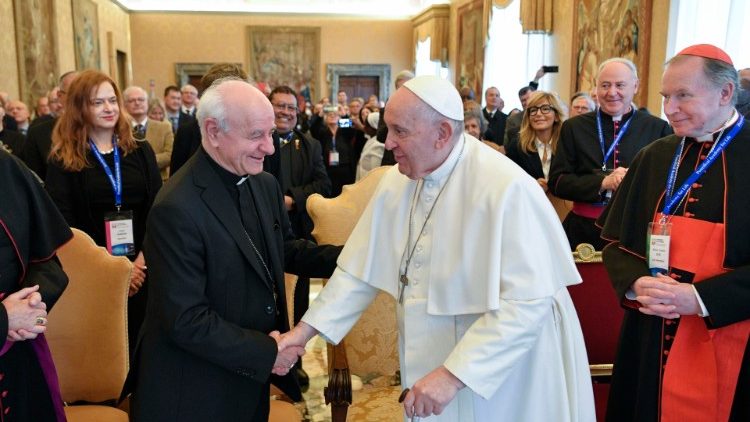
Pope Leo XIV meets with members of the Pontifical Academy for LifePope Leo XIV meets with members of the Pontifical Academy for Life  (@Vatican Media)

Pope: War is gravest attack possible against life and public health

Pope Leo XIV addresses participants in the Plenary Assembly of the Pontifical Academy for Life, and underlines the importance of promoting health in a world consumed by conflict.

By Isabella H. de Carvalho

In a world consumed by conflicts, we must dedicate time and resources to promote life and health, while addressing inequalities by strengthening our understanding of the common good, Pope Leo highlighted on Monday, February 16.

Today, we are faced with “wars that impact civilian structures, including hospitals, which constitute the most grave attacks that human hands can make against life and public health,” he said, in his address at the Vatican to the participants in the Plenary Assembly of the Pontifical Academy for Life.

“In a world scarred by conflicts, which consume enormous economic, technological, and organizational resources in the production of arms and other types of military equipment, it has never been more important to dedicate time, people, and expertise to safeguarding life and health.”

The Pontifical Academy for Life’s Plenary Assembly takes place in Rome on February 16-17 and focuses on the theme “Healthcare for all: Sustainability and equity.” 

Health is not promoted in same way for everyone

Pope Leo expressed his appreciation for this theme. "It is often said that life and health are equally fundamental values for all, but this statement is hypocritical if, at the same time, we ignore the structural causes and policies that determine inequalities," he said.

“Despite declarations and statements to the contrary," he continued, "all lives are not equally respected, and health is neither protected nor promoted in the same way for everyone.”

He explained that “the situations in which communities find themselves,” in terms of their quality of health and life, “are the result of social and environmental policies,” which affect variables such as income, education or the neighborhood one lives in.

“When we look at life expectancy and the quality of health in different countries and social groups, we discover enormous inequalities,” he said.

One health and our interdependence  

The Pope emphasized in this regard the importance of recognizing “the connection between the health of all and that of each individual," adding how the COVID-19 pandemic demonstrated this reality.

Our responsibility, he said, lies “not only in taking measures to treat diseases and ensure equitable access to healthcare, but also in recognizing how health is influenced and promoted by a combination of factors, which need to be examined and confronted in their complexity.”

He compared this to a mosaic where different fields such as “medicine, politics, ethics, management, and others” need to come together to confront all-encompassing issues and find solutions. He added that this also means not focusing “on immediate profit, but on what will be best for everyone.” 

Continuing on this line of thought, the Pope insisted on the importance of promoting the concept of “one health,” which “emphasizes the environmental dimension and the interdependence of the various forms of life and ecological factors that enable their balanced development.”

“One health” can be “a basis for a global, multidisciplinary, and integrated approach to health issues,” as it reminds us that “human life is incomprehensible and unsustainable without other creatures,” the Pope said.

In terms of public health, Pope Leo explained that this concept “calls for the integration of health considerations into all policies (transportation, housing, agriculture, employment, education, and so on).”  

Strengthening our understanding of common good

Therefore, to promote this concept, the Pope reflected that “we need to strengthen our understanding and promotion of the common good,” so it does not succumb to specific individual or national interests.

He added that the common good is “one of the fundamental principles of the Church’s social teaching," and it “risks remaining an abstract and irrelevant notion if we do not recognize that it is rooted in the fostering of close relationships between people and bonds between members of society.”

The Pope noted that this is the ground upon which a “democratic culture” uniting “efficiency, solidarity, and justice” can grow, calling for all to “rediscover the fundamental attitude of care as support and closeness to others, not only because someone is in need or is sick, but because they experience vulnerability, which is common to all human beings.”

He insisted that only in this way “will we be able to develop more effective and sustainable healthcare systems, capable of satisfying every health need in a world of limited resources as well as restoring trust in medicine and healthcare professionals, notwithstanding any misinformation or skepticism regarding science."

In this regard, Pope Leo XIV reiterated his call to strengthen international and multilateral relations so that conflicts can be prevented and no actor prevails over another “with the mindset of force.” 

“This vision also applies to the cooperation and coordination carried out by supranational organizations engaged in the protection and promotion of health,” he concluded.

Tuesday, May 27, 2025

Pope Leo XIV appoints new head for Pontifical Academy for Life replacing Archbishop Paglia


Msgr. Renzo PegoraroMsgr. Renzo Pegoraro 

Msgr. Renzo Pegoraro appointed President of Pontifical Academy for Life

Pope Leo XIV appoints Monsignor Renzo Pegoraro, an expert in medicine and bioethics, as President of the Pontifical Academy for Life, expressing his heartfelt gratitude to Archbishop Vincenzo Paglia for his years of service.

By Vatican News

Pope Leo XIV has appointed Msgr. Renzo Pegoraro as the new President of the Pontifical Academy for Life (PAV), who has served as the Academy’s Chancellor since September 2011.

Msgr. Pegoraro, a bioethicist with a medical degree, succeeds Archbishop Vincenzo Paglia, who turned 80 on April 21.

In an Academy-issued statement, Msgr. Pegoraro expressed, "I thank Pope Leo XIV for appointing me as President of the Pontifical Academy for Life." 

"The work done over these years alongside Archbishop Vincenzo Paglia, and previously with Bishop Ignacio Carrasco de Paula," said the Italian-born priest, "has been both fascinating and stimulating, in line with the operational and thematic directions of the late Pope Francis."

Expert in medicine and bioethics

Born in the northern Italian city of Padua on June 4, 1959, Msgr. Pegoraro would later be ordained a priest on June 11, 1989. He was incardinated in the Diocese of Padua.

He earned a degree in Medicine and Surgery in 1985 from the University of Padua, and, in 1990, he received a Licentiate in Moral Theology from the Pontifical Gregorian University in Rome.

He also has a Postgraduate Diploma in Bioethics from the Catholic University of the Sacred Heart.

The new President of the Academy for Life has served as Secretary General of the Lanza Foundation in Padua and as a Professor of Bioethics at the Theological Faculty of Triveneto.

Since 2000, he has been a professor of Nursing Ethics at the "Bambino Gesù" Pediatric Hospital in Rome.

From 2010 to 2013, he was president of the European Association of Centers of Medical Ethics.

Msgr. Pegoraro has published several books, articles, and essays.

Pope thanks Archbishop Paglia for service

In a letter signed by Cardinal Secretary of State Pietro Parolin, as reported in the Pontifical Academy for Life's statement, Pope Leo XIV expresses to Archbishop Paglia “his heartfelt thanks” for the service he rendered since 2016 as President of the Pontifical Academy for Life and as Grand Chancellor of the Pontifical John Paul II Theological Institute for Marriage and Family Sciences.

Monday, February 20, 2023

Pope Francis meets with Pontifical Academy for Life


Pope meeting with the Pontifical Academy for LifePope meeting with the Pontifical Academy for Life  (ANSA)

Pope: Technology must be at the service of humanity

Pope Francis addresses participants in a workshop hosted by the Pontifical Academy for Life on the relationship between the person, emerging technologies and the common good, and reiterates that progress of science and technology must always be at the service of human dignity and integral human development.

By Lisa Zengarini

As it meets for its general assembly this week, the Pontifical Academy for Life is holding a two-day workshop focused on the ethical aspects of the so-called “Converging Technologies” (Nanotechnology, Biotechnology, Information Technology, and Cognitive Science).

Entitled “Converging on the person: Emerging Technologies for the Common Good”, the international workshop is taking place on 20-21 February with the participation of academics from around the world.

In his address to the participants on Monday, Pope Francis highlighted three important challenges in this delicate field “where progress, ethics and society meet, and where," he said, "faith, in its perennial relevance, can provide a valuable contribution.”

The impact of technological advances on human living conditions

The first challenge is the rapid change brought by technological progress in humanity's living conditions. Indeed, the Pope noted, the "strength and acceleration” of these advances are having an unprecedented impact on the environment and on human living conditions, “with effects and developments that are not always clear and predictable”, as shown by the multiple crises the world is facing today, from the pandemic to the energy crisis, from  climate change to migration. Therefore, “healthy technological development cannot fail to take these complex interweaving into account”.

Technology cannot replace human contact and must not forget the vulnerable

The second challenge is the impact of new technologies on the definitions of "humanity" and "relationship", especially with regard to the condition of vulnerable individuals. Noting that the technological form of human experience is becoming ever more “pervasive”, Pope Francis stressed the need for “a serious reflection on the very value of humanity”, and in particular to “reaffirm the importance of the concept of personal conscience as a relational experience, which cannot disregard either corporality or culture.”

“In the network of relationships, both subjective and community, technology cannot replace human contact, the virtual cannot replace the real and neither can social media replace the social sphere.”

The Pope went on to remark that even within scientific research processes, the relationship between the person and the community signals “increasingly complex ethical implications”, for example in the health sector, where he highlighted the urgent need to guarantee equal access to care “especially for the most fragile subjects, such as the disabled, the sick and the poor .“

Technology and cultures

This is why, he said, it is important “to monitor the speed of transformations, the interaction between changes and the possibility of guaranteeing an overall balance”, also keeping in mind that this balance is different in different cultures.

“(Efforts) should be aimed at making sure that everyone grows with the style that is peculiar to them, developing their ability to innovate starting from the values of their own culture.”

Promoting mutual understanding between science, technology and society

Finally, the third challenge is the definition of the concept of knowledge and the resulting consequences. Noting that “the type of knowledge we implement already has in itself moral implications”, the Pope underscored the need for more “articulated models”, considering “ the intertwining of relationships of which the single events are woven” instead of simplistic approaches.

In this regard, he remarked that the idea highlighted in his Apostolic Exhortation Evangelii Gaudium and above all in his Encyclical Letter Laudato Si' of a human-centred technical knowledge based on the principle that "the whole is greater than the part”,  and that "everything in the world is intimately connected”, can foster a “renewed way of thinking also in the theological sphere”.  In fact, he said, “it is good that theology continues to overcome eminently apologetic approaches, to contribute to the definition of a new humanism and to encourage mutual listening and mutual understanding between science, technology and society.”

“The lack of a constructive dialogue between (science, technology and society) impoverishes the mutual trust which is at the basis of all human coexistence and of all forms of "social friendship".”

Role of religions

Pope Francis also highlighted the crucial contribution religious traditions can give to this dialogue, noting their ancient wisdom “can help in these processes.”

Concluding, Pope Francis encouraged the Pontifical Academy for Life to continue its commitment to ensure that “scientific and technological growth is increasingly reconciled with a parallel development of the human being", insisting on the importance of “trans-disciplinary dialogue and collaboration” to address these complex issues.

Friday, October 21, 2022

Pro-life Catholic doctor challenges pro-abortion appointees to the Pontifical Academy for Life


Catholic Doctor Criticizes Pontifical Academy for Life’s Appointing of Abortion Advocates


A leading Catholic physician voiced harsh criticism of the continued appointment of “pro-abortion academics, advocates of euthanasia to some degree, or detractors of Humanae Vitae” as members of the Pontifical Academy for Life, lamenting that “someone convinced the Holy Father of it.”

In an article titled “Academy for Life: I Can’t Remain Silent Anymore!” published Oct. 19, Spanish doctor José María Simón Castellví, president emeritus of the International Federation of Catholic Medical Associations (FIAMC), warned that these appointments are “just the opposite of what John Paul II [who founded the Pontifical Academy for Life in 1994] wanted.”

Furthermore, he warned, the appointments go against “what is reasonable for the good of the pilgrim Church on this earth.”

“And worthy pro-life scientists were left out,” he lamented.

Although Dr. Castellví doesn’t mention names in his article, the most recent appointments of Pope Francis to the Pontifical Academy for Life were made Oct. 15 and included the atheist and pro-abortion economist Mariana Mazzucato as well as Msgr. Philippe Bordeyne, a theologian critical of St. Paul VI’s encyclical Humanae Vitae, on the regulation of birth.

Castellví noted in his article that the feast of St. John Paul II is coming up on Oct. 22, and the saint “in many ways is also called the Pope of Life and the Family.”

“He created the Pontifical Academy for Life in order to study in depth ways to defend human life and its transmission from conception to natural death,” Castellví explained.

The president emeritus of FIAMC noted that the institution “collaborated many times with the academy and we organized joint conferences of a very high scientific level. We also published in high-impact scientific journals.”

“Those were times when, leaving aside legitimate academic or organizational discussions, both its presidents and all its members defended human life as God led them to understand,” he recalled.


Pontifical Academy for Life’s Presidents

In addition, he highlighted that in the Pontifical Academy for Life, “there were presidents who knew what DNA was, good obstetrics and the communication of the infallible aspects of doctrine and the laws of nature.”

“Professor Jérôme Lejeune, discoverer of the cause of Trisomy 21 and a defender of the life of the unborn and the dignity of those born with Down syndrome, was the first president,” he noted.

Pope Francis appointed Archbishop Vincenzo Paglia as president of the Pontifical Academy for Life on Aug. 15, 2016.

Castellví stated in his article that “the presidency of a pontifical academy is a very suitable position for a layman or for a woman. Or is it that we don’t have in the Church a woman who is personable, married with children, with a solid training in medicine, who speaks languages and who can go to Rome frequently? Are we that bad?”

“I don’t think it’s good for anyone for women to hold mid-level positions or be named ‘deaconesses,’” he said.

“Yes, it’s true that the fact that a competent cleric is appointed president is not a sin nor even close to it. But it is a potentially missed opportunity for a layman or laywoman to do much-needed work with a certain visibility,” he added.

The Catholic doctor warned that “induced abortion is an offense against God, mothers, children and medicine. It’s anti-medicine. It can never be accepted or promoted.”

In this regard, Castellví stressed the importance of revoking the alleged “right” to legal abortion in the United States with the Supreme Court ruling overturning Roe v. Wade in June.

“It’s an open door for protecting life in a very important Western country from various points of view and I believe that it will help us over time to reverse the scourge of abortion, whether the [abortion] lobby likes it or not,” he said.

“It’s not everything and not everything is won, but we should still be celebrating it,” he said.

The Catholic doctor then said that he understands “that we must try to dialogue with those who support the destruction of intrauterine life and attract them to the cause of the culture of life.”

“But they cannot be offered a platform to spread their ideas. They already have too many in the secular world and with an overwhelming majority,” he pointed out.


The Academy and Church Teaching on Contraception

Castellví recalled that St. Paul VI “asked doctors and health care personnel to acquire all the science necessary to, with regard to the transmission of life, give the spouses who consult us wise advice and healthy guidelines that they expect from us with every right.”

“Thus, instead of losing time and health with contraceptives or discussions that are useless, we should help mothers with problems and spouses who need to space a birth for serious reasons,” he said, pointing to the recent controversies caused by a book by the Pontifical Academy for Life that would aim to change the Church’s teaching on contraception.

Help for married couples, explained the Catholic doctor, can be given “using the resources that nature already offers us: women’s infertile periods, which today can be recognized in a simple way, for example with the Billings ovulation method.”

In addition, he pointed out, “the end of life should always be accompanied by the family, a religious minister, and good palliative care.”

“It’s not the same to die as to be killed. We will die from sickness or old age, perhaps from war, but we should never die from a deliberate medical act,” he said.

At the end of his article, Castellví added “an old prayer in support of the Holy Father and his collaborators, one of whom is the president of the Academy for Life. We Christians have to speak but we also have to pray: ‘The Lord protect him, bless him and keep him; make him happy on earth and not deliver him to the fury of his enemies.’”