Showing posts with label Nazi Germany. Show all posts

Tuesday, January 27, 2026

Pope Leo XIV acknowledges Holocaust Remembrance Day; calls for a reject of all anti-semitism


Pope on Holocaust Remembrance Day: Church rejects every form of antisemitism

Eighty-one years after the Auschwitz concentration and extermination camp was liberated, we remember the millions of lives lost to the Holocaust and focus on preventing the recurrence—in any form—of this form of “hatred, bigotry, racism and prejudice”.

By Kielce Gussie 

Eighty-one years ago today, the Auschwitz Birkenau German Nazi Concentration and Extermination Camp was liberated. In this camp alone, more than one million people were murdered, the majority of them Jews.

To mark the historic moment where the survivors were freed, the date—January 27—was chosen by the United Nations in 2005 as International Holocaust Remembrance Day. 2026 is the 25th anniversary of the creation of this day.

Pope Leo XIV commemorated the International Day with a Tweet on his Pontifex account, stressing that “the Church remains faithful to the unwavering position of the Declaration Nostra Aetate against every form of antisemitism. The Church rejects any discrimination or harassment based on ethnicity, language, nationality, or religion.”

The dangers of hatred and bigotry

From the horrors of the second World War and the Holocaust, the United Nations was born. Its goal is to maintain international peace and security, provide humanitarian aid to people in need, safeguard human rights, and uphold international law.


A participant lights candles during a ceremony marking International Holocaust Remembrance Day   (AFP or licensors)


With this mission in mind, the United Nations adopted two foundational documents in 1948: the Universal Declaration of Human Rights and the Convention on the Prevention and Punishment of the Crime of Genocide.

Together with these documents, the UN’s resolution creating this International Day stress that the Holocaust “will forever be a warning to all people of the dangers of hatred, bigotry, racism and prejudice”.

Ways of remembrance

From this resolution, the United Nations urged member states to “develop educational programmes that will inculcate future generations with the lessons of the Holocaust in order to prevent future acts of genocide”. Twenty-one years after this summons, countries have responded in their own ways.

In the United Kingdom, the Centre for Holocaust Education offers a look into understanding how and why it took place. Research at the Centre is focused on ensuring the Holocaust does not simply fade into memory, rather that its story and lessons continue to be taught to current generations.

At the United Nations General Assembly Hall in New York, diplomats and members of the public will come together to observe the International Day with Holocaust survivors and their families. Keeping alive the voices of those who lived through the horrors prevents the full impact of the Holocaust from being reduced to words in a textbook.

25 years of voices and stories

The theme for this 25th anniversary of the International Day is “Holocaust Remembrance for Dignity and Human Rights”. As the United Nations described, “remembrance dignifies the victims and survivors of the Holocaust. It keeps alive their memories of the communities and traditions and loved ones the Nazis sought to erase.”

Remembering challenges everyone to reflect on the “deadly consequences of antisemitism and hatred, dehumanization and apathy left unchallenged.”

The UN points out that after more than eight decades since the Holocaust, people today face daily attacks around the world.

Antisemitism has been on the rise and the denial and distortion of the Holocaust continue. According to a report by the Ministry for Diaspora Affairs and Combating Antisemitism, across Europe there has been a “400% increase in hateful content”.

Remembering the Holocaust, however, “defies denial and distortion, rejects falsehoods, confronts hatred, and insists on the humanity of the victims”, the UN noted. Placing an emphasis on universal rights for everyone—no matter their ethnicity, religion, or background—is essential for achieving peace. It is also a central part of the UN’s mission.

This International Day continues to be a poignant reminder to the world of the danger hatred, bigotry, and antisemitism pose. The UN stated, “in honoring the victims of the Holocaust, we reaffirm our common humanity and commit to defending the dignity and human rights of all people.”

Moreover, Holocaust Remembrance Day is a call to action: Do not forget, rather reflect on where the world is in order to prevent atrocities such as the Holocaust from ever occurring again.

Wednesday, June 5, 2024

Pope Francis marks anniversary of End of Nazi occupation of Rome


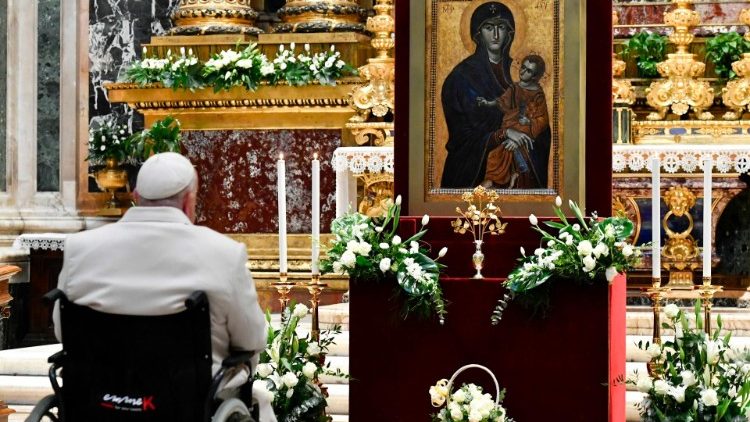
The Pope prays in front of the Salus Populi Romani in the Basilica of Santa Maria MaggioreThe Pope prays in front of the Salus Populi Romani in the Basilica of Santa Maria Maggiore  (Vatican Media)

Pope recalls end of Nazi occupation of Rome

Pope Francis writes a letter to mark the 80th anniversary of the vow made in Rome in front of the Marian icon ‘Salus Populi Romani’ after the city was liberated from the Nazis.

By Vatican News

This is the first time the event has been commemorated in this way, writes the Pope in his letter to the Viceregent of Rome, Auxiliary Bishop Baldassare Reina, which was published on Tuesday evening. 

On 4 June 1944, the people of Rome, together with their bishop, Pope Pius XII, implored Our Lady to save the city when a direct clash between the German army and the Anglo-American Allies was imminent and the city was facing "the nightmare of Nazi devastation".

Eighty years later, this is an occasion, the Pope said, “to pray for the victims of the Second World War and to reflect anew on the terrible scourge of war.”

“We cannot and must not give in to the logic of weapons!”

The innocent victims of wars in Ukraine, Palestine and Israel, Sudan, Myanmar and elsewhere challenge “the conscience of all”, the Pope wrote: “We cannot and must not give in to the logic of weapons!”

Everyday peacemakers

Peace is a gift from God, but it needs people who are willing to accept it “and commit themselves to being builders of reconciliation and witnesses of hope”, Pope Francis wrote.

He expressed his hope that the commemoration of the vow he made to Our Lady 80 years ago would inspire Romans “to be architects of true peace everywhere and to revive fraternity as an essential condition for the resolution of conflicts and hostilities”.

The Pope urged for a peaceful attitude in everyday life: it is a matter, he said, of advocating good relations between people “with courage and gentleness” and “reconciling tensions in the family, at work, at school and among friends”.

The Pope’s devotion to the Salus Populi Romani

In the eleven years of his pontificate, Francis has done much to revitalise devotion to the Marian icon Salus Populi Romani (‘Salvation of the Roman People’).

He regularly visits the image, which is kept in the Basilica of Santa Maria Maggiore, before and after journeys abroad, as well as on the Feast of the Conception on 8 December.

He often has it brought to the Vatican for his liturgies.

Most recently, this Roman icon of the Virgin Mary could be seen behind the Pope on Corpus Christi, when he gave the Eucharistic blessing at the end of the procession in front of Santa Maria Maggiore.

“The most important events in the religious and civil life of Rome found their echo in front of this image”

For centuries, the Pope writes in his letter, the image of the Virgin Mary has been “alive in the hearts of Romans”, who invoked her in prayer during epidemics, natural disasters and wars. “The most important events in the religious and civil life of Rome found their echo in front of this image,” said the Pope.

Thus, Romans also entrusted themselves to Maria Salus Populi Romani as they feared the destruction of their city by the Nazi occupiers in 1944.

4 June 1944: The peaceful liberation of Rome

On 4 June 1944, Rome was the first capital to be freed from Nazi occupation, and, contrary to fears, this was done without fighting.

Some contemporary witnesses considered it a miracle that the city was not devastated, especially as the Americans had bombed and completely destroyed Montecassino on 15 February.

The Vatican and Pope Pius XII (1939-1958) persuaded Field Marshal Albert Kesselring to declare Rome an ‘Open City’, a place that is not defended and therefore may not be attacked.

Thursday, March 14, 2024

Pope to beatify a priest and 15 nuns all martyred during World War II


2022.10.27 croce - fede

Pope recognizes martyrdom of priest, 15 nuns killed during World War II

Pope Francis authorizes the promulgation of several decrees recognizing the martyrdom of a priest guillotined in Nazi Germany and 15 German-born nuns killed in the Soviet Union, as well as miracles attributed to three Venerables.

By Vatican News

Among the soon-to-be Beatified are 16 martyrs, killed out of hatred for the faith under Nazism and Soviet communism. The group includes a priest guillotined in Nazi Germany and 15 nuns of German origin killed by soldiers of the Red Army or who died in concentration camps in Soviet Russia.

On Thursday, Pope Francis met with Cardinal Marcello Semeraro, Prefect of the Dicastery for the Causes of Saints, and authorized the promulgation of the decrees related to 25 Catholic women and men.

The decrees include recognition of the martyrdom of 15 German-born women religious who were serving in Poland during the invasion by the Red Army.

Sr. Christophora Klomfass and her 14 companions of the Congregation of the Sisters of St. Catherine, Virgin and Martyr (CSC) died in 1945.

The nuns were killed out of hatred for the faith by Soviet soldiers, enduring rape, torture, and death due to hardship, maltreatment, or diseases in concentration camps in Soviet Russia. As a fierce sign of contempt for the Christian faith, their tormentors often cut and tore their religious clothing.

A priest for peace and ecumenism during Hitler's time

Fr. Max Josef Metzger, a German diocesan priest and founder of the Secular Institute Societas Christi Regis, was killed on April 17, 1944, in Nazi Germany.

The priest was active in pacifist and ecumenical movements, and in 1917 he founded the Universal Peace League of the White Cross. Ten years later, he participated as a Catholic observer at the Lausanne Assembly, which gave rise to the Ecumenical Council of Churches.

Upon the rise of Nazism, he spoke out openly against Hitler. He was first arrested in 1939 and a second time in 1943.

Sentenced to death, he was guillotined on April 17, 1944, in the Brandenburg-Görden prison. He was aware that his commitment to peace and ecumenism, as well as his refusal of the Nazi regime in the name of Christ, could cost him his life.

The other future Beatified

Pope Francis also recognized miracles attributed to the intercession of three Venerables, clearing the way for their beatification.

Among the future new Beatified is also the Patriarch of Antioch of the Maronites, Stephane Douayhy, Lebanese, who lived in the 17th century (1630-1704). He performed an intense work of assistance to the poor and in favor of ecumenical dialogue between East and West.

The Pope also cleared the way for the beatification of Venerable José Torres Padilla, a Spanish diocesan priest, co-founder of the Congregation of the Sisters of the Company of the Cross (1811-1878), and Venerable Camillo Costa de Beauregard, a French diocesan priest (1841-1910), nicknamed the "father of orphans" for founding the Le Bocage orphanage in Chambery.

Seven new Venerables

The seven new venerables are:

-  Geervaghese Thomas Panickaruveetil Mar Ivanios, Archbishop of Trivandrum of the Syro-Malankara Catholic Church, founder in 1919 of the Congregations of the Order of the Imitation of Christ Bethany Ashram and the Sisters of the Imitation of Christ Bethany Madhom, a pioneer of ecumenism in India and first bishop of the Syro-Malankara Catholic Church;

-  Brazilian Fr. Liberio Rodrigues Moreira, (1884-1980) who spent his life for the sick and the poor and lived with deep Christian spirit the trials of life, tireless adorer of the Eucharist;

-  Professed layman Antonio Tomičić, (1901-1981) a Croatian of the Order of Friars Minor Capuchin, who during the years of communism, when wearing religious signs in public provoked ridicule and hostility, never took off his habit, enduring public insults and persevering, with firm trust in the Lord, in his quest for the needs of the brothers;

-  Italian laywoman and mother Maddalena Frescobaldi Capponi, (1771-1839) founder of the Congregation of the Passionist Sisters of St. Paul of the Cross;

-  Maria Alfinda Hawthorne, (1851-1926) founder of the Dominican Sisters of Saint Rose of Lima, born in the mid-19th century to a Protestant family in the US state of Massachusetts and became Catholic in Europe along with her husband, from whom she separated due to his alcoholism, then dedicating herself to the service of Christ in cancer patients;

-  Angelina Pirini, (1922-1940) lay leader of the parish Catholic Action in Celle di Sala di Cesenatico in Emilia Romagna died in 1940;

-  Elisabetta Jacobucci, (1858-1939) professed sister of the Institute of the Alcantarine Franciscan Tertiaries, lived at the turn of the 19th and 20th centuries. She was always willing to accept the most humble tasks, and managed to combine the ascetic aspect of the contemplation of the Passion with an intense charitable apostolate for orphans and the elderly.