Showing posts with label Mozambique. Show all posts

Sunday, February 1, 2026

Pope Leo XIV adds global prayer intentions at end of today's Angelus Address


Artisanal miners dig at the Rubaya coltan mine (file photo)Artisanal miners dig at the Rubaya coltan mine (file photo) 

Pope prays for over 200 dead in eastern DRC mine collapse

Pope Leo XIV prays for the hundreds of people who died this week when a coltan mine collapsed in the eastern part of the Democratic Republic of Congo and recalls the victims of storms in Mozambique and Portugal.

By Devin Watkins

A landslide struck a major coltan mining site in DR Congo’s eastern North Kivu province on Wednesday, collapsing several mines.

At least 200 people died in the incident at the Rubaya mines, according to the North Kivu province governor, who was appointed by the M23 rebels that control the area.

Speaking at the Angelus on Sunday, Pope Leo XIV expressed his closeness to the victims of the tragedy and their families.

“I assure my prayers for the many victims of the landslide in a mine in North Kivu, in the Democratic Republic of Congo,” he said. “May the Lord sustain that people who suffer so much!”

Leaders appointed by the M23 rebels temporarily halted artisanal mining near Rubaya, which lies around 50 kilometers from Goma.

The government of the Democratic Republic of Congo expressed solidarity with the victims but accused M23 rebels of illegally and unsafely exploiting the region’s natural resources.

DR Congo is a major supplier of coltan, a metallic ore containing minerals used to produce smartphones, computers, and aircraft engines, producing around 40 percent of the world’s supply in 2023.

Former miners from the area told the Associated Press that mines consist of large pits from which tunnels are dug by hand and left poorly maintained. Since many run parallel to one another, a collapse in one can cause several others to fail.

Prayers for flood victims in Mozambique, Portugal, Italy

At the Angelus, Pope Leo also prayed for the victims of recent storms in Portugal, southern Italy, and Mozambique.

At least 150 people were killed this week when severe storms struck Mozambique, and nearly a million people were affected by torrential rains and flooding.

In central Portugal, at least 6 people were killed due to Storm Kristin, which saw winds up to 202 kilometers per hour that left a trail of destruction.

Sunday, August 24, 2025

A couple of prayer intentions by Pope Leo XIV today


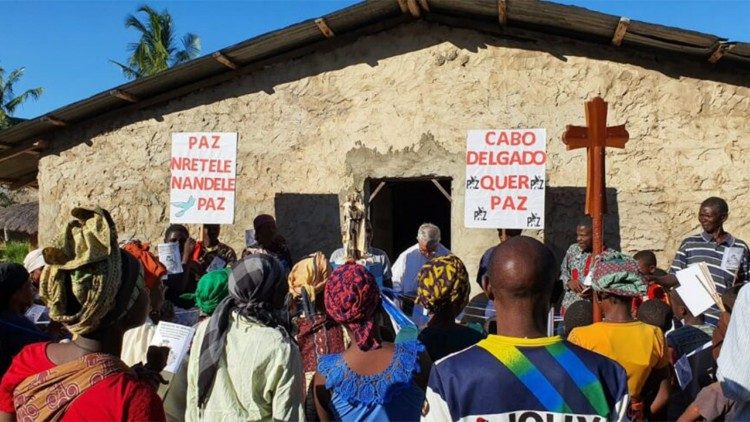
In Cabo Delagdo people hold up peace signs In Cabo Delagdo people hold up peace signs  

Pope prays for Mozambique: that the country’s leaders restore peace and security

After the Sunday Angelus, Pope Leo turns his thoughts to Mozambique’s Cabo Delgado province and to Ukraine, urging prayer and closeness for peoples wounded by violence and war.

By Francesca Merlo

At the conclusion of the recitation of the Angelus prayer on Sunday, Pope Leo XIV once again drew the world’s attention to regions suffering from violence, calling for prayer and concrete solidarity.

Closeness to Mozambique

The Pope first expressed his concern for the people of Cabo Delgado in Mozambique, who have endured years of insecurity caused by extremist violence. Since 2017, attacks in the northern province have killed thousands and forced more than a million people to abandon their homes, seeking safety in other parts of the country. 

“I express my closeness to the people of Cabo Delgado who have become victims of an unsecure and violent situation that continues to cause death and displacement,” said Pope Leo. He urged the faithful not to forget “these brothers and sisters of ours,” and expressed his hope that the efforts of Mozambique’s leaders will succeed in restoring security and peace.

Prayer for Ukraine

 dialogue be opened


Pope Leo then recalled the day of prayer and fasting observed on Friday, 22nd of August, for all those suffering from the scourge of war. With this in mind, and marking the anniversary of Ukraine's independence, he emphasised the initiative “World Prayer for Ukraine,” a spiritual appeal uniting Christians and people of goodwill across the globe to entrust the nation to the Lord.

“Today,” Pope Leo concluded, “we join our Ukrainian brothers and sisters who, with the spiritual initiative ‘World Prayer for Ukraine,’ are asking the Lord to grant peace to their tormented country.”

Thursday, October 10, 2024

At the Synod: a healthy discussion on the diaconate


Synod briefing – Day 7: The diaconate

Synod interventions on Tuesday and Wednesday focus on the themes of ecclesial discernment and Christian initiation; and speakers at the daily press briefing highlight the vocation of the diaconate.
Alessandro Di Bussolo and Giampaolo Mattei


De Cubber: A post-synodal encounter for deacons?

Deacon De Cubber repeated what he had said in the Synod Hall: the deacon is a ‘bridge-builder’ in the family, with other families, in the community, and also with wider society. This, he said, “can be really useful in a secularized society” like Belgium, which the Pope visited at the end of September after a brief stop in Luxembourg.

The deacon’s task, De Cubber added, is to go out and “go where the Church does not go, to those who have no voice and are marginalized by the Church itself and by society and bring them back into the Church.”

In a Church where the faithful are often tired and elderly, and where “if we do not walk in a synodal way the Church will not survive,” the Belgian deacon sought to bring synodality to the youth, uniting the youth ministries of all the Flemish-speaking dioceses in the effort.

Prompted by a journalist’s question, he admitted that deacons could have been better represented at the synod, and that he knows that deacons in the US, for instance, “where the ministry is very strong,” are “not very happy that we are so few.”

He thus proposed a post-synodal meeting of deacons in the future, as was done this year with parish priests.

“Being a deacon,” De Cubber concluded, “is not for me at all a preparation for the priesthood, I do not have this vocation. Ours is a ministry exclusively of service.”

Chile and the richness of the permanent diaconate

The Archbishop of Puerto Montt, Chile, Luis Fernando Ramos Pérez, was asked about the experience of the permanent diaconate in his country, which has seen many permanent deacons ordained in the wake of the Second Vatican Council. Today, he said, permanent deacons outnumber priests and religious, and their contribution – including collaborating with pastors in the administration of parishes – is “extraordinary and appreciated.”

At the same time, the Archbishop emphasized that deacons are not “miniature priests.”

For his part, Archbishop Inácio Saure, Archbishop of Nampula, Mozambique – the president of his country’s Episcopal Conference and a member of the Missionaries of the Consolata – explained that there are no deacons in his particular Church at the moment, because limited resources are already being used in the formation of priest. He noted, however, that in the future, if the opportunity arises, permanent deacons would certainly be ordained.

At the same time, he highlighted the need to prepare the parish communities, helping understand the difference between deacons and priests.

Sunday, February 18, 2024

The Pope's special prayer requests at today's Angelus


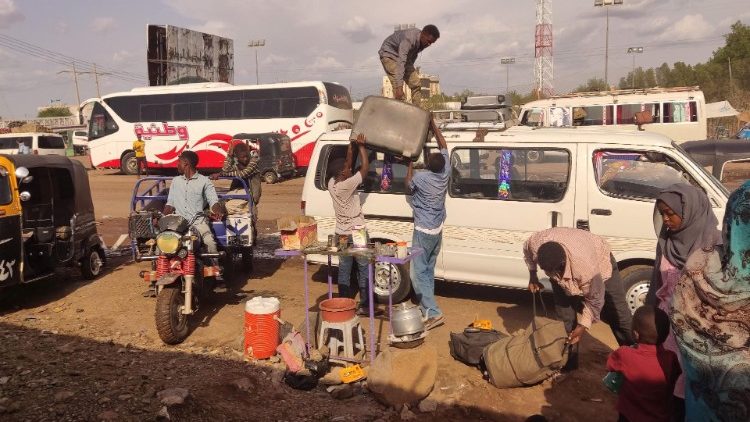
Sudanese families load a van to flee violence (file photo)Sudanese families load a van to flee violence (file photo)  (AFP or licensors)

Pope prays for Sudan, northern Mozambique as Catholic church attacked

Pope Francis urges global leaders to push for peace in Sudan and northern Mozambique, where a Catholic mission was set ablaze.

By Devin Watkins & Nathan Morley

“Wherever fighting occurs, people are exhausted, tired of war, which as always is pointless and inconclusive, and will only bring death, only destruction, and will never solve the problem.”

Pope Francis launched that appeal on Sunday after praying the Angelus prayer with pilgrims in St. Peter’s Square.

The Pope recalled that 10 months have passed since conflict broke out in Sudan, leading to a serious humanitarian situation.

“I once again ask the warring parties to stop this war, which causes so much harm to the people and the future of the country,” he said. “Let us pray that paths to peace are soon found to build the future of dear Sudan.”

Violences flares up in northern Mozambique

Pope Francis lamented a flare-up in “violence against defenseless populations, the destruction of infrastructure, and widespread insecurity” in the northern Cabo Delgado Region of Mozambique.

He noted that the Catholic mission of Our Lady of Africa in Mazeze was set ablaze.

According to Oliveira Amimo, the administrator of Mozambique’s Chiúre district, armed assailants destroyed the Catholic chapel and several people’s homes.

“Let us pray for peace to return to that tormented region,” said the Pope.

He also prayed for people suffering from conflict in other counties on the African continent, as well as in Ukraine and the Holy Land.

War, he recalled, “is always a defeat.”

“Let us instead pray tirelessly,” concluded Pope Francis, “because prayer is effective, and let us ask the Lord for the gift of minds and hearts dedicated concretely to peace.”

Misery continues in Sudan

Despite attempts to bring the brutal conflict in Sudan to an end, fighting is continuing in the country.

Sudan has been witnessing brutal armed clashes between the Sudanese army and the Rapid Support Forces––or RSF––since April 2023, with the two sides accusing each other of initiating the conflict.

Now, the Sudanese military––or SAF––have advanced in Omdurman for the first time since the war with the paramilitary RSF erupted.

Omdurman is regarded as the twin city to Sudan’s capital, Khartoum, which sits on the opposite side of the Nile.

On Sunday, reports from the country suggested that the SAF have joined their peers in the engineering corps in the south of the city, where they have been surrounded by the RSF for the last ten months.

The clashes in Sudan have left more than 25 million people reliant on humanitarian assistance with eight million forced from their homes, including 1.6 million who have fled to other countries.

Peace efforts

Last week, the UN Secretary-General’s Personal Envoy for Sudan embarked on renewed engagement to try and end the fighting.

The UN said Ramtane Lamamra trying to strengthen multilateral coordination around political and mediation efforts, working in support of and in close partnership with African and other regional and international partners.

The diplomat has already commenced a wide tour of key capitals in the Horn of Africa, in Europe and in the Gulf in a bid to relaunch a political process.

The United Nations has previously said the worsening situation is having a negative impact on neighboring countries, many of which are coping with their own crises.

Monday, December 23, 2019

The Apostolic Journeys of 2019 by Pope Francis

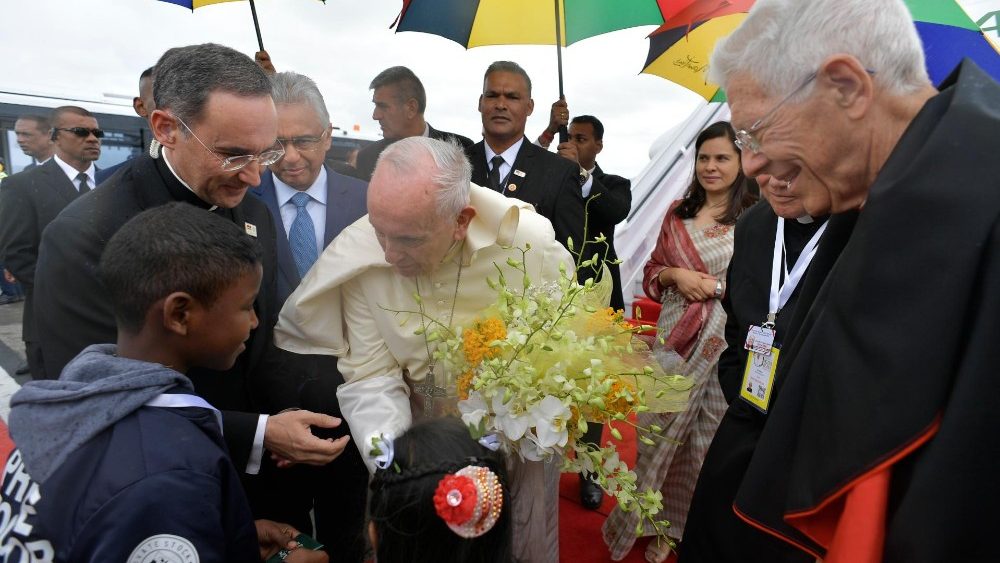
Pope Francis boarding a plane to Maputo, Mozambique. Pope Francis boarding a plane to Maputo, Mozambique.   (ANSA)


A Pontificate on the roads of the world


In 2019 Pope Francis made 7 international Apostolic Journeys to 11 countries. His has been an “itinerant pontificate” that has focused on the world’s geographical and existential peripheries.


By Alessandro Gisotti
 “I'll tell you something: I don't like to travel.”  These are the surprising words that Pope Francis pronounced on 9 June when addressing a group of children whom he received in the Vatican as part of the “Children's Train” initiative.  
It is a well-known fact that as Archbishop Jorge Mario Bergoglio of Buenos Aires, he rarely left his diocese.  There were few international trips, mostly to Latin America or to Rome for synods and consistories.  
However, the future Pope always kept alive the missionary spirit of a traveller, which as a young man made him dream of going to Japan in the footsteps of Saint Francis Xavier. This dream which he was unable to realize as a young Argentine Jesuit, was fulfilled this year when he visited the Land of the Rising Sun.  
Frankly speaking, the future Pope never stood still in his vast Archdiocese of Buenos Aires.   He travelled far and wide, and almost always used public transport.  It was a “normal thing” for the Argentine bishop and then cardinal.  However, this caused a sensation when, immediately after his election to the papacy, some earlier photos of the new Pope in a clerical shirt sitting like an ordinary commuter in a bus in the Argentine capital began circulating. 
Hence, he was a “callejero”  (itinerant) bishop, in the midst of the people, who preferred to spend time in the “Villas Miserias” (shanty towns) in the “existential peripheries” of the metropolis, rather than in the city centre.  As bishop, he always travelled within his diocese.  And so, when he became the Shepherd of the Universal Church, Pope Francis immediately felt that his diocese was now the world and that he had to set out again, with the same spirit that had animated him until then, but on a much larger space.
In his encounter with the “Children's Train”, Pope Francis admitted that in travels “you always find people, good people and you learn a lot”.  In these candid words, one can discover the purpose of Pope Francis’ travels - meeting people and understanding the contexts.  In some way, as the Washington Post also noted recently in an article by Chico Harlan, the Pope uses his Apostolic Journeys to “reform the Church” by focusing on the peripheries from which to draw the sap to initiate new processes of evangelization.
With a record number of Apostolic Journeys, 2019 has been a remarkable year of an “itinerant”, “synodal” pontificate.  This year, Pope Francis made 7 foreign trips, visiting 11 countries on 4 continents, equalling Pope Saint John Paul II, who also visited 11 countries in 1982.
On the other hand, it is significant that this year, so full of international journeys, coincides with the centenary of Pope Benedict XV's Maximum Illud on the Church’s missionary action in the world. With his travels, Pope Francis emphasizes precisely this intrinsically missionary dimension of the Lord's disciple,  who is called to be “outward going” to announce the Good News throughout the world, because no land is far away and no people is alien to the Word of God.
“Re-reading” the Pope’s 7 foreign trips this year, one can also find the great features of his pastoral thrust:  young people, in the trip to Panama for WYD; interreligious dialogue, in trips to the Arab Emirates and Morocco; ecumenical dialogue, in visits to Bulgaria and North Macedonia and then to Romania.   In his visits to Mozambique, Madagascar and Mauritius, the themes of the protection of the environment and care of the poor were predominant.  Finally, peace and the promotion of women's and children's rights were the key points of his Asian trip to Thailand and Japan.
In his remarks to journalists, on his flight to Thailand, he noted that “it is so good for people to be informed and also to know the cultures that are far from the West”.   With his travels, the Pope actually brings light to corners of the world where the mass media would never go, but which, thanks to his presence, become “visible” to the international community, which is called to care for peoples and lands otherwise forgotten.  
These Apostolic Journeys also promote the “culture of encounter” well beyond the moment after the Pope flies back to Rome.  This is true not only for the people but also for him.  In an interview, he confided carrying in his heart the people he met in his travels, that he prayed "for them, for the painful and difficult situations", so that the inequalities he saw may be reduced.

Tuesday, September 10, 2019

Pope Francis concludes his 4th Apostolic Visit to Africa

© Vatican Media

Pope Concludes Visit to Mozambique, Madagascar, & Mauritius, Marking 4th Apostolic Visit in Africa

Francis Will Still Have His General Audience Tomorrow Morning

After celebrating Mass in private and saying his final farewells, Pope Francis has departed from Madagascar and is returning toward Rome.
Before leaving for the airport, Francis also greeted about ten poor elderly women at the apostolic nunciature where he was staying who represent those who the nunciature assists every Friday.
At 9:40 a.m. local time (8:40 Rome time) today, the Madagascar Airlines A340neo papal flight carrying the Pope, his entourage and journalists, took off from Madgascar’s Antananarivo Airport, en route for Rome’s Ciampino Airport.
The Holy Father’s Sept. 4-10 visit to the ‘three ‘M’s’ of Mozambique, Madagascar, and Mauritius, marked the Pope’s fourth visit to Africa, his second to Sub-Saharan Africa, and represented the Holy Father’s attention to the peripheries and the poor. It also marked his 31st Apostolic Trip.
Each of these nations had been visited by St. Pope John Paul II during his pontificate.
As is customary, Pope Francis likely this evening will visit Rome’s Basilica of Santa Maria Maggiore to thank Our Lady for the fruits of the trip, and for her help and protection.
The Holy Father will also hold his press conference on the return flight and ZENIT will provide you with the full English translation of the Q & A as soon as possible.
Tomorrow morning, the Pope will still have his weekly General Audience in the Vatican.