Showing posts with label Bulgaria. Show all posts

Monday, December 23, 2019

The Apostolic Journeys of 2019 by Pope Francis

Pope Francis boarding a plane to Maputo, Mozambique. Pope Francis boarding a plane to Maputo, Mozambique.   (ANSA)


A Pontificate on the roads of the world


In 2019 Pope Francis made 7 international Apostolic Journeys to 11 countries. His has been an “itinerant pontificate” that has focused on the world’s geographical and existential peripheries.


By Alessandro Gisotti
 “I'll tell you something: I don't like to travel.”  These are the surprising words that Pope Francis pronounced on 9 June when addressing a group of children whom he received in the Vatican as part of the “Children's Train” initiative.  
It is a well-known fact that as Archbishop Jorge Mario Bergoglio of Buenos Aires, he rarely left his diocese.  There were few international trips, mostly to Latin America or to Rome for synods and consistories.  
However, the future Pope always kept alive the missionary spirit of a traveller, which as a young man made him dream of going to Japan in the footsteps of Saint Francis Xavier. This dream which he was unable to realize as a young Argentine Jesuit, was fulfilled this year when he visited the Land of the Rising Sun.  
Frankly speaking, the future Pope never stood still in his vast Archdiocese of Buenos Aires.   He travelled far and wide, and almost always used public transport.  It was a “normal thing” for the Argentine bishop and then cardinal.  However, this caused a sensation when, immediately after his election to the papacy, some earlier photos of the new Pope in a clerical shirt sitting like an ordinary commuter in a bus in the Argentine capital began circulating. 
Hence, he was a “callejero”  (itinerant) bishop, in the midst of the people, who preferred to spend time in the “Villas Miserias” (shanty towns) in the “existential peripheries” of the metropolis, rather than in the city centre.  As bishop, he always travelled within his diocese.  And so, when he became the Shepherd of the Universal Church, Pope Francis immediately felt that his diocese was now the world and that he had to set out again, with the same spirit that had animated him until then, but on a much larger space.
In his encounter with the “Children's Train”, Pope Francis admitted that in travels “you always find people, good people and you learn a lot”.  In these candid words, one can discover the purpose of Pope Francis’ travels - meeting people and understanding the contexts.  In some way, as the Washington Post also noted recently in an article by Chico Harlan, the Pope uses his Apostolic Journeys to “reform the Church” by focusing on the peripheries from which to draw the sap to initiate new processes of evangelization.
With a record number of Apostolic Journeys, 2019 has been a remarkable year of an “itinerant”, “synodal” pontificate.  This year, Pope Francis made 7 foreign trips, visiting 11 countries on 4 continents, equalling Pope Saint John Paul II, who also visited 11 countries in 1982.
On the other hand, it is significant that this year, so full of international journeys, coincides with the centenary of Pope Benedict XV's Maximum Illud on the Church’s missionary action in the world. With his travels, Pope Francis emphasizes precisely this intrinsically missionary dimension of the Lord's disciple,  who is called to be “outward going” to announce the Good News throughout the world, because no land is far away and no people is alien to the Word of God.
“Re-reading” the Pope’s 7 foreign trips this year, one can also find the great features of his pastoral thrust:  young people, in the trip to Panama for WYD; interreligious dialogue, in trips to the Arab Emirates and Morocco; ecumenical dialogue, in visits to Bulgaria and North Macedonia and then to Romania.   In his visits to Mozambique, Madagascar and Mauritius, the themes of the protection of the environment and care of the poor were predominant.  Finally, peace and the promotion of women's and children's rights were the key points of his Asian trip to Thailand and Japan.
In his remarks to journalists, on his flight to Thailand, he noted that “it is so good for people to be informed and also to know the cultures that are far from the West”.   With his travels, the Pope actually brings light to corners of the world where the mass media would never go, but which, thanks to his presence, become “visible” to the international community, which is called to care for peoples and lands otherwise forgotten.  
These Apostolic Journeys also promote the “culture of encounter” well beyond the moment after the Pope flies back to Rome.  This is true not only for the people but also for him.  In an interview, he confided carrying in his heart the people he met in his travels, that he prayed "for them, for the painful and difficult situations", so that the inequalities he saw may be reduced.

Wednesday, May 8, 2019

Zenit's much delayed story of the General Audience

© Vatican Media

General Audience: Pope Looks Back on Visit to Bulgaria, North Macedonia

‘I was guided in Bulgaria by the lively memory of Saint John XXIII.’

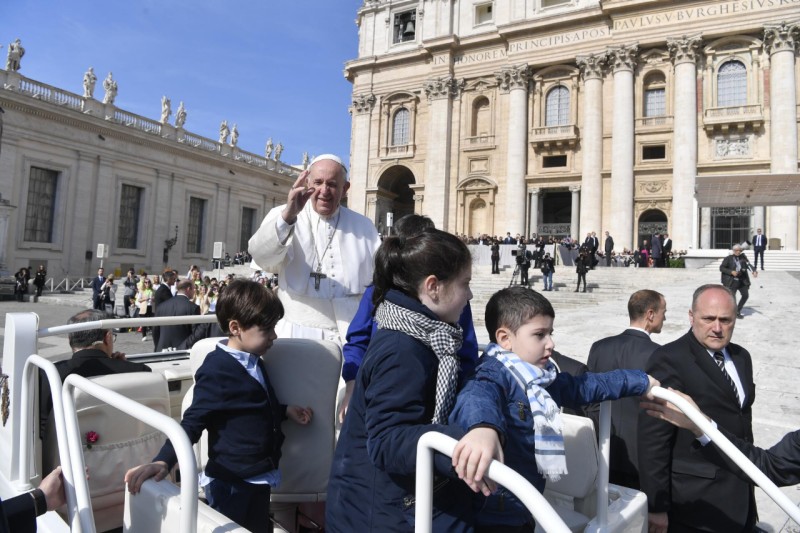
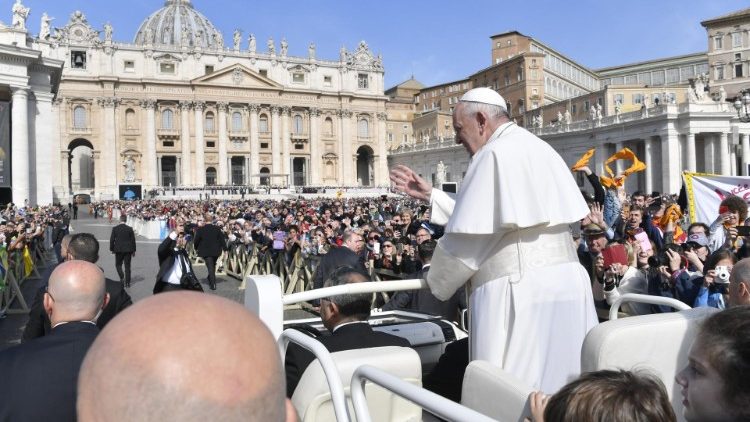
This morning’s General Audience was held at 9:10 in St. Peter’s Square, where the Holy Father Francis met with groups of pilgrims and faithful from Italy and from all over the world.
In his address in Italian, the Pope focused his meditation on his Apostolic Journey to Bulgaria and North Macedonia, which ended yesterday evening (Biblical passage: From the Gospel according to Luke 12:22.30-32).
After summarizing his catechesis in several languages, the Holy Father expressed special greetings to groups of faithful present.
The General Audience ended with the singing of the Pater Noster and the Apostolic Blessing.
* * *
The Holy Father’s Catechesis
Dear Brothers and Sisters, good morning!
I returned yesterday evening from a three-day Apostolic Journey, which took me to Bulgaria and North Macedonia. I thank God for enabling me to make these visits, and I renew my gratitude to the Civil Authorities of these two countries, which received me with great courtesy and availability. My most cordial “thank you” goes to the Bishops and to the respective Ecclesial Communities for the warmth and devotion with which they accompanied my pilgrimage.
I was guided in Bulgaria by the lively memory of Saint John XXIII, who was sent to that country in 1925 as Visitor and then as Apostolic Delegate. Animated by his example of pastoral benevolence and charity, I met that people — called to be a bridge between Central, Eastern and Southern Europe, — with the motto “Pacem in Terris,” I invited all to walk on the way of fraternity and on this way I had, in particular, the joy of taking a step forward in the meeting with Patriarch Neofit of the Bulgarian Orthodox Church and the Members of the Holy Synod. In fact, as Christians, our vocation and mission are to be sign and instrument of unity, and we can be so, with the help of the Holy Spirit putting first what unites us to what has divided or still divides us.
Present-day Bulgaria is one of the lands evangelized by Saints Cyril and Methodius, whom Saint John Paul II placed next to Saint Benedict as Patrons of Europe. At Sofia, in the majestic Patriarchal Cathedral of Saint Alexander Nevsky, I paused in prayer before the sacred image of the two Holy Brothers. Of Greek origin, they were able to use their culture with creativity, to transmit the Christian message to the Slav people. They invented a new alphabet with which they translated the Bible and liturgical texts into the Slavic language. Also today, there is need of passionate and creative evangelizers, so that the Gospel can reach all those that still don’t know it and be able to water again the lands where the ancient Christian roots are parched. With this horizon, I celebrated the Eucharist twice with the Catholic community in Bulgaria and encouraged it to be hopeful and generative. I thank those people of God again, who showed me so much faith and so much affection.
The last act of the journey in Bulgaria was carried out together with the representatives of the different religions: we invoked from God the gift of peace, while a group of children carried lighted torches, symbol of faith and hope.
In North Macedonia, I was accompanied by the strong spiritual presence of Saint Mother Teresa of Calcutta, who was born in Skopje in 1910 and received, in her parish there, the Sacraments of Christian Initiation and learned to love Jesus. In this woman, minute but full of strength thanks to the Holy Spirit’s action in her, we see the image of the Church in that country and in other peripheries of the world: a small community that, with the grace of Christ, becomes a welcoming home where many are restored for their life. At Mother Teresa’s Memorial, I prayed, in the presence of other religious leaders and of a large group of poor, and I blessed the first stone of a Shrine dedicated to her. North Macedonia is a country that has been independent since 1991. The Holy See has sought to support its path from the beginning. I wished to encourage especially, with my journey, its traditional capacity to host different ethnic and religious groups, as well as its commitment in welcoming and helping a great number of migrants and refugees during the critical period of 2015 and 2016.
It is a young country from the institutional point of view; a small country in need of opening itself to wide horizons without losing its own roots. Significant, therefore, was the fact that the meeting with young people happened there. They were boys and girls from different Christian Confessions and also from other religions, all united by the desire to build something beautiful in life. I exhorted them to dream big and to get involved, as young Agnes — the future Mother Teresa — listening to God’s voice who speaks in prayer and in the flesh of needy brothers.
In addition to the testimonies of young people, in Skopje, I listened to those of priests and of consecrated persons, men, and women who have given their life to Christ. For them, sooner or later, comes the temptation to say: “Lord, what is this small gift of mine in face of the problems of the Church and of the world?” Therefore, I reminded them that a little leaven can make the whole dough grow, and a little perfume — pure and concentrated — can permeate with a lovely scent the whole environment. It’s the mystery of Jesus-Eucharist, seed of new life for the whole of humanity. The Holy Mass celebrated in the Square of Skopje, renewed once again in the periphery of today’s Europe, the miracle of God, who with a few loaves and fish, broken and shared, satiates the hunger of the multitudes.
We entrust to His inexhaustible Providence the present and future of the peoples I visited on this trip.
[Original text: Italian]  [ZENIT’s translation by Virginia M. Forrester]
© Libreria Editrice Vatican

In Italian
Proclaimed Blessed last Saturday in Mexico City was Maria de la Concepcion Cabrera, mother of a family, who witnessed the salvific value of Christ’s Cross, inspiring the foundation of various religious and lay institutions. We thank God for this, His courageous witness!
A warm welcome goes to the Italian-speaking pilgrims.
I’m happy to receive the Capitulars of the Capuchin Tertiaries; the new Priests of the Legionaries of Christ, with their relatives; the docents and students of the Pontifical Athenaeum “Regina Apostolorum” of Rome, on the 25th anniversary of its foundation.
I greet the parish groups; the school institutes, in particular, the “Leonardo da Vinci” Lyceum of Pescara and the Highlands Institute of Rome; the “Bell of Peace” delegation of Vigo di Fassa and that of Cisco Italia, and of the Meter Association, committed against the exploitation of children.
A special thought goes to young people, the elderly, the sick and newlyweds.
Observed today is the Supplication to Our Lady of Pompeii.  We are in spiritual union with all those in that Marian Shrine, as elsewhere, who will come together at midday to recite with faith the Prayer to Our Lady, so that She may turn her gaze on the world and intercede for the whole Church and for all those suffering in body and in spirit.

Wednesday General Audience 05.08.2019

Pope Francis at the general audience in Rome's St. Peter's Square on May 8,  2019. Pope Francis at the general audience in Rome's St. Peter's Square on May 8, 2019.   (Vatican Media)


Pope at Audience: memories of trip to Bulgaria and North Macedonia


At this week’s Wednesday’s General Audience in St Peter’s Square, Pope Francis reflects on his Apostolic journey to Bulgaria and North Macedonia.


By Vatican News
Pope Francis’ reflections at this Wednesday’s General Audience were really a synthesis of his recent Apostolic journey to Bulgaria and North Macedonia.

Bulgaria and Saint John XXIII

The Pope began by saying how, in Bulgaria, he was “guided by the living memory of Saint John XXIII”, who spent nearly ten years in the country as Apostolic Delegate. The motto chosen for the Bulgaria leg of the trip was the title of Pope John XXIII’s encyclical, "Pacem in Terris". Inspired by this motto, Pope Francis said he had “invited everyone to walk on the path of brotherhood”, and mentioned his meeting with the Patriarch of the Bulgarian Orthodox Church and Members of the Holy Synod. “As Christians, our vocation and mission is to be a sign and instrument of unity”, he said.

Bulgaria and Saints Cyril and Methodius

The Pope also mentioned the Saintly Brothers Cyril and Methodius, evangelizers of Bulgaria. They were of Greek origin, but they used “their culture creatively to transmit the Christian message to the Slav peoples”, said Pope Francis. “Even today there is a need for passionate and creative evangelizers”, he added, “so that the Gospel may reach those who do not yet know it and may irrigate again the lands where ancient Christian roots have dried up”.

North Macedonia and Saint Mother Teresa

The second stop on the Pope’s three-day Apostolic journey was to North Macedonia. There he said “the strong spiritual presence of Mother Teresa of Calcutta” accompanied him. Mother Teresa was born in Skopje, the present-day capital of North Macedonia, in 1910. In this small but strong woman “we see the image of the Church in that country”, said Pope Francis, noting that he had prayed at Mother Teresa's Memorial, and blessed the first stone of a shrine dedicated to her.

North Macedonia and the young

Pope Francis explained how, with this visit, his intention was to encourage what he called North Macedonia’s “traditional capacity to host different ethnic and religious affiliations”, as well as the country’s “commitment to welcoming and helping a large number of migrants and refugees”.
This is a “young country from an institutional point of view”, said the Pope. Which is why his meeting with young people was so significant. Pope Francis said he invited them “to dream big and get involved”, just like the future Mother Teresa, “listening to the voice of God”, who speaks to us in prayer, and responding concretely to “our needy brothers and sisters”.

Tuesday, May 7, 2019

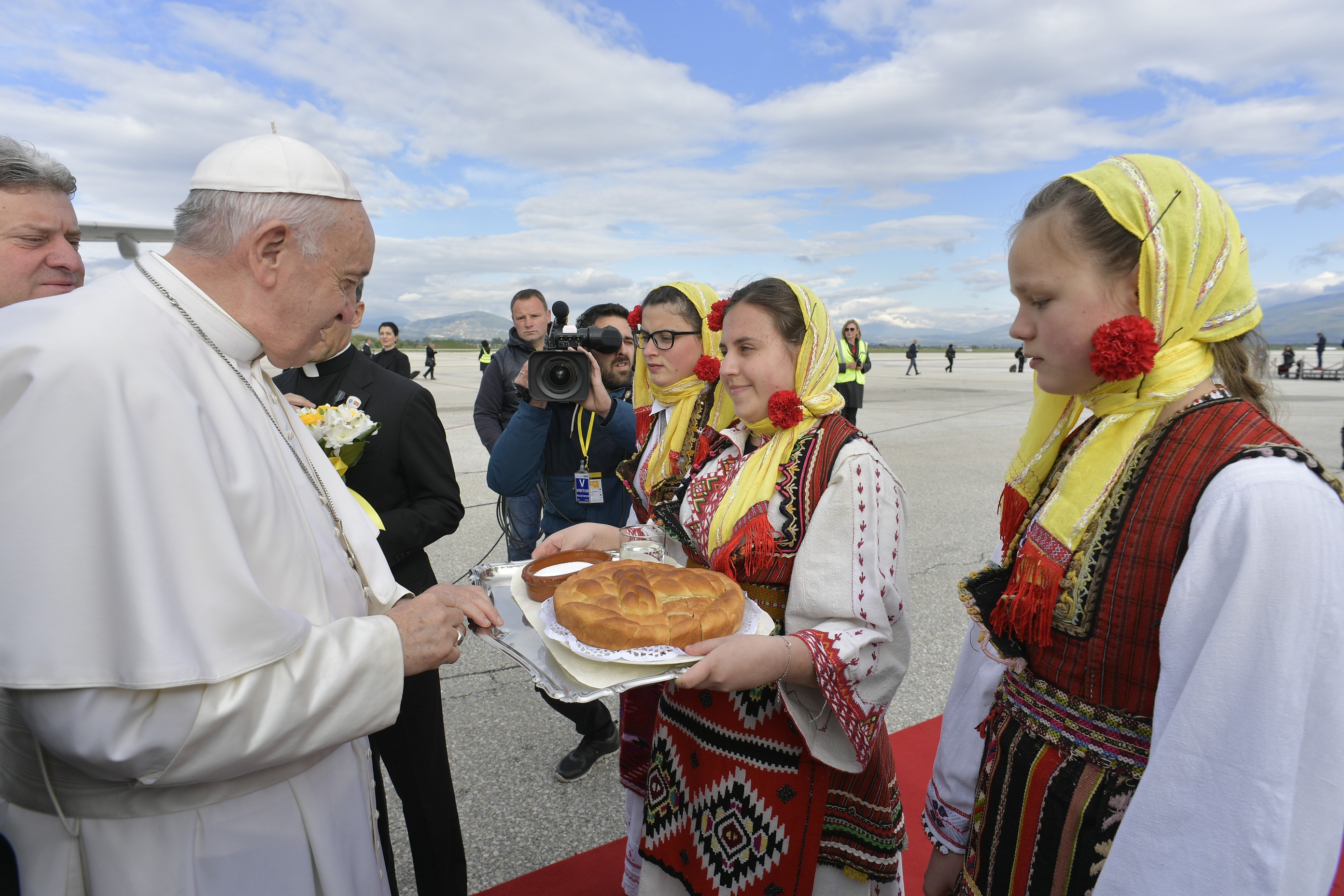
Pope Francis arrives in North Macedonia

Pope in Macedonia - Vatican Media Photo

For 1st Time in History, a Roman Pontiff Visits North Macedonia

Remembering Incredible Person and Impact of Saint Mother Teresa (ZENIT Has Been Covering Francis’ 29th Apostolic Trip on the Ground)

For the first time in history, a Roman Pontiff has stepped foot in North Macedonia, formerly known as Macedonia.
With the intention to remember and celebrate the incredible life of Mother Teresa, encourage the country’s minuscule Catholic community (less than 0.4%, with only one bishop) and encourage ecumenical dialogue, Pope Francis has made this visit. He is kicking off his day in North Macedonia, May 7, his final day of his May 5-7, Apostolic Visit there and to Bulgaria.