Showing posts with label Synod of Bishops. Show all posts

Tuesday, May 5, 2026

Final Synod Report released for selecting Bishop candidates and following theological criteria and methodologies


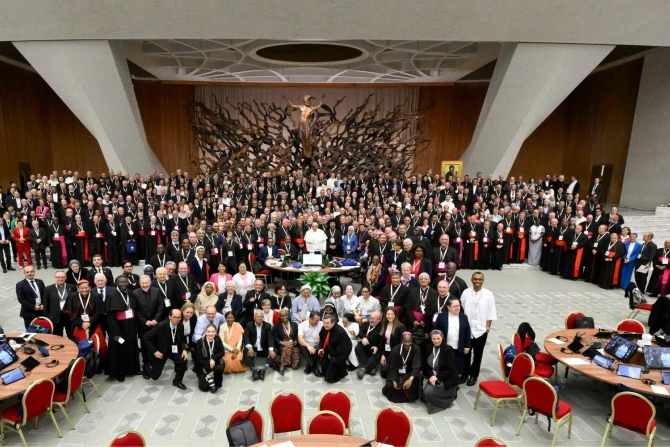
Bishops gathered in the New Synod HallBishops gathered in the New Synod Hall  (@Vatican Media)

Synod releases final reports on selection of bishops, emerging issues

The General Secretariat of the Synod publishes the first part of the Final Report of Study Group No.7, regarding criteria for selecting candidates for the episcopate, and the Report of Study Group No. 9, on theological criteria and synodal methodologies for discerning doctrinal, pastoral, and ethical questions.

By Antonella Palermo

The Final Reports of Study Groups No. 7 & 9 reaffirm that discernment lies at the heart of selecting a bishop, while adopting specific theological criteria to discern how to address the most difficult questions facing the Church, according to Cardinal Mario Grech, Secretary General of the General Secretariat of the Synod of Bishops.

As reflection continues on the judicial function of the bishop, ad limina apostolorum visits, and the formation of bishops, the preliminary part of the Final Report on the criteria for selecting bishops has been released.

The report reaffirms the underlying premise that there is no shepherd without a flock, and no flock without a shepherd.

The synodal competencies identified by Study Group No. 7 for candidates include the ability to build communion, engage in dialogue, possess deep knowledge of local cultures, and show a willingness to integrate into them constructively.

The group calls for Apostolic Nuncios to have “a synodal and missionary profile,” so that he may also look for this profile in those proposed as possible bishops.

The report states that every diocese should periodically carry out processes of discernment regarding its situation and needs, verifying whether those processes meet the standards of a synodal and missionary Church, in order to promote the sharing of best practices.

“As an episcopal succession approaches, the Bishop is to convene the Presbyteral Council and the Diocesan Pastoral Council, whose members express, in a collegial manner, an opinion on the needs of the diocese and submit to the Bishop – in a sealed envelope – the names of priests they consider suitable for the episcopate,” it says. “Where possible, consultation is also to include the Cathedral Chapter, the Finance Council, the Lay Council, and representatives of consecrated persons, young people and the poor.”

Involvement of consecrated persons and laypeople in consultations

The Study Group encourages what it describes as “a formative investment,” aimed at helping all members of the People of God sharpen their capacity for discernment.

It proposes creating dedicated teams to assist the bishop in the ongoing formation of the clergy.

In cases where a local see is vacant, the group suggests that a committee be established in the diocese, which the Nuncio may consult in order to clarify the state of the diocese, the profile of the new shepherd, and possible candidates.

The Group recommends that consultations involve not only clerics, but also, as far as possible, an equivalent number of consecrated men and women, laymen and laywomen. The aim, it explains, is to bring out the truth as fully as possible.

The Report also asks the Dicastery's of the Roman Curia to review their procedures in a more synodal direction and proposes periodic forms of independent evaluation of selection processes.

Linguistic and methodological paradigm shift

The Final Report of Study Group No. 9 draws on the biblical image found in chapters 10–15 of the Acts of the Apostles, which shows how cultural diversity can be valued without betraying the newness of the Gospel.

It proposes a change of paradigm in the way the Church addresses the most difficult doctrinal, pastoral, and ethical questions.

First, the report prefers the adjective “emerging” rather than “controversial” to describe these questions.

The statement explains that “the aim is not merely to resolve problems but to build the common good through relational conversion, shared learning and transparency.”

In addition, since there can be no proclamation of the Gospel without taking responsibility for the interlocutor, “in whom the Spirit is already at work,” the document introduces the “principle of pastorality.”

The report identifies three methodological steps for addressing these questions: listening to ourselves, listening to reality, and convening different forms of knowledge.

Conversation in the Spirit, it recalls, remains the privileged tool for developing an ecclesial culture of synodality.

Concrete testimonies as basis for discernment

The report calls for these guidelines to be applied concretely to the experience of homosexual Catholics and the practice of active nonviolence.

With regard to forms of nonviolence in particular, the group was guided by the testimony of a movement of young Serbs who contributed to the peaceful fall of Milošević, drawing inspiration from the Christians of the early Church.

In both cases, testimony serves as the starting point for paths of ethical and theological discernment, as well as for open questions, so that every community may take up “the responsibility of recognizing and promoting the good through which God acts in history and in people’s experience.”

Tuesday, March 3, 2026

Two Study Group reports, # 3 and #4, are now Final Reports in the Synod on Synodality


File photo of the Synod on SynodalityFile photo of the Synod on Synodality  (ANSA)

Synod Office releases first two Final Reports of the Study Groups

The General Secretariat of the Synod publishes the first two Final Reports of the Study Groups established by Pope Francis following the First Session of the XVI Ordinary General Assembly of the Synod of Bishops: that of Study Group No. 3 on 'The mission in the digital environment' and that of Study Group No. 4 on 'The revision of the Ratio Fundamentalis Institutionis Sacerdotalis in a missionary synodal perspective.'

By Vatican News

The General Secretariat of the Synod has today released the first two Final Reports of the Study Groups established by Pope Francis following the First Session of the XVI Ordinary General Assembly of the Synod of Bishops.

The reports published were that of Study Group No. 3 on 'The Mission in the Digital Environment' and Study Group No. 4 on 'The Revision of the Ratio Fundamentalis Institutionis Sacerdotalis in a Missionary Synodal Perspective.'

Pope Leo XIV has directed the publication of these Final Reports to share with the entire People of God the fruits of the reflection and discernment undertaken during the Synod, in a spirit of transparency and accountability. The Final Reports are published in English and Italian, with an indication of the original language and the working translation.

A summary, available in various languages, accompanies each Report to facilitate access. With the presentation of their Final Reports, Study Groups No. 3 and No. 4 conclude their mandate and are therefore to be considered dissolved.

The General Secretariat will continue to release the Final Reports progressively, with the next publication scheduled for 10 March 2026.

Cardinal Mario Grech, Secretary General of the Synod, said that the Reports, “beyond the value of their content," "testify to the shared journey undertaken with the Dicastery's.

"It is not the first time that the Dicastery's have collaborated on a common project, but here," he added, "there is something more: an authentic exercise of shared listening, reflection, and discernment. It is synodality put into practice, not merely bureaucratic cooperation.”

The Mission in the Digital Environment

The Report of Study Group No. 3 addresses a central question that emerged during the XVI Assembly, namely, how to live the Church’s mission within a culture increasingly shaped by the digital sphere.

The Group, drawing on a broad consultation involving pastoral workers, experts, and ecclesial realities from all continents, gathered experiences, analyzed challenges, and formulated concrete recommendations.

Key themes include the need to integrate digital mission into the Church’s ordinary structures, an in-depth analysis of territorial jurisdiction in light of online communities, and the formation of pastors and pastoral workers in digital culture.

The Report concludes with a series of operative proposals articulated at three levels: the Holy See, Episcopal Conferences, and dioceses. It also includes an extensive section on the methodology adopted and the entities consulted.

Formation to the Priesthood

Rather than proceeding with a revision of the Ratio Fundamentalis Institutionis Sacerdotalis (2016), which is still considered valid in its fundamental principles, Study Group No. 4 opted to elaborate a Proposal for a Guiding Document for its implementation in a missionary synodal key, in line with the Final Document of the XVI Assembly.

The document is structured in two parts. The Preamble offers an ecclesiological-pastoral framework and identifies a series of necessary conversions in priestly formation: relational, missionary, toward communion, toward service, and toward a synodal style. At its heart lies a central insight: the identity of the priest is formed “in and from” the People of God, not in separation from it.

The Guidelines in the second part translate these conversions into concrete operative pathways.

Some of the most significant proposals include alternating residence between the seminary and parish communities or other ecclesial contexts; shared formative experiences and moments with lay faithful, consecrated persons, and ordained ministers, starting from the propaedeutic stage; the inclusion of qualified and competent women as co-responsible at all levels of formation, including within formation teams; and the acquisition of skills for co-responsibility and communal discernment.

The Group also proposed a pathway for the dissemination and implementation of the operative directions offered.

Nature and publication of the Final Reports

Along with the Final Report of Study Group No. 3, the General Secretariat also published a Note outlining the origin and mandate of the Study Groups, the nature of the Reports, and the envisaged operational follow-up.

In the note, it highlights that the Final Reports are the fruit of a structured process: the listening to diverse competencies and professional expertise, the analysis of numerous contributions, academic research, dialogue with various ecclesial bodies, from Episcopal Conferences to Catholic universities, and, above all, discernment and prayer.

They are to be understood as working documents.

Pope Leo XIV has directed that the Final Reports be published progressively, as they are presented to the General Secretariat of the Synod, in a spirit of transparency.

In order that the content that has emerged may be translated into concrete orientations, decisions and processes, the Holy Father has requested the competent Dicastery's and the General Secretariat of the Synod to draw up, on the basis of the Final Reports, operative proposals, also giving an account of the choices made and of any elements not received.

This joint effort, the General Secretariat's note continues, ensures coherence with the synodal dynamism and rootedness in the Church’s missionary perspective.

The operative proposals thus formulated will be submitted to the Holy Father, who will evaluate and may approve them.

With the submission of the Final Report to the General Secretariat of the Synod, the Study Groups that have delivered it conclude the mandate entrusted to them and are therefore to be considered dissolved.

Monday, October 28, 2024

The Synod's final document; now what?


The Synod on Synodality’s final document: What you need to know


Participants of the Synod on Synodality gather for a group photo on Oct. 26, 2024. | Credit: Vatican Media


In a significant departure from previous synods, Pope Francis adopted the final document of the Synod on Synodality on Saturday, forgoing the traditional apostolic exhortation in favor of direct implementation of the assembly’s conclusions.

The 52-page document, approved by 355 synod members in attendance, outlines substantial proposals for Church renewal.

The proposals include expanded women’s leadership roles, greater lay participation in decision-making, and significant structural reforms.

Key developments

The document emerges from a two-year consultative process that began in 2021, incorporating 1,135 amendments from both collective and individual submissions.

Compared with its 2023 predecessor, the text presents more concrete recommendations and clearer structural guidelines.

The final document is organized into five main sections and calls for five forms of conversion: spiritual, relational, procedural, institutional, and missionary.

Structural reforms

Among the most significant proposals is a call for strengthening pastoral councils at parish and diocesan levels.

The document advocates for regular ecclesiastical assemblies across all Church levels — including continental — and heightened ecumenical dialogue.

The text introduces the concept of synodal authority while acknowledging that in “a synodal Church, the authority of the bishop, of the episcopal college, and of the bishop of Rome in regard to decision-taking is inviolable.”

“Such an exercise of authority, however, is not without limits,” the document adds.

On this view, the text calls for a revision in canon law, “clarifying the distinction and relation between consultation and deliberation and shedding light on the responsibilities of those who play different roles in the decision-making process.”

Women’s leadership

In a notable development, the document explicitly states there is “no reason or impediment” to prevent women from assuming leadership roles in the Church.

Furthermore, “the question of women’s access to diaconal ministry remains open,” and that discernment should continue.

The text advocates for increased female participation in clergy formation and broader involvement in Church decision-making processes.

Lay participation

The document significantly expands the role of lay faithful in Church governance. It calls for their increased presence in synodal assemblies and all phases of ecclesiastical decision-making.

New procedures for selecting and evaluating bishops and expanded lay participation in diocesan leadership and canonical processes are proposed.

Implementation phase

While Pope Francis has declared the synodal path “completed,” the document emphasizes that a crucial implementation phase lies ahead. This next stage will focus on integrating synodality as a “constitutive dimension of the Church.”

The text also addresses accountability measures, calling for enhanced financial transparency and protocols for abuse prevention, declaring: “The need within the Church for healing, reconciliation, and the rebuilding of trust has resounded at every stage of the synodal process.”

Background

The document represents the culmination of one of the most extensive consultative processes in Church history, building on both the 2023 assembly’s work and the broader synodal journey initiated by Pope Francis in 2021.

The exercise aimed to balance traditional Church teaching with contemporary pastoral needs while promoting greater inclusivity and transparency in Church governance.

This article was first published by ACI Prensa, CNA's Spanish-language news partner, and has been translated and adapted by CNA.

Monday, October 21, 2024

Drafting the final synod document


File photo: Timothy Radcliffe addresses the synodFile photo: Timothy Radcliffe addresses the synod  (ANSA)

Radcliffe on drafting of final synod document - full text

Reflecting on the process of drafting of the final synod document, Fr Timothy Radcliffe urges participants to speak "with freedom", as "free children of God".

Meditation by the  Rev. Timothy Radcliffe, O.P.


Monday, 21st October 2024

We are about to embark on our last task, to consider the final document, amend and vote on it. Today we prepare ourselves to exercise this weighty responsibility. How are we do so?

With freedom! St Paul wrote to the Galatians, ‘For freedom, Christ has set us free.’ (5.1). Our mission is to preach and embody this freedom. Freedom is the double helix of the Christian DNA. First of all, it is the freedom to say what we believe and to listen without fear to what others say, in mutual respect. This is freedom of the children of God to speak boldly, with parrésia (e.g. Acts 4.29), as the disciples boldly declared the good news of the Resurrection in Jerusalem. Because of this freedom, each of us can say ‘I’. We do not have the right to keep silent.

This freedom is rooted in a deeper freedom, interior freedom of our hearts as we discover the decisions that are taken. We may be disappointed with the decisions of the Synod. Some of us will consider these to be ill-advised or even wrong. But we have the freedom of those who believe that, as St Paul wrote to the Romans, ‘God works all for the good of those who love him’ (Romans 8.28). And, we hope, even for those who do not! We can be at peace because ‘nothing can separate us from the love of God’, not even incompetence, not even mistakes. Because of this freedom, we can dare to belong to the Church and say ‘We.’

The heart of our decision making is this double helix of graced freedom. For God’s freedom operates in the very depths of our own free thinking and deciding. St Thomas Aquinas taught that grace perfects nature. It does not destroy it.  When St Thomas asked how the wise men managed to get to Bethlehem so quickly he replied that it was due to the grace of God and the speed of the dromedaries[1]!

Let consider briefly each dimension of this graced freedom. A priest once began his homily at the evening Mass saying ’This morning I had no time to prepare and so I had to rely on the Holy Spirit. Now I have had time to think for myself and so I hope to do better!’ He was not a Dominican or even a Jesuit!  Belief in the Holy Spirit does not excuse us from using our minds as we search for the truth. Thomas asserted that it would be an insult to the Holy Spirit not to think about decisions and, for example, draw lots. Vivian Boland OP said, ‘we are children of God so that in our thinking desiring, fearing and preferring, the Holy Spirit too is at work[2].’

In a play called A Man for all Seasons, St Thomas More implores his daughter Meg to honour our God-given ability to think: ‘Listen, Meg, God made the angels to show Him splendour, as He made animals for innocence and plants for their simplicity. But Man He made to serve Him wittily (intelligently), in the tangle of his mind.[3]’

Yves Congar was silenced by Rome. He was even exiled to England, a terrible fate for a Frenchman! Strangely he never appreciated our cuisine! In the depths of this crisis, he wrote in his diary, that the only response to this persecution was ‘to speak the truth. Prudently, without provocative and useless scandal. But to remain – and to become more and more – an authentic and pure witness to what which is true.[4]’

We need not be afraid of disagreement, for the Holy Spirit is at work in it. One day a man came to his rabbi to complain about his wife. At the end of the conversation the Rabbi said to him: 'My friend you are absolutely right, you are justified!' That afternoon the wife of the man came to the Rabbi and complained about her husband at great length. At the end of the conversation, the Rabbi said to the woman: 'My friend, you are absolutely right, you are justified!' When the woman was gone the Rabbi’s wife said to him: 'But you're absolutely mistaken. You cannot say that both of them are right, that both of them justified.' And the Rabbi said to his wife: 'You are right!'

So this is our freedom, to think, speak and to listen without fear. But this is nothing unless we also have the freedom of those who trust that  ‘God works all for the good of those who love God.’  So we  may be at peace with whatever is the result. As the fourteenth century English mystic Julian of Norwich famously said, ‘All shall be well; all manner of things shall be well.”. God’s providence is gently, silently at work even when things seem to go wrong.

God’s providence is woven into the story of our salvation from the beginning. The fall of Adam and Eve becomes through God’s grace the felix culpa which leads to the incarnation. The hideous death of Our Lord on the cross leads to Christ’s triumph over death.

So even if you are disappointed by the result of the Synod, God’s providence is at work in this Assembly, bringing us to the Kingdom in ways that God alone knows. His will for our good cannot be frustrated.  During the retreat I quoted Cardinal Consalvi’s reply to the alarmed monsignor who said that Napoleon wished to destroy the Church: ‘Not even we have succeeded in doing that.’ When Abraham thought that he was required to kill his beloved only son, the Lord provided the ram stuck in the bushes. ‘On the mountain, the Lord will provide.’ (Genesis 22.14)

Often we can have no idea as to how God’s providence is at work in our lives. We do what we believe to be right and the rest is in the hands of the Lord. This is just one synod. There will be others. We do not have to do everything, just try to take the next step. St. Teresa of Avila wrote at the end of her long and difficult life, ‘It is we who have begun the work; it is up to those who follow to keep on beginning[5]’. How we do not know. That is now out business.

Like Congar, Henri de Lubac SJ endured persecution prior to the Council. But in the midst of that suffering he wrote the beautiful and serene Méditation sur l’Eglise[6], a hymn of love to the same Church that was persecuting him. He wrote: ‘Far from losing patience, [the person who is persecuted] will try to keep the peace, and for his own part make a big effort to do that hard thing – retain a mind bigger than its own ideas. He will cultivate “that sort of freedom through which we transcends what involves us most remorselessly…He will avoid ‘the terrible self-sufficiency which might lead him to see himself as the incarnate norm of orthodoxy, for he will put “the indissoluble bond of Catholic peace” (quoting St Cyprian) above all things…[7]’  I hope that he will be canonised soon!

If we have only the freedom to argue for our positions, we shall be tempted by the arrogance of those who, in the words of de Lubac, see themselves as ‘the incarnate norm of orthodoxy.’ We shall end up beating the drums of ideology, whether of the left or the right. 

If we have only the freedom of those who trust in God’s providence but dare not wade into the debate with our own convictions, we shall be irresponsible and never grow up. God’s freedom works in the core of our freedom, welling up within us.  The more that it is truly of God, the more it is truly our own. As the free children of God, we can each say ‘I’ and together say ‘We.’

Cardinal Fernandez on still promoting leadership roles for women


A moment at the Synod Assembly in the Paul VI HallA moment at the Synod Assembly in the Paul VI Hall  (Vatican Media)

Cardinal Fernandez proposes ‘step-by-step’ approach to women’s role in the Church

The Prefect of the Dicastery for the Doctrine of the Faith, issues a formal clarification regarding his absence from an October 18 meeting of Synod delegates, which focused on the role of women in the Church and says the Church is committed to promoting women’s leadership roles.

By Vatican News

Addressing the Synod Assembly on Monday morning, Cardinal Victor Manuel Fernandez, explained that his absence at a meeting of Synod delegates last week on the topic of female diaconate was due to a medical procedure undergone by a colleague responsible for coordinating the group.

His absence had raised questions in some of the press that suggested it showed a lack of interest in the topic.

The Cardinal addressed the issue as part of a broader communication and apologized for what he called a “misunderstanding,” stating that he will be present, together with the study group’s coordinator on October 24 meeting to discuss the study group’s work and address the concerns raised by the participants.

A delicate Issue

According to Cardinal Fernandez, Pope Francis has expressed that “at this moment the question of the female diaconate is not ripe”.

"The commission studying the topic has reached partial conclusions, which will be made public at the appropriate time he explained, adding that the commission, chaired by Cardinal Giuseppe Petrocchi, will continue its work and those who wish to submit proposals or reflections on the topic are encouraged to do so.

While the question of female deacons remains unresolved, Cardinal Fernandez stressed that the Pope is deeply concerned about enhancing the role of women in the Church.

The Holy Father, he said, has asked the Dicastery for the Doctrine of the Faith to explore ways to elevate women's leadership within the Church without focusing exclusively on the Sacrament of Ordination.

A broader vision for women's leadership

Cardinal Fernandez argued that focusing solely on the female diaconate would not address the broader issue affecting millions of women in the Church.

He pointed out that several steps toward increasing women's roles could already be implemented, and the Church has not fully embraced them.

One such example is the ministry of the catechist. After the creation of this new ministry, the Dicastery for Divine Worship sent a letter to episcopal conferences outlining two ways to implement the ministry. One option involved catechists leading the teaching of the faith, while the second aligned with Pope Francis' vision in Querida Amazonia, where women lead communities in the absence of priests, taking on roles of leadership and responsibility. However, Cardinal Fernandez noted, only a small number of episcopal conferences chose this second option.

Similarly, he added, the ministry of acolyte, now available to women, has been granted in only a small percentage of dioceses, and he said this was often due to local priests' reluctance to nominate women for the role.

He also criticized the limited adoption of the male diaconate in many parts of the world, noting that, in some places, deacons are perceived merely as "ordained altar boys."

These examples, he said, illustrate that rushing to ordain women as deacons is not the most pressing solution to promoting women's participation in the Church.

Instead, Cardinal Fernandez emphasized the need for deeper, more inclusive reflections on how women can assume leadership roles in the Church without being restricted by the traditional understanding of priestly power.

Listening to the voices of women

As part of his call for greater inclusion of women, Cardinal Fernandez urged synod members, especially the women, to share testimonies and proposals with the Dicastery for the Doctrine of the Faith.

He asked for stories of women who have assumed leadership roles within their communities, not as a result of imposed structures, but because of the needs of the people and the prompting of the Holy Spirit. “Reality is superior to the idea,” he remarked, emphasizing the importance of recognizing and affirming women's existing contributions to Church life.

Thus, the Cardinal pledged to gather and listen to these contributions, and he committed to facilitating a discussion on the role of women in the Church during Thursday’s assembly, and he reassured participants that concerns about the procedural aspects of the synod would also be addressed during that session, along with more information about the Vatican study group's members.

A step-by-step approach

In his concluding remarks, Cardinal Fernandez expressed confidence that the Church can make concrete progress in promoting women's leadership roles through a step-by-step approach.

"There is nothing in the nature of women that prevents them from holding very important positions in the leadership of the Church," he affirmed, adding that what comes from the Holy Spirit cannot be stopped.

Saturday, October 19, 2024

At the Synod they tackle the fight against Abuse


Archbishop Filippo Iannone, Prefect of the Dicastery for Legislative TextsArchbishop Filippo Iannone, Prefect of the Dicastery for Legislative Texts  (Vatican Media)

Archbishop Iannone on Church's fight against abuse and existing norms

As the Synod on Synodality explores the issue of abuse and the Church's efforts to combat it, Archbishop Filippo Iannone, Prefect of the Dicastery for Legislative Texts, speaks to Vatican News about the various procedures being implemented and the efficacy of existing canonical norms.

By Andrea Tornielli

The fight against abuse remains a constant concern within the Church, especially in recent years. The topic has also surfaced in the discussions of the ongoing Synod and continues to be monitored closely by the media.

We spoke to Archbishop Filippo Iannone, Prefect of the Dicastery for Legislative Texts, to explore some of the procedures being implemented.

Q: Can you tell us where we stand in terms of the laws in force? Are they effective?

This is certainly a topic of central concern for the entire Church, as the Pope frequently emphasizes, so it naturally found its way into the interventions of the Synod members. Canon law for the repression and punishment of crimes of abuse against minors and vulnerable adults has been updated in recent years, taking into account the experience gained in past years, various suggestions from local Churches, and individuals working at different levels in combating the phenomenon. Most importantly, it reflects the 2019 meeting in the Vatican, convened by Pope Francis, with the Presidents of Episcopal Conferences from around the world and officials from the Roman Curia.

Canon penal law has been revised, and the new motu proprio Vos estis lux mundi was promulgated, which establishes "universal procedures aimed at preventing and combating these crimes that betray the trust of the faithful." The norms followed by the Dicastery for the Doctrine of the Faith when judging crimes reserved to it have also been revised. In all the legislative texts, the focus is increasingly placed on the well-being of those whose dignity has been violated and the desire to ensure a "just" process, respecting the fundamental principles of the legal system. Among other things, the obligation for priests and consecrated persons to report potential abuses to ecclesiastical authorities if they become aware of them has been established.

Regarding the effectiveness of the norms, it is difficult to give a global judgment because it would require access to all relevant data. However, based on my personal experience, I would say yes. In any case, I would like to recall Pope Francis' words: " Even if so much has already been accomplished, we must continue to learn from the bitter lessons of the past, looking with hope towards the future.."

Q: Can you explain how the possible remission of an excommunication is granted? Are there expedited processes for this? Who is involved?

Excommunication, which canon law classifies among the censures, is the penalty that deprives a baptized person who has committed a crime (such as the desecration of the Eucharist, heresy, schism, abortion, or violation of the seal of confession by a priest) and is contumacious (i.e., disobedient) of certain spiritual goods until they cease to persist in this state and are absolved. The spiritual goods, or those attached to them, that the penalty deprives the individual of are those necessary for Christian life, primarily the sacraments.

Excommunication has a strictly “medicinal” purpose, aimed at the recovery and spiritual healing of the person affected, so that, once repentant, they may once again receive the goods from which they have been deprived (the salvation of souls is the supreme law in the Church). Consequently, to obtain remission, the person must demonstrate that this purpose has been achieved. No specific timeframes are set. The necessary condition is that the individual has truly repented of the crime and has made adequate reparation for the scandal and damage caused, or at least has seriously promised to make such reparation. Obviously, the evaluation of these circumstances must be made by the authority responsible for granting the remission of the penalty, in a pastoral spirit, taking into account the person's good disposition and the social impact of such a decision.

Q: In recent weeks, several media articles have offered various interpretations regarding the canonical procedures for reserved crimes. Could you explain what these procedures are and how they are applied?

We are dealing with crimes that, due to their gravity in matters of faith or morals, are judged exclusively by the Dicastery for the Doctrine of the Faith. The procedure followed by the Dicastery can be of two types: the so-called "administrative" procedure or the judicial procedure. In the case of an administrative process, once the procedure is concluded with an extrajudicial penal decree, the convicted individual has the possibility of appealing the decision to the College for the examination of appeals, specially constituted within the same Dicastery. The decree issued by this College is final. In the case of a judicial penal process, once the various stages of the trial have been completed, the sentence becomes final (res iudicata) and thus enforceable.

In both cases, the convicted person may request restitutio in integrum (i.e., the restoration of their original condition) from the Dicastery for the Doctrine of the Faith. It is also possible to request a review in the form of mercy; in this case, the procedure is ordinarily handled by the Supreme Tribunal of the Apostolic Signatura, but it may also be entrusted to other bodies. Given the confidential nature of such communications, the Secretariat of State coordinates the various instances and sends the relevant decisions for the execution of the adopted measures.