Showing posts with label Romania. Show all posts

Tuesday, June 3, 2025

Special commemoration by Pope Leo XIV for the Greek Romanian "prophet of hope"


Pope Leo XIV honours Blessed Iuliu Hossu as a prophet of hope

Pope Leo XIV pays tribute to Blessed Iuliu Hossu, recalling his heroic defense of Jews during WWII and his unwavering faith under Communist persecution.

By Linda Bordoni

Presiding over a commemoration for Blessed Cardinal Iuliu Hossu, the Greek-Catholic Bishop of Cluj-Gherla and martyr for the faith, Pope Leo XIV upheld the Cardinal’s legacy of interfaith solidarity and forgiveness and encouraged believers to follow his example of hope, courage and mercy.

The ceremony, which took place on Monday afternoon in the Sistine Chapel, was held to mark the 5th anniversary of the late Pope Francis’ visit to Romania and the celebration in Freedom Square, Blaj, of the liturgy for the beatification of seven martyred Greek Catholic Bishops, including Iuliu Hossu. The initiative was agreed upon a year ago with the late Pope at the request of the Federation of Jewish Communities of Romania.

“Today, in a certain sense, he enters this Chapel,” Pope Leo said, referring to Cardinal Hossu, who was created cardinal in pectore by Saint Paul VI in 1969 while still imprisoned under the Communist regime in Romania. The Pope recalled the courage and constancy of the prelate who, even amid severe persecution, remained faithful to the Church of Rome.

Addressing participants, who included representatives of Romania’s Greek-Catholic Church, civil authorities, and the President of the Federation of Jewish Communities in Romania, Hon. Silviu Vexler, the Pope said Cardinal Hossu’s legacy is “a symbol of fraternity transcending all ethnic and religious boundaries.”


Commemoration of the Blessed Hossu   (@Vatican Media)

Defender of the oppressed

The Holy Father highlighted the ongoing process to bestow upon Cardinal Hossu the title of “Righteous Among the Nations”,  an initiative prompted by his heroic efforts to protect Jews in Northern Transylvania during the Nazi occupation between 1940 and 1944.

“At enormous risk to himself and to the Greek-Catholic Church,” Pope Leo noted, “Blessed Hossu undertook extensive activities on behalf of the Jews aimed at preventing their deportation.”

Quoting from a pastoral letter issued on 2 April 1944, the Pope gave voice to the cardinal’s call to his faithful:

“Our plea is addressed to all of you… to help the Jews not only with your thoughts, but also with your sacrifice, knowing that there is no act more noble to be carried out today than providing Christian and Romanian assistance, born of ardent human charity.”

The testimony of former Chief Rabbi Moshe Carmilly-Weinberger was also recalled, confirming that Cardinal Hossu’s interventions helped save thousands of Jewish lives.


Commemoration of the Blessed Hossu (@Vatican Media)

Faith rooted in forgiveness

The Pope described Cardinal Hossu as a “man of dialogue and a prophet of hope,” whose beatification by Pope Francis in 2019 affirmed his status as a martyr and model of Christian virtue.

Citing the beatified cardinal’s own words, “God has sent us into this darkness of suffering in order to offer forgiveness and to pray for the conversion of all,” Pope Leo highlighted the enduring power of forgiveness as a transformative force in the face of persecution.

“These words embody the spirit of the martyrs,” he said, “an unshakeable faith in God, devoid of hatred and coupled with a spirit of mercy that turns suffering into love for one’s persecutor.”

Witness for today

Pope Leo XIV drew a parallel between Hossu’s example and the teaching of Nostra Aetate, the Second Vatican Council’s declaration on the Church’s relation to non-Christian religions, written by Pope Paul VI, whose 60th anniversary is approaching.

“What he did for the Jews of Romania,” the Pope said, “today makes him a model of freedom, courage and generosity, even to the point of making the supreme sacrifice.”

Calling on the faithful to adopt Hossu’s episcopal motto, “Our Faith is Our Life”, as their own, Pope Leo offered a forceful appeal against all forms of violence, particularly those directed at the most vulnerable:

“Let us say ‘No!’ to violence in all its forms, and even more so when it is perpetrated against those who are defenseless and vulnerable, like children and families.”

The Pope concluded invoking God’s blessing on all present and expressed his hope that Cardinal Hossu’s example might continue to shine “as a beacon for today’s world.”

Monday, December 23, 2019

The Apostolic Journeys of 2019 by Pope Francis

Pope Francis boarding a plane to Maputo, Mozambique. Pope Francis boarding a plane to Maputo, Mozambique.   (ANSA)


A Pontificate on the roads of the world


In 2019 Pope Francis made 7 international Apostolic Journeys to 11 countries. His has been an “itinerant pontificate” that has focused on the world’s geographical and existential peripheries.


By Alessandro Gisotti
 “I'll tell you something: I don't like to travel.”  These are the surprising words that Pope Francis pronounced on 9 June when addressing a group of children whom he received in the Vatican as part of the “Children's Train” initiative.  
It is a well-known fact that as Archbishop Jorge Mario Bergoglio of Buenos Aires, he rarely left his diocese.  There were few international trips, mostly to Latin America or to Rome for synods and consistories.  
However, the future Pope always kept alive the missionary spirit of a traveller, which as a young man made him dream of going to Japan in the footsteps of Saint Francis Xavier. This dream which he was unable to realize as a young Argentine Jesuit, was fulfilled this year when he visited the Land of the Rising Sun.  
Frankly speaking, the future Pope never stood still in his vast Archdiocese of Buenos Aires.   He travelled far and wide, and almost always used public transport.  It was a “normal thing” for the Argentine bishop and then cardinal.  However, this caused a sensation when, immediately after his election to the papacy, some earlier photos of the new Pope in a clerical shirt sitting like an ordinary commuter in a bus in the Argentine capital began circulating. 
Hence, he was a “callejero”  (itinerant) bishop, in the midst of the people, who preferred to spend time in the “Villas Miserias” (shanty towns) in the “existential peripheries” of the metropolis, rather than in the city centre.  As bishop, he always travelled within his diocese.  And so, when he became the Shepherd of the Universal Church, Pope Francis immediately felt that his diocese was now the world and that he had to set out again, with the same spirit that had animated him until then, but on a much larger space.
In his encounter with the “Children's Train”, Pope Francis admitted that in travels “you always find people, good people and you learn a lot”.  In these candid words, one can discover the purpose of Pope Francis’ travels - meeting people and understanding the contexts.  In some way, as the Washington Post also noted recently in an article by Chico Harlan, the Pope uses his Apostolic Journeys to “reform the Church” by focusing on the peripheries from which to draw the sap to initiate new processes of evangelization.
With a record number of Apostolic Journeys, 2019 has been a remarkable year of an “itinerant”, “synodal” pontificate.  This year, Pope Francis made 7 foreign trips, visiting 11 countries on 4 continents, equalling Pope Saint John Paul II, who also visited 11 countries in 1982.
On the other hand, it is significant that this year, so full of international journeys, coincides with the centenary of Pope Benedict XV's Maximum Illud on the Church’s missionary action in the world. With his travels, Pope Francis emphasizes precisely this intrinsically missionary dimension of the Lord's disciple,  who is called to be “outward going” to announce the Good News throughout the world, because no land is far away and no people is alien to the Word of God.
“Re-reading” the Pope’s 7 foreign trips this year, one can also find the great features of his pastoral thrust:  young people, in the trip to Panama for WYD; interreligious dialogue, in trips to the Arab Emirates and Morocco; ecumenical dialogue, in visits to Bulgaria and North Macedonia and then to Romania.   In his visits to Mozambique, Madagascar and Mauritius, the themes of the protection of the environment and care of the poor were predominant.  Finally, peace and the promotion of women's and children's rights were the key points of his Asian trip to Thailand and Japan.
In his remarks to journalists, on his flight to Thailand, he noted that “it is so good for people to be informed and also to know the cultures that are far from the West”.   With his travels, the Pope actually brings light to corners of the world where the mass media would never go, but which, thanks to his presence, become “visible” to the international community, which is called to care for peoples and lands otherwise forgotten.  
These Apostolic Journeys also promote the “culture of encounter” well beyond the moment after the Pope flies back to Rome.  This is true not only for the people but also for him.  In an interview, he confided carrying in his heart the people he met in his travels, that he prayed "for them, for the painful and difficult situations", so that the inequalities he saw may be reduced.

Monday, June 3, 2019

A usual detour before the Pope returns home from a Papal visit

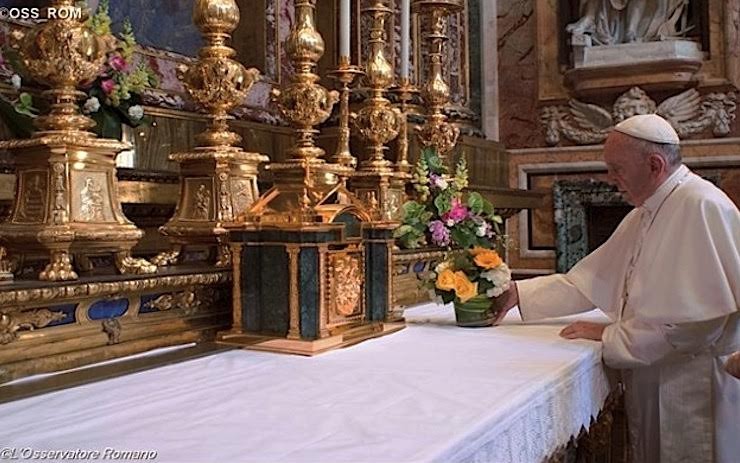
Pope Prays at Santa Maria Maggiore - © PHOTO.VA - OSSERVATORE ROMANO

Returning From Romania, Pope Stops at Santa Maria Maggiore

After His 30th Apostolic Visit Abroad, Francis Prays Before Mary in Marian Basilica

After having landed in Rome’s Ciampino Airport the evening of Sunday, June 2, 2019, Pope Francis traveled to the Basilica of Santa Maria Maggiore to offer thanks for the success of his three-day Apostolic Visit to Romania, May 31-June 2, 2019. ZENIT French journalist, Anne Kurian, was on the papal flight, covering the trip.
After the stop, Director ‘ad interim’ of the Holy See Press Office, Alessandro Gisotti, on his Twitter, made the following tweet: “On returning from his journey to #Romania, Pope Francis went to the Basilica of Saint Mary Major to pray. @HolySeePress.
It is already a usual detour for the Holy Father to go to the Marian Basilica; he always venerates the icon before and after his international apostolic trips.
During his time inside, Francis prayed before the ancient image of Mary, Salus Populi Romani, in silence for several minutes.

Sunday, June 2, 2019

Pope Francis surely to raise eyebrows with latest in-flight presser

Francis criticizes traditionalist Catholics who 'safeguard the ashes' of the past


This article appears in the Francis in Romania feature series. View the full series.

ncrhammondREVISEapril2019 resize.jpg

Pope Francis answers questions from journalists aboard his flight from Sibiu, Romania, to Rome June 2. (CNS/Paul Haring)
Aboard the papal flight from Romania — Pope Francis has criticized traditionalist Catholics who seek to "safeguard the ashes" of the past, saying the global church's centuries of tradition are not akin to a container for preserved objects but instead like roots to be drawn on for future growth.
Laudato-Si_web.jpg
Explore Pope Francis' environmental encyclical with our complimentary readers' guide.
In a press conference aboard the papal flight back to Rome after his three-day visit to Romania, he singled out Catholic "fundamentalists," who he said have a nostalgia for "returning to the ashes."
"Tradition is the guarantee of the future and not the container of the ashes," said Francis.
"Tradition is like roots [of a tree], which give us nutrition to grow," he explained. "You will not become like the roots. You will flower, grow, give fruit. And the seeds become roots for other people."
"The tradition of the church is always in movement," he said. "The tradition does not safeguard the ashes."
Francis did not specify in his remarks whom he had in mind while speaking of Catholic traditionalists. But the pontiff has come under criticism during his six-year papacy from a vocal minority of Catholics, including some cardinals, who have expressed concern that he has not been clear in enunciating some of the church's teachings.
Francis spoke about the church's tradition after being asked about his relationship with retired Pope Benedict XVI.
Francis repeated his frequent characterization that having Benedict live in retirement at the Vatican is for him like having a grandfather at home. Francis said that going to speak with his predecessor always gives him strength.
"I feel the nutrition coming up through the roots, and it helps me go forward," said Francis.
Among other issues he spoke about in the half-hour press conference, the pope also made an impassioned plea for Catholics to pray for the future of the European Union, which he said has "aged" and is in danger of being "overcome by pessimism."
In his first remarks about the 28-member block since European parliamentary elections last week resulted in gains for populist parties across the continent, the pope lamented the appearance of what he called "new borders" across the EU and said the organization "has lost the goal of working together."
"Europe is not being attacked by cannons or bombs in this moment but by ideologies, ideologies that are not European, that come either from outside or that stem from small groups," he said.
After referring to the tragedy of the two World Wars, he pleaded: "Please, let's not return to this. Let's learn from history. Let's not fall in the same hole."
"I would say to believers, 'Pray for Europe … for unity, that the Lord will give us this grace,' " the pope added later.
Francis had been in Romania May 31-June 2 for a visit that focused both on encouraging the country's minority Catholic population and reaching out to the 16-million-member Romanian Orthodox Church.
Asked about his May 31 meeting with Romanian Orthodox Patriarch Daniel, Francis called him "a man of great heart, and a great scholar."
"He is also a man of prayer," said the pope. "It is easy to get close to Daniel because I felt that he was a brother."
Francis said that ecumenical relations between Catholics and Orthodox are built by walking together, and by jointly serving those in need.
"There is already Christian unity," he said. "Let's not wait for the theologians to come to agreement on the Eucharist."
"The Eucharist is celebrated everyday with prayer, with remembrance of the blood of our martyrs, with the works of charity, and also wanting each other to be well," he added.
Francis also addressed the prayer service he and Daniel hosted together, in which the two leaders both recited the Our Father prayer in each other's presence, but separately — the pope going first in Latin, followed by the patriarch in Romanian.
Some right-wing Orthodox consider it inappropriate for believers to pray with Catholics.
The pope revealed that while the patriarch said the prayer in Romanian, Francis had said it again quietly in Italian. He said that from what he could see, "the majority" of the crowd gathered for the event at Bucharest's new Orthodox Cathedral had prayed both times.
"The people went beyond us leaders," said Francis. "We leaders must have diplomatic balance, to ensure that we are going forward together. There are diplomatic rules that are good to safeguard, so as not to ruin the thing. But the people pray together."
Making his first reference in the press conference to Catholic "fundamentalists," the pontiff said that even some Catholics are "closed" on the issue of praying with Orthodox, thinking them schismatics.
"There are Catholic groups who are a bit fundamentalist," said the pope. "We must tolerate it, praying for them, so that the Lord and the Holy Spirit soften their hearts a bit."

Pope Francis final stop in Romania

Blaj, Romania: Holy Father Extols Family and Life Values of Roma Community

‘My heart, however, is heavy. It is weighed down by the many experiences of discrimination, segregation, and mistreatment experienced by your communities.’

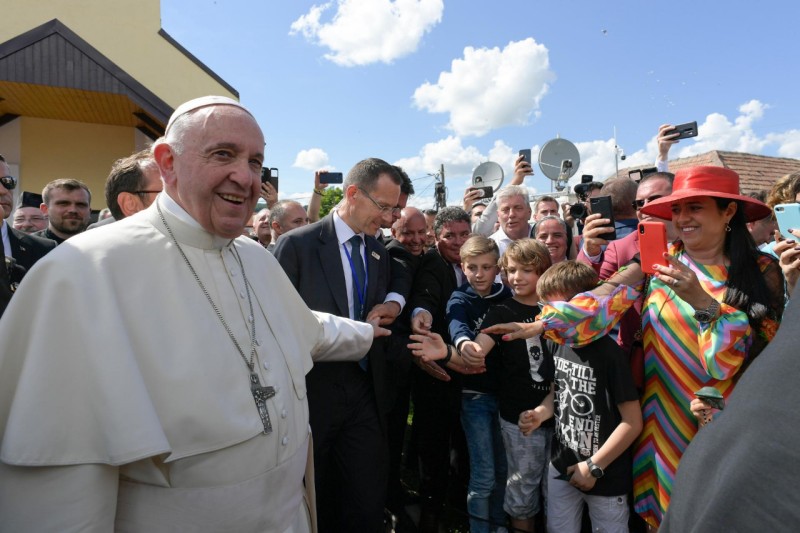
Pope Francis on June 2, 2019, extolled the family and life values of the Roma community while deploring the prejudice and persecution the community has suffered over many years.
His remarks came during his last stop during his May 31-June 2 apostolic journey to Romania. After celebrating Mass with a crowd of more than 100,000 in the Field of Liberty in Blaj, the Holy Father visited the Barbu Lăutaru district of Blaj where he met the Roma community of the city in the new church dedicated to St. Andrew the Apostle and the Blessed Ioan Suciu. Blaj is in Transylvania and is the principal religious and cultural center of the Romanian Greek-Catholic Church in the region.
“Dear brothers and sisters, as a people, you have a great role to play,” Pope Francis said. “Do not be afraid to share and offer the distinctive gifts you possess and that have marked your history.
“We need those gifts: respect for the value of life and of the extended family, solidarity, hospitality, helpfulness, support and concern for the vulnerable within your community, respect and appreciation for the elderly and for the religious meaning of life, spontaneity and joie de vivre.”
The Holy Father also apologized for any role Christians and Catholics have played in the persecution of the Roma people, one of the largest minority groups across Europe.
“My heart, however, is heavy. It is weighed down by the many experiences of discrimination, segregation, and mistreatment experienced by your communities,” Francis said. “History tells us that Christians too, including Catholics, are not strangers to such evil.
“I would like to ask your forgiveness for this. I ask forgiveness – in the name of the Church and of the Lord – and I ask forgiveness of you. For all those times in history when we have discriminated, mistreated or looked askance at you, with the look of Cain rather than that of Abel, and were unable to acknowledge you, to value you and to defend you in your uniqueness.”

The Holy Father’s Full Remarks

Dear Brothers and Sisters, Good afternoon!
I am happy to meet you, and I thank you for your welcome. You, Father Ioan, are quite right when you point to a truth as certain as it is often forgotten: in Christ’s Church, there is room for everyone. The Church is a place of encounter. We need to keep this in mind, not as a pretty slogan but rather as part of our identity card as Christians. You reminded us of this by recalling the example of the bishop and martyr Ioan Suciu, who gave concrete expression to the desire of God our Father to encounter every person in friendship and in sharing. The Gospel of joy is communicated in the happiness of encounter and the knowledge that we have a Father who loves us. Knowing that he watches out for us, we learn how to watch out for one another. In this spirit, I have wanted to shake hands with you, to look you in the eye and to open my heart to you, in prayer and in the hope of becoming part of your own prayers and entering into your hearts.
My heart, however, is heavy. It is weighed down by the many experiences of discrimination, segregation, and mistreatment experienced by your communities. History tells us that Christians too, including Catholics, are not strangers to such evil. I would like to ask your forgiveness for this. I ask forgiveness – in the name of the Church and of the Lord – and I ask forgiveness of you. For all those times in history when we have discriminated, mistreated or looked askance at you, with the look of Cain rather than that of Abel, and were unable to acknowledge you, to value you and to defend you in your uniqueness. Cain was not concerned about his brother. Indifference breeds prejudices and fosters anger and resentment. How many times do we judge rashly, with words that sting, with attitudes that sow hatred and division! Whenever anyone is left behind, the human family cannot move forward. Deep down, we are not Christians, and not even good human beings, unless we are able to see the person before his or her actions, before our own judgments and prejudices.
The history of humanity is never without Abel and Cain. There is the hand held out and the hand raised to strike. There is the open door of encounter and the closed door of conflict. There is acceptance and there is rejection. There are those who see in others a brother or a sister, and those who see instead an obstacle standing in their way. There is the civilization of love and the civilization of hate. Each day we have to choose between Abel and Cain. Like a person standing at a crossroads, we are faced with a decisive choice: to go the way of reconciliation or the way of vengeance. Let us choose the way of Jesus. It is a way that demands effort, but the way that brings peace. And it passes through forgiveness. May we not let ourselves be dragged along by the hurts we nurse within us; let there be no room for anger. For one evil never corrects another evil, no vendetta ever satisfies an injustice, no resentment is ever good for the heart and no rejection will ever bring us closer to others.
Dear brothers and sisters, as a people, you have a great role to play. Do not be afraid to share and offer the distinctive gifts you possess and that have marked your history. We need those gifts: respect for the value of life and of the extended family, solidarity, hospitality, helpfulness, support and concern for the vulnerable within your community, respect and appreciation for the elderly and for the religious meaning of life, spontaneity and joie de vivre. Wherever you find yourselves, share those gifts and try to accept all the good that others can offer to you. For this reason, I would encourage you to journey together, wherever you are, in helping to build a more humane world, overcoming fear and suspicion, breaking down the barriers that separate us from others, and encouraging mutual trust in the patient and never fruitless search for fraternity. Keep trying to journey together with dignity: the dignity of the family, the dignity of earning your daily bread – this is what helps you to go forward – and the dignity of prayer. Keep looking to the future (cf. Prayer Meeting with Roma and Sinti People, 9 May 2019).
Our meeting is the last of my visit to Romania. I came to this beautiful and welcoming country as a pilgrim and a brother, in order to meet all its people. Now I am returning home enriched by the experience of different places and special moments, but above all by faces. Your faces will color my memories and populate my prayers. I thank you and I bring you with me. And now, before I bless you, I ask you a great favor: please pray for me. Thank you!

On a Sunday afternoon, I just gotta blog

I realize that I do not do this nearly as much as I used to.  No real reason why just a current fact.  Today feels just like one of those days I need to blog, and reflect and share with those kind enough to read my stuff.  As Sunday's go there are no grandiose plans and I am "working" hard this day as a Deacon.  Working is in quotes because, well, it's not work.  I am assisting today at 3 separate masses, 8 and 10 in the morning(check, done) and 6 pm tonight.  I also got to visit with quite a few folks at the 1st weekend coffee and donut event this morning and the unexpected pleasure of picking up some BBQ at the Knights of Columbus event also held this morning on the church grounds.  In the meantime I have decided there will be no grass cutting today, after all I have cut some grass 4 of the past 5 days.  There is the distinct hope of an afternoon nap but I am enjoying some golf on the tube.

This weekend has been full of many Catholic highlights.  Here at home we witnessed the ordination of 8 new Priests for the Archdiocese of New Orleans.  That is a pretty darn good number.  These are good men who will make fine Priests and they all will begin their new pastoral assignments on July 1.  I did not attend the event in person but did watch it all unfold live on the computer.  You know what was incredible?  The pure joy in the 8 men who became Priests of Jesus Christ yesterday by the laying on of hands.  The ordination was attended by an overflow crowd and greeted with excitement by the people of New Orleans.  I thought about the decisions of these men, and the perseverance and the hope their ordinations give to us even in what has not been a stellar year for the church in America.  Yet every single report that we can dissect tells us that vocations are up, vocations are strong and that the church is ordaining more men who happen to be slightly older and undeniably zealous in their desire to serve.

As this is happening at home, more than half-way around the world, the Pope is celebrating all things Catholic in Romania.  He has been met by large and enthusiastic crowds and has presided over simply beautiful liturgies.  These events, always infused by local culture, help remind me of the universality of the church; of course the word catholic means universal.  I was able to take in several events from Romania thanks to EWTN and have posted every major event on this very blog.  These papal events almost always remind me of the hope that Jesus expressed that we all be one.  Sometimes I reflect on just how separated we are in Christianity.  It seems every year someone or something comes along hoping to be the next new shiny toy or the latest flavor of the month.  If we are all ever going to be one, as Jesus prayed, how can it not be anything but under the authority of the Catholic Church, founded itself by Jesus.  That thought makes me smile.

This weekend we had a wedding at the church that was celebrated according to the extraordinary form.  After the actual nuptials there was a full celebration of the Mass, in Latin, according to the 1962 missal.  I was not there but my wife Wendy was as she directs all weddings at the parish.  Wendy has never been to a mass celebrated in the EF.  As she put it, this was my first Latin Mass.  I asked for her thoughts and she loved it.  She was unaware of the beautiful aspects of worship in the EF; the music, the reverence, the way communion is distributed and received.  You know if you ever wanted to come and see the Mass celebrated in the EF, in Latin, according to the 1962 missal, come on over.  Every Sunday at noon our celebration of the Mass is in the EF.

So the longer I blog the shorter the window for a good nap before returning to St. Jane Church this evening.


Pope Francis delivers Regina Caeli in Romania

Regina Coeli Romania -- Copyright: Vatican Media

Regina Coeli: Pope Tells Romanian Catholics ‘I Thank God for Opportunity to Pray With You’

Prays Mary Bestow Her Maternal Protection on All Romania (ZENIT French journalist, Anne Kurian, is on Papal Flight)

I thank God for the opportunity to be here and pray with you….
Pope Francis told this to Romania’s Catholics–who make up 7.2 percent of the population in the mainly Orthodox country– during his Regina Caeli address in Romania, his final day of his three-day, May 31-June 2, 2019, visit to the nation, marking his 30th Apostolic Visit abroad. ZENIT French journalist, Anne Kurian, is on the Papal Flight.
“I greet the faithful of the Catholic Church: the Bishops, priests, religious and lay faithful of Bucharest and IaÅŸi, together with the many pilgrims from Åžumuleu Ciuc,” Francis said, underscoring: “I thank the Lord for giving me the opportunity to pray with you and to encourage your commitment to evangelization and your witness of charity.”
“Here in Blaj, the land of martyrdom, freedom and mercy, I pay tribute to you, the sons and daughters of the Greek-Catholic Church, who for three centuries have borne witness to your faith with apostolic zeal.”
Pope Francis prayed that the Virgin Mary bestow her maternal protection upon all the citizens of Romania “who in the course of history have always trusted in her intercession.”
“In entrusting all of you to her,” Pope Francis said, before praying the Marian prayer, “I ask her to guide you on your journey of faith, as you advance towards a future of authentic progress and peace, and contribute to the building of an ever more just and fraternal homeland.”
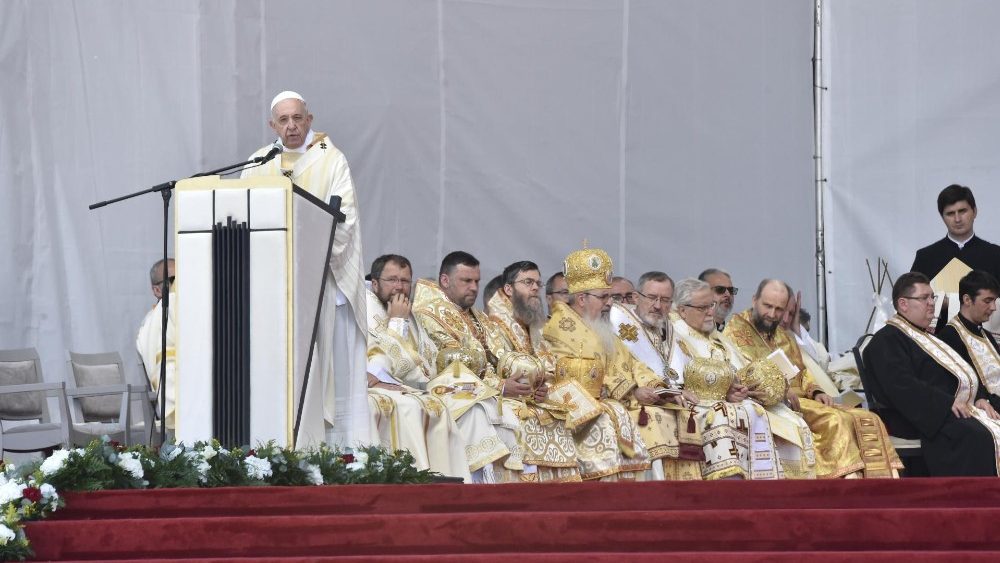
In the Romanian city of Blaj, Francis beatified seven Romanian bishops, including a cardinal, martyred, between 1950 and 1970, tortured for their faith.
In his homily at the Divine Liturgy, Francis said: “[I] encourage you to bring the Gospel to our contemporaries and to continue, like these Blesseds,” and “to resist” new ideologies. “May you be witnesses of freedom and mercy , allowing fraternity and dialogue to prevail over divisions,” he also encouraged.
Here is the full Vatican-provided text of the Regina Caeli:
* * *
Dear Brothers and Sisters,
Before concluding this Divine Liturgy, I want once again to greet all of you and all those whom I have met in the course of these days. I thank you for your warm welcome. I offer a respectful
greeting to the President of the Republic and to the Authorities present here. I express my heartfelt gratitude for their generous cooperation in the planning and the unfolding of my visit. I am grateful to His Beatitude Patriarch Daniel, to the Holy Synod, and to the clergy and faithful of the Romanian  Orthodox Church for their fraternal welcome. May the Lord bless this ancient and illustrious Church and sustain it in its mission.
I also offer a greeting full of affection and gratitude to His Beatitude Cardinal Lucian MureÅŸan. I greet the faithful of the Catholic Church: the Bishops, priests, religious and lay faithful of Bucharest and IaÅŸi, together with the many pilgrims from Åžumuleu Ciuc. I thank the Lord for giving me the opportunity to pray with you and to encourage your commitment to evangelization and your witness of charity. Here in Blaj, the land of martyrdom, freedom and mercy, I pay tribute to you, the sons
and daughters of the Greek-Catholic Church, who for three centuries have borne witness to your faith with apostolic zeal.
May the Virgin Mary bestow her maternal protection upon all the citizens of Romania who in the course of history have always trusted in her intercession. In entrusting all of you to her, I ask her to guide you on your journey of faith, as you advance towards a future of authentic progress and peace, and contribute to the building of an ever more just and fraternal homeland.
Regina Coeli…