Showing posts with label Holy See. Show all posts

Friday, October 9, 2026

At the United Nations the Holy See seeks moratorium on the use of the death penalty


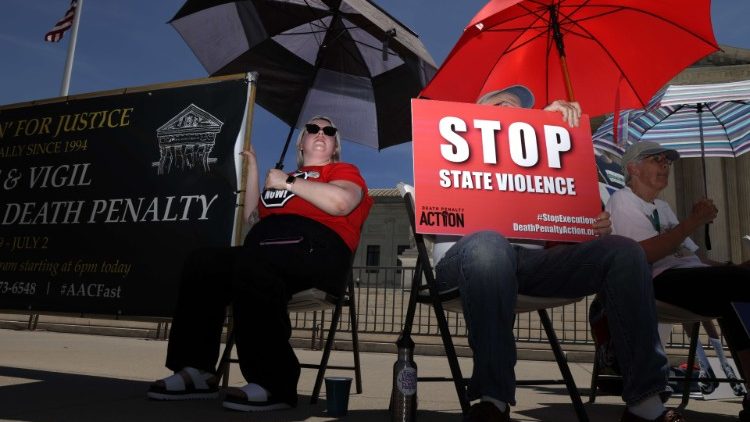
US protesters call for an end to the death penaltyUS protesters call for an end to the death penalty (2021 Getty Images)

Holy See at UN: Moratorium on executions must pave the way for abolition

Archbishop Christophe Z. El-Kassis addresses the UN General Assembly on the protection of human rights, calling for the abolition of the death penalty. In a separate statement on criminal justice and drug control, he stresses the importance of prevention, treatment and rehabilitation.

By Giada Aquilino and Francesca Merlo

The defense of life must be “consistent and universal, extending to every person, at every stage and in every circumstance”.

Archbishop Christophe Z. El-Kassis, Permanent Observer of the Holy See to the United Nations, reaffirmed this principle in a statement to the Third Committee of the 81st session of the UN General Assembly on 7 October, addressing the promotion and protection of human rights.

Recalling the Catholic Church’s teaching that “the death penalty is inadmissible because it is an attack on the inviolability and dignity of the person”, the Archbishop stressed that a person’s God-given dignity “is never forfeited, no matter the gravity of the crime”.

Advances in penal systems, he noted, now allow States to protect society effectively “without foreclosing the possibility of repentance and redemption”.

Justice, not vengeance

Archbishop El-Kassis also highlighted the irreversible consequences of miscarriages of justice when the death penalty is enforced.

Victims and their families, he said, “are entitled to solidarity, support and a justice that is prompt, impartial, and humane”. However, “the taking of another life cannot restore what has been lost”.

“The purpose of punishment is not vengeance,” he continued, “but rather to repair the social bond, protect the common good, and reintegrate the offender.”

While welcoming the abolition of the death penalty in many States and the introduction of moratoriums in others, the Archbishop warned that “executions continue in too many places”.

He recalled Pope Leo XIV’s hope that “efforts are made to abolish the death penalty, a measure that destroys all hope of forgiveness and renewal”.

States that retain capital punishment, he said, should consider “establishing, without delay, a moratorium on executions as a step towards abolition”. They should also commute existing sentences, guarantee fair trials with adequate legal defense, and invest in rehabilitation and restorative approaches.

Tackling drug trafficking

In a separate statement delivered on the same day, addressing crime prevention, criminal justice and international drug control, Archbishop El-Kassis called for renewed determination in responding to expanding drug markets and the links between drug trafficking, corruption and criminal activity.

Drawing on the UN’s World Drug Report 2026, he noted that organized criminal groups are exploiting technology and innovation to expand their reach and diversify their operations, affecting how drugs are produced, trafficked, procured and used.

Society and law enforcement authorities, he said, should focus on identifying criminal networks and prosecuting major criminals, while also preventing drug use and reducing production and trafficking.

At the same time, “true justice cannot be satisfied with punishment alone”. These efforts must include approaches marked by perseverance and mercy, aimed at “the re-education and full integration of offenders into the fabric of society”.

Treatment, rehabilitation and education

Archbishop El-Kassis called for comprehensive programs for people struggling with addiction, particularly young people and those serving criminal sentences. These should provide access to medical treatment, psychological support and sustained rehabilitation.

Prevention, he added, must be accompanied by adequate, quality education.

Quoting Pope Leo XIV, he stressed that “education must begin within the family and be strengthened in the school”, providing accurate scientific knowledge of the harmful effects of narcotics on the brain, the body, personal conduct and the wider community.

The Catholic Church, Archbishop El-Kassis concluded, will continue to contribute to the common good and uphold the inalienable, God-given dignity of every human person.

Cardinal Luis Tagle appointed Dean of the College of Cardinals


Cardinal Luis Antonio Tagle, new Dean of the College of CardinalsCardinal Luis Antonio Tagle, new Dean of the College of Cardinals (AFP or licensors)

Cardinal Tagle elected new Dean of College of Cardinals

Filipino Cardinal Luis Antonio Tagle—Pro-Prefect of the Section for First Evangelization and New Particular Churches within the Dicastery for Evangelization—succeeds 92-year-old Cardinal Giovanni Battista Re, as Dean of the College of Cardinals.

By Salvatore Cernuzio

After leading one of the world's oldest bodies—the College of Cardinals—for nearly seven years, 92-year-old Cardinal Giovanni Battista Re is stepping down as Dean. He is succeeded by the Filipino Cardinal Luis Antonio G. Tagle, 69, Pro-Prefect of the Section for First Evangelization and New Particular Churches within the Dicastery for Evangelization.

Cardinal Tagle, who—according to the Holy See—will assume the title of the Suburbicarian Church of Ostia while retaining the title of the Suburbicarian Church of Albano, was elected to the position on Thursday, 8 October, by the cardinals of the Order of Cardinal-Bishops. The appointment to this top-ranking position in the ecclesiastical hierarchy was announced on Friday.

Pope Francis's Reform

Cardinal Re—a historic figure of the Roman Curia who has served through the last four pontificates, from John Paul II to the present—retains the title of the Suburbicarian Church of Sabina-Poggio Mirteto and assumes the title of “Dean Emeritus” of the College of Cardinals.

This latter title is an innovation introduced by Pope Francis in a 2019 motu proprio, in which he reformed the office of Dean, establishing that the role would no longer be for life but for a five-year term, renewable only once. This decision stemmed from the fact that “with the increase in the number of cardinals” (fifteen beyond the traditional threshold of 120 electors), “ever-greater responsibilities” were weighing on the Dean of the College of Cardinals.

While confirming that the leader of the Sacred College is elected by members of the Order of Bishops—in accordance with the procedures established by Canon 352 § 2 of the Code of Canon Law—Pope Francis had instituted a fixed term of office and the possibility of a second term.

The reappointment of Cardinal Re

Cardinal Re—appointed Dean in 2020 to succeed Cardinal Angelo Sodano—was reappointed in 2025 by Pope Francis himself, who valued the work he had done during the Conclave of March 2013. At that time, Re—a former nuncio who had served as Assessor and Substitute for General Affairs at the Secretariat of State under John Paul II, and as Prefect of the Congregation for Bishops from 2000 to 2010—was a cardinal-elector but performed the duties that would have fallen to the then-Dean Sodano, who was absent from the Sistine Chapel having passed the age of 80. The Argentine Pontiff also appreciated the characteristic verve, experience, and straightforward nature of the cardinal from Brescia.

On 7 January 2025, the Pope reappointed him for a second term; Argentine Cardinal Leonardo Sandri was also reconfirmed in his role as Vice-Dean.

Three months later, acting in his capacity as Dean, Cardinal Re presided over the funeral rites for Jorge Mario Bergoglio on April 26, 2025, as well as the subsequent Missa pro eligendo Pontifice (Mass for the Election of the Pope)—the Eucharistic celebration held on the morning of the beginning of the Conclave on 7 May 2025, which subsequently saw the election of Pope Leo XIV.

Primus inter pares

At the age of 92, Cardinal Re—a native of Borno—thus concludes this service to the Church. He is succeeded by the younger Cardinal Tagle, a cardinal widely known within the Asian Church and the global Church alike; until now, Tagle has headed one of the two sections of the Dicastery formerly known as Propaganda Fide.

Tagle will therefore lead the cardinals of the world, though always in the capacity of primus inter pares—meaning he will not exercise hierarchical governing authority over his fellow cardinals but rather coordinate their activities.

The Dean’s primary duty is to convene any future Conclave in the event of a sede vacante (vacant see) and to preside over it, provided he is under the age of eighty and thus included among the electors.

Saturday, July 25, 2026

Meet the new U.N. Permanent Observer for the Holy See


Archbishop Christophe El-KassisArchbishop Christophe El-Kassis 

Pope appoints new Holy See Permanent Observer to UN in New York

Pope Leo XIV has appointed Archbishop Christophe-Zakhia El-Kassis as the Holy See's new Permanent Observer to the United Nations in New York, where he will represent the Holy See at the UN headquarters.

Vatican News

Pope Leo XIV has appointed Archbishop Christophe-Zakhia El-Kassis as the Holy See's new Permanent Observer to the United Nations (UN) in New York.

The appointment was announced on Saturday by the Holy See Press Office.

Lebanese-born Archbishop El-Kassis, Titular Archbishop of Roselle, has until now served as Apostolic Nuncio to the United Arab Emirates and Yemen, as well as Apostolic Delegate to the Arabian Peninsula.

He was ordained in 1994, and he entered the Holy See diplomatic service in 2000, working in Indonesia, Sudan, Turkey, and the Secretariat of State.

The Holy See maintains Permanent Observer status at the United Nations, enabling it to participate in the work of the General Assembly and other UN bodies.

Thursday, May 21, 2026

Pope Leo XIV addressed the various ambassadors to the Holy See; urges peace


Pope Leo XIV addresses a group of non-resident ambassadors to the Holy See during the presentation of their credential lettersPope Leo XIV addresses a group of non-resident ambassadors to the Holy See during the presentation of their credential letters  (@Vatican Media)

Pope urges new ambassadors to contribute to 'greatly needed peace'

Pope Leo XIV addresses a group of non-resident Ambassadors to the Holy See and expresses his wish that their mission may "strengthen dialogue, deepen mutual understanding, and contribute to the peace so greatly needed in our world."

By Deborah Castellano Lubov

"No nation, no society, and no international order can call itself just and humane if it measures its success solely by power or prosperity while neglecting those who live at the margins. Indeed, Christ’s love for the least and the forgotten compels us to reject every form of selfishness that leaves the poor and the vulnerable invisible."

Pope Leo XIV made this statement on Thursday morning in the Vatican when addressing new non-resident ambassadors from Sierra Leone, Bangladesh, Yemen, Rwanda, Namibia, Mauritius, Chad, and Sri Lanka, accredited to the Holy See, on the occasion of the presentation of their credential letters.

READ POPE LEO XIV'S FULL ADDRESS

The Holy Father asked them to convey his respectful greetings to their Heads of State, together with the assurance of his prayers for them and their fellow citizens.

Pope Leo addresses the ambassadors (@Vatican Media)

A vision for diplomatic unity

He said he was particularly pleased to receive them as the Church approaches the Solemnity of Pentecost, recalling how the Holy Spirit descended upon the disciples, transforming fear into courage and division into unity by enabling them to speak in the languages of all peoples.

"It is my hope," the Pope stated, "that a similar vision of unity may inspire the world of diplomacy, where constructive relations among nations flourish through genuine openness, the fostering of mutual respect, and a shared sense of responsibility."

Key to overcoming misunderstandings and restoring trust

In this regard, the Pope said he wished to renew the appeal he made when addressing members of the diplomatic corps in early January.

"In a time when 'peace is sought through weapons as a condition for asserting one’s own dominion'," he reiterated, "there is an urgent need for a return to 'a diplomacy that promotes dialogue and seeks consensus' on all levels—bilateral, regional, and multilateral.'"

"Such dialogue, 'motivated by a sincere search for ways leading to peace,'" he said, "demands that words once again express clear realities without distortion or hostility."

Only in this way, Pope Leo underscored, can misunderstandings be overcome and trust be rebuilt in the context of international relations.

Dialogue requires a change of heart

While courteous and clear dialogue is essential, the Pope said, it "must be accompanied by a deeper conversion of heart: the willingness to set aside particular interests for the sake of the common good."

Pope Leo warned that if success is measured solely by power and prosperity, while neglecting those on the margins, no nation, society, or international order can truly call itself just and humane.

He stressed that Christ, with His love for the forgotten, calls us to reject all forms of selfishness that leave the vulnerable and poor invisible.


Thursday, May 7, 2026

Pope Leo XIV had cordial audience with U.S. Secretary of State Marco Rubio


Pope Leo XIV shakes hands with US Secretary of State Marco Rubio on May 7, 2026Pope Leo XIV shakes hands with US Secretary of State Marco Rubio on May 7, 2026 (@Vatican Media)

Pope Leo XIV meets with US Secretary of State Marco Rubio

Pope Leo XIV holds an audience with US Secretary of State Marco Rubio in the Vatican, with discussions including countries marked by war.

Vatican News

As he arrived in Italy on Thursday, US Secretary of State Marco Rubio headed to the Vatican, where he met in the Apostolic Palace with Pope Leo XIV.

According to a communique from the Holy See Press Office, the “cordial talks” saw both states renew “the shared commitment to fostering sound bilateral relations between the Holy See and the United States of America.”

Their encounter also included an exchange of views "regarding situations on the regional and international levels, with particular attention given to countries experiencing war, political tensions and difficult humanitarian situations as well as the need to work tirelessly for peace."

Separately, the Holy See Press Office said discussions about countries enduring war included some African and Middle Eastern countries, such as Lebanon and Iran.

They also spoke about Cuba, which has seen heightened tensions with the US recently.


Secretary Rubio presents the Pope with a crystal football (@Vatican Media)

The below is attributable to Spokesperson Tommy Pigott:

Secretary of State Marco Rubio met today with His Holiness Pope Leo XIV to discuss the situation in the Middle East and topics of mutual interest in the Western Hemisphere.  The meeting underscored the strong relationship between the United States and the Holy See and their shared commitment to promoting peace and human dignity.


Friday, May 1, 2026

The Papal Foundation meets in Rome; Mass for the foundation presided by our own Archbishop Checchio


(R-L) Ward Fitzgerald, President, The Papal Foundation, Cardinal Timothy Dolan, Chairman, Archbishop Nelson Perez of Philadelphia, David Savage, Executive Director(R-L) Ward Fitzgerald, President, The Papal Foundation, Cardinal Timothy Dolan, Chairman, Archbishop Nelson Perez of Philadelphia, David Savage, Executive Director 

The Papal Foundation visits Rome to reaffirm cooperation and support for the poor

Several representatives of The Papal Foundation are making a pilgrimage to Rome from the United States and Canada, focusing on furthering support for the poor and advancing the Church’s mission worldwide, with a central meeting with Pope Leo XIV.

By Karol Darmoros and Fr. Paweł Rytel-Andrianik

The Papal Foundation's pilgrimage to Rome, taking place from April 29 to May 2, includes a rich spiritual and formation program, featuring Masses, meetings, and visits to key locations connected with the work of the Holy See. 


Archbishop James Checchio presides over the Mass for the members and staff of the Papal Foundation

On the first day, Mass was celebrated at St. Mary of the Angels, with Archbishop James Checchio as celebrant. In his homily, he emphasized that Christians are called to be apostles of the Risen Jesus Christ.

On the second day, special attention was given to a tour of Vatican Radio and Vatican News, along with meetings involving the Prefect of the Dicastery for Communication, Paolo Ruffini; Editorial Director Andrea Tornielli; Theological-Pastoral Director Nataša Govekar; and the Deputy Director of the Press Office of the Holy See, Sister Nina Krapić.

Among the initiatives discussed was the introduction of the new Vatican News widget. As Pope Leo XIV wrote, the widget of Vatican News “is a tool for evangelization; it offers an opportunity to create a network and exchange gifts."

Among other activities, the Stewards of St. Peter also visited the US Embassy to the Holy See.

Mission of the Foundation

During a welcome reception in Rome, the work of The Papal Foundation was presented. The U.S.-based charitable organization supports the Holy Father's initiatives in developing countries. 

“The mission of The Papal Foundation is to serve the Holy Father and the Roman Catholic Church. We bring and offer our faith, our energy, and our financial resources to share the love of Christ with our poorest brothers and sisters,” emphasized the Foundation’s president, Ward Fitzgerald.

Concrete Assistance

As noted by the organization’s Vice President, Tim Ristoff, the scale of support is significant, especially in Africa.

“Since 1997, 855 general grants have been awarded, totaling 63 million dollars, and since 2011, 69 humanitarian grants worth 4.9 million dollars,” he explained. He also added that 2,700 students have received support through the Saint John Paul II Scholarship Program.

Cardinal Timothy Dolan, chairman of the Foundation’s Board of Trustees, stressed that its activities are part of the mission of the universal Church and provide concrete assistance to those most in need.

Support also includes the reconstruction of churches, assistance for schools, orphanages, and healthcare centers, as well as initiatives for children and those most at risk of exclusion.

The Foundation operates in more than 130 countries and, since 1988, has distributed over 270 million dollars for charitable, educational, and humanitarian projects. It shows particular care for children in difficult situations and for those most vulnerable to exclusion.

Growth and Cooperation

During the welcome event in Rome, attention was also drawn to the dynamic development of the Foundation’s initiatives. Over the past 18 months, 27 new donor families have joined, enabling the organization to achieve nearly half of its five-year goal.

The visit to the Vatican marks an important moment in strengthening ties with the universal Church and confirms The Papal Foundation’s commitment to serving those most in need.

Monday, March 30, 2026

Three Papal Appointments announced today


Archbishop Paolo Rudelli, Archbishop Petar Rajič, Archbishop Edgar Peña ParraArchbishop Paolo Rudelli, Archbishop Petar Rajič, Archbishop Edgar Peña Parra 

Pope appoints new Substitute, Nuncio to Italy, and Prefect of Papal Household

Pope Leo XIV makes three significant appointments: Archbishop Paolo Rudelli, Apostolic Nuncio to Colombia, takes the place of Substitute for General Affairs Archbishop Edgar Peña Parra, who becomes Apostolic Nuncio to Italy, succeeding Archbishop Petar Rajič, who has been appointed Prefect of the Papal Household.

By Salvatore Cernuzio 

From Colombia to the Secretariat of State, from the Secretariat of State to the Nunciature in Italy, from the Nunciature in Italy to the Prefecture of the Papal Household. Today a round of appointments were announced within the Holy See.

Pope Leo XIV has chosen Archbishop Paolo Rudelli, who will turn 56 in July, to be the new Substitute for General Affairs of the Secretariat of State, one of the most important and sensitive positions in the entire Vatican apparatus, effectively a kind of “Interior Minister” of the Vatican City State.

Ordained a priest in 1995 and incardinated in Bergamo, Archbishop Rudelli holds a degree in moral theology and has until now served as Apostolic Nuncio to Colombia. He assumed that post in 2023 following his appointment by Pope Francis, who had consecrated him Bishop in 2019 and sent him, in January 2020, as his representative to Zimbabwe.

The prelate's experience in the Holy See’s diplomatic service, however, dates back over twenty years to 2001, with assignments in the Pontifical Representations in Ecuador and Poland, and in the Section for General Affairs of the Secretariat of State.

Today, by the will of Pope Leo XIV, he becomes the head of that Section, marking the Pope's second significant appointment in the Secretariat of State, following last November’s appointment of the Assessor, the Nigerian theologian and canonist Anthony Onyemuche Ekpo, previously Undersecretary of the Dicastery for Promoting Integral Human Development.

'Gesture of trust'

In a statement issued following today's announcement, Archbishop Rudelli said, “The call from His Holiness Pope Leo to work closely in the exercise of his supreme mission as Substitute of the Secretariat of State is a gesture of undeserved trust that deeply honors me.” 

The Archbishop reassured that “moved by faith,” he will “take on this service in the spirit indicated by the Apostolic Constitution Praedicate Evangelium.”

He said he will do so with the awareness that he can rely on the guidance of Vatican Secretary of State, Cardinal Pietro Parolin, and on the collaboration of Assessor, Monsignor Anthony Onyemuche Ekpo, and all the staff of the Section for General Affairs.

In particular, the new Substitute noted he places his trust in the “intercession” of a distinguished fellow countryman of Bergamo, Pope Saint John XXIII.

Archbishop Peña Parra becomes Nuncio to Italy

Archbishop Rudelli succeeds Venezuelan Archbishop Edgar Peña Parra, whom Pope Leo XIV today appointed Apostolic Nuncio to Italy.

Pope Francis had previously appointed Archbishop Peña Parra as Substitute on 15 August 2018, transferring him from Mozambique. Since 2015, he had led the Apostolic Nunciature in that East African country and also participated in a mediation group to restore peace between the national government and an opposition political party.

Born in 1960, a seasoned diplomat with experience in Kenya, the former Yugoslavia, Honduras, and Mexico, and later serving as Pontifical Representative in Pakistan, Archbishop Peña Parra became the second Latin American to hold the post of Substitute, after the Argentine Leonardo Sandri.

Archbishop Rajič becomes Prefect of the Papal Household

Today also sees the appointment of Archbishop Petar Rajič as Prefect of the Papal Household.

The position had been vacant for more than six years, since the departure of Archbishop Georg Gänswein, now Apostolic Nuncio to the Baltic States of Latvia, Estonia, and Lithuania. Rajič himself had served as Nuncio to the same countries from 2019 before arriving in Italy in 2024.

As Prefect, the Archbishop will oversee the work of the Prefecture, a Curial body responsible for the internal order and daily management of the Pope’s life.

Thursday, February 26, 2026

Candid interview with U.S. Ambassador to the Holy See


US Ambassador sees potential for ‘Catholic Moment’ with Leo


Pope Leo XIV receives the letters of credential of Brian F. Burch as U.S. ambassador to the Holy See during an audience Sept. 13, 2025, in the Apostolic Palace at the Vatican. (Credit: Vatican Media.)


ROME – United States Ambassador to the Holy See Brian Burch, in an exclusive sit-down interview with Crux Now, said he sees the potential for a “Catholic Moment” in the U.S. given the high-profile Catholics in the current administration, with history’s first U.S.-born pope.

According to Ambassador Brian Burch, there is a new kind of conservativism in U.S. politics being shaped largely by prominent Catholic personalities including U.S. Vice President JD Vance and Secretary of State Marco Rubio, a “common good conservatism” which can help shape the future of the country.

RELATED: US immigration law ‘not rooted in hate or xenophobia,’ ambassador says

“There is a real moment, I think, and Pope Leo and I talked about this when I sat down with him to present my credentials,” Burch told Crux Now in a wide-ranging sit-down interview in his office at the U.S. Embassy to the Holy See.

President Donald Trump, he said, “deeply cares about and understands intuitively this Catholic view of the human person and of human communities.”

“I think this is represented in the vice president he chose, in the secretary of state he chose. They speak about this frequently,” he said.

Burch noted that Rubio in a speech at the Catholic University of America spoke about a “common good conservatism” as a new and upcoming type of conservative instinct that is bubbling up in U.S. politics and culture, and which is distinct from similar movements in the past.

“We have this political camp that I came from that sees old Republican politics as inadequate, certainly progressive ideology as incompatible, and a kind of third way that’s this common good conservatism that I think is deeply rooted in a lot of the principles found in Catholic social teaching and which I think will contribute to the possibilities of a ‘Catholic Moment’,” he said.

In his interview Burch also spoke about collaboration between the U.S. and the Holy See on issues such as religious freedom and artificial intelligence, a potential papal trip, celebrations for the U.S.’s 250th anniversary this year, and Pope Leo’s sports affinity.

Please read below for Part Two of Crux Now’s sit-down interview with U.S. Ambassador to the Holy See Brian Burch (Part One is here):

Crux Now: There are many areas where the Holy See and the United States do have a lot of common ground. The area of religious freedom, for example, parents’ rights in education, and artificial intelligence. What do you think are the strongest points of interaction and dialogue between the United States and the Holy See at this point?

Burch: I think any ambassador in this role inherits a set of issues where there has been a deep and abiding collaboration, and that includes global peace and security and religious freedom and human dignity writ large. Of course, we’ve talked about Russia-Ukraine, we talked about the Middle East, we talked about Venezuela. In many respects, I think the Holy See and the United States see the world very similarly in terms of, we’re not on different sides, we want to work towards a peaceful resolution, we believe in principles of justice, and we understand that there’s a moral order that ought to govern human action. We are a part of a Christian civilization that they help shape. We may not always agree on the best means, or rhetoric, or tools, but there is a deep shared commonality when it comes to the peace and security of the world in terms of the goal.

Religious freedom, as you point out. Archbishop [Paul] Gallagher in his recent UN speech pointed out that the Christians are the largest persecuted group in the world. The numbers are shocking and there are many places where that is especially felt like Nigeria, for example, or the church in Nicaragua, or various places where Catholics, Christian believers’ lives are being threatened.

There’s a bigger opportunity here within the realm of religious freedom. I’m going to play armchair theologian here with an Augustinian pope. Saint Augustine talks about the tranquility of order, peace as the tranquility of order, which is that peace is not simply the absence of conflict or coercion, but it’s actually the set of conditions that lead to broad flourishing. This is the kind of religious freedom, and this is the peace that the U.S. wants to help advance. It’s not simply not being threatened inside the walls of a church so that you can read the Bible. It’s to be able to live out one’s faith in the public square, within your community, within your family to have access to faith-based health care, to have access to a religious school, to be able to speak and to write and to share faith-informed opinions in the public square without fear of censorship or coercion.

This is religious freedom broadly understood. It’s not simply lack of coercion; it’s a set of conditions that will lead to broad flourishing as a believer. I think that that’s an important piece because I think sometimes religious freedom can shrink. I think rightly understood, at least in the tradition of both the Church and I think in the way that the United States is best understood, it’s that people of faith can not merely believe, but can thrive.

It’s widely acknowledged that [Pope] Leo chose his name with reference to his predecessor by the same name [Leo XIII]. There is a lot of expectation around what his first encyclical might include, and the fact that probably the most transformative thing that will happen during my time here is, what impact will AI have on our world? There perhaps be no bigger issue while I’m here than to help relate U.S. policy to the Church’s rich tradition around a rightly understood human anthropology and a set of ethical principles that need to guide innovation and technology that’s transforming our world.

The U.S. has a particular proposal for the world when it comes to AI. We have tech leadership, we have commercial interests, we have a set rule of law, we have a deep tradition of respect for speech, for freedom of religion, for privacy, for intellectual property. We have an opportunity to take advantage of all of the benefits that AI will bring the world, circumscribed by this ethical and human dimension that the Church contributes and which could be extraordinary and spectacular. There could be amazing leaps of innovation that could change the world in great ways.

There are also lots of risks. Some of the ethical and human questions that the Church will guide are extremely important. I think some of the threats that alternatives to the AI model that the U.S. is advancing that other parts of the world are proposing will threaten censorship, privacy, intellectual property, religious freedom, fundamental human rights, because of how transformative this technology could be. It’s very important that countries, and I’m going to call this a Western-civilization-modeled AI, an AI that’s worth pursuing and that’s good for the world, is going to have to incorporate some of those Western civilization ideas that Secretary [Rubio] spoke about in Munich.

You mentioned playing armchair theologian. You are Catholic, and the U.S. usually sends a Catholic to this assignment, but you are here with history’s first American pope when there are two other prominent Catholics serving in the current administration. Is this a ‘Catholic moment’ for the U.S.? How can this shape U.S.-Vatican relations at this point?

When I hear ‘Catholic Moment’ I think of Father Richard John Neuhaus and his book [The Catholic Moment: The Paradox of the Church in the Postmodern World, Harper Collins, 1987]. I wrote a far less erudite and interesting book, similarly titled, about Donald Trump and the ‘Catholic Moment’, in part because I believe the president and what he represented and his policies are not just compatible, but in many ways help advance a Catholic understanding of the world.

Now you have an American Pope, with a president who has a deep commitment to broad human flourishing and the common good, rightly understood. There is a real moment, I think, and Pope Leo and I talked about this when I sat down with him to present my credentials, that for all of the political noise and the accusations that surround the president – in a very real sense, this is a president who deeply cares about and understands intuitively this Catholic view of the human person and of human communities. I think this is represented in the vice president he chose, in the secretary of state he chose. They speak about this frequently.

What they say and how they carry out their work is informed by their Catholic faith, and they find the faith to be one not just of spiritual inspiration, but of rich intellectual and social teaching and to be deeply helpful to how they are doing their work.

There are different kinds of models for, let’s call, conservatism that are being advanced. Marco Rubio called it common good conservatism at the Catholic University of America, and we have this political camp that I came from that sees old Republican politics as inadequate, certainly progressive ideology as incompatible, and a kind of third way that’s this common good conservatism that I think is deeply rooted in a lot of the principles found in Catholic social teaching and which I think will contribute to the possibilities of a ‘Catholic Moment.’

Obvious question: the answer to this has flip-flopped like a pancake from one week to the next, but when will the U.S. get a papal trip?

Pope Leo said to me when I met with him that he wants to go to the U.S. Who wouldn’t? When he does go to U. S., it will be the largest gathering of Catholics in American history. It will be extraordinary. We’ve engaged in conversations about the possibility of a trip. I know he’s been invited by the United Nations to speak as well. There was some talk that he may go this year. I think if I had to make a guess, I think he’ll probably go next year sometime, that’s latest we’ve heard.

He’s already built that already that every pope has which is, it’s the pope, but also people just sense in him that, ‘he cares about me’. Just his disposition exudes that; he doesn’t have to even say anything. I think the other piece of it would be, we’re living in this moment in history where there is such deep thirst for real spiritual richness and the Church always thrives in the midst of moments where people say, ‘Who has the answers to eternal life? To whom shall we go?’

I ask people all this all the time, when did this all really start to pick up? I think it was really post-COVID when people had this kind of moment of reset. We stopped our routines, we had this time to do some more reflection and found this wanting for something more out of life. Often when people spend enough serious time asking the bigger questions, they get to religion again. Then once you get to the religion, you start to ask, to whom shall we go, right.

There are some other things we’re working on with respect to the Holy Father in the United States that we’ll probably be announcing fairly soon. It’s a big year for the U.S., ‘America 250’, our 250th anniversary. I know the Holy See, and this pope in particular, understands that wants to ways to acknowledge the significance of our anniversary.

This is the big curveball: This Pope is a sports fan, and this year, most of the World Cup is going to be played in the Americas. Are you going to have a watch party?

People have asked about this. We were joking, actually, at the diplomatic corps address. I went up to him when you get to greet him. I said some substantive things to him about some things we had going on, and he acknowledged a couple things we said back and forth. Then I said at the end, oh yeah, and one more thing, ‘go Bears!’ If you remember, the Chicago Bears were in the playoffs and I knew he was watching because anyone from Chicago – you might like Cubs or Sox, but everyone was watching the Bears this season because it was extraordinary and he really laughed out loud. He just laughed like it was so funny that after this kind of serious substance thing, which tells me he is a real sports fan.