reflections, updates and homilies from Deacon Mike Talbot inspired by the following words from my ordination: Receive the Gospel of Christ whose herald you have become. Believe what you read, teach what you believe and practice what you teach...
Showing posts with label Cardinal Luis Tagle. Show all posts
Showing posts with label Cardinal Luis Tagle. Show all posts
Pope Leo: Take to heart the riches of ‘Amoris laetitia’
In his homily read by Cardinal Luis Antonio Tagle at the concluding Mass of the Vatican encounter to mark the 10th anniversary of 'Amoris laetitia,' Pope Leo XIV calls on the Church to put the Apostolic Exhortation's pastoral guidance into practice in the heart of families.
By Christopher Wells
“Today, as we celebrate the Eucharist, we offer to the Lord the fruits of the work we have carried out” on Amoris laetitia, “and we seek to take its riches to heart and put its pastoral guidance into practice”, Pope Leo said on Wednesday, 14 October, in his homily for the concluding Mass of the ecclesial Encounter marking the 10th anniversary of Pope Francis’ Apostolic Exhortation on love in the family.
The Holy Father’s homily was read by Cardinal Luis Antonio Tagle, the new Dean of the College of Cardinals and Pro-Prefect of the Dicastery for Evanglization.
The Filipino Cardinal presided at the liturgy in place of the Pope, who is recovering in Rome’s Gemelli Hospital following surgery on Tuesday to remove a “small, localized nodule” from his lung.
Cardinal Tagle reads the homily prepared by Pope Leo XIV (VATICAN MEDIA)
The family: an ‘icon of God’s love’
In his homily, Pope Leo reflected on the family as “an affective… spiritual and sacrificial union” and “an icon of God’s love." Christian families and communities, he said, need to “mature in love,” which must become “the foundation of our families.”
This love, he continued, involves instruction in “the importance of the virtues,” especially chastity, which is “invaluable for the genuine growth of love between persons.”
Pope Leo went on to emphasize the importance of the witness borne by parents and children, the young and the old, through which the truth of the Gospel is spread throughouth the world.
Growing as ‘a family of families’
He encouraged Catholics to put into practice Jesus’ command to love one another, “so that we may grow as a Church that is a ‘family of families’,” taking up an image used by Pope Francis.
In particular, he said those who are most vulnerable, or experiencing difficulties, should be “surrounded by affection and shielded from judgment.”
Respect for life
The Holy Father also highlighted, once again, “the values of openness to life and respect for life from conception to natural death,” saying that “without strong families open to the gift of children and attentive to their education and growth,” the world has no future.
Finally, Pope Leo encouraged families to renew the practice of prayer within the home, and emphasized the importance of attending Sunday Mass together, saying, “I therefore strongly encourage everyone to rediscover and encourage these practices.”
Communion with the Successor of St Peter
Before concluding the homily, Cardinal Tagle, recalling that he was presiding at the Liturgy through a special mandate of Pope Leo XIV, publicly proclaimed the “ecclesiastical communion” already granted by the Pope to the Patriarch of Baghdad of the Chaldeans, Paul III Nona, who was elected in April of this year.
“A Patriarch’s communion with the Successor of Peter recalls an ancient practice that affirmed the unity in faith and charity between a patriarchal Church and the See of Rome — and, at that time, among the Churches themselves,” Cardinal Tagle said.
The presence of the Patriarch at the Mass, he continued, “helps us better understand our identity as the Church, which is a communion in Christ the Lord of the Churches of various rites and traditions, in a unity that is expressed tangibly with the Successor of Peter.”
Entrusting families to the Holy Family
Cardinal Tagle closed his homily with an invitation to entrust “all families and the whole Church to the Holy Family of Nazareth,” with Pope Francis’ prayer from the end of Amoris laetitia:
Holy Family of Nazareth, grant that our families too may be places of communion and prayer, authentic schools of the Gospel and small domestic churches… May families never again experience violence, rejection and division; may all who have been hurt or scandalized find ready comfort and healing… make us once more mindful of the sacredness and inviolability of the family, and its beauty in God’s plan. Jesus, Mary and Joseph, Graciously hear our prayer. Amen.
Cardinal Tagle elected new Dean of College of Cardinals
Filipino Cardinal Luis Antonio Tagle—Pro-Prefect of the Section for First Evangelization and New Particular Churches within the Dicastery for Evangelization—succeeds 92-year-old Cardinal Giovanni Battista Re, as Dean of the College of Cardinals.
By Salvatore Cernuzio
After leading one of the world's oldest bodies—the College of Cardinals—for nearly seven years, 92-year-old Cardinal Giovanni Battista Re is stepping down as Dean. He is succeeded by the Filipino Cardinal Luis Antonio G. Tagle, 69, Pro-Prefect of the Section for First Evangelization and New Particular Churches within the Dicastery for Evangelization.
Cardinal Tagle, who—according to the Holy See—will assume the title of the Suburbicarian Church of Ostia while retaining the title of the Suburbicarian Church of Albano, was elected to the position on Thursday, 8 October, by the cardinals of the Order of Cardinal-Bishops. The appointment to this top-ranking position in the ecclesiastical hierarchy was announced on Friday.
Pope Francis's Reform
Cardinal Re—a historic figure of the Roman Curia who has served through the last four pontificates, from John Paul II to the present—retains the title of the Suburbicarian Church of Sabina-Poggio Mirteto and assumes the title of “Dean Emeritus” of the College of Cardinals.
This latter title is an innovation introduced by Pope Francis in a 2019 motu proprio, in which he reformed the office of Dean, establishing that the role would no longer be for life but for a five-year term, renewable only once. This decision stemmed from the fact that “with the increase in the number of cardinals” (fifteen beyond the traditional threshold of 120 electors), “ever-greater responsibilities” were weighing on the Dean of the College of Cardinals.
While confirming that the leader of the Sacred College is elected by members of the Order of Bishops—in accordance with the procedures established by Canon 352 § 2 of the Code of Canon Law—Pope Francis had instituted a fixed term of office and the possibility of a second term.
The reappointment of Cardinal Re
Cardinal Re—appointed Dean in 2020 to succeed Cardinal Angelo Sodano—was reappointed in 2025 by Pope Francis himself, who valued the work he had done during the Conclave of March 2013. At that time, Re—a former nuncio who had served as Assessor and Substitute for General Affairs at the Secretariat of State under John Paul II, and as Prefect of the Congregation for Bishops from 2000 to 2010—was a cardinal-elector but performed the duties that would have fallen to the then-Dean Sodano, who was absent from the Sistine Chapel having passed the age of 80. The Argentine Pontiff also appreciated the characteristic verve, experience, and straightforward nature of the cardinal from Brescia.
On 7 January 2025, the Pope reappointed him for a second term; Argentine Cardinal Leonardo Sandri was also reconfirmed in his role as Vice-Dean.
Three months later, acting in his capacity as Dean, Cardinal Re presided over the funeral rites for Jorge Mario Bergoglio on April 26, 2025, as well as the subsequent Missa pro eligendo Pontifice (Mass for the Election of the Pope)—the Eucharistic celebration held on the morning of the beginning of the Conclave on 7 May 2025, which subsequently saw the election of Pope Leo XIV.
Primus inter pares
At the age of 92, Cardinal Re—a native of Borno—thus concludes this service to the Church. He is succeeded by the younger Cardinal Tagle, a cardinal widely known within the Asian Church and the global Church alike; until now, Tagle has headed one of the two sections of the Dicastery formerly known as Propaganda Fide.
Tagle will therefore lead the cardinals of the world, though always in the capacity of primus inter pares—meaning he will not exercise hierarchical governing authority over his fellow cardinals but rather coordinate their activities.
The Dean’s primary duty is to convene any future Conclave in the event of a sede vacante (vacant see) and to preside over it, provided he is under the age of eighty and thus included among the electors.
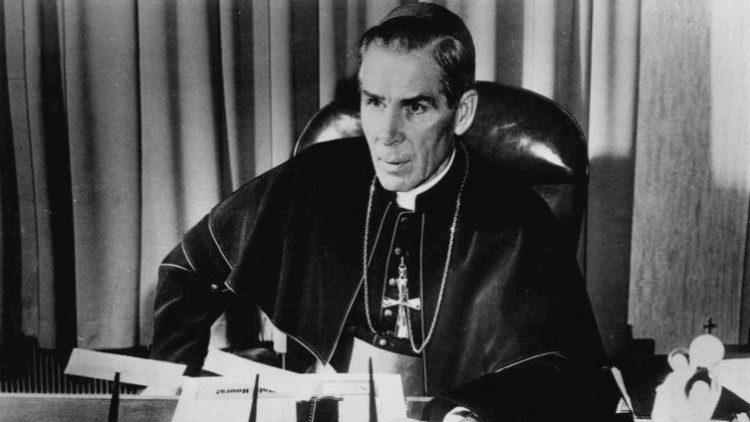
Venerable Fulton Sheen to be beatified in St. Louis on 24 September
The late American Archbishop Fulton J. Sheen will be beatified at a Mass presided over by Cardinal Luis Antonio Tagle on September 24, 2026, in St. Louis, Missouri, according to the Dicastery for the Causes of Saints.
By Deborah Castellano Lubov and Robin Gomes
Venerable Fulton J. Sheen of the United States is set to be beatified on Thursday, September 24, 2026, in St. Louis, Missouri.
Cardinal Luis Antonio Tagle, Pro-Prefect of the Dicastery for Evangelization, will preside at the beatification Mass, representing Pope Leo XIV.
After his heroic virtue was recognized, Fulton Sheen was declared Venerable in 2012 by Pope Benedict XVI. In 2019, Pope Francis authorized a decree recognizing a miracle through his intercession.
This recognition cleared Archbishop Sheen for beatification, after which he will have the title "Blessed."
The future Blessed Fulton Sheen was known for his dynamic preaching, especially on television and radio.
Born to an Irish family in El Paso, Illinois, on May 8, 1895, Sheen discovered his call to the priesthood at the age of 24 and was ordained a priest in 1919.
He pursued higher studies at the Catholic University of America in Washington (US), the Catholic University of Leuven (Belgium), and the Pontifical University of St. Thomas Aquinas in Rome.
He returned to the U.S. in 1926 and began teaching at the Catholic University of America, a position he held until 1950. Sheen served as the Bishop of Rochester, New York, from 1951 to 1969, and Pope Paul VI later appointed him as the Titular Archbishop of Newport, Wales, in 1969.
A gifted teacher and speaker, Sheen’s homilies were much appreciated. In 1930, he began participating in the Sunday radio program entitled “The Catholic Hour," which reached an estimated four million listeners at the height of its popularity.
In 1951, he began hosting a weekly television series, “Life is Worth Living," on matters of faith that attracted some 30 million viewers.
He died in New York at the age of 84, on December 9, 1979.
Pope: St John Henry Newman Patron of Urbaniana University
A Chirograph signed by Pope Leo XIV proclaims St John Henry Newman Patron of the Pontifical Urbaniana University.
Vatican News
Dated 1 November, the Solemnity of All Saints, the Chirograph decrees that Saint John Henry Newman is Patron Saint of the Pontifical Urbaniana University. The decision comes on the day when, during the Mass celebrated in St. Peter’s Square for the Jubilee of the World of Education, the English cardinal was proclaimed a Doctor of the Church.
The document notes that Cardinal Tagle, Grand Chancellor of the Pontifical Urbaniana University, put forward the request, following a proposal by Professor Vincenzo Buonomo, Pontifical Delegate of the university with the authority and powers of Rector.
Thus, the Pope decrees that “Saint John Henry Newman, Doctor of the Church, born on 21 February 1801 in London, died on 11 August 1890 in Edgbaston, canonized on 13 October 2019 in St. Peter’s Square, be proclaimed Patron of the Pontifical Urbaniana University, so that he may intercede for this academic institution and be, for all who are formed within it for the Church’s missionary service, a luminous model of faith and of the sincere search for truth.”
In his homily during Mass on 1 November, Pope Leo highlighted “Newman’s impressive cultural and spiritual stature,” an inspiration for future generations “whose hearts thirst for the infinite, and who, through research and knowledge, are willing to undertake that journey which, as the ancients said, takes us per aspera ad astra, through difficulties to the stars.”
Pope at Mass: Creators should promote encounters between hearts
At the close of Mass for digital missionaries and Catholic influencers, presided over by Cardinal Tagle, Pope Leo challenges everyone to use social media to promote a human culture.
By Kielce Gussie
St. Peter’s Basilica was filled with young people coming from across the globe to partake in the Mass as part of the Jubilee for Digital Missionaries and Catholic Influencers. Cardinal Luis Antonio Tagle, Pro-Prefect of the Section for the First Evangelization and New Particular Churches of the Dicastery for Evangelization, presided over the Eucharistic celebration.
In his homily, the Cardinal reflected on the word “influence” and what exactly it means for Catholics and digital missionaries.
What is influence today?
Cardinal Tagle emphasized that the everyone is an influencer, and at the same time, everyone is influenced. “Daily life is a tapestry of crisscrossing influences”, the Cardinal shared, pointing out that we are constantly being influenced by our families, neighborhoods, schools, and other social settings.
When these aspects of life are corrupted, they, in turn, impact who we are and what type of society we create. Moreover, the Pro-Prefect continued, “as the earth and the environment affect us, our activity affects the planet as well.”
Some 1400 pilgrims participated in the Mass for the Jubilee of Digital Missionaries and Catholic Influencers (@Vatican Media)
He insisted that this Jubilee event is an invitation to “scrutinize the intention that fuels the influence our contemporary world wants to effect.” The change we wish to see in the world is directly connected to how we choose to influence others and our motivations behind it.
Some use false advertising to sway people; others use blackmail or bribery. Still others resort to war, bombings, forced starvation as a means of influencing those around them.
God is our influencer
Cardinal Tagle turned to the day’s readings to answer the question: what is influence? Rather than sending us a text or email with an attachment, he pointed out that God sent us His Son.
The Gospel message encourages us to allow Jesus to influence us with His love, through which we can influence others for good. The Cardinal challenged the pilgrims present to “let the love of God in Jesus and the Holy Spirit prevent various poisonous influences from flowing into human hearts and societies.”
Pope Leo’s call for peace
At the end of the Mass, Pope Leo XIV addressed the young people present in the Basilica in three languages: Spanish, English, and Italian. In his message, he began by once again calling for an end to violence, emphasizing “how much we need peace in these times torn apart by enmity and war”.
He reiterated that proclaiming peace is the mission of both the Church and all those who have gathered in Rome for the Jubilee. “Peace needs to be sought, proclaimed, and shared everywhere; both in the tragic places of war and in the empty hearts of those who have lost the meaning of existence and the taste for interiority, for spiritual life.”
Therefore, today, more than ever, Pope Leo stressed, digital missionaries are essential to spreading this message to the ends of the earth.
Let our culture remain human
A particular challenge facing those who embark on this mission is to always look for the “suffering flesh of Christ” in every person they meet online. As we find ourselves in a technological society and culture, the Pope challenged the influencers: “It is up to us – to each one of you – to ensure that this culture remains human.”
Even though science and technology play an essential role in our daily lives, nothing man-made “should be used to undermine the dignity of others.” Being Catholics and influencers and digital missionaries, our mission is to promote “Christian humanism” in our culture.
Go mend the nets of friendship
Throughout history, there have been many moments of change and, the Pope stressed, the Church has never remained passive. In today’s culture so saturated with technology, the challenge is to “work together to develop a way of thinking and a language of our time, that gives voice to love.”
More than simply creating content, Pope Leo urged these digital missionaries to create encounters among hearts. This, he continued, leads to another call—to mend nets. Nets of relationships, of love, of free exchange, where friendships run deep.
The Pope argued we are called to mend the nets that “open space for others more than ourselves, where no ‘filter bubble’ can silence the voice of the weakest.” Through this, we can create a single network of God.
Closing, Pope Leo thanked the young people present for all their work and encouraged them on their path to reaching the ends of the earth through digital means.
Cardinal Tagle: Eucharistic Congress was a ‘blessed experience’
In this interview with Vatican Radio, Cardinal Luis Antonio Tagle reflects on his experience at the Tenth National Eucharistic Congress in the United States, and shares the message Pope Francis had for participants.
By Christopher Wells
The National Eucharistic Congress in the United States was “a blessed experience for me,” Cardinal Luis Antonio Tagle told Vatican Radio on his return from the event, which he attended as Pope Francis’ personal representative, known as a “pontifical legate.”
The Pro-Prefect for the Section of First Evangelization for the Dicastery for Evangelization, Cardinal Tagle said, “It was palpable that people were responding to a calling from God who sent His Son Jesus in the flesh and whose presence remains among us in in the Eucharist.” And, he added, “This has sent the Holy Spirit touching their hearts through the voice of their pastors and their religious orders and their lay movements or groups, to come to respond to the call and to express their faith now in Jesus’ Presence among us.”
Recovering a sense of wonder
Noting that it was customary for the Pope to commission his legate with a personal letter, Cardinal Tagle said, “It was very clear that first, the Holy Father wanted to encourage the people to recover the sense of wonder, of amazement at the gifts, the spiritual gifts that the Eucharist brings to us, again, a sense of wonder.”
He went on to say that “the Holy Father added immediately that having received the gift, they should impart to others the beauty of that gift – the missionary of dimension of our Eucharistic devotion so that our Eucharistic devotion does not end up being a closed relationship between Jesus and me, and I forget the world and I forget others.” Instead, the Cardinal explained, “If you have received the gift, then we should go on mission proclaiming the good news that we have seen, that we have tasted, that we have received.”
Interview with Cardinal Luis Antonio Tagle
Pontifical Legate to the National Eucharistic Congress
Vatican Radio: Your Eminence, Cardinal Tagle, thank you for joining us this afternoon. You’ve just returned from the United States, where you were the pontifical legate, the pope’s representative to the National Eucharistic Congress. Can you tell us about your experience of the event?
Cardinal Luis Antonio Tagle: Well, first of all, it is a blessed – and a blessing – a blessed experience for me. And I thank the Holy Father for sending me as his representative to the National Eucharistic Congress. You know, it gave me, first of all, an experience once again of a church in the original sense of the word, a gathering of people, but not just a gathering because they wanted to party or just because they have a common interest, but a gathering that is really a response to a calling.
And it was palpable that people were responding to a calling from God who sent His Son Jesus in the flesh and whose presence remains among us in in the Eucharist. And this has sent the Holy Spirit touching their hearts through the voice of their pastors and their religious orders and their lay movements or groups, to come to respond to the call and to express their faith now in Jesus’ presence among us.
So for me, it’s a wonderful experience to see the Church, in coming together in the name of Jesus, in prayer, in wanting to learn more regarding the Word of God through the speeches, through the catechetical events, and most especially through the testimonies of peoples who have been transformed by their Eucharistic life and spirituality. I count it as a blessing for me.
Q. And again, you were the representative of Pope Francis to the National Eucharistic Congress. Can you share with us, what was the message that you brought from the Holy Father to the US faithful?
Speaker2: Well, the Holy Father wrote me a letter – and it is customary for the Holy Father to write a letter to the person that he is sending, as a delegate, to any event, and in this case, to the National Eucharistic Congress. And aside from the letter, I had an opportunity to talk with him before my departure.
But in the letter, it was very clear that first, the Holy Father wanted to encourage the people to recover the sense of wonder, of amazement at the gifts, the spiritual gifts that the Eucharist brings to us, again, a sense of wonder. That’s why I emphasized in my homily the sense of the renewed vision of receiving gifts, the sense of wonder at having been the recipient of this tremendous gift, which is not just anything but the presence of Jesus who fulfilled His mission of love by coming as one of us except in sin. So His mission is accomplished in His being a gift in the flesh. And now He gives His flesh to us as food as a pledge of eternal life.
So the Holy Father wants the people, not only those who attended, but everyone, especially the United States, to recover that sense of amazement and gratitude for the gift being received.
But the Holy Father added immediately that having received the gift, they should impart to others the beauty of that gift – the missionary dimension of our Eucharistic devotion, so that our Eucharistic devotion does not end up being a closed relationship between Jesus and me, and I forget the world and I forget others. No. If you have received the gift, then we should go on mission proclaiming the good news that we have seen, that we have tasted, that we have received.
So I just emphasized those two important aspects of the Pope’s message to me, which I thought he wanted me to relay to everyone in the Congress.
Q. And in fact, the idea of going on mission and sharing the gift we’ve received is part of the ongoing National Eucharistic revival. That was the overall context of the Eucharistic Congress, and that’s still ongoing. What fruits – given your experience in these past few days and over the past few years – what fruits do you hope to see in the Church in the United States as a consequence of the Congress and the Eucharistic revival?
Of course, we rely on the gift of God, the Holy Spirit that moves the hearts of people, and we rely on the power of the presence of Jesus in the Eucharist to produce those fruits.
But I can, in hope, also say that after listening to the people who had participated – even in the airport, I met some of them who were also flying out of Indianapolis – and I already see the beginnings of the growth of the fruits sown during the Congress.
First of all, I saw the joy of being gifted with the Lord. And that joy I hope will be spread by people. Because I think the Holy Father stressed that the Evangelii gaudium, the joy of the gospel, yes, our life as Christians, our Eucharistic practice are not just obligations imposed on us, but they are gifts to us that we should receive with gratitude and with joy.
And I saw much joy, much joy, and I hope that would be one fruit that people will see that following Jesus is a joyful matter. It is. Yes, it will have its challenges. We will bear the Cross, but we bear it with joy.Not with lonely and regretful hearts, but with joy.
And secondly, the fruit is also to encourage people to come together, to come together for the Mass. Because I heard that there was, since the Covid pandemic, there was a drop in the attendance at Mass, the physical attendance at Mass. I hope this big gathering will encourage people to come back to church in their parishes and to experience the totality of the Eucharist, that Jesus gathers us as His Body. We listen to the word of Jesus in the Liturgy of the Word, we gather the gifts of the earth, the fruits of human labor, that will become the body of Christ. And then after receiving it, we go on mission, but before we can go, we should be gathered.
And I hope that this Congress would have encouraged the viewers, those who follow the Congress to go out and go back to church, be with the community, experience being Body of Christ and together also to go on mission.
Q. One last question for you. You’re the pro-prefect of the section of the dicastery for evangelization dealing with the first evangelization and new particular churches. How can renewed Eucharistic devotion, not just in the United States, but maybe throughout the Church, contribute to the first evangelization?
You know, there is what you call an intimate connection between the Eucharist and evangelization. First, when we go to the experience of the early Church after the Resurrection and Ascension of the Lord, we see that the early Christian communities gathered to listen to the teachings of the apostles, to break bread together, and they shared their goods, their properties to be shared in common, especially with the poor. And according to the Acts of the Apostles, that gathering in the Word of God, gathering the Breaking of Bread, the gathering in charity, which is very Eucharistic, caught the attention of many people, and many were converted to the Catholic faith.
So the Eucharistic gathering is in itself a proclamation in action of the good news of what Jesus could do to a community, of what new life, the new life that Jesus brings to a community that is gathered in the Eucharist.
So we hope, we hope that, and I have to testify that in many parts of the world where Christians are a tiny minority, Christians are eager. They walk for miles and miles, even for days, in order to join the community in the celebration of the Eucharist. And in that gathering, they are renewed and they give a witness to non-Christians about the good news. Sometimes it happens that it is the Eucharistic assembly that makes non-Christians curious what I call this holy curiosity. They ask why? Where are you gathering every Sunday and why do you share songs? Why do you share even your food with each other? They open the gates for us to proclaim what we have seen, heard, and touched Jesus in the Eucharist.
Q. Cardinal Tagle, thank you again so much for taking time to speak with us. I know you’ve had a long trip. Is there anything else you’d like to share as we conclude our interview?
Well, I just hope that people who went, from different parts of the United States – because there were pilgrimages leading up to Indianapolis – now the expectation is from Indianapolis, will there be a movement going back to the different parts of the country? That’s where we have to be open to the Holy Spirit, that will lead us to bring Jesus wherever He wants us to go