Showing posts with label Ambassador Brian Burch. Show all posts

Friday, October 2, 2026

Bishop Robert Barron meets Pope Leo XIV and ordains 18 new Deacons from the Pontifical North American College


Bishop Barron meets Pope Leo XIV at Vatican, ordains 18 deacons in St. Peter’s Basilica

 October 1, 2026

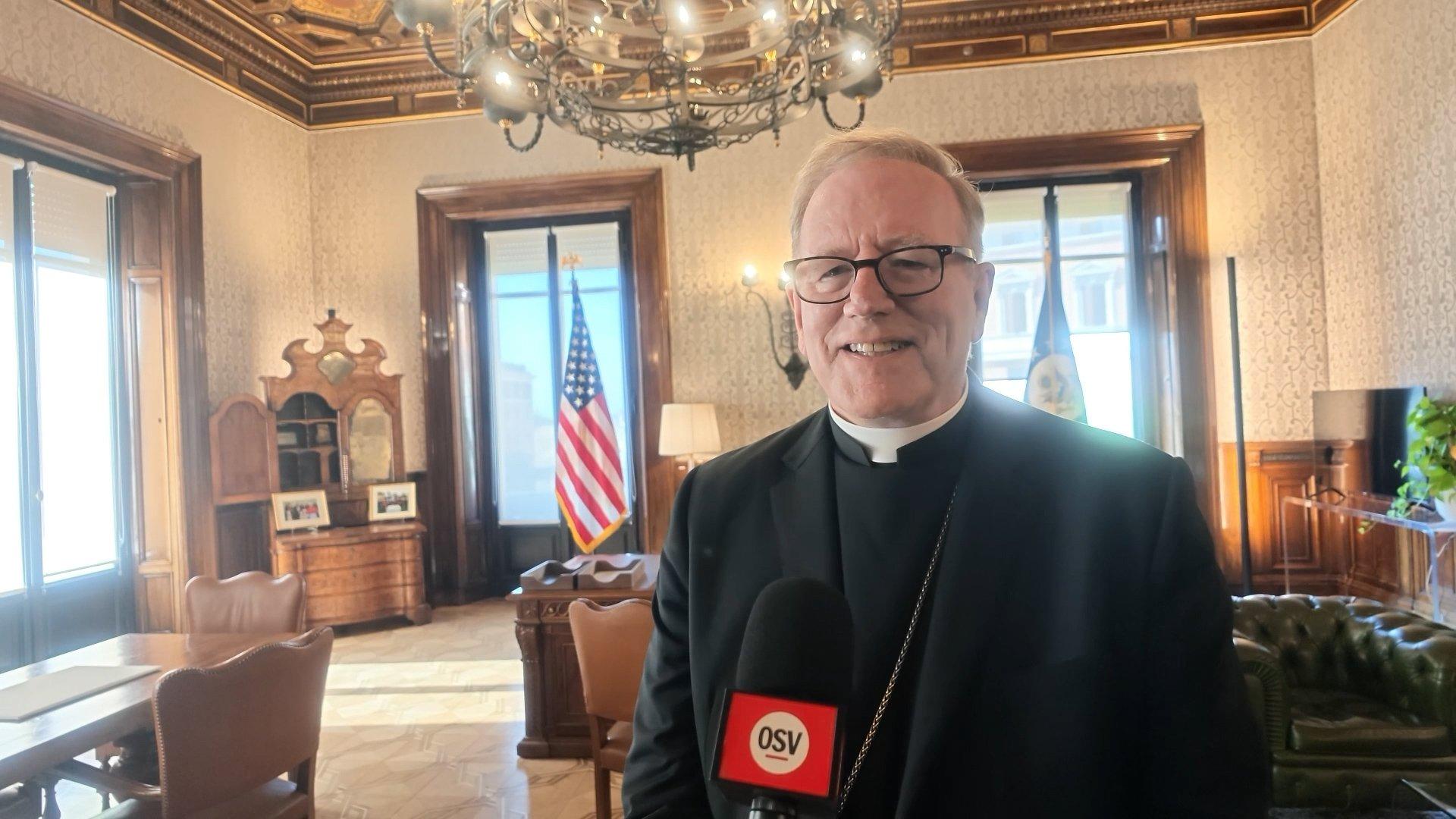
ROME (OSV News) — Bishop Robert E. Barron met Pope Leo XIV for a private audience at the Vatican Oct 1, describing his first extended, one-on-one conversation with a pope as covering “a lot of different topics.”

The Chicago-born pope opened with a hometown connection, “‘Well, two guys from Chicago,'” Bishop Barron recalled Pope Leo telling him.

“It was just a very comfortable conversation. We covered a lot of different topics, but it was just delightful to be with him and, you know, to be with the successor of Peter and our spiritual father,” he said in a video posted to social media shortly after the meeting in the Apostolic Palace.

In an interview with OSV News the day before the papal audience, Bishop Barron, who has led the Minnesota Diocese of Winona-Rochester since 2022, reflected on the influence of Pope Leo and signs of renewed religious interest in the United States.


‘His papacy means a lot to our country’

“There is a revival going on for a lot of different reasons and some of that antedated Pope Leo, but I think his papacy means a lot to our country,” Bishop Barron said in the interview at the U.S. Embassy in Italy on Sept. 30.

“When you hear the pope speaking in the dulcet tones of Chicago, I think that has an impact on Americans,” he added, noting that he sees Pope Leo’s presence and charisma positively influencing young people.

“They say, well, look, I can understand this fellow,” he said. “And just his presence, his charisma. And precisely as an American, I think sure has a positive impact on our country.” 

Bishop Barron was in Rome to ordain 18 American seminarians from the Pontifical North American College to the diaconate during an evening Mass in St. Peter’s Basilica on Oct. 1. In his homily, the bishop told the seminarians to imitate the example of Blessed Fulton Sheen in preaching the Gospel.

“Preaching is not sharing your opinions on culture or politics, not even offering your point of view on matters spiritual, nor is it talking about Jesus or God or the Church,” Bishop Barron said.

How ‘authentic preaching’ happens

“Authentic preaching happens when you allow Jesus to use you to speak his Word to his people,” he emphasized. “You preach when Jesus has so seized your heart, your mind, your personality that he effectively speaks through you. 

Bishop Baron, 66, is the founder of the Word on Fire Catholic Ministries, a global Catholic media apostolate. He gained national prominence more than a decade ago as the host of the television series “Catholicism” and through his regular YouTube videos exploring popular culture, faith and Catholic teaching. 

His latest documentary, “Heaven in Stone and Glass,” which explores the Gothic cathedrals of France, was shown in U.S. movie theaters on the eve of Pope Leo’s visit to France.

Reflecting on the papal visit, Bishop Barron told OSV News he was particularly moved by the stadium prayer vigil celebrating France’s Catholic heritage attended by 80,000 young people. 

“It was a wonderful celebration of the Catholic culture of France, which I think is much needed today when an aggressive secularism is trying to push religion out,” he said.

A ‘bold reaffirmation’ of France’s Catholic heritage

Bishop Barron described the event as a “bold reaffirmation” of France’s Catholic heritage, adding that he found it especially encouraging that the event was held “in the presence of the Pope, who was clearly moved himself by it.” 

“I think it is part of this trend of revival that you can find all across the West,” he said. “Spiritual hunger meeting social media, which allows us now to reach out to that world. That’s a powerful combination.”

Bishop Barron also said that a papal visit to the U.S. by Pope Leo would be “a wonderful event for our country” that could help revive “the hearts and minds” of American Catholics.

During his visit to the Eternal City, Bishop Barron also addressed diplomats and scholars at an event hosted by the U.S. Embassy to the Holy See on Sept. 30 celebrating the 250th anniversary of America’s independence this year. 

In his remarks, he highlighted President Abraham Lincoln and civil rights leader the Rev. Dr. Martin Luther King Jr. as examples of prominent Americans whose understanding of public life was shaped by biblical principles. 

‘Points of contact’ between American political sensibility and Catholicism 

“There are very important points of contact between the American political sensibility and Catholicism,” Bishop Barron told OSV News after the event. “It’s not perfectly congruent, but there are important points of contact. You can’t really talk, I think, coherently about freedom and about rights without talking about God. And if God is removed from the conversation, those are severely threatened,” he said.

U.S. Ambassador to the Holy See Brian Burch, who also spoke to OSV News after the bishop’s speech, commented on how “Bishop Barron pointed to is this deep compatibility between the Church’s understanding of democracy, of freedom, of rights, of equality, and the American founding.”

“There’s some real, I think, specialness to that compatibility that I think is worthwhile thinking about as we map where this papacy will go and how the Holy Father will be thinking about these very important questions that are important to the United States,” the ambassador added.

Friday, July 24, 2026

U.S. Ambassador to the Holy See clarifies his remarks ; acknowledges that Pope Leo is above all else, universal shepherd of the Church


U.S. ambassador clarifies view on pope’s role in politics, war after Vatican response

Burch said his recent comments to the New York Times were not meant to imply that Pope Leo’s statements about the Iran war should be seen as simply diplomatic — rather than spiritual — guidance.


After the Vatican reframed statements that U.S. Ambassador to the Holy See Brian Burch made to The New York Times, the ambassador has clarified that he understands Pope Leo XIV’s role as a head of state is “inseparable” from his role as the universal shepherd of the Church.

During a July 23 interview with the EWTN News program “The World Over with Raymond Arroyo,” Burch clarified that his July 9 comments to the Times were not meant to imply that Leo’s statements about Iran war policy should be seen as simply diplomatic — rather than spiritual — guidance.

“I think thereʼs a misunderstanding,” Burch explained. “... [The role of] the pope as the universal sovereign of the Holy See and as the universal pastor — a pastor of the universal Church — is inseparable.”

The controversy stemmed from a quotation in the Times article in which Burch said: “When the pope acts as the sovereign leader of the Holy See, he is coequal with world leaders.” The article also paraphrased Burch’s position by saying the ambassador argued that the pope’s comments about the Iran war were not made as the vicar of Christ but rather as the political leader of the Vatican City State.

Without naming Burch, the Editorial Director for the Vatican Dicastery for Communication, Andrea Tornielli, subsequently wrote a July 13 op-ed saying that “even when he speaks about war and peace … the Successor of Peter remains, above all, a spiritual leader.” Even though Leo is a head of state, he wrote, this “does not mean that he acts or speaks as a politician when addressing issues concerning the affairs of humanity.”

In his interview with Arroyo, Burch disputed the Times’ characterization of his views, saying the outlet “doesnʼt exactly understand the nuances of Catholic social teaching and how to apply it.”

“The pope has this dual role,” Burch said. “He is both the head of the sovereign territory of the Holy See, which has diplomatic relations with the world, but inseparable from that is his role as the universal pastor of the Catholic Church. And when he acts, he certainly acts in such a way to call the world to these high moral principles, to the ideals of … how [humanity] ought to live together.”

At the same time, Burch insisted that “there are some very difficult, contingent, practical matters” that play into decisions about going to war, which he said are “the responsibility of the prudential wisdom of those responsible for the common good,” which are political leaders like President Trump.

“I tried to explain [to the Times] where there are certain prudential questions,” Burch said. “For example, what does the intelligence information tell us about the situation in Iran? Where is the dialogue at? What [do] the regional alliances look like? What [does] the war game scenario implicate?”

“These are very contingent, prudential questions that inform this question on the legitimate use of force,” he added. “And I think, to the Holy Fatherʼs credit, he is the universal shepherd that is calling humanity to this high ideal to try to resolve these sorts of conflicts without violence, without the use of force.”

Burch told Arroyo that he does not see disagreement between Trump and Leo on the intended end goal: “Thereʼs no disagreement on peace, on disarming Iran, on the need for interreligious dialogue, for religious freedom.”

“Where the challenge comes is the means to get there,” Burch said. He added that it’s not “a surprise, nor a shock, nor an unwelcome message from the Holy Father that we ought to seek peace, that we ought to seek ways to resolve these sorts of conflicts without the use of force.”

“But as you know, original sin exists, and there are evil people in this world with evil intentions that, if they arenʼt stopped, certainly could do enormous damage, catastrophic damage, in the world,” the ambassador emphasized.

Monday, July 6, 2026

On 4th of July, Pope Leo pays visit to the U.S. embassy; states he is rooting for Team USA in World Cup


Pope visits U.S. embassy July 4 for discussion on peace and freedom, with a side of apple pie


Pope Leo XIV spends the evening of July 4, 2026, with U.S. ambassador Brian Burch and his family, where they discussed peace and freedom, and the Burch family presented the pope with a U.S.A. World Cup jersey, a baseball and an apple pie. (OSV News photo/courtesy U.S. Embassy to the Holy See)

After spending the morning praying for migrants on the island of Lampedusa, Italy, Pope Leo XIV celebrated the 250th anniversary of the signing of the Declaration of Independence with the U.S. Ambassador to the Holy See and his family.

“I am deeply honored to celebrate this special day with a fellow American and the Bishop of Rome,” Ambassador Brian Burch said, in a post on X.

Further posts on X said that the ambassador and Pope Leo “discussed President Trump’s bold leadership and American efforts to pursue peace, religious freedom, and the need for moral clarity and courage around the world.”

They also indicated that Pope Leo had received “a USA World Cup jersey, a commemorative Freedom 250 baseball, and a homemade apple pie” from the Burch family, the post said.

In a message to journalists, the Holy See Press Office July 4 confirmed the visit, saying, “welcoming an invitation from the U.S. Ambassador to the Holy See, the Holy Father visited the ambassador’s residence on the evening of Saturday, July 4, on the occasion of the national holiday.”

The post thread added that Pope Leo had confirmed during the visit that he is rooting for Team USA in the World Cup.

Thursday, February 26, 2026

Candid interview with U.S. Ambassador to the Holy See


US Ambassador sees potential for ‘Catholic Moment’ with Leo


Pope Leo XIV receives the letters of credential of Brian F. Burch as U.S. ambassador to the Holy See during an audience Sept. 13, 2025, in the Apostolic Palace at the Vatican. (Credit: Vatican Media.)


ROME – United States Ambassador to the Holy See Brian Burch, in an exclusive sit-down interview with Crux Now, said he sees the potential for a “Catholic Moment” in the U.S. given the high-profile Catholics in the current administration, with history’s first U.S.-born pope.

According to Ambassador Brian Burch, there is a new kind of conservativism in U.S. politics being shaped largely by prominent Catholic personalities including U.S. Vice President JD Vance and Secretary of State Marco Rubio, a “common good conservatism” which can help shape the future of the country.

RELATED: US immigration law ‘not rooted in hate or xenophobia,’ ambassador says

“There is a real moment, I think, and Pope Leo and I talked about this when I sat down with him to present my credentials,” Burch told Crux Now in a wide-ranging sit-down interview in his office at the U.S. Embassy to the Holy See.

President Donald Trump, he said, “deeply cares about and understands intuitively this Catholic view of the human person and of human communities.”

“I think this is represented in the vice president he chose, in the secretary of state he chose. They speak about this frequently,” he said.

Burch noted that Rubio in a speech at the Catholic University of America spoke about a “common good conservatism” as a new and upcoming type of conservative instinct that is bubbling up in U.S. politics and culture, and which is distinct from similar movements in the past.

“We have this political camp that I came from that sees old Republican politics as inadequate, certainly progressive ideology as incompatible, and a kind of third way that’s this common good conservatism that I think is deeply rooted in a lot of the principles found in Catholic social teaching and which I think will contribute to the possibilities of a ‘Catholic Moment’,” he said.

In his interview Burch also spoke about collaboration between the U.S. and the Holy See on issues such as religious freedom and artificial intelligence, a potential papal trip, celebrations for the U.S.’s 250th anniversary this year, and Pope Leo’s sports affinity.

Please read below for Part Two of Crux Now’s sit-down interview with U.S. Ambassador to the Holy See Brian Burch (Part One is here):

Crux Now: There are many areas where the Holy See and the United States do have a lot of common ground. The area of religious freedom, for example, parents’ rights in education, and artificial intelligence. What do you think are the strongest points of interaction and dialogue between the United States and the Holy See at this point?

Burch: I think any ambassador in this role inherits a set of issues where there has been a deep and abiding collaboration, and that includes global peace and security and religious freedom and human dignity writ large. Of course, we’ve talked about Russia-Ukraine, we talked about the Middle East, we talked about Venezuela. In many respects, I think the Holy See and the United States see the world very similarly in terms of, we’re not on different sides, we want to work towards a peaceful resolution, we believe in principles of justice, and we understand that there’s a moral order that ought to govern human action. We are a part of a Christian civilization that they help shape. We may not always agree on the best means, or rhetoric, or tools, but there is a deep shared commonality when it comes to the peace and security of the world in terms of the goal.

Religious freedom, as you point out. Archbishop [Paul] Gallagher in his recent UN speech pointed out that the Christians are the largest persecuted group in the world. The numbers are shocking and there are many places where that is especially felt like Nigeria, for example, or the church in Nicaragua, or various places where Catholics, Christian believers’ lives are being threatened.

There’s a bigger opportunity here within the realm of religious freedom. I’m going to play armchair theologian here with an Augustinian pope. Saint Augustine talks about the tranquility of order, peace as the tranquility of order, which is that peace is not simply the absence of conflict or coercion, but it’s actually the set of conditions that lead to broad flourishing. This is the kind of religious freedom, and this is the peace that the U.S. wants to help advance. It’s not simply not being threatened inside the walls of a church so that you can read the Bible. It’s to be able to live out one’s faith in the public square, within your community, within your family to have access to faith-based health care, to have access to a religious school, to be able to speak and to write and to share faith-informed opinions in the public square without fear of censorship or coercion.

This is religious freedom broadly understood. It’s not simply lack of coercion; it’s a set of conditions that will lead to broad flourishing as a believer. I think that that’s an important piece because I think sometimes religious freedom can shrink. I think rightly understood, at least in the tradition of both the Church and I think in the way that the United States is best understood, it’s that people of faith can not merely believe, but can thrive.

It’s widely acknowledged that [Pope] Leo chose his name with reference to his predecessor by the same name [Leo XIII]. There is a lot of expectation around what his first encyclical might include, and the fact that probably the most transformative thing that will happen during my time here is, what impact will AI have on our world? There perhaps be no bigger issue while I’m here than to help relate U.S. policy to the Church’s rich tradition around a rightly understood human anthropology and a set of ethical principles that need to guide innovation and technology that’s transforming our world.

The U.S. has a particular proposal for the world when it comes to AI. We have tech leadership, we have commercial interests, we have a set rule of law, we have a deep tradition of respect for speech, for freedom of religion, for privacy, for intellectual property. We have an opportunity to take advantage of all of the benefits that AI will bring the world, circumscribed by this ethical and human dimension that the Church contributes and which could be extraordinary and spectacular. There could be amazing leaps of innovation that could change the world in great ways.

There are also lots of risks. Some of the ethical and human questions that the Church will guide are extremely important. I think some of the threats that alternatives to the AI model that the U.S. is advancing that other parts of the world are proposing will threaten censorship, privacy, intellectual property, religious freedom, fundamental human rights, because of how transformative this technology could be. It’s very important that countries, and I’m going to call this a Western-civilization-modeled AI, an AI that’s worth pursuing and that’s good for the world, is going to have to incorporate some of those Western civilization ideas that Secretary [Rubio] spoke about in Munich.

You mentioned playing armchair theologian. You are Catholic, and the U.S. usually sends a Catholic to this assignment, but you are here with history’s first American pope when there are two other prominent Catholics serving in the current administration. Is this a ‘Catholic moment’ for the U.S.? How can this shape U.S.-Vatican relations at this point?

When I hear ‘Catholic Moment’ I think of Father Richard John Neuhaus and his book [The Catholic Moment: The Paradox of the Church in the Postmodern World, Harper Collins, 1987]. I wrote a far less erudite and interesting book, similarly titled, about Donald Trump and the ‘Catholic Moment’, in part because I believe the president and what he represented and his policies are not just compatible, but in many ways help advance a Catholic understanding of the world.

Now you have an American Pope, with a president who has a deep commitment to broad human flourishing and the common good, rightly understood. There is a real moment, I think, and Pope Leo and I talked about this when I sat down with him to present my credentials, that for all of the political noise and the accusations that surround the president – in a very real sense, this is a president who deeply cares about and understands intuitively this Catholic view of the human person and of human communities. I think this is represented in the vice president he chose, in the secretary of state he chose. They speak about this frequently.

What they say and how they carry out their work is informed by their Catholic faith, and they find the faith to be one not just of spiritual inspiration, but of rich intellectual and social teaching and to be deeply helpful to how they are doing their work.

There are different kinds of models for, let’s call, conservatism that are being advanced. Marco Rubio called it common good conservatism at the Catholic University of America, and we have this political camp that I came from that sees old Republican politics as inadequate, certainly progressive ideology as incompatible, and a kind of third way that’s this common good conservatism that I think is deeply rooted in a lot of the principles found in Catholic social teaching and which I think will contribute to the possibilities of a ‘Catholic Moment.’

Obvious question: the answer to this has flip-flopped like a pancake from one week to the next, but when will the U.S. get a papal trip?

Pope Leo said to me when I met with him that he wants to go to the U.S. Who wouldn’t? When he does go to U. S., it will be the largest gathering of Catholics in American history. It will be extraordinary. We’ve engaged in conversations about the possibility of a trip. I know he’s been invited by the United Nations to speak as well. There was some talk that he may go this year. I think if I had to make a guess, I think he’ll probably go next year sometime, that’s latest we’ve heard.

He’s already built that already that every pope has which is, it’s the pope, but also people just sense in him that, ‘he cares about me’. Just his disposition exudes that; he doesn’t have to even say anything. I think the other piece of it would be, we’re living in this moment in history where there is such deep thirst for real spiritual richness and the Church always thrives in the midst of moments where people say, ‘Who has the answers to eternal life? To whom shall we go?’

I ask people all this all the time, when did this all really start to pick up? I think it was really post-COVID when people had this kind of moment of reset. We stopped our routines, we had this time to do some more reflection and found this wanting for something more out of life. Often when people spend enough serious time asking the bigger questions, they get to religion again. Then once you get to the religion, you start to ask, to whom shall we go, right.

There are some other things we’re working on with respect to the Holy Father in the United States that we’ll probably be announcing fairly soon. It’s a big year for the U.S., ‘America 250’, our 250th anniversary. I know the Holy See, and this pope in particular, understands that wants to ways to acknowledge the significance of our anniversary.

This is the big curveball: This Pope is a sports fan, and this year, most of the World Cup is going to be played in the Americas. Are you going to have a watch party?

People have asked about this. We were joking, actually, at the diplomatic corps address. I went up to him when you get to greet him. I said some substantive things to him about some things we had going on, and he acknowledged a couple things we said back and forth. Then I said at the end, oh yeah, and one more thing, ‘go Bears!’ If you remember, the Chicago Bears were in the playoffs and I knew he was watching because anyone from Chicago – you might like Cubs or Sox, but everyone was watching the Bears this season because it was extraordinary and he really laughed out loud. He just laughed like it was so funny that after this kind of serious substance thing, which tells me he is a real sports fan.
Tuesday, September 16, 2025

Pope Leo XIV offers prayers for Charlie Kirk, his family, and an end to political violence


A man holds an American flag and a rosary at a vigil for Charlie Kirk in New York CityA man holds an American flag and a rosary at a vigil for Charlie Kirk in New York City  (ADAM GRAY)

Pope prays for Charlie Kirk and bereaved family

Pope Leo XIV expresses concern about political violence and is praying for the late American activist Charlie Kirk, his wife, and two children, according to the Holy See Press Office.

By Vatican News

The Director of the Holy See Press Office, Matteo Bruni, responded to reporters’ questions on Tuesday about the Pope’s reaction to the murder of Charlie Kirk.

“I know that during the conversation with the new U.S. Ambassador, the Pope confirmed that he is praying for Charlie Kirk, his wife, and his children; that he expressed concern about political violence; and that he spoke of the need to refrain from rhetoric and instrumentalization that lead to polarization rather than dialogue,” said Mr. Bruni.

Pope Leo XIV met on September 13 with the new US Ambassador to the Holy See, Brian Francis Burch, as he presented his credential letters to begin his mandate.

During that audience, the Pope shared his condolences for Mr. Kirk’s family and his concern about political violence.

Mr. Kirk was an American political activist, author, and media personality who co-founded the organization “Turning Point USA.”

The 31-year-old was shot dead on September 10 during a public event at the Utah Valley University campus. His funeral will be held on Sunday, September 21, in Glendale, Arizona.