Showing posts with label Bishop Robert Barron. Show all posts

Monday, May 18, 2026

Rededicate 250 held in D.C. A faith-filled religious & spiritual event or something else?


Trump allies lead thousands in prayer to 'rededicate' America to God on National Mall

WASHINGTON (RNS) — The speakers largely advanced the ideas that the U.S. has a religious — and particularly Christian — founding and that its future success depends on prayer.

People attend Rededicate 250, a mostly Christian prayer gathering in honor of the United States’ 250th anniversary, Sunday, May 17, 2026, on the National Mall in Washington. (RNS photo/Aleja Hertzler-McCain)

Jack Jenkins, Aleja Hertzler-McCain and Adelle M. Banks

May 17, 2026


WASHINGTON (RNS) — As House Speaker Mike Johnson stood before a crowd of thousands on the National Mall on Sunday (May 17), he did something not altogether unusual for the outspoken Southern Baptist: He closed his eyes, bowed his head and prayed.

But as Johnson began speaking, his frame dwarfed by enormous screens featuring patriotic and religious imagery, he made clear this particular prayer was meant to hold more weight than usual.

“Just as we in the beginning dedicated this land to your most holy name, today, here, Lord, in this 250th year of American independence, we hereby rededicate the United States of America as one nation under God,” said Johnson, a Republican, to cheers.

It was one of many such moments at the daylong event, titled “Rededicate 250: A National Jubilee Of Prayer, Praise & Thanksgiving.” The effort was one of several projects overseen by Freedom 250, an organization partnering with the White House and other branches of the federal government to celebrate the 250th anniversary of the signing of the Declaration of Independence. Like Johnson, the speakers largely advanced the ideas that the U.S. has a religious — and particularly Christian — founding and that its future success depends on prayer.

The event featured a video of President Donald Trump reading from 2 Corinthians, which he prepared for a separate event two weeks ago.

After the clip ended, Pastor Lou Engle led the crowd in chanting “Revival! Revival! Revival!”

The prayers moved Michelle Calhoun of Florida, a Catholic, to tears.

“I think they’re bringing on the Holy Spirit over our country, and I’m proud to be an American,” she said, voice shaking.

The Rev. Samuel Rodriguez, president of the National Hispanic Christian Leadership Conference and longtime Trump adviser, formally opened the event in prayer, declaring “America is not done with God and God is not done with America.”

Rodriguez’s remarks kicked off an hour's long lineup of religious leaders, government officials, musical acts and media personalities who stood on top of a massive stage that featured towering columns and video screens that simulated stained-glass windows. The sprawling multiracial crowd — a sea of red, white and blue, dotted with banners of Jesus and MAGA hats — held arms high and sang along with the worship music featured throughout the event.

Most of those who spoke from the stage, either in person or on video, were evangelical Christians, with several longtime supporters of Trump, including Paula White-Cain, a Florida pastor who now serves as head of the White House Faith Office; Apostle Guillermo Maldonado of King Jesus International Ministry; Pastor Robert Jeffress of First Baptist Church in Dallas; and Pastor Jack Graham of Prestonwood Baptist Church in Plano, Texas.

“America has become morally wrong, completely sick with sin,” the Rev. Franklin Graham, son of famed evangelist Billy Graham, said in a video, citing LGBTQ+ issues, mass shootings and violence. “We have an insatiable appetite for violence, and I believe this grieves the heart of God and will bring his judgment if we don’t repent as a nation.”

Several political leaders also spoke, including Defense Secretary Pete Hegseth, who is a member of the Communion of Reformed Evangelical Churches; Secretary of State Marco Rubio, a Catholic; and director of intelligence Tulsi Gabbard, a Hindu.

Aside from Gabbard and one Jewish leader, the program was largely devoid of speakers from non-Christian faith traditions, such as Muslims, Sikhs or practitioners of Indigenous spiritual traditions.

Hegseth’s remarks, delivered via video, concluded with a story of George Washington kneeling in prayer at Valley Forge.

“Let us pray as he did,” Hegseth said. “Let us pray without ceasing. Let us pray for our nation on bended knee.”

While Washington was a Christian, historians — including the director of the George Washington Presidential Library at Mount Vernon — have long dismissed the story of his Valley Forge prayer as a likely fabrication.

Though there has recently been public tension between Trump and Catholic leadership, including the U.S. Catholic bishops and the first American pope, there were a few Catholic leaders who spoke at the event. Bishop Robert Barron, the leader of the Winona-Rochester, Minnesota, diocese who has a large social media audience, including more than 3 million subscribers on YouTube, gave a speech and a separate prayer. Barron has participated in various administration efforts to honor the 250th anniversary, arguing the U.S. conception of rights is rooted in God and against understandings of freedom that allow for “self-invention.”

“As we reflect on our history,” said Barron from the stage, “we can see this consistent thread, the conviction that human dignity, equality, rights, freedom and the rule of law are all grounded in God.”

Cardinal Timothy Dolan, retired archbishop of New York, spoke by video. He said, “Our founders knew that — they knew that in order to be faithful and productive citizens and true patriots, well, we must recognize that we’re children of God first.”

The speakers were met with a boisterous, supportive crowd. Some of those mingling about the National Mall said they had spent the night or rose early to get a spot. Many said they came from across the country. 

Actor Jonathan Roumie speaks during Rededicate 250 on the National Mall, Sunday, May 17, 2026, in Washington. (RNS photo/Adelle M. Banks)

Standing in a line to enter that stretched multiple blocks, a woman who identified herself only as Dena chatted with two other women who traveled with her from West Virginia. All three wore shirts that read “One Nation Under God.”

Dena said she had come to Washington because she believed America was “founded on God,” but also, she said, to express support for Trump.

“It’s about time that it happened, and we’re not backing down,” she said, as her colleagues urged her on, with an occasional “Amen.”

Dena referenced an Anglican chaplain who was part of the early English settlement in Jamestown, Virginia, to argue the U.S. had a religious founding, then added: “I think God has graced us with a president who has opened the door up to allow it to happen again.”

Billy and Dorothea Ohlandt, a Southern Baptist couple from Franklinton, North Carolina, said they were some of the first to arrive on the site, having slept overnight outside a gate of the event.

“The reason we came here: because this is such an important thing for our nation, just to put Christ back first, and it’s the biggest thing our country needs to do is to turn to God,” Dorothea Ohlandt said.

Asked how they respond to critics of the event who said it was not inclusive of people of a variety of religious beliefs or none, Billy Ohlandt said that from his perspective, it was.

“I guess what I would say to them is try it for 30 – try Jesus for 30 days,” he said. “We don’t exclude anybody.”

Rabbi Meir Soloveichik of New York City’s Congregation Shearith Israel addressed the crowd during the event. He celebrated U.S. involvement in World War II and in the defeat of the Nazis.

“In the years that followed 1938, the prayer that is ‘God bless America’ was carried by American soldiers who defeated evil, liberating Europe and the world,” he said. “It is a reminder, as hatred of Jews makes itself manifest again, that anti-Semitism is utterly un-American.”

Gabbard, who addressed the assembly via video, did not reference her Hindu faith in her remarks. Instead, she appealed repeatedly to God in general and seemed to reference the Lord’s Prayer — a Christian orison.

“On this day, let us humble ourselves before God,” she said. “Let us beg for his mercy and guidance. Let us be willing to forgive those who have offended us as we ask God to forgive us for our trespasses.”

Notably absent from the lineup were mainline Protestant speakers — despite those traditions being overwhelmingly represented among signers of the Declaration of Independence. According to Pew Research, while 62% of Americans identify as Christian, only 23% identify as some form of evangelical. An additional 19% are Catholic, 11% are mainline Protestants, 5% are historically Black Protestants and around 2% are members of The Church of Jesus Christ of Latter-day Saints.

Sen. Tim Scott of South Carolina, who attends an evangelical church, was among several speakers who discussed the Black church tradition and the Civil Rights Movement in his remarks.

“The journey for justice for all was rooted in the Black church, a body of believers who refused to let go of God,” Scott said. He later added that the Rev. Martin Luther King Jr. “did not lead from merely a podium. He led from the pulpit.”

Scott was followed by Alveda King, a longtime anti-abortion activist and King’s niece. She also discussed the Civil Rights Movement, as well as the legacy of her uncle.

“Faith was the heartbeat of that struggle,” she said. “When doors of schools, buses and voting booths were closed, the doors of the church swung wide open. There your people prayed. There we preached. There we sang the throne of Zion and found courage to stand.”

Neither Scott nor King mentioned the Supreme Court’s recent ruling effectively gutting the Voting Rights Act, one of the seminal legislative achievements of the Civil Rights Movement.

Meanwhile, leaders of the Progressive National Baptist Convention, a historically Black denomination that Martin Luther King Jr. once called home, issued a statement on Saturday that appeared to decry the event as evidence of “the continued rise of White Christian Nationalism in American public life.”

“We are especially troubled by recent and upcoming public gatherings in the nation’s capital that merge Christian symbolism with exclusionary politics, extremist rhetoric, and partisan loyalty while excluding the rich diversity of faith traditions and communities that make up our nation,” the statement read. “Such displays do not reflect the fullness of the American faith experience nor the inclusive spirit of democracy.”

Throughout the crowd, small groups carried the Appeal to Heaven flag — which dates back to the Revolutionary War and was carried at the Jan. 6, 2021, attack on the Capitol — or wore it on their shirts or hats. Kevin Wells of Tampa, Florida, who wore an Appeal to Heaven hat, told RNS he’d committed to come to the event months ago when he heard Dutch Sheets, a South Carolina pastor who is part of the New Apostolic Reformation, promote it on his YouTube show. 

Wells emphasized the importance of Trump backing the event. “When the highest leader of our nation says ‘we’re going to rededicate our nation back to the Lord Jesus Christ, back to the one true God, the God of Abraham, Isaac and Jacob,’ that shifts things in the spirit world,” he told RNS.

A group of friends from Wyoming and North Dakota who wore Appeal to Heaven T-shirts also cited their desire to see Sheets speak at the event and expressed concern that immigration was hurting America by bringing non-Christians to the country.

A group of Christian immigrants from South America told RNS they were worried that Muslims were getting preferential treatment and that Virginia schools were promoting Indian and Chinese holidays. Natalie Sanchez Davidia, a member of that group who was attending with her Peruvian parents, said, “It seems to be a very great thing to see our nation united, especially knowing who our creator is and that his son also died for our sins.”

People attend Rededicate 250 on the National Mall in Washington. (RNS photo/Adelle M. Banks)

Friday, May 15, 2026

Rededicate coming to a National Mall near you (Washington D.C.)


Rededicate 250 touts a star-studded prayer bash with politicians, Christian celebrities

(RNS) — But a new poll finds many Americans aren’t comfortable mixing religion and politics.


Kathryn Post and Yonat Shimron

May 14, 2026

(RNS) — Bishops, evangelical influencers, Cabinet members and an actor who plays Jesus are a few of the speakers and performers scheduled to participate in “Rededicate 250,” the Trump administration’s daylong prayer celebration happening on the National Mall this weekend.

Advertised as a “rededication of our country as One Nation Under God” and a “once in a lifetime national moment,” the Sunday event is intended to reflect on the faith of America’s founders and to appeal to God to bless and guide the nation. It’s an initiative of Freedom 250, a White House-backed, public-private campaign staging patriotic events to celebrate the nation’s 250th birthday (not to be confused with the bipartisan America 250 efforts). Supporters welcome the event as a tribute to America’s roots, while critics say the Christian-saturated, MAGA-heavy festival casts an exclusionary vision of America’s past and present. Americans United for Separation of Church and State suggested the event advances Christian nationalism rather than religious freedom.

The rally has inspired both supportive and oppositional pre-events, the former led by activist and worship leader Sean Feucht, and the latter spearheaded by the Interfaith Alliance and a cadre of progressive religious leaders.

In recent days, a handful of Christian celebrities have been announced as Rededicate 250 participants. Grammy-winning Christian musician Chris Tomlin, known for the hits “Holy Forever” and “How Great Is Our God,” will headline the event. Jonathan Roumie, the Catholic actor, influencer and star of the hit Jesus show “The Chosen,” was recently added as a speaker.  Roumie has spoken at the March For Life and starred in a Super Bowl ad. He will be joined by evangelical influencer, podcast host and “Duck Dynasty” alum Sadie Robertson Huff, who built a ministry platform catered to women and has over 5 million Instagram followers.

Other listed speakers include many of President Donald Trump’s closest friends and allies, most of them conservative Christians. Prominent political figures include House Speaker Mike Johnson (a Southern Baptist); Defense Secretary Pete Hegseth (who worships in churches linked to the Communion of Reformed Evangelical Churches); and Secretary of State Marco Rubio (a Catholic). Trump is expected to send a recorded video message.

Of the 19 faith leaders currently listed, 18 are Christian, and most are evangelical. Among them are the Rev. Franklin Graham, president and CEO of the Billy Graham Evangelistic Association; Pastor Samuel Rodriguez, president of the National Hispanic Christian Leadership Conference; Pentecostal preacher and White House faith office senior adviser Paula White-Cain; and Pastor Robert Jeffress, who leads First Baptist Church in Dallas.

Bishop Robert Barron, who leads the Diocese of Winona-Rochester, Minnesota, and Cardinal Timothy Dolan, who recently retired from his position as bishop of the Archdiocese of New York, both Catholic, are also scheduled speakers.

The only non-Christian religious leader currently listed is Rabbi Meir Soloveichik, who leads Congregation Shearith Israel in New York City and serves on Trump’s Religious Liberty Commission.

According to organizers, the speaker list is still being finalized.

If Trump’s religious revival is meant to encourage a fusion of Christianity and government, a new Pew Research poll released Thursday (May 14) shows Americans are not buying it. Although more than half of Americans say religion plays a positive role in society, they do not want their government to stop enforcing separation of church and state.

The poll, taken in April among 3,592 U.S. adults, shows that those views have barely budged over the past few years. Eight of out 10 Americans say religious congregations should not support candidates in elections. And two-thirds say churches and other houses of worship should keep out of political matters. 

As for Christian nationalism, the poll shows, it is far from popular.

Only 17% of Americans think the government should declare Christianity the official religion of the U.S., a slight jump over 2024 when 13% said so. Generally, the idea of Christian nationalism remains more negative than positive: 31% view it unfavorably, 10% view it favorably and the rest don’t know enough or don’t have an opinion.

“To the extent that President Trump has a rally that explicitly espouses Christian nationalism, he’s not going to get very far beyond, perhaps, the people at the rally,” said John Green, professor emeritus of political science at the University of Akron. “There are people that have that view, but they’re a very small minority, even within the Republican Party.”

The poll also found 52% of U.S. adults think “conservative Christians have gone too far in trying to push their religious values in the government and public schools.” It had a margin of error of plus or minus 1.9 percentage points.

Feucht, the activist and musician, and Pastor Mark Driscoll, who were previously rumored to be Rededicate 250 participants, will instead be hosting a concert at Washington, D.C.’s Sylvan Theater. In a video this week, Feucht said Driscoll would join him at Saturday’s concert, which he described as a “four-hour revival meeting” that’s part of the battle for the “soul of America.”

Several groups have come out against Rededicate 250. The Council on American-Islamic Relations called for organizers to expand the speakers list to better reflect the nation’s diverse religious landscape.

“Muslims have been present in significant numbers in the country since the colonial era,” the advocacy organization said. “Inviting speakers who represent many faiths projects the strength of our religious liberty.”

Americans United for Separation of Church and State said the event advanced Christian nationalism rather than religious freedom, and on Friday, a group of progressive faith leaders — including the Rev. Paul Raushenbush, president and CEO of the Interfaith Alliance; Rabbi Jonah Pesner, director of the Religious Action Center of Reform Judaism; and the Rev. Adam Russell Taylor, president of Sojourners — will host a virtual press briefing that argues Rededicate 250 misrepresents how America’s founders approached religious tolerance. 

As a counterpoint to the Rededicate event, Interfaith Alliance said it will team up with protest artist Robin Bell to project pro-religious freedom messages, including “Democracy NOT Theocracy” and “Reject Christian Nationalism, on the walls of the National Gallery of Art on Thursday evening.

“Instead of leaning into the incredible tapestry of American religion, they’re really only highlighting a thin slice of American religiosity and elevating it into a primary role and a privileged role, one could argue, with government funding,” Raushenbush said. “Unfortunately, it feels more like a political rally than a religious one.”

Wednesday, April 29, 2026

Even prominent U.S. Catholic Church can't agree on just war doctrine


Views vary among prominent U.S. Catholic clergy on ‘just war’ pronouncements

One of the U.S. Church’s most prominent public figures contends that it’s not the role of the Church’s leaders to make a final determination about whether a particular war is just or not.


Father Gerald Murray (left) and Bishop Robert Barron. | Credit: “The World Over with Raymond Arroyo”/Screenshot; Daniel Ibañez/EWTN News


Ken Oliver-Méndez
April 28, 2026 at 1:39 PM ET

While various leading U.S. prelates have taken the position that the U.S. war with Iran fails to meet the Churchʼs classic just war criteria, opinion on the matter is not unanimous.

In recent days, one of the countryʼs most prominent bishops in the public arena, Bishop Robert Barron of Winona-Rochester, Minnesota, contended that itʼs not even the role of the Churchʼs leaders to make a final determination about whether a particular war is just or not.

“The role of the Church,” Barron wrote in an X post on April 20, “is to call for peace and to urge that any conflict be strictly circumscribed by the moral constraints of the just war criteria,” which is outlined in the Catechism of the Catholic Church (No. 2309).

However, he continued, “it is not the role of the Church to evaluate whether a particular war is just or unjust.” To buttress his argument, Barron cited the catechism’s explicit “just war” doctrine teaching (No. 2309) that “the evaluation of these conditions for moral legitimacy belongs to the prudential judgment of those who have responsibility for the common good.”

“So, is the war in question truly the last resort?” Barron asked, referencing just war criteria. “Is there really a balance between the good to be attained and the destruction caused by the war? Are combatants and noncombatants being properly distinguished in the waging of the conflict? Do the belligerents have right intention? Is there a reasonable hope of success? The posing of those questions — indeed the insistence upon their moral relevance — belongs rightly to the Church, but the answering of them belongs to the civil authorities,” he concluded.

Meanwhile, other clergy with significant public influence, such as Archdiocese of New York priest Father Gerald Murray, a former U.S. Navy chaplain, hold outright that the U.S. military action against Iran does qualify as a just war.

In an extensive appraisal of the situation in the light of just war teaching, Murray wrote in The Free Press that “the justice of the United States attack on Iran is confirmed by the Iranian regime’s admissions.”

Murray cited U.S. negotiator Steve Witkoff, who revealed that in the days just prior to the outbreak of the war “both Iranian negotiators said to us [Witkoff and fellow U.S. negotiator Jared Kushner] directly with, you know, no shame, that they controlled 460 kilograms of 60% [enriched uranium] and they’re aware that that could make 11 nuclear bombs, and that was the beginning of their negotiating stance.” The Iranian negotiators told their U.S. counterparts, Witkoff continued, that “they had the inalienable right to enrich all their nuclear fuel that they possessed.”

“A nuclear-armed Iran with ballistic missiles is an imminent threat to the United States, Israel, and many other countries,” Murray said.

“The advanced state of uranium enrichment meant that the United States and Israel faced an imminent threat. The clear intent of the Iranian regime to build nuclear weapons has not changed. Given that, it was just for the United States and Israel to attack Iran in order to eliminate the nuclear threat,” Murray affirmed, calling the joint military action “an act of protection, rather than aggression, under just war theory.”

Murray also pointed out that the negotiations that preceded the attack on Iran “show the length to which the United States was willing to go to avoid war — evidence that the strike was a last resort.”

Furthermore, he noted that when Witkoff and Kushner told the Iranian negotiators that the United States would provide non-weapons-grade uranium to Iran for 10 years if it stopped pursuing nuclear weapons, they were rebuffed by the Iranians.

“They rejected that, which told us at that very moment that they had no notion of doing anything other than retaining enrichment for the purpose of weaponizing,” Witkoff recounted.

“I do believe this is a just war precisely because of the nature of the threat that a nuclear-armed Iran poses to the United States, Israel, and its allies,” Murray said in a separate interview. “The just war criteria, in my opinion, does not require that we first absorb a nuclear attack before we can actually then respond to try to destroy their nuclear weapons.”

The U.S. and Israel attacked Iran in late February but have been in a ceasefire since April 8, which President Donald Trump extended indefinitely amid negotiations. No side has agreed to long-term peace.

Pope Leo XIV criticized the war and urged peace while Vatican Secretary of State Cardinal Pietro Parolin said the attack “does not seem to meet the conditions” of just war. 

On April 23, Leo doubled down on his opposition to war, saying he encourages “the continuation of dialogue for peace” amid the ceasefire negotiations. 

“As a pastor, I cannot be in favor of war, and I would like to encourage everyone to make every effort to seek responses that come from a culture of peace and not of hatred,” the Holy Father said.

Monday, April 13, 2026

President Donald Trump rants on against Pope Leo XIV' claiming Leo is Pope because Trump was the President? WHAT

Trump v. Leo: the latest


On the Sunday devoted to celebrating Divine Mercy and reconciliation, the president of the United States attacked the Pope.

First, there was this, via The Washington Post: 

President Donald Trump on Sunday issued sharp criticism of Pope Leo XIV, calling the bishop of Rome “WEAK on crime,” and “terrible for Foreign Policy” while claiming that the first U.S.-born pontiff would not have been selected if it hadn’t been for Trump.

“I don’t want a Pope who thinks it’s terrible that America attacked Venezuela,” Trump wrote on Truth Social shortly before returning to Washington from Miami on Sunday night. “And I don’t want a Pope who criticizes the President of the United States because I’m doing exactly what I was elected, IN A LANDSLIDE, to do,” Trump continued.

He wrote that Leo “should be thankful,” calling his election by the College of Cardinals last year a shock.

“He wasn’t on any list to be Pope and was only put there by the Church because he was an American, and they thought that would be the best way to deal with President Donald J. Trump,” Trump wrote. “If I wasn’t in the White House, Leo wouldn’t be in the Vatican.”

Asked about the post after landing at Joint Base Andrews, Trump called Leo “a very liberal person.”

“I don’t think he’s doing a very good job. He likes crime, I guess,” Trump said. “I am not a fan of Pope Leo.”

The full text from President Trump:

Pope Leo is WEAK on Crime, and terrible for Foreign Policy. He talks about “fear” of the Trump Administration, but doesn’t mention the FEAR that the Catholic Church, and all other Christian Organizations, had during COVID when they were arresting priests, ministers, and everybody else, for holding Church Services, even when going outside, and being ten and even twenty feet apart. I like his brother Louis much better than I like him, because Louis is all MAGA. He gets it, and Leo doesn’t! I don’t want a Pope who thinks it’s OK for Iran to have a Nuclear Weapon. I don’t want a Pope who thinks it’s terrible that America attacked Venezuela, a Country that was sending massive amounts of Drugs into the United States and, even worse, emptying their prisons, including murderers, drug dealers, and killers, into our Country. And I don’t want a Pope who criticizes the President of the United States because I’m doing exactly what I was elected, IN A LANDSLIDE, to do, setting Record Low Numbers in Crime, and creating the Greatest Stock Market in History. Leo should be thankful because, as everyone knows, he was a shocking surprise. He wasn’t on any list to be Pope and was only put there by the Church because he was an American, and they thought that would be the best way to deal with President Donald J. Trump. If I wasn’t in the White House, Leo wouldn’t be in the Vatican. Unfortunately, Leo’s Weak on Crime, Weak on nuclear weapons, does not sit well with me, nor does the fact that he meets with Obama Sympathizers like David Axelrod, a LOSER from the Left, who is one of those who wanted churchgoers and clerics to be arrested. Leo should get his act together as Pope, use Common Sense, stop catering to the Radical Left, and focus on being a Great Pope, not a Politician. It’s hurting him very badly and, more importantly, it’s hurting the Catholic Church! President DONALD J. TRUMP

The first reaction came from Archbishop Paul Coakley, head of the USCCB:

Archbishop Paul S. Coakley, president of the U.S. Conference of Catholic Bishops issued a brief response to a social media post by President Trump on Sunday evening.

“I am disheartened that the President chose to write such disparaging words about the Holy Father. Pope Leo is not his rival; nor is the Pope a politician. He is the Vicar of Christ who speaks from the truth of the Gospel and for the care of souls.”

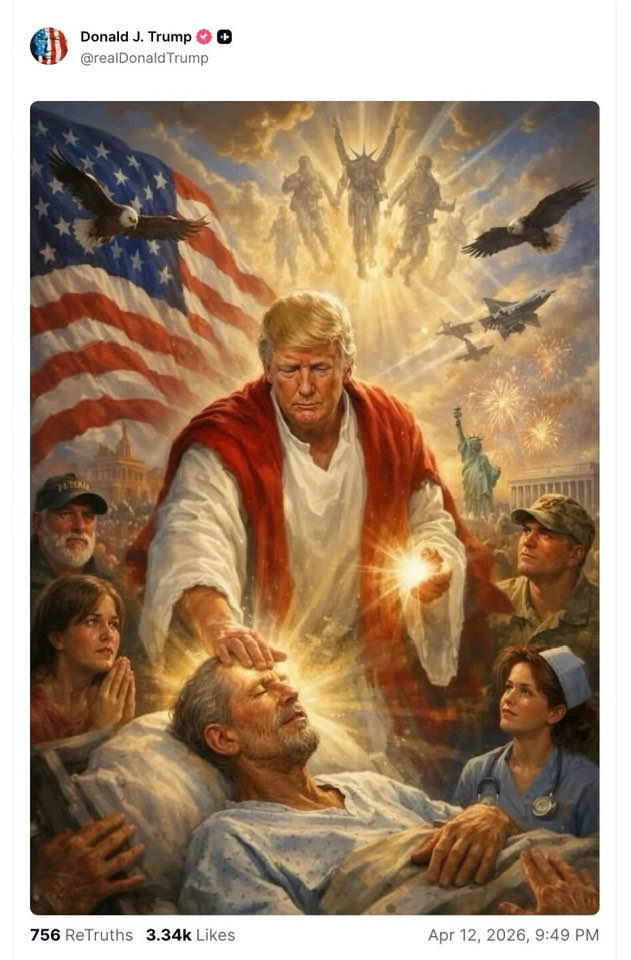
Last night, President Trump also posted this image on Truth Social:

Monday morning, Pope Leo himself spoke with journalists on the plane enroute to Algeria. From The New York Times: 

Pope Leo XIV said on Monday that he was not afraid of the Trump administration, hours after President Trump lashed out at the pontiff on social media.

Leo, speaking to reporters on a flight to Algeria ahead of a 10-day tour of several African nations, said: “I have no fear of the Trump administration, or speaking out loudly of the message of the Gospel, which is what I believe I am here to do.” Asked directly about Mr. Trump’s comments on Truth Social, Leo said: “It’s ironic — the name of the site itself. Say no more.”

Leo’s comments came after Mr. Trump’s lengthy attack on the pope on Sunday night, in which the president accused the pontiff of being “weak on crime” and “catering to the Radical Left.” Mr. Trump also said Leo, the first American pope, should “focus on being a Great Pope, not a Politician.”

Tensions between the two leaders have risen in recent weeks. The pope has criticized President Trump’s attacks on Iran and appeared to distance himself from efforts by Pete Hegseth, the Secretary of Defense, to portray the U.S.-Israeli campaign against Iran as a Christian mission.

On Monday, Leo said he would continue to publicly oppose war, while downplaying the idea that he was engaged in a direct dispute with Mr. Trump.

“The things I say are not meant as attacks on anyone,” Leo told reporters.

He added: “I do not look at my role as being political, a politician. I don’t want to get into a debate with him. I don’t think that the message of the Gospel is meant to be abused in the way that some people are doing.”

The pope answered questions during a two-hour flight from Rome to Algiers on Monday, speaking with journalists accompanying him on his tour through Algeria, Cameroon, Angola and Equatorial Guinea.

He added: “I will continue to speak out loudly against war, looking to promote peace, promoting dialogue and multilateral relationships among the states to look for just solutions to problems. Too many people are suffering in the world today. Too many innocent people are being killed. And I think someone has to stand up and say there’s a better way.”

You can watch the pope’s statement below.


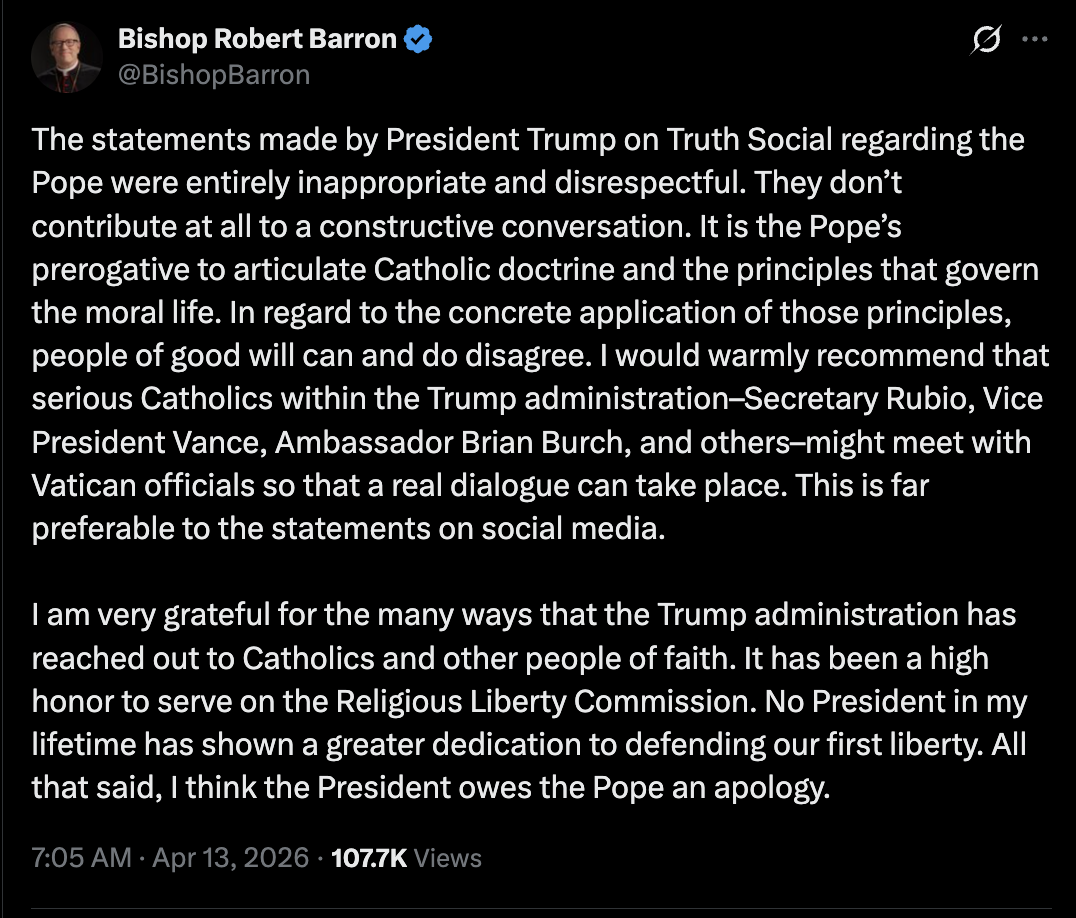
UPDATE: Bishop Robert Barron weighed in early Monday morning, posting this on X: