Showing posts with label Diocese of Winona-Rochester. Show all posts

Friday, October 2, 2026

Bishop Robert Barron meets Pope Leo XIV and ordains 18 new Deacons from the Pontifical North American College


Bishop Barron meets Pope Leo XIV at Vatican, ordains 18 deacons in St. Peter’s Basilica
 October 1, 2026

ROME (OSV News) — Bishop Robert E. Barron met Pope Leo XIV for a private audience at the Vatican Oct 1, describing his first extended, one-on-one conversation with a pope as covering “a lot of different topics.”

The Chicago-born pope opened with a hometown connection, “‘Well, two guys from Chicago,'” Bishop Barron recalled Pope Leo telling him.

“It was just a very comfortable conversation. We covered a lot of different topics, but it was just delightful to be with him and, you know, to be with the successor of Peter and our spiritual father,” he said in a video posted to social media shortly after the meeting in the Apostolic Palace.

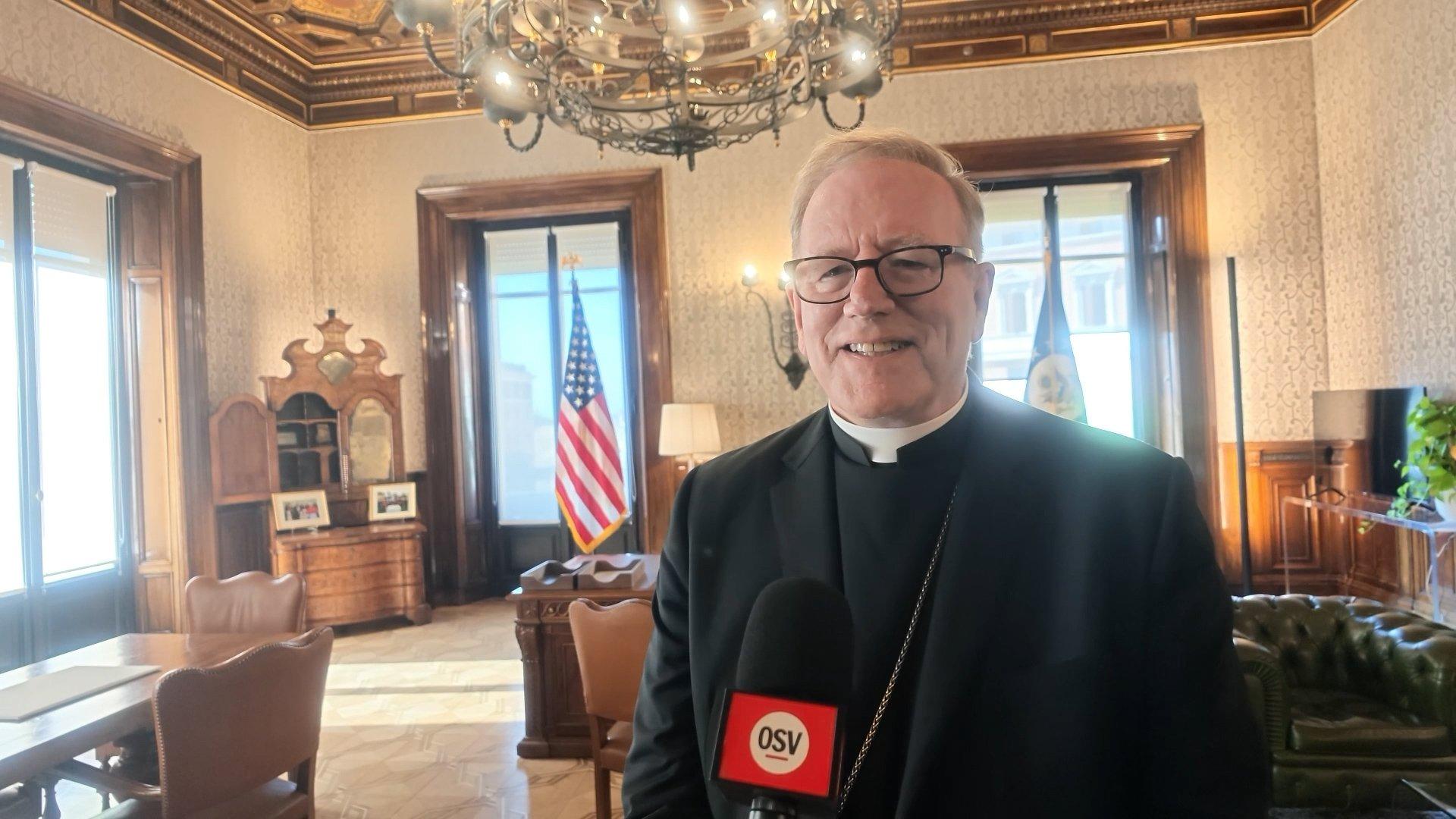
In an interview with OSV News the day before the papal audience, Bishop Barron, who has led the Minnesota Diocese of Winona-Rochester since 2022, reflected on the influence of Pope Leo and signs of renewed religious interest in the United States.


‘His papacy means a lot to our country’

“There is a revival going on for a lot of different reasons and some of that antedated Pope Leo, but I think his papacy means a lot to our country,” Bishop Barron said in the interview at the U.S. Embassy in Italy on Sept. 30.

“When you hear the pope speaking in the dulcet tones of Chicago, I think that has an impact on Americans,” he added, noting that he sees Pope Leo’s presence and charisma positively influencing young people.

“They say, well, look, I can understand this fellow,” he said. “And just his presence, his charisma. And precisely as an American, I think sure has a positive impact on our country.” 

Bishop Barron was in Rome to ordain 18 American seminarians from the Pontifical North American College to the diaconate during an evening Mass in St. Peter’s Basilica on Oct. 1. In his homily, the bishop told the seminarians to imitate the example of Blessed Fulton Sheen in preaching the Gospel.

“Preaching is not sharing your opinions on culture or politics, not even offering your point of view on matters spiritual, nor is it talking about Jesus or God or the Church,” Bishop Barron said.

How ‘authentic preaching’ happens

“Authentic preaching happens when you allow Jesus to use you to speak his Word to his people,” he emphasized. “You preach when Jesus has so seized your heart, your mind, your personality that he effectively speaks through you. 

Bishop Baron, 66, is the founder of the Word on Fire Catholic Ministries, a global Catholic media apostolate. He gained national prominence more than a decade ago as the host of the television series “Catholicism” and through his regular YouTube videos exploring popular culture, faith and Catholic teaching. 

His latest documentary, “Heaven in Stone and Glass,” which explores the Gothic cathedrals of France, was shown in U.S. movie theaters on the eve of Pope Leo’s visit to France.

Reflecting on the papal visit, Bishop Barron told OSV News he was particularly moved by the stadium prayer vigil celebrating France’s Catholic heritage attended by 80,000 young people. 

“It was a wonderful celebration of the Catholic culture of France, which I think is much needed today when an aggressive secularism is trying to push religion out,” he said.

A ‘bold reaffirmation’ of France’s Catholic heritage

Bishop Barron described the event as a “bold reaffirmation” of France’s Catholic heritage, adding that he found it especially encouraging that the event was held “in the presence of the Pope, who was clearly moved himself by it.” 

“I think it is part of this trend of revival that you can find all across the West,” he said. “Spiritual hunger meeting social media, which allows us now to reach out to that world. That’s a powerful combination.”

Bishop Barron also said that a papal visit to the U.S. by Pope Leo would be “a wonderful event for our country” that could help revive “the hearts and minds” of American Catholics.

During his visit to the Eternal City, Bishop Barron also addressed diplomats and scholars at an event hosted by the U.S. Embassy to the Holy See on Sept. 30 celebrating the 250th anniversary of America’s independence this year. 

In his remarks, he highlighted President Abraham Lincoln and civil rights leader the Rev. Dr. Martin Luther King Jr. as examples of prominent Americans whose understanding of public life was shaped by biblical principles. 

‘Points of contact’ between American political sensibility and Catholicism 

“There are very important points of contact between the American political sensibility and Catholicism,” Bishop Barron told OSV News after the event. “It’s not perfectly congruent, but there are important points of contact. You can’t really talk, I think, coherently about freedom and about rights without talking about God. And if God is removed from the conversation, those are severely threatened,” he said.

U.S. Ambassador to the Holy See Brian Burch, who also spoke to OSV News after the bishop’s speech, commented on how “Bishop Barron pointed to is this deep compatibility between the Church’s understanding of democracy, of freedom, of rights, of equality, and the American founding.”

“There’s some real, I think, specialness to that compatibility that I think is worthwhile thinking about as we map where this papacy will go and how the Holy Father will be thinking about these very important questions that are important to the United States,” the ambassador added.

Tuesday, February 14, 2023

Bishop Robert Barron moves Latin Mass to a chapel; accused wrongly of eliminating the TLM


Bishop Barron ‘has no intention of eliminating’ Tridentine Mass


Bishop Robert Barron “has no intention of eliminating” the Tridentine Mass in his Diocese of Winona-Rochester, Minnesota, the diocese said in a Feb. 13 statement responding to a recent outcry that described the decision of Bishop Barron to move the Tridentine Mass out of a parish church as “canceling [Traditional Latin Mass].”

Bishop Barron

Bishop Robert Barron (CNS/OSV News)

Responding to the pastoral provisions of Pope Francis’ 2021 motu proprio Traditionis Custodes — which mandates that each diocesan bishop “is to designate one or more locations where the faithful adherents of these groups may gather for the Eucharistic celebration (not however in the parochial churches and without the erection of new personal parishes)” — Bishop Barron ended the celebration of the Tridentine Mass, often called the Traditional Latin Mass, at the Basilica of St. Stanislaus in Winona, Minnesota.

Approximately 75 parishioners had attended the Tridentine Mass at St. Stanislaus prior to Bishop Barron’s decision to relocate the Mass.

Saint Mary’s University of Minnesota confirmed to Our Sunday Visitor that the university received a request from the diocese to host the regular celebration of the Tridentine Mass at St. Mary of the Angels chapel. Located just 2.5 miles from St. Stanislaus Basilica, its status as a chapel rather than a parish church — and its current availability — makes it a potential site to host the Tridentine Mass. The chapel is owned by the university.

Seeing no conflict with the diocesan proposal and the pastoral provisions of Traditionis Custodes, the university told Our Sunday Visitor that the request would be considered.

Currently, St. Mary of the Angels chapel does not host regularly scheduled weekend Masses. The university makes the space available to Catholic groups on request, often hosting weddings and retreats. Saint Mary’s said that the Tridentine Mass community would be expected to use the chapel within the same provisions as any other group, including financially contributing to assist with the chapel’s upkeep.

Saint Mary’s said that the chapel’s availability and its furnishings make it an ideal place for the celebration of the traditional liturgy. A worthy setting for the liturgy is important, too, for the Diocese of Winona-Rochester, which stated, “Every effort is being made to find sacred spaces for this purpose which suitably reflect the beauty and dignity of the liturgy.”

Chapel of St. Mary's of the Angels.

Chapel of St. Mary of the Angels. Facebook screengrab

The question of the Traditional Latin Mass is particularly neuralgic in Winona, where for years the Society of Saint Pius X (SSPX), founded by Archbishop Marcel Lefebvre in 1970, had its seminary. Rejecting liturgical reforms and doctrinal teaching of Vatican II, Lefebvre was excommunicated in 1988 by Pope St. John Paul II for consecrating four SSPX priests as bishops without the required ecclesiastical permissions.

Today, the SSPX uses the former Winona seminary as a novitiate. In 2015, Pope Francis granted the faculty for priests of the society to hear confessions, a permission which was renewed in 2016 and “remains until further provisions can be made” according to the apostolic letter Misericordia Et Misera. However, the society’s irregular canonical status continues.

Built in 1924 and named for the famous church in Assisi, the Chapel of St. Mary of the Angels was the campus chapel for the College of Saint Teresa, which operated from 1913 until 1989. The former St. Teresa campus was purchased by the Hiawatha Education Foundation in 1991. Today, various buildings are owned or leased by Cotter Schools (a diocesan elementary and high school), Saint Mary’s University and Winona State University.

According to the Winona Post, the Chapel of St. Mary of the Angels underwent a substantial conservation effort overseen by the Midwest Art Conservation Center in 2018. The six-month project included cleaning the chapel’s marble high altar and “famed mosaic ceiling.”

Thursday, June 2, 2022

Bishop Robert Barron to Minnesota


Bishop Barron ‘thrilled’ to lead Minnesota diocese after pope’s appointment


Pope Francis has named Bishop Robert E. Barron the next bishop of the Diocese of Winona-Rochester in Minnesota, transferring him from the Santa Barbara pastoral region of the Archdiocese of Los Angeles, where he has served as an auxiliary bishop for nearly seven years.

“I’m thrilled to receive this new appointment as bishop of Winona-Rochester,” Bishop Barron told Angelus Thursday morning. “I look forward to meeting the people and priests of this diocese. I’ll certainly miss LA, especially the good people of the Santa Barbara pastoral region. I’d ask humbly for prayers.”

The appointment was announced by the Vatican at noon today in Rome (3 a.m. Los Angeles time).

The 62-year-old Chicago native will succeed Bishop John M. Quinn, who in December 2020 turned 75, the age at which canon law requires bishops to submit their resignation to the pope. Bishop Barron is expected to be formally installed as bishop of the diocese sometime in the coming months.

In a statement shared via Word on Fire Thursday morning, Bishop Barron recalled the “extraordinary privilege” of serving in the Archdiocese of Los Angeles, a place “where the priests and people received me, from the beginning, with warmth and enthusiasm, and where I had the good fortune to observe close up the ministry of Archbishop Jose Gomez, one of the great churchmen on the scene today.”

“It is with real sadness in my heart that I take leave of the good people of the Santa Barbara pastoral region,” Bishop Barron added. “Together, we made our way through fire, flood, mudslides, and COVID, and I will never forget your kindness to me and never cease to draw strength from your faith.”

For his part, Archbishop José H. Gomez of Los Angeles praised Bishop Barron as “a man of prayer, with a fine intellect and a beautiful zeal to spread the love of Jesus Christ.”

“I am certain that he will be a great shepherd for the family of God in Winona-Rochester,” said Archbishop Gomez, who ordained Barron a bishop in 2015 at the age of 55, together with the two other so-called “triplets” named auxiliary bishops for Los Angeles at the time, David G. O’Connell and Joseph Brennan. “I am very grateful for his service here in the Santa Barbara Pastoral Region over these past several years.”

“Personally, I am going to miss him, and so will the people of Santa Barbara and all of us in the Archdiocese of Los Angeles,” Archbishop Gomez continued. “Entrusting him to the tender care of Our Lady of Guadalupe, I wish him all God’s blessings in his new appointment.”

The nomination places Bishop Barron as shepherd of a diocese home to more than 100,000 Catholics in 107 parishes spread across more than 12,000 square miles in southern Minnesota. Winona is also home to St. Mary’s University of Minnesota, a Catholic liberal arts college founded in 1912 and associated with the De La Salle Brothers.

Formerly known as the Diocese of Winona, the diocese was renamed the Diocese of Winona-Rochester by the Vatican in 2018 to include the city of Rochester 40 miles to the west, which has far outgrown Winona since the diocese was first established in 1889. The diocese filed for Chapter 11 bankruptcy in 2018, and in 2021 announced a $21.5 million settlement with survivors of sexual abuse as part of a court-ordered reorganization plan.

When Bishop Barron was first named a bishop by Pope Francis in 2015, he came to Los Angeles with a reputation as a noted theologian and the Catholic Church’s best-known English-speaking media evangelist. During his time as a priest in Chicago, he founded the Word on Fire media apostolate, which in 2011 produced the award-winning “Catholicism” mini-series and has since grown in its efforts to introduce the Catholic faith to audiences around the world, especially online.

Over the past seven years, Bishop Barron has become a familiar presence in parishes in the Santa Barbara Pastoral Region, the northernmost of the LA Archdiocese’s five pastoral regions. He was also involved in the Holy See’s decision to elevate Mission San Buenaventura, founded in 1782 by St. Junípero Serra and located in the Santa Barbara Pastoral Region, to the rank of minor basilica in 2020.

At the time of his appointment to LA in 2015, then-Father Barron was rector/president of the Archdiocese of Chicago’s Mundelein Seminary and University of St. Mary of the Lake. Since moving to California, Bishop Barron has continued to stress evangelizing the digital realm as a top priority for the Church.  

“So much of the culture in the West is determined out of a place like this, for weal and for woe: both the good and the bad are here,” Bishop Barron said of Los Angeles in an interview with Angelus in 2018. “I think that is important.”

In recent years, Bishop Barron has emerged as a leader among the U.S. bishops on the task of evangelization.

From 2017 to 2020, he served as chairman of the United States Conference of Catholic Bishops’ Committee on Evangelization and Catechesis. In 2018, he was one of five bishops elected by the conference to represent the U.S. as delegates at the Synod of Bishops on Young People, the Faith, and Vocational Discernment at the Vatican. 

Last November he was elected to lead the USCCB’s Committee on Laity, Marriage, Family Life and Youth, a role he will officially begin in November of this year.