Thursday, September 8, 2022

Cardinal Nichols of Westminster offers prayers and praise on the passing of Queen Elizabeth II


Updated: Cardinal Nichols pays tribute to Queen Elizabeth II after her death at 96


Jonah McKeown

By Jonah McKeown

Updated Sept. 8 at 2:07 pm EST.

Cardinal Vincent Nichols of Westminster, England, offered prayers for and paid tribute to Queen Elizabeth II, who died Sept. 8 while under medical supervision at Balmoral Castle in Scotland with multiple family members by her side. She was 96.

“On 21 April 1947, on her twenty-first birthday, Princess Elizabeth said, ‘I declare before you all that my whole life whether it be long or short shall be devoted to your service.’ Now, seventy-five years later, we are heartbroken in our loss at her death, and so full of admiration for the unfailing way in which she fulfilled that declaration,” Nichols, president of the Catholic Bishops’ Conference of England and Wales, said in a statement.

“Even in my sorrow, shared with so many around the world, I am filled with an immense sense of gratitude for the gift to the world that has been the life of Queen Elizabeth II.”

The British monarch had been on a summer break at her Scottish home since July, the BBC reported. As of Thursday afternoon, all the queen’s children were traveling to or had arrived at the castle. 

Nichols noted that Elizabeth’s deep Christian faith — and her encouragement to others to practice their faith — made her a “shining light” in British history.

“This faith, so often and so eloquently proclaimed in her public messages, has been an inspiration to me, and I am sure to many. The wisdom, stability and service which she consistently embodied, often in circumstances of extreme difficulty, are a shining legacy and testament to her faith.

“Our prayer is that she is now received into the merciful presence of God, there to be reunited with her beloved Prince Philip. This is the promise of our faith, and our deep consolation.

“Queen Elizabeth II will remain, always, a shining light in our history. May she now rest in peace. We pray for His Majesty the King, as he assumes his new office even as he mourns his mother. God save the King,” Nichols concluded.

Buckingham Palace issued a brief — and rare — statement concerning the queen’s health just after noon local time, saying that following an evaluation this morning, the queen’s doctors are “concerned for Her Majesty’s health and have recommended she remain under medical supervision.” 

The archbishop of Canterbury, Justin Welby, said: “My prayers, and the prayers of people across the [Church of England] and the nation, are with Her Majesty the Queen today. May God’s presence strengthen and comfort Her Majesty, her family, and those who are caring for her at Balmoral,” reported the BBC. The British monarch is head of the Church of England.

Since her reign began in 1952, Queen Elizabeth has met five popes. In 2010, she welcomed then Pope Benedict XVI to the U.K., the first state visit of a pope to the country. St. John Paul II had visited the U.K. and met with the queen in 1982, but his was a pastoral rather than a state visit. 

Benedict later said he retained “warm memories of the gracious welcome” given to him by Queen Elizabeth at the Palace of Holyroodhouse in Edinburgh on the first day of his visit.

Cardinal Cupich offers support to migrants while criticizing Texas Governor Abbott


Chicago cardinal pledges support for migrants sent from Texas


NEW YORK – Cardinal Blase Cupich of Chicago has pledged the archdiocese’s support for city efforts to respond to busloads of migrants arriving from the southern border at the direction of Texas Gov. Greg Abbott, simultaneously calling Abbott’s actions “unbecoming of any elected official.”

“Treating children of God as political pawns is unbecoming of any elected official, especially when it involves marginalized, suffering people,” Cupich said in a Sept. 3 statement. “The Archdiocese of Chicago stands with local municipal and religious leaders who have pledged to support these new arrivals seeking better and safer lives.”

As of Sept. 6, more than 150 migrants had been sent to Chicago on three buses, according to Abbott’s press office. The first bus arrived on Aug. 31. Abbott’s press office declined to comment on what the frequency of buses would look like going forward. Migrants are not forced onto the buses. They board voluntarily after they are processed by U.S. immigration officials.

Chicago is the third Democrat-led city to which Abbott has bused migrants. The Republican governor started busing migrants to Washington, D.C. in April, followed by New York City at the beginning of August. As of Sept. 6, more than 7,700 migrants had been sent to the nation’s capital on over 185 buses, and more than 2,100 migrants had been sent to New York City on over 40 buses, according to Abbott’s press office.

Abbott began the practice as a rebuke of President Joe Biden’s border policies, which he blames for the unprecedented number of migrants that have arrived at the southern border this year. U.S. Customs and Border Protection data shows that there were more than 1.9 million southwest land border encounters between October 2021 and July 2022 – exceeding the total for Fiscal Year 2021 by more than 200,000.

Announcing that the first bus had arrived in Chicago on Aug. 31, Abbott said that like New York and Washington, D.C., Chicago is a sanctuary city.

“Mayor [Lori] Lightfoot loves to tout responsibility of her city to welcome all regardless of legal status, and I look forward to seeing this responsibility in action as these migrants receive resources from a sanctuary city with the capacity to serve them,” Abbott said.

Lightfoot at a Sept. 4 press conference said her frustration with the situation isn’t the city’s need to respond to the migrants, but the actions and lack of coordination from Abbott.

“There could be a level of coordination and cooperation, but he chooses to do none of those things and instead tries to send human beings, not cargo, not freight, but human beings across the country to an uncertain destination,” Lightfoot said. “We have yet to hear from anybody in an official capacity from Texas. It’s unacceptable.”

“We’re talking about human beings’ lives, who have themselves gone through an incredible journey to go to the United States,” she added. “I think the decent human thing to do is to cooperate and collaborate.”

Phil Zepeda, vice president of communication for Catholic Charities of the Archdiocese of Chicago told Crux on Sept. 1, that the organization is “helping the city … welcome immigrants and assess very initial basic human needs on their journey.” Zepeda and the organization declined to comment further, citing that the city of Chicago is handling all media inquiries.

A spokesperson for the mayor’s office declined multiple Crux interview and comment requests.

In the statement, Cupich acknowledged that the “burden of supporting migrants has fallen disproportionately on border states,” adding that the “issue would be better addressed by a strategy of national cooperation.”

Cupich went on to call welcoming immigrants “a fundamental moral imperative of Christianity.”

“We Christians are called to welcome the stranger, the migrant, the refugee, because they too, are children of God, all of us members of the same family, the human family.” Cupich said.

“After all Jesus himself was a refugee, as Mary and Joseph were forced to flee their homeland because it had become too dangerous,” he continued. “When Christians choose to help our immigrant brothers and sisters, we are doing as Jesus taught – we are choosing to see them in the Holy Family, who only wanted to live. We are choosing life.”

The cardinal concluded with a welcome message to all immigrants.

“So to all immigrants and refugees, those who have recently arrived, as well as those who have made lives for themselves here, enriching their communities and indeed the whole nation, we welcome you, along with the opportunity to show you God’s family cares for its own,” Cupich said.

Pope meets with Pontifical Reps and again calls for peace in a world at war


Pope to Pontifical Representatives: ‘World shaken by risk of nuclear war’

Pope Francis holds a triennial meeting with Pontifical Representatives in the Vatican, and calls attention to the Holy See’s efforts to seek peace amid a “third world war fought piecemeal”.

By Devin Watkins

The Pope’s representatives in nations across the globe met with the Holy Father on Thursday as part of their triennial encounter in the Vatican.

The group includes 91 Apostolic Nuncios and 6 Permanent Observers, while 5 Pontifical Representatives were unable to attend due the health reasons or other impediments.

Pope Francis spoke to his representatives about various global issues affecting nations and the Church in the world.

World shaken by war

The Pope noted that this encounter comes in the wake of the pandemic.

“The tempest of the Covid-19 pandemic forced various constraints on our daily lives and pastoral activities,” he said. “Now it seems the worst may be behind us, and thank God we are able to meet.”

However, added Pope Francis, the spectre of war has descended on Europe and the world.

“Unfortunately, Europe and the entire world are shaken by a particularly serious war, due to the violation of international law, the risks of nuclear escalation, and the grave economic and social consequences.”

Pope’s closeness amid world war

The Pope added that a “third world war fought piecemeal” has gripped the globe, and that Pontifical Representatives are present in the countries involved in the various conflicts.

He thanked them for bringing his closeness to peoples who are suffering.

“You bring the Pope’s closeness to peoples and the Church. You are points of reference in moments of extreme bewilderment and turbulence.”

Focusing on mission

Pope Francis urged his representatives to entrust their work to the Lord, as they labor in the “today of the Church and world”.

He noted that the Church is currently journeying through the Synod on synodality, while the Roman Curia seeks to apply the Apostolic Constitution Praedicate Evangelium.

The Pope also recalled two Apostolic Nuncios who died while in office: Archbishop Joseph Chennoth and Archbishop Aldo Giordano.

“Our brothers have preceded us in our journey, and they invite us to keep our gaze fixed on the path ahead and on the heavens.”

Wednesday, September 7, 2022

Thursday we mark the Birthday of Mary


Ordinary Time: September 8th

Feast of the Nativity of the Blessed Virgin Mary


MASS READINGS

September 08, 2022 (Readings on USCCB website)

COLLECT PRAYER

Feast of the Nativity of the BVM: Impart to your servants, we pray, O Lord, the gift of heavenly grace, that the feast of the Nativity of the Blessed Virgin may bring deeper peace to those for whom the birth of her Son was the dawning of salvation. Through our Lord Jesus Christ, your Son, who lives and reigns with you in the unity of the Holy Spirit, God, for ever and ever.

show

RECIPES (8)

show

ACTIVITIES (18)

show

PRAYERS (9)

show

LIBRARY (3)

show

BLOG & PODCASTS (7)


Entrance Antiphon:

Let us celebrate with joy the Nativity of the Blessed Virgin Mary, for from her arose the sun of justice, Christ our God.


Gospel Verse:

Blessed are you, holy Virgin Mary, deserving of all praise; from you rose the sun of justice, Christ our God.


Preface I of the Blessed Virgin Mary:

It is truly right and just, our duty and our salvation,
always and everywhere to give you thanks,
Lord, holy Father, almighty and eternal God,
and to praise, bless, and glorify your name
on the Nativity of the Blessed ever-Virgin Mary.

For by the overshadowing of the Holy Spirit
she conceived your Only Begotten Son,
and without losing the glory of virginity,
brought forth into the world the eternal Light,
Jesus Christ our Lord.

Through him the Angels praise your majesty,
Dominions adore and Powers tremble before you.
Heaven and the Virtues of heaven and the blessed Seraphim
worship together with exultation.
May our voices, we pray, join with theirs
in humble praise, as we acclaim:


Today the Church celebrates the Feast of the Nativity of the Blessed Virgin Mary. The Roman Martyrology states Mary was "of the lineage of Abraham, born of the tribe of Judah and of the progeny of King David, from whom the Son of God was born, made man by the work of the Holy Spirit, to free humanity from the ancient bondage of sin."

Mary was born to be the mother of the Savior of the world, the spiritual mother of all men, and the holiest of God's creatures. Because of her Son's infinite merits, she was conceived and born immaculate and full of grace. Through her, Queen of heaven and of earth, all grace is given to men. Through her, by the will of the Trinity, the unbelieving receive the gift of faith; the afflicted are tendered the works of mercy; and the members of Christ grow in likeness of their Head. In Mary all human nature is exalted. We rejoice in her birthday, as the Church has done from the earliest times. This is one of the three birthdays in the Church Calendar—the Birth of Jesus (December 25), the Birth of John the Baptist (June 24) and the Birthday of Mary. All three were born without original sin, although Mary and Jesus were conceived without sin, and St. John was cleansed of original sin while in the womb at the Visitation of Mary.


The Birth of Mary
On Our Lady's birthday the Church celebrates the first dawning of redemption with the appearance in the world of the Savior's mother, Mary. The Blessed Virgin occupies a unique place in the history of salvation, and she has the highest mission ever commended to any creature. We rejoice that the Mother of God is our Mother, too. Let us often call upon the Blessed Virgin as "Cause of our joy", one of the most beautiful titles in her litany.

Since September 8 marks the end of summer and beginning of fall, this day has many thanksgiving celebrations and customs attached to it. In the older form of the Roman Ritual there is a blessing of the summer harvest and fall planting seeds for this day.

The winegrowers in France called this feast "Our Lady of the Grape Harvest." The best grapes are brought to the local church to be blessed and then some bunches are attached to hands of the statue of Mary. A festive meal which includes the new grapes is part of this day.

In the Alps section of Austria this day is "Drive-Down Day" during which the cattle and sheep are led from their summer pastures in the slopes and brought to their winter quarters in the valleys. This was usually a large caravan, with all the finery, decorations, and festivity. In some parts of Austria, milk from this day and all the leftover food are given to the poor in honor of Our Lady’s Nativity.

What is Catholic Social Teaching


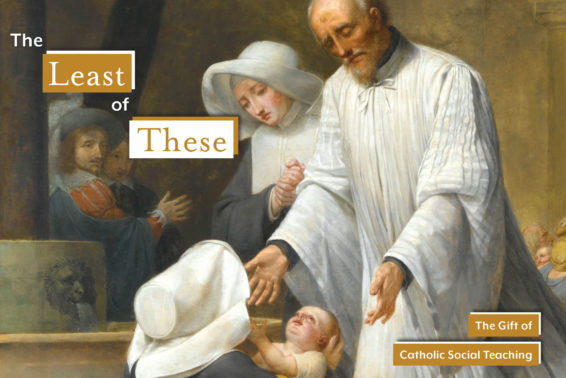
The Least of These

The Gift of Catholic Social Teaching

BY: DEACON GREG KANDRA

The Least of These: The Gift of Catholic Social Teaching by Deacon Greg Kandra

What is Catholic social teaching? At first blush, it sounds like a topic for a high school thesis paper that Sr. Margaret would make you write during detention.

But wait! It’s a lot more interesting than you may think. In fact, it’s probably something you have already put into practice. As Sr. Margaret knew, it’s important to understand what the Church teaches on this topic. Because the more we learn, the more we’ll be inspired to reach out creatively to those in need.

The Church’s teaching on issues of justice, fairness, and human dignity makes up one of its most important cornerstones—and one of its great gifts to the whole world. As the U.S. Catholic bishops have said, “Catholic social teaching is a central and essential element of our faith.” The Catechism of the Catholic Church puts it succinctly: “To receive in truth the Body and Blood of Christ given up for us, we must recognize Christ in the poorest, his brethren” (1397).

However, if you want to boil down the social teachings of the Church to their essence, you only need this one sentence: “Whatever you did for one of the least brothers of mine, you did for me” (Matthew 25:40).

It’s just that simple—and just that challenging.

A Biblical Imperative. We tend to think of Catholic social teaching as something relatively new, beginning when Pope Leo XIII articulated the doctrine in his landmark encyclical Rerum Novarum in 1891. But its origins go much further back. As the U.S. bishops point out:

Its roots are in the Hebrew prophets who announced God’s special love for the poor and called God’s people to a covenant of love and justice. It is a teaching founded on the life and words of Jesus Christ, who came “to bring glad tidings to the poor . . . liberty to captives . . . recovery of sight to the blind” (Luke 4:18), and who identified himself with “the least of these,” the hungry and the stranger (cf. Matthew 25:45). Catholic social teaching is built on a commitment to the poor.

You can find all of this explained at greater length in the Compendium of the Social Doctrine of the Church, released during the pontificate of St. John Paul II in 2004. And indeed, John Paul himself summed up Catholic social teaching in 1999 by noting that the foundation of social justice “rests on the threefold cornerstone of human dignity, solidarity, and subsidiarity” (Ecclesia in America, 55).

Is there a simpler way of understanding all this? I think so. And it begins close to home.

Concentric Circles. Years ago, in the wake of 9/11, a member of the local police precinct came to our parish in New York City to give a presentation about how to be best prepared for an emergency. He asked us to think of our responsibilities as a set of concentric circles. “First off,” he said, “there’s the smallest circle: your immediate family, the people in your house. Make sure your immediate family is safe. Then go to the next circle, just outside. Check on your neighbors. After that, widen the circle to look at those beyond your neighborhood. But your priority has to be that smallest circle, those closest to you. One person, or one family.”

I think that model can also help us look at Catholic social teaching as well. It starts with the person, just one solitary soul, and then expands to the community, and ultimately, it embraces the whole world. Let’s break it down.

1. Honor the dignity of every single person. This shouldn’t be a surprise. Every Catholic knows: life matters. Respect it. Embrace it. Cherish it. Fight for it, from conception until natural death. As the bishops explain, “We believe that every person is precious, that people are more important than things, and that the measure of every institution is whether it threatens or enhances the life and dignity of the human person.”  

Out of this central idea flows our respect for the poor and vulnerable, our concern for the rights and dignity of workers, and our compassion for the poor and marginalized. We believe this in our bones: everyone, no matter his or her station in life, is made in the image and likeness of God—whether it’s the grocer in the supermarket or the homeless person on the street.

This also means that we are responsible for one another. Each of us realizes that, yes, I am my brother’s keeper. Remember the parable of the Good Samaritan. It begins when someone asks Jesus, “Who is my neighbor?” and concludes with Jesus tasking his listeners, “Go and do likewise” (Luke 10:29, 37). We are called to “do likewise” for those in need. Or to borrow the anthem from High School Musical, we’re all in this together!

2. Honor the family and the community. Marriage and family are central institutions that must be supported, strengthened, and encouraged. The same goes for local communities. This is really part of the concept of subsidiarity, which holds that decisions regarding care for one another are best handled at the lowest possible level, closest to the people affected by those decisions. This means that “a community of a higher order should not interfere in the internal life of a community of a lower order” (Catechism, 1883). Ultimately, that should lead us to an understanding of our place in the world—which is ultimately in connection with one another.

I saw a beautiful example of this some years back, when I was leaving work to take the subway home. I stopped at a local bakery to pick up a dozen bagels. Waiting just inside the subway station was an older homeless man rattling a cardboard cup, asking for any change. I offered him one of my bagels. He eagerly accepted it and thanked me. He disappeared down the platform. When my train came and I was about to board, I looked to see where he’d gone and noticed him at the end of the platform. He was breaking his bagel in two and giving half to another man sitting on the floor of the platform.

I was moved beyond words: a man who had next to nothing gave half of what he had to someone who had even less. Here was caring for the common good, measured as one small community of two homeless, hungry men living underground. Here too was something else vital to Catholic social teaching:

3. Expressing solidarity. We are one big family, and we need to work together for the common good. In a general audience last year, Pope Francis said the principle of solidarity is more necessary than ever because of the pandemic, which highlighted our need for one another. “To emerge from this crisis better than before,” he said, “we have to do so together; together, not alone. . . . Either it is done together, or it is not done” (September 2, 2020).

Solidarity goes beyond just helping others, the pope explained. “It is a matter of justice,” which requires us to care about the conditions under which many people are forced to live. It also means that we care for and respect the earth, “a common home which God has entrusted to us” (Laudato Si, 232).

Love One Another. So how does all this impact our lives as Catholic Christians? Can’t we just go to Mass, toss an envelope in the collection basket, and consider our work done?

Well, actually, no. A critically important part of Catholic social teaching is right in the middle of its name: social. We are called through our baptism not only to be people of faith and belief but also to be active in the world. To be engaged with the struggles and sufferings of those around us. By extension, that means we strive to live in imitation of Christ.

It is important to remember that the Gospels repeatedly show us that Jesus was not merely a teacher or a man of prayer. He was a doer, a man of action. He journeyed, healed, touched, blessed; he calmed storms and drove out demons and money changers. He engaged with the world. In particular, he engaged with those on the margins—the poor, the sick, the outcast, the despised. He cared for the smallest and weakest of God’s children—and, as we read in Matthew, he identified with them the most: “Whatever you did for one of the least brothers of mine, you did for me” (Matthew 25:40).

The tenets of Catholic social teaching are woven into the Gospels, into Christ’s teachings, and into the very fabric of our faith. They are not optional, and the reason they are not optional is because they ultimately come down to one simple word: love. Pope Benedict XVI said as much: “Charity is at the heart of the Church’s social doctrine” (Caritas in Veritate, 2).

Which brings us back to Sr. Margaret. At some point, we might have noticed her writing on the blackboard, “God is love.” The secret has been hiding in plain sight all along. That is really at the heart of Catholic social teaching—and at the heart of our lives as Catholic Christians.

Love. For the vulnerable, the outcast, the forgotten. Class dismissed.

Quotations from the U.S. bishops come from their 1998 document, “Sharing Catholic Social Teaching: Challenges and Directions,” available at usccb.org.

Get to know Sister Thea Bowman; she's on the path to Sainthood


New documentary on Sister Thea Bowman highlights her faith, justice work

By Anna Capizzi Galvez • Catholic News Service • Posted September 6, 2022

WASHINGTON (CNS) — A new documentary on Sister Thea Bowman shines a light on her life and work as an advocate for racial justice and intercultural understanding.

The idea for the documentary came to Franciscan Sister Judith Ann Zielinski, who wrote and produced the film, after the 2020 death of George Floyd while in police custody in Minneapolis.

“I thought, I have to do something, what can I do?” and “Thea Bowman popped into my head. She was a Franciscan sister, a woman who had been fighting systemic racism in her own time and in her own way.”

The documentary is a comprehensive look at Sister Thea, the first African American member of the Franciscan Sisters of Perpetual Adoration and one of six Black Catholics known as a “Servant of God.”

It also makes a case for her sainthood and for contemporary spirituality, Sister Zielinski said.

“Going Home Like a Shooting Star: Thea Bowman’s Journey to Sainthood,” comes from NewGroup Media and the Diocese of Jackson, Mississippi. Along with archival media of Sister Thea, the documentary features interviews with her colleagues, friends, fellow Franciscan Sisters of Perpetual Adoration, former students and African American scholars, priests and bishops.

The one-hour film, a part of the Interfaith Broadcasting Commission’s fall documentary season, will begin airing on ABC stations nationwide Oct. 2.

Redemptorist Father Maurice Nutt, associate producer and biographer of Sister Thea, called her an “apostle for racial reconciliation in our church today.”

Noting that she died in 1990, Father Nutt said the film would make her known to a new generation. He also said her life resonates with much of what younger Catholics are looking for in the church — someone who speaks truth to power.

“Her call for justice, justice for the roles of women, justice for those who experience no matter what ethnicity, oppression or hatred” speaks to “us as a church being the body of Christ,” he said.

He also said her call for people to come together and share their gifts is pivotal message to put a stop to “some of the racial hatred that we see in our society even today,” Father Nutt told Catholic News Service.

Bishop Joseph R. Kopacz of Jackson, Mississippi, petitioner for Sister’s Thea’s cause and executive producer of the documentary, said the film “speaks the need for the church to never give up that desire to be more united and more universal.”

He said Sister Thea had a “timeless message” that included a desire for greater harmony, unity, racial understanding and reconciliation and “being the body of Christ in a more faithful way.”

The bishop also remarked at the depth of her call, describing her as gifted, charismatic, prophetic and a “dynamo of energy.”

Sister Thea was born Bertha Bowman in 1937 in Yazoo City, Mississippi, to Dr. Theon Bowman, a physician and Mary Esther Bowman, a teacher. Her family moved to Canton where she encountered the Franciscan Sisters of Perpetual Adoration at Holy Child Jesus School.

At age 9, Bertha became Catholic and at age 15, she left home for La Crosse, Wisconsin, to attend the Franciscan Sisters of Perpetual Adoration’s high school, later joining the community and taking the name Sister Mary Thea.

Sister Thea went on to receive her doctorate from The Catholic University of America and returned to La Crosse to teach English and linguistics at Viterbo University.

Her parents’ deteriorating health called her back to Canton, where she led the Diocese of Jackson’s first Office for Intercultural Affairs. Her gifts for preaching, singing and teaching led her to countless speaking engagements across the United States.

In 1984, she was diagnosed with breast cancer. She died March 30, 1990, at age 52.

She was declared a “Servant of God” in May 2018 and the U.S. bishops voiced their consent to her canonization cause at their Nov. 2018 fall general meeting in Baltimore.

Sister Eileen McKenzie, president of the Franciscan Sisters of Perpetual Adoration, said Sister Thea’s canonization would “hold up the spirituality and the gift of the Black Catholic Church” and “give courage to our African American brothers and sisters who often don’t have platform.”

It would also be significant for her order. One of the primary values of Franciscans is continual conversion, Sister McKenzie explained, noting that Sister’s Thea’s canonization would call the community into deeper conversion.

“Her spirituality, her witness, her prophetic spirit resonates with us today. It’s hard to even speak of Thea in the past tense. It’s as if she’s with us today,” Father Nutt said.

“Going Home Like a Shooting Star” was funded in part by the Catholic Communication Campaign. Streaming opportunities will be announced by the Diocese of Jackson. To watch a preview of the film, visit: https://youtu.be/tkzhnKG7mxc.

Ahead of the birthday of Mary, Pope Francis prays for all mothers


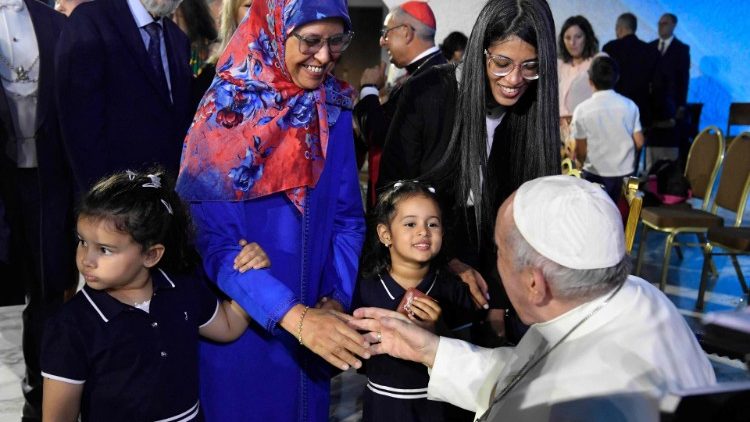
Pope Francis shakes hands with a mother at a Vatican event in JunePope Francis shakes hands with a mother at a Vatican event in June 

Pope prays for all mothers ahead of Nativity of Virgin Mary

As the Church prepares to celebrate the Nativity of Mary on Thursday, Pope Francis prays for all mothers, especially those whose children suffer in some way.

By Devin Watkins

“Mary experienced the tenderness of God as a daughter, full of grace, in order to share this tenderness as a mother through her union with the mission of her Son.”

Pope Francis offered that reflection in his greetings at the Wednesday General Audience, tying Mary’s motherhood to that of all mothers ahead of the liturgical feast of the Nativity of the Blessed Virgin Mary on Thursday.

The Pope pledged his closeness to mothers everywhere, mentioning especially those with children who suffer.

“I wish to express my closeness to all mothers, especially to those mothers with suffering children, who are ill, marginalized, or in prison.”

Special prayer for mothers of prisoners

He prayed in a special way for the mothers of young detainees, “so that their hope may not die.”

“Unfortunately, there are many people in prison who commit suicide, sometimes even young prisoners,” he said. “At times, a mother’s love can help preserve someone from this danger.”

“May Our Lady console all mothers, and all mothers who are afflicted by the suffering of their children.”

Prisons and suicide

As the Pope mentioned, suicide rates are much higher in prisons than among the general population.

Some studies say prisoners in the United States are four times more likely to commit suicide, with motivations ranging from fear of other inmates and the consequences of a person’s crime to the loss of a meaningful relationship. Most suicides occur in isolation cells.

In England and Wales, there were 92 self-inflicted deaths in prisons in 2018 alone.

According to Samaritans, an international charitable network, key risk factors for prison suicide include “mental ill-health, past self-harm, traumatic life experiences, and a background of disadvantage”.

More prayers for victims of war offered at today's General Audience


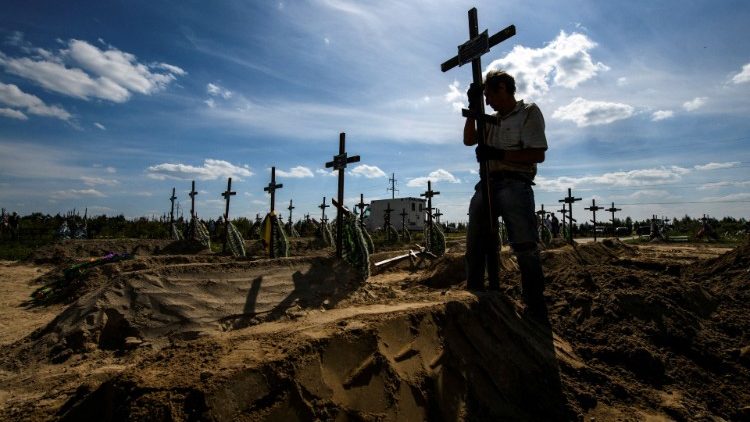
Crosses are planted over the graves of unidentified war victims in Bucha, near KyivCrosses are planted over the graves of unidentified war victims in Bucha, near Kyiv 

Pope Francis prays for victims of every war, including Ukraine

At the Wednesday General Audience, Pope Francis prays for the victims of every war, including the ongoing war in Ukraine, and entrusts them to the intercession of Our Lady.

By Benedict Mayaki, SJ

During the weekly General Audience, Pope Francis prayed for Ukraine amid its ongoing war which has lasted over 6 months now.

“I do not forget martyred Ukraine,” the Pope said in his appeal towards the end of the Audience.

Addressing the faithful present, the Holy Father encouraged each person to “be a builder of peace and to pray that thoughts and plans of concord and reconciliation will spread in the world” in the face of all the scenarios of war in our time.

“Today we are experiencing a world war, let us please stop!” he urged.

Finally, Pope Francis entrusted the victims of every war, especially the “dear people of Ukraine” to the Blessed Virgin Mary.

War in Ukraine

As the war drags on in Ukraine, concerns continue to mount with the fighting in the Zaporizhzhia region, near a nuclear power plant.

United Nations chief, Antonio Guterres, has urged Russia and Ukraine to agree to a demilitarised perimeter around the Russian-held Zaporizhzhia nuclear power plant in Ukraine.

Mr. Gutteres' remarks come following the release of an International Atomic Energy Agency (IAEA) report on the power station which recommended the establishment of a security zone around the area.

Meanwhile, EU members Lithuania, Latvia and Estonia have reached an agreement to restrict the entry of Russian citizens traveling from Russia and Belarus. The restrictions will only include exceptions for humanitarian and family reasons, lorry drivers and diplomats, said Latvian Foreign Minister Edgar Rinckevics.