Showing posts with label Catholic social teaching. Show all posts

Tuesday, July 21, 2026

First, the Pope is an American and now, the British Prime Minister is a Catholic.


How Andy Burnham's religious roots shaped Britain's first Catholic-born prime minister

(RNS) — Back in 2009, Burnham recalled that important influences on him were, in order: the Everton FC soccer team, the Labour Party and the Catholic Church.


Britain's new prime minister, Andy Burnham, and his, wife Marie-France van Heel, wave as they arrive at 10 Downing Street in London, Monday, July 20, 2026. (AP Photo/Kirsty Wigglesworth)

Catherine Pepinster

(RNS) — When Andy Burnham began his term as the United Kingdom’s 59th prime minister on Monday (July 20), he made history — not only for taking office in an unusual way after the resignation of his unpopular predecessor, Sir Keir Starmer, but also for becoming Britain’s first Catholic-born prime minister.

Hundreds of years of restrictions following the English Reformation and institutional bias meant Catholics did not achieve high political offices until relatively recently, and Burnham’s move into the role marks a major shift.

Some may argue former Prime Ministers Tony Blair and Boris Johnson beat Burnham to this spot in history. But Blair converted to Roman Catholicism, the faith of his wife and children, after he left office. Many observers speculated that he did not do so earlier because it might have affected delicate negotiations over the Good Friday Agreement in Northern Ireland. Johnson, baptized a Catholic, had left the church for the Church of England.

Burnham has said on several occasions that his values were shaped by his faith, though in 2015, he said he’s “not particularly religious now.” Back in 2009, he recalled that important influences on him were, in order: the Everton FC soccer team, the Labour Party and the Catholic Church.

Constitutionally, his Catholicism matters, too.

The law still decrees those “who profess the Popish religion” cannot “possess or enjoy the Crown and Government of this Realm,” stemming from England’s split from Rome during the reign of Henry VIII, leading to the creation of the Church of England. After a brief interlude with Catholic Mary I, who appointed a Catholic to the role of chief minister to the crown — as the country’s top job was then called, over 500 years ago — the Church of England became fully rooted in the life of the country as the established church under Elizabeth I.

Today, the monarch still pledges to uphold the Protestant religion at his coronation. And according to a UK Parliament research briefing, if the prime minister is Catholic, some jobs related to Church of England appointments may have to be delegated to another government minister who is part of that church.

Burnham, 56, has said he was shaped by the Catholic Church. Last year, he spoke of its influence during his lecture for the religion-meets-politics think tank, Theos. He told the audience there is a need to move from a crisis of trust to “a culture of encounter,” a phrase he attributed to the late Pope Francis, whom he met at the Vatican two years earlier.

Born in 1970, Burnham grew up with a Catholic mother and attended Catholic school. He grew up between Manchester and Liverpool, where many families stayed loyal to Catholicism despite persecution during the Reformation. Many residents there also descended from Catholic Irish migrants who crossed the Irish Sea looking for work.

He grew up in the years after the Second Vatican Council, when lay Catholics were increasingly encouraged to take roles in church life. His school years also coincided with tough times in the North West, with growing unemployment in traditional industries.

Among the most powerful voices concerned about the impact of government policies of then-Prime Minister Margaret Thatcher was the Roman Catholic Archbishop of Liverpool, Derek Worlock. The archbishop often spoke about the Catholic social gospel and how people must stand in solidarity with the poorest in society.

“As an altar boy, he would have heard messages from Derek Worlock criticizing the way central government was failing parts of the North West,” said Francis Davis, a social scientist and visiting fellow at Kellogg College, Oxford. “Worlock would deliver his message to his parishes by cassette, and Burnham, the altar boy, would press the button to play the cassette.

Britain’s new prime minister, Andy Burnham, arrives at 10 Downing Street in London, Monday, July 20, 2026. (AP Photo/Alberto Pezzali)


During his first campaign to secure the Labour leadership in 2010 — he lost to Ed Miliband — Burnham was interviewed by The Tablet, the Catholic weekly. “My mother was not religious in any showy way,” he told The Tablet. “I am like her in that, to use a Scouse (Liverpudlian) phrase, we don’t lick the altar steps.”

But what has clearly profoundly affected Burnham is the body of theology known as Catholic social teaching. Acknowledging the importance of individual responsibility, Catholic social teaching focuses on the importance of the common good and people working together toward it.

“It is about what we do together to build society,” Davis said.

That influence seemed apparent in a recent Burnham speech, as he talked about “taking power out of the center and putting it in the hands of the people and places who can use it best.”

Burnham, who previously served as a government minister, has spent the past nine years as mayor of Manchester, where he stressed the importance of transferring power to regions and local communities. These efforts led Burnham to work closely with different faith leaders and to travel for a week to Rome in 2023 to meet Pope Francis. He was accompanied by his mother, Eileen, who, he told The Times in an interview published Monday, “will be wearing her rosary beads out” as he enters 10 Downing Street, the prime minister’s official residence.

Burnham’s father, Roy, who has dementia and is being cared for in a Catholic care home, according to The Times, is not Catholic himself. But one of his brothers, Nick Burnham, runs Cardinal Newman College in Preston, Lancashire — one of the largest Catholic sixth form colleges in the North West. The prime minister also sent his own children to a Catholic school.

Burnham has also indicated he has difficulties with some aspects of Catholic teaching, particularly personal sexual morality. In 2015, in an interview with Premier Christian News, he said he had issues with its teaching on contraception and homosexuality, describing it as developing “a more judgmental mode” under Pope Benedict XVI. But he went on to say that “Catholic social teaching underpins my politics.”  

Catholic leaders will no doubt watch how the new prime minister might deal with contentious issues such as assisted dying, considered anathema to the Catholic Church, or funding for faith schools.

The leading Catholic cleric in England and Wales, the archbishop of Westminster, Richard Moth, told the BBC earlier this month that being a Catholic and Christian as Burnham is, “informs conscience, the way you think about things.”

Under Burnham, he said he hoped “we are going to see that real concern for humanity, not just on the grand scale but for the needs of families and the homeless.” And outside Downing Street on Monday, Burnham said his first task as prime minister is to end “rough sleeping in our country,” referring to unhoused people sleeping on the street.

Moth told the BBC he hoped to have a meeting with Burnham soon.

Burnham will soon meet with international leaders, too. If they include U.S. Vice President JD Vance, a Catholic convert, he will meet a fellow believer who has also acknowledged the importance of Catholic social teaching, but which has led him to different political conclusions. Another contender for a Burnham encounter is the pope. Leo XIV chose his papal name in homage to Leo XIII, the writer of the first Catholic social teaching encyclical, “Rerum Novarum.” Pope Leo XIV added to that body of teaching with his own first encyclical, “Magnifica Humanitas,” published in May, on artificial intelligence.

Last week, the papal representative to the UK, Archbishop Miguel Maury Buendia, told a Spanish TV service that a visit from Pope Leo to the UK is “likely, desirable and I would say even unavoidable.” The nuncio was referring to the protocol that means that the UK would invite the pope for a reciprocal visit, after King Charles III visited Pope Leo at the Vatican last year. But given Britain now has its first Catholic chief minister and will mark the bicentennial of Catholic emancipation, which gave Catholics full English citizenship again, in 2029, it could be a particularly timely visit.

Friday, January 23, 2026

Pope Leo XIV upholds Catholic Social Teaching as a path to respect and peace


File photo of Pope Leo XIVFile photo of Pope Leo XIV  (@Vatican Media)

Pope: Catholic Social Teaching shows path to peaceful coexistence

In a message to the 2026 European Conference organized by the Centesimus Annus Pro Pontifice Foundation in Luxembourg, Pope Leo XIV upholds the Church’s Social Teaching as showing societies a path to authentic respect and peaceful coexistence.

By Devin Watkins

The Centesimus Annus Pro Pontifice Foundation is holding its 2026 European Conference in Luxembourg on Friday, January 23.

Pope Leo XIV sent a message, signed by Cardinal Secretary of State Pietro Parolin, expressing his appreciation for its theme: “Peace Building in Europe: What Role for Catholic Social Thought and Universal Values?”

The Pope said the theme is particularly relevant in today’s world, in which societies resist discussing the universal values proposed by religion and their contribution to the common good.

“While this resistance arises for various reasons, the underlying crisis is the spread of relativism and the reduction of truth to opinion,” he said.

No continent or community, added the Pope, can “live in peace and thrive without commonly held truths that inform its norms and values.”

Pope Leo then recalled that the human person is created in the image and likeness of God.

He pointed to Pope St. John Paul II’s words in his encyclical Centesimus Annus, which state that: “no authentic progress is possible without respect for the natural and fundamental right to know the truth and live according to that truth.”

Catholic Social Teaching, said Pope Leo XIV, is rooted in the words and deeds of Jesus Christ, who revealed Himself as the Way, the Truth, and the Life.

The Church’s Social Magisterium, he said, “has much to offer as it goes beyond borders and provides a platform for collective interests and way of living, thus making peaceful coexistence possible.”

In conclusion, Pope Leo expressed his hope that the conference in Luxembourg will contribute to reminding Europe of its deep Christian roots and advance the role of Catholic values “in building a more peaceful and just European continent.”

Monday, January 19, 2026

The Catholic realities of the social justice at the heart of Dr. Martin Luther King


A Catholic reflection on racism, dignity and dream of Dr. King


This month, the country celebrates the legacy of Dr. Martin Luther King, Jr.

As the country pauses to honor Dr. King, we must remember that this day is much more than a federal holiday in the middle of winter. It is a day to examine our conscience individually – as a nation and as a Church – and to remember that the dream of Dr. King remains unfinished. His dream of a society shaped by justice, dignity and love continues to challenge us as the wounds of racism remain evident in our communities, institutions and hearts.

Known as a civil rights leader, we cannot forget that Dr. King was a preacher. His speeches on justice and racial harmony were formed by his prayer and dedication to God’s inspired Word in Scripture. Just two months before he died, Dr. King preached at Ebenezer Baptist Church in Atlanta. In that sermon, he reflected on Jesus’ teaching about service and warned the congregation against ego, status-seeking and self-centered ambition.

He asked those in attendance: “What are you doing for others?” He also reflected on Matthew 25, when Jesus separates the sheep from the goats, saying: “Whatever you do, or do not do, for the least of my sisters and brothers, you do, or do not do, for me.” 

Throughout the years, the bishops of the United States, as well as recent popes, have echoed Dr. King’s call for racial justice. In the document “Open Wide Our Hearts,” the U.S. bishops state that racism is more than a social problem – it is a sin. Racism denies the truth of God’s Word in the Book of Genesis that every human being is created in the image and likeness of God. Racism contradicts the command proclaimed through Scripture – to love our neighbor.  

A contemporary of Dr. King was Saint Paul VI. Pope Paul VI welcomed Dr. King to the Vatican in 1964. Both Dr. King and Pope Paul VI rejected a shallow understanding of peace as mere calm or absence of war. Peace, they insisted, must be rooted in justice, especially social justice that addresses inequality, oppression and exclusion. This shared vision grounds peace not in the avoidance of conflict, but in the hard moral work of transforming unjust structures.

In an address to the Black Catholic Community of New Orleans, Saint John Paul II also recognized the “providential role” played by Dr. Martin Luther King Jr. “in contributing to the rightful human betterment of Black Americans and therefore to the improvement of American society itself.” 

When Pope Francis visited the United States in 2015, he addressed Congress in a joint session and invoked the memory of Dr. King. Pope Francis said: “A nation can be considered great when … it fosters a culture that enables people to ‘dream’ of full rights for all their brothers and sisters, as Martin Luther King Jr. sought to do.”

Pope Francis said that the dream of Dr. King continues to inspire us all, and that the dream must lead to action, to participation and to commitment. 

In his recent Apostolic Exhortation, “Dilexi Te” (On Love for the Poor), Pope Leo XIV writes that “Christian love breaks down every barrier, brings close those who were distant, unites strangers, and reconciles enemies.” (#120)

His words reflect the message of Dr. Martin Luther King Jr., and more importantly, the words of Jesus in the Gospel of John: “I give you a new commandment: love one another. As I have loved you, so you also should love one another. This is how all will know that you are my disciples, if you have love for one another.” (Jn. 13:34–35)

As the nation honors Dr. King, we recognize that our Catholic Church also honors his legacy of civil rights and non-violence. I pray this national holiday is more than a commitment to a day of service, but a commitment to be an ambassador of peace and racial justice in our families, our churches and our community.

Father Vince Guest is pastor of Sacred Heart Parish, Camden, vicar for the City of Camden, and coordinator of the Black Catholic Ministry Commission.

Tuesday, November 11, 2025

With the "shutdown" nearing an end, Catholic groups still concerned about health insurance subsidies


As deal to end shutdown advances, Catholic groups urge action on health insurance costs


The U.S. Capitol building after the U.S. Senate advances a bill to end the government shutdown in Washington Nov. 10, 2025. (OSV News photo/Evelyn Hockstein, Reuters)


WASHINGTON (OSV News) — A key procedural vote in the Senate signaled the beginning of a funding deal that may bring about the end of the longest federal government shutdown in U.S. history. But Catholic groups expressed concerns that the potential deal leaves the matter of health insurance subsidies to a future vote with an uncertain outcome and just as premiums are skyrocketing.

The Senate voted 60-40 late Nov. 9 to advance the House-passed stopgap funding legislation, which lawmakers indicated they will use as a vehicle for a funding deal. The potential deal would involve three full-year appropriations bills to fund certain departments through the end of the fiscal year, including the U.S. Department of Agriculture which manages the Supplemental Nutrition Assistance Program. SNAP is a major part of the nation’s social safety net that provides food support for 42 million Americans and has already been disrupted under the shutdown. A continuing resolution would then fund the rest of the government at status-quo spending levels through Jan. 30.

“After 40 long days, I’m hopeful we can bring this shutdown to an end,” Senate Majority Leader John Thune, R-S.D., said in remarks on the floor shortly before the vote.

Impasse over health insurance subsidies

Republicans and Democrats previously reached a stalemate in October over the subsidies under the Affordable Care Act, former President Barack Obama’s health care law also known as “Obamacare.” The subsidies, or tax credits, are used by lower-to-middle-income households to reduce their out-of-pocket costs for enrolling in the program. It is set to expire soon, and Democrats are seeking an extension.

Health policy researcher KFF published an analysis Sept. 30 showing ACA marketplace premiums are expected to spike an average of 114% in 2026 for those relying on health insurance subsidies unless they are extended. A family of four with a household income of $40,000 is expected to pay $840 more annually, while a family of four with a household income of $110,000 is expected to pay more than $3,200. 

KFF found approximately 24.3 million Americans access health care through the ACA marketplace, and almost 22.4 million Americans receive subsidies in the form of advanced premium tax credits.

“Democrats have wanted to lower costs,” Senate Minority Leader Chuck Schumer, D-N.Y., said in his own remarks on the floor Nov. 9. “But Republicans have fought us every step of the way. We gave Republicans not one, not two, but three chances this year to extend the ACA premium tax credits. Republicans said no every time.”

Lucas Swanepoel, senior director of government relations at Catholic Health Association of the United States, told OSV News, “We are glad that members of Congress are beginning to discuss a path to reopen the government and ensure critical safety net and government programs for those who need them most. However, if extending the enhanced premium tax credits is not included in the final agreement, Congress’s work is not done.”

“Open enrollment is already underway, and families across the country are experiencing real sticker shock as they shop for coverage,” Swanepoel said. “For households already stretched thin by rising costs in food, housing and the cost of living, dramatically higher health care premiums mean millions of Americans will face the real choice of deciding whether to buy health care coverage or food to feed their families. As Catholic health care providers, this is not a choice that any person should have to make.” 

Loss of health insurance could affect millions

A substantial number of Catholic households are affected by the government shutdown and rising health care costs pricing out families. Updated Pew Research data released in 2025 found 36% of Catholic households make under $50,000, including 18% making under $30,000.  

The federal poverty line for a family of four in the U.S. is $32,150 in 2025.

The Senate deal was met with pushback among Schumer’s party as the health insurance subsidies were a key part of the Democrats’ position about funding bills. Sen. Bernie Sanders, I-Vt., an independent who caucuses with Democrats, called it “a very bad night” in a video posted on social media.

Laurie Carafone, executive director of Network, a Catholic social justice advocacy group, said in a Nov. 10 statement, “The American people are worried for good reason: without the extension of the ACA health care premium subsidies, millions of people will lose their health insurance, and it is projected 50,000 people will die every year.”

A letter from public health and policy researchers at Yale University and the University of Pennsylvania issued earlier this year warned that 51,000 Americans annually could die as a result of disenrolling from Medicaid and the Affordable Health Care marketplace, cuts to nursing home staffing rules, and the expiration of the enhanced ACA premium tax credits.

A policy brief from the Center on Budget and Policy Priorities from Aug. 27 detailed the non-partisan Congressional Budget Office’s findings that as many as 15 million Americans will lose health coverage by 2034 due to $1.1 trillion in cuts to Medicaid and ACA marketplaces from the One Big Beautiful Bill Act enacted by Congress this year and the expected expiration of ACA premium subsidies.

Catholic positions set out on government shutdown

Swanepoel added, “Health care is a fundamental human right — not a privilege reserved for the few. Our leaders have a responsibility to ensure that every person has access to affordable, reliable coverage. Extending these tax credits isn’t just a necessary step — it’s a vital safeguard for millions of families who depend on stable, affordable health care.”

Teaching set out by the U.S. Catholic bishops in their 1993 “Framework for Comprehensive Healthcare Reform” declared that “every person has a right to adequate health care. This right flows from the sanctity of human life and the dignity that belongs to all human persons who are made in the image and likeness of God.”

Catholic leaders and ministries have expressed concern about other aspects of the government shutdown that affects the vulnerable, notably the lapse in SNAP federal food assistance, which 1 in 8 Americans rely on. 

Archbishop Timothy P. Broglio of the U.S. Archdiocese for the Military Services, president of the U.S. Conference of Catholic Bishops, said in a statement released late Oct. 28 the bishops are “deeply alarmed that essential programs that support the common good, such as SNAP, may be interrupted.”

Catholic Charities USA, the network organization dedicated to carrying out the domestic humanitarian work of the Catholic Church in the United States, recently announced a national fundraising effort to provide an emergency supply of food to Catholic Charities agencies around the country.

Carafone added, “It is our government’s moral obligation to make sure Americans can eat, work, and access health care in this, the world’s richest nation.”

Kate Scanlon is a national reporter for OSV News covering Washington. Follow her on X @kgscanlon. OSV News national news editor Peter Jesserer Smith contributed to this report.

Thursday, October 16, 2025

Immigration Enforcement policies having an impact on Catholic priests, seminarians and religious

ICE enforcement impacts immigrant priests, seminarians and religious in the US


The badge of a U.S. Immigration and Customs Enforcement official is seen in this illustration photo. (OSV News photo/Lucy Nicholson, Reuters)


 WASHINGTON (OSV News) — Immigrant priests, seminarians and religious in the U.S. are among those impacted by immigration enforcement policy, advocates and analysts told OSV News.

Bishop Joseph J. Tyson of the Diocese of Yakima in central Washington wrote in a recent newsletter that several seminarians in the diocese were among them, including one who was born in the U.S. but left to be with his parents, who had self-deported to Mexico. 

In an interview with OSV News, Bishop Tyson said many of the priests and seminarians in his diocese come from immigrant backgrounds.

“I know how hard it is to keep my priests and my seminarians in status,” he said. “I can only imagine what it’s like for parishioners who don’t have a fleet of lawyers.”

Joint report found many vulnerable to deportation are Christians

Bishop Tyson cited a joint report released earlier this year by the National Association of Evangelicals, the U.S. Conference of Catholic Bishops‘ Migration and Refugee Services, the Center for the Study of Global Christianity at Gordon-Conwell Theological Seminary, and World Relief, which found many of those vulnerable to deportation themselves — or those who have a family member vulnerable to deportation — are Christians. 

More than 10 million Christians living in the U.S. would be vulnerable to deportation under Trump administration policies implemented in 2025, the report said. Christians account for approximately 80% of all those at risk of deportation, it added, and the Christians most at risk of deportation were Catholics, 61% of the total. The report found one in six Catholics (18%) are either vulnerable to deportation or live with someone who is. 

In the Diocese of Yakima, the bishop said, that number is probably higher. 

Priests and religious “are in a challenging situation”

J. Kevin Appleby, senior fellow for policy at the Center for Migration Studies in New York and former director of migration policy for the USCCB, told OSV News, “I think priests and religious from other nations are in a challenging situation, caught between looking after their flock here and perhaps also being a target of enforcement, even if they have legal status.”

“They can play an important role, however, in ministering to immigrants and their families, as they have a shared experience with them and understand the fear they are feeling,” Appleby said. “When push comes to shove — and loyal to their ministry — they will stand with their immigrant brothers and sisters and be a great asset to the church in the U.S. at this troubling time.”

The National Study of Catholic Priests — released in 2022 by The Catholic University of America’s Catholic Project — indicated 24% of priests serving in the U.S. are foreign-born, but the study didn’t record visa or green card status. 

Of these priests, 15% were ordained outside the U.S., while others are foreign-born priests who came to the U.S. as seminarians, were ordained in the U.S. and are also subject to visa renewals, it said.

The consequence of immigration enforcement to the maximum degree, Bishop Tyson said, would mean “we have parishes without priests immediately.”

Bipartisan legislation may ease religious worker immigration restrictions

The U.S. bishops have offered their support to bipartisan congressional legislation that would ease some immigration restrictions on religious workers from other countries. The legislation, titled the Religious Workforce Protection Act, would permit religious workers already in the U.S. on temporary R-1 status with pending EB-4 applications to stay in the U.S. while waiting for permanent residency.

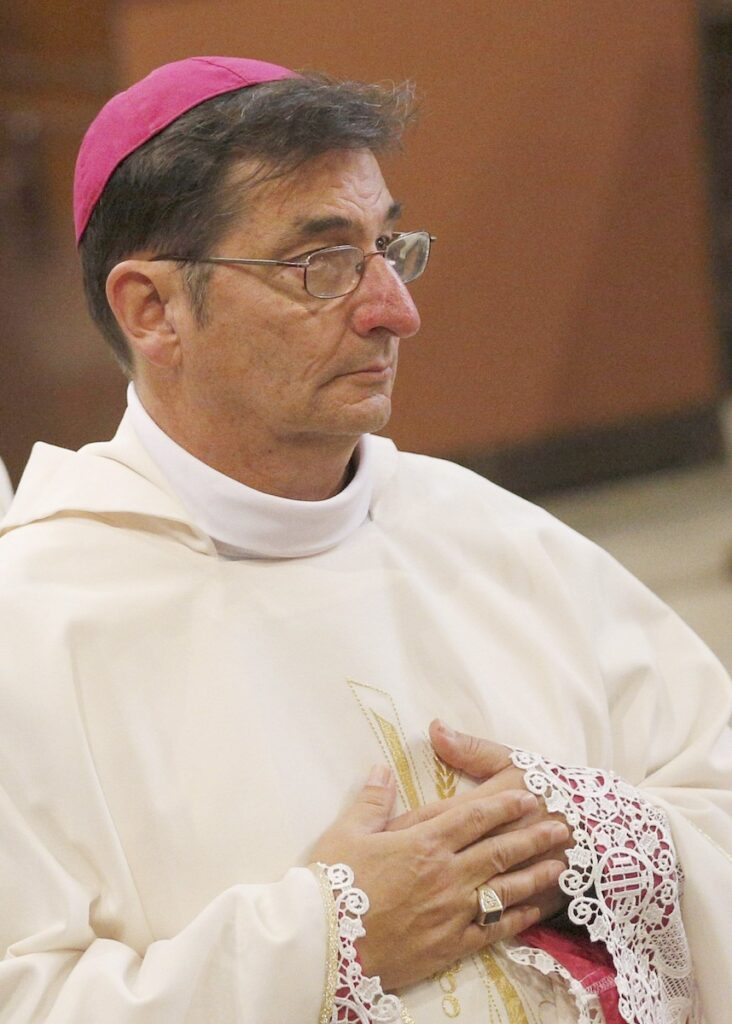
Bishop Joseph J. Tyson of the Diocese of Yakima, Wash., is pictured concelebrating Mass at the Basilica of St. John Lateran in Rome Feb. 4, 2020. Bishop Tyson wrote in a recent newsletter that several seminarians in the diocese were among those impacted by immigration enforcement policy, including one who was born in the U.S. but left to be with his parents, who had self-deported to Mexico. (CNS photo/Paul Haring)

An April letter from the USCCB to lawmakers about the Religious Workforce Protection Act said, “Simply put, an increasing number of American families will be unable to practice the basic tenets of their faith if this situation is not addressed soon. Likewise, hospitals will go without chaplains, schools will go without teachers, and seminaries will go without instructors.”

Catholic groups are among those urging the Trump administration to address the backlog in the R-1 visa category.

Bishop Tyson said that legislation would help ease some of the challenges presented by ensuring his priests’ legal status remains in good order.

“Foreign-born religious workers play a vital role in serving immigrant communities in the U.S., often providing services in the languages people know best and offering a sense of home and support,” Miguel Naranjo, director of religious immigration services at the Catholic Legal Immigration Network, commonly known as CLINIC, told OSV News.

“With the end of the protected locations policy, we have seen growing fear in immigrant communities about ICE presence in houses of worship — and even greater risks to the religious workers themselves,” Naranjo said. “Many now carry proof of status at all times, aware of the heightened enforcement climate. Immigrants are increasingly afraid to leave home, attend services, or risk being separated from their families. Yet, despite these challenges, foreign-born religious workers remain steadfast. Their courage and commitment to their ministry have only deepened, knowing their role in serving immigrant communities is more critical than ever.”

Pope Leo XIV’s recent comments for bishops’ unified voice

Asked about Pope Leo XIV‘s recent comments calling on the U.S. bishops to speak with a unified voice on migration issues, Bishop Tyson said, “I think we’ve got to somehow find a way of reclaiming the pulpit, because I think there’s voices outside the bishops’ conference that are very loud on this, and we have Catholics in public life that teach things that are incorrect about the human person.”

“I think that’s kind of where we the bishops really have to figure out how we’re going to work with the social media landscape, TikTok, Facebook, Instagram — the plethora of people that launch things and tend to minimize the weight of our teachings in general on Catholic social teaching, very specifically around immigration,” he said.

Catholic social teaching on immigration balances three interrelated principles — the right of persons to migrate in order to sustain their lives and those of their families, the right of a country to regulate its borders and control immigration, and a nation’s duty to regulate its borders with justice and mercy.

Bishop Tyson noted there was controversy surrounding Pope Leo’s recent comments in which the pontiff said church teaching on both immigration and abortion were clear.

“In the Diocese of Yakima, I don’t have the luxury of choosing between protecting the unborn and protecting the undocumented,” he said. “If you want to save the unborn, you have to walk through the doors of the undocumented, because that’s where the pregnancies are, that’s where the births are, that’s where the vast majority of my baptisms are. These are not separate universes. It’s one thing.”