Showing posts with label Diocese of Charlotte. Show all posts

Monday, August 17, 2026

The story of vocation growth & success from Charlotte, North Carolina and Kansas & Virginia too


‘It’s always the Holy Spirit’: Meet 3 dioceses seeing large numbers of priestly ordinations

Multiple dioceses throughout the U.S. are bucking national trends and seeing large numbers of men discern into the priesthood.

Seminarians in the Diocese of Charlotte stand together prior to their ordination, March 14, 2025. | Credit: Photo courtesy of the Diocese of Charlotte


Daniel Payne

August 16, 2026

What drives a young man to discern into the priesthood — a supportive family, a vibrant parish, a proactive pastor, an outspoken bishop?

Father John Eckert’s response: “Yes.”

Eckert, the vocations director for the Diocese of Charlotte, North Carolina, chuckled a little when describing the myriad paths that a young man may take when finding his way to holy orders. But, he said, “it’s always the Holy Spirit at work. It’s always cooperating with the grace of God.”

The Charlotte Diocese is among those in the U.S. seeing high numbers of seminarians and priestly ordinations. The diocese in western North Carolina saw a record 10 young men ordained to the priesthood earlier in 2026; that followed six ordinations in 2025 and seven in 2024.

“We’re blessed in the Diocese of Charlotte,” Eckert said. “It’s a beautiful moment.”

The priest just wrapped up his first full year as vocations director there. He said one of the strengths of the diocese is in its vibrant faith life, which he attributed partly to the “evangelical Bible-belt roots” of the region.

“This is Billy Graham territory,” he joked.

The diocese itself bears out that witness, he said. “The Church is growing like crazy down here,” he said. “We have wonderful families. We have faithful, hardworking priests. We’ve had five bishops who keep on striving to bear the Gospel message and bring that to every corner of the diocese.”

The growing ranks of the priesthood is proof of that high spirit, though Eckert said it can be tricky to tease out just what contributes to years of high ordinations. One of the diocese’s strengths, he said, is its own “in-house college seminary.”

“It’s so wonderful that if we have a young man interested in the priesthood, we can actually just bring him to this place and show him where the initial years of formation will take place,” he said.

The school offers prospective seminarians a chance to see “a group of men living this out, being very intentional about their prayer life, striving to grow in love of Our Lord.”

Charlotte Bishop Michael Martin, OFM Conv, told EWTN News that when seeing such high levels of devotion to the priesthood, “we often have to just marvel at God’s work.”

Priests in the diocese, he said, excel at offering candidates to the priesthood “the opportunity to see a healthy, holy, good person that they can see themselves becoming.”

Families, meanwhile, have become “far more open” to communicating to their sons that they would be “honored to see [them] consider the priesthood.”

“That dynamic has come about because the presbyterate gives a good example,” the bishop said. “It makes families, and parents in particular, more willing to be able to create that environment in their own families.”

Both Martin and Eckert said that at a certain point Church leaders simply have to acknowledge the work of the Holy Spirit. “To fully try to understand it is important,” Martin said, “but in some ways it’s best just to appreciate and enjoy it and be grateful for it.”

Eckert, meanwhile, cited as an example 1 Corinthians 3:6, in which Paul tells the Church at Corinth about its faith: “I planted, Apollos watered, but God gave the growth.”

The priest spoke joyfully about his work in the diocesan vocations office, though he downplayed his own role in bringing men to holy orders. He recounted with a laugh what a speaker told a group of vocations directors at a recent conference: “Gentlemen, get over yourselves. Nobody ever entered seminary because of their vocations director.”

Priestly vocation ‘seen as a natural, fulfilling life’

Father Garett Burns, the director of vocations promotion in the Diocese of Wichita, Kansas, admitted that the Midwestern diocese is “blessed with a strong culture of vocations.”

“For example, this past May six men were ordained to the priesthood,” he said. “We’ve been blessed to generally have a steady number of ordinations each year. There have been 22 priestly ordinations since 2020 and 44 priestly ordinations in the last 10 years. We will begin this academic year with 50 seminarians in formation.”

He said that it is “difficult to capture succinctly” why a diocese might have such abundant vocations, describing every Catholic’s vocation as a “mystery of grace.” But he said promoting vocations throughout every aspect of Church life — including in families, schools, and parishes — has borne steady fruit.

The diocese has an abundance of Eucharistic adoration, he said, including perpetual adoration. Such chapels present opportunities for young people to spend time in silence before Christ, he said, and “these moments are where vocations grow and flourish.”

Priests and bishops in the diocese, meanwhile, are “deeply committed to the Lord.”

“When priests love their priesthood and enjoy each other, that is attractive to young men,” he said. A local seminary program has also borne fruit, he said, allowing young men to form a close, core connection with the Church “at home.”

The priest said he hesitates to offer advice to other dioceses, admitting that there is “no universal solution” given the unique histories, gifts, and challenges of each diocese. But expanding opportunities for Eucharistic adoration, he said, offers “one viable option that promises to deepen the culture of vocations.”

Father Noah Morey, the vocations director in the Diocese of Arlington, Virginia, echoed the assessment of his fellow vocations directors: “It’s not just one thing, it’s everything,” he told EWTN News.

The Arlington Diocese saw seven new priests ordained in 2026; it recorded 12 ordinations in 2025. Morey noted that when it comes to ordinations, “it’s not about numbers, it’s about quality.” But he said the Arlington Diocese has a “strong culture of vocations” that has helped produce exemplary priests over the years.

The diocese has promoted vocations since its founding in 1974. Its first leader, Bishop Thomas Welsh, “really fostered that culture” in part by bringing a Poor Clares monastery to the diocese.

“Our bishops have all taken a hands-on approach of fostering vocations in young men from a young age,” Morey said. Bishops in Arlington regularly attend seminary events and meet personally with aspiring priests, he said.

Eucharistic adoration is prolific throughout the diocese, meanwhile; several years ago, Morey said, current Bishop Michael Burbidge asked every pastor in the diocese to institute 40 hours of Eucharistic adoration annually.

The diocese also holds St. Andrew dinners several times a year, which allows young men to speak to both the bishop and diocesan priests about their potential discernment.

“I tell the young men, it’s a very low-commitment event — you’re not signing your life away!” he said. “You just show up for a free dinner with the bishop.”

A yearly “Quo Vadis?” summer camp offers another opportunity for young men to have face-to-face discernment with Church leaders.

An active, vibrant priesthood in the diocese also helps foster vocational discernment, he said. “If a young man sees a priest who’s in love with the Lord, that’s really attractive to the priesthood,” he said.

And faith-filled and encouraging families are equally to credit for fostering vocations in young men, Morey continued.

He offered a baseball analogy to describe the process by which young men find their way to the priesthood. “The families are the starting pitchers,” he said. “The priests are the middle relievers. And the vocations director is the closer.”

Globally the Church has continued to see lower vocations; the most recent data shows a continued drop in priests, with significant declines in Europe and the Americas, though Africa and Asia saw notable increases.

In the first 15 months of his pontificate Pope Leo XIV has continued to emphasize the importance of vocations. In June 2025 he told vocations ministers at the Vatican that their job consisted of “forming men capable of loving, listening, praying, and serving as a community.”

The pope said God “continues to call and remains faithful to his promises.” He urged leaders to help bring about the creation of appropriate conditions “to hear [God’s] voice.”

In Charlotte, Bishop Martin said the best response to an increase in vocations is to be both joyful for the gift and determined to help it flourish.

“There’s something in God’s design that’s beyond even what I can say,” he said. “I can provide some insights, but at the end of the day, this is the work of the Holy Spirit.”

Eckert, meanwhile, said an increase in vocations is a blessing no matter where it develops.

“The job that I think we all have is being intentional in our discipleship of Jesus Christ,” he said. “I pray for myself and all my brother vocations directors out there. Whether it happens in Peoria or it happens in Charlotte, it’s good for all of us.”

Tuesday, June 2, 2026

There is NO vocations problem in Charlotte North Carolina; they just ordained 10 NEW PRIESTS!


Record number of priests ordained in Diocese of Charlotte, North Carolina

“We stand in awe of God’s work in our midst,” Bishop Michael Martin said.


Amira Abuzeid
June 1, 2026 

St. Peter’s Catholic Church in Charlotte, North Carolina. | Credit: J. Michael Jones/Shutterstock


Bishop Michael Martin of the Diocese of Charlotte, North Carolina, ordained 10 men to the priesthood on May 30, the highest number of priests ordained in one year in the diocese’s history.

The number surpasses the previous record high of seven ordinations (set in 2000 and 2024) and follows six ordinations in 2025.

“We stand in awe of God’s work in our midst,” Martin told EWTN News in a statement. “We give thanks for the ‘yes’ of these men, which is freely offered by them to God’s free invitation.”

The ordinands will bolster the diocese’s 145 active priests who serve more than 575,000 Catholics. The Diocese of Charlotte, covering western North Carolina, has seen steady growth in vocations amid a booming Catholic population.

“There is always a desire to explain a moment such as ours,” Martin said, noting that there are “factors unique to each man in our seminary formation program” that explain the record number of ordinations and that there is “no one set formula.”

“God uses whatever he chooses to invite and foster a faith-filled response from these men,” he said.

He credited families, who are “responsible as they are placing faith in Christ in its rightful place at the center of daily life,” as well as the diocese’s priests, who “are more regularly inviting young men to consider the priesthood.”

He also said the diocese has promoted a culture of vocations” for years and it “is clearly making a difference.”

In 2016, then-Bishop Peter Jugis founded St. Joseph’s College Seminary. Eight of this year’s 10 ordinands studied there before advancing to major seminary. The other two lived there during their pastoral years of parish ministry.

“Many years ago, seeing the desperate need for priests, Bishop Jugis and his clergy made the cultivation of vocations the highest priority,” said the seminary’s rector, Father Matthew Kauth, in May.

In addition, under the leadership of Father Christopher Gober, who served as the diocese’s vocations director until July 2025, two vocations camps were launched: “Quo Vadis Days” in 2014 for young men and “Duc in Altum” in 2016 for young women. The programs are held at Belmont Abbey College.

“We are now reaping the harvest of 20-plus years of labor. It didn’t just happen,” Kauth said. “God has blessed our efforts, and a culture of vocations has been established — yielding increasing returns, just as Christ said it would. Now, we must cultivate and care for those vocations and give thanks to God.”

Saturdayʼs ordination drew an overflowing crowd of more than 1,640 attendees, many of whom arrived hours early.

In his homily, Martin described the occasion as “a day of great joy for the Church and for these 10 men.”

The bishop urged the new priests to love so that people “will follow not just what you say but follow who you are,” and encouraged them to “love the people of God you’re being sent out to serve.”

“His sheep are every human person on the face of the Earth, every person in whatever school or parish, every community, every hospital or nursing home,” Martin told the new priests. “Wherever you go, love them all … you cannot wait for them to come to you, you have to go out to them. That is the nature of the apostolic Church. As you feed them with this holy banquet, you nourish them in ways only the Lord can.”

The new priests are Father Robert Bauman, Father Michael Camilleri, Father Daniel Chaves Peña, Father John Cuppett, Father Maximilian Frei, Father Juan González Hernández, Father Bryan Ilagor, Father Michael Lugo, Father Peter Townsend, and Father James Tweed.

They offered first blessings for more than two hours after the Mass and will celebrate their inaugural Masses of thanksgiving in the coming days. Effective July 1, they will take up assignments across the diocese, serving as university and high school chaplains and in parochial vicar positions.

Also on May 30, the nine perpetual pilgrims from the National Eucharistic Pilgrimage arrived in the diocese where they were greeted by more than 100 Catholics at Our Lady of Lourdes Parish in Monroe.

The 2026 theme, “One Nation Under God,” recognizes the nation’s 250th anniversary. The pilgrimage began on Pentecost Sunday and will continue through Independence Day weekend.

A group of nine perpetual pilgrims carrying the Blessed Sacrament will journey up the Eastern Seaboard on the St. Frances Xavier Cabrini Route, named for the first U.S. citizen to be canonized.

All are invited to join the public processions and other events.

Tuesday, January 13, 2026

Debate and discord continue in Charlotte between the faithful and the Bishop over kneeling for communion


Rules about kneeling at Communion spark debate over bishop's authority in Charlotte

Bishop Michael Martin concelebrates his ordination and installation Mass as the new bishop of Charlotte, at St. Mark Church in Huntersville, N.C., May 29, 2023. (OSV News/Catholic News Herald/Troy Hull)

January 12, 2026

Fiona Murphy

After Bishop Michael Martin of the Diocese of Charlotte, North Carolina, issued a pastoral letter outlining that Catholics are expected to stand during the reception of Communion in the diocese — and directing churches to remove kneeling supports like altar rails — clergy and lay Catholics quickly began reacting both in Charlotte and online.

In the Dec. 17 letter, Martin cited guidance from the U.S. Conference of Catholic Bishops, with Vatican approval, in stating that "the norm ... is that Holy Communion is to be received standing, unless an individual member of the faithful wishes to receive Communion while kneeling." Martin emphasized that Catholics will not be denied Communion "solely based on their posture." However, the new directive prohibits diocesan churches from placing kneelers, altar rails and prie-dieus, all used to provide support for those who choose to kneel. The directive is set to take effect Jan. 16.

Preexisting, permanent altar rails will not be removed, diocesan officials said. Only temporary or movable kneelers are set to leave churches.

Liz Chandler, director of communications for the Charlotte Diocese, said only a small number of the diocese's 93 parishes currently use such kneelers. "We don't have a solid count but it's a small number," Chandler wrote in an email to RNS. "There's no cost associated since those being removed are not fixed to the floor."

Reaction to the pastoral letter has become a popular topic in Catholic online spaces, drawing commentary from Charlotte and beyond, with one X user writing this week, "The incoherence of the Charlotte diocese's ban on altar rails." Another asked, "If a parish wants to use the rails, why is this a problem? Doesn't it encourage piety?"

However, as the Jan. 16 implementation date approaches, the letter has exposed divisions in the Charlotte Diocese over liturgical authority, leadership style and worship practices that predate Martin's letter.

In May, the National Catholic Register reported on a leaked draft of new liturgical norms attributed to Martin that outlined restrictions on altar rails and kneelers, using Latin, ad orientem worship and other traditional practices, igniting backlash online.

While diocesan officials frame removing the kneelers as a reaffirmation of universal Catholic norms, critics — including Charlotte priests, canon lawyers and some local Catholics — are questioning the bishop's authority to mandate them. The debate has also played out online, demonstrating how social media has amplified internal church disputes that historically took place largely outside of public view.


 More than 30 priests in Charlotte had submitted a formal request to the Vatican seeking clarification on the bishop's authority regarding the directive. The request, known as a dubia, asks the Holy See to weigh in on questions of episcopal authority over liturgical practice.

"I don't think I've experienced anything like that, where there is this questioning of the bishop's authority to Rome," said Fr. Patrick Cahill, pastor of Charlotte's St. Matthew Catholic Church, which has about 12,000 registered families, making it the largest parish in the diocese.

Cahill said he believes Catholic faith is, in part, belief that God has given the community the right leader at the right time. "It's kind of a confusing sign to me," he said. "Rome is the one that put this bishop here last year. So, it's kind of like, ask them if they're sure, I guess." He plans to obey the bishop's directive. 

Ellen, a lifelong Charlotte resident and Catholic who has attended the same parish in the diocese for six years, did not want her last name published due to the intensity of the reaction to the issue and concerns about protecting her family. "I can't say I've ever seen a bishop treated like this before," she said. "But perhaps social media is just giving more public avenues for it."

At her parish, Ellen said the directive itself has had little practical effect. "Everyone at the Masses I attend stands anyway," she said. "I truly don't think I've seen a single person kneel for Communion at my parish." Ultimately, Ellen said she supports the bishop.

"Communion isn't the place to make a spectacle of yourself to be a distraction to the priest or to other parishioners," she said.

Fr. Noah Carter, director of liturgy for the Charlotte Diocese, said his initial response to the letter was simply obedience. At his own parish, Holy Cross Parish in Kernersville, two long kneelers were constructed in 2021 by a parishioner but will be moved to the front of the sanctuary and not used for Holy Communion, Carter said. "By our conformity with the bishop's letter, we're removing them," he said.

At Holy Cross, which has 2,700 registered families, approximately 45% of whom are Spanish-speaking, Carter said he does not closely track how parishioners are positioned while receiving Communion. "I can't give a number or even say whether it's a majority or minority," he said. "I don't really pay attention to the posture of people who come up to receive Communion."

Still, Carter said the directive aligns with Catholic practice. "No one in the Catholic Church celebrates Mass in their own way," Carter said. "We follow universal norms and local standards."

Before the Second Vatican Council of the 1960s, Catholics typically received Communion while kneeling at altar rails, which were standard fixtures in churches across the United States. Although most Catholics today receive Communion standing, kneeling and other traditional postures have become more common in some parishes in recent years, a trend sometimes associated with the so-called "trad Cath" movement — a popular subject for both news outlets and online communities.

Ellen and Cahill said that in Charlotte, some of the local backlash reflects an adjustment to Martin's leadership style. Martin, a Franciscan appointed by Pope Francis in 2024, succeeded Bishop Peter Jugis, who led the diocese for more than two decades and was regarded as more conservative in liturgical matters.

"You have a new bishop come in a year and a half ago, who has a completely different style," Cahill said. "He's focused on renewal, poverty, simplicity ... which is completely different from the previous mission. That has kind of heightened this whole conversation."

During his tenure, Martin has also reduced the number of parishes permitted to celebrate the traditional Latin Mass from three to one. The Chapel of the Little Flower in Mooresville is now the only parish in the diocese authorized to offer it.

The pastoral letter does not explicitly address the traditional Latin Mass, but diocesan officials clarified that the directive does not apply to the Chapel of the Little Flower. Fr. Brandon Jones, the chapel's pastor, declined to comment and directed RNS to Chandler.

For some Catholics, the directive raises legal questions about canon law. Dominican Fr. Pius Pietrzyk, a canon lawyer based in Washington, D.C., questioned whether the pastoral letter carries the legitimacy of binding law.

"For the most part, when the Mass gives options, the universal authority, the church has vested those options in ... not the bishop, [but] the priest celebrant," Pietrzyk said. "It's not clear that his document is that, and it does seem to lack some of the indicia one would normally expect of a legislative act."

In his view, Pietrzyk said he sees the directive as Martin enforcing his liturgical preference. "It's very clear that the bishop has a certain personal taste in liturgy, and what it seems that he's doing is imposing his personal taste in liturgy on his diocese," Pietrzyk said.

Martin was unavailable for comment, Chandler said. 

Within the Catholic Church, bishops are charged with ensuring that Mass is celebrated according to universal norms, though the Vatican has not indicated whether it will respond to the dubia submitted by Charlotte priests.

Timothy O'Malley, the academic director of the University of Notre Dame's Center for Liturgy in Indiana, said he has been following debates in Charlotte for over six months regarding the issue and that online backlash has complicated an already sensitive situation.

"Bits and pieces of this pastoral letter have been leaking out over the last several months," O'Malley said. "I wish these conversations were happening between priests and their bishop — that's the healthy thing."

"I don't know who's at fault," he said. "But this is not a healthy way to proceed."

Ellen said she hopes tensions will ease and that online commentary will not affect the future of the local Catholic Church.

"I hope the bishop has the fortitude to stay the course," she said, "and stop the local church from being dragged backwards."

Friday, May 30, 2025

Lots of drama in the Diocese of Charlotte over additional crackdowns on Latin Mass/traditional customs


Leaked draft shows Charlotte bishop’s planned crackdown on traditional liturgical customs

Credit: PIGAMA/Shutterstock

A leaked draft from Charlotte, North Carolina, Bishop Michael Martin, OFM Conv, shows the prelate’s far-reaching and highly detailed intent to crack down on what he describes as “older liturgical practices” in order to bring about “a more uniform celebration of the Mass” in the diocese. 

The lengthy letter was first published by the blog Rorate Caeli; officials with the diocese subsequently confirmed the authenticity of the letter to the National Catholic Register, CNA’s sister news partner.

The letter, which references Pope Francis in the present tense, appears to have been written prior to the late pontiff’s death last month. 

Its leak, meanwhile, comes after the Charlotte Diocese announced that it would significantly restrict the practice of the Traditional Latin Mass, limiting it to a single chapel in what Martin said was a bid to “promote the concord and unity of the Church.”

Regulations on altar candles, women’s veils, and more

The document details an extensive list of behaviors and practices that Martin said would be tightly regulated or else abolished going forward in an effort at “purifying and unifying the celebration of the Mass.”

Among the directives: Celebrants are to place candles “arranged around the altar” during Mass “since placing them on the altar will always obstruct the vision of the faithful.”

As well, priests are directed to not offer “vesting or devesting prayers” either before or after Mass, as there is “no option given in the current liturgical books” for such practices. Rather, “prayerful preparation before Mass and thanksgiving after Mass is to take place in some other way.”

Women who choose to wear veils during Mass “are not to do so when they are assisting in any official capacity,” such as when lectoring or cantoring, the document states. 

Parishes will be forbidden from using bells to signal the start of Mass, the directives say; rather, a “verbal welcome” by the lector “followed by an indication of the hymn to be sung and an invitation to stand” should be normative at all Masses. 

At times the document seems to run afoul of other, authoritative Church directives. Martin at one-point writes that the Church “does not … call for the Latin language to be used widely in the liturgy,” and that the ancient language “diminishes the role of the laity in the Mass.” Yet guidance from the U.S. Conference of Catholic Bishops explicitly states that “care should be taken to foster the role of Latin in the liturgy,” with the bishops even going so far to state that singers and choir directors should “deepen their familiarity with the Latin language.” 

The bishop’s order that candles are “always to be arranged around the altar,” meanwhile, explicitly cites the General Instruction on the Roman Missal (GIRM), but the relevant portion of that document does not forbid placing candles at the front of the altar. 

The intensively detailed list has drawn criticism and backlash from some commentators. Matthew Hazell, a British liturgy scholar, told the Register that Martin’s perspective was consistent with what Pope Benedict XVI famously described as a “hermeneutic of discontinuity and rupture.” 

“Rather than allow the novus ordo to be celebrated in a manner in keeping with its own rubrics and with the Church’s tradition, Bishop Martin seems to see it as an entirely new creation that cannot even be seen to have anything in common with what came before,” Hazell told the Register.

Father Paul Hedman, a priest from the Archdiocese of St. Paul and Minneapolis, similarly criticized the directives, writing on X that the document appears to be “banning things explicitly allowed in the GIRM and explicitly called for in Vatican II.”

“He denigrates the practice of using water and wine for purification of the vessels,” Hedman wrote, but the GIRM “explicitly allows this.” 

The bishop “presumes the ability to regulate the private prayer of the priest before Mass,” the priest wrote further. “This is simply ridiculous and — I do not use this [word] lightly — tyrannical.”

Though the guidelines have generated intense debate and criticism, the diocese told the Register that the document was “an early draft” and is still being debated by diocesan leadership. 

“It represented a starting point to update our liturgical norms and methods of catechesis for receiving the Eucharist,” a diocesan spokeswoman said, adding that the directives will be “thoroughly reviewed” prior to their official promulgation.

Tuesday, October 8, 2024

Catholic responses and call to action in the flooded areas of western North Carolina due to Hurricane Helene


In Hurricane Helene’s Wake, Priests Offer Mass by Candlelight as Catholic Parishes Become Lifelines

Such a storm is uncommon for the region, but Good Samaritans and the Church are lending a hand in the devastating aftermath.


A load of supplies is blessed by chaplain Father Christopher Brock at Bishop McGuinness High School in Kernersville, North Carolina. (photo: Courtesy of the Catholic News Herald/Diocese of Charlotte)

Among the hardest-hit communities in the wake of Hurricane Helene are those in the Diocese of Charlotte in western North Carolina, where more than half of the more than 200 deaths recorded so far occurred, with fast-moving water wiping away communities and leaving residents homeless and at risk. 

Many residents remain isolated without electricity, water, email or phone communication and other vital supplies and services, and some still have no contact with loved ones in the hardest-hit regions. 


The flooding has devastated the western portion of North Carolina.(Photo: Courtesy of the Diocese of Charlotte and the Catholic News Herald)


The diocese is playing a leading role in recovery efforts, both in providing basic necessities and for pastoral needs.

Father Patrick Cahill, pastor of St. Eugene parish in the historic town of Asheville, said early Friday morning, Sept. 27, was the worst for the storm. 

“The rain wouldn’t let up, holy cow!” he told the Register. From midnight onward, “We had 12 straight hours of pouring rain. It was unbelievable to see the volume of water pouring off our rectory house and down the hills, as drains clogged with debris.”

Howling winds followed. As he drove to the parish church (about a mile away) last Friday evening, he said it was a challenge to navigate fallen trees and downed power lines. 

A week later, power and water is still off at the church, he said, but “Good Samaritans” have since descended on the parish to clean up. One parishioner drowned, and many parishioners’ homes are damaged. He said his permanent deacon’s house was “crushed” by trees. Had the deacon and his wife been home at the time, they, too, might have become fatalities.

Father Cahill noted that local hospitals were “overrun” with injured victims; and he knew of one parishioner, a nurse practitioner, who worked a 24-hour hospital shift in the immediate aftermath of the storm. He added that as he and a fellow priest were waiting for utilities to be turned back on, they were living off bottled water and tap water from a bathtub they’d filled before the storm hit.


Shelter From the Storm

Claudia Graham is business manager of St. Margaret Mary Church in Swannanoa, which was “ground zero” of storm damage in North Carolina. She lives 6 miles from the church; she and her husband took shelter in their basement as winds of more than 100 mph battered the mountain community. 

The next morning, she went to the church amid widespread destruction that was “mind-boggling,” she told the Register. Of greatest concern was the extensive damage to the community’s water and sewer system.

Although a large cherry tree fell atop the church building, damage to the parish was not deemed as serious. Water and power is not yet back on, and cellphone service is irregular. The parish is still attempting to locate parishioners. 


St. Margaret Mary Catholic Church in Swannanoa remains closed and without electricity after a large oak tree fell on the 88-year-old church building during Tropical Storm Helene Sept. 27. However, parishioners have turned the church into a central distribution point for aid supplies to residents in need, with a daily supply line from Charlotte bringing truckloads of relief supplies from the Diocese of Charlotte's Pastoral Center to the church. Swannanoa, which sits alongside the Swannanoa River, has been one of the worst affected communities.(Photo: Gabriel Swinney for the Catholic News Herald/Diocese of Charlotte)


Catholic Charities appeared quickly on site, with two truckloads of emergency supplies, with a third truck on standby for when storage space can be acquired. 

“It is hard to express all the good that has already occurred amongst so much damage and suffering,” Graham said. “The Diocese of Charlotte has been incredible. I am doing what good I can through our parish; I think that is why God has put me here.”

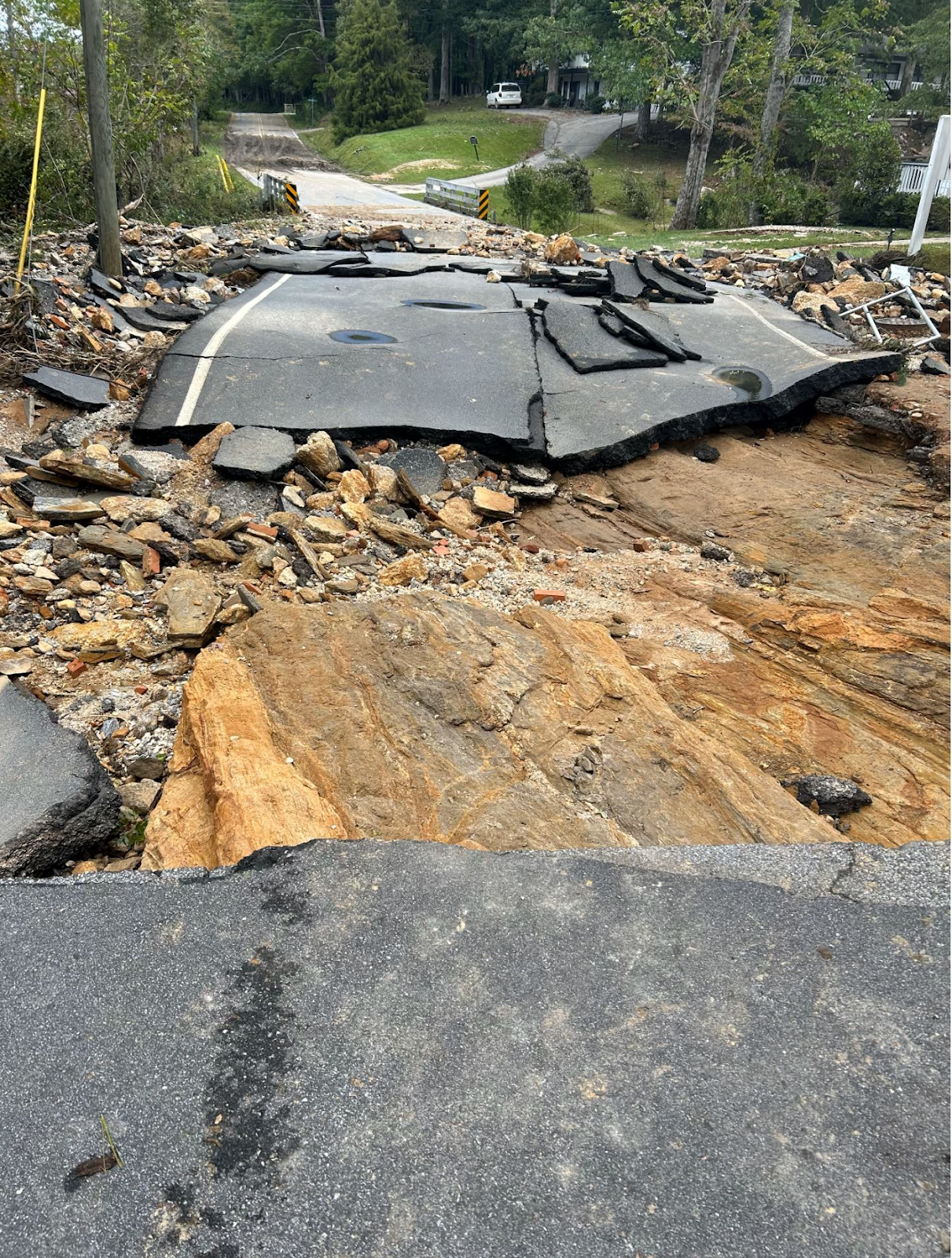
Father Joshua Johnson of St. Edmund Campion parish in Flat Rock noted that his parish was undamaged, but “our roads are flooded out and their concrete and asphalt have been washed away.”


N.C. road washed away.(Photo: Father Joshua Johnson)


Trees fell on the homes of three parishioners, and six feet of water flooded the interior of a fourth home. 

Father Johnson is one of multiple priests being called on to go to the harder hit areas to provide Mass and the sacraments, this weekend celebrating Mass for St. Margaret Mary, as well as assisting with emergency resources. He has been celebrating Mass by candlelight, due to the lack of electrical power.

44 Parishes Severely Affected

Father Shawn O’Neal, pastor of Sacred Heart Church in Brevard, said some of his parishioners were flooded out of their homes and that there was one death of a parishioner’s relative during clean-up efforts. The parish provided temporary shelter, as well as hot meals, to the homeless.

Father Patrick Winslow, vicar general and chancellor of the Diocese of Charlotte, noted that 44 of the diocese’s 93 parishes were in severely affected areas. And, while damage to diocesan structures has been minor, “our parishioners have experienced a great deal of devastation from the flooding. With the water rising and flowing hard, it created a lot of destructive force and power,” he told the Register. “Many of our people are without homes and automobiles, communication, potable water and basic supplies.”

He noted such a storm was uncommon for western North Carolina and that “many of our towns are in valleys surrounded by mountains so they were hit by large volumes of runoff.”

The Catholic Charities team of the Diocese of Charlotte immediately sprung to action to connect with victims, he said, starting by compiling lists of needed items. 

“Within 24 hours we were loading trucks and getting them to places where we knew we could reach,” said Father Winslow.

Donations of cash and supplies began coming in from surrounding communities, and distribution sites, such as Immaculata School and Immaculate Conception Church in the hard-hit community of Hendersonville, became distribution sites for supplies. 

Nearly half of the parishes in the Diocese of Charlotte lie within a federal disaster area declared by FEMA. The diocese and its Catholic Charities agency have organized emergency supply drives in the eastern half of the diocese to gather aid, including bottled water that is then being trucked multiple times each day to the hardest-hit communities in the western half of the diocese. Water has been among the greatest needs for the region, where municipal water systems have been severely damaged by catastrophic flooding from the storm.(Photo: Catholic News Herald)


The diocese has also been active in providing for the spiritual needs of parishioners, Father Winslow added, “as our priests are imbedded in the affected areas and are doing what they can to help parishioners put their lives back together.”

Charlotte Bishop Michael Martin noted that he was moved by the suffering of so many within the diocese and promised that the Church would do what it could long term to help people rebuild their lives. 

Touring the affected areas, he commented, “Along with Catholic Charities providing for the material needs of the people, I think the most important thing the Church can do is be with these people as they are suffering.”

Father Winslow added, “While the hurricane has been devastating, it’s been impressive and inspiring to see neighbors coming together to help one another.”


HOW YOU CAN HELP

Bishop Martin welcomes donations for victims of Hurricane Helene: giving.classy.org/campaign/624511/donate. 

Also help via Catholic Charities USA: Hurricane Helene Response - Catholic Charities USA.