Showing posts with label formation. Show all posts

Wednesday, September 30, 2026

A boom in vocations to the Priesthood in Archdiocese of Baltimore


Archbishop William E. Lori prays as 12 candidates to the transitional diaconate kneel during their ordination Mass May 16, 2026, at the Cathedral of Mary Our Queen in Homeland. They are expected to be ordained priests in 2027, the largest number of priests ordained for the Archdiocese of Baltimore in a single year in more than half a decade. (Kevin J. Parks.CR Staff)

With 66 seminarians in formation, Archdiocese of Baltimore sees vocations surge 



By


The Archdiocese of Baltimore is preparing for a milestone not seen in more than half a century: the ordination of 12 new priests in a single year.

One seminarian is expected to be ordained in January and 11 more in June, as the archdiocese’s number of men in priestly formation continues to climb.
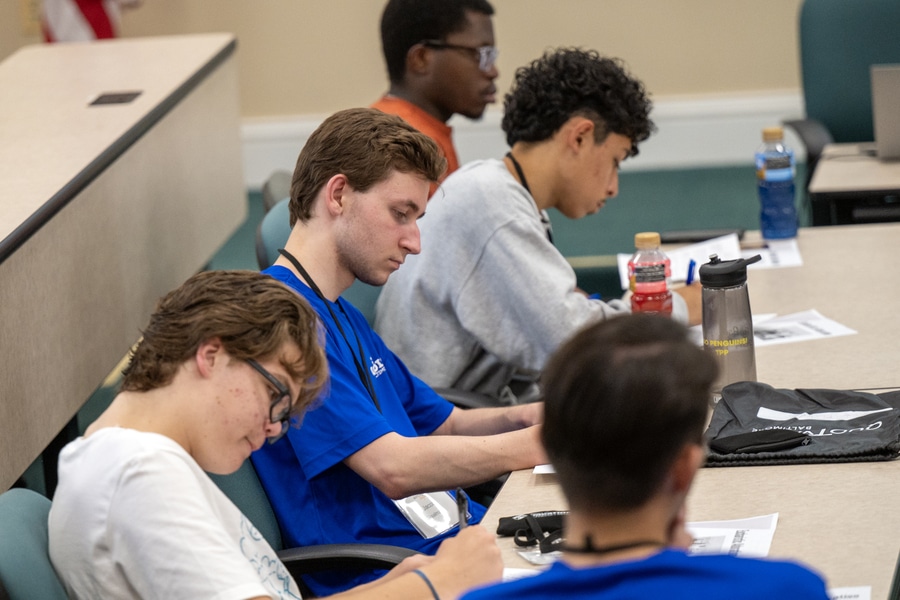
Jacob Paalmana, a member of the Class of 2026 at Chesterton Academy of Annapolis, along with fellow recent high school graduates, take notes during a talk on June 18 by Father Erik Arnold, pastor of St. John the Evangelist in Severna Park. The discussion focused on relationships and was part of the Quo Vadis Beyond experience for recent high school graduates at St. Mary’s Seminary and University in Roland Park. (Kevin J. Parks/CR Staff)

The archdiocese now has 66 seminarians in formation, with 14 men entering this year alone. Representing 14 different parishes and ranging in age from 17 to 36, the newest seminarians are part of a yearslong increase that Church leaders attribute to prayer, intentional vocational outreach and stronger support from parishes.

The total number of seminarians is up from 28 in 2007 and 52 in 2020.

For Archbishop William E. Lori, who has led the archdiocese for 14 years, the growth is among the great joys of his tenure.

“This has not been sudden,” said Archbishop Lori, who ordained five men to the priesthood this year. “It’s been building every year, and this is due to a lot of people praying before the Blessed Sacrament. It’s due to a good vocations team. It’s also due to pastors who are encouraging vocations in their parishes – and to parents who are generously open to the possibility that their son might have a priestly vocation.”

The surge has filled both of the archdiocese’s propaedeutic houses, in Emmitsburg and Baltimore, to capacity. Three of this year’s new seminarians will spend their propaedeutic year – a foundational period of prayer, discernment and human formation – at the Basilica of the National Shrine of the Assumption of the Blessed Virgin Mary in Baltimore instead, taking part in the Source of All Hope urban missionary program serving people experiencing homelessness.
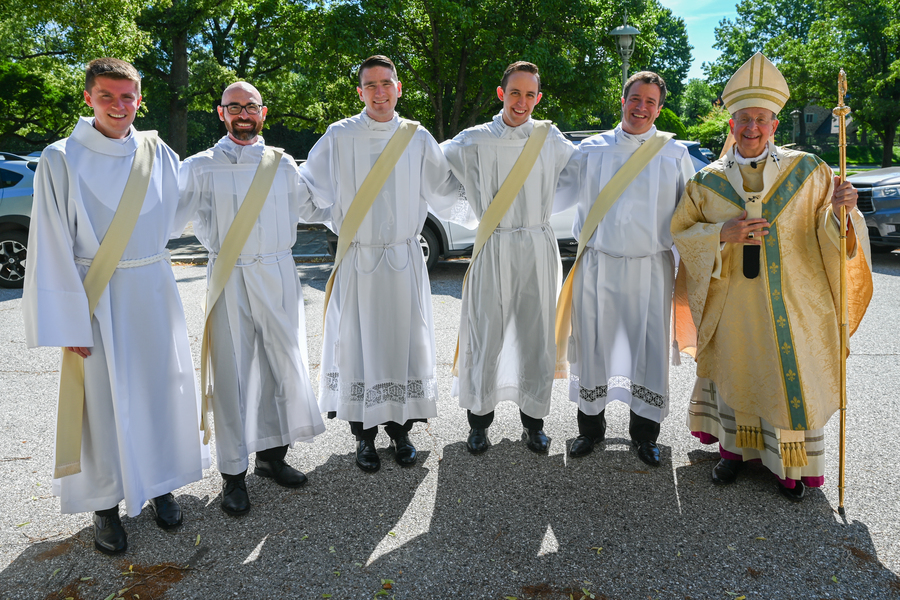
Archbishop William E. Lori poses with the five men ordained to the priesthood June 20, 2026, at the Cathedral of Mary Our Queen in Homeland. There will be 12 men ordained to the priesthood next year. (Kevin J. Parks/CR Staff)

Father Steven Roth, vocations director and associate vicar for clergy for the archdiocese, said the growing number of men discerning the priesthood is encouraging, but he’s even more proud of the caliber of those stepping forward. 

“These are hardworking, talented guys who really could do anything else, and they’re freely choosing to discern whether the Lord is calling them to be a priest,” Father Roth said.

The influx is already changing pastoral life in the archdiocese, allowing new placements in ministries that have gone without priests for years – including high school and college chaplaincies and parishes that haven’t had an associate pastor in a generation.

Depending on a man’s educational background, formation for the priesthood can take up to nine years, Father Roth said. The lengthy process reflects the Church’s desire to form the whole person.

Alongside academic studies, seminarians receive spiritual direction, gain experience in parish ministry and meet regularly with priests and formators as they discern their vocation. They undergo background checks before being accepted into the program.
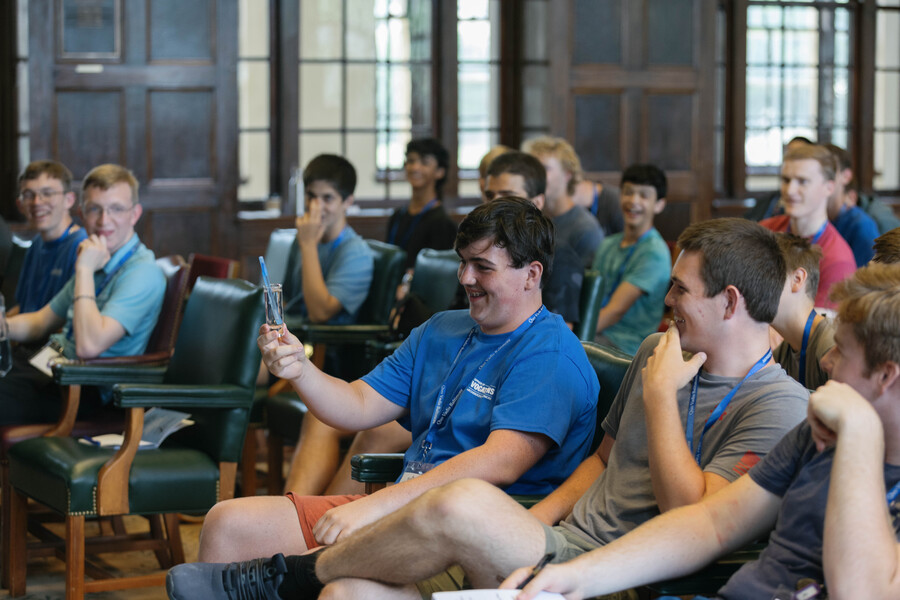
Participants of the Quo Vadis Beyond experience laugh together during a discussion at St. Mary’s Seminary and University in Roland Park. (Stephen Herrera/Special to the Catholic Review)

Formation is also a time of discernment, Father Roth explained, both for the Church and for the seminarians. The goal is to give men the time and support they need to understand God’s call and prepare for ministry.

“We don’t rush it,” Father Roth said. “By the time that the Lord is calling them to be a priest, they’re ready and capable and able to say yes to that call.”

Father Roth is assisted by Father Lenin Suarez, associate director of vocations, whom Father Roth said has been building up the office’s online resources. In an increasingly digital age, the goal is to make essential information available to men discerning a vocation before they ever sit down with a priest – giving them a way to work through questions they might be hesitant to raise in person.

Veimar Martinez, 18, a parishioner of St. John in Westminster and a graduate of Westminster High School, is among the archdiocese’s newest seminarians.

Serving as an usher at his home parish was “life-changing,” he said, giving him an inside look at both the parish’s inner workings and the liturgy itself. He later became involved with the Boys and Girls Club, working with young people from a range of backgrounds.
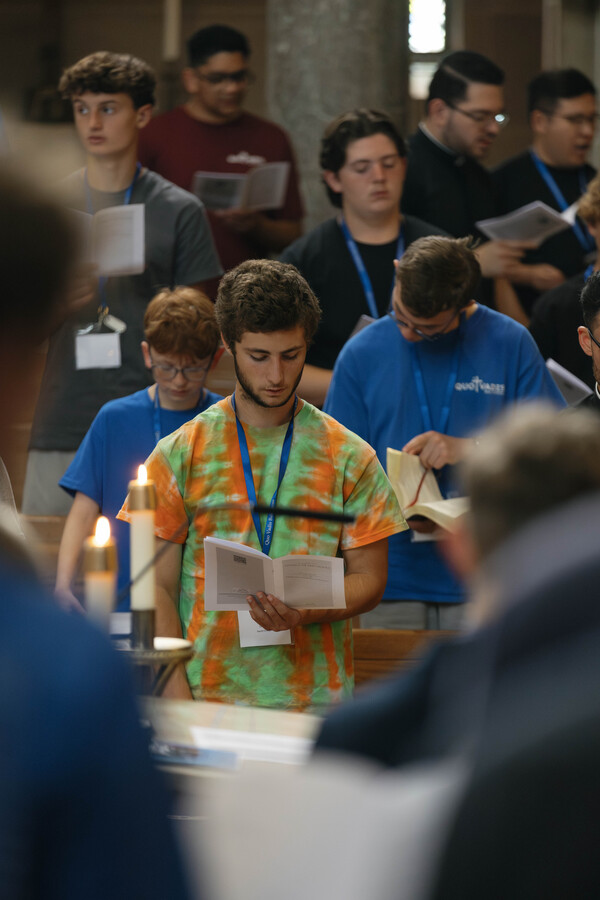
Young men gather during the Quo Vadis Beyond experience for recent high school graduates at St. Mary’s Seminary and University in Roland Park. (Stephen Herrera/Special to the Catholic Review)

“A full circle for me was that my mom taught me my faith, and then here I am teaching other kids the faith,” Martinez said.

He traces his first step toward discernment to 2024, when a confession led to a penance of an hour in eucharistic adoration.

“I felt I was in a relatively rough spot at the time, and then when I stepped in there, everything I felt was like a weight was lifted off me,” he said. “It felt lighter. I felt warm. I felt loved in that room, and eucharistic adoration is something that’s very important to me.”

Father Roth pointed to archdiocesan programs including the Quo Vadis retreat, designed to help young men listen for God’s voice, and a new offshoot introduced this year, Quo Vadis Beyond, aimed at recent high school graduates.

Those efforts are reaching an increasingly diverse group of young men.

For the first time in many years, two African Americans have entered priestly formation. While several Black men from Africa have been ordained to the priesthood for the Archdiocese of Baltimore in recent years, it has been more than three decades since an African American was ordained for the archdiocese. 

Father Roth recalled a visit with young African American parishioners years ago. They told him they hadn’t realized they were needed and they didn’t know they were wanted.
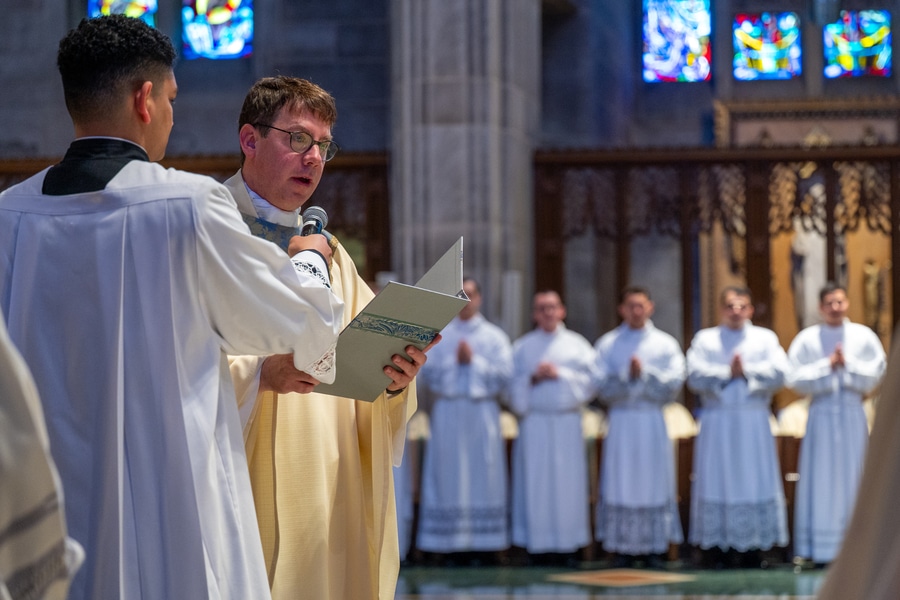
Father Steven Roth, vocations director and associate vicar for clergy, presents 12 seminarians to be ordained to the transitional diaconate May 16, 2026, at the Cathedral of Mary Our Queen in Homeland. (Kevin J. Parks/CR Staff)

“I thought we really need to fix this,” he said. “We have such a diverse archdiocese that we celebrate, and I just want to be sure that our clergy reflects that diversity.”

Despite the growth, Father Roth warned that now is not the time to “rest on our laurels.” He encouraged constant prayer for religious vocations and said he sees every Catholic as a vocations director.

“I would encourage people that when they’re at church, at Mass or different events, and they see a young person who they think has the qualities that they like – that they see in their pastor as well – to not be afraid to go up to the person and say, ‘Have you ever thought about becoming a priest?'” he said. 

Jenna Mattern contributed to this story.

Thursday, February 5, 2026

Cardinal Farrell: local Churches must help laypeople in basic Christian formation


Cardinal Kevin Farrell, Prefect of the Dicastery for Laity, Family and Life, addresses plenary assemblyCardinal Kevin Farrell, Prefect of the Dicastery for Laity, Family and Life, addresses plenary assembly 

Cardinal Farrell: Local Church must help lay people with basic formation

Cardinal Kevin Farrell, Prefect of the Dicastery for the Laity, the Family and Life, opens the Dicastery's plenary assembly taking place this week in Rome with a call for local Churches to help laypeople in basic formation and with the hope that World Meetings be 'authentic experiences of encounter with Jesus.'

By Tiziana Campisi

On Wednesday, Cardinal Kevin Farrell, Prefect of the Dicastery for the Laity, the Family and Life, opened his Dicastery's third plenary assembly, being held from 4 to 6 February at the Jesuit General Curia in Rome, insisting there is a great need for a “basic formation” in the Christian life among lay people, in order to respond to “the alarming increase in the number of people who do not know Jesus Christ at all.”

Specifically, he called for a “formation of the heart,” which involves the whole life: at the origin of Christian life there is an encounter with the person of Jesus Christ, who first changes the heart, then our mindset, and eventually transforms daily conduct and all of life.

Evangelization and Catechesis

Cardinal Farrell stressed that the solution to the challenges facing the Church is not to change structures or the principles of Catholic doctrine or morality. Such changes, he said, will not “bring people back to Mass,” increase vocations, or draw young people back to the Church.

Rather, the Cardinal stressed, every local Church, diocese, and parish must offer, on a permanent basis, "paths of evangelization, catechesis, initial proclamation of the faith, Christian initiation, formation in the faith, and accompaniment in spiritual growth.”

He recalled that Pope Leo, in his Apostolic Letter Drawing New Maps of Hope, affirmed that Christian formation must embrace “the entire person: spiritual, intellectual, emotional, social, and physical,” and he encouraged lively, kerygmatic catechesis, introduction to sacramental life, liturgical celebrations, prayer life, examination of life in the light of Scripture, dialogue, experiences of fraternity, service, charity, and missionary activity.

A key element of this formation, he said, is the synergistic collaboration of all ecclesial components—pastors, lay people, families, single people, consecrated persons, lay associations and movements, youth groups, parish structures and programs, even online formation and “web apostles.”

Formation of families and couples

The Cardinal also insisted on the particular need for Christian formation and accompaniment of families and spouses, explaining that listening to Bishops during ad limina visits, and other interlocutors of the Dicastery, revealed a strong need to provide families with opportunities for formation in married spirituality, married life, family prayer, and the transmission of faith to children.

In this context, Cardinal Farrell encouraged that such formation be led primarily by couples who, through the witness of their own lives, can guide, enlighten, and support other spouses—especially younger couples and those facing moments of crisis.

Thus, He invited the Church to pray that “new saints may arise—whose zeal and creativity help the Church to bring many people closer to the faith”—and to foster “a renewed impetus for evangelization and catechesis.”

Objectives of formation

Summarizing the formation goals of the Dicastery, Cardinal Farrell said that in many ecclesial environments faith is not being generated in people but rather is often taken for granted. Christian formation must therefore generate faith and lead people into “a living relationship with God and with Christ,” fostering a mature Christian life in the Church.”

He emphasized the need for Episcopal Conferences to genuinely commit themselves to formation, and to identify fundamental criteria that can be used to develop guidelines for Christian formation that local Churches can adopt in their pastoral contexts.

World Meetings

Regarding the World Meetings organized by the Dicastery, including World Youth Day, the World Meeting of Families, and the World Day for Grandparents and the Elderly, Cardinal Farrell said that profound changes around the world must be taken into account, citing "cultural and economic globalization, increased social mobility and interculturality, growing religious indifference, and a renewed search for spirituality among younger generations."

Faced with these scenarios, the Pope called for pastoral creativity and new approaches and expressed his hope that the Meetings "can be evangelically more effective, touch people’s hearts, transmit grace, and have a lasting impact on their lives," becoming “authentic experiences of encounter with Jesus Christ.”

The Dicastery's activities

In his address, Cardinal Farrell also reviewed the Dicastery’s work since its establishment in 2016. In the area of Associations and Movements, eight annual meetings of moderators have been held, with ongoing accompaniment through meetings, statute review, and formation initiatives.

In the field of Family and Life, two World Meetings of Families have taken place, that in Dublin in 2018 and in Rome in 2022, and in 2022, the Dicastery published the Catechumenal Pathways for Married Life to introduce preparation for marriage and accompaniment in the early years of married life.

Regarding pastoral care of life, he recalled the work in this field of numerous Episcopal conferences using the resource Life is Always a Good.

Meanwhile, in youth ministry, World Youth Day was celebrated in Panama in 2019 and Lisbon in 2023, with preparations underway for Seoul in 2027, and, in pastoral care of the elderly, two international congresses have been held in 2020 and 2025.

Tuesday, November 4, 2025

Seminarians praising the Propadeutic Year in Formation


Seminaries report seeing fruits of discipleship, discernment in ‘propadeutic year’


(OSV News) — Seminary formation was already notoriously long — at least six years — and recently, an additional year has been added: the propadeutic year. 

Yet few people are complaining. 

As outlined in the Program for Priestly Formation, the document governing seminary formation that was developed by the U.S. Conference of Catholic Bishops’ Committee on Clergy, Consecrated Life and Vocations, the propadeutic year is the first year of seminary formation during which time formators lead men through human and spiritual formation.

“Discipleship is a lifelong journey of following Jesus Christ; this is certainly the case for the priest,” the document states. 

It explains that during the propadeutic stage of seminary, “the man is introduced to the life of the Church as a community in which excellence of character is nurtured, to the practice of daily participation in the Holy Mass, to love for Sacred Scripture, to the prayer of the Church (the Divine Office, or the Divine Praises in the Eastern Catholic Churches), and to the basic elements of the Christian faith as he discerns attentively and purposefully his potential vocation to priesthood in the presence of a supportive community of fellow seminarians and formators.”

What is the propadeutic year?

During this year, propadeutic seminarians usually live apart from other seminarians and have their own schedule to introduce them to seminary life and go through intentional formation.

Formators say that this year has been a huge benefit for men discerning the priesthood, providing these seminarians the time and space to intentionally discern God’s call and grow in relationship with him before beginning their studies. 

“Guys are entering into discernment more freely and more intentionally because of the propadeutic year as they are able to hear the call of God more clearly, whether it’s calling them away from the seminary and saying, ‘No, this isn’t for me,’ or whether it’s calling them to continue and to move towards the priesthood,” Father Kurt Young, vice-rector of propaedeutic formation and coordinator of human formation at Notre Dame Seminary in New Orleans told OSV News. 

The newest edition of the Program for Priestly Formation — released in 2022 — outlined new instructions for seminarian formation, including mandating the propadeutic year. The propadeutic year sought to intentionally focus on two of the four dimensions of seminary formation — human and spiritual. The other two dimensions, intellectual and pastoral, are introduced after this stage. 

The document says that woven together, the four dimensions “can be seen as an ‘integrated journey of the disciple called to priesthood.'”

“This integrated journey of discipleship is aimed at conforming the heart to the heart of Christ,” the document explains.

“The propadeutic year is meant to focus on the human and the spiritual formation of the men, primarily to give a man a good, strong foundation in the human and spiritual life,” Father Young said. “It is really to help build that prayer life with the Lord, that intimacy with the Lord, as well as a deeper understanding of himself, his own gifts, his own talents as a man.” 

Since 2022, most seminaries in the United States have implemented the propadeutic year and have seen immense success with seminarians calling it a great “gift”. 

“There was the fear that it’s gonna be burdensome, or that guys are not going to like it or are going to complain about it,” Father Young said. “But this is now our third year. We’ve done it every year. Each class has said that this year has been a gift.”

Propadeutic year varies across seminaries and dioceses

The propadeutic year looks different for every seminary and every diocese. The Diocese of Wichita, Kansas, opened a house of formation for college and pre-theology seminarians. When the propadeutic year was added, they sent those men to the house of formation.

“The propadeutic year allows us to shift focus for men, for them to come together in a community and to get accustomed to a new way of life,” Father Chad Arnold, director of seminarians for the Diocese of Wichita, told OSV News. “Oftentimes, guys in their very first year of seminary come in thinking they know what seminary is. The first year is kind of coming to a deeper understanding of what the church actually expects from a guy during seminary.”

Propadeutic seminarians in Wichita take introductory theology classes, learn how to pray Liturgy of the Hours, the form of the divine office most commonly prayed in the Latin Church, and receive spiritual direction. They attend Mass daily, and make a Holy Hour every day. 

What makes the Wichita program unique, however, is that the men are also responsible for all of the household chores, including cooking, shopping, and cleaning. 

“In our culture right now, there are so many struggles with the family,” Father Arnold said. “We made a conscious decision to make our early seminary program less institutional and more familial. And in a family, you don’t have a catered dining service; you don’t have hired maintenance men to clean the house. It’s your house and you live in it in a community. You take care of it. And all the problems that come up with that are formative.”

Eliminating technology noise from seminarians’ lives

At St. Paul Seminary in Minneapolis, the propadeutic seminarians live separate from the other seminarians at an old convent at a nearby parish. Father John Floeder, director of human formation and director of the propaedeutic stage program, told OSV News this allows the men to form an intentional community amongst themselves.

“We have a rhythm of prayer: Holy Hour every morning, Mass midday, evening prayer in the evening. And then a couple of days a week, I do Lectio Divina with them. We do a media fast. So no screens, no nothing except on Saturdays, so they can kind of detox,” Father Floeder said. 

This tech fast, he says, helps to remove much of the noise from the men’s lives. 

“The problem with all technology, all these things, is that guys can easily use them as a means of avoiding or numbing. I want my guys to actually have to feel their feelings and learn about their feelings, and learn about what it is to be sad or lonely, and then how do I deal with that in a positive way?”

Father Floeder also spends time helping the men to develop rich interior lives by introducing them to various methods of prayer, celebrating daily Mass and leading them in Lectio Divina — a method of contemplatively and prayerfully reading Scripture — and the Liturgy of the Hours. 

“A lot of these guys are coming in who love the church, they want to serve Jesus. They’ve had an encounter with Jesus, but their prayer lives are still in the beginning stages,” Father Floeder said. “We want to help them deeply encounter the Lord.” 

“I saw that as a great need, that guys need to learn how to pray deeply, because that’s necessary for any Christian man, but particularly a man who is wanting to discern priesthood,” he added.

Community life key for vocational discernment

While the spiritual and the human formation is important, a highlight for all formators is watching the seminarians embrace their new community.

“I love when you actually see them forming a community that allows them to be honest and just straightforward with one another. Sometimes that comes by the way in which they give correction. Sometimes that comes in the way of the vulnerability in which they share themselves,” he said. “But when you can see a real community forming — this guy, he’s suddenly part of the community and you can see that shift take place and that’s a beautiful thing to see.”

Living in community allows the men to more intentionally discern the particular vocation Jesus is calling them to live as his disciples and helps support their spiritual life. 

“This environment accelerates vocational discernment,” Father Floeder said. “The approach we take is to fall in love with the Trinity and let the Trinity love you. And in a relationship of love, that’s where God’s going to put on our hearts, what he wants for us and where he’s calling us.”

“It accelerates discernment because we are trying to live in a community here where we practice doing that, living in communion with the Lord and with one another,” he added. 

Impact of the propadeutic year

The propadeutic year is having tremendous impacts. Formators across the country have realized that this year of intentional formation and community building leaves a lasting impact on the seminarians.

“Every year I have three or four guys who do not continue on, but we honor them for good discernment,” Father Floeder said. “Then the other guys are actually more convicted.”

For those that continue on in seminary, their propadeutic experience is influencing the broader seminary community in a positive way. 

“They bring that sense of community with each other into the greater community,” Father Young said. “It’s really been helpful in building up the seminary community as a whole.”

Jack Figge is a correspondent for OSV News. He writes from Kansas.

Friday, July 25, 2025

Pope Leo XIV to seminary formators: Friendship with Christ, same mind as Christ, house built on rock: keys to Christian happiness


Pope Leo XIV receives participants in course for seminary formators and receives Xaverian MissionariesPope Leo XIV receives participants in course for seminary formators and receives Xaverian Missionaries  (@Vatican Media)

Pope Leo XIV: Friendship with Christ is the key to Christian happiness

Cultivating friendship with Christ and experiencing the Master's closeness and love is vital to happiness for priests and lay faithful alike, reminds Pope Leo XIV when welcoming formators and Xaverian Missionaries in the Vatican on Friday.

By Deborah Castellano Lubov

It is so important to cultivate friendship with Jesus...

Pope Leo XIV gave this important reminder on Friday in the Vatican to participants in the Course for Seminary Formators held at Rome's Pontifical Athenaeum Regina Apostolorum University, and to Xaverian Missionaries at the conclusion of their General Chapter.

To those who just concluded the course or their General Chapter, Pope Leo admitted, "These are certainly two different events, yet we can see a common thread that unites them because, in different ways, we are called to enter into the dynamism of mission and to face the challenges of evangelization."

To have the 'same mind' as Christ Jesus

It is precisely this call, the Pope marveled, that requires of us all, ordained ministers and lay faithful alike, "a solid and integral" formation, "which is not limited to specialized knowledge, but must aim to transform our humanity and our spirituality so that they reflect the Gospel, and so that we have 'the same mind' as Christ Jesus."

The Pope went on to offer some thoughts for reflection in this regard, also remembering that with such inspiration the Dicastery for the Clergy recently hosted an international gathering dedicated to priests on the theme, “Joyful Priests.”  

"We can add that to be enthused by the joy of the Gospel," Pope Leo suggested, "is not just for priests, but for everyone, and so we can speak of happy Christians, happy disciples and happy missionaries."

“We can add that to be enthused by the joy of the Gospel, is not just for priests, but for everyone, and so we can speak of happy Christians, happy disciples and happy missionaries”

A Christian's 'house' must be founded on 'rock'

If this hope is not to remain a mere slogan, he said, formation is essential.

"Indeed, it is necessary that the 'house' of our life and vocational journey, whether priestly or lay, be founded on 'rock,'" the Pope highlighted, clarifying that is, on solid foundations "with which to face the human and spiritual storms from which even the lives of Christians, priests and missionaries are not exempt."  

The Holy Father next asked, "how we can build our house on rock," and, in this regard, went on to offer three brief suggestions.

Need to personally experience the Master's closeness and love

The first, he reminded, is to "cultivate friendship with Jesus," noting this is the foundation of the house, "which must lie at the heart of every vocation and apostolic mission."  

"We need personally to experience the closeness of the Master," he said, "to know that we have been seen, loved and chosen by the Lord by pure grace and without merit on our part, because it is above all our own personal experience that we then exude in our ministry." 

“We need personally to experience the closeness of the Master, to know that we have been seen, loved and chosen by the Lord by pure grace and without merit on our part.”

"Moreover, when we form others in the priestly life and, according to our specific vocation, proclaim the Gospel in mission lands," Pope Leo reminded, "we first radiate our personal experience of friendship with Christ, which shines through in our way of living, in our attitude, in our humanity, and in how we are capable of living out healthy relationships.


Pope Leo XIV receives participants in course for seminary formators and receives Xaverian Missionaries   (@Vatican Media)


Need to constantly work on ourselves

The Holy Father in this context reminded that evangelization is first and foremost "witness," "witness of personally encountering Jesus Christ," which, he acknowledged, requires a continuous journey of conversion, in which "we are constantly to work on ourselves."

"A concerted effort," he said, "is needed to look into our hearts in order to see the shadows and wounds that mark us, and then to have the courage to abandon our masks and cultivate an intimate friendship with Christ." "In this way," the Holy Father continued, "we will allow ourselves to be transformed by the life of the Gospel and become authentic missionary disciples."

The second suggestion, Pope Leo next stated, is to "live an effective and affective fraternity among ourselves."  

In this respect, the Pope noted, "we must work hard on ourselves in order to overcome individualism and the desire to overtake others, which makes us competitors," and rather "learn gradually to build human and spiritual relationships that are both healthy and fraternal."  "In principle, I think everyone agrees on this," he said, "but in reality," he recognized, "there is still a long way to go."

Priests are not alone

Finally, Pope Leo XIV suggested the third aspect is to "share the mission with all the baptized," as he observed, "priests must also be trained in this, not to think of themselves as lone leaders, nor to live out the ordained priesthood with a sense of superiority."  

On this point, the Pope said, "We need priests who are able to discern and appreciate in lay people the grace of Baptism and the charisms that flow from it, perhaps even helping them to open up to these gifts and then to find the courage and enthusiasm to commit themselves to help the life of the Church and society." 

"In concrete terms," Pope Leo explained, "this means that the preparation of future priests must be increasingly immersed in the reality of the People of God and carried out with the contribution of its members: priests, laity, and consecrated men and women."

Before concluding, the Holy Father thanked those before him  for this opportunity to be together, but above all, for their service, care in carrying out priestly formation, and missionary work in evangelizing lands that are often wounded and in need of the hope of the Gospel.  "I encourage you to continue on your journeys," he said.

Thursday, June 6, 2024

Pope tells Priests: formation is not enough, don't walk alone ; avoid loneliness and use the resources of the Permanent Diaconate


The Pope meeting with participants in the dicastery's Plenary meetingThe Pope meeting with participants in the dicastery's Plenary meeting  (Vatican Media)

Pope: Priests are not meant to walk alone

Meeting with participants in the Plenary Assembly of the Dicastery for the Clergy, the Pope emphasised formation, vocation, and the importance of the permanent diaconate.

By Adriana Masotti

Pope Francis met with participants in the Dicastery for the Clergy’s Plenary Assembly in the Vatican on Thursday morning, focusing on three main aspects: the ongoing formation of priests, the promotion of vocations, and the permanent diaconate.

The Pope emphasized the importance of priests living within a network of fraternal relationships because "we are not meant to journey alone”, and expressed his gratitude for the generosity with which the majority of priests work, in the face of many difficulties.

The Pope's gratitude

The Pope greeted the participants in the audience with affection, taking the opportunity to express his gratitude to priests and deacons worldwide:

"I have often warned against the risks of clericalism and spiritual worldliness, but I am well aware that the vast majority of priests devote themselves with great generosity and faith to the good of the holy People of God, bearing the burden of many labors and sometimes facing challenging pastoral and spiritual difficulties.”

Seminary formation is not enough

The Pope addressed each of the three themes discussed in the Plenary, starting with the central issue of formation.

He emphasized that this formation must be ongoing, especially in a constantly changing world like the one we live in today.

"We are called to consolidate, strengthen, and develop what we have learned in the seminary,” he said, “as part of a path that helps us mature, grow spiritually, find suitable languages for evangelization, and go deeper into what we need in order to adequately address the new issues of our time."

Loneliness

For the Pope, the issue of the loneliness experienced by many priests is of fundamental importance.

"This journey is not meant to be made alone," he said, noting that many priests lack the "lifeline" represented by a "sense of belonging."

"Weaving a strong network of fraternal relationships is a priority task of ongoing formation … it is essential that priests feel 'at home.' You, as a Dicastery, have already begun to weave a worldwide network: I urge you to do everything possible to ensure that this continues and bears fruit around the world."

The decline in vocations

The decline in vocations to the priestly and consecrated life is "one of the great challenges for the People of God," the Pope observed.

He added that the crisis also affects vocations to marriage. For this reason, he explained, his recent messages for the World Day of Prayer for Vocations has broadened the focus "to include all Christian vocations," particularly the "fundamental vocation of discipleship" that unites all baptized individuals.

"We cannot resign ourselves,” the Pope warned, “to the fact that for many young people, the prospect of a radical offer of life has disappeared from the horizon. Instead, we must reflect together and remain attentive to the signs of the Spirit, and you can carry out this task through the Pontifical Work for Priestly Vocations. I invite you to reactivate this reality with methods suited to our times."

Reflection on the Permanent Diaconate

The Pope then addressed the third theme of the Plenary: the permanent diaconate, whose "specific identity" is often questioned today.

The Pope invited participants to contribute to the ongoing reflection on this ministry, as recommended by the Synthesis Report of the first Session of the Ordinary General Assembly of the Synod of Bishops last October, focusing especially "on the diaconia of charity and service to the poor."

"Accompanying these reflections and developments is a very important task of your Dicastery. I encourage you to work towards this and to mobilize all the necessary resources."

The Pope's brought his address to a close by inviting participants to work "so that the People of God might have pastors according to the heart of Christ," accompanied by Mary, "the model of every vocation."