Showing posts with label magisterium. Show all posts

Friday, January 23, 2026

Pope Leo XIV upholds Catholic Social Teaching as a path to respect and peace


File photo of Pope Leo XIVFile photo of Pope Leo XIV  (@Vatican Media)

Pope: Catholic Social Teaching shows path to peaceful coexistence

In a message to the 2026 European Conference organized by the Centesimus Annus Pro Pontifice Foundation in Luxembourg, Pope Leo XIV upholds the Church’s Social Teaching as showing societies a path to authentic respect and peaceful coexistence.

By Devin Watkins

The Centesimus Annus Pro Pontifice Foundation is holding its 2026 European Conference in Luxembourg on Friday, January 23.

Pope Leo XIV sent a message, signed by Cardinal Secretary of State Pietro Parolin, expressing his appreciation for its theme: “Peace Building in Europe: What Role for Catholic Social Thought and Universal Values?”

The Pope said the theme is particularly relevant in today’s world, in which societies resist discussing the universal values proposed by religion and their contribution to the common good.

“While this resistance arises for various reasons, the underlying crisis is the spread of relativism and the reduction of truth to opinion,” he said.

No continent or community, added the Pope, can “live in peace and thrive without commonly held truths that inform its norms and values.”

Pope Leo then recalled that the human person is created in the image and likeness of God.

He pointed to Pope St. John Paul II’s words in his encyclical Centesimus Annus, which state that: “no authentic progress is possible without respect for the natural and fundamental right to know the truth and live according to that truth.”

Catholic Social Teaching, said Pope Leo XIV, is rooted in the words and deeds of Jesus Christ, who revealed Himself as the Way, the Truth, and the Life.

The Church’s Social Magisterium, he said, “has much to offer as it goes beyond borders and provides a platform for collective interests and way of living, thus making peaceful coexistence possible.”

In conclusion, Pope Leo expressed his hope that the conference in Luxembourg will contribute to reminding Europe of its deep Christian roots and advance the role of Catholic values “in building a more peaceful and just European continent.”

Thursday, December 4, 2025

Yet another Vatican commission report rules out Holy Orders and the Order of Deacons for women


St Peter's Basilica (file photo)St Peter's Basilica (file photo) 

Petrocchi Commission says no to female diaconate, though judgment not definitive

A report presenting the results of the Commission’s work has been released. It rules out admitting women to the diaconate understood as a degree of the sacrament of Holy Orders but says that it is not currently possible “to formulate a definitive judgment, as in the case of priestly ordination.”

By Vatican News

“The status quaestionis of historical research and theological investigation, as well as their mutual implications, rules out the possibility of moving in the direction of admitting women to the diaconate understood as a degree of the sacrament of Holy Orders. In light of Sacred Scripture, Tradition, and the Church’s Magisterium, this assessment is strongly maintained, although it does not at present allow for a definitive judgment to be formulated, as is the case with priestly ordination.”

The above is the conclusion reached by the second commission chaired by Cardinal Giuseppe Petrocchi, Archbishop emeritus of L’Aquila, Italy, which — at the request of Pope Francis — had examined the possibility of proceeding with the ordination of women as deacons and concluded its work in February. This is explained in the seven-page report the Cardinal sent to Pope Leo XIV on 18 September and which is now being made public at the Pope’s request.

During its first working session (2021), the Commission determined that “the Church has, at different times, in different places, and in various forms, recognized the title of deacon/deaconess with reference to women, though attributing to it no univocal meaning.” In 2021 the theological discussion unanimously concluded that “a systematic study of the diaconate, within the framework of the theology of the sacrament of Holy Orders, raises questions about the compatibility of the diaconal ordination of women with Catholic doctrine on ordained ministry.” The Commission also unanimously expressed support for the establishment of new ministries that “could contribute to synergy between men and women.”

In the second working session (July 2022), the Commission approved (with seven votes in favor and one against) the statement quoted in full at the beginning of this article, which rules out the possibility of proceeding toward the admission of women to the diaconate as a degree of Holy Orders, but without issuing “a definitive judgment” at this time.

At the last working session (February 2025), after the Synod had allowed anyone who wished to submit contributions, the Commission examined all the material received. “Although many interventions were submitted, the persons or groups who sent their writings numbered only twenty-two and represented few countries. Consequently, although the material is abundant and, in some cases, skillfully argued, it cannot be considered the voice of the Synod, much less of the People of God as a whole.”

The report summarizes arguments for and against. Supporters argue that the Catholic and Orthodox tradition of reserving diaconal ordination (as well as priestly and episcopal ordination) to men alone seems to contradict “the equal condition of male and female as the image of God,” “the equal dignity of both genders, based on this biblical reference”; the profession of faith that “there is no longer Jew or Greek, slave or free, male or female, for you are all ‘one’ in Christ Jesus” (Galatians 3:28); and social developments “which promote equal access for both genders to all institutional and operative functions.”

On the opposing side, the following thesis was advanced: “The masculinity of Christ, and therefore the masculinity of those who receive Holy Orders, is not accidental but is an integral part of sacramental identity, preserving the divine order of salvation in Christ. To alter this reality would not be a simple adjustment of ministry but a rupture of the nuptial meaning of salvation.” This paragraph was put to a vote and received five votes in favor of confirming it in this form, while the other five members voted to remove it.

By nine votes to one, the Commission expressed the hope that “women’s access to ministries instituted for the service of the community might be expanded (…) thus ensuring adequate ecclesial recognition of the diakonia of the baptized, particularly of women. Such recognition will be a prophetic sign especially where women still suffer situations of gender discrimination.”

In his conclusion, Cardinal Petrocchi highlights the existence of “an intense dialectic” between two theological orientations. The first maintains that the ordination of a deacon is for ministry and not for priesthood: “this factor would open the way toward the ordination of women deacons.” The second, by contrast, insists “on the unity of the sacrament of Holy Orders, together with the nuptial meaning of the three degrees that constitute it, and rejects the hypothesis of a female diaconate; it also notes that if the admission of women to the first degree of Holy Orders were approved, exclusion from the others would become inexplicable.”

For this reason, according to the Cardinal, it is essential, for continued study, to undertake “a rigorous and wide-ranging critical examination focused on the diaconate in itself—that is, on its sacramental identity and its ecclesial mission—clarifying certain structural and pastoral aspects that are currently not fully defined.” Indeed, there are entire continents in which the diaconal ministry is “almost nonexistent” and others where it is active with functions often “coinciding with roles proper to lay ministries or to altar servers in the liturgy.”

Report translated from the Italian original.

Monday, November 25, 2024

Synod documents to be part of the papal Magisterium


File Photo: Holy Mass for the conclusion of the Synod of BishopsFile Photo: Holy Mass for the conclusion of the Synod of Bishops  (Vatican Media)

Pope: ‘Synod final document forms part of papal Magisterium’

Pope Francis publishes a note accompanying the Final Document of the Synod of Bishops of Synodality. In it, he entrusts the Document to the Church and calls for creative implementation and a renewed commitment to communion, participation, and mission.

By Francesca Merlo

Pope Francis has written a note to accompany the Final Document of the XVI Ordinary General Assembly of the Synod of Bishops, a text that captures the results of the two-year-long Synod of Bishops on Synodality which Pope Francis called for in October 2021 that concluded in October 2024. 

Guided by the spirit

In the text accompanying the Document, Pope Francis writes that from its very creation, the synodal path has been characterised by openness to the voice of the Holy Spirit. This spirit has guided the Church across continents, languages, and cultures. 

“This journey,” Pope Francis writes, “has allowed the Church to read her own experiences and identify steps to live communion, realise participation, and promote the mission entrusted to her by Christ.”

He describes how this synodal journey actually began at the local level, moving then through national and continental phases. Now that the Assembly has concluded, Pope Francis entrusts the Final Document and its contents back to the local Churches, whom he invites to implement the contents of the Document with discernment, creativity, and respect for their unique contexts.

Synodality forward

Pope Francis then goes on to describe the Document as part of the "ordinary Magisterium of the Successor of Peter" and asks that its authoritative nature be respected as such. "It represents a form of exercising the authentic teaching of the Bishop of Rome", explains the Pope, adding that "it contains elements of novelty but aligns with what I clarified on October 17, 2015, when I stated that synodality is the proper interpretive framework for understanding hierarchical ministry".

However, he clarifies that the Document "is not strictly normative" but rather a call for reflection differently applied in each context.

He also reiterates "the conclusion of the XVI Ordinary General Assembly of the Synod of Bishops does not mark the end of the synodal process". Instead, he says, it marks the beginning of a phase of implementation, and "local Churches and their groupings are now called to implement, in different contexts, the authoritative directions contained in the Document through discernment and decision-making processes foreseen by canon law and the Document itself".

Accountability and Support

Pope Francis then goes on to entrust the General Secretariat of the Synod and the Dicasteries of the Roman Curia with the task of accompanying local Churches as they work to effectively implement the synodal vision. Bishops, too, he continues, "will report on the choices made in their local Church concerning the indications in the Final Document, the difficulties encountered, and the fruits achieved, and are called to report on progress during their ad limina visits, sharing both challenges and fruits of their efforts".

The Pope encourages bishops to approach this phase with courage, creativity, and humility, acknowledging that it will take time to address certain issues that require consensus across the global Church.

A renewed Church

Bringing his note to a close Pope Francis reminds all the faithful that the synodal journey "needs shared words to be accompanied by deeds", before expressing his hope that the Holy Spirit, as the "harmony" of the Church, will continue to renew and guide her, leading her to full communion with Christ.


Tuesday, January 5, 2021

For Catholics, vaccines and following proper ecclesial authority


Coronavirus, vaccines, and mutating strains of authority

Analysis

As the coronavirus was the story of 2020, 2021 will be the year of the vaccine, the centerpiece of global efforts to return life to ‘normal’ after the annus horribilis that has now concluded. 

In Catholic circles, the vaccine has become the center of considerable debate - a controversy that illustrates a growing shift in how many Catholics - especially in the United States - receive both news and moral teaching.  

Credit: James GathanyContent Providers/ Public Health Image Library.

At the heart of the debate over coronavirus vaccines is the use, or non use, of genetic material derived from children aborted in the 1970s. 

The Vatican’s Congregation for the Doctrine of the Faith issued an explainer last month, restating the Church’s long-standing moral teaching on proximate and remote cooperation in the clear evil of abortion, to which the Church remains implacably opposed.

Catholics receiving a vaccine, the CDF emphasized, should do so with “the certain knowledge that the use of such vaccines does not constitute formal cooperation with the abortion”. (italics original.)

Bishops, at the level of the USCCB, state conferences, and individual dioceses, issued similar guidance to help Catholics understand the moral implications of vaccines in a time of pandemic. Groups like the National Catholic Bioethics Center have similarly weighed in from positions of informed expertise. 

At the same time, dissenting Catholic voices have arisen, challenging the development of three vaccines already in production and disputing the Church’s moral teachings about them. Those fringe voices have found a ready audience.


Abby Johnson, a former Planned Parenthood clinic director, now a pro-life campaigner and convert to Catholicism, has publicly challenged the Church’s moral teaching on the subject - which predates both the vaccines and the pandemic. 

While the Vatican and local bishops underscored the Church’s absolute opposition to abortion, and insisted on ethically coherent medical research, Johnson has told priests and bishops (to some applause on social media) that by concluding vaccines are morally permissible: “You are choosing to justify abortion. You can pretty it up however you want.” 

There is, of course, a real link between the specific abortion from which, for example, the HEK-293 cell line is derived and the vaccines developed or tested using that genetic material. But it is logically false, and flatly contradictory to what the Church teaches, to suggest that the need for a coronavirus vaccine in 2020 either caused or justifies the abortion fifty years earlier. 

Incidentally, there is a case to be made that the Church’s opposition to the use of abortion-derived cell lines in medical research has substantially contributed to the restriction on new materials from abortion being used in research. Not for nothing is there a reliance on fifty-year-old material, even in this case. 

At the same time, there is room for Catholics to take the Church’s moral pronouncements on this matter and make prudent decisions for themselves. The CDF, for example, noted that “practical reason” - common sense, in Vatican speak - dictates that “vaccination is not, as a rule, a moral obligation,” and some might want to refuse vaccines with any connection to abortion, however remote.

But Johnson, joined by other Catholic social media figures, has not been content to accept the legitimacy of diverse prudential judgments on covid vaccines, and has instead insisted that her position is right and the Church is teaching a moral error. Again, to some applause.

Asked if she had read the Church’s moral teaching on vaccine development in detail, she responded “I have studied it. I think it’s wrong.” Johnson later said directly that she was “rejecting” the Church’s moral teaching on the subject. 

The substance of her public statements also includes a rejection of mask-wearing in public, and of social distancing and compliance with public health measures for the reopening of churches for public worship. This suggests that, in addition to exercising a legitimate choice of conscience to refuse vaccines, she also dissents from the CDF’s instruction that those who do refuse vaccines in good conscience “must do their utmost” to avoid becoming an agent of infection.

Johnson is not, of course, a moral theologian, a doctor, an epidemiologist, or a medical ethicist. Nevertheless she, and other online Catholic figures command an audience. Indeed, in terms of raw social media followers, she dwarfs most bishops. Her platform and following is based not on objective knowledge, institutional authority, or demonstrable expertise. Instead, her following derives from a personal narrative - former abortion worker turned anti-abortion evangelist - and an increasingly familiar brand of public persona, pitched as uncompromising and straight-shooting, and framed as foil to a cautious and compromising hierarchy.

Johnson’s self-described “rejection” of the Church’s moral teaching is of a kind, though not of the same degree, as other public Catholics who have, for years, placed their own consciences above the determinations of the Church on moral matters. 

While the Catholicism of such people is crucial to their narrative and public persona, their reach is largely due to personal charisma and style, which substitutes for, or even trumps, true expertise or authority. In this way, they seem to resemble pop-up evangelical preachers more than Catholic intellectuals.

The increasing prominence of self-appointed experts speaking “as Catholics” but against the Church, across a range of subjects, presents an evolving challenge for the Church’s episcopal leaders, especially in the United States. 

And whether the bishops recognize and react to this emerging challenge to the Church’s moral authority and ecclesiastical unity may prove to be one of the more important ecclesiastical stories of 2021.

Tuesday, June 19, 2018

Lizzie explains the error of Sola Scriptura

I believe one of her better apologetic videos with just enough exegesis.  Lizzie tackles the incredible error of Sola Scriptura, the belief that the entire deposit of faith lies in the Bible only theory; and then even worse, for other faiths, the New Testament only.

Don't get me wrong, Catholics revere the Scriptures, our faith tradition gave everyone the canon of the Bible.  But there is sacred Tradition, there is the Church, the only thing Jesus did leave us, the incredible way the earliest Christians wrote down and handed on the Catholic faith and then also, the Magisterium!

So Lizzie tackles it head on and here she goes:

https://www.youtube.com/watch?v=K5EBNY65ozk&t=97s

Thursday, August 24, 2017

We can affirm with certainty and magisterial authority that the liturgical reform is irreversible

Vatican II’s Liturgy: a “school of prayer” (full translation)
Pope’s Address to the 68th National Italian Liturgical Week
68th Italian Liturgical Week 24/08/2017 © L'Osservatore Romano
“We must not hesitate to make ourselves first of all disciples and then supporters of the school of prayer, which is about to begin,” Pope Francis quoted blessed Pope Paul VI on the occasion of the Italian Liturgical Week.
Pope Francis received in audience, August 24, 2017, at 12:00, in Paul VI Hall (Vatican City), the participants in the 68th National Italian Liturgical Week. This year’s theme is “A Living Liturgy for a Living Church,” on the occasion of the 70th anniversary of the founding of the Italian Center of Liturgical Action.
“Vatican Council II matured, as good fruit of the tree of the Church. The Constitution on the sacred liturgy Sacosantum Concilium (SC), whose lines of general reform responded to the real needs and the concrete hope of a renewal: a living liturgy was desired for a Church altogether enlivened by the mysteries celebrated,’ said Pope Francis.
And the Pope underlined the “vitality” of  the Church in prayer: “It was about expressing in a renewed way, the perennial vitality of the Church at prayer, being eager so that the faithful do not assist as strangers and silent spectators to this mystery of faith, but, understanding well through rites and prayers, participate in the sacred action knowingly, piously, actively” (SC , 48)”.
He also quoted Paul VI’s speech during a General Audience in 1965: “This was recalled by Blessed Paul VI in explaining the first steps of the announced reform:’It’s good to warn how it is proper for the authority of the Church to desire, to promote, to arouse this new way of praying, thus giving greater increment to her spiritual mission [. . .]; and we must not hesitate to make ourselves first of all disciples and then supporters of the school of prayer, which is about to begin.'”
“We can affirm with certainty and with magisterial authority that the liturgical reform is irreversible,” said Pope Francis.
The Holy Spirit, said the Pope, creates a “harmony” although there are different Catholic rites: “The harmony of the ritual traditions of the East and West, by the breath of the same Spirit gives voice to the one praying Church for Christ, with Christ and in Christ, to the glory of the Father and for the salvation of the world.”
Here is ZENIT’s full translation of the Pope Francis’ address, in Italian, to those present at the meeting.
AB
* * *
The Holy Father’s Address
Dear Brothers and Sisters, good morning!
I welcome you all and I thank the President, His Excellency Monsignor Claudio Maniago, for the words with which he presented this National Liturgical Week, at 70 years from the birth of the Center of Liturgical Action.
This span of time is a period in which, in the history of the Church and, in particular, in the history of the liturgy, essential and not superficial events have happened. As Vatican Council II will not be able to be forgotten, so will the liturgical reform be remembered from which it issued.
The Council and the reform are two directly linked events, which did not flower suddenly but were prepared for long. It is attested by what was called the liturgical movement, and the answers given by the Supreme Pontiffs to the hardships perceived in ecclesial prayer. When a need is noticed, even if the solution isn’t immediate, there is the need to start to move.
I think of Pius X, who ordered a reordering of sacred music[1] and the celebratory restoration of Sunday,[2] and instituted a Commission for the general reform of the liturgy, knowing that it would entail a work both great and short-lived; and therefore – as he himself recognized – it was necessary for many years to pass, before this, so to speak, liturgical edifice [. . .] reappeared shining in its dignity and harmony, once it had been cleansed from the squalor of ageing.”[3]
Pius XII took up the reforming project with the Encyclical Mediator Dei[4] and the institution of a Study Commission;[5] he also took concrete decisions regarding the version of the Psalter,[6] the attenuation of Eucharistic fasting, the use of a living language in the Ritual, the important reform of the Easter Vigil and of Holy Week.[7] From this impulse, on the example of other Nations, the Center of Liturgical Action arose in Italy, led by Bishops solicitous of the people entrusted to them and animated by scholars that loved the Church as well as the liturgical pastoral.
Vatican Council II then matured, as good fruit of the tree of the Church, the Constitution on the sacred liturgy Sacosantum Concilium (SC), whose lines of general reform responded to the real needs and the concrete hope of a renewal: a living liturgy was desired for a Church altogether vivified by the mysteries celebrated. It was about expressing in a renewed way, the perennial vitality of the Church at prayer, being eager “so that the faithful do not assist as strangers and silent spectators to this mystery of faith, but, understanding well through rites and prayers, participate in the sacred action knowingly, piously, actively” (SC , 48). This was recalled by Blessed Paul VI in explaining the first steps of the announced reform: “It’s good to warn how it is proper for the authority of the Church to desire, to promote, to arouse this new way of praying, thus giving greater increment to her spiritual mission [. . .]; and we must not hesitate to make ourselves first of all disciples and then supporters of the school of prayer, which is about to begin.”[8]
The direction traced by the Council found form, according to the principle of respect of the healthy tradition and of legitimate progress (Cf. SC, 23),[9] in the liturgical books promulgated by Blessed Paul VI, well received by the Bishops themselves who were present at the Council, and by now for almost 50 years universally in use in the Roman Rite. The practical application, guided by the Episcopal Conferences, for the respective countries, still prevail, because it’s not enough to reform the liturgical books to renew the mentality. The reformed books, following the norm of the decrees of Vatican II, have implanted a process that requires time, faithful reception, practical obedience, wise celebratory implementation on the part, first of all, of ordained ministers, but also of the other ministers, the cantors, and all those that take part in the liturgy. In truth, we know it, the liturgical education of Pastors and faithful is a challenge to address always again. Paul VI himself, a year before his death, said to the Cardinals gathered in Consistory: “The moment has now come, to let the tendencies to division fall, equally pernicious in one way and another, and to implement integrally in their just inspiring criteria, the reform approved by Us, in the implementation of the Council’s votes.”[10]
And there is still work to do today in this direction, in particular, rediscovering the reasons for the decisions taken with the liturgical reform, surmounting unfounded and superficial readings, partial reception and practices that disfigure it. It’s not about rethinking the reform by looking again at the choices, but of knowing better the underlying reasons, also through historical documentation, as well as to internalize the inspirational principles and observing the discipline that regulate it. After this magisterium, after this long journey we can affirm with certainty and with magisterial authority that the liturgical reform is irreversible.
The task to promote and guard the liturgy is entrusted by law to the Apostolic See and to the diocesan Bishops, whose responsibility and authority count much at the present moment; also involved are the national and diocesan organisms of the liturgical pastoral, the Institutes of formation and the Seminaries. Distinguished in this formative realm in Italy is the Center of Liturgical Action with its initiatives, among which is the annual Liturgical Week.
After having reviewed this journey with the memory, I would now like to touch upon some aspects in the light of the theme on which you have reflected these days, namely: “A Living Liturgy for a Living Church”
The liturgy is “living” because of the living presence of Him who “dying has destroyed death and rising has restored life to us again” (Easter Preface I), Without the real presence of the mystery of Christ, there is no liturgical vitality. As without a beating heart there is no human life, so without the beating heart of Christ here is no liturgical action. What defines the liturgy is in fact the implementation, in the holy signs, of the priesthood of Jesus Christ, that is, the offering of His life to the point of extending His arms on the cross, priesthood rendered present constantly through the rites and the prayers, maximally in His Body and Blood, but also in the person of the priest, in the proclamation of the Word of God, in the assembly gathered in prayer in His name (Cf. SC , 7). Among the visible signs of the invisible Mystery is the altar, sign of Christ living stone, discarded by men but becoming the corner stone of the spiritual edifice in which worship is offered to the living God in spirit and in truth (Cf. 1 Pt 2:4; Eph 2:20). Therefore the altar, center toward which our attention converges in our churches,[11] is dedicated, anointed with chrism, incensed, kissed, venerated: the gaze of the praying people, priest and faithful, is oriented to the altar, convoked for the holy assembly around it;[12] placed on the altar is the offering of the Church that the Spirit consecrates Sacrament of Christ’s sacrifice; given from the altar are the bread of life and the chalice of salvation “so that we become in Christ one body and one spirit” (Eucharistic Prayer III).
The liturgy is life for the entire people of the Church.[13]By its nature the liturgy is in fact “popular” and not clerical, being – as the etymology shows – an action for the people, but also of the people. As so many liturgical prayers recall, it is the action that God Himself carries out in favor of His people, but also the action of the people that listen to God who speaks, and they reacts praising Him, invoking Him, receiving the inexhaustible source of life and of mercy that flows from the holy signs. The Church at prayer gathers all those who have a heart listening to the Gospel, without discarding any one: convoked are the little and the great, the rich and the poor, children and elderly, the healthy and the sick, the righteous and sinners. In the image of the “immense multitude” that celebrates the liturgy in the shrine of Heaven (Cf. Revelation 7:9), the liturgical assembly surpasses, in Christ, every limit of age, race, language and nation. The “popular” scope of the liturgy reminds us that it is inclusive and not exclusive, advocate of communion with all without, however, homologizing, because it calls each one, with his vocation and originality, to contribute in building the Body of Christ: “The Eucharist is not a Sacrament “for me,” it is the Sacrament of many that form one body, the holy faithful people of God.”[14] We must not forget, therefore, that it is first of all the liturgy that expresses the pietas of all the people of God, prolonged then by pious exercises and devotions that we know with the name of popular piety, to be appreciated and encouraged in harmony with the liturgy.[15] The liturgy is life and not an idea to understand. In fact it leads to living an initiating experience, which is transformative in the way of thinking and behaving, and not to enrich one’s baggage of ideas on God. Liturgical worship “is not first of all a doctrine to understand or a rite to carry out; it is, of course, also this but in another way, it is essentially different: it is a source of life and of light for our journey of faith.”[16]
Spiritual reflections are something different from the liturgy, which “is in fact to enter in the mystery of God; to let oneself be led to the mystery and to be in the mystery.”[17] There is a good difference between saying that God exists and feeling that God loves us, as we are, now and here. In liturgical prayer we experience communion signified not by an abstract thought but by an action that has for agents God and us, Christ and the Church.[18] The rites and the prayers (cf. SC , 48) for what they are and not for the explanations we give them, become therefore a school of Christian life, open to all who have open ears, eyes and heart to learn the vocation and the mission of Jesus’ disciples. That is in line with the mystagogic catechesis practiced by the Fathers, taken up also in theVCatechism of the Catholic Church, which treats of the liturgy, of the Eucharist and of the other Sacraments in the light of the texts and rites of today’s liturgical books.
The Church is truly alive if, forming one living being with Christ, she is bearer of life, is maternal, is missionary, goes out to encounter the neighbor, solicitous of serving without chasing after worldly powers that render her sterile. Therefore, celebrating the holy mysteries recalls Mary, the Virgin of the Magnificat, contemplating in her “as in a most pure image, what the whole of her desires and hopes to be” (SC, 103).
Finally, we canot forget that the richness of the Church at prayer in as much as “catholic” goes beyond the Roman Rite that, although being the most extensive, is not the only one. The harmony of the ritual traditions of the East and West, by the breath of the same Spirit gives voice to the one praying Church for Christ, with Christ and in Christ, to the glory of the Father and for the salvation of the world.
Dear brothers and sisters, I thank you for your visit and I encourage those in charge of the Center of Liturgical Action to continue having faith in the original inspiration, that of serving the prayer of the holy people of God. In fact, the Center of Liturgical Action has always been distinguished for the care it gives to the liturgical pastoral, in fidelity to the indications of the Apostolic See as well as of the Bishops and enjoying their support. The long experience of the Liturgical Weeks, held in numerous dioceses of Italy, together with the “Liturgy” review, has helped to the liturgical renewal in the life of the parishes, of seminaries and of religious communities. Toil has not been lacking, nor has joy! It is again this commitment that I ask of you today: to help the ordained minsters, as well as the other ministers, the cantors, the artists, the musicians to cooperate so that the liturgy is “source and summit of the vitality of the Church” (Cf. SC, 10). I ask you, please, to pray for me and I impart to you from my heart the Apostolic Blessing.

Thursday, June 8, 2017

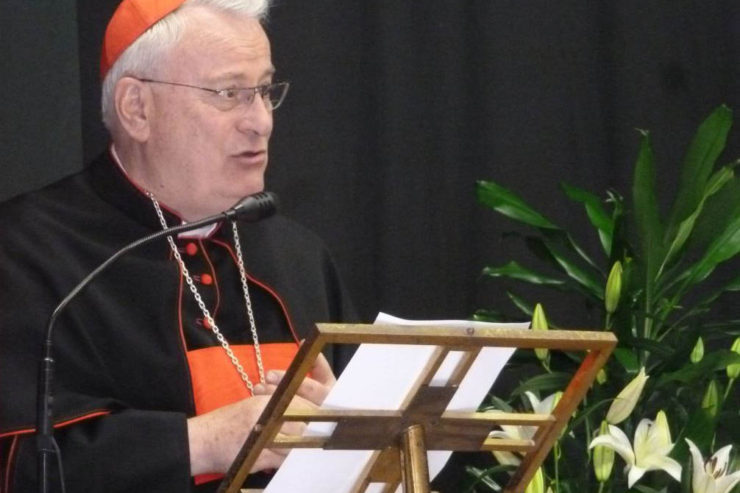
Italian Cardinal defends Amoris Laetitia; says it's not debatable

Cardinal Bassetti: “Amoris Laetitia Is Presented as It Was Written. It Is Not Debatable, But Magisterium
The New President of the Italian Episcopal Conference Answers Several Questions
Source: Archdiocese of Perugia - Città della Pieve
On May 24, Pope Francis chose the new President of the Italian Episcopal Conference (CEI) among the three candidates chosen by the Bishops’ 70th Plenary Assembly. The following day, CEI’s new president, Cardinal Gualterio Bassetti, answered several questions during a press conference, some of which were of interest only for Italy.
In the cardinal’s gratitude to the Holy Father for his new post, he pointed out that with his 75 years, he was already in the “twilight of his life” and, responding to questions on this expression he said: “I see it as a sunset, which will still be able to illuminate a bit, but that afterwards will be preparing for the new day.” He acknowledged that at the beginning he felt disoriented, although later, on receiving the Pope’s affection and that of the Bishops, he felt encouraged and thought” together we will still be able to do something beautiful.”
In regard to Amoris Laetitia and some discussions on the subject, he pointed out that this Apostolic Exhortation “is the synthesis of the Doctrine on Marriage and the Family, suffice it to look at the references.”
The Cardinal added that “to understand this document we must take an important step and avoid a simplification: by stating every irregular situation is mortal sin,” because, before “pointing out a mortal sin” the “Catechism presents a series of conditions that must be fulfilled at the same time.”
He added that the Pope “does not speak of admission to the Sacraments, but of discernment about the real situation of a person, of a couple. Also to begin, if necessary, a penitential journey and afterwards evaluate. He made it very clear that “Amoris Laetitia is presented as it was written. It is not a debatable document, but Magisterium.”
On the Pope’s final address to CEI’s Assembly, the new President said “I saw a clear exposition of Evangelii Gaudium: that the Pope wants very much the pastoral conversion of the Church.” “Not only to change something, but a change of mentality, of heart, with hands on the job.”
In regard to sexual abuses, CEI”s new President said that they are “not beginning from zero” and that “Benedict XVI’s teaching was clear and we must be in contact with the Congregation for the Doctrine of the Faith, to receive the guidelines, and to evaluate each case in particular.” It is “for us, Pastors, to be vigilant,” he said.
On euthanasia, he pointed out that if a person “has the perception that he is of value to others, it is very much more difficult that he will want to take his life.”
Cardinal Bassetti also addressed the issue of ecumenism, stating that “the Church is in dialogue with today’s world, but she is not afraid of dialogue, but of the mediocrity of one who doesn’t have a clear identity and doesn’t know where he will end up.” Moreover, he stressed: “to be able to dialogue it is necessary to have solid principles to eventually receive and correct the other.”
On the Italian political Movement (Five Stars), Cardinal Bassetti explained: “the post-Conciliar Church dialogues with all. However, in the case of politics she makes a distinction. There is politics with a small ‘p’ which is that of all the parties and I respect them. Then there is politics with a capital ‘P’, which refers to the common good of all.” And the Church and CEI are in agreement “with possibilities to which they can commit themselves.”
In regard to immigration, the Cardinal noted that “from the Bible and from the Magisterium the need emerges to receive,” although there is awareness that the problem is complex and that Italy is part of the European context. In addition to immigrants’ reception, “it is necessary to create conditions so that people don’t feel obliged to leave.”
Referring to the 2018 Synod for Young People, Cardinal Bassetti said the Pope “stresses the importance of the Oratories,” because “they are not only a pastoral instrument but also a cultural and missionary one. They are a richness.” Moreover, the Bishops “look at young people with the heart of Pastors. Our concern is for our young people. May no one will rob them of hope, because there are so many rapacious wolves that want to rob them of it.” The Cardinal hopes that “they will be given the possibility of work, of building a valid future for themselves,” because “the lack of work takes away young people’s dignity.”
In regard to the Pontiff’s attention to the poor, the Cardinal said: “I think that in his teaching Pope Francis has taken a step forward, also in regard to the teaching of his predecessors,” because “they called the poor the last” but “the Pope uses a new term that must make us reflect: rejection.” And if “one is the last he always has his dignity, but to be rejected is to be no longer considered a person; it is to be regarded as rubbish

Sunday, August 30, 2015

It takes Sacred Scripture and Sacred Tradition and the Magisterium to behold the fullness of truth and the deposit of faith

I just addressed this topic yesterday, although briefly, in my homily for this weekend!  Here, a brother Deacon expounds beautifully and, I believe, accurately, on the subject of Sacred Tradition.  Yes, we Catholics believe heart in soul in the Bible and we encourage the faithful to read and pray the Scriptures!!!  But without Sacred Tradition and the teaching authority known as the Magisterium, it is not enough.  Sola Scriptura is in and of itself non-Scriptural.  My brother deacon has a length article and I reproduce below, in it's entirety.  Yes it's a bit long but oh so worth the read!

Here it is:

The Holy Bible and Sacred Tradition comprise the Word of God

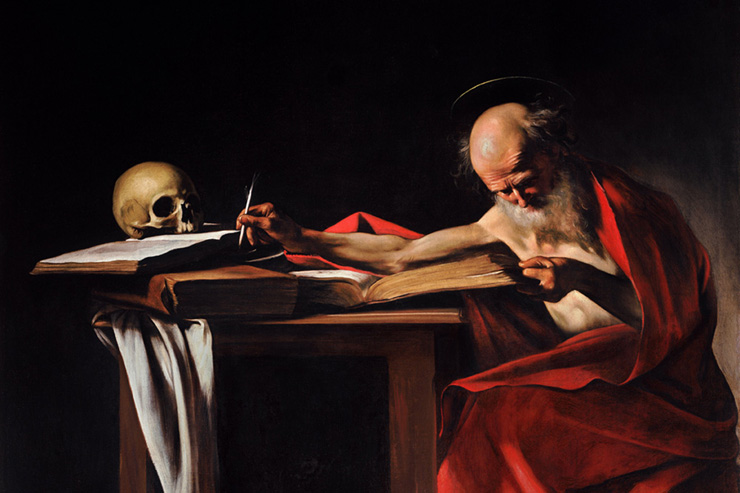
"St. Jerome Writing" (detail) by Caravaggio
“St. Jerome Writing” (detail) by Caravaggio
“Deacon Mike, why do we believe that it belongs to the Church to interpret the bible? Can’t we just read the bible for ourselves? The guys I do bible study with say that we (Catholics) add things that are not there.”
A young man who participates in a “non-denominational” bible study recently asked me this question. This question comes up from time to time, so I thought we might look at the question again in a slightly larger context.

Sola Scriptura

One of the “pillars” or founding principles of the Protestant Reformation is the teaching of Sola Scriptura. Simply defined, Sola Scriptura is the belief that the Bible alone is the sole rule of faith for the believer. In other words, if a teaching is not contained in the Bible, then it is to be rejected as having no authority over the individual Christian. Therefore, according to Sola Scriptura, the Church’s teachings (or a pastor’s—or anyone’s teachings, for that matter) are true only as far as they are found in the bible. Another aspect of Sola Scriptura is that each believer, guided by the Holy Spirit, will be led to the proper interpretation and understanding of what he reads in the Bible.
There are several problems with this teaching:
  • First, Sola Scriptura is not found anywhere in the Bible, therefore, by its own definition it is untrue.
  • Second, the Bible teaches a far different doctrine; God’s revealed word consists of both Divine Revelation in written form (Sacred Scripture) and Divine Revelation in oral form (Sacred Tradition) and the interpretation of Divine Revelation is entrusted to the Church’s teaching office (Magisterium).
  • Finally, it is clear from both the Bible and history, that Christians who lived prior to the Protestant Reformation had a decidedly different experience and understanding of the place of the Bible in the Church.

Approach to the Question

In examining the question of whether the Protestant teaching of Sola Scriptura is true, we need to take the following approach:
  • First, we will look at what the Bible has to say about the rule of faith and the private interpretation of its contents. This is only reasonable if we expect to reach the hearts and minds of those who hold to Sola Scriptura. After all, that is their approach.
  • Second, we will look at the experience of the first Christians and see how they received and made use God’s Word. This will include, to a limited degree, commenting on the experience of the period from after the death of the last apostle to the Reformation and then to the experience of Protestants over the last, nearly five-hundred years.

What Does the Bible Say about Sola Scriptura?

As already mentioned, the Bible says nothing directly supporting this Protestant teaching, but it has a lot to say in opposition to it. But let’s begin with a passage that is often cited by Protestants in support of it.
One of my closest childhood friends was a devout and zealous Presbyterian. James and I often spent hours together debating our respective beliefs. I particularly wanted to persuade him that Sola Scriptura was false because it is so critical to Protestantism.  If this one pillar is untrue, then it is open-season on many other Protestant doctrines because they are built upon this foundational belief. Invariably, James would point to two verses above all others to support his case. For example:
“All scripture is inspired by God and is useful for teaching, for refutation, for correction, and for training in righteousness, so that one who belongs to God may be competent, equipped for every good work” (2 Timothy 3:16-17).
Observe carefully, that these verses say that scripture is “useful” (I believe his translation said “profitable”). The Catholic Church would agree fully, scripture is indeed useful and profitable, but those verses do not even imply that scripture is the only source “useful for teaching, for refutation, for correction, and for training.” Quite the contrary, the Bible says that there is another source that is the “pillar and foundation of truth.”
“I am writing you about these matters, although I hope to visit you soon. But if I should be delayed, you should know how to behave in the household of God, which is the church of the living God, the pillar and foundation of truth” (1 Timothy 3:14-15).
Catholics do not depend upon an isolated text for their proof of a teaching. Instead, the context of the passage within its surrounding chapters, book, testament, and even in relation to the whole of the Bible is important. The Church calls this principle of reading and understanding the meaning of what the bible says the Canonical Approach. That the Protestant reading of 2 Timothy 3:16-17 is taken out of context is demonstrated by also reading 1 Timothy 3:14-15.

What is this “Church” that is the pillar and foundation of truth?

The passage from 1 Timothy refers to the Church, so let’s look at what that Church is. We will look at two, longer passages from St. Matthew’s Gospel:
“When Jesus went into the region of Caesarea Philippi he asked his disciples, ‘Who do people say that the Son of Man is?’ They replied, ‘Some say John the Baptist, others Elijah, still others Jeremiah or one of the prophets.’ He said to them, ‘But who do you say that I am?’ Simon Peter said in reply, ‘You are the Messiah, the Son of the living God.’ Jesus said to him in reply, ‘Blessed are you, Simon son of Jonah. For flesh and blood has not revealed this to you, but my heavenly Father. And so I say to you, you are Peter, and upon this rock I will build my church, and the gates of the netherworld shall not prevail against it. I will give you the keys to the kingdom of heaven. Whatever you bind on earth shall be bound in heaven; and whatever you loose on earth shall be loosed in heaven’” (Matthew 16:13-19).
“If your brother sins (against you), go and tell him his fault between you and him alone. If he listens to you, you have won over your brother. If he does not listen, take one or two others along with you, so that ‘every fact may be established on the testimony of two or three witnesses.’ If he refuses to listen to them, tell the church. If he refuses to listen even to the church, then treat him as you would a Gentile or a tax collector. Amen, I say to you, whatever you bind on earth shall be bound in heaven, and whatever you loose on earth shall be loosed in heaven…” (Matthew 18:15-18).
In the first passage from Matthew 16, we witness Jesus establishing His Church and entrusting it with authority. It is outside the scope of this article to dive deeply into the meaning of the images of the keys, binding and loosing, Peter’s name-change or even the great rock and location of this event at Caesarea Philippi. It is sufficient to see that the Church was founded by Christ. And it is also important to understand that this Church is something more than an invisible collection of believers—no it is much more than that.
In the passage from Matthew 18, we see that it is an institution that Jesus instructed to exercise the authority He entrusted to it. If all efforts to resolve a problem are unsuccessful, even after three have gathered to attempt it, then the problem is to be brought to the Church; and the Church will provide a binding resolution. This is contrary to what most of my Protestant friends would acknowledge, even if it is seen in their practice.

What does the bible teach about private interpretation of the Scriptures?

Matthew 18 speaks, at least indirectly to the matter of who has the authority to interpret what the Bible contains. In taking the above, very short overview of verses from the Bible, we have to look at other passages that expressly address private interpretation of the Bible and the consequences of doing so.
“We ourselves heard this voice come from heaven while we were with him on the holy mountain. Moreover, we possess the prophetic message that is altogether reliable. You will do well to be attentive to it, as to a lamp shining in a dark place, until day dawns and the morning star rises in your hearts. Know this first of all, that there is no prophecy of scripture that is a matter of personal interpretation, for no prophecy ever came through human will; but rather human beings moved by the holy Spirit spoke under the influence of God” (2 Peter 1:18-21 NAB).
St. Peter states that “we possess the prophetic message that is altogether reliable.” But how is it reliable given that he also says that “there is no prophecy of scripture that is a matter of personal interpretation”? How can so many well-meaning Christians—of our day and days past—whose hearts are aflame in their love for Christ; whose lives are devoted to the service of their fellow-man because of that love; how can these good people disagree with such certainty on doctrines that are central to our salvation, if this message is reliable?
The answer is that their very belief in and exercise of private interpretation has torn the unity of the Church and resulted in the very uncertainty of their many differing beliefs.
St. Peter speaks to this as well.
“And consider the patience of our Lord as salvation, as our beloved brother Paul, according to the wisdom given to him, also wrote to you, speaking of these things as he does in all his letters. In them there are some things hard to understand that the ignorant and unstable distort to their own destruction, just as they do the other scriptures. Therefore, beloved, since you are forewarned, be on your guard not to be led into the error of the unprincipled and to fall from your own stability” (2 Peter 3:15-17).
Very clearly, St. Peter warns against private interpretation of the Bible and even cites examples of people who practice it to their own destruction. What stronger warning could we need? Some might say that the oral teaching of the Apostles is of higher standing than that of their successors.  But this is untenable and contrary to the practice recorded in the Pastoral Epistles of the New Testament which instructs bishops, such as Timothy, to teach others what they have received from the Apostles.

What was the experience of Early Christians—and Later Christians Too?

Consider the following points often overlooked by many today.
  • The first book of the New Testament was not written until the late 40s A.D. at the earliest.
  • St. John’s Gospel was not written until the 90s A.D. or later.
  • The bible itself records that the official teaching of the Church, exercised in the form of a Church Council, and not the private interpretation of individual Christians, answers questions of faith. (cf. the Jerusalem Council; Acts of the Apostles, Chapter 15)
  • There was not a definitive list (or canon) of books accepted as Sacred Scripture until the late 300s A.D. and later. (Local Council of Hippo in 393; Local Council of Carthage in 397; Letter of Pope Innocent I in 405)
  • Protestant reformers removed portions of the Old Testament that had been held by the Catholic Church to be a part of the canon of scripture for centuries. Where did they receive that authority? They relied upon the “authority” of Jewish rabbis exercised 60+ years after the Crucifixion and Pentecost; 60+ years after when Jesus had established His Church and authorized it to teach. Martin Luther even wanted to remove the Epistle of James and the Apocalypse (Book of Revelation). He was prevented from doing so by the other reformers.
  • It is estimated that fewer than ten percent of those who lived in the Roman Empire could read. Even if the people had been more literate, there was no printing press, and therefore, no easy or affordable access to the written word prior to the invention of the printing press in the fifteenth  century.
So, the earliest Christians lived before there was a New Testament. And it was 300+ years after the writing of the New Testament before Christians had a definitive witness of the Catholic Church regarding the list of books that were a part of the Bible. Who decided which of the hundreds of writings by the apostles and their successors would form that canon of Scripture? It was the Catholic Church, in the decisions of its councils and the teaching of its Popes that gave witness to what books should be considered a part of the Bible. And it was not until the fifteenth century that the printing press made it possible to own a copy of the Bible, even if the owner could not read. How could the Bible be the sole rule of faith during all that time?
It has already been mentioned that the private interpretation of the Bible that came from the Reformation in the 1500s A.D. has resulted not in unity of faith and belief, but just the opposite; non-Catholic Christianity is comprised of more than thirty thousand denominations  by Protestantism’s own counts.
Christians today should read the Bible and read it prayerfully, meditating on its contents. One who honestly and humbly seeks and embraces the Truth who is the Word of God cannot help but be transformed by Him.  But this is not how we arrive at an orthodox belief, apart from the Church. It must be acknowledged that the vast majority of Christians who have lived, received and experienced Sacred Scripture the way it was intended: proclaimed and taught within the Liturgy of the Church, which has always claimed the authority to interpret and teach. The apostles established local churches; they formed them and taught them, they appointed bishops to continue their work once they were gone.  For centuries, it was the handing down of the Word of God in oral form—Sacred Tradition—that was the manner in which these Christians received the Word of God.  This is simply a historical fact. It is also supported by St. Paul writing in the bible:
“Therefore, brothers, stand firm and hold fast to the traditions that you were taught, either by an oral statement or by a letter of ours” (2 Thessalonians 2:15).
St. Paul also writes, “So faith comes from what is heard, and what is heard comes by the preaching of Christ” (Romans 10:17).
Protestants might object that Jesus warned not to follow tradition.
“You have nullified the word of God for the sake of your tradition. Hypocrites, well did Isaiah prophesy about you when he said: ‘This people honors me with their lips, but their hearts are far from me; in vain do they worship me, teaching as doctrines human precepts’” (Matthew 15:6-9).
However, the traditions that Jesus condemns are those that “nullify” the Word of God. Sacred Tradition does not nullify the Word of God; it is a part of the Word of God as demonstrated by the Jerusalem Council recorded in Acts 15.

What Does the Catholic Church Teach?

Simply look at the following sequence:
  • In prior times, God spoke to us through prophets in varied ways and through a succession of covenants.
  • In present times God spoke to us through His Son.
  • Divine Revelation was fulfilled, completed and perfected in the person of Jesus Christ, the Word of God. We await no further Divine Revelation.
  • Jesus Christ gave this perfected revelation (the Deposit of the Faith) to the apostles.
  • The deposit (word of God) has been passed on (transmitted) to us in writing (Sacred Scripture) and oral preaching (Sacred Tradition) from the apostles through their successors (the bishops).
  • It is not by scripture alone that we receive God’s word. (cf. 2 Th 2:15)
  • The authority to interpret and teach the Word is entrusted to the Church’s Magisterium. (cf. 1 Tim 3:15; Matthew 16; Matthew 18; 2 Peter)
The above can be found in the Catechism of the Catholic Church and in Dei Verbum, the Dogmatic Constitution on Divine Revelation that was issued by the Second Vatican Council which has this to say about the Word of God. “The Church has always venerated the divine Scriptures just as she venerates the body of the Lord, since, especially in the sacred liturgy, she unceasingly receives and offers to the faithful the bread of life from the table both of God’s word and of Christ’s body.” (Dei Verbum #21)
Indeed, the Catholic Church holds the written Word of God in such high esteem, that she has painstakingly seen to it that it was preserved and handed on from generation to generation, all the way down to our own. The Church gives witness to the Word of God, that which has been handed on as Sacred Scripture and that which has been handed on as Sacred Tradition; faithfully teaching with the authority of Christ.