“I have decided that the opening of the Vatican Archives for the Pontificate of Pius XII will take place on 2 March 2020, exactly one year after the eightieth anniversary of the election to the See of Peter of Eugenio Pacelli.”
With these words, Pope Francis made a long-awaited announcement. The statement came in his address about a year ago on, March 4, 2019, to superiors, employees and collaborators of the Vatican Secret (now renamed Vatican Apostolic Archives), on the eightieth anniversary of the election as Supreme Pontiff of the Servant of God Pius XII.
“The figure of that Pontiff, who found himself guiding the Barque of Peter at one of the saddest and darkest moments of the twentieth century, agitated and lacerated by the last world war, with the consequent period of reorganization of the nations and post-war reconstruction,” Pope Francis observed, “has already been investigated and studied in many aspects, sometimes discussed and even criticized (it could be said with some prejudice or exaggeration).”
“Today,” he added, “he has been appropriately re-evaluated and indeed placed in the correct light for his many qualities: pastoral, above all, but also theological, ascetic, and diplomatic.”
The Pope said he assumed this decision after hearing the opinion of his closest collaborators. Francis expressed his certainty “that serious and objective historical research will be able to evaluate, in the proper light and with appropriate criticism, the praiseworthy moments of the Pontiff and, without any doubt, also moments of serious difficulties, of tormented decisions, of human and Christian prudence, which to some might have seemed to be reticence, and which instead were attempts, humanly also very hard-fought, to keep the flame of humanitarian initiatives lit during periods of more intense darkness and cruelty, of hidden but active diplomacy, of hope in possible good openings of hearts.”
“The Church is not afraid of history,” the Jesuit Pontiff highlighted, adding: “rather, she loves it, and would like to love it more and better, as God does! So, with the same trust of my predecessors, I open and entrust to researchers this documentary heritage.”
To remember that today marks this historic opening, ZENIT brings you from our archives this exclusive interview with Gary Krupp, who through the Pave the Way Foundation and experts, historians and leaders of the archives themselves, have through research inside demonstrated that the controversial pope, criticized for not being vocal against Hitler, actually was responsible for saving the lives of about 800,000 Jewish people. Enjoy the interview:
***
INTERVIEW: Thanks to Pius XII, Almost a Million Jews Saved from Nazis, Says Jewish Man Who Hated Pacelli But Now Calls Him a Hero
Pave the Way Foundation Worked Since 2006 to Restore the Good Name of Pope Pius XII Smeared by the Soviet ‘Disinformation Project Called ‘Seat 12”
by Deborah Castellano Lubov MARCH 26, 2019
Thanks to Pope Pius XII nearly 1 million Jews were saved from the Nazis, and hence a Jewish hater of Pius XII has become his strongest advocate.
In an exclusive interview, ZENIT learned this was the situation of Gary Krupp, founder, along with his wife Meredith, founders and directors of the
Pave the Way Foundation, which has tirelessly worked to reveal the truth of the action of the Vatican during World War II.
The Pave the Way Foundation is a nonsectarian organization which works to remove obstacles between religions, partially through eliminating non-theological challenges, and to initiate gestures of good will.
Pope Francis last month announced in an audience with members of the Vatican Secret Archives that for the 80th Anniversary of Pacelli’s death, he would open to academics and researchers, the Archives of Pacelli’s pontificate, which has been controversial, with some having said that while he was Pope during the Second World War he did not speak out, and others claiming there is evidence that he did more than almost anyone else to save Jews from the Nazis.
Here is ZENIT’s exclusive interview with Gary Krupp:
***
ZENIT: On March 4th, Pope Francis announced that in a year’s time, the Vatican Archives of Pius XII’s pontificate (1939-1958) will be open for consultation to any researchers and academics who wish to consult it. How did you receive this news?
Gary Krupp: We were extremely excited to hear the news! The Vatican archives will be opened eight years earlier than Canon Law dictates, as we have been urging all the Vatican officials over the last several years. We also acted to reveal the documentation unearthed by our team of scholars, Dr Michael Hesemann, Pave the Way Foundation Director for Germany, Johan Ickx, Ronald Rychlak, William Doino, Martin Gilbert, Limore Yagil, Edouard Husson, Dimitri Cavalli, Mark Riebling, Deacon Dominiek Oversteyne, all made incredible discoveries of documents from many archives that have been open for decades disproving the false narrative disseminated of Pius XII.
ZENIT: We speak about a remarkable number of historical documents…
Krupp: It will take years to properly research this amount of information. What we need is objective researchers who are seeking the truth, rather than those who come up with a theory and look to simply support their theory.
ZENIT: Your view of Pope Pius XII is not the same as of some time ago. How has it evolved?
Krupp: Pius XII was Pope when I was a child. My uncle met him twice in 1948 and he received a medal from him when he was in Rome with the US Navy. At that time my recollections of Pope Pius XII were always very positive. Then when I went to high school the world opinion completely changed. After reading some books dealing with this subject, I was convinced that he was not a friend of the Jewish people and at worst a collaborator with Nazi Germany against communism.
ZENIT: Then? What happened?
Krupp: A long time later, in 2006, through what I consider divine intervention, I was gradually exposed to some incredible documentation and testimony that brought me to a conclusion: I had been lied to! My emotions went from being shocked to being extremely angry.
Armed with documents, I traveled to Jerusalem to meet with the chief Ashkenazi Rabbi of Israel Yona Metzger and revealed what I had discovered. He told me: “I want you to find everything you possibly can on this subject and bless you for this work.” In Judaism, the worst character flaw a Jew can have is ingratitude. The defamation and character assassination of Pacelli, robbed the Jewish people of the dignity of expressing a measure of thanks to the one religious leader who acted to save more Jews than all the religious and political leaders of the era. This is to me a Jewish responsibility.
ZENIT: What did you do after that meeting?
Krupp: I submitted this potentially explosive international project to the board of PTWF to consider. Since our mission is to identify and eliminate obstacles between religions this project fit into my mission statement. The board approved it almost universally. So, we proceeded to contact International Scholars on the subject. Meredith, my wife, and I traveled throughout Europe to explore every possible path towards revealing the truth of the actions of the Holy See, towards Jewish people, under the pontificate of Pope Pius XII.
ZENIT: As a Jewish man, I suppose this issue is particularly meaningful…
Krupp: As a Jewish man I thought that utilizing my positive relationship with the Vatican to identify and reveal these documents to the world would be praised and heralded. I was shocked when I was simply attacked and criticized by many of the “historians” internationally. The good news is that the critical comments made about our work at PTWF remains on the Internet. Our vindication will come when the world’s opinion returns to where it was in 1958. One day Pius the XII will be recognized as righteous among nations at Yad Vashem.
ZENIT: There a lot of people who do not agree with this last statement. What would you reply?
Krupp: According to Israeli historian and diplomat Pinchas Lapide and sustained by Sir Martin Gilbert, the Catholic Church under the pontificate of Pius XII acted to save the lives of an estimated 847,000 Jews, almost a million. The difference is that Lapide and all the Jewish leaders who unreservedly praised Pius XII, lived through the war years and witnessed these actions. The modern historical revisionists simply read the false demonizing books to push their negative agendas.
ZENIT: You and your wife Meredith are the founders of the Pave the Way Foundation. Please, make us understand a little better what the Foundation has done, in cooperation with the Vatican, related to Pius XII.
Krupp: Since 2006, with the help of our international scholar partners, we have unearthed and posted online over 76,000 pages of primary source documents, along with eyewitness interviews, thanks to the cooperation with the Vatican, too. Two very dear and close friends of mine, Cardinal Tauran and the Archbishop Pietro Sambi both said to me that “Gary this is going to be your life’s work”. Cardinal Bertone, the former Vatican Secretary of State, personally gave us a set of the volumes of Acts and Documents of the Holy See during the Second World War so that we could digitize the 5000 pages and make them available for international scholarly study, on the Vatican website, the website of the Holy See Mission to the United Nations and Pave the Way’s Pius XII resource website page.
In addition, we were given permission to publish many Vatican documents with the stipulation that they not be used for commercial purposes. Consequently, when we traveled internationally, we were given access to many of the archives. We have discovered literally hundreds of ‘smoking guns.’
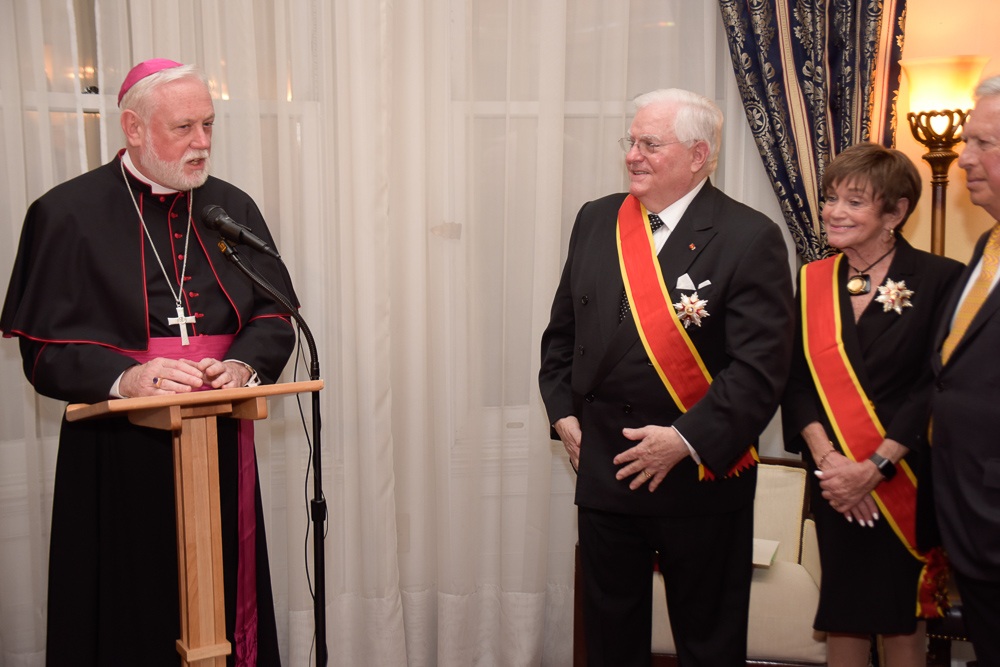
ZENIT: With regard to the cooperation with the Vatican, you and Meredith also are the first married couple to both be papal knight and dame of the Grand Cross of St Gregory the Great. Why were you bestowed this honor?
Krupp: Because of our decades of work to help the hospital of Padre Pio. On July 31, 2000. I was invested by Pope John Paul II and made a Knight Commander of the Pontifical Order of Saint Gregory the Great. Then again January 2007 I was raised in rank by Pope Benedict XVI further enhancing our level of trust. Then, October 1, 2019 on the 16th anniversary of the creation of Pave the Way, Meredith and I were raised to the highest class of the highest papal honor awarded to a lay person again by Pope Francis. These are providential signs of God’s approval of our work. Pave the Way is now in 23 countries where we work to solve problems with many of the world’s religions always from behind the scenes quietly all due to our Vatican recognition. Ironically, our Vatican recognition has been invaluable in working with the leaders of other faiths including the Christian Orthodox, Protestant churches and the Islamic world.
ZENIT: The judgment on the work of Pius XII towards Nazism and the Holocaust still divides the Catholic Church and the Jewish world. What will be the consequences of opening the Vatican archives?
Krupp: The opening of the six main archives will go a long way towards resolving the misunderstandings of the actions of the Holy See during World War II, even if it will take decades of devoted research to comb through the material.
The problem however is that many of the critics of Pius XII simply have not done any legitimate research on the subject. A recent interview of Robert Ventresca is very revealing. He doesn’t believe that there will be a smoking gun in the Vatican archives. He’s probably correct, because our international scholar partners have already discovered hundreds of “smoking guns” throughout the world. The critics have conveniently chosen not to even look at these documents. In his recent book Church of Spies, Mark Riebling has revealed that Pius XII was aware of every assassination attempt against Hitler. His research was done at the archives of the American CIA and the British archives. Not one word will be in any of the Vatican archives.
ZENIT: Very interesting…
Krupp: A further example in in Susan Zuccotti’s book Under His Very Windows. Here, she at least attempted to interview an eyewitness, Msgr Aldo Brunacci in Assisi. Msgr Brunacci stated that Cardinal Nicolini of Assisi summoned him and held up a letter of the Holy Father asking to do everything possible to save the persecuted Jews. Zuccotti asked Brunacci if he read the letter. He said no. So, she concluded there is no proof this letter really existed. These written requests were given to many of the diocese but ordered to be burned to protect the Holy See neutrality.
ZENIT: And what about Rome, the city of the Pope?
Krupp: Professor Johan Ickx and Dr. Michael Hesemann have done a huge amount of research in the archives of Santa Maria dell’Anima, which revealed the facts that Pius XII directly acted to stop the arrest of the Roman Jews October 16, 1943. Then, when we traveled to Austria, Meredith and I obtained 250 pages of wartime documents from the Archdiocese of Vienna showing how Pius XII sent money to support the Israelite community in Vienna and further the Vatican’s actions to obtain visas for Jews to go to Portugal and ultimately to the Dominican Republic, USA, Cuba and South America. These are just a few examples of how the critics have never bothered to even examine archives that of been open for decades.
ZENIT: How has it been possible?
Krupp: When Pave the Way published these on our Pius XII Resource page website literally none of the revisionists bothered to sign onto our site to examine these documents. We literally hand fed this information to them and they still refused to even look at this material. We must then conclude that literally nothing the future will reveal will change the mindset of some of these people. They will accuse the Vatican of sanitizing the archives. The unfortunate consequences of such denial will be the loss of any credibility of their qualifications as scholars.
ZENIT: There are some Jews – for example the Chief Rabbi of Rome, Riccardo Di Segni – who said that their negative judgment on Pope Pius XII will not change anyway. How do you judge this statement?
Krupp: In 2008, Meredith and I went to visit the Chief Rabbi of Rome to invite him to attend the symposium for 80 international Jewish scholars we were sponsoring in Rome. He simply said: “You’re paving the way to Pius XII’s Canonization. The Pope remained silent when 1259 Roman Jews with sent to Auschwitz. I studied this issue and you are wrong. No Roman Jews will attend your symposium.” The reality is that Di Segni never lived through the war contrasted by his predecessors, Rabbi Elio Toaff and Rabbi Israel Zolli, eye witnesses of the actions of Pius XII. Ironically, he remains within walking distance from multiple archives, which would’ve proved the truth.
ZENIT: And what is the truth?
Krupp: Had the chief Rabbi examined the archives of Bishop Hudal as Professor Johan Ickx did in Santa Maria dell’Anima, he would’ve discovered how it was Pius XII who acted directly to end the arrest of the Roman Jews on October 16, 1943. It was Pius XII who sent Fr Pancratius Pfeiffer to try to gain the release of the 1259 Jews arrested; he was unfortunately only successful in rescuing 224 Jews. The documents discovered at Santa Maria dell’Anima also showed how Pius XII used the threat to speak out against Hitler and the Nazis in order to end the arrest of the Roman Jews. He knew that such a public statement would have triggered the planned invasion of the Vatican. Something the German military feared since this could have resulted in massive riots throughout Europe. Pius XII acted while he was mindful that he was to be arrested and assassinated according to the 1972 testimony of General Karl Wolff obtained by Michael Hesemann.
ZENIT: You have quoted Israel Zolli, the Chief Rabbi of Rome during World War II, famous for having decided to convert to Roman Catholicism, after the war…
Krupp: Even his wife! They both took the name Eugenio and Eugenia, as Eugenio Pacelli, Pius XII. The reality is that the entire Roman Jewish community would have been massacred if Pius XII didn’t act to end the arrest and move to protect the Jews in the hundreds of ecclesiastical facilities and encourage Italian Catholics to give shelter to their Jewish neighbors.
ZENIT: To summarize, what discoveries could probably come out of the Vatican archives on the relationship between Pius XII and Nazism?
Krupp: The discoveries have already been made from hundreds of sources, from newspaper reports and documents and letters and eyewitness interviews. Much of this information had been revealed when Pope Benedict XVI ordered to open the archives up to 1939 in 2006. But these “smoking guns” have not publicly been accepted or acknowledged. Pacelli’s personal hatred of Hitler and Pacelli’s support of the excommunication of any Nazi who wore the uniform or flew the flag by the German Bishops in 1930 was reported to the US government in a confidential letter the day after he was elected Pope March 3, 1939. Of the 44 public speeches Pacelli made as Nuncio from up to 1929, 40 condemned the Nazi movement.
ZENIT: “The Church is not afraid of history,” Francis said last March 4th. How did you interpret this statement?
Krupp: He said that because he knows that truth will set us free. The Vatican archives possess over 16 million pages of documents, which will reveal many of the facts of the actions of the Holy See during WWII. But when Pope Benedict XVI opened the Secret Archives up to the period of 1939, only a few of the critics ever came to do any real research. The unfortunate reality is that many of those who have disparaged the name of Eugenio Pacelli have simply not properly researched the history of this great man. I do have confidence in Yad Vashem. They will ultimately come to the correct conclusion. Some time ago, a commission of experts, concluded that the negative plaque in their Hall of Shame was incorrect. So, they modified it, stating that they will wait for the archives to open to finalize their conclusions. I believe they will do their duty as an historical institution whose agenda is simply the truth.
ZENIT: The cause of beatification of Pope Pacelli is proceeding very slowly. What effects could the opening of the Vatican Archives have?
Krupp: The course of beatification of Pacelli is determined by Canon Law. I believe that once the truth is revealed, the process will be proceeding properly, after having been slowed down for political reasons. In the Jewish faith I believe that one day Eugenio Pacelli will be recognized as righteous among nations which is almost our equivalent of canonization.